<BARCELONA,
Mediterranean port in Aragon, northeastern Spain, seat of
one of the oldest Jewish communities in the country.
[Some spots of the Jewish
community of Barcelona]
*Amram Gaon sent his version of the prayer book to "the
scholars of Barcelona". In 876/7 a Jew named Judah
(Judacot) was the intermediary between the city and the
emperor Charles the Bald. Tenth- and eleventh-century
sources mention Jews owning land in and around the city.
The prominence of Jews in Barcelona is suggested by the
statement of an Arabic chronicler that there were as many
Jews as Christians in the city, but a list of 1079 records
only 60 Jewish names. The book of
Usatges ("Custumal")
of Barcelona (1053-71) defines the Jewish legal status.
Jewish ownership of real estate continued: the site of the
ancient Jewish cemetery is still known as Montjuich. a
number of Jewish tombstones have been preserved. From the
end of the 11th century the Jews lived in a special
quarter in the heart of the old city, near the main gate
and not far from the harbor. The main street of the
quarter is still called Calle del Cal ("The Quarter of the
Kahal").
[Jurisdiction - Jewish
minters in Barcelona - Jewish services for the king -
professions]
Barcelona Jews were subject to the jurisdiction of the
counts of Barcelona. The forms of contract used by Jews
here from an early date formed the basis of the
Sefer ha-Shetarot of
*Judah b. Barzillai al-Bargeloni, written at the beginning
of the 12th century.
In the first half of the 11th century, some Barcelona Jews
(col. 208)
were minters, and coins have been found bearing the name
of the Jewish goldsmith who minted them. In 1104, four
Jews of Barcelona received the monopoly to repatriate
Muslim prisoners of war to southern Spain. Shortly
afterward, *Abraham b. Hiyya was using his mathematical
knowledge in the service of the king of Aragon and the
counts of Barcelona, possibly assisting them to apportion
territories conquered from the Muslims. From the beginning
of the 13th century, the Jewish community provided beds
for the royal retinues on their visits to Barcelona and
looked after the lions in the royal menagerie.
The Jews were mainly occupied as artisans and merchants,
some of them engaging in overseas trade.
Communal Life.
Documents of the second half of the 11th century contain
the first mention of nesi'im ("princes"; see *
nasi) of the house of
Sheshet (see Sheshet b. Isaac *Benveniste), who served the
counts as suppliers of capital, advisers on Muslim
affairs, Arab secretaries, and negotiators. From the
middle of the 12th century the counts would frequently
appoint Jews also as bailiffs (baile) of the treasury;
some of these were also members of the Sheshet family.
Christian anti-Jewish propaganda in Barcelona meanwhile
increased. [[...]]
The bailiff and
mintmaster of Barcelona at the time was Benveniste de
Porta, the last Jew to hold this office.
The Jews were subsequently replaced by Christian burghers;
Jews from families whose ancestors had formerly acquired
wealth in the service of the counts now turned to commerce
and moneylending. However, learned Jews such as Judah
*Bonsenyor continued to perform literary services for the
sovereign.
[[...]]
[Disputations in
Barcelona]
In 1263 a public *disputation was held at Barcelona in
which *Nahmanides confronted *Pablo Christiani in the
presence of James I of Aragon. [[...]]
By the beginning of the 13th century, a number of Jewish
merchants and financiers had become sufficiently
influential to displace the
nesi'im in the conduct of communal
affairs. In 1241, James I granted the Barcelona community
a constitution to be administered by a group of
ne'emanim (
secretarii, or
"administrative officers") - all drawn from among the
wealthy, who were empowered to enforce discipline in
religious and social matters and to try monetary suits.
James further extended the powers of these officials in
1272.
Solomoin b. Abraham *Adret was now rabbi in Barcelona, an
office which he held for about 50 years. Under his
guidance, the Barcelona Jewish community became foremost
in Spain in scholarship, wealth, and public esteem. He and
his sons were among the seven
ne'emanim, and he must have favored the
new constitution.
The ne'emanim did not admit to their number either
intellecutals whose beliefs were suspect or shopkeepers
and artisans. When the controversy over the study of
philosophy was renewed at the end of Adret's life, the
intellectuals of Barcelona did not therefore dare to voice
their opinions. In 1305, Adret prohibited the youth from
studying philosophy under penalty of excommunication: this
provision was also signed by the
ne'emanim and some 30 prominent members
of the community.
[1327: Third constitution
- Jewish refugees from France]
A third constitution was adopted in 1327, by which time
the community had been augmented, in 1306, by 60 families
of French exiles. The privileges, such as exemption from
taxes, enjoyed by Jews close to the court were now
abolished, and, alongside the body of
ne'emanim, legal
status was accorded to the "Council of Thirty", an
institution that had begun to develop early in the 14th
century. The new regulations helped to strengthen the
governing body. Several Spanish communities used this
constitution as a model.
Berurei averot
("magistrates for misdemeanors") were appointed for the
first time in 1338 to punish offenders against religion
and the accepted code of (col. 209)
conduct. In the following year
berurei tevi'ot ("magistrates for
claims") were elected to try monetary suits. The communal
jurisdiction of Barcelona, which at times acted on behalf
of all the communities of Catalonia and Aragon, extended
to several communities, both small and large, including
that of Tarragona.
[Trade restrictions for
the benefit of the Christians - Black Death -
protection]
In the 14th century the monarchy yielded to the demands of
the Christian merchants of Barcelona and restricted Jewish
trade with Egypt and Syria. In addition, the community
suffered severely during the *Black Death of 1348. Most of
the "thirty" and the
ne'emanim
perished in the plague, and the Jewish quarter was
attacked by the mob. Despite protection extended by the
municipality, several Jews were killed.
In December 1354, delegates for the communities of
Catalonia and the province of Valencia convened in
Barcelona with the intention of establishing a national
roof organization for the Jewish communities of the
kingdom in order to rehabilitate them after the
devastations of the plague.
In the second half of the century R. Nissim *Gerondi
restored the yeshivah [[religious Torah school]] of
Barcelona to its former preeminence. Among his disciples
were R. *Isaac b. Sheshet and R. Hasdai *Crescas, both
members of old, esteemed Barcelona families who took part
in the community administration after the late 1360s.
The Decline.
[Defamation of 1367 and
recovery]
Around 1367 the Jews were charged with desecrating the
*Host, several community leaders being among the accused.
Three Jews were put to death, and for three days the
entire community, men, women, and children, were detained
in the synagogue without food. Since they did not confess,
the king ordered their release. However, Nissim Gerondi,
Isaac b. Sheshet, Hasdai Crescas, and several other
dignitaries were imprisoned for a brief period.
The community gradually recovered after these misfortunes.
Jewish goldsmiths, physicians, and merchants were again
employed at court. After Isaac b. Sheshet's departure from
Barcelona and Nissim Gerondi's death, Hasdai Crescas was
almost the sole remaining notable; he led the community
for about 20 years.
[Professions: artisans -
1386: New Jewish charter of professions]
The main element in the (col. 210)
Barcelona community was now the artisans - weavers, dyers,
tailors, shoemakers, carpenters, blacksmiths, and
coral-workers. These were organized into guilds, and
demanded their share in the communal administration.
After the long period in which the ruling oligarchy had
been exercising their authority to their own advantage,
the 1327 charter was abolished by royal edict in 1386. A
new charter was approved by which representatives of the
two lower estates, the merchants and artisans, shared in
the administration.
[The pogroms and the
massacres of 1391]
During the persecutions of 1391, the city fathers and even
the artisans of Barcelona tried to protect the Jews of the
city, but without success. The violence in Barcelona was
instigated by a band of Castilians, who had taken part in
the massacres in Seville and Valencia and arrived in
Barcelona by boat. News of the onslaught on the Jewish
quarter in Majorca set off the attack on Saturday, August
5. About 100 Jews were killed and a similar number sought
refuge in the "New Castle" in the Jewish quarter. The gate
of the
judería
[[Jewish quarter]] and the notarial archives were set on
fire and looting continued throughout that day and night.
The Castilians were arrested and ten were sentenced to the
gallows.
The following Monday, however, the "little people"
(populus minutus), mostly dock workers and fishermen,
broke down the prison doors and stormed the castle. Many
Jews were killed. At the same time, serfs from the
surrounding countryside attacked the city, burned the
court records of the bailiff, seized the fortress of the
royal vicar, and gave the Jews who had taken refuge there
the alternative of death or conversion.
The plundering and looting continued throughout that week.
Altogether about 400 Jews were killed; the rest were
converted. Only a few of them (including Hasdai Crescas,
whose son was among the martyrs) escaped to the
territories owned by the nobility or to North Africa. At
the end of the year John I condemned 26 of the rioters to
death, but acquitted the rest.
[1393: restored Jewish
rights - prohibition of Jewish community in 1401]
In 1393 John took measures to rehabilitate the Jewish
community in Barcelona. He allotted the Jews a new
residential quarter and ordered the return of the old
cemetery. All their former privileges were restored and a
tax exemption was granted (col. 211)
for a certain period, as well as a moratorium on debts.
Hasdai was authorized to transfer Jews from other places
to resettle Barcelona, but only a few were willing to
move. Reestablishment of a Jewish community in Barcelona
was finally prohibited in 1401 by Martin I in response to
the request of the burgers.
The Conversos.
[Inquisition - emigration
of the rich Jews - crisis of the town]
The renewed prosperity of Barcelona during the 15th
century should be credited in part to the Conversos, who
developed wide-ranging commercial and industrial
activities. Despite protests by the city fathers, in 1486
Ferdinand decided to introduce the Inquisition on the
Castilian model in Barcelona. At the outset of the
discussions on procedure the Conversos began to withdraw
their deposits from the municipal bank and to leave the
city. The most prosperous merchants fled, credit and
commerce declined, the artisans also suffered, and
economic disaster threatened. The inquisitors entered
Barcelona in July 1487. Some ships with refugees on board
were detained in the harbor. Subsequently several
high-ranking officials of Converso descent were charged
with observing Jewish religious rites and put to death. In
1492 many of the Jews expelled from Aragon embarked from
Barcelona on their way abroad.
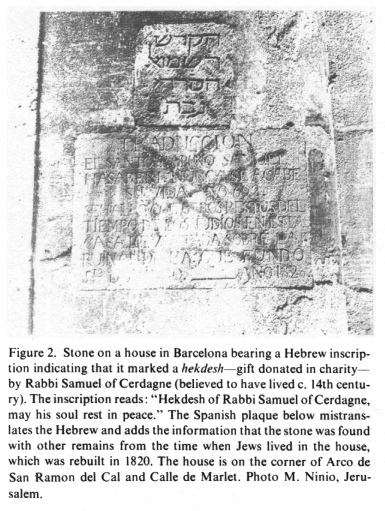
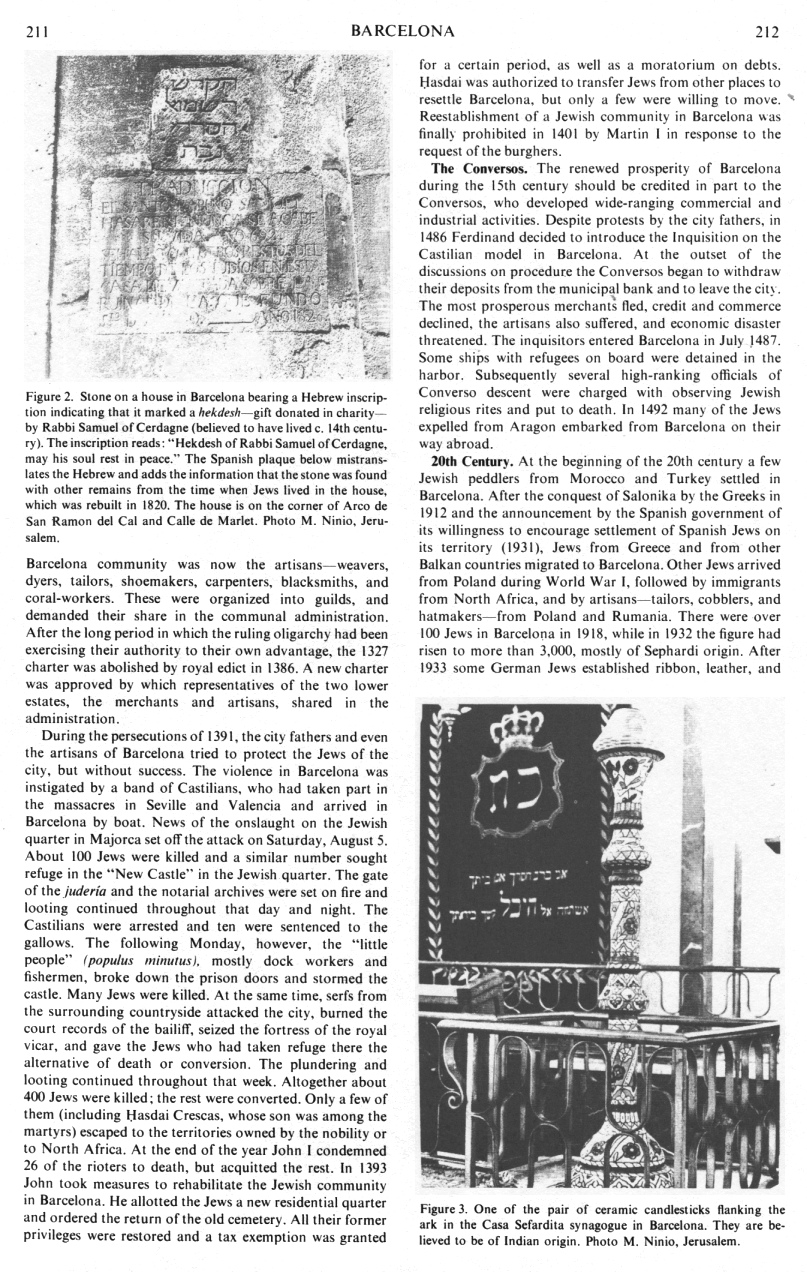
Encyclopaedia Judaica (1971): Barcelona, vol. 4, col.
211, inscription in a wall stone, 1820
At the beginning of the 20th century a few Jewish peddlers
from Morocco and Turkey settled in Barcelona. After the
conquest of Salonika by the Greeks in 1912 and the
announcement by the Spanish government of its willingness
to encourage settlement of Spanish Jews on its territory
(1931), Jews from Greece and from other Balkan countries
migrated to Barcelona. Other Jews arrived from Poland
during World War I, followed by immigrants from North
Africa, and by artisans - tailors, cobblers, and hatmakers
- from Poland and Rumania [[Romania]]. There were over 100
Jews in Barcelona in 1918, while in 1932 the figure had
risen to more than 3,000, mostly of Sephardi origin.
After 1933 some German Jews established ribbon, leather,
and (col. 212)
candy industries. By 1935 Barcelona Jewry numbered over
5,000, the Sephardim by now being a minority. During the
Spanish Civil War (1936-39), many left for France and
Palestine. Some of the German Jews left the city after the
Republican defeat in 1939, but during and after World War
II Barcelona served as a center for refugees, maintained
by the *American Jewish Joint Distribution Committee, and
others returned to resettle.
The Barcelona community, consisting of approximately 3,000
people in 1968, is the best organized in Spain. The
communal organization unites both Sephardi and Ashkenazi
synagogues. There is also a community center, which
includes a rabbinical office and cultural center. The
community runs Jewish Sunday schools for children
attending secular schools, and has a
talmud torah. Youth
activities include summer camps and a growing Maccabi
movement. An old-age home supported by Jewish agencies
outside Spain is maintained. The University of Barcelona
offers courses in Jewish studies. Together with leaders of
the Madrid community, Barcelona community heads were
received in 1965 by General Franco, the first meeting
between a Spanish head of state and Jewish leaders since
1492.
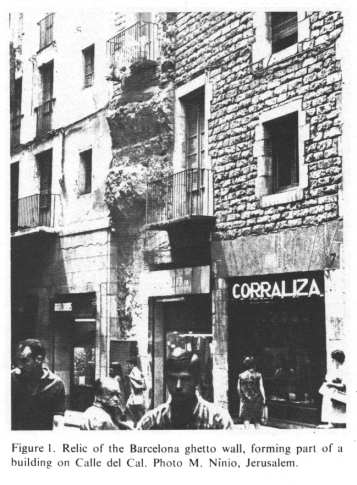
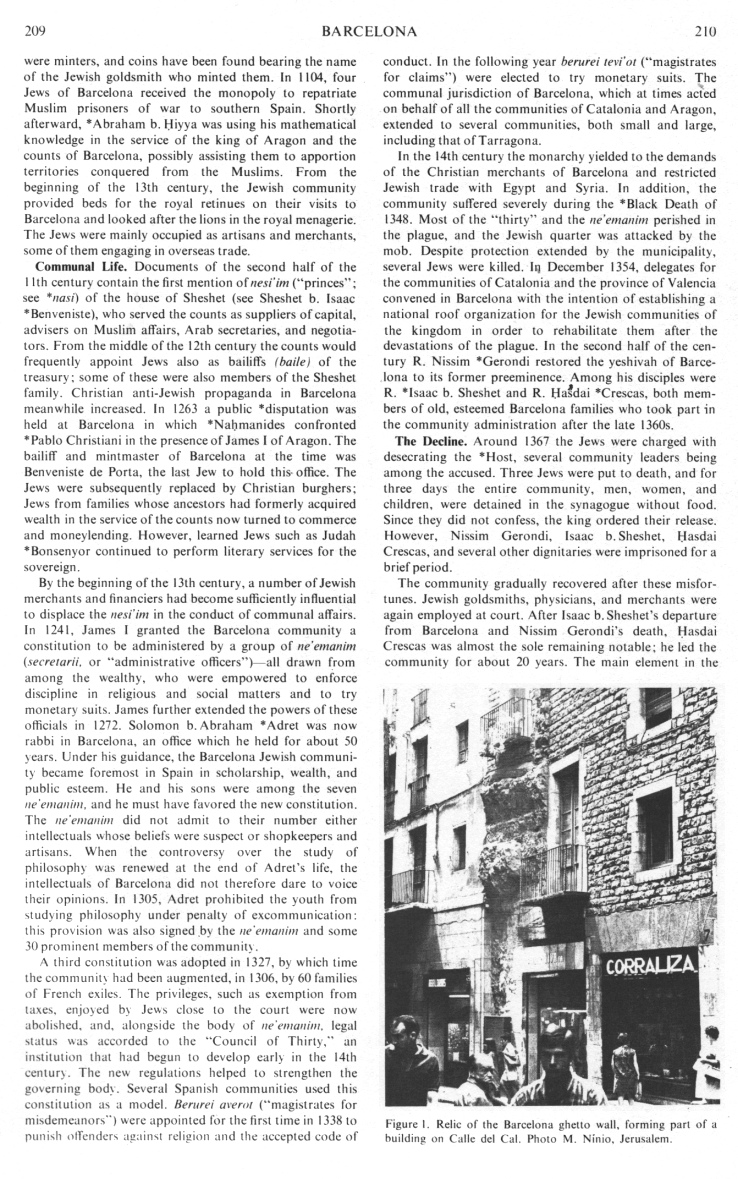
Encyclopaedia Judaica (1971): Barcelona, vol. 4, col.
210, rest of ghetto wall in Calle del Cal