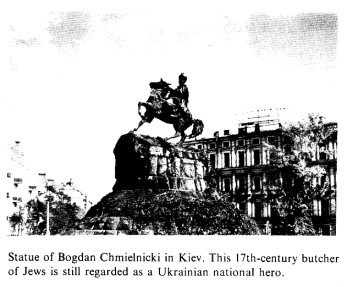
<CHMIELNICKI (Khmelnitski),
BOGDAN (1595-1657), leader of the Cossack and peasant
uprising against Polish rule in the Ukraine in 1648 which
resulted in the destruction of hundreds of Jewish
communities; later hetman of autonomous Ukraine and
initiator of its unification with Russia.
[Chmielnicki's
fight against Polish occupation and coalition with the
Muscovite Czar]
The son of a minor landowning official of the lower
aristocracy, in 1646 Chmielnicki became involved in a
quarrel with the governor of the province where he lived.
He was arrested, released on bail, and in 1647 fled to the
Cossack center of Zaporozhye on the Dnieper, from where he
began to foment rebellion against Polish rule.
His propaganda fell on the soil of social-religious
unrest, accompanied by repeated uprisings. Having gained
experience from the failure of former rebellions,
Chmielnicki (col. 480)
sought the assistance of the Tatar khan of Crimea, who
authorized one of his military leaders to join
Chmielnicki. With varying luck and several interruptions
he waged war against the Poles until his death; in 1654
his followers took the oath of allegiance to the Muscovite
Czar.
In the course of their campaigns Chmielnicki's followers
acted with savage and unremitting cruelty against the
Jews. Chmielnicki aimed at establishing an autonomous
Ukraine, if not under Poland, then under the Ottoman
Empire, Moscow, or Sweden. After his death, this plan
ended with the annexation of eastern Ukraine to Muscovite
Russia (1667).
[Chmielnicki's
aim to destruct the Jews in Ukraine - ruin of Ukraine by
Chmielnicki - a wrong symbol]
Chmielnicki was bent on eradicating the Jews from the
Ukraine. From the social aspect, he aspired to transform
the Cossack leaders into the ruling aristocracy of the
principality while returning the peasantry to serfdom. His
activity brought destruction and ruin to the land and did
not assure its independence.
Nevertheless the members of the Ukrainian nationalist
movement in recent generations have come to see him as a
symbol of the awakening of the Ukrainian people, while
Russian nationalists regarded him as a "great patriot" who
brought about the unification of Ukraine with Russia.
During World War II, a military decoration was named after
him, and in 1954, the town *Proskurov was renamed
Khmelnitski; the name of Chmielnicki was also added to
that of the town Pereyaslav (Pereyaslav-Khmelnitski).
[Chmielnicki
"the Wicked" - Chmielnicki as the cause for prosecution
of Polish Jewry]
In the annals of the Jewish people, Chmielnicki is branded
as "Chmiel the Wicked", one of the most sinister
oppressors of the Jews of all generations, the initiator
of the terrible 1648-49 massacres (gezerot tah ve-tat).
Chmielnicki has gone down in history as the figure
principally responsible for the holocaust of Polish Jewry
in the period, even though in reality his control of
events was rather limited.
[Jewish
population as colonizing factor in Ukraine steppes -
Jews as agents for Polish rule]
The Jewish population of Ukraine had been an active factor
in colonizing the steppes before the massacres. Many Jews
settled in the villages, and were occupied as lessees (see
*arenda) or
administrators of the estates of the nobles; they also
played a role in developing the towns and in their armed
defense at times of danger. However, as agents of the
Polish nobles and Polish rule, they incurred the hatred of
the Ukrainian serfs.
[Ukrainian
historiography give the blame for the pogroms to Jewish
lessees and agents]
Both Polish and Ukrainian modern anti-Semitic
historiography has attempted to fasten the overwhelming
responsibility for the terrible bloodshed during the
rebellion on the Jewish lessee and agent, thus justifying
the singular cruelty directed against the Jews. But the
reports of persecution of the peasants by Jews or of
offenses caused to their religious feelings by the lease
of churches to them find no confirmation whatsoever in the
sources.
[May-November
1648: The majority of the massacres]
It was during the months of May to November 1648 that
(col. 481)
most of the massacres took place. At the beginning of the
uprising, the communities east of the Dnieper were
immediately destroyed. Those Jews who did not manage to
escape or join the Polish army of Wisniowiecki on its
retreat westward met violent deaths; some converted to
Christianity to save their lives; many were seized by the
Tatars and sold into slavery. During the summer, the
persecutions spread to the western bank of the Dnieper and
by the middle of June there were no more Jews in the
villages and the open cities.
The overwhelming majority, with the exception of those who
had been murdered while fleeing, crowded into several
fortified cities which were also occupied by Polish
garrisons. Even these however were unable to sustain the
siege of the peasant hordes, and after the towns were
taken, most of the Jews were butchered.
[Massacre
at Nemirov]
The first large-scale massacre took place in *Nemirov,
into which the Cossacks penetrated in the disguise of
Polish soldiers. Jews died in their masses as martyrs when
faced with the demand that they convert to Christianity:
"They arrived ... as if they had come with the Poles ...
in order that he open the gates of the fortress ... and
they succeeded ... and they massacred about 6,000 souls in
the town ... and they drowned several hundreds in the
water and by all kinds of cruel torments.
In the synagogue, before the Holy Ark, they slaughtered
with butchers' knives ... after which they destroyed the
synagogue and took out all the Torah books ... they tore
them up ... and they laid them out ... for men and animals
to trample on ... they also made sandals of them ... and
several other garments" (*Shabbetai b. Meir ha-Kohen, Megillah Afah).
In 1650, the leaders of the *Council of the Four Lands
"took upon themselves and their children after them to
fast in the Four Lands every year on the 20th day of the
month of Sivan, the day upon which the calamity began in
... Nemirov."
[1650:
Massacre at Tulchin - massacre at the border to
Bielorussia / White Russia - flight from Volhynia -
massacre at Bar]
The fortified city of *Tulchin fell at the end of June,
after the Poles agreed to surrender the Jews to the rebels
in exchange for their own lives. There is information on
prolonged resistance by the Jews after they had been
driven out of the fortress.
At that time, all the Jews in the towns bordering upon
Bielorussia were massacred; only those living in the
surroundings of *Brest-Litovsk succeeded in escaping. At
the end of July *Polonnoye fell into the hands of a band
led by the hetman Krivonos and there was a frightful
massacre. The remaining Jews in Volhynia left their towns
and fled westward. In the important fortress of *Bar,
where the Jews had stayed behind, they were slaughtered
after its capture.
[Massacres
in the Lvov region - massacre at Narol - flight over the
Vistula]
During the months of October-November, the persecution
also overtook the Jews living in the region of *Lvov; in
this area a terrible slaughter took place at *Narol. In
the town of Lvov itself Jews took an active part in its
defense and contributed a considerable share of the ransom
paid for lifting the siege. Most of the Jews of this
region who were saved fled to the areas beyond the
Vistula.
[Number
of victims and no security]
It is impossible to determine accurately the number of
victims who perished, but it undoubtedly amounted to tens
of thousands; the Jewish chronicle mention 100,000 killed and 300
communities destroyed. The problem of the
refugees was a severe one:
"for many of our people have left their countries and have
been expelled from their places and properties; they have
not yet gained rest and security, because the country has
not found peace so that the distant ones can once again
return to their possessions" (Pinkas Medinat Lita, ed. by S. Dubnow
(1925), no. 460).
[Further
military activities - 1650: Council of Lithuania decrees
3 years of mourning]
The Jews also suffered during the military activities
which continued subsequently. The blow struck at "the
whole of the House of Israel, when ... the hand of God
went out against us and many myriads of Israel fell ...
and they were strewn over the fields as prey for the birds
of heaven and were not even buried. The hand of the enemy
also prevailed and they (col. 482)
stretched out their hands against the synagogues." Under
the impact of the calamity, the Council of Lithuania, at
its meeting of 1650, decreed three years of consecutive
mourning. This took the form of a prohibition on wearing
elaborate clothes or ornaments during that time, and it
was decided that "no musical instrument be heard in the
House of Israel, not even the musical entertainment at
weddings, for a full year"; "suitable measures were to be
taken in order to limit feasts as much as possible" (ibid., nos. 469-470).
[Children
from violated women by Cossacks - wives without
husbands]
Authors of that generation also mention regulations which
sought to prevent the increase within the community of the
children born to women ravished by the Cossacks. A great
effort was then made to ease the plight of thousands of agunot (wives of
missing husbands), and the overwhelming majority of the
women who escaped were freed from their marriage bonds by
halakhic decisions; many precedents in agunot regulations
were then established.
[1654:
Muscovites and Cossacks start new wave of massacres]
A new wave of massacres occurred at the time of the joint
campaign of the Muscovites and Cossacks in 1654, and the
cruelty of the Muscovites toward the Jews (in *Mogilev and
*Lublin) was no less than that of the peasants several
years earlier.
[Comment
of R. Shabbetai b. Meir ha-Kohen about the massacres of
1648-1649]
In Vilna, R. Shabbetai b. Meir ha-Kohen wrote:
"The anger of God the King of Hosts is not yet appeased
... the anger of the hand ... of the oppressor ... is yet
outstretched with swords and spears; they continually
invade the land and are prepared for war; wherever they
find Jews, they kill them ... a great multitude of the
empty-headed have gathered with weapons and dressed in
coats of mail; a large number of the Kedars (= the Tatars)
have joined them and are encamped around them and they
say: come let us destroy Israel" (Megillah Afah).
The massacres of 1648-49 came as a deep shock to that
generation, and R. Shabbetai Sheftel *Horowitz speaks of
"the Third Destruction which occurred in the year 408 of
the sixth millennium (1648) ... which was just the same as
the First and Second Destruction."
[Reconstruction
of Jewish settlements in Ukraine west of the Dnieper]
The Jewish settlement in Ukraine west of the Dnieper was
nevertheless continued. The Polish king authorized the
forced converts to return to Judaism. The Councils of the
Lands concerned themselves with the redemption of captives
and the salvation of converts:
"Many souls of Israel which were taken into captivity
assimilated among and were almost lost among them ... we
have written an authorization to all the communities and
to every place where there is a minyan (quorum) of Jews ... to redeem
every soul"; various tariffs and the share of the
different communities in the acts of redemption were also
established (Pinkas
Medinat Lita, no. 452).
Jews began to return to their localities in Volhynia at
the end of 1648, and a short while later were again living
throughout the territory up to the Dnieper. Despite the
memory of the holocaust of 1648-49, this region was one of
the most densely populated by Jews during the 18th and
19th centuries.
[Literature
about Chmielnicki pogroms]
The horror of the massacres of 1648-49 is expressed in
Hebrew literature; many liturgical poems and laments were
composed on this subject, as well as many works of poetry
and prose, including the ballad Bat ha-Rav ("The Daughter of the Rabbi")
of Saul *Tchernichovsky. It also holds a most important
place in popular folklore. Scholars differ as to the
measure in which these massacres influenced the
development of the Shabbatean movement.
See *Shabbetai Zevi. (col. 483)