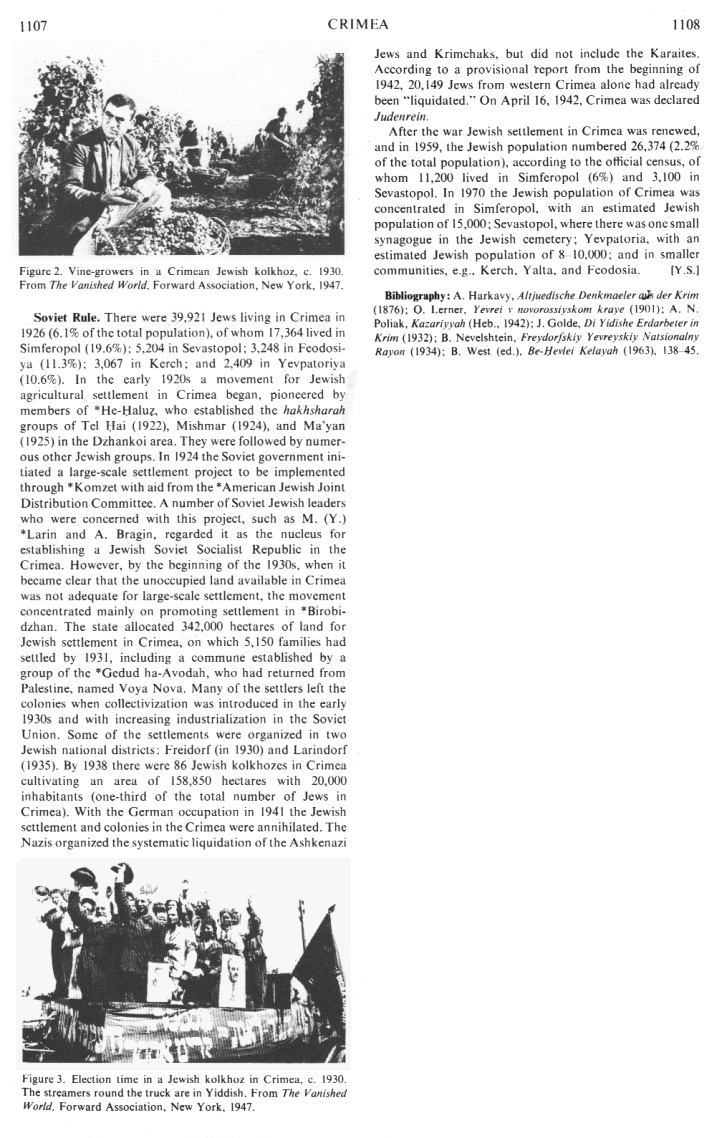
[Jews
since Hellenistic times in Crimea - Bible sources -
thesis about converted Khazars]
CRIMEA (Rus. Krym or Krim), peninsula of S. European
Russia on the Black Sea; since 1954 oblast of Ukrainian
S.S.R.
Late
Antiquity and Early Middle Ages.
Jews first settled in the southeastern area and a Jewish
Hellenistic community existed there by the end of the
first century C.E. (inscriptions). *Jerome (d. 420; on
Zech. 10:11, Obad. 20) heard from Jews that the Jewish
settlers by the Bosporus were descended from families
exiled by the Assyrians and Babylonians, and from deported
warriors of *Bar Kokhba; the Bosporus was called by the
Jews "Sepharad". In ancient and medieval times
southeastern Crimea was linked to the Taman Peninsula,
across the Kerch Strait.
In the seventh to tenth centuries the *Khazar conquerors
had there their regional center from which they ruled much
of Crimea and confronted the Byzantine coastal base of
Cherson, near the present Sevastopol. The Arab geographers
Idrisi and Abu al-fida' call the Khazar city merely
Khazariyya (Khazaria); it was located on the site of the
town Sennaya (formerly Phanagoria), adjacent to the Jewish
settlement mentioned by the Byzantine historian
Theophanes, and is probably identical with the port
Samkush (Samkerch) "of the Jews", referred to by the
Arabic geographer Ibn al-Faquih.
Tombstones of Jews and Khazar proselytes have Jewish
Hellenistic ornamentation. Similar Jewish tombstones have
been found in Kerch and Partenit (Parthenita), near Yalta.
The Byzantine chronicler Cedrinus relates that in 1016 a
Byzantine Russian-assisted fleet subdued the region of
Khazaria ruled by Georgios Tzoulos. The Russians were
henceforth represented by a prince at Tmutorokan (Taman),
while the Byzantines overlooked most of Crimea from
Cherson. The Khazars served as the prince's military (col.
1103)
auxiliaries in an inner Russian conflict in 1023, and in
1079 intervened with Byzantium in the competition for the
princely office; this led to their massacre in 1083.
From the 9th to 15th centuries the terms "Gazaria" (as the
territory) and "Gazari" (as the population) were
understood in Western Europe as the Taman peninsula and
the adjacent changeable Crimean area. Gazaria is,
according to Poliak, the "Kazariyya" mentioned by the
12th-century Jewish travelers *Benjamin of Tuleda (in
connection with the sea trade with Constantinople and
Alexandria), and *Pethahiah of Regensburg (the Kuban
delta).
Isaac *Abrabanel commenting on Genesis 10:3 equates the
"Qasari" in "Ashkenaz" with Gazaria, "below" (south of)
the Azov Sea.
In the 16th to 17th centuries "Gazaria" and "Crimea" were
synonymous. This late usage led the Russian historian N.M.
Karamzin (1816) to regard the Crimea as the ultimate
domain of the Khazar kings, lost in 1016. After C.M.Y.
Fraehn (1822) had dated the downfall of the Caspian
Khazars to 969, the period 969-1016 was left for the
duration of the mythical Crimean kingdom, considered
henceforth as Jewish. The early draft of H. *Graetz's
"History of the Jews" (1860) included the history of the
kingdom, written according to the manuscript discoveries
claimed by the Karaite collector A. *Firkovich.
After these claims had been attacked, the story was
partly, but mechanically, deleted: in the late version the
Crimean kingdom has a beginning but no end (Eng. ed., 3
(1949), 222ff.). Graetz's original coherent description
continued to influence Jewish historians, notably S.
*Dubnow (History of the
Jews in Russia and Poland, 1 (1916), 28ff.).
Firkovich also is the source of the idea that the Crimea
was the cultural center which influenced the conversion of
the Khazar royalty to Judaism, and that the Crimean
Karaites were descended from ancient Israelite settlers
and Khazar converts.
The rival Karaite historian M. Sultanski (d. 1862)
regarded the Crimean Karaites as purely medieval Jewish
immigrants from various parts, while later Karaite authors
consider that they were basically Khazars-Turks. The
Rabbanite *Krimchaks (i.e., "Crimeans") were also
sometimes considered basically Khazars. All these views
are founded on the late meaning of "Gazaria". Foreign
Karaites (contrary to Rabbanites) in Khazar times never
claimed that the Khazars had converted to Judaism and
sometimes displayed intense hatred toward them (even
expecting them to fight the Messiah in Erez Israel): the
sect was then seeking to uphold the Palestinian descent of
the Jews and Judaism.
[The
first Jewish settlements]
In late antiquity and the early medieval period, Crimean
Jewish tradition and records indicate that Jewish
settlement existed in the following units:
THE CHERSONESE (CHERSON).
Jews were living there at least in the 9th to 11th
centuries. Excavations have shown that the locality never
recuperated from a devastation in the (col. 1104)
late tenth century by the Russians (988?), and was
ultimately destroyed at the end of the 14th (by
Tamerlane's raiders, 1395/6?). The Hebrew letter
attributed to the Khazar Kind Joseph (long version) lists
among his tributaries in the 950s localities from Samkerch
to "Gruzin" (Cherson?), including Kerch and "Bartenit".
The Hebrew "Cambridge Document" claims that under him
"Shurshun" was made tributary by a counteroffensive
against Byzantium after the Byzantine-instigated Russian
raid on Samkerch.
"GOTHIA".
This is the medieval name for the rugged mountains north
of Cherson, so -called after a Teutonic tribe which had
remained there following the great migrations. The city of
Partenit was the coastal mart of Gothia; a Jewish
tombstone inscription there mentioned "Her(i)f(r)idil [a
Teutonic name] ha-kohen [priest]."
Around 787 the Khazars placed their garrison in Doros, the
capital of Gothia; the Life
of Bishop John tells of the unsuccessful revolt he
instigated. Doros is assumed despite temporary doubts of
archaeologists in 1928-38) to be the "eagle's nest" later
called Mangup (first in Joseph's Letter, as his
tributary). In Ottoman-Tatar times (1475-1783) it
increasingly became an all-Jewish (mostly Karaite) town.
CHUFUT-KALE.
More to the north, a similar fortress town, known under
the Tatars as Qirquer (Quirqer), became referred to more
frequently as *Chufut-Kale ("the Jews' Fortress", Heb. Sela ha-Yehudim).
Excavations of 1946-61 showed that it existed on the site
from the 10th or 11th century; a Christian cemetery (late
fifth to early ninth centuries) attests the corresponding
beginnings of the enormous Jewish cemetery. Here, also, it
was under Tatar rule that the town definitely became all
Jewish (mostly Karaite); it later had a Hebrew printing
press (1734).
Tatar
Times. [caravan point, Judaizers and Jewish revival]
The conquest of Eastern Europe by the Tatars (Mongols) in
1236-40 made the Crimea the foremost link for the
trans-Asian caravans with the Mediterranean and Western
trade. The Crimean Tatar center was Solkhat or Qyrym (from
which the name "the Crimea" derives); now Stary Krym,
inland near the port of Kaffa (now Feodosiya), the city
was made by the Genoese the center of their activities in
Gazaria and on the Black Sea.
The contact of the Crimean Jews with the outside world
grew. The Jew "Khoza Kokos" was Muscovy's representative
there in 1472-75. According to a Russian tradition Jews
from Crimea were among the instigators of the movement of
*Judaizers in 15th-century Muscovy. There was a Jewish
revival in Taman, by then ethnically Circassian and ruled
by the Genoese Guizolfis (1419-82), who were considered
Jews in modern Jewish historiography and Christians in
Russian. In Muscovite documents the lasts ruler is called
a "Jew" and "Hebrew" as well as "Italian" and
"Circassian"; if so-called after the environment, this
significantly (col. 1105)
emphasizes the Jewish resurgence [[revival]]. However the
Tatar decline commenced early. The Karaites of Poland
(western Ukraine) and Lithuania later considered that they
had been deported from Solkhat by Lithuanian raiders under
Witold (Votort), 1392-1430.
[Genoese
Crimea - Ottoman Crimea - conversion to Judaism at the
home of Genghis Khan]
The Genoese extended their possessions from Kaffa, and
their relatively mild attitude to other communities
(including the Jews) maintained prosperity in the area
despite the shrinking geographical extent of trade. From
around 1420 the Tatar realm [[territory]] of inner Crimea
developed into a split kingdom.
After the Ottomans conquered the Genoese possessions in
1475, they made the inland Tatars Vassals, used them for
raiding Muscovy and Poland-Lithuania, and protected them
from reprisals by a vast belt of scorched earth
(depopulated steppe). This led to a sharp economic decline
and massive emigration. The remaining population was
basically Tatar, which was then a Muslim Turkish-speaking
blend under leadership of Mongol descent. The remaining
Krimchaks and Karaites shared their tongue and many
customs, though the two communities differed somewhat in
these respects both from each other as well as from the
Tatars.
Their divergent existence is certain from Tatar times
only. The Mongol influence, which made the Karaite
anthropological type distinct, must be attributed to
conversions, but of the early Tatar conquerors; a point
unknown to former scholars who disputed the matter.
Conversions to Judaism even took place at the home of
Genghis Khan. Only this can explain the transfer of
strategic strongholds to Jews (mainly Karaites), and the
establishment by the Crimean Tatar kings of the
unfortified valley suburb of the "Jews' Fortress" as the
new capital Baghche-Saray (Bakhchisarai, 1454). It
officially became a distinct town only in the 17th
century. [...]
Tatar raids into the Ukraine and neighboring districts of
Poland-Lithuania in the 16th centuries, in particular
during the Tatar alliance with *Chmielnicki in 1648,
brought into Tatar hands many Jewish captives, who were
usually ransomed by Jews. [...]
Czarist
Rule (1783-1917). [Jewish mass flight to Ottoman
territory - Pale of Settlement without Sevastopol and
Yalta - split between Karaite and other Jewish
communities - religious life and writers]
During the Russian conquest of Crimea from the Turks the
Jewish communities suffered severely. Many Jews left for
Ottoman territory [[mostly to Istanbul]]. In 1783, when
Crimea was annexed by Russia, there were 469 Jewish
families (Rabbanite and Karaite) living in the peninsula.
[...]
After the Russian annexation of Crimea it was included in
the *Pale of Settlement (1791), although the major centers
of development were later excluded, among them the
military port of Sevastopol (1829-59, later admitting
wealthier Jews), and the resort Yalta (1893).
![Czarist-Russian Pale of Settlement with Crimea
[1]](../d/EncJud_juden-auf-der-Krim-d/Martin-Gilbert_karte-Pale-of-Settlement-ansiedlungsrayon.gif "Czarist-Russian Pale of Settlement with
Crimea [1]")
Czarist-Russian Pale of Settlement with Crimea [1]
Jewish settlers from Russia soon outnumbered the small
local communities (Krimchaks, Karaites). There were 2,837
Jews living in Crimea in 1847. The Karaites' successful
struggle for exemption from the anti-Jewish czarist
legislation (1863), and the abandonment of the common
fortress towns (now ruins) because of the economic revival
in the lowlands, definitely estranged the Karaite society
from the rest of Jewry.
From 1867 to 1900 Hayyim Hezakiah *Medini officiated as
chief rabbi of Crimean Jewry, and did much to raise the
level of the spiritual and cultural life of the community.
Among the few scholars of Crimean Jewry notable were
Abraham *Kirimi, author of Sefat Emet, a commentary on the torah,
in the 14th century, and David *Lekhno, author of Mishkan David, in the
18th century.
In the 19th century the archaeological discoveries of the
Karaite scholar A. Firkovich, part of which were found to
be forgeries, caused a sensation among scholars. There
were 28,703 Jews living in Crimea in 1897 (5.1% of the
total population) and 5,400 Karaites. The Krimchak Jews
numbered 3,300. The large communities were in *Simferopol
(8,951 persons); *Kerch (4,774); Sevastopol (3,910);
*Karasubazar (Belogorsk; 3,144, nearly all Krimchaks);
*Feodosiya (3,109); and Yevpatoriya (Eupatoria).
[A.N.P.] (col. 1106)
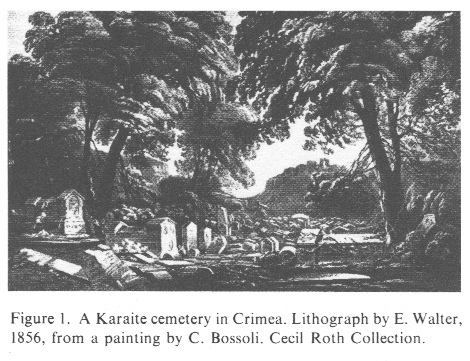
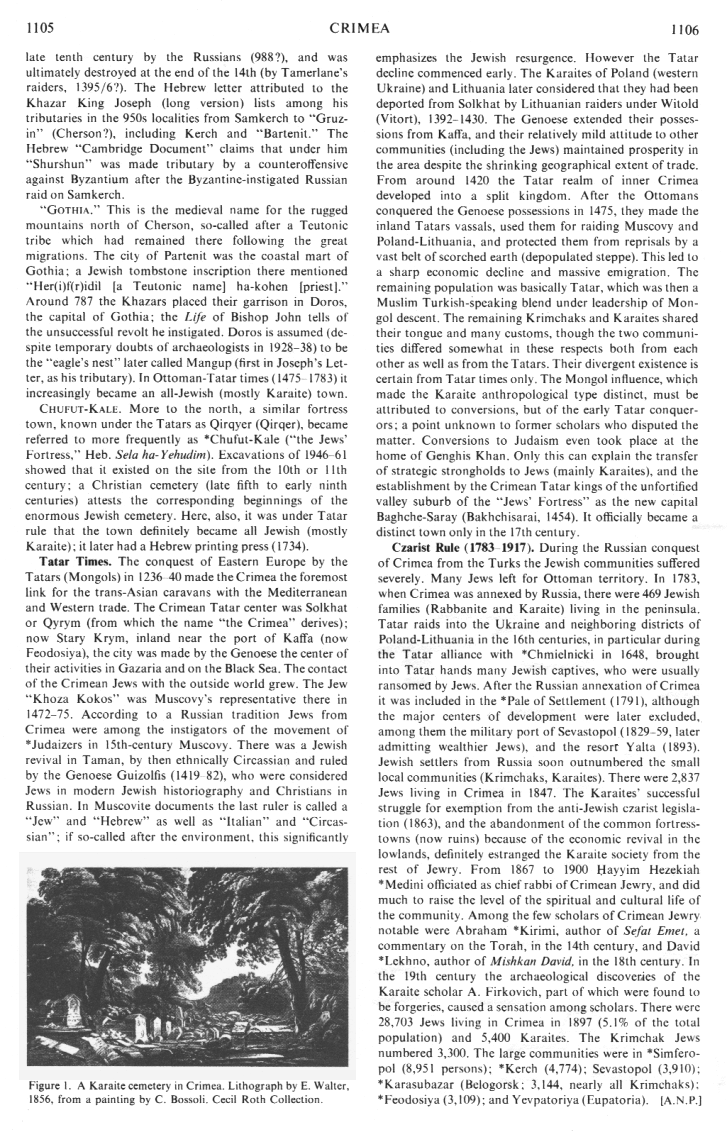
Encyclopaedia Judaica (1971): Crimea, vol. 5, col. 1105,
Karaite cemetery in Crimea
Soviet
Rule [1917-1941]
There were 39,921 Jews living in Crimea in 1926 (6.1% of
the total population), of whom 17,364 lived in Simferopol
(19.6%); 5,204 in Sevastopol; 3,248 in Feodosiya (11.3%);
3,067 in Kerch; and 2,409 in Yevpatoriya (10.6%). IN the
early 1920s a movement for Jewish agricultural settlement
in Crimea began, pioneered by members of *He-Haluz, who
established the hakhsharah
groups [[pioneer training groups]] of Tel Hai (1922),
mishmar (1924), and Ma'yan (1925) in the Dzhankoi area.
They were followed by numerous other Jewish groups. In
1924 the Soviet government initiated a large-scale
settlement project to be implemented through *Komzet with
aid from the "American Jewish Joint Distribution
Committee. A number of Soviet Jewish leaders who were
concerned with this project, such as M. (Y.) *Larin and A.
Bragin, regarded it as the nucleus for establishing a
Jewish Soviet Socialist Republic in the Crimea. However,
by the beginning of the 1930s, when it became clear that
the unoccupied land available in Crimea was not adequate
for large-scale settlement, the movement concentrated
mainly on promoting settlement in *Birobidzhan.
the state allocated 342,000 hectares of land for Jewish
settlement in Crimea, on which 5,150 families had settled
by 1931, including a commune established by a group of the
*Gedud ha-Avodah, who had returned from Palestine, named
Yoya Nova. [...] Some of the settlements were organized in
two Jewish national districts: Freidorf (in 1930) and
Larindorf (1935).>
Details:
Since 1921 the "Soviet" regime had plans to install a
Jewish republic in the Crimea (Lustiger, p. 82).
In August 1924 a State's
Committee for Settlement in the Crimea (Komert, Russian:
Komset) is found under Jewish-Soviet leadership of Juri
Larin. Communist state money and land is given for
Jewish Krim colonization, all in all 342'000 ha of land.
Money is also collected in the Western countries for
this (Lustiger, p.82, 83).
For this projected Jewish
colony in the Crimea the "American"-Jewish organization
Joint is making much propaganda so even West European
Jews arrive in the Crimea of the "Soviet Union", with
the support of the "American" Jew James Rosenberg from
the Joint (Lustiger, p.82)
In February 1925 a special company "Geselschaft fur
einordnen jid oif erd in FSSR" (Geserd, Russ. Oset) is
found. It's a half official land settlement organization
for Jews in the Crimea (Lustiger p.82) under leadership
of Juri Larin (Russ. Michail Lurje), stepfather of
Bucharin and high Jewish party official (Lustiger, p.
83). The task of Geserd is to collect money for Jewish
settlements in the Crimea in the whole world. Offices
are opened in the whole world (Lustiger, p.82).
The Jews got land which was cut from the neighbors and
this was not a good atmosphere at all and Antisemitism
grew until WW II: See: Yehuda
Bauer:
A History of the American Jewish Joint Distribution
Committee 1929-1939, chapter II:
<Under Rosen's direction, 5,646 families were settled
between 1924 and 1928, some in the Ukraine, some in the
Crimea. [...] The head of COMZET was a non-Jewish
vice-premier of the Russian Soviet Socialist Republic,
Peter Smidovich, a man who was very much interested in
the success of the venture. He was influential in
obtaining the government's agreement to the Jewish
settlement of a large tract of land in the Crimea; as
much as one million acres were set aside for use by
Jewish settlers. [...] It is an indubitable fact that
the settlements in the Crimea (Bauer, p.60)
founded by the Agro-Joint included a number of Zionist
colonies settled by people who saw the Crimea as a
stepping-stone on the road to Palestine. There were some
13 of these with Hebrew names, some of them - like Tel
Chai (there were two separate settlements by that name),
Mishmar, Khaklai, Avoda, Kheruth, Maaian, Kadimah -
having distinct Palestine-centered connotations.
In 1928 there were 112 Agro-Joint colonies in the
Ukraine and 105 in the Crimea. In addition to these,
Agro-Joint also helped other colonies with occasional
loans or by other means.> (Bauer, p.61)
In 1927/1928 the Soviet Regime used the Jews for
tactical reasons:
<At this juncture Russia came forward with the idea
of a vast expansion of the Jewish colonization scheme
and offered the Jews large tracts of land, especially in
the Crimea. In 1927/8 it was obviously interested in
transforming the Jewish population into a productive and
loyal force. It also needed grain, and the establishment
and encouragement of state farms (sovkhozy), which
were set up on state lands, had so far not been very
successful. Moreover, Soviet Russia needed American
dollars very badly, and an arrangement with JDC meant
not only a contribution to the solution of the pressing
Jewish problem, but also an influx of both hard currency
and valuable machinery, of which the Soviets were very
short.> (Bauer, p.62)
<In 1929 79 new groups were settled in the Crimea and
three more in the Ukraine. The total number of families
settled was 2,276.> (Bauer, p.69)
There were tactical jail punishments against Jews in
Crimea to show to the non-Jews:
<The situation looked very grim nevertheless. Boris
Smolar, the Jewish Telegraphic Agency (JTA) journalist
who happened to be in Russia at that time, cabled on
November 24, 1929, that "notwithstanding their loyalty",
four of the Jewish colonists in the Crimea
were nevertheless arrested and sentenced to three years'
jail each [and] their property confiscated, leaving only
the property mortgaged by the Agro-Joint which according
to law cannot be confiscated. ... The local population
assured me (that) even government officials are aware
that (the) arrested submitted all (the surplus grain)
they could. However, arrest was made with (the) purpose
of showing neighboring non-Jewish peasants that also
Jews are arrested.> (Bauer, p.71)
German and Tartar settlers had to leave land to the Jews
in Crimea:
<Investment for the establishment of colonies was not
interrupted. According to one set of JDC figures,
-- in 1929, 2,276 families were settled;
-- in 1930, 2,250;
-- by the end of 1930, it was said that some 12,100
families had been settled by the Agro-Joint on its
colonies in the Ukraine and in the Crimea.
It was claimed that 289 colonies had been founded. A
Jewish autonomous region was established near Krivoi Rog
around the center of Kalinindorf.
German and Tartar settlers in the Crimea had
been moved "voluntarily" to allow for close Jewish
settlement.> (Bauer, p.75)
The set up of the Jewish settlements happened by the
"American" Agrojoint. Yiddish became the official
language in the Jewish settlements (Lustiger, p.82).
Tatar, Russian and Ukraine parts of the population began
to resist because the Jews were said having the most
fertile land. Add to this Crimea was seen to be too
little for a republic of all Russian Jews and any Jewish
republic in the Crimea would have no future, so
(Lustiger, p.83).
<Five autonomous Jewish districts (p. 103) were
founded (Freidorf in February 1931, Stalindorf in June
1930, Kalinindorf in March 1937, New Zlatopol in 1929,
and Larindorf in January 1935).> (p.104)
With the Biro-Bidjan project since 1928 the Crimea
project is downgraded and no state's money is given any
more for the Jewish Crimea project (Lustiger, p. 83).
<Many of the settlers left the
colonies when collectivation was introduces in the early
1930s and with increasing industrialization in the Soviet
Union.> (col. 1107)
Details
can be seen again in the book of Yehuda Bauer and
Lustiger. During 1930-1931 many Jews left Crimean Jewish
collectives to work in the new industries:
The 86 common farms were converted into kolkhozes and a
big part of the Jewish kind of living is made impossible
by this (Lustiger, p. 83).
<During collectivization, some Jewish farmers in the
Crimea tended to run away because of the
collectivization drive. Rosen himself stated that "400
families had run away from the colonies during the
drive."
Zionist colonies had their Hebrew names changed, and the
Communists instituted strict political control. "Great
numbers of Jewish settlers who were brought during last
month from shtetlach into colonies to join collectives
are returning home", cabled Smolar from Moscow in April
[1930]. They were saying that recent Soviet decrees
opened wider possibilities for them in shtetlach than in
collective colonies. This resulted in a lack of laborers
on the farms and endangered the existence of many Jewish
collectives, which had to go to the expense of hiring
labor. Even when they arrived, new Jewish settlers
didn't remain on the collectives.> (Bauer, p.82)
<In 1931 1,800 families were settled, about 50 % of
the number originally planned; the Jews had become the
third largest group in the Crimea.> (Bauer, p.83)
< Then in 1932/3 another famine struck the Soviet
Union. > (Bauer, p.83)
In the same year 1932 the boss of Geserd Juri Larin dies
and the Jewish settlement movement in the Crimea stops
(Lustiger, p.83).
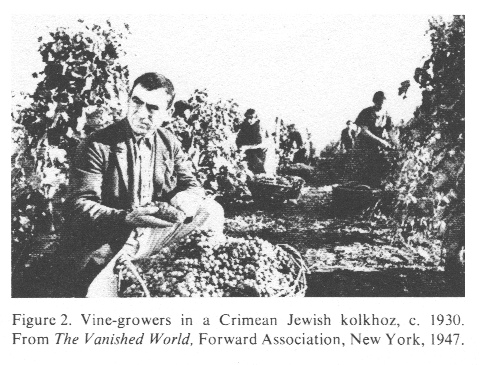
Encyclopaedia Judaica (1971): Crimea, vol. 5, col.
1107, Jewish winegrowers in Crimea, 1930 approx.
<In 1932-34, work [[of the Joint]] was concentrated
in the Crimea. Government supervision in all respects
except the purely agroeconomic one was complete. Some of
the assets of the Agro-Joint were not, it s true,
handed over: for example, the Jankoy tractor station and
repair shop, buildings in Simferopol and Moscow,
supplies, and commodities.> (Bauer, p.90)
<Rosen claimed that in 1933 only 1,400 families were
settled in the Crimea, but even this looked rather
doubtful.> (Bauer, p.89)
<After 1934 no more claims are made of families
settling on land in the Crimea, the Ukraine, or White
Russia. JDC claimed that altogether 14,036 families had
been settled in its (Bauer, p.83) colonies by 1934.>
(Bauer, p.84)
<Jews now did not have to go to the Crimea in order
to become small-scale farmers on the outskirts of
villages and towns, but could do so wherever they lived.
The Jewish economic position continued to improve, and
the Agro-Joint and its operations seemed to be more and
more superfluous.> (Bauer, p.89)
< In about 1934 a consolidation of the tracts settled
by the Jewish settlers in the Crimea took place.
Villages were united under a common administration.>
(Bauer, p.103)
<Even after the termination of its actual settlement
work in 1934, the Agro-Joint still maintained a large
staff of experts who, with income from the existing
assets and some very small sums in dollars, continued to
advise the settlements about their agricultural
production. The Jankoy station was one of the prototypes
of the MTS tractor stations that were to provide tractor
work for the kolkhozy later on. In other respects too,
such as well-drilling and horticulture, Agro-Joint help
was still significant.> (Bauer, p.90)
In 1935 the "Soviet" government planned more Jewish
settlers in Crimea and Biro-Bijan:
<The Soviet proposal was that 1,000 Jewish families
and 500 single people would be settled, some in
Biro-Bidjan, some in the Crimea (100 families) and the
Ukraine, in both agriculture and industry. The
Agro-Joint would provide the money to transport them to
the Russian border and then supervise the agricultural
settlement in the Crimea and in Biro-Bidjan.> (Bauer,
p. 93)
[[All in all it can be admitted that German and Tartar
settlers in Crimea did not like the Jewish colonies in
Crimea very much because they had to give land to them,
because they knew that the Jewish settlements were only
for tactical reasons to the advantage of the "Soviet"
regime and they just waited for a moment to take revenge.
So these Jews there were in a latent danger and nobody
worried about this but the Jewish "organizations"
considered the Crimean settlements as a training for the
founding of racist Herzl Israel against the Arabs]].
<By 1938 there were 86 Jewish kolkhozes in Crimea
cultivating an area of 158,850 hectares with 20,000
inhabitants (one-third of the total number of Jews in
Crimea).> (col. 1107)
1939 are
living 85,000 Jews in Crimea, inclusive 7,000 Krimchaks
and 5,000 Karaites, a Jewish splinter group (Lustiger,
p.174).
Before NS German occupation [[in 1941]] Stalin let
deport the German friendly elements from Crimea [[in
1940-1941]].
(In: Martin Gilbert: Soviet History Atlas 1972, map 45)
[Holocaust
1941-1942: Destruction of the Jewish settlements in the
Crimea]
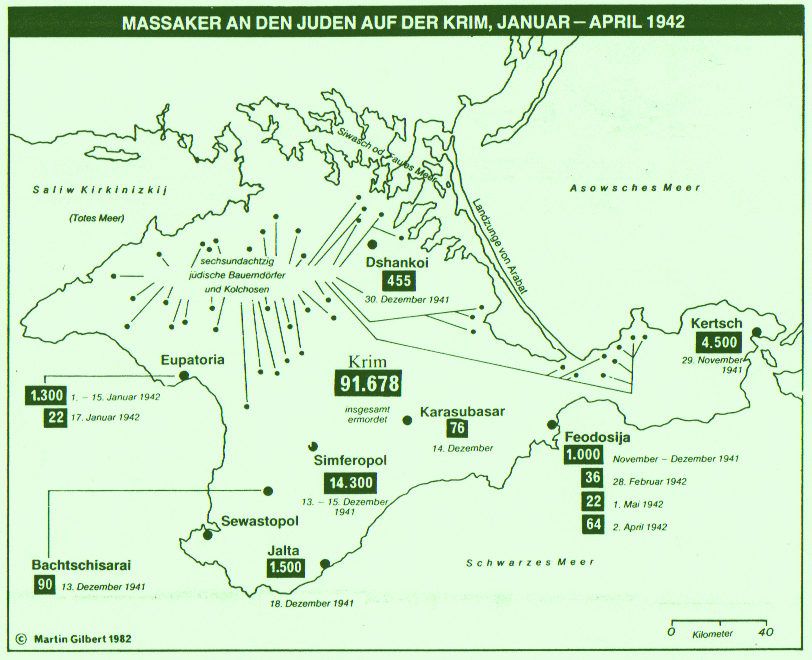
With the German occupation in 1941 the Jewish settlement
and colonies in the Crimea were annihilated. The Nazis
organized the systematic liquidation of the Ashkenazi
(col. 1107)
Jews and Krimchaks, but did not include the Karaites.
According to a provisional report from the beginning of
1942, 20,149 Jews from western Crimea alone had already
been "liquidated". On April 16, 1942, Crimea was declared
Judenrein.
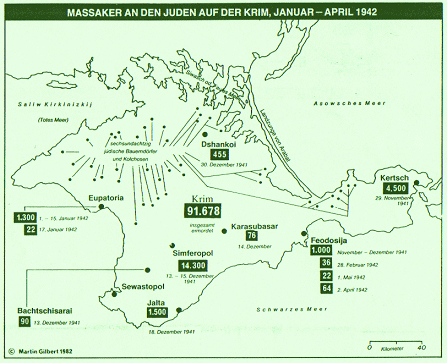
 Map
of Holocaust massacres in the Crimea 1941-1942 [2]
Map
of Holocaust massacres in the Crimea 1941-1942 [2]
Almost
all Jews in Crimea are murdered in July 1941 by
Einsatzgruppe D. The Karaites are declared non-Jews by
the Hitler regime and are not persecuted (Lustiger,
p.174). The Tatars in Crimea were collaborating with the
NS regime to annihilate the Jews in Crimea (Lustiger,
p.175).
In July 1942 the NS regime declares the Crimea Tatars as
an "allied people". But the NS regime has further plans
to settle Germans from Romania and South Tyrol there to
form a German "Gibraltar" there with "Goths", to form
another "Goths land", a "German spa to reign over the
Black Sea. Hitler dreams of a motorway down to Crimea to
reach it within 2 days (Lustiger, p.174).
In the second half of 1943 Joint officials from Jewish
organizations, James Rosenberg (Joint) and Louis Levine
(Jewish Russian War Relief), suggest the "revival" of
the Crimea project (Lustiger, p.176).
At the end of December 1943 the Russian Jewish agents
from the Jewish anti-Fascist Committee (JAFK) Micho'els
and Fefer declare officially that there would be founded
another Jewish Republic in the Crimea, and this fantasy
is wandering through the Jewish press in the whole world
until 1946 (p.177-178). This illusion has it's base on
the factors
-- that Jewish population is extremely poor at this time
-- that all Jewish colonies are eliminated at this time
-- that Jewish partisans and soldiers give their lives
in the Red Army
-- that there could be organized easily massive aid of
goods and money from abroad (p.176).
On 24 February 1944 the Jewish anti-Fascist Committee
(JAFK) under Micho'els, Epstein and Fefer publishes a
Crimea memorandum (Lustiger, p.177-178) with the
indication that 1.5 mio. Jews were murdered on the
former German occupied territories (Lustiger, 180). The
government for a Jewish Crimean republic are already
distributed:
-- Micho'els should be the
president of the Jewish Republic
-- Epstein should be head of the government
-- Schimeliowitsh should be health minister
-- Kwitko should be education minister
-- Trainin should be justice minister
-- Jusefowitsh should be boss of the labor unions
-- Markish should be head of the writer's union
(Lustiger, p.179).
But Stalin estimates the new Jewish Crimea project as a
game of "American" [[racist]] Zionists to give the base
for an "American" invasion of Russia. So, Stalin rejects
the project (Lustiger, p.179).
On 7 May 1944 Crimea is occupied by communist Red Army
forces when Sevastopol falls (Lustiger, p.175).
Stalin has other actions: In
March 1944 the 180,000 Crimean Tatars are collectively
deported because of collaboration with the Third Reich
(Lustiger, p.175), resp. from 10 to 30 May 1944 200,000
Crimea Tatar inhabitants are deported to Kazakhstan,
within 40,000 children. The reason is that 20,000 Tatars
had deserted and would fight in the Tatar legion within
the Wehrmacht. Ukrainians and Russian people is not
suffering deportation even if Ukrainians and Russian
deserters are fighting in the Wehrmacht (Lustiger,
p.175).
In the middle of 1944 Kaganowitsh from the "Soviet"
regime rejects the Jewish Crimea plan which is an
invention of actors and poets (Lustiger, p.178).
In May 1945 the Jewish anti-Fascist Committee (JAFK) is
still waiting for an agreement with the "Soviet" regime
with a future Jewish Crimean Republic (Lustiger, p.178).
In the beginning of 1949 the "Soviet" regime arrests
members of the Jewish anti-Fascist Committee above all
because of the Crimea Project (Lustiger, p.180).
In 1952 there is the process
against the protagonists of the Jewish Crimea project
(Lustiger, p.193). On 28 June 1952 Fefer avows the
espionage activity for the "USA" and he had misused the
confidence of Western personalities (Lustiger, p.151).
The process ends with death sentences for the
protagonists of the Crimea project of 1944 (Lustiger,
p.179).
But some Jews from the central
"Soviet Union" seem to have been allowed to settle in the
Crimea after 1945:
<After the war Jewish settlement in Crimea was renewed,
and in 1959, the Jewish population numbered 26,374 (2.2%
of the total population), according to the official
census, of whom 11,200 lived in Simferopol (6%) and 3,100
in Sevastopol.
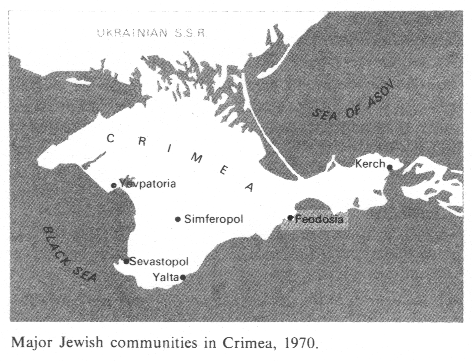
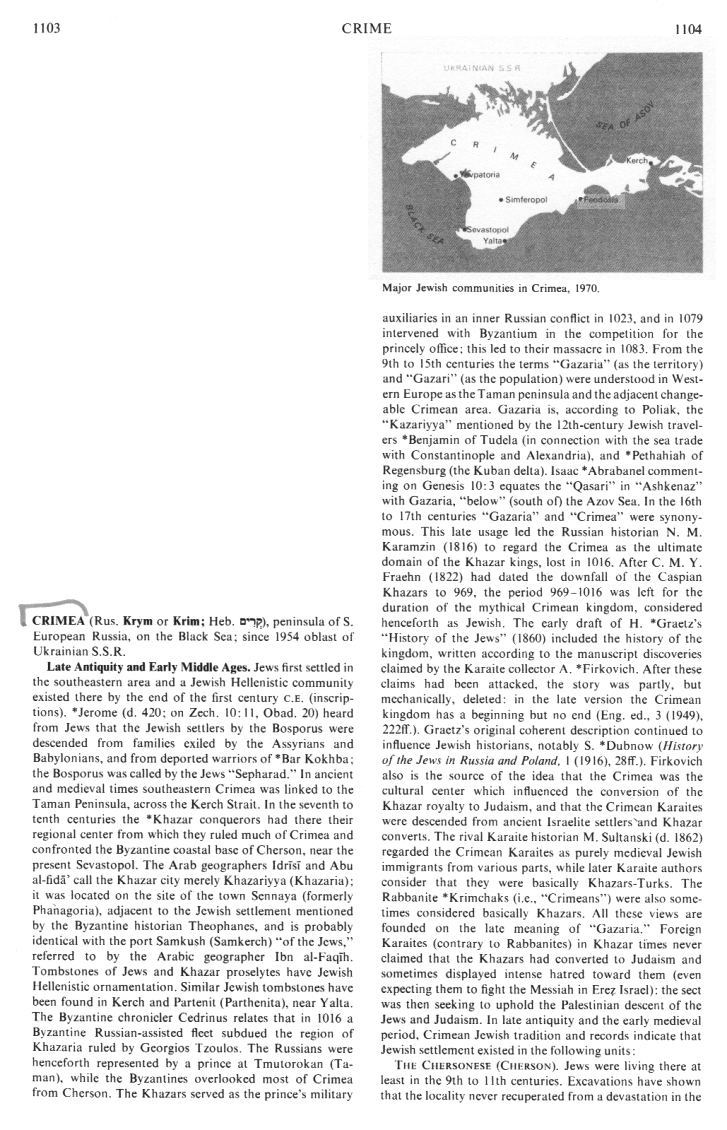
In 1970 the Jewish population of Crimea was concentrated
in Simferopol, with an estimated Jewish population of
15,000; Sevastopol, where there was one small synagogue in
the Jewish cemetery; Yevpatoria, with an estimated Jewish
population of 8-10,000; and in smaller communities, e.g.,
Kerch, Yalta, and Feodosia.
[Y.S.]
Bibliography
-- A. Harkavy: Altjuedische Denkmaeler aus der Krim (1876)
-- O. Lerner: Yevrei v novorossiyskom kraye (1901)
-- A.N. Poliak: Kazariyyah (Heb., 1942)
-- J. Golde: Di Yidishe Erdarbeter in Krim (1932)
-- B. Nevelshtein: Freydorfskiy Yevreyskiy Natsionalny
Rayon (1934)
-- B. West (ed.): Be-Hevlei Kelayah (1963), 138-45>
(col. 1108)