Encyclopaedia Judaica
Jews in South Africa 06: Jewish schooling
Board of Jewish Education since 1928 - Jewish day schools since 1948 - "national" tradition
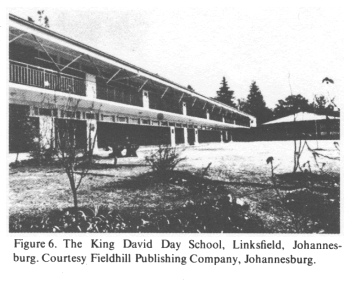
Encyclopaedia Judaica (1971): Jews in South Africa, vol. 15, col. 196: The King David Day School,
Linksfield, Johannesburg. Courtesy Fieldhill Publishing Company, Johannesburg
from: South Africa; In: Encyclopaedia Judaica 1971, vol. 15
presented by Michael Palomino (2008 / 2010 / 2020)


| Share: |
Facebook |
|
Twitter
|
<EDUCATION.
[since 1928: South African Board of Jewish Education]
Overall supervision of Jewish education is undertaken by the South African Board of Jewish Education, established in 1928, which operates from headquarters in Johannesburg for all the schools in the country, with the exception of those in the Cape Province. The latter are affiliated to the Cape Board of Jewish Education, with headquarters in Cape Town. The South African Board supervises all the Jewish educational institutions - day schools as well as talmud torah institutions - in its area; and appoints a director of education and one or more inspectors, more particularly for the schools in the smaller communities. It has direct responsibility, both financial and administrative, for the Jewish day schools in Johannesburg, for the maintenance of a college for the training of teachers and nursery school teachers, and for the maintenance of a hostel, attached to the King David High School in Johannesburg, where over 100 boarders, mainly pupils resident in rural areas, are accommodated. Analogous functions are carried out by the Cape Board of Education in relation to Jewish education in its area.
Heder-type [[Jewish religious school to age 13]] supplementary Hebrew education, usually maintained by independent congregations, continues to be the norm in communities except where full-time Jewish day schools exist.
[[...]]
[since 1948: Jewish day schools]
In Johannesburg the effect of the day schools is seen in the diminishing enrollment in the United Talmud Torahs. This body, functioning as the Johannesburg regional body of the South African Board under its own director, controlled 29 schools in 1968 with an enrollment of 1,291 pupils, the great majority under bar mitzvah age [[under 13, the age of the Jewish religious maturity]].
Since the first day school was established in Johannesburg in 1948, three primary and two high schools have been established in that city. There are similar schools in Cape Town, Port Elizabeth, Durban, and Pretoria. The total pupil enrollment in the day schools in 1969 was about 6,000 (approximately 30% of all the school-going Jewish youth). These schools provide a complete secular education, with Jewish studies integrated into the general curriculum, up to matriculation standard. The Rabbi J.L. Zlotnik Seminary (col. 196)
in Johannesburg, founded in 1944, and named after the director of education who greatly influenced the Board's development (see Y.L. *Avida), provides facilities for the training of Hebrew teachers and nursery school teachers. Government policy has precluded financial support to new private schools, of whatever denomination, and financing of Jewish education remains a problem. (col. 197)
[[...]]
<EDUCATION TRENDS.
[1950-1970: "National traditional" Jewish schools - the day schools and the effects]
The most significant development of the past two decades has been in Jewish education, through the establishment of well-organized Jewish day schools in all the large urban centers (see education).
The ideological basis of the day schools is officially described as "broadly national traditional", a formula (col. 200)
intended to indicate both the religious and the Zionist character of the education. However, there has been constant pressure from certain Orthodox religious groups for more intensive religious instruction and greater religious observance. Protagonists of this type of education created in 1958 a small Yeshivah College [[religious Torah school]] which developed into a full-time day school from nursery school up to matriculation. Because of the popularity of the day schools, attendance in the talmud torah institutions diminished in the large cities. However, in the smaller communities, the talmud torah continues as the only source of institutionalized Jewish education.
[The problem of the recruitment of qualified teachers]
The recruitment of qualified teachers (who, in the smaller communities must also be ministers and shohatim [[ritual slaughterers]]) became an urgent problem. Senior Hebrew teachers continue to be sought in Israel. Chairs of Hebrew or Semitic languages exist at all the universities, but only a minority are filled by Jews.
Attention is being given to the question whether the chairs in some of the universities might be induced to offer a wider range of Jewish studies, such as sociology, philosophy, and Jewish thought generally.> (col. 201)
[1969: Figures about Jewish schools]
<In 1969 the South African Board supervised 47 such schools, with a total enrollment of 2,300 pupils and 95 teachers. Additionally, 43 nursery schools (21 in Johannesburg) were affiliated to, and inspected by, the Board, having an enrollment of 2,700 children and 198 teachers.> (col. 196)
Sources
Encyclopaedia Judaica 1971: South Africa, vol. 15, col. 183-184
Encyclopaedia Judaica 1971: South Africa, vol. 15, col. 185-186
Encyclopaedia Judaica 1971: South Africa, vol. 15, col. 187-188
Encyclopaedia Judaica 1971: South Africa, vol. 15, col. 189-190
Encyclopaedia Judaica 1971: South Africa, vol. 15, col. 191-192
Encyclopaedia Judaica 1971: South Africa, vol. 15, col. 193-194
Encyclopaedia Judaica 1971: South Africa, vol. 15, col. 195-196
Encyclopaedia Judaica 1971: South Africa, vol. 15, col. 197-198
Encyclopaedia Judaica 1971: South Africa, vol. 15, col. 199-200
Encyclopaedia Judaica 1971: South Africa, vol. 15, col. 201-202
Encyclopaedia Judaica 1971: South Africa, vol. 15, col. 203-204
Encyclopaedia Judaica 1971: South Africa, vol. 15, col. 205-206
Encyclopaedia Judaica 1971: South Africa, vol. 15, col. 207-208
^


