[[Addition:
Financing World War II
The Second World War was financed by the "US" banks which
financed Communism (bank house: Schiff) and Nazis (bank
house: Warburg) at the same time. Hitler had many more
moneylender, e.g., French royalists, Russian czarists,
Mussolini, German and "US" industrialists etc. By this war
manipulation, Europe was destroyed and at the end the
"USA" and the "Soviet Union" were celebrated as the
saviors of the peace with chewing gums and chocolate.
Within this war manipulation there was much war profit -
by Jews and non Jews, and there were many victims - Jews
and non Jews...]]
[Jewish war moods - Jews
in the "US" army]
During the public debates between 1939 and December 1941,
concerning U.S. (col. 1632)
foreign policy during World War II, U.S. Jews were
generally found on the side favoring maximum aid to
England and France, and later Russia. Jewish sympathies
were less with Great Britain, whose imperialism and White
Paper of 1939 on Palestine were deeply resented, as their
fear and loathing [[disregarding]] focused on Nazi
Germany.
![Encyclopaedia Judaica (1971):
"USA", Vol. 15, col. 1632: U.S.
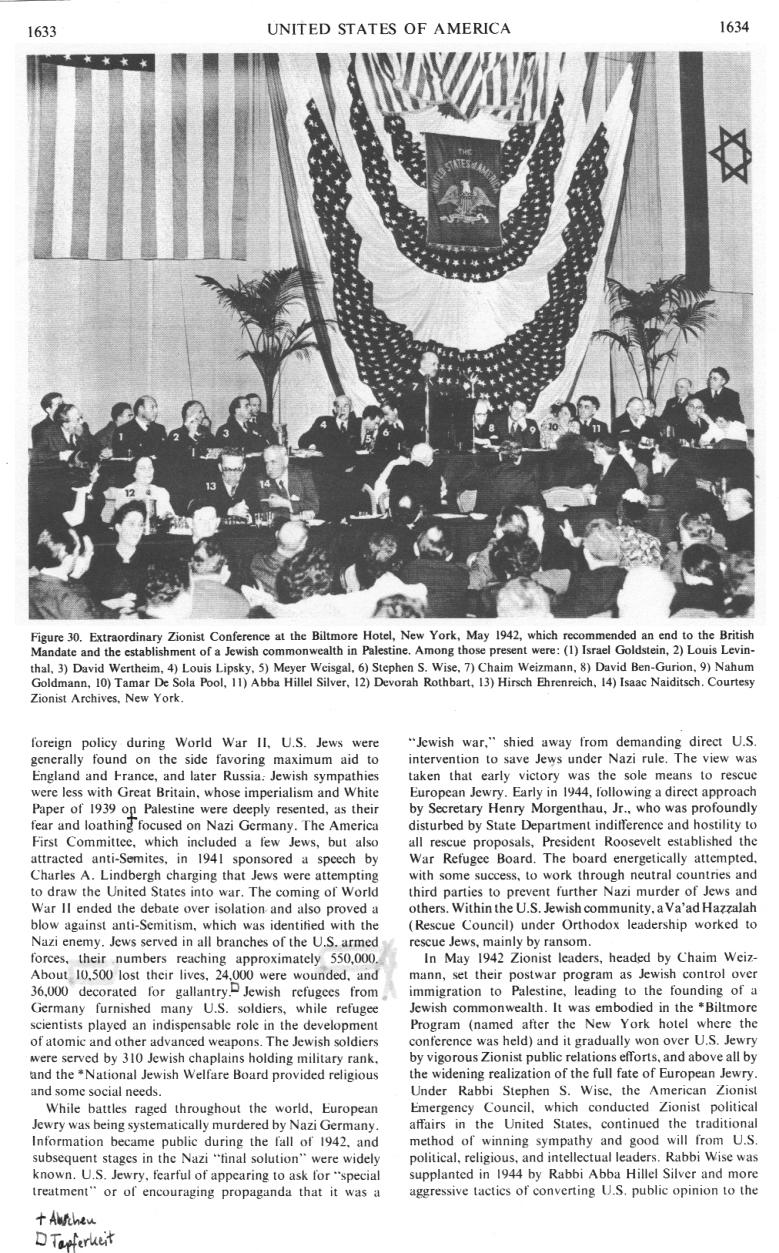
[[racist]] Zionist leaders at the British
Embassy in Washington, D.C., to protest
against the White Paper, 1940.](EncJud_juden-in-USA-d/EncJud_USA-band15-kolonne1632-zionistenfuehrer-demo-gg-GB-Weisspapier1940-27pr.jpg "Encyclopaedia Judaica (1971):
\"USA\", Vol. 15, col. 1632: U.S.
[[racist]] Zionist leaders at the British
Embassy in Washington, D.C., to protest
against the White Paper, 1940.") |
Encyclopaedia Judaica (1971): "USA",
Vol. 15, col. 1632: U.S. [[racist]] Zionist
leaders at the British Embassy in Washington,
D.C., to protest against the White Paper, 1940. 1)
Solomon Matz, 2) Nellie Ziv, 3) Leon Gellman, 4)
Isadore Breslau, 5) Solomon Goldman, 6) Hayim
(Ḥayim) Greenberg, 7) Stephen S. Wise, 8) Louis
Segal, 9) Herman Hollander, 10) Israel Goldstein.
Courtesy Keren Hayesod-United Israel Appeal,
Jerusalem
[[Racism Darwinism was a "normal" subject in every
university at this time, and the aim of the racist
Zionists was a big Jewish Empire from the Nile to
the Euphrates, see the Bible, 1st Mose, chapter
15, phrase 18. This aim is not given up until now
(2008) in the Jewish military strategies and in
the dreams of the Jewish political parties. The
Arabs don't count, as the natives in the "USA" do
not count. The "Christians" did not count the
natives either but are terrorizing the whole
world...]] |
The America First Committee, which
included a few Jews, but also attracted anti-Semites, in
1941 sponsored a speech by Charles A. Lindbergh charging
that Jews were attempting to draw the United States into
war. the coming of World War II ended the debate over
isolation and also proved a blow against anti-Semitism,
which was identified with the Nazi enemy.
[[But some anti-Semitic restrictions in the "USA" were
lifted only in the 1960, see: *Discrimination]].
Jews served in all branches of the U.S. armed forces,
their numbers reaching approximately 550,000. About 10,500
lost their lives, 24,000 were wounded, and 36,000
decorated for gallantry. Jewish refugees from Germany
furnished many U.S. soldiers, while refugee scientists
played an indispensable role in the development of atomic
and other advanced weapons. The Jewish soldiers were
served by 310 Jewish chaplains holding military rank, and
the *National Jewish Welfare Board provided religious and
some social needs.
[War escalation 1942-1944
- the manipulation of the public opinion into a racist
Zionist line]
While battles raged throughout the world, European Jewry
was being systematically murdered by Nazi Germany.
Information became public during the fall of 1942 [[right
at the time of the NS defeat of Stalingrad]], and
subsequent stages in the Nazi "final solution" were widely
known [[with systematic death in the tunnel and bunker
systems for underground weapon production]]. U.S. Jewry,
fearful of appearing to ask for "special treatment" or of
encouraging propaganda that it was a (col. 1633)
"Jewish war", shied away from demanding direct U.S.
intervention to save Jews under Nazi rule. The view was
taken that early victory was the sole means to rescue
European Jewry. (col. 1634) [[...]]
In May 1942 [[racist]] Zionist leaders, headed by [[racist
Zionist leader]] Chaim Weizmann, set their postwar program
as Jewish control over immigration to Palestine, leading
to the founding of a Jewish commonwealth. [[The Arabs were
not asked]]. It was embodied in the *Biltmore Program
(named after the New York hotel where the conference was
held) and it gradually won over U.S. Jewry by vigorous
[[racist]] Zionist public relations efforts, and above all
by the widening realization of the full fate of European
Jewry.
![Encyclopaedia Judaica (1971):
"USA", Vol. 15, col. 1633-1634:
[[Racist]] Zionist Conference at the Biltmore
Hotel, New York, May 1942. [[The Arabs are not
asked]].](EncJud_juden-in-USA-d/EncJud_USA-band15-kolonne1633-1634-zionistenkongress-Biltmore1942-35pr.jpg "Encyclopaedia Judaica (1971):
\"USA\", Vol. 15, col. 1633-1634:
[[Racist]] Zionist Conference at the Biltmore
Hotel, New York, May 1942. [[The Arabs are not
asked]].") |
Encyclopaedia
Judaica (1971): "USA", Vol. 15, col. 1633-1634:
[[Racist]] Zionist Conference at the Biltmore
Hotel, New York, May 1942. [[The Arabs are not
asked]].
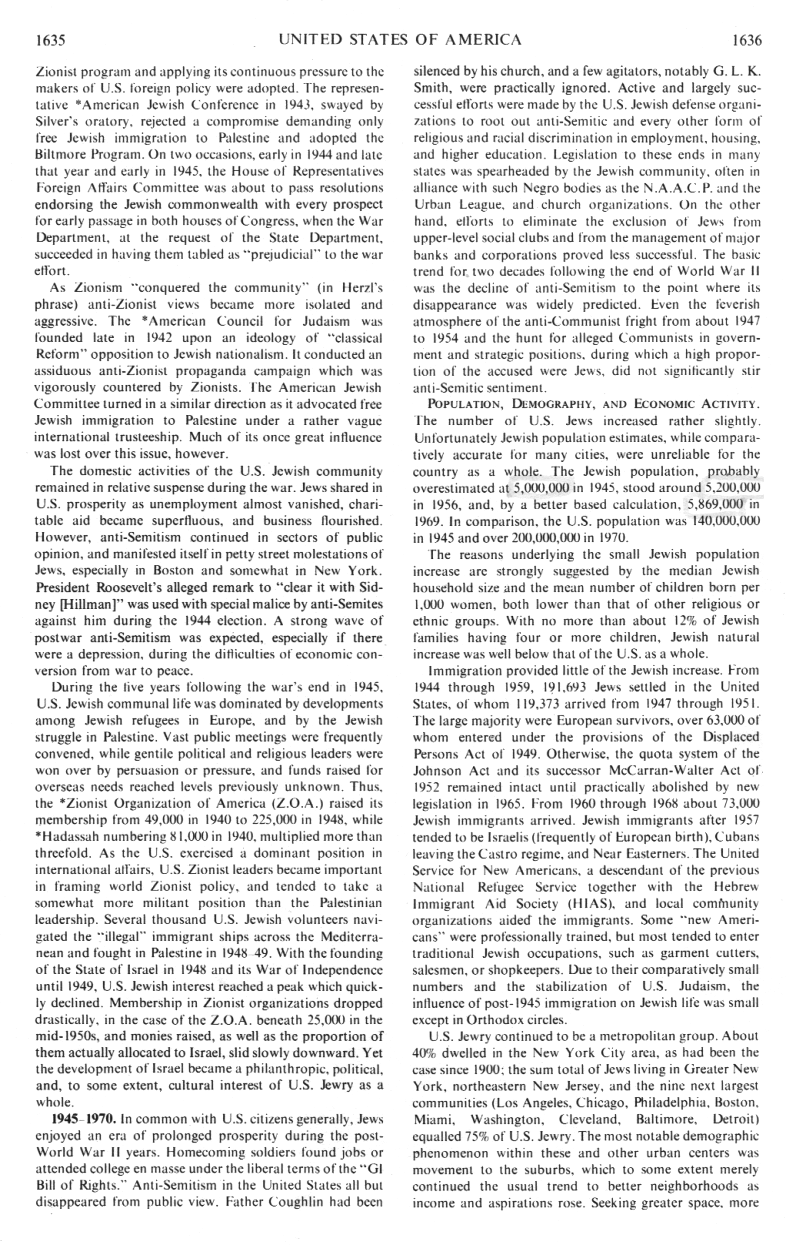
The extraordinary [[racist]] Zionist Conference at
the Biltmore Hotel, New York, May 1942,
recommended an end to the British Mandate and the
establishment of a Jewish commonwealth in
Palestine. Among those present were: (1) Israel
Goldstein, 2) Louis Levinthal, 3) David Wertheim,
4) Louis Lipsky, 5) Meyer Weisgal, 6) Stephen S.
Wise, 7) Chaim Weizmann, 8) David Ben-Gurion, 9)
Nahum Goldmann, 10) Tamar De Sola Pool, 11) Abba
Hillel Silver, 12) Devorah Rothbart, 13) Hirsch
Ehrenreich, 14) Isaac Naiditsch. Courtesy Zionist
Archives, New York. [[The Arabs are not asked. At
the same time the Arabs are partly manipulated by
the German government with promises to be freed of
the racist colonialist "democratic" powers of
England and France]]. |
Under Rabbi Stephen S. Wise, the
American Zionist Emergency Council, which conducted
Zionist political affairs in the United States, continued
the traditional method of winning sympathy and good will
from U.S. political, religious, and intellectual leaders.
Rabbi Wise was supplanted in 1944 by Rabbi Abba Hillel
Silver and more aggressive tactics of converting U.S.
public opinion to the (col. 1634)
[[racist]] Zionist program and applying its continuous
pressure to the makers of U.S. foreign policy were
adopted. The representative *American Jewish Conference in
1943, swayed by Silver's oratory, rejected a compromise
demanding only free Jewish immigration to Palestine and
adopted the Biltmore Program. On two occasions, early in
1944 and late that year and early in 1945, the House of
Representatives Foreign Affairs Committee was about to
pass resolutions endorsing the Jewish commonwealth with
every prospect for early passage in both houses of
Congress, when the War Department, at the request of the
State Department, succeeded in having them tabled as
"prejudicial" to the war effort. (col. 1635) [[...]]
[War Refugee Board since
1944]
Early in 1944, following a direct approach by Secretary
Henry Morgenthau, Jr., who was profoundly disturbed by
State Department indifference and hostility to all rescue
proposals, President Roosevelt established the War Refugee
Board. The board energetically attempted, with some
success, to work through neutral countries and third
parties to prevent further Nazi murder of Jews and others.
Within the U.S. Jewish community, a Va'ad Hazzalah
(Haẓẓalah) Rescue Council) under Orthodox leadership
worked to rescue Jews, mainly by ransom. (col. 1634)
[[...]]
[[Then the mass murder of the Jews in the tunnel and
bunker systems and on the front line between the Wehrmacht
and the Red Army was at it's peak]].
[Anti-Zionists in the
"USA"]
As [[racist]] Zionism
[[which wanted to instigate another world war against the
Arabs with a "Greater Israel" from the Nile to the
Euphrates according to the Bible, 1st Mose, chapter 15,
phrase 18]]
"conquered the community" (in Herzl's phrase)
[[who was the writer of the booklet "The Jewish State"
with the plan to drive all Arabs away as the natives in
the "USA" had been driven away, and with the plan to
enslave all Arabs for the Jews, and the Jews would manage
gold mines]]
anti-Zionist views became more isolated and aggressive.
The *American Council for Judaism was founded late in 1942
upon an ideology of "classical Reform" opposition to
Jewish nationalism. It conducted an assiduous anti-Zionist
propaganda campaign which was vigorously countered by
[[racist]] Zionists. The American Jewish Committee turned
in a similar direction as it advocated free Jewish
immigration to Palestine under a rather vague
international trusteeship. Much of its once great
influence was lost over this issue, however.
[Economic growth because
of the war activities 1942-1945 - anti-Semitism of the
"America First Committee" with Lindberg - reduced
anti-Semitism after Pearl Harbor]
The domestic activities of the U.S. Jewish community
remained in relative suspense during the war. Jews shared
in U.S. prosperity as unemployment almost vanished,
charitable aid became superfluous, and business
flourished. However, anti-Semitism continued in sectors of
public opinion, and manifested itself in petty street
molestations of Jews, especially in Boston and somewhat in
New York. President Roosevelt's alleged remark to "clear
it with Sidney [Hillman]" was used with special malice by
anti-Semites against him during the 1944 election. A
strong wave of postwar anti-Semitism was expected,
especially of there were a depression, during the
difficulties of economic conversion from war to peace.>
(col. 1635) [[...]]
[[Details of anti-Semitism 1940-1945]]:
The approach of World War II in the late 1930s saw the
formation of a powerful isolationist movement in the
United States. The America First Committee, organized in
1940, attracted anti-Semites to its banner. At an America
First rally, on September 11, 1941, Charles A. Lindbergh,
hero of American aviation, termed the Jews the most
dangerous force pushing the United States into war.
Although his speech was followed by the protest
resignation of the more liberal members of the committee,
Lindbergh and the conservative faction persisted in their
propaganda. Similar remarks were heard on the floor of
Congress from such isolationist Senators as Burton K.
Wheeler and Gerald Nye. After the attack on Pearl Harbor
and the entrance of the United States into the war, open
anti-Semitic agitation (col. 1655)
declined. The tensions of the war years, however,
stimulated a considerable amount of anti-Semitic
sentiment. In 1944, for example, a public opinion poll
showed that 24% of the respondents still regarded Jews as
a "menace" to America and one-third to one-half would have
supported a hypothetical anti-Semitic campaign. The fate
of European Jewry appeared to have little impact on the
prejudices of the American public.> (col. 1656) [[...]]


![Encyclopaedia Judaica (1971):
"USA", Vol. 15, col. 1632: U.S.
[[racist]] Zionist leaders at the British
Embassy in Washington, D.C., to protest
against the White Paper, 1940.](EncJud_juden-in-USA-d/EncJud_USA-band15-kolonne1632-zionistenfuehrer-demo-gg-GB-Weisspapier1940.jpg "Encyclopaedia Judaica (1971):
\"USA\", Vol. 15, col. 1632: U.S.
[[racist]] Zionist leaders at the British
Embassy in Washington, D.C., to protest
against the White Paper, 1940.")
![Encyclopaedia Judaica (1971):
"USA", Vol. 15, col. 1633-1634:
[[Racist]] Zionist Conference at the Biltmore
Hotel, New York, May 1942. [[The Arabs are not
asked]].](EncJud_juden-in-USA-d/EncJud_USA-band15-kolonne1633-1634-zionistenkongress-Biltmore1942.jpg "Encyclopaedia Judaica (1971):
\"USA\", Vol. 15, col. 1633-1634:
[[Racist]] Zionist Conference at the Biltmore
Hotel, New York, May 1942. [[The Arabs are not
asked]].")