Jewry in Iraq 01: 634-1917
Caliph rules and occupation rules - tolerant laws and discrimination laws
from: Iraq; In: Encyclopaedia Judaica 1971, vol. 8
presented by Michael Palomino (2007)


| Share: |
Facebook |
|
Twitter
|
<IRAQ,
country in S.W. Asia (for period prior to 634 C.E. see *Mesopotamia and *Babylonia).
The Jews of Babylonia, who had suffered from persecution at the end of Sasanid rule in Persia, sympathetically received the conquerors of the land, which from then onward became known as "Iraq".
[The legend about foundation of the Jewish community in Iraq]
Tradition relates that the caliph Omar (634-644) was grateful for this and honoured the exilarch *Bustanai b. Haninai (618-c. 670). The caliph gave him as a wife Izdundad, the captive daughter of Khosrau II, the king of Persia. Abraham ibn Daud, however, writes (Sefer ha-Kabbalah, 34) that Bustanai married the daughter of Yezdegerd.
It is also related in a letter of Sherira Gaon that when the caliph *Ali ibn Talib (656-661) conquered the town of *Firuz Shapur in 658, the head of the academy R. Isaac (630-660) went out to welcome him with 70,000 (or 90,000) people.
The caliph recognized him as the spiritual leader of the Jewish community.
[Prospering Arab Talmud academies - the academy leaders geonim - relations abroad]
Indeed, under the Arab rule the academies of *Sura and *Pumbedita began to prosper. The heads of these academies were from then on known as geonim (see *Gaon). The golden era of the geonim parallels the days of splendor of the Arab caliphate (mid-seventh century-c. mid-11th century). Many students streamed to the two academies, whose sages delved deeply into the Babylonian Talmud, giving the decisions on controversial legal decisions, or those which still lacked a solution.
With the stabilization of the frontiers of the caliphs and the growth of Arab influence, the relationship between the Babylonian academies and the Jewish communities abroad - in Persia, Syria, Palestine, Egypt, North Africa, and Spain - was gradually strengthened.
History (634-1917).
[Jews under tolerant and not so tolerant caliphs]
The political situation of the Jews in the Arab state was dependent on the caliphs' attitude toward them: during the reigns of tolerant caliphs they benefited from freedom in their social and economic activities, while under intolerant caliphs all non-Muslims were subjected to decrees of social discrimination.
661-750: Umayyad dynasty - caliphs in al-Kufa, in Damascus, and in Harran
The extant information on the attitude of the caliphs of the *Umayyad dynasty (661-750) toward the Jews is very limited. During this period the Jews suffered from the (col. 1444)
political disputes and controversies which took place in Iraq. When Babylonia was conquered by the Arabs, the town of al-Kufa, which was situated near the ruins of ancient Babylon, became the capital of Iraq. The fourth caliph, Ali ibn Talib, established his residence there. When Mu'awiya (661-680) of the Umayyad dynasty ascended the caliphal throne, he removed his residence to Damascus. Al-Kufa became the residence of the governor of Iraq, who was appointed by the caliph in Damascus. Only the last Umayyad caliph, Marwan II ibn Muhammad (744-750), transferred his residence to Harran in Iraq.
[717-720: Intolerant caliph Omar II ibn 'Abd al 'Aziz]
It may be assumed that during the reign of the fanatical caliph Omar II ibn 'Abd al 'Aziz (717-720), the Jews of Babylonia, together with all the *dhimmis, suffered intolerance toward their religion. He forbade the governors to appoint members of other religions as tax collectors and scribes and considered friendship toward Jews or Christians sinful. He also prohibited the Ahl al-dhimma ("protected subjects") to dress as Arabs and sought to degrade them socially (Covenant of *Omar).
750-1258: Tolerant and not so tolerant Abbasid caliphs
Additionally, the situation of the Jews was not stable during the reign of the Abbasid caliphs (750-1258). Some rulers contented themselves with the collection of taxes from the Jews and let them manage their spiritual affairs without hindrance. Others oppressed them by various methods. In several provinces the fate of the Jews was decided by the governors.
[754-775: Caliph al-Mansur makes Baghdad as main town - Baghdad Jewish community growing]
During the reign of the caliph al-Mansur (754-775), *Baghdad, which had been a small suburb near Ctesiphon, the capital of the Sasanids, became the capital of the caliphs of the Abbasid dynasty.
In Baghdad a small Jewish community had existed from the third century C.E.; R. Hana Bagdata'a, the disciple of Samuel, lived there. From the time that Baghdad became the capital of the caliphs, the Jewish community gradually expanded until it became the largest Jewish community in Iraq and the seat of the *exilarch.
During this period several clashes occurred between the [[academy leaders]] geonim and the exilarch and among the geonim themselves. This resulted in a weakening of their status.
[786-809: Prosecution of the Jews under caliph Harun al-Rashid]
The caliph Harun al-Rashid (786-809) was a religious fanatic; he persecuted the Jews and sought to humiliate them, imposed heavy taxes, and discriminated against them in regard to their clothing, their commerce, and other matters.
[813-833: Prosecution of the Jews under Caliph al-Ma'mun who follows his intolerant advisers]
The enlightened caliph al-Ma'mun (813-833), who was a devotee of the sciences, at first revealed a juster attitude toward the Jews, but near the close of his reign he changed for the worse as a result of his advisers' influence.
[847-861: Prosecution of Jews and other religions under caliph al-Mutawakkil: Yellow hat and patch - clothing laws, living and tax restrictions]
The Jews' situation was severely aggravated during the reign of the caliph al-Mutawakkil (847-861), who was also a religious fanatic. In 850 he issued decrees which degraded the Jews and the other non-Muslims. He instituted a yellow headcovering, and for the servants and the poor, a yellow patch to be prominently worn on their clothes, on the chest or on the back.
Four years later he added some new decrees on the color of clothes and on women's clothing. Various restrictions concerned with living quarters, taxes, and other matters are also attributed to him (see Covenant of *Omar).
[Jews adapting to Arab culture - Jews in high professions and in government positions]
It may be assumed that in practice not all these decrees were applied. In spite of all the restrictions, many Jews adapted themselves to the values of Arab culture. They distinguished themselves as physicians and writers, played important roles in the economic life, and held government positions because of the lack of educated officials. The fact that it was necessary from time to time to renew the decrees on clothing proves that they were not generally enforced.
[892-902: Caliph al-Mu'tasim: Jews in the government - Netira and the poll tax]
During the reign of the caliph al-Mu'tasim (892-902) the vizier Ibn Suleiman encouraged the employment of educated Jews and Christians in the royal service because they were more honest than the Muslims. It is said that the caliph ordered the abolition of the poll tax (jizya) for the (col. 1445)
Jews, but Netira, one of the leading and wealthiest Jews of Baghdad, opposed this and said to the caliph:
"By the payment of the poll tax the Jew becomes a 'protected subject' [dhimmi]; were the tax to be abolished, Jewish blood would be shed freely."
According to the story the caliph made Netira responsible for the collection of the tax.
[908-932: Caliph al-Muqtadir: Prosecution of Jews and Christians with profession laws and clothing laws]
The caliph al-Muqtadir (908-932) ordered that the Jews and the Christians should only act as physicians and customs collectors if they wore yellow clothes with coloured patches on them.
[934-940: Caliph al-Radi with Jewish officials]
The caliph al-Radi (934-940) appointed several Jewish officials, among them Ibn Fadlan.
Occupations of Iraq
[945-1055: Persian Buwayhid occupation of Baghdad - fanatism against other religions]
During the terms of office of the gaon *Aaron b. Joseph ha-Kohen Sargado, Baghdad was conquered by the Buwayhid emirs, who ruled Iraq for more than a century (945-1055). Under them the political and secular rule of the Abbasid caliphs reached its lowest level; they still held their positions, but in fact they were merely titular rulers.
The Persian Shi'ite Buwayhid dynasty was extremely fanatic and cruelly persecuted the Sunni Muslims, the Jews, and the Christians. They abolished the former rights of the exilarch; while the poll tax had previously been paid through the exilarch, the Jews were now compelled to pay it to Muslim collectors who oppressed them severely.
[1055-1150: Seljuk regime - persecution of Jews and Christians under caliph al-Muqtadi (1075-1094)]
The situation of the Jews improved at the beginning of the rule of the *Seljuks (1055-1150), but a change for the worse occurred during the reign of the caliph al-Muqtadi (1075-1094), who adopted a harsh attitude toward both Jews and Christians, imposed heavy taxes upon them, and compelled them to live according to the discriminatory decrees issued by the caliph al-Mutawakkil [[yellow hat and patch, clothing laws, living and tax restrictions]].
[Jewish messianic movements - David Alroy]
During the 11th and 12th centuries Iraqi Jewry was agitated by messianic movements; the most famous of these was that of David *Alroy in the town of Amadiya.
Abbasid caliphs
[Abbasid caliphs - tolerant caliphs al-Muqtafi and al-Mustanjid]
After the rule of the Seljuks, the Abbasid caliphs returned to power. During the reigns of the caliphs al-Muqtafi (1136-1160) and al-Mustanjid (1160-1170), the situation of the Jews improved and their former autonomy was restored to them.
According to the traveler *Benjamin of Tudela, who visited Iraq in about 1170, the caliph "was most favorable to the Jews, there are many Jewish officials in his service, he is fluent in all languages and is familiar with the Torah of the Jews, and he reads and writes the holy language [i.e., Hebrew]" (M.N. Adler (ed.), Massa'ot shel Rabbi Binyamin (1907), 35 (Heb. section)).
The situation of the Jews was also good during the reign of al-Mustadi (1170-1179). The traveler R. *Pethahiah of Regensburg, who visited Iraq at the beginning of the reign of the caliph al-Nasir (1180-1225), wrote that the king (caliph) who had preceded him had loved the exilarch R. Solomon and that in his heart he had adopted the Jewish religion (Sibbuv Rabbi Petahyah (1905), 27).
R. Pethahiah greatly admired the erudition of the Jews of Babylonia:
"There is not an ignoramus throughout the lands of Babylon and Assyria ... who does not know all the 24 Books in their punctuation and accuracy [grammar], their lacks and superfluities, because the hazzan does not read in the Torah, but the one who is called to the Torah reads himself" (ibid., 8) and "Babylonia is an entirely different world, their affairs consisting of Torah study and the fear of Heaven, even the Ishmaelites are trustworthy ... and in Babylon there are 30 synagogues, in addition to that of Daniel ..." (ibid., 24).
After the death of R. Hai the offices of head of the academy (rosh yeshivah) and exilarch (resh galuta) were both held by *Hezekiah b. David (1038-58). He was succeeded by his son David and then by his grandson Hezekiah b. David II (c. 1090).
[Replacement of the academies - succession of academy leaders ("gaon")]
The academies of Sura and Pumbedita, which had been transferred to Baghdad during the ninth and tenth centuries and merely retained the names of their ancient seats, ceased to exist during the middle of (col. 1446)
the 11th century; they were replaced by the Academy of Baghdad, to which many students from various places came. In 1070 the gaon [[geonim, academy leader]] *Isaac b. Moses ibn Sakri, of the community of Denia in Spain, acted as rosh yeshivah. He was succeeded in 1140 by R. *Eli ha-Levi (d. 1151), whose lineage could be traced to the prophet Samuel. R. *Solomon b. Samuel followed him in 1150. After his death, the position of gaon was held by R. *Samuel b. Ali ha-Levi (1164-94), who was known in Arabic as Ibn al-Dastur. In his time there were ten yeshivot in Baghdad. Another nine geonim succeeded him as rosh yeshivah in Baghdad.
[Jewish communities in Iraq]
In addition to the large community of Baghdad, there were also at that time Jewish communities in the following places: Irbil, Baqsard (Baqsarin), Bira, *Basra (or Bassora), Jahijan, Daquqa, Wasit, Harba, Hilla, Harran, al-Kufa, Kufri, Khuftidhkan (or Khuftiyan), al-Nil, Samura, Ukbara, Folush, al-Pumbedita (or al-Anbar), Qusan, Qirqisiyya, Ra's al-'Ayn, Raqqa, Rahba.
At that time there were 10,000 Jews in Basra, whose leaders were exilarchs descended from Zakkai b. Azariah b. Solomon.
Occupations of Iraq
[since 1258: Mongolian occupation of Iraq]
In 1258 the Mongols, led by Hulagu, conquered Iraq. Hulagu Khan founded the dynasty of the Khans (1258-1335). During this period the condition of the Jews improved, and in the reign of Arghun Khan (1284-91), the Jews *Sa'd al-Dawla (d. 1291) attained importance. He was at first employed as the physician of the khan, and in 1289 he was appointed finance minister of the Il-Khan kingdom. He lived in the capital, Tabriz, and was given great authority. Two years later, however, he was executed and the situation of the Jews was aggravated.
When a financial crisis broke out within the government in 1293, they again turned to an apostate Jews named *Rashid al-Dawla (1247-1318), who was a physician, a capable financier, a historian, and a philosopher. He attained high rank and was appointed physician to the khan an chief minister (vizier), as a result of which he acquired enemies and rivals.
With the death of Uljaitu Khan (also known as Muhammad Khadabandah Khan, 1305-16), they accused him of having poisoned the khan and had him executed. A number of Jews were compelled to convert to Islam, among them Sadid al-Dawla, a Jewish notable.
[1336-76: Jelirite dynasty - 1376-1469: Ottoman dynasty in Iraq]
After the Mongols, Iraq was ruled by the Jelirites (1336-76) and then by an Ottoman tribe of Armenia, "the Black Sheep" or Kara-Kuyunlu (1376-1469). During this period the nesi'im Sar Shalom b. Phinehas (early 14th century) and David b. Hodayah (1376) lived in Babylonia.
In 1333 and 1344 the synagogues of Baghdad were destroyed. Jewish property was looted, and a number of Jews converted to Islam.
In 1393 Iraq was conquered by Tamerlane, who destroyed a large part of Baghdad and other towns. The Jews fled from Baghdad and did not return until about a century later. Between 1470 and 1508 the Ottoman tribe of "the White Sheep" (Ak-Kuyunlu), whose center was in Diyarbakr, ruled. The founder of the tribe Hasan al-Tawil (1470-1478) and his sons were known as upright and just kings.
[1508-1534, 1623-1638: Persian rule in Iraq]
After them Baghdad was alternately ruled by the Persians (1508-34, 1623-38), who dealt very harshly with the Jews, and the Ottomans (1534-1623, 1638-1917).
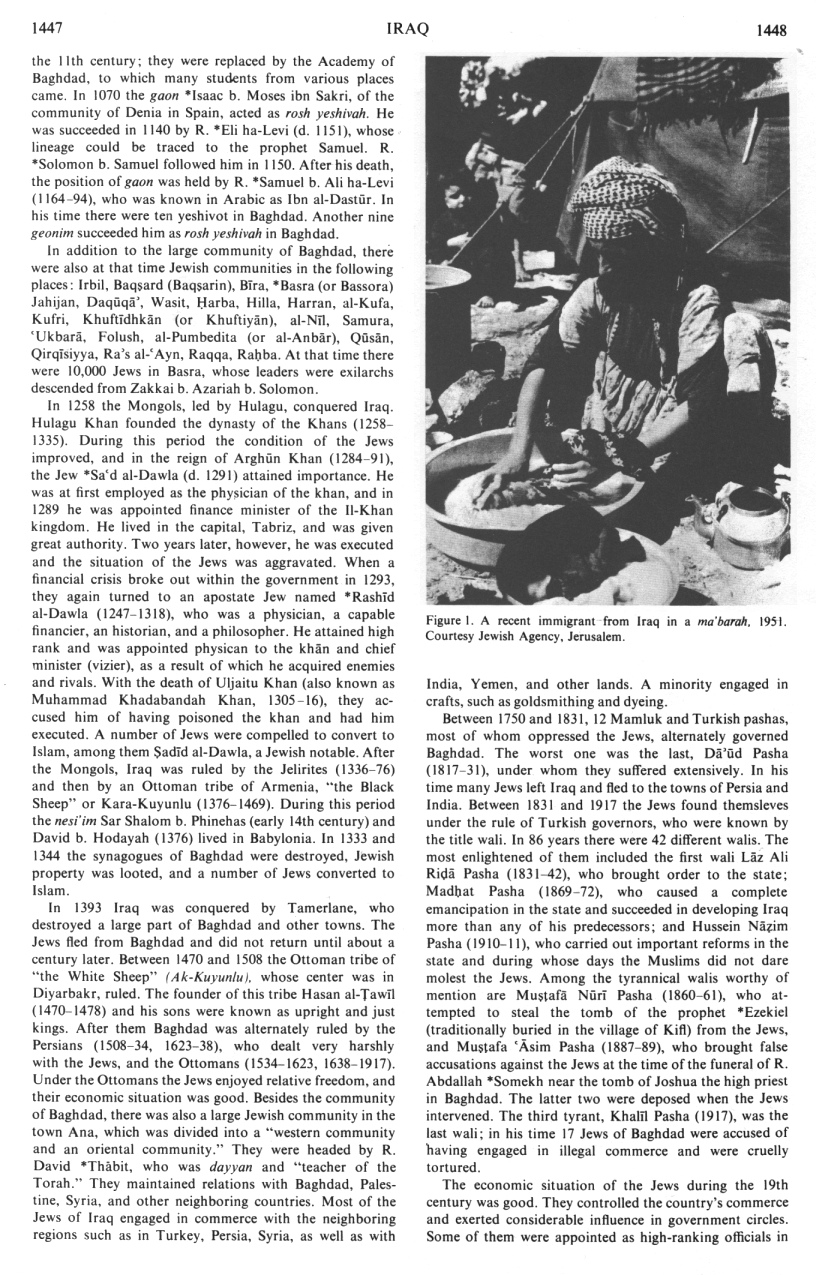
Under the Ottomans the Jews enjoyed relative freedom, and their economic situation was good. Besides the community of Baghdad, there was also a large Jewish community in the town Ana, which was divided into a "western community and an oriental community". They were headed by R. David *Thabit, who was dayyan and "teacher of the Torah". They maintained relations with Baghdad, Palestine, Syria, and other neighbouring countries.
Most of the Jews of Iraq engaged in commerce with the neighbouring regions such as in Turkey, Persia, Syria, as well as with (col. 1447)
India, Yemen, and other lands. A minority engaged in crafts, such as goldsmithing and dyeing.
[1750-1831: Mamluk and pasha rule - anti-Jewish laws - flight of the Jews to Persia and India]
Between 1750 and 1831, 12 Mamluk and Turkish pashas, most of whom oppressed the Jews, alternately governed Baghdad. The worst one was the last, Da'ud Pasha (1817-31), under whom they suffered extensively. In his time many Jews left Iraq and fled to the towns of Persia and India.
1831-1917: Turkish wali rules in Iraq
Between 1831 and 1917 the Jews found themselves under the rule of Turkish governors, who were known by the title wali. In 86 years there were 42 different walis. The most enlightened of them included the first wali Laz Ali Rida Pasha (1831-42), who brought order to the state; Madhat Pasha (1869-72), who caused a complete emancipation in the state and succeeded in developing Iraq more than any of his predecessors; and Hussein Nazim Pasha (1910-11), who carried out important reforms in the state and during whose days the Muslims did not dare molest the Jews.
Among the tyrannical walis worthy of mention are Mustafa Nuri Pasha (1860-61), who attempted to steal the tomb of the prophet *Ezekiel (traditionally buried in the village of Kifl) from the Jews, and Mustafa 'Asim Pasha (1887-89), who brought false accusations against the Jews at the time of the funeral of R. Abdallah *Somekh near the tomb of Joshua the high priest in Baghdad. The latter two were deposed when the Jews intervened.
The third tyrant, Khalil Pasha (1917), was the last wali; in his time 17 Jews of Baghdad were accused of having engaged in illegal commerce and were cruelly tortured.
[19th century: Jewish commercial dominance in Iraq]
The economic situation of the Jews during the 19th century was good. They controlled the country's commerce and exerted considerable influence in government circles. Some of them were appointed as high-ranking officials in (col. 1448)
Baghdad, Basra, and Mosul.
[1908-1917: Young Turkish rule: Emancipation of religions - Jewish delegates in Turkish parliament]
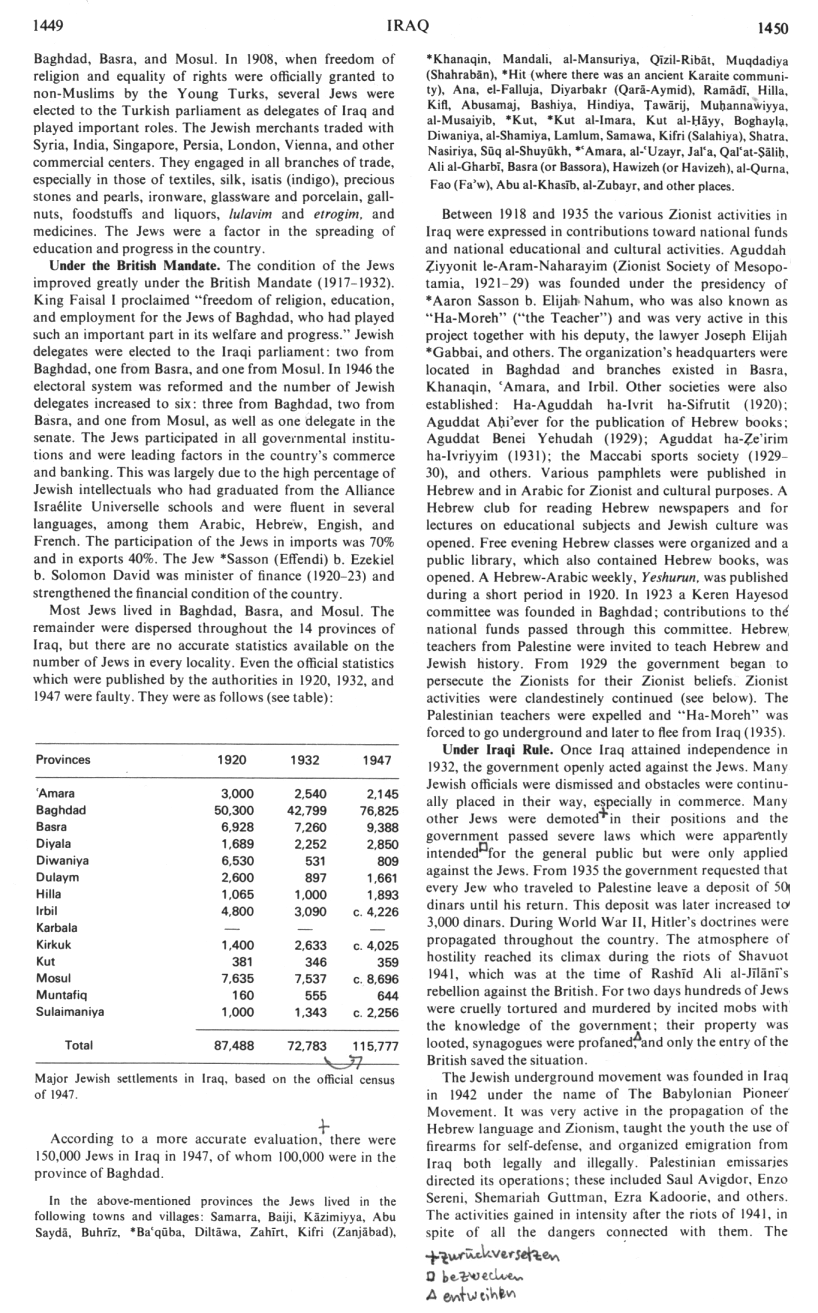
In 1908, when freedom of religion and equality of rights were officially granted to non-Muslims by the Young Turks, several Jews were elected to the Turkish parliament as delegates of Iraq and played important roles.
[Iraqi Jewish international trade and civilization]
The Jewish merchants traded with Syria, India, Singapore, Persia, London, Vienna, and other commercial centers. They engaged in all branches of trade, especially in those of textiles, silk, isatis (indigo), precious stones and pearls, ironware, glassware and porcelain, gallnuts, foodstuffs and liquors, lulavim [[fronds]] and etrogim [[lemons]], and medicines. The Jews were a factor in the spreading of education and progress in the country. (col. 1449)
========
Sources
Encyclopaedia Judaica 1971: Iraq, vol. 8, col. 1444
Encyclopaedia Judaica 1971: Iraq, vol. 8, col. 1445-1446
Encyclopaedia Judaica 1971: Iraq, vol. 8, col. 1447-1448
Encyclopaedia Judaica 1971: Iraq, vol. 8, col. 1449-1450
^