Jewry in Iraq 02: English Mandate 1917-1932
Emancipation of the religions - Jewish commercial dominance - restrictions against Zionists since 1929
from: Iraq; In: Encyclopaedia Judaica 1971, vol. 8
presented by Michael Palomino (2007)


| Share: |
Facebook |
|
Twitter
|
Under the British Mandate.
[Emancipation of the religions - Jewish commercial dominance in Iraq]
The condition of the Jews improved greatly under the British Mandate (1917-1932). King Faisal I proclaimed "freedom of religion, education, and employment for the Jews of Baghdad, who had played such an important part in its welfare and progress."
Jewish delegates were elected to the Iraqi parliament: two from Baghdad, one from Basra, and one from Mosul. In 1946 the electoral system was reformed and the number of Jewish delegates increased to six: three from Baghdad, two from Basra, and one from Mosul, as well as one delegate in the senate. The Jews participated in all governmental institutions and were leading factors in the country's commerce and banking. This was largely due to the high percentage of Jewish intellectuals who had graduated from the Alliance Israélite Universelle schools and were fluent in several languages, among them Arabic, Hebrew, English, and French. The participation of the Jews in imports was 70% and in exports 40%. The Jew *Sasson (Effendi) b. Ezekiel b. Solomon David was minister of finance (1920-23) and strengthened the financial condition of the country.
[Jewish population figures for Iraq 1920-1947]
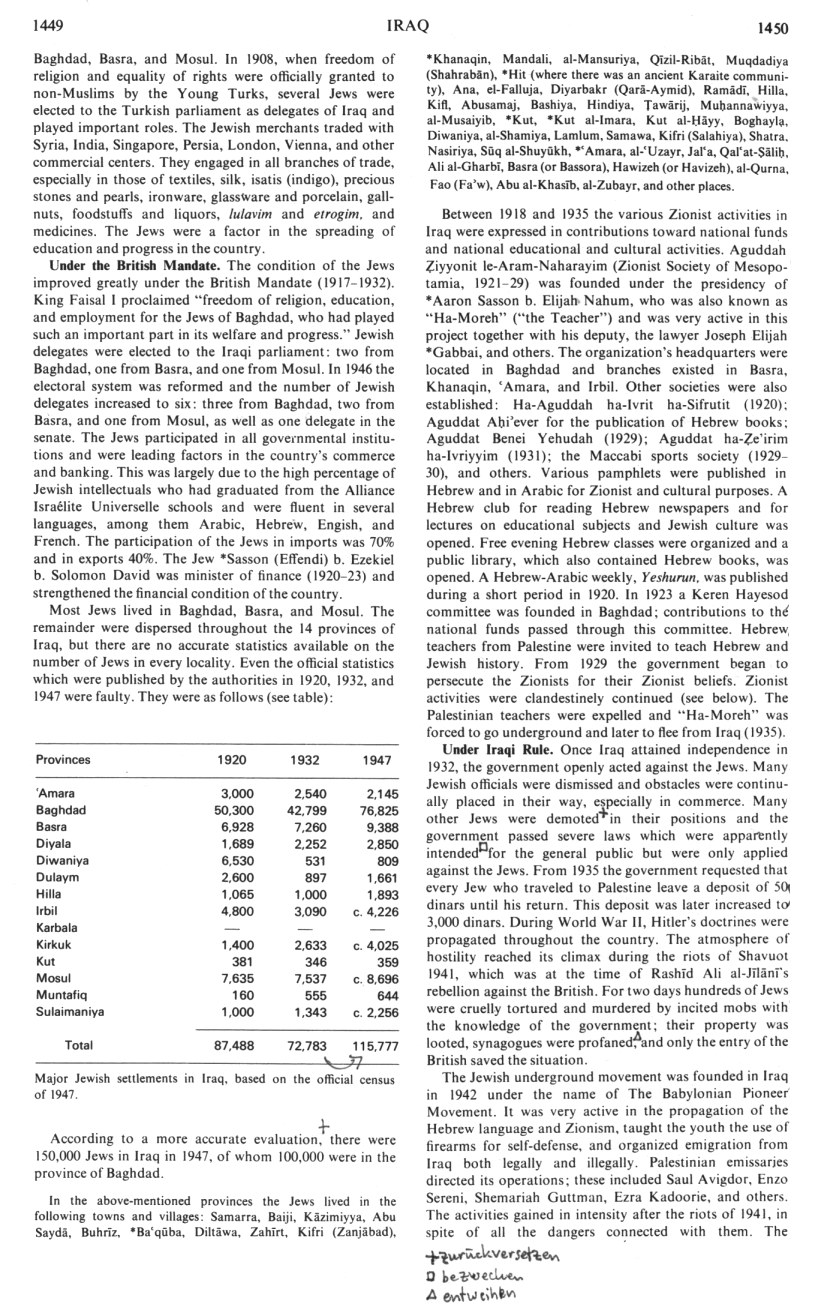
Most Jews lived in Baghdad, Basra, and Mosul. The remainder were dispersed throughout the 14 provinces of Iraq, but there are no accurate statistics available on the number of Jews in every locality. Even the official statistics which were published by the authorities in 1920, 1932, and 1947 were faulty. They were as follows (see table):
Table: Major Jewish settlements in Iraq, based on the official census of 1947 (faulty figures) Provinces
1920
1932
1947
xxxxxxxxxxxxxxxxxxxxxxxxxxxxx xxxxxxxxxxxxxxxxx
xxxxxxxxxxxxxxxxx xxxxxxxxxxxxxxxxx 'Amara
3,000xxxxxxxx
2,540xxxxxxxx 2,145xxxxxxxx Baghdad
50,300xxxxxxxx 42,799xxxxxxxx 76,825xxxxxxxx Basra
6,928xxxxxxxx 7,260xxxxxxxx 9,388xxxxxxxx Diyala
1,689xxxxxxxx 2,252xxxxxxxx 2,850xxxxxxxx Diwaniya
6,530xxxxxxxx 531xxxxxxxx 809xxxxxxxx Dulaym
2,600xxxxxxxx 897xxxxxxxx 1,661xxxxxxxx Hilla
1,065xxxxxxxx 1,000xxxxxxxx 1,893xxxxxxxx Irbil
4,800xxxxxxxx 3,090xxxxxxxx c. 4,226xxxxxxxx Karbala
-
-
-
Kirkuk
1,400xxxxxxxx 2,633xxxxxxxx c. 4,025xxxxxxxx Kut
381xxxxxxxx 346xxxxxxxx 359xxxxxxxx Mosul
7,635xxxxxxxx 7,537xxxxxxxx c. 8,696xxxxxxxx Muntafiq
160xxxxxxxx 555xxxxxxxx 644xxxxxxxx Sulaimaniya
1,000xxxxxxxx 1,343xxxxxxxx c. 2,256xxxxxxxx
Total
87,488xxxxxxxx 7,783xxxxxxxx 115,777xxxxxxxx from: Iraq; In: Encyclopaedia Judaica 1971, vol. 13, col. 1449
According to a more accurate evaluation, there were 150,000 Jews in Iraq in 1947, of whom 100,000 were in the province of Baghdad.
In the above mentioned provinces the Jews lived in the following towns and villages:
Samarra, Baiji, Kazimiyya, Abu Sayda, Buhriz, *Ba'quba, Diltawa, Zahirt, Kifri (Zanjabad), (col. 1449)
*Khanaqin, Mandali, al-Mansuriya, Quizil-Ribat, Muqdadiya (Shahraban), *Hit (where there was an ancient Karaite community), Ana, el-Falluja, Diyarbakr (Qara-Aymid), Ramadi, Hilla, Kifl, Abusamaj, Bashiya, Hindiya, Tawarij, Muhannawiyya, al-Musaiyib, *Kut, *Kut al-Imara, Kut al-Hayy, Boghayla, Diwaniya, al-Shamiya, Lamlum, Samawa, Kifri (Salahiya), Shatra, Nasiriya, Suq al-Shuyukh, *'Amara, al-'Uzayr, Jal'a, Qal'at-Salih, Ali al-Gharbi, Basra (or Bassora), Hawizeh (or Havizeh), al-Qurna, Fao (Fa'w), Abu al-Khasib, al-Zubayr, and other places.
[1918-1935: Free Mason Zionism activities in Iraq]
[[It can be assumed that the racist book of Theodor Herzl "The Jewish State" also was spread there under the British rule which was not at all welcome under the Muslim population. The Muslims already were dominated by the Jewish commerce, why should there be a "Jewish State" add to this? So, the Muslims only were waiting for a destruction of Zionist culture in Iraq]].
Between 1918 and 1935 the various Zionist activities in Iraq were expressed in contributions toward national funds and national educational and cultural activities. Aguddah Ziyyonit le-Aram-Naharayim (Zionist Society of Mesopotamia, 1921-29) was founded under the presidency of *Aaron Sasson b. Elijah Nahum, who was also known as "Ha-Moreh" ("the Teacher") and was very active in this project together with his deputy, the lawyer Joseph Elijah *Gabbai, and others. The organization's headquarters were located in Baghdad and branches existed in Basra, Khanaqin, 'Amara, and Irbil.
Other societies were also established:
-- Ha-Aguddah ha-Ivrit ha-Sifrutit (1920)
-- Aguddat Ahi'ever for the publication of Hebrew books
-- Aguddat Benei Yehudah (1929)
-- Aguddat ha-Ze'irim ha-Ivriyyim (1931)
-- the Maccabi sports society (1929-39)
-- and others.
Various pamphlets were published in Hebrew and in Arabic for Zionist and cultural purposes. A Hebrew club for reading Hebrew newspapers and for lectures on educational subjects and Jewish culture was opened. Free evening Hebrew classes were organized and a public library, which also contained Hebrew books, was opened.
A Hebrew-Arabic weekly, Yeshurun, was published during a short period in 1920. In 1923 a Keren Hayesod committee was founded in Baghdad; contributions to the national funds passed through this committee. Hebrew teachers from Palestine were invited to teach Hebrew and Jewish history.
[since 1929: Restrictions against the Free Mason Zionists]
From 1929 the government began to persecute the Zionists for their Zionist beliefs. Zionist activities were clandestinely continued (see below). The Palestinian teachers were expelled and "Ha-Moreh" was forced to go underground and later to flee from Iraq (1935).> (col. 1450)
========
Sources
Encyclopaedia Judaica 1971: Iraq, vol. 8, col. 1449-1450
^