Jews in Iraq 03: The Jews in Iraq under Iraqi rule 1932-1948
Iraqi independence is introducing anti-Jewish laws against Zionism - pogroms and Zionist underground movement during Second World War - British occupation
from: Iraq; In: Encyclopaedia Judaica 1971, vol. 8
presented by Michael Palomino (2007)


| Share: |
Facebook |
|
Twitter
|
<Under Iraqi Rule.
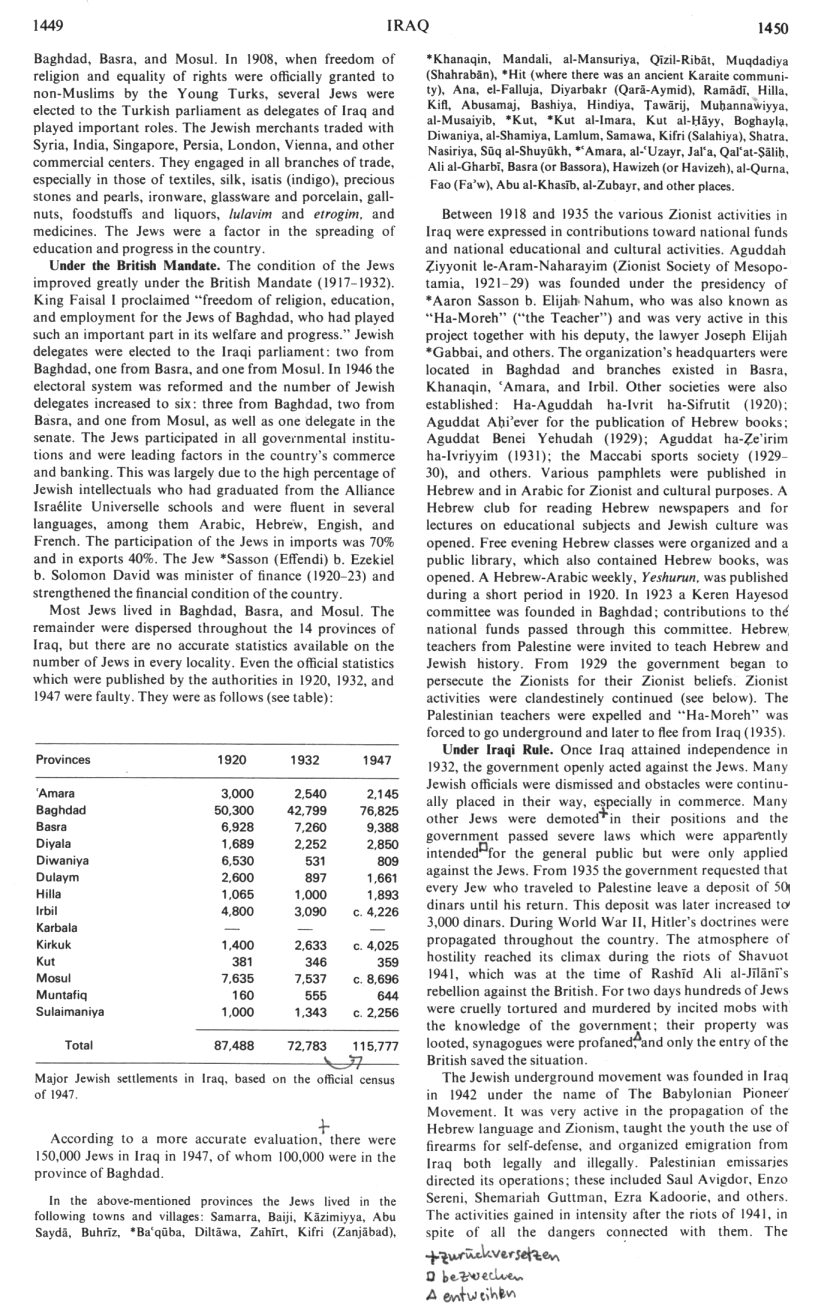
Once Iraq attained independence in 1932, the government openly acted against the Jews. Many Jewish officials were dismissed and obstacles were continually placed in their way, especially in commerce. Many other Jews were demoted in their positions and the government passed severe laws which were apparently intended for the general public but were only applied against the Jews.
[[This is the general revenge for criminal Zionism with the racist Herzl booklet "The Jewish State". This criminal Zionism is agitating since 1896 saying that the Jews could drive the Arabs from the Earth like the natives had been driven away by the racist Whites in the "USA". It's no wonder that the Arabs will take measures, but the problem was not solved because the Zionists themselves were not attacked but all Jews together, of which the big majority did not support criminal Zionism. As long the Jews would not take measures against Zionism and Herzl themselves they are a general target for any Muslim]].
From 1935 the government requested that every Jews who traveled to Palestine leave a deposit of 50 dinars until his return. This deposit was later increased to 3,000 dinars.
[1939-1945: NS rule in Iraq - pogroms 1941 - British occupation of Iraq - Zionist underground movement]
During World War II, Hitler's doctrines were propagated throughout the country. The atmosphere of hostility reached its climax during the riots of Shavuot 1941, which was at the time of Rashid Ali al-Jilani's rebellion against the British. For two days hundreds of Jews were cruelly tortured and murdered by incited mobs with the knowledge of the government; their property was looted, synagogues were profaned, and only the entry of the British saved the situation.
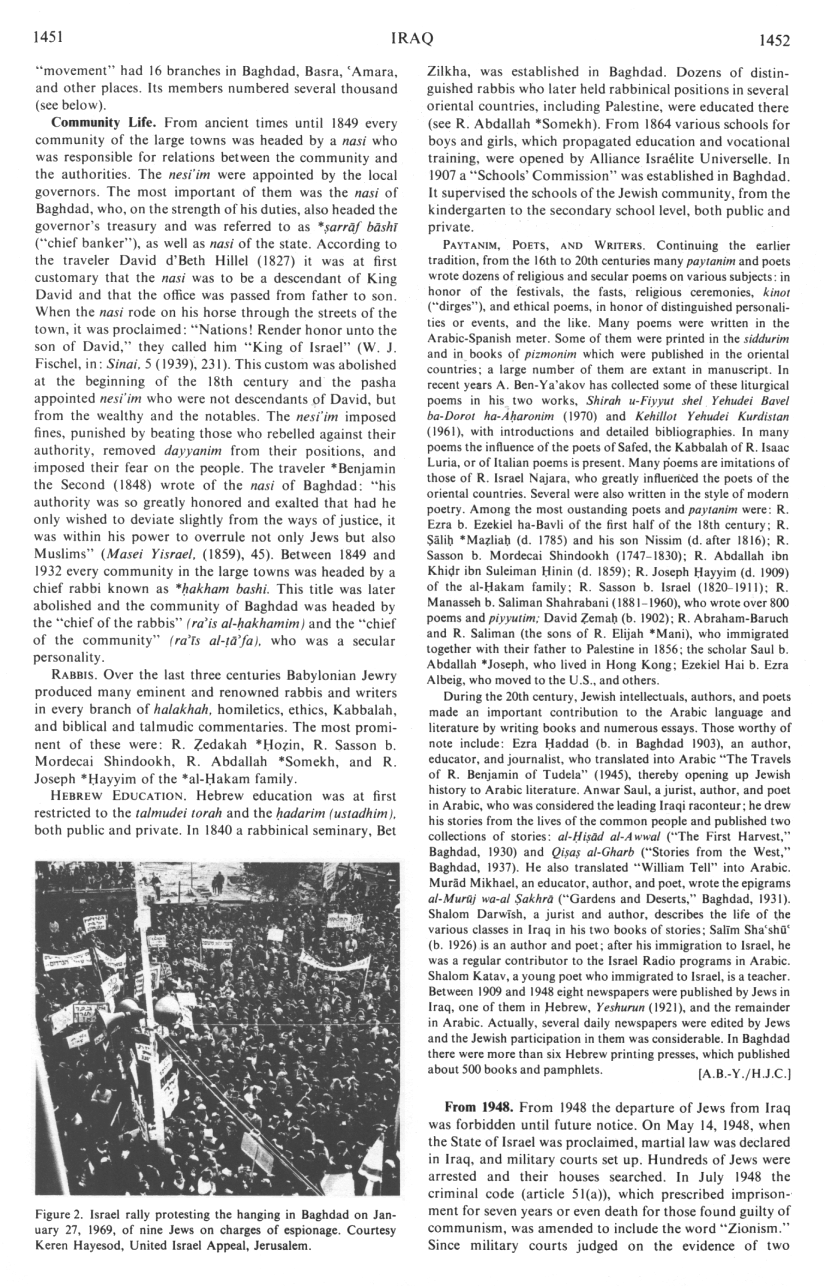
The Jewish underground movement was founded in Iraq in 1942 under the name of The Babylonian Pioneer Movement. It was very active in the propagation of the Hebrew language and Zionism, taught the youth the use of firearms for self-defense, and organized emigration from Iraq both legally and illegally.
Palestinian emissaries directed its operations; these included Saul Avigdor, Enzo Sereni, Shemariah Guttman, Ezra Kadoorie, and others. The activities gained in intensity after the riots of 1941, in spite of all the dangers connected with them. The (col. 1450)
"movement" had 16 branches in Baghdad, Basra, 'Amara, and other places. Its members numbered several thousand (see below).> (col. 1451)
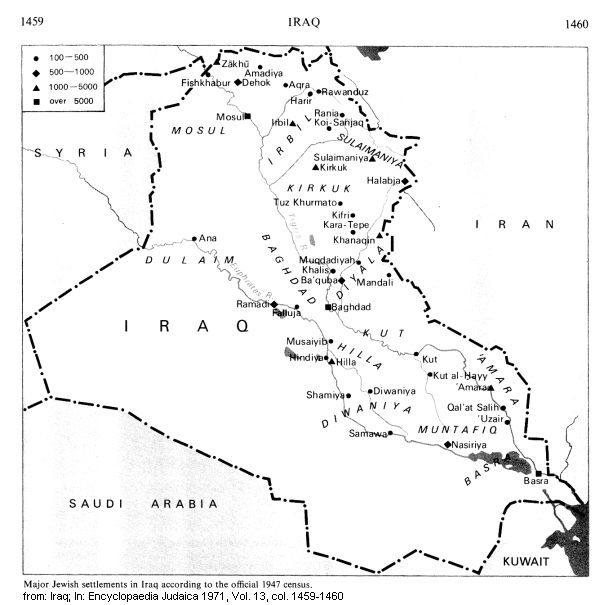
Jewish centers in Iraq 1947
Jewish settlements with over 5,000: Mosul, Baghdad, Basra
Jewish settlements with 1,000-5,000 Jews: Zakhu, Irbil, Sulaimaniya, Kirkuk, Khanaqin, Hilla, Amara
Jewish settlements with 500-1,000 Jews: Dehok, Halabja, Ba'quba, Ramadi, Nasiriya
Jewish settlements with 100-500 Jews: Amadiya, Fishkhabur, Aqra, Rawanduz, Harir, Rania, Koi-Sanjaq, Tuz Khurmato, Kifri, Kara-Tepe, Ana, Muqdadiyah, Khalis, Mandali, Falluja, Musaiyib, Hindiya, Kut, Kut al-Hayy, Diwaniya, Shamiya, Qal'at Salih, Uzair, Samawa
========
Sources
Encyclopaedia Judaica 1971: Iraq, vol. 8, col. 1449-1450
Encyclopaedia Judaica 1971: Iraq, vol. 8, col. 1451-1452
^