|
|
|
Jews in Iraq 07: The states policy between Israel and Iraq 1918-1969
Iraqi aggressivity together with Jordan against Zionist Free Mason Herzl Israel with "US" alliance - oil weapon against western countries who are supporting Herzl Israel - Iraqi support of Palestinian guerrilla since 1967
from: Iraq; In: Encyclopaedia Judaica 1971, vol. 8
presented by Michael Palomino (2007)


| Share: |
Facebook |
|
Twitter
|
|
|
|
<Iraq and Israel.
[Influence of Iraq on Jordan and Great Britain toward Zionist Free Mason Herzl Israel]
[[Preconditions: Herzl said the Arabs can be driven away like the natives in the "USA" and the Jewish question would be solved by this. Israel is a satellite of criminal CIA and "USA", and the danger that the Arabs will be driven away is real. So the Arab policy is absolutely against the Israeli regime which is calling for a Greater Israel on the base of First Mose chapter 15 phrase 18, and all western media are dissimulating these reasons of the Middle East conflict. And Israel has even got atomic bombs against the Arabs which not even one of the Arab states has]].
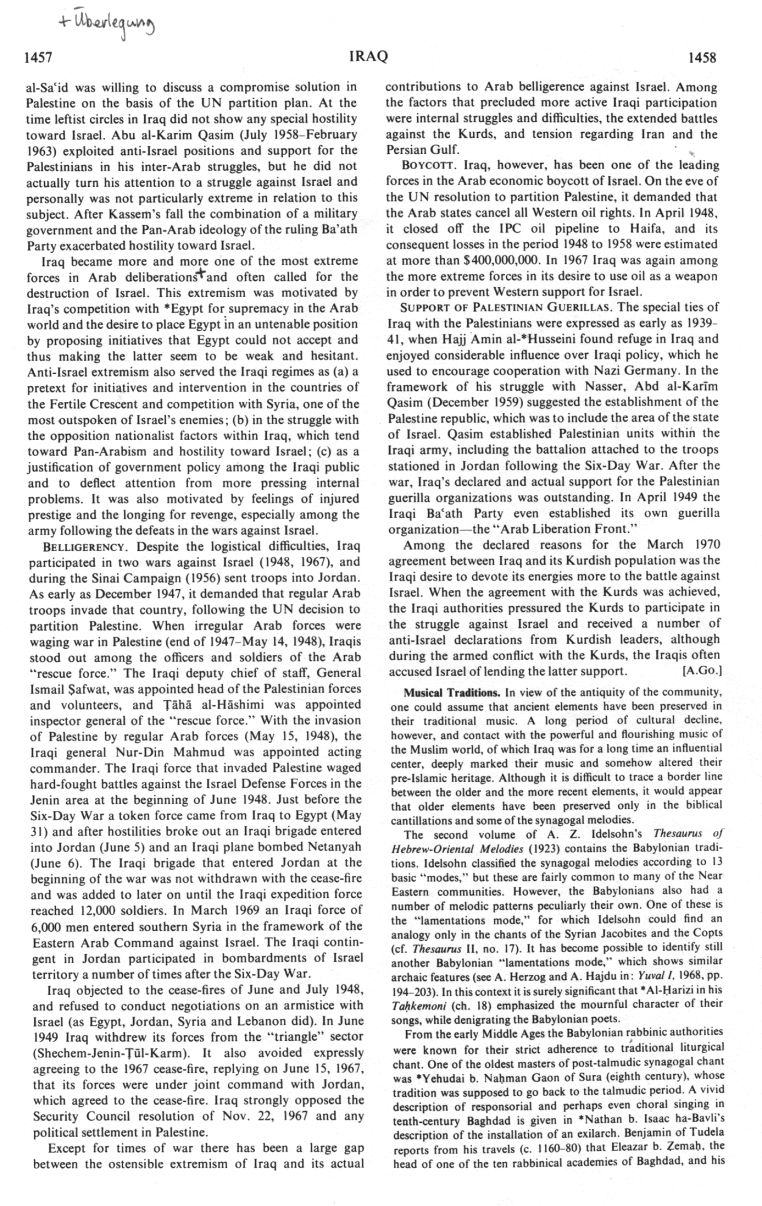
Jordan and Syria, including 440 mi. (700 km.) of desert and steppe, come between Iraq and Israel, making Iraq's interests and fears vis-à-vis Israel less realistic than those of the Arab states that border directly upon the latter. Iraq has no territorial questions to settle with Israel, and its own internal and foreign problems (the Kurds, the Persian Gulf, conflicts with Iran, social and economic unrest, the absence of a stable and representative government) are more pressing and important than the conflict with Israel.
The position taken by Iraq toward Israel is a function of its inter-Arab aspirations and relations; the importance of the Pan-Arab factor among active Iraqi circles, especially the Sunnis, who are the basic support of the Iraqi authorities; and its interest in an outlet on the Mediterranean Sea. Under both Hashemite and republican rule, Iraq nonetheless displayed active and extreme hostility toward Israel.
There were, however, certain differences in Iraqi policy toward Israel between the Hashemite period and the "revolutionary" republic established in 1918. During the Hashemite monarchy and Nuri al-Sa'id's rule, the latter proposed (in his "Blue Book" of 1943) a certain degree of autonomy for the Jewish community in Palestine in the framework of his plan for a federation of the Fertile Crescent. This period was also characterized by the special ties between Hashemite Iraq and Jordan and the need to justify the alliance between Iraq and Britain by displays of anti-Israel extremism and anti-Israel influence on Britain.
On the other hand, in his contacts with the British, Nuri (col. 1456)
al-Sa'id was willing to discuss a compromise solution in Palestine on the basis of the UN partition plan. At the time leftist circles in Iraq did not show any special hostility toward Israel. Abu al-Karim Qasim (July 1958-February 1963) exploited anti-Israel positions and support for the Palestinians in his inter-Arab struggles, but he did not actually turn his attention to a struggle against Israel and personally was not particularly extreme in relation to this subject. After Kassem's fall the combination of a military government and the Pan-Arab ideology of the ruling Ba'ath Party exacerbated hostility toward Israel.
[Iraq calls for destruction of Zionist Free Mason Israel - Iraqi interventions]
Iraq became more and more one of the most extreme forces in Arab deliberations and often called for the destruction of Israel. This extremism was motivated by Iraq's competition with *Egypt for supremacy in the Arab world and the desire to place Egypt in an untenable position by proposing initiatives that Egypt could not accept and thus making the latter seem to be weak and hesitant.
Anti-Israel extremism also served the Iraqi regimes as
(a) a pretext for initiatives and intervention in the countries of the Fertile Crescent and competition with Syria, one of the most outspoken of Israel's enemies;
(b) in the struggle with the opposition nationalist factors within Iraq, which tend toward Pan-Arabism and hostility toward Israel;
(c) as a justification of government policy among the Iraqi public and to deflect attention from more pressing internal problems. It was also motivated by feelings of injured prestige and the longing for revenge, especially among the army following the defeats in the wars against Israel.
BELLIGERENCY.
[Iraqi troops operating from Jordan against Zionist Free Mason Herzl Israel]
Despite the logistical difficulties, Iraq participated in two wars against Israel (1948, 1967), and during the Sinai Campaign (1956) sent troops into Jordan. As early as December 1947, it demanded that regular Arab troops invade that country, following the UN decision to partition Palestine. When irregular Arab forces were waging war in Palestine (end of 1947-May 14, 1948), Iraqis stood out among the officers and soldiers of the Arab "rescue force". The Iraqi deputy chief of staff, General Ismail Safwat, was appointed head of the Palestinian forces and volunteers, and Taha al-Hashimi was appointed inspector general of the "rescue force".
With the invasion of Palestine by regular Arab forces (May 15, 1948), the Iraqi general Nur-Din Mahmud was appointed acting commander. The Iraqi force that invaded Palestine waged hard-fought battles against the Israel defense Forces in the Jenin area at the beginning of June 1948. Just before the Six-Day War a token force came from Iraq to Egypt (May 31) and after hostilities broke out an Iraqi brigade entered into Jordan (June 5) and an Iraqi plane bombed Netanyah (June 6).
The Iraqi brigade that entered Jordan at the beginning of the war was not withdrawn with the cease-fire and was added to later on until the Iraqi expedition force reached 12,000 soldiers. In March 1969 an Iraqi force of 6,000 men entered southern Syria in the framework of the Eastern Arab Command against Israel. The Iraqi contingent in Jordan participated in bombardments of Israel territory a number of times after the Six-Day War.
Iraq objected to the cease-fires of June and July 1948, and refused to conduct negotiations on an armistice with Israel (as Egypt, Jordan, Syria and Lebanon did).
[[The atrocities of the Jewish army to the Palestinians and the violations of the Jewish army to Palestinian women are not mentioned, and the Palestinian refugees are not mentioned]].
In June 1949 Iraq withdrew its forces from the "triangle" sector (Shechem-Jenin-Tul-Karm).
It also avoided expressly agreeing to the 1967 cease-fire, replying on June 15, 1967, that its forces were under joint command with Jordan, which agreed to the cease-fire. Iraq strongly opposed the Security Council resolution of Nov. 22, 1967 and any political settlement in Palestine.
[[The Jewish Free Mason Herzl Israeli government announced in 1967 that a big step to a Greater Israel had been done...]]
Except for times of war there has been a large gap between the ostensible extremism of Iraq and its actual (col. 1457)
contributions to Arab belligerence against Israel. Among the factors that precluded more active Iraqi participation were internal struggles and difficulties, the extended battles against the Kurds, and tension regarding Iran and the Persian Gulf.
[Iraqi boycott movements with blocking of the Mosul-Haifa oil pipeline]
BOYCOTT.
Iraq, however, has been one of the leading forces in the Arab economic boycott of Israel.
On the eve of the UN resolution to partition Palestine, it demanded that the Arab states cancel all Western oil rights. In April 1948, it closed off the IPC oil pipeline to Haifa, and its consequent losses in the period 1948 to 1958 were estimated at more than $ 400,000,000. In 1967 Iraq was again among the more extreme forces in its desire to use oil as a weapon in order to prevent Western support for Israel.
[[When nationalism came up the Palestinians wanted also to have the profits from the Mosul-Haifa pipeline, but Israel got all profit of it, and by this the blocking of the pipeline had it's sense for Iraq: Herzl Israel should not be too rich. When a Herzl army is supported by "US" machinery against all Arabs this boycott seems to be an appropriate measure. In Western Europe only reports about "poor little Israel" are spread, and the racist Herzl ideology against all Arabs is never mentioned]].
SUPPORT OF PALESTINIAN GUERRILLAS.
[Palestinian nationalism for a Palestine republic - guerrilla against Israel after Six-Day War]
The special ties of Iraq with the Palestinians were expressed as early as 1939-41, when Hajj Amin al-*Husseini found refuge in Iraq and enjoyed considerable influence over Iraqi policy, which he used to encourage cooperation with Nazi Germany. In the framework of his struggle with Nasser, abd al-Karim Qasim (December 1959) suggested the establishment of the Palestine republic, which was to include the area of the state of Israel. Qasim established Palestinian units within the Iraqi army, including the battalion attached to the troops stationed in Jordan following the Six-Day War. After the war, Iraq's declared an actual support for the Palestinian guerrilla organizations was outstanding.
In April 1949 the Iraqi Ba'ath Party even established its own guerrilla organization - the "Arab Liberation Front".
[[Israel has the atomic bomb headed against the Arabs...]]
[Strategies with the Kurds]
Among the declared reasons for the March 1970 agreement between Iraq and its Kurdish population was the Iraqi desire to devote its energies more to the battle against Israel. When the agreement with the Kurds was achieved, the Iraqi authorities pressured the Kurds to participate in the struggle against Israel and received a number of anti-Israel declarations from Kurdish leaders, although during the armed conflict with the Kurds, the Iraqis often accused Israel of lending the latter support.
[A.GO.]> (col. 1458)
[[It would be so easy to settle any conflict and to bring the region to peace when Human Rights would be signed]].
Bibliography: Iraq
-- S.A. Poznanski: Babylonische Geonim im nachgaonaeischen Zeitalter (1914)
-- B.M. Levin (ed.): iggeret Rav Sherira Ga'on (1921)
-- J. Obermeyer: Die Landschaft Babylonien (1929)
-- C. Roth: Sassoon Dynasty (1941)
-- A. Ben-Jacob: Toledot ha-Rav Abdallah Somekh (1949)
-- idem: Kehillot Yehudei Kurdistan (1961)£
-- idem: Yehudei Bavel (1965), with extensive bibliography
-- idem: Shirah u-Fiyyut shel Yehudei Bavel ba-Dorot ha-Aharonim (1970)
-- idem: Kizzur Toledot Yehudei Bavel (1970)
-- D. Sassoon: History of the Jews in Baghdad (1949)
-- idem: Massa Bavel (1955)
-- S. Landshut: Jewish Communities in the Muslim Countries of the Middle East (1950)
-- S. Shinah: Mi-Bavel le-Ziyyon (1955)
-- M. Sicron: Immigration to Israel, 1948-1953 (1957)
-- A Agasi: 20 Shanah la-Pera'ot bi-Yhudei Baghdad (1961)
-- S. Jackson: The Sassoons (1968)
-- H.J. Cohen: Ha-Pe'ilut ha-Ziyyonit be-Iraq (1969)
-- idem, in: JJSO, 11 (1969), 59-66
-- Y Atlas: Ad Ammud ha-Teliyyah (1969)
Contemporary period
-- Yalkut ha-Mizrah ha-Tikhon, 1-3 (1949-51)
-- R. Alan, in: Commentary, 28 (1959), 185-92
-- J. Caspar, ibid., 193-201
-- the Baghdad daily newspapers Al-Zaman and Al-Bitad
-- N. Rokarion, in: J. Freid (ed.): Jews in Modern World (1962), 50-90
Iraq and Israel
-- E. Berger: The Covenant and the Sword, 1948-56 (1965)
Musical Tradition
-- A. Idelsohn: Thesaurus of Oriental Hebrew Melodies, 2 (1923)
-- J. Al-Hanafi: al-Mughanun al-Baghdadiyun (1964), a directory of Baghdad - including Jewish - musicians. (col. 1461)
Sources
Encyclopaedia Judaica 1971: Iraq, Vol. 8, col. 1457-1458
Encyclopaedia Judaica 1971: Iraq, Vol. 8, col. 1461
^