|
|
|
Jews in Iraq 06: Pressed Jews in Iraq 1952-1969
Jewish communists, Zionists, espionage - restrictions against the Jews - exodus down to 2,500 Jews
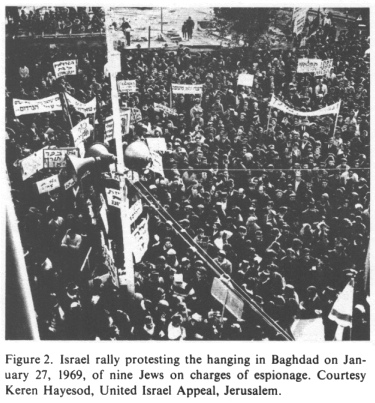
Encyclopaedia Judaica (1971): vol. 8, col. 1451: demonstration against the hanging of 9 Jews in Baghdad on 27 January 1969. The Jews were charged of espionage. Courtesy Keren Hayesod, United Israel Appeal, Jerusalem.
from: Iraq; In: Encyclopaedia Judaica 1971, Vol. 8
presented by Michael Palomino (2007)


| Share: |
Facebook |
|
Twitter
|
|
|
|
<After 1952.
[New identity cards - ban on travel - expulsion of 200 Jewish communists and of some Zionists]
In June 1952 approximately 6,000 Jews remained in Iraq, living under difficult conditions. In January 1952 all those remaining had to receive new identity cards, and were forbidden to leave the country. However, about 200 communists and a number of members of the Zionist underground who were imprisoned were exiled from the country after they had served their sentence.
[Last Jewish representation in the lower house ends in 1952 - more restrictions against Jews since Dec. 1954]
After the resignation of the six Jewish members of the lower house and the death of the senator Ezra Daniel in 1952, Jews were no longer represented in parliament (Iraqi law demanded the election of one representative per 20,000 of the population).
In December 1954 the "Jewish Congregation Law" was passed; it restricted their rights even more than the previous law. Limitations on the exit of Jews continued until 1958, although restrictions were eased somewhat for short interim periods, in 1955 for example.
[1958-1963: New Jewish rights in Iraq under Qasim - new restrictions after Qasim since 1963 - play with the citizenship]
Only under the rule of Abd al-Karim Qasim (July 1958-February 1963) did their condition improve, and they were even allowed to leave the country. The Qasim regime also returned property to those who had had it confiscated for not returning to Iraq within the specified period.
When Qasim was overthrown, Jews were again forbidden to leave the country, and in December 1963 a law was passed which deprived Jews of their citizenship if they did not register with the Department of Nationality and Citizenship, the property of those who failed to do so being confiscated.
During this period arrests were again made among the remaining 3,000 Iraqi Jews. In 1964, however, Iraqi citizens were permitted to leave the country for a period of not more than one year, those who failed to return being deprived of their citizenship and having their property confiscated.
[1967: The situation of the Jews in Iraq after the Six-Day War - yet about 2,500 Jews - espionage trials]
Arrests of Jews became more widespread after the *Six-Day War in June 1967. In July 1967 the Iraqi authorities imposed controls on the transfer of Jewish capital abroad and several new economic decrees were published. A few succeeded in leaving, and the number of those remaining in Iraq fell to about 2,500 (1968).
Most of the remaining Jews (col. 1455)
in Iraq lived in Baghdad and Basra, and in 1968 still had religious and educational institutions. Most of them owned property which hindered their leaving the country. They lived under conditions of fear, dispossession, and danger, which reached a peak on January 27, 1969, when nine Jews were hanged in the streets of Baghdad after being accused of espionage, while manifestations of joy took place around the corpses of the executed. On August 25, 1969, another two Jews were hanged following a similar accusation.> (col. 1456)
|
|
|
^