|
|
|
Iraq: Jews in Baghdad
Structure of the Jewish communities - Jewish poets and Jewish writers in Baghdad - escalation because of Herzl Israel with "USA" as ally destroys the big part of the Jewish existence in Baghdad - integration of the remaining Jews
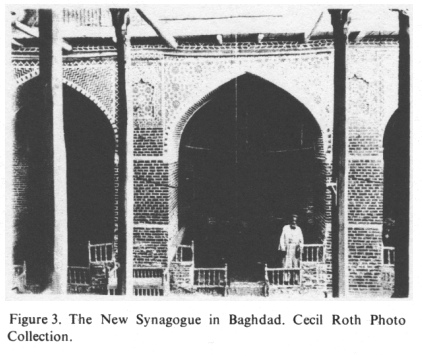
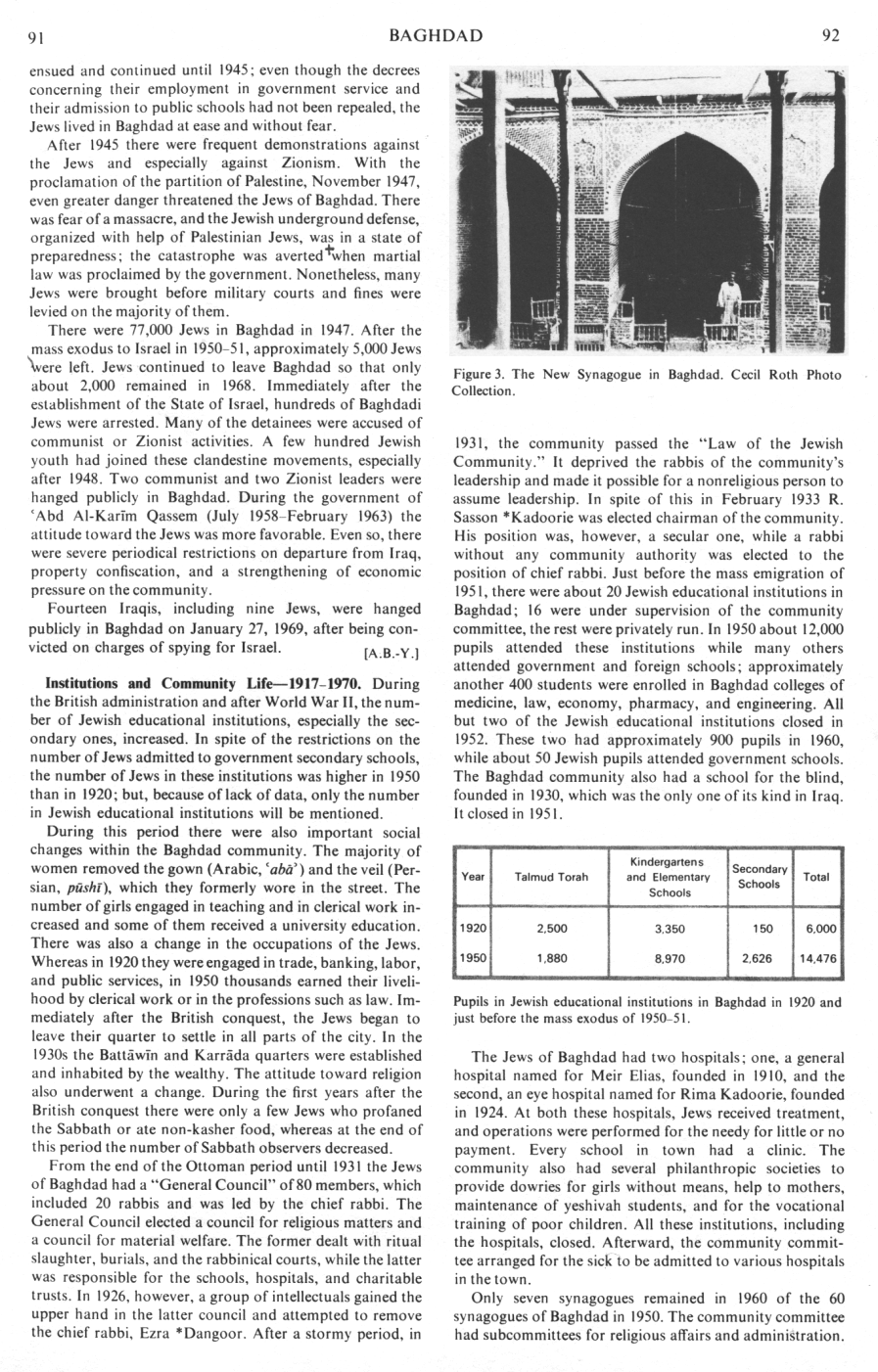
Encyclopaedia Judaica (1971): Baghdad, vol. 4, col. 92: The new synagogue in Baghdad
from: Baghdad; In: Encyclopaedia Judaica 1971, vol. 4
presented by Michael Palomino (2007)


| Share: |
Facebook |
|
Twitter
|
|
|
|
<BAGHDAD,
capital city of *Iraq. Baghdad was the capital of the Abbasid dynasty from its foundation in 762. From then a Jewish community existed there which eventually became the largest Jewish community of Iraq, and the seat of the exilarch. During the geonic period the Jews lived in a special quarter, Dar al-Yahud ("Jewish Quarter"). The bridge in the western section of the town, which led to the Karkh quarter, was named Quantarat al-Yahud ("Bridge of the Jews"). A tomb situated in this quarter was until recently the site of prayer gatherings. The local Jews believed it to be the tomb of Joshua son of Jehozadak, the high priest. By the end of the ninth century the famous yeshivot of Sura and Pumbedita were established in Baghdad. The Karaites also played an important part in the life of the city.
Early and Early Modern History.
[Jews during the caliph times in Baghdad]
During the tenth century there were two distinguished Jewish families in Baghdad, *Netira and *Aaron. They were both influential in the royal court and they showed concern for the welfare of the community. At the end of the tenth century R. Isaac b. Moses ibn Sakri of Spain was the rosh yeshivah [[head of Jewish school]]. He had traveled to Iraq and "had been ordained as gaon [[head of Jewish academy]] in order to fill the position of Rav Hai, of saintly memory.2
During the 12th century, beginning with the reign of Caliph al-Muktafi, the situation of the Jews in Baghdad greatly improved. A short while before 1170 Benjamin of Tudela, the traveler, found approximately 40,000 Jews living peacefully in Baghdad, among them scholars and exceedingly wealthy people. He noted that there were 28 synagogues and ten yeshivot [[Jewish schools]].
During the reigns of Caliph al-Muktafi and his successors, the rights and the authority of the exilarch were increased and with it the prestige of the Baghdad community also grew. In that period the exilarch *Daniel b. Hasdai was referred to by the Arabs as "Our lord, the son of David". The Baghdad community reached the height of its prosperity during the term of office of rosh yeshivah *Samuel b. Ali ha-Levi (c. 1164-94), an opponent of Maimonides, who raised Torah study in Baghdad to a high level.
During the late 12th century through the middle 13th century, some prominent poets, as well as the great scholars and the rashei yeshivot appointed by the caliphs, lived in Baghdad. The most important were R. Eleazar b. Jacob ha-Bavli and R. Isaac b. Israel, whom Judah *Al-Harizi, the poet and traveler, referred to as the greatest Iraqi poet.
Isaac b. Israel headed the Baghdad yeshivah from 1221 to 1247. There were many physicians, perfumers, shopkeepers, goldsmiths, and moneychangers among the Jews of Baghdad; however, Judah Al-Harizi considered this period as one of decline in view of the past importance of the community.
[Mongol occupation - conversion to Islam and discrimination of the Jews and Christians - flight]
In 1258 Baghdad was conquered by the Mongols and the Jews were not maltreated, as was the case with the Muslims. Arghum Khan (1284-91) appointed the Jews *Sa'd al-Dawla, who had previously been the sultan's physician, director of financial administration of Iraq. During the few years he held office, Sa'd al-Dawla developed the economic importance of Baghdad and as a result of this he was appointed chief vizier of the Mongol Empire in 1289. After (col. 86)
the death of Arghun, Sa'd al-Dawla was executed on the pretext that he had not given the khan the appropriate medical care. After their final conversion to Islam in the early 14th century, the Il-Khanids reinstated decrees which they formerly had abolished, concerning the discriminatory dress of the Jews and Christians and the special taxes which applied to all "unbelievers" under Muslim rule. When Baghdad was conquered for a second time in 1393 by Tamerlane, many Jews fled to Kurdistan and Syria, leaving almost no Jews in Baghdad until the end of the 15th century.
[Ottoman (pro-Jewish) and Persian (anti-Jewish) Iran rule in Baghdad]
During the struggle between the Ottomans and the Persian kings of the Safevid dynasty for the domination of Iraq, the political situation of the Jews of Baghdad underwent many changes. Generally, the Jews were oppressed by the Persians, who were fanatical Shi'ites and haters of non-Muslims; on the other hand they enjoyed fair treatment under the Ottomans. The conquest of Baghdad in 1514 by Shah Isma'il I did not worsen the situation of the Jews, but with the beginning of the reign of his son Tahmasp I (1524-76), they suffered greatly from the hostile attitude of the Persian authorities.
During the first part of the Ottoman rule, which lasted from 1534 to 1623, there was again an improvement in the situation for the Jews. Their economic position improved; their trade with foreign countries increased; and there were several wealthy merchants among them.
In the early 17th century Pedro *Teixeria, the Portuguese Marrano explorer, found 25,000 houses in Baghdad, of which 250 belonged to Jews.
In 1623 the Persians again conquered Baghdad, and during their (col. 87) rule, which lasted until 1638, there was a new deterioration in the situation of the Jews. Because of this, they gave their support to Sultan Murad IV, who conquered Baghdad in 1638. The day of the conquest, Tevet 16, 5399, was fixed as a yom nes ("day of miracle"). Additional evidence of the sympathy of the Jews toward the Ottomans is the custom fixing 11 Av, 5493 (1733), the day that the Persians were defeated trying to reoccupy Baghdad, as a yom nes. Carsten Niebuhr, a Danish traveler and scholar who visited Iraq some 30 years later, relates that there was a large Jewish community in Baghdad and that its influence was felt in the economic life of the city.
[Baghdad under Turkish rule - 100,000 Jews in Baghdad in the 1930s]
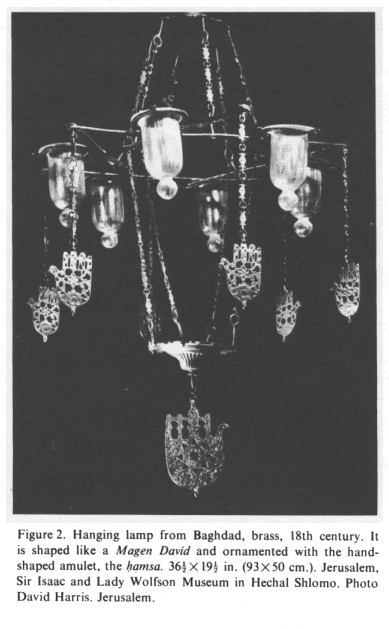
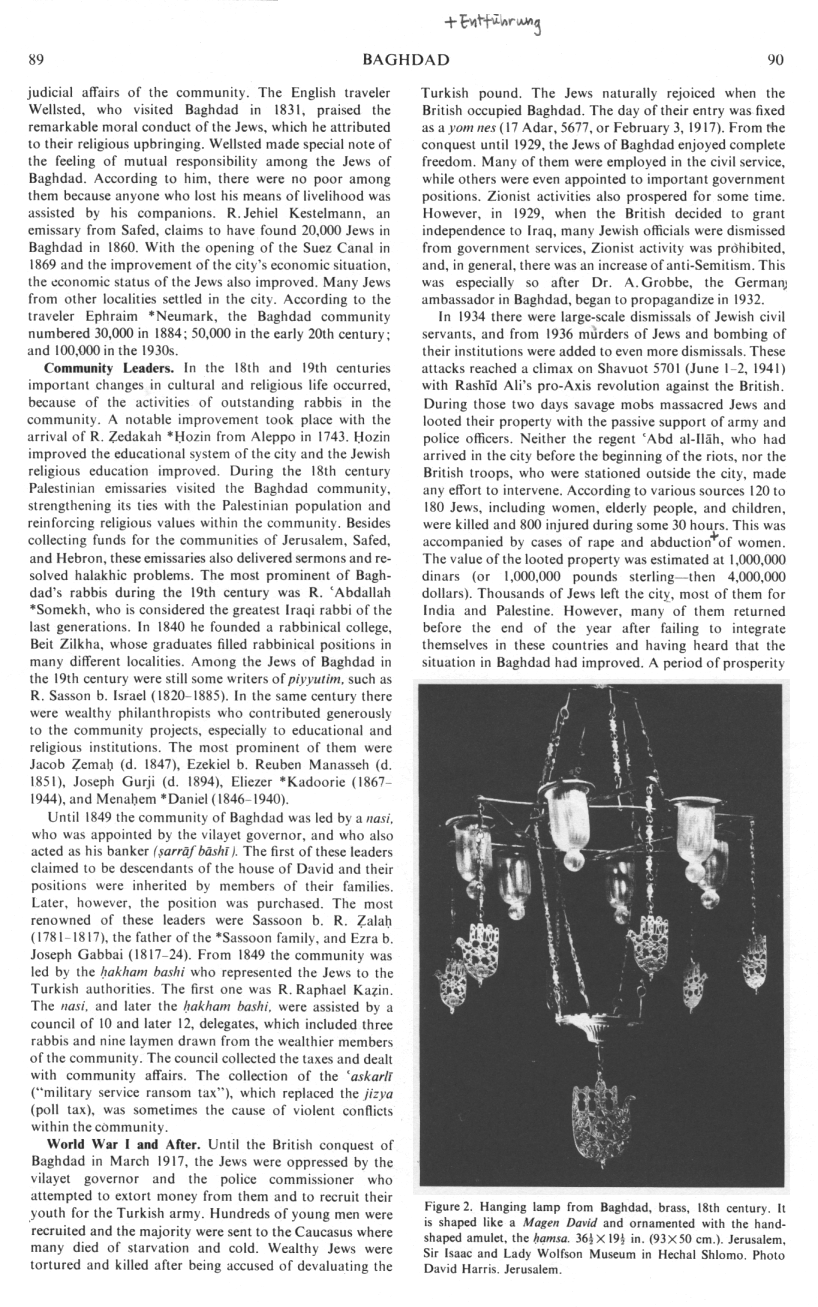
Encyclopaedia Judaica (1971): Baghdad, vol. 4, col. 90: a lamp in form of a David's star: Hanging lamp from Baghdad, brass, 18th century. It is shaped like a Magen David and ornamented with the handshaped amulet, the hamsa (ḥạmsa), 36 1/2 to 19 1/2 in. (93 to 50 cm). Jerusalem, Sir Isaac and Lady Wolfson Museum in Hechal Shlomo. Photo David Harris, Jerusalem.
During the second half of the 18th century and the early 19th century Turkish rule deteriorated in efficiency and the attitude of the government toward the Jews became harsh. Even so, some Jewish bankers were involved in the affairs of the governing circles, especially in the attempted rebellion of the governors.
During the reign of Sultan Mahmud II, the banker Ezekiel *Gabbai supported the removal of the governor of Baghdad, who had rebelled against the sultan in 1811. the last Mamluk governor, Da'ud Pasha (1817-31), who had also tried to rebel against the sultan, oppressed the Jews of Baghdad, and many of the wealthier ones fled to Persia, India, and other countries. Among them was David b. *Sassoon, a member of the distinguished Baghdad family.
The number of Jews at that time was still considerable. R. *David D'Beth Hillel, who visited the city in 1828, found 6,000 Jewish families there led by a pasha, also known as "king of the Jews", who was also responsible for the (col. 88)
judicial affairs of the community. The English traveler Wellsted, who visited Baghdad in 1831, praised the remarkable moral conduct of the Jews, which he attributed to their religious upbringing. Wellsted made special note of the feeling of mutual responsibility among the Jews of Baghdad. According to him, there were no poor among them because anyone who lost his means of livelihood was assisted by his companions. R. Jehiel Kestelmann, an emissary from Safed, claims to have found 20,000 Jews in Baghdad in 1860.
With the opening of the Suez Canal in 1869 and the improvement of the city's economic situation, the economic status of the Jews also improved. Many Jews from other localities settled in the city. according to the traveler Ephraim *Neumark, the Baghdad community numbered 30,000 in 1884; 50,000 in the early 20th century; and 100,000 in the 1930s.
Community leaders
In the 18th and 19th centuries important changes in cultural and religious life occurred, because of the activities of outstanding rabbis in the community. A notable improvement took place with the arrival of R. Zedakah *Hozin from Aleppo in 1743. Hozin improved the educational system of the city and the Jewish religious education improved.
During the 18th century Palestinian emissaries visited the Baghdad community, strengthening its ties with the Palestinian population and reinforcing religious values within the community. Besides collecting funds for the communities of Jerusalem, Safed, and Hebron, these emissaries also delivered sermons and resolved halakhic problems.
The most prominent of Baghdad's rabbis during the 19th century was R. 'Abdallah *Somekh, who is considered the greatest Iraqi rabbi of the last generations. In 1840 he founded a rabbinical college, Beit Zilkha, whose graduates filled rabbinical positions in many different localities. Among the Jews of Baghdad in the 19th century were still some writers of piyyutim, such as R. Sasson b. Israel (1820-1885). In the same century there were wealthy philanthropists who contributed generously to the community projects, especially to educational and religious institutions. The most prominent of them were Jacob Zemah (d. 1847), Ezekiel b. Reuben Manasseh (d. 1851), Joseph Gurji (d. 1894), Eliezer *Kadoorie (1867-1944), and Menahem *Daniel (1846-1940).
Until 1849 the community of Baghdad was led by a nasi, who was appointed by the vilayet governor, and who also acted as his banker (sarraf bashi). The first of these leaders claimed to be descendants of the house of David and their positions were inherited by members of their families. Later, however, the position was purchased.
The most renowned of these leaders were Sassoon b. R. Zalah (1781-1817), the father of the *Sassoon family, and Ezra b. Joseph Gabbai (1817-24). From 1849 the community was led by the hakham bashi who represented the Jews to the Turkish authorities. The first one was R. Raphael Kazinh. The nasi, and later the hakham bashi, were assisted by a council of 10 and later 12, delegates, which included three rabbis and nine laymen drawn from the wealthier members of the community. The council collected the taxes and dealt with community affairs. The collection of the 'askarli ("military service ransom tax"), which replaced the jizya (poll tax), was sometimes the cause of violent conflicts within the community.
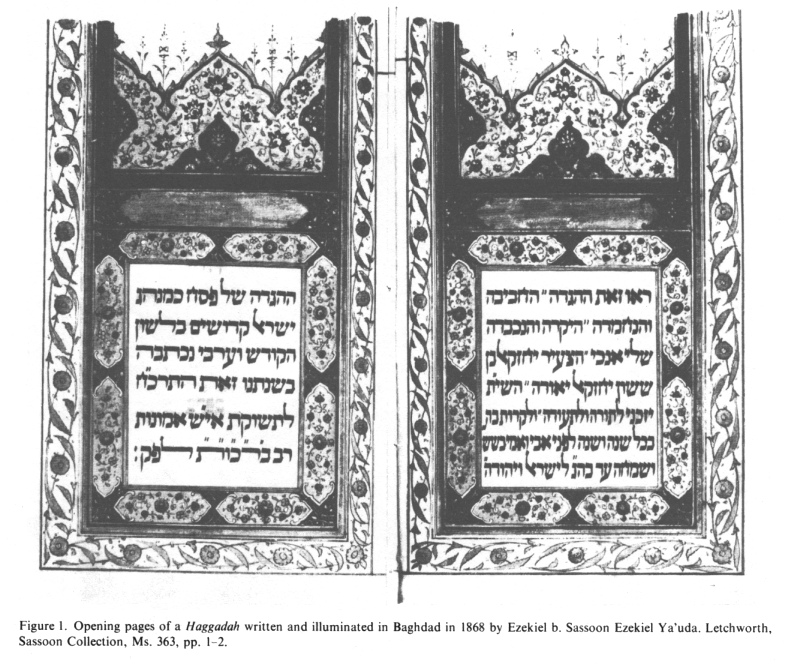
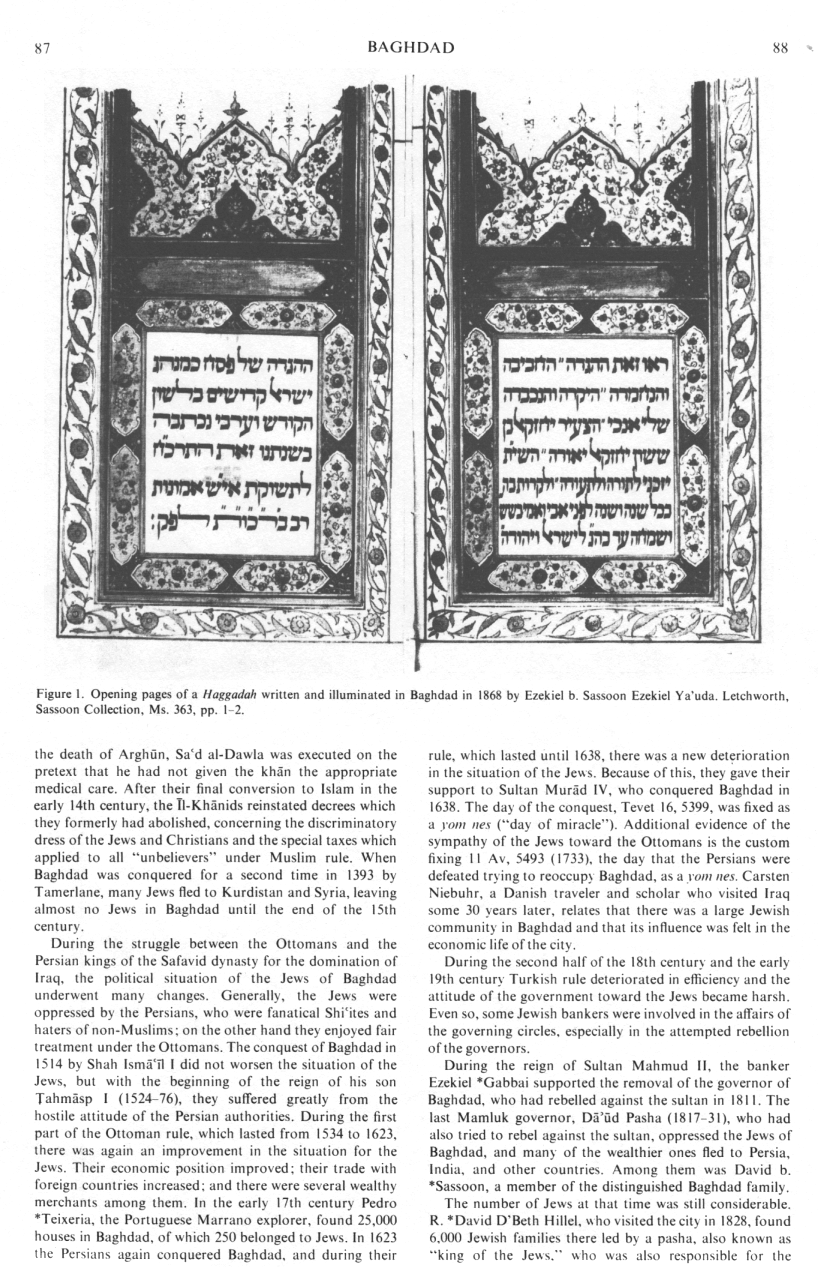
Encyclopaedia Judaica (1971): Baghdad, vol. 4, col. 87-88: haggadah of 1868
World War I and After.
[1914-1917: Harsh Turkish army rule for the Jews of Baghdad - liberal English occupation 1917-1929]
Until the British conquest of Baghdad in March 1917, the Jews were oppressed by the vilayet governor and the police commissioner who attempted to extort money from them and to recruit their youth for the Turkish army. Hundreds of young men were recruited and the majority were sent to the Caucasus where many died of starvation and cold. Wealthy Jews were tortured and killed after being accused of devaluating the (col. 89)
Turkish pound.
The Jews naturally rejoiced when the British occupied Baghdad. The day of their entry was fixed as a yom nes (17 Adar, 5677, or February 3, 1917). From the conquest until 1929, the Jews of Baghdad enjoyed complete freedom. Many of them were employed in the civil service, while others were even appointed to important government positions. Zionist activities also prospered for some time.
[Movement against Free Mason Zionists in Baghdad]
However, in 1929, when the British decided to grant independence to Iraq, many Jewish officials were dismissed from government services, Zionist activity was prohibited, and, in general, there was an increase of anti-Semitism. This was especially so after Dr. A. Grobbe, the German ambassador in Baghdad, began to propoagandize in 1932.
[[The Zionist program has its base on the book "The Jewish State" of racist Theodor Herzl. This book propagates that the Jews should found a Great Israel by driving all Arabs away as the natives were driven away in the "USA. So the removement of Zionists can be understood. But a general ban of all Jews cannot be understood, because many Jews were anti-Zionists. When anti-Zionist Jews are banned they will be driven into the hands of the Zionists, and this was the Arab fault in their policy. But the Zionists with their Mosad also have never given up their racist Herzl program. And so the escalation is running on and on]].
[1934-1936: Murder, bombs and pogroms against the Jews in Baghdad - flight and return of thousands of Jews - prospering situation 1936-1945]
In 1934 there were large-scale dismissals of Jewish civil servants, and from 1936 murders of Jews and bombing of their institutions were added to even more dismissals. These attacks reached a climax on Shavuot 5701 (June 1-2, 1941) with Rashid Ali's pro-Axis revolution against the British. During those two days savage mobs massacred Jews and looted their property with the passive support of army and police officers. Neither the regent 'Abd al-Ilah, who had arrived in the city before the beginning of the riots, nor the British troops, who were stationed outside the city, made any effort to intervene.
According to various sources 120 to 180 Jews, including women, elderly people, and children, were killed and 800 injured during some 30 hours. This was accompanied by cases of rape and abduction of women. The value of the looted property was estimated at 1,000,000 dinars (or 1,000,000 pounds sterling - then 4.000,000 dollars).
Thousands of Jews left the city, most of them for India and Palestine. However, many of them returned before the end of the year after failing to integrate themselves in these countries and having heard that the situation in Baghdad had improved. A period of prosperity (col. 90)
ensued and continued until 1945; even though the decrees concerning their employment in government service and their admission to public schools had not been repealed, the Jews lived in Baghdad at ease and without fear.
[since 1945: Aggravated situation because of racist Free Mason Herzl Zionism]
After 1945 there were frequent demonstrations against the Jews and especially against Zionism.
[[The fear that Zionism would found the "Jewish State" with the alliance of the racist "USA" was already real, and then the Zionists had the exterminator of the natives as their ally, and the next would be the Arabs, as Herzl says. But the Arab policy with a general punishment of Jews is also not the right reaction]].
With the proclamation of the partition of Palestine, November 1947, even greater danger threatened the Jews of Baghdad. There was fear of a massacre, and the Jewish underground defense, organized with help of Palestinian Jews, was in a state of preparedness; the catastrophe was averted when martial law was proclaimed by the government. Nonetheless, many Jews were brought before military courts and fines were levied on the majority of them. There were 77,000 Jews in Baghdad in 1947.
[1950-1951: Mass exodus of the Jews - judgment against Jewish communists and Zionists, and against espionage]
After the mass exodus to Israel in 1950-51, approximately 5,000 Jews were left. Jews continued to leave Baghdad so that only about 2,000 remained in 1968.
[[It can be that this general anti-Semitism in Iraq before the mass exodus was also provoked by the "Soviet Union" which was Iraqi ally in this situation against racist Free Mason Herzl Zionist Israel and its racist ally "USA"]].
Immediately after the establishment of the State of Israel, hundreds of Baghdadi Jews were arrested. Many of the detainees were accused of communist or Zionist activities. A few hundred Jewish youth had joined these clandestine movements, especially after 1948.
Two communist and two Zionist leaders were hanged publicly in Baghdad. During the government of 'Abd Al-Karim Qassem (July 1958-February 1963) the attitude toward the Jews was more favorable. Even so, there were severe periodical restrictions on departure from Iraq, property confiscation, and a strengthening of economic pressure on the community.
Fourteen Iraqis, including nine Jews, were hanged publicly in Baghdad on January 27, 1969, after being convicted on charges of spying for Israel.
[[Israel has always headed the atomic bomb against the Arabs to fulfill the Herzl program...]]
[A.B.-Y.]> (col. 91)
<Institutions and Community Life - 1917-1970
During the British administration and after World War II, the number of Jewish educational institutions, especially the secondary ones, increased. In spite of the restrictions on the number of Jews admitted to government secondary schools, the number of Jews in these institutions was higher in 1950 than in 1920; but, because of lack of data, only the number in Jewish educational institutions will be mentioned.
During this period there were also important social changes within the Baghdad community. The majority of women removed the gown (Arabic, 'aba') and the veil (Persian, pushi), which they formerly wore in the street. The number of girls engaged in teaching and in clerical work increased and some of them received a university education.
There was also a change in the occupations of the Jews. Whereas in 1920 they were engaged in trade, banking, labour, and public services, in 1950 thousands earned their livelihood by clerical work or in the professions such as law. Immediately after the British conquest, the Jews began to leave their quarter to settle in all parts of the city. In the 1930s the Battawin and Karrada quarters were established and inhabited by the wealthy. The attitude toward religion also underwent a change.
During the first years after the British conquest there were only a few Jews who profaned the Sabbath or ate non-kasher food, whereas at the end of this period the number of Sabbath observers decreased.
From the end of the Ottoman period until 1931 the Jews of Baghdad had a "General Council" of 80 members, which included 20 rabbis and was led by the chief rabbi. The General Council elected a council for religious matters and a council for material welfare. The former dealt with ritual slaughter, burials, and the rabbinical courts, while the latter was responsible for the schools, hospitals, and charitable trusts.
In 1926, however, a group of intellectuals gained the upper hand in the latter council and attempted to remove the chief rabbi, Ezra *Dangoor. After a stormy period, in (col. 91)
1931, the community passed the "Law of the Jewish Community". It deprived the rabbis of the community's leadership and made it possible for a nonreligious person to assume leadership. In spite of this in February 1933 R. Sasson *Kadoorie was elected chairman of the community. His position was, however, a secular one, while a rabbi without any community authority was elected to the position of chief rabbi.
Just before the mass emigration of 1951, there were about 20 Jewish educational institutions in Baghdad; 16 were under supervision of the community committee, the rest were privately run. In 1950 about 12,000 pupils attended these institutions while many others attended government and foreign schools; approximately another 400 students were enrolled in Baghdad colleges of medicine, law, economy, pharmacy, and engineering. All but two of the Jewish educational institutions closed in 1951.
These two had approximately 900 pupils in 1960, while about 50 Jewish pupils attended government schools. The Baghdad community also had a school for the blind, founded in 1930, which was the only one of its kind in Iraq. It closed in 1951.
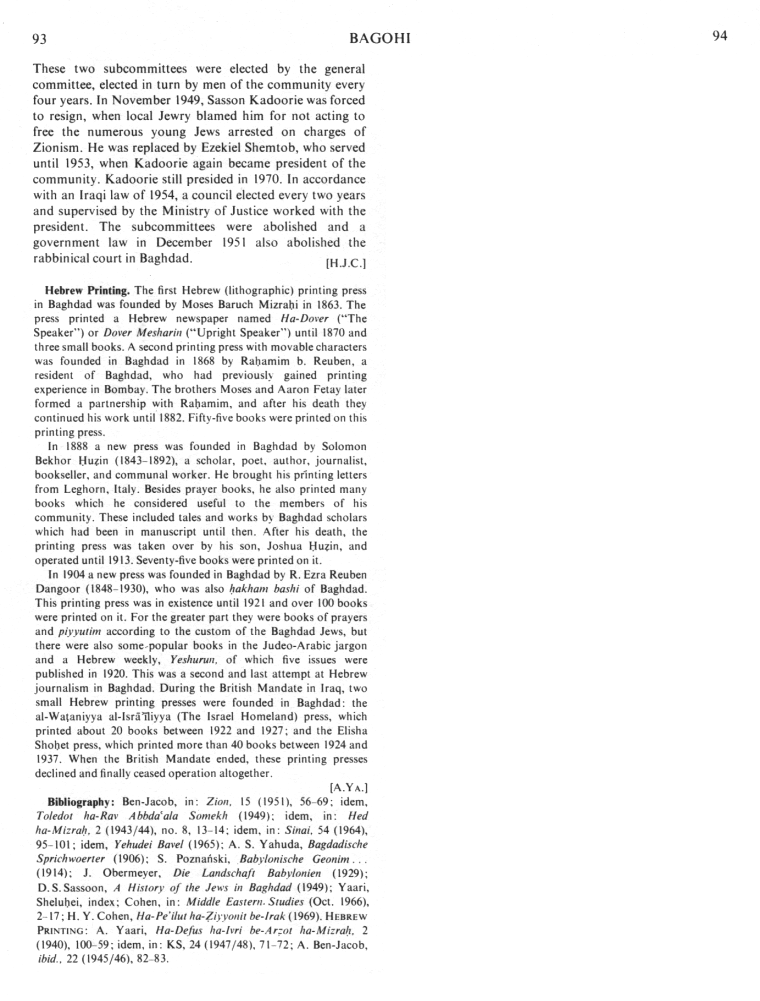
Table: Pupils in Jewish educational institutions in Baghdad in 1920 and just before the mass exodus of 1950-51
Year
Talmud Torah
Kindergartens and Elementary Schools
Secondary Schools
Total
1920
2,500
3,350
150xxxxxxxxxx
6,000xx
1950
1,880
8,970
2,626xxxxxxxxxx 14,476xx
[[It can be seen that the Jews in Iraq had been more integrated in 1950 as it was the way of the Jews in the Soviet Union since the 1920ies]].
The Jews of Baghdad had two hospitals; one, a general hospital named for Meir Elias, founded in 1910, and the second, an eye hospital named for Rima Kadoorie, founded in 1924. At both these hospitals, Jews received treatment, and operations were performed for the needy for little or no payment. Every school in town had a clinic. The community also had several philanthropic societies to provide dowries for girls without means, help to mothers, maintenance of yeshivah students, and for the vocational training of poor children. All these institutions, including the hospitals, closed. Afterward, the community committee arranged for the sick to be admitted to various hospitals in the town.
Only seven synagogues remained in 1960 of the 60 synagogues of Baghdad in 1950. The community committee had subcommittees for religious affairs and administration. (col. 92)
These two subcommittees were elected by the general committee, elected in turn by men of the community every four years. In November 1949, Sasson Kadoorie was forced to resign, when local Jewry blamed him for not acting to free the numerous young Jews arrested on charges of Zionism. He was replaced by Ezekiel Shemtob, who served until 1953, when Kadoorie again became president of the community. Kadoorie still presided in 1970. In accordance with an Iraqi law of 1954, a council elected every two years and supervised by the Ministry of Justice worked with the president. The subcommittees were abolished and a government law in December 1951 also abolished the rabbinical court in Baghdad.
[H.J.C.]> (col. 93)
<Hebrew Printing
The first Hebrew (lithographic) printing press in Baghdad was founded by Moses Baruch Mizrahi in 1863. The press printed a Hebrew newspaper named Ha-Dover ("The Speaker") or Dover Mesharin ("Upright Speaker") until 1870 and three small books. A second printing press with movable characters was founded in Baghdad in 1868 by Rahamim b. Reuben, a resident of Baghdad, who had previously gained printing experience in Bombay. The brothers Moses and Aaron Fetay later formed a partnership with Rahamim, and after his death they continued his work until 1882. Fifty-five books were printed on this printing press.
In 1888 a new press was founded in Baghdad by Solomon Bekhor Huzin (1843-1892), a scholar, poet, author, journalist, bookseller, and communal worker. He brought his printing letters from Lethorn, Italy. Besides prayer books, he also printed many books which he considered useful to the members of his community. These included tales and works by Baghdad scholars which had been in manuscript until then. After his death, the printing press was taken over by his son, Joshua Huzin, and operated until 1913. Seventy-five books were printed on it.
In 1904 a new press was founded in Baghdad by R. Ezra Reuben Dangoor (1848-1930), who was also hakham bashi of Baghdad. This printing press was in existence until 1921 and over 100 books were printed on it. For the greater part they were books of prayers and piyyutim according to the custom of the Baghdad Jews, but there were also some popular books in the Judeo-Arabic jargon and a Hebrew weekly, Yeshurun, of which five issues were published in 1920. This was a second and last attempt at Hebrew journalism in Baghdad.
During the British Mandate in Iraq, two small Hebrew printing presses were founded in Baghdad: the al-Wataniyya al-Isra'iliyya (The Israel Homeland) press, which printed about 20 books between 1922 and 1927; and the Elisha Shohet press, which printed more than 40 books between 1924 and 1937. When the British Mandate ended, these printing presses declined and finally ceased operation altogether.
[A.YA.]> (col. 93)
<Bibliography
-- Ben-Jacob, in: Zion, 15 (1951), 56-69
-- idem: Toledot ha-Rav Abbda'ala Somekh (1949)
-- idem: In: Hed ha-Mizrah, 2 (1943/44), no. 8, 13-14
-- idem: In: Sinaui, 54 (1964), 95-101
-- idem: Yehudei Bavel (1965)
A.S. Yahuda: Bagdadische Sprichwoerter (1906)
-- S. Poznanski: Babylonische Geonim ... (1914)
-- J. Obermeyer: Die Landschaft Babylonien (1929)
-- D.S. Sassoon: A History of the Jews in Baghdad (1949)
-- Yaari, Sheluhei, index
-- Cohen; In: Middle Eastern. Studies (Oct. 1966), 2-17
-- H.Y. Cohen: Ha-Pe'ilut ha-Ziyyonit be-Irak (1969)
HEBREW PRINTING
-- A. Yaari: Ha-Defus ha-Ivri be-Arzot ha-Mizrah, 2 (1940), 100-59
-- idem; In: KS, 24 (1947/48), 71-72
-- A. Ben-Jacob, ibid., 22 (1945/46), 82-83> (col. 93)
Sources
Encyclopaedia Judaica 1971: Baghdad, vol. 4, col.86
Encyclopaedia Judaica 1971: Baghdad, vol. 4, col.87-88
Encyclopaedia Judaica 1971: Baghdad, vol. 4, col.89-90
Encyclopaedia Judaica 1971: Baghdad, vol. 4, col.91-92
Encyclopaedia Judaica 1971: Baghdad, vol. 4, col.93-94
^