[Jews become citizens]
<NAPOLEON
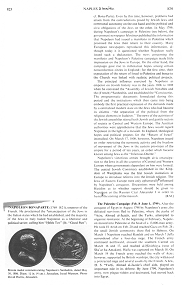
BONAPARTE (1769-1821), emperor of the French. He proclaimed
the *emancipation of the Jews in the Italian states which he
had established, and the majority of the Jews in Italy
hailed Napoleon as a liberator and political savior, calling
him "Helek Tov" (lit. "Good Part"; (col. 823)
cf. Bona-Parte).
Even by this time, however, problems had arisen from the
contradictions posed by Jewish laws and communal autonomy on
the one hand and the political and civic obligations of the
Jews on the other. In May 1799, during Napoleon's campaign
in Palestine (see below), the government newspaper Moniteur published the
information that Napoleon had issued a manifesto in
Palestine which promised the Jews their return to their
country. Many European newspapers reproduced this
information, although today it is questioned whether
Napoleon really issued such a declaration.
The news concerning the manifesto and Napoleon's Palestine
campaign made little impression on the Jews in Europe. On
the other hand, the campaign gave rise to millenarian hopes
among certain nonconformist circles in England; for the
first time, their expectation of the return of Israel to
Palestine and hence to the Church was linked with realistic
political projects.
[[The Arabs were not asked, but racist Zionism did no exist
yet]].
The principal influence exercised by Napoleon as emperor on
Jewish history was in the years 1806 to 1808 when he
convened the *Assembly of Jewish Notables and the (French)
*Sanhedrin, and established the *Consistories. The
programmatic documents formulated during this period and the
institutions which then came into being embody the first
practical expression of the demands made by a centralized
modern state on the Jews who had become its citizens - "the
separation of the political from the religious elements in
Judaism". The news of the activities of the Jewish
assemblies stirred both Jewish and gentile [[non-Jewish]]
sectors of society in Central and Western Europe. The
Austrian authorities were apprehensive [[worried]] that the
Jews would regard Napoleon in the light of a messiah. In
England, theological hopes and political projects for the
"Return of Israel" intensified.
On March 17, 1808, however, Napoleon issued an order
restricting the economic activity and the freedom of
movement of the Jews in the eastern provinces of the empire
for a period of ten years, an order which became known among
Jews as the "Infamous Decree".
Napoleon's victorious armies brought civic emancipation to
the Jews in all the countries of Central and Western Europe
where governments dependent on him were formed. The central
Jewish Consistory established in the Kingdom of Westphalia
was the first Jewish institution in Europe to introduce
reforms into the Jewish religion. The Jews of Eastern Europe
were only ephemerally [[short lived]] influenced by
Napoleon's conquests. Discussions were held among Hasidim
[[Orthodox]] as to whether support should be given to
Napoleon or the Russian Czar Alexander I in order to hasten
[[speed up]] the coming of the messiah.
[B.M.]> (col. 824)
<The Palestine Campaign
(Feb. 8-June 1, 1799) [Napoleon states the strategic
importance of Palestine]
After the conquest of Egypt in August 1798 by Napoleon's
army, the defeated survivors fled to Palestine, where the
pasha of *Acre, Ahmad al-Jazzar, and the Turks, attempted to
organize resistance. At the beginning of February, Napoleon
moved into Palestine at the head of a 13,000-man army.
He took El Arish on Feb. 20 and reached Gaza on Feb. 24: the
small Jewish community there fled to Hebron. On March 1
Napoleon reached Ramleh and on March 7 Jaffa surrendered
after a four-day siege. The French army continued northward,
crossed the southern Carmel on March 16 and 17, and reached
al-Havithiyya (west of Sha'ar ha-Amakim). Haifa was captured
on March 18. On March 19 the French army reached the walls
of Acre; however, supported by British warships, the city
withstood a protracted siege and several assaults by the
French.
A Jew, H.S. *Farhi, Ahmad al-Jazzar's chief aide, played an
important role in its defense. By June 1799, Napoleon's
army, now plague-ridden and decimated, had moved back into
Egypt. (col. 824)
From a political point of view, Napoleon's campaign in
Palestine marked the beginning of a renewed interest of the
Western Powers in Palestine as occupying an important
international position [[without asking the Arabs]]. From a
social-cultural point of view the importance of the campaign
was much more limited. However, this was the first
substantial contact made between the inhabitants of
Palestine and Westerners since the destruction of Crusader
Acre.
[A.J.BR.]> (col. 825)
<Impact on Jewish
History. [Napoleon opens new worlds to the Jews]
The forces unleashed by Napoleon brought in their wake
contradictory effects on the course of modern Jewish
history. The breakup of old European feudal patterns of
societal organization was eventually to open up a range of
new economic and political options for the Jew.
The closed societies that restricted but sheltered him were
never again to be the same. On the other hand, the immediate
effect of these forces was to provoke an almost total
reversal in the process of civic emancipation brought about
in the course of Napoleonic conquests.
Nonetheless, Jewish Emancipation was to come eventually,
even if its triumph was to be delayed till later in the
century. Well in advance of that time the Napoleonic
uprooting of the established order forced the Jewish
community to contend with the many challenges posed by that
process to their traditions and their lives. Already before
Napoleon there were individual Jews seeking an accommodation
with the world outside the ghetto. The events that
surrounded the Napoleonic adventure extended the concern of
the few to the preoccupation of the people as a whole.
Moreover, Napoleon's insistence on a price to be paid by the
Jew for his entrance into the modern world was to set the
tone for much of the debate within the Jewish community
during the Emancipation era. How to remain loyal to the
traditions of his people and at home in the modern world was
a problem with which the Jew wrestled throughout the period
of his modern history; it is a problem first posed
practically and seriously by the threat of Napoleonic
successes.
[A.SHA.]