|
|
|


Encyclopaedia Judaica
Jews in Alsace
German rule: Jewish refugees from France - Armleder pogrom 1338 - Black Death persecution - always expulsion and re-admittance - trade connections - taxes, wars, and badge - French rule with emancipation - Holocaust with flight to central and southern France - Jewish influx from North Africa
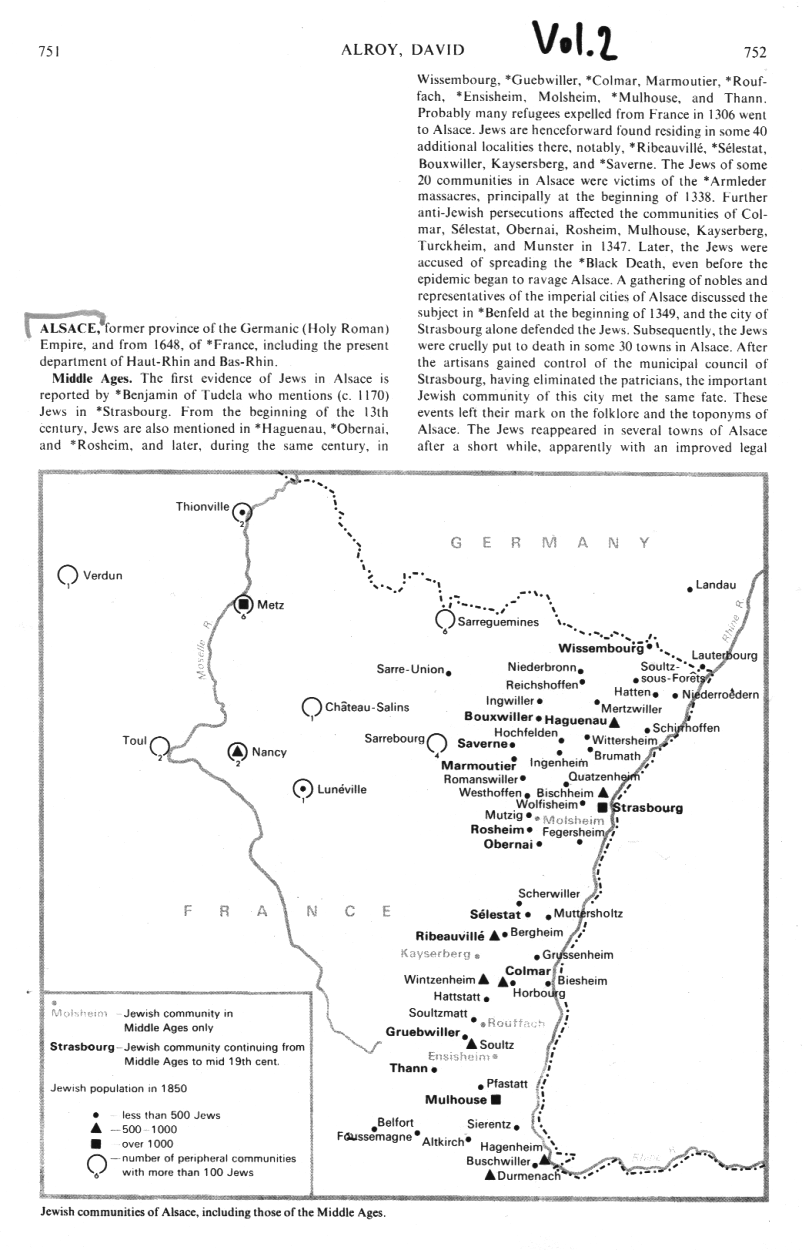
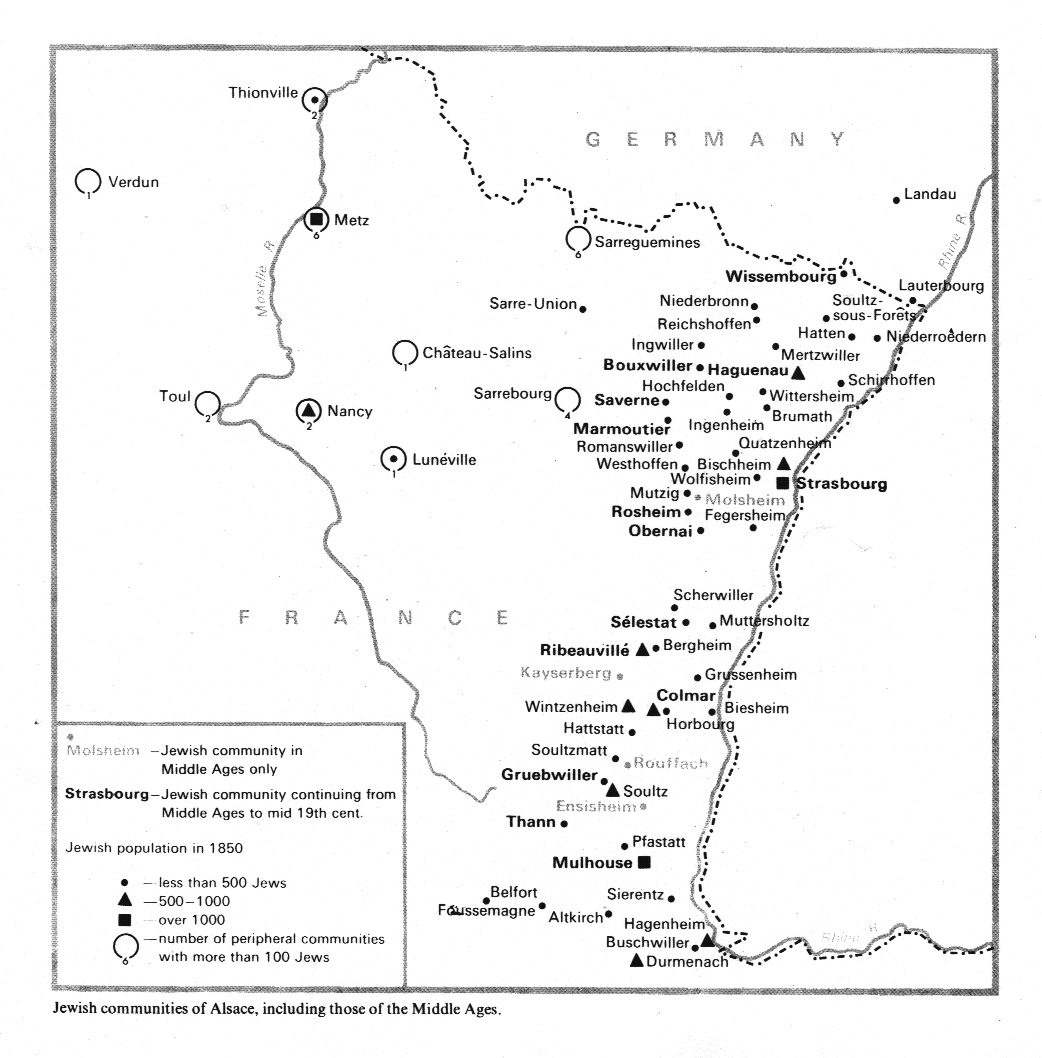
Encyclopaedia Judaica (1971): Alsace, vol. 2, col. 751-752. Map of Alsace with the Jewish communities
in Middle Ages and communities continuing from Middle Ages to mid 19th cent.
from: Alsace; In: Encyclopaedia Judaica 1971, vol. 2
presented by Michael Palomino (2008)

| Teilen / share: |
Facebook |
|
Twitter
|
|
|
|
<ALSACE, former province of the Germanic (Holy Roman) Empire, and from 1648, of *France, including the present department of Haut-Rhin [[Upper Rhine]] and Bas-Rhin [[Lower Rhine]].
Middle Ages.
[Jewish settlement of Jewish refugees from France - Armleder pogrom of 1338]
The first evidence of Jews in Alsace is reported by *Benjamin of Tuleda who mentions (c. 1170) Jews in *Strasbourg. From the beginning of the 13th century, Jews are also mentioned in *Haguenau, *Obernai, and *Rosheim, and later, during the same century, in (co. 751)
Wissembourg, *Guebwiller, *Colmar, Marmoutier, *Rouffach, *Ensisheim, Molsheim, *Mulhouse, and Thann. Probably many refugees expelled from France in 1306 went to Alsace. Jews are henceforward found residing in some 40 additional localities there, notably, *Ribeauvillé, *Sélestat, Bouxwiller, Kaysersberg, and *Saverne.
The Jews of some 20 communities in Alsace were victims of the *Armleder massacres, principally at the beginning of 1338. Further anti-Jewish persecutions affected the communities of Colmar, Sélestat, Obernai, Rosheim, Mulhouse, Kayserberg, Turckheim, and Munster in 1347.
[Black Death persecution - and resettlement in some towns]
Later, the Jews were accused of spreading the *Black Death, even before the epidemic began to ravage Alsace. A gathering of nobles and representatives of the imperial cities of Alsace discussed the subject in *Benfeld at the beginning of 1349, and the city of Strasbourg alone defended the Jews. Subsequently, the Jews were cruelly put to death in some 30 towns in Alsace.
After the artisans gained control of the municipal council of Strasbourg, having eliminated the patricians, the important Jewish community of this city met the same fate. These events left their mark on the folklore and the toponyms of Alsace.
The Jews reappeared in several towns of Alsace after a short while, apparently with an improved legal (col. 752)
status. They were admitted as citizens in Colmar from 1361, in Sélestat from the end of the 14th century, and in Mulhouse from 1403, with almost the same rights as the Christian citizens.
End of 15th Century to Middle of 17th Century.
[Further back and forth with expulsions and re-admittance - trade connections - cultural life]
Jews were able to settle in the villages of Alsace when expelled from its cities. They mainly engaged in moneylending. Jews were admitted into Strasbourg during the day to carry on trade, but were compelled to leave the city at nightfall.
Regular contact and traffic existed between the Jews of Alsace and those in western Germany, Switzerland, Holland, and Lorraine.
Alsace Jewry, basically Ashkenazi, developed individual characteristics, in certain ritual matters, for instance, in the choice of Selihot (Seliḥot) ("penitential prayers"). The Alsatian rite (Minhag Elzos), has been published several times in at least ten editions (for the first time in Frankfort, 1725). Communal leadership was centralized and authoritarian. The outstanding personality in Alsace Jewry during the Renaissance period was the shtadlan ("interceder") *Joseph (Joselmann) of Rosheim. The works of Joselmann's older contemporary, Johanan Luria, show that Alsace Jews at this period were much influenced by Christian society, ideas, and manners; their social and religious life shows on this evidence much variety, and indicates the social tensions and patrician tendencies in certain circles.
[Tax oppression - war victims - badge - baptize regulation for illegitimate children - no trade with houses]
The aristocracy and citizenry found the Jews a profitable source of income and oppressed them in every way. In places where Jews were not granted the right of residence, they had to pay exorbitant transit tolls. Whenever Alsace was ravaged by war, the Jews were the first victims of the soldiers. The Jews living in Alsace were subjected to many restrictions. These extended to the wearing of the Jewish *badge, the humiliating form of *oath, and to family life. (Every Jewish marriage was submitted for authorization, and illegitimate children were forcibly baptized).
Jews were not permitted to own land or any building except their place (col. 753)
of residence. Newcomers were excluded unless they obtained special authorization.
Under France (the Ancien Régime).
[Growing Jewish communities under French rule in suburbs - professions - local Jewish dialect]
Although a new tax, the Leibzoll ("body-tax") was imposed on Alsace Jewry by the French. Jews continued to enter Alsace, and in certain cities their numbers rapidly increased. There were 522 Jewish families living in Alsace in 1689, 1,269 families in 1716, and 2,125 in 1740. The "General Enumeration of the Jews Tolerated in the Province of Alsace" of 1784, published in Colmar in 1785, shows that Jewish communities were scattered throughout the province, numbering 3,910 families (nearly 20,000 persons). The principal settlements were often near main towns, from which the Jews had been expelled but into which they were temporarily admitted for purposes of trade under differing regulations.
Communities existed in *Bischheim, a suburb of Strasbourg (473 persons), Haguenau (325), Marmoutier (299), Westhoffen (282), Mutzig (307), Rosheim (268), Wintzenheim, near Colmar (381), *Bergheim (327), Ribeauville (286), Biesheim (256), *Hegenheim, near Basle (409), Niederhagenthal (356), Oberhagenthal (271), Durmenach (340), Zillisheim (332), and Rixheim (243).
Economic conditions for the Jews in Alsace were precarious. Many engaged in moneylending almost always on a small scale, frequently to peasants. A few Jews acquired wealth as army contractors. The majority consisted of hawkers and dealers in livestock, grain, and scrap iron. In most of the villages where they were living, the Jews kept the butcher shops. The chief communities of Bouxwiller, Haguenau, Mutzig, and Niedernai wielded extensive jurisdiction according to the administrative division of Alsace. The inflexible piety of the Jews and their distinctive Judeo-Alsatian language distinguished them clearly from their neighbors, although in many aspects they blended into the Alsatian environment.
[Hebrew prohibition act in 1735 - register act in 1784 - cases provoking tensions: Cerfberr - false receipts of François-Joseph of Hell - Leibzoll act of 1784]
In 1735 Jews were forbidden to draw up their accounts in Hebrew characters and they were ordered to keep registers (col. 754)
of civil status in 1784. Efforts were made to reduce their numbers by preventing Jews from other countries from settling in Alsace and severely limiting Jewish marriages.
Tensions built up toward the end of the 18th century: [[...]]
In 1775 Herz Mendelsheim *Cerfberr of Bischheim, a wealthy purveyor to the king, obtained permission to reside in Strasbourg permanently with his family, although this was opposed by the municipality. Cerfberr was in contact with Christian *Dohm who advocated reform of the Jewish status. Cerfberr appealed also to Louis XVI for its amelioration. [[...]]
In 1777 a band of criminals, egged on by the bailiff François-Joseph of Hell, forged a mass of false receipts which they sold to peasants indepted to Jews, purportedly freeing them from their obligations. Although the culprits were eventually executed, this affair aggravated the economic difficulties of the Jews and inflamed the Christian populace against them. [[...]]
An edict was issued in 1784 repealing the Leibzoll. Subsequent letters patent brought some security to the Jews, although reinforcing other restrictions. A commission presided over by *Malesherbes was considering the position of the Jews in Alsace, when the French Revolution swept away the Ancien Régime.
The Emancipation (1789-1844).
[Alsace and Lorraine are resistance centers against the emancipation of the Jews - the emancipation edicts by Napoleon I in 1807 and 1808]
Despite the efforts of Jewish notables such as Cerfberr, Isaiah *Beer-Bing of Metz, and *Berr Isaac Berr of Turique, supported by "Mirabeau, Robespierre and, above all, by Abbé *Grégoire, a change in the status of the "German" Jews was strenuously and successfully opposed in the first years of the Revolution by the deputies from Alsace and Lorraine. They claimed that such a move would provoke riots and massacres in their districts. Even when the equality of the Jews before the law was proclaimed on Sept. 27, 1791, people in the eastern provinces became used to it only gradually. These districts of France became in practice, and in formulation of anti-Jewish theory, the hotbed of opposition to Jewish emancipation.
Many attacks were made on Jews in Alsace-Lorraine. While the Jews themselves were not overly eager to integrate there, they gladly used their newly won rights, especially concerning freedom of settlement. The Jewish population of Strasbourg, for instance, grew in about ten years from less than 100 Jewish inhabitants to over 1,000. *Napoleon I tried to force the Jews of Alsace-Lorraine to integrate, first on the basis of the document formulated by the *Assembly of Jewish Notables and the *Sanhedrin of 1807, and later by the edict of March 17, 1808, called by the Jews the "infamous decree" (Décret infâme).
[Financial regulations under Napoleon I - army draft in Alsace and Lorraine - name act forces all Jews to integrate]
The repayment of debts owed to Jews by Christian peasants was deferred, trading by Jews was subjected to special authorization, and the possibilities of finding replacements for the army draft were restricted. The regulations were theoretically aimed at Jews throughout the country but were implemented only in Alsace and Lorraine. Napoleon's requirement that Jews should adopt family *names, and the creation of the consistorial organization (see *Consistoire), compelled even the Jews most opposed to reforms, to conform to the general legal and economic structure of the country despite attempts at resistance.
[Recognition of Jewish religion 1831 and full integration - Ordonnance act of 1849 makes the Jews of Alsace and Lorraine important]
The discriminatory regulations were not renewed in 1818, and the Jewish religion was recognized by the July Monarchy in 1831 as one of the three religions supported financially by the state. This more liberal policy finally succeeded in turning the Jews of Alsace, like their French coreligionists, into loyal citizens of the realm. (col. 755)
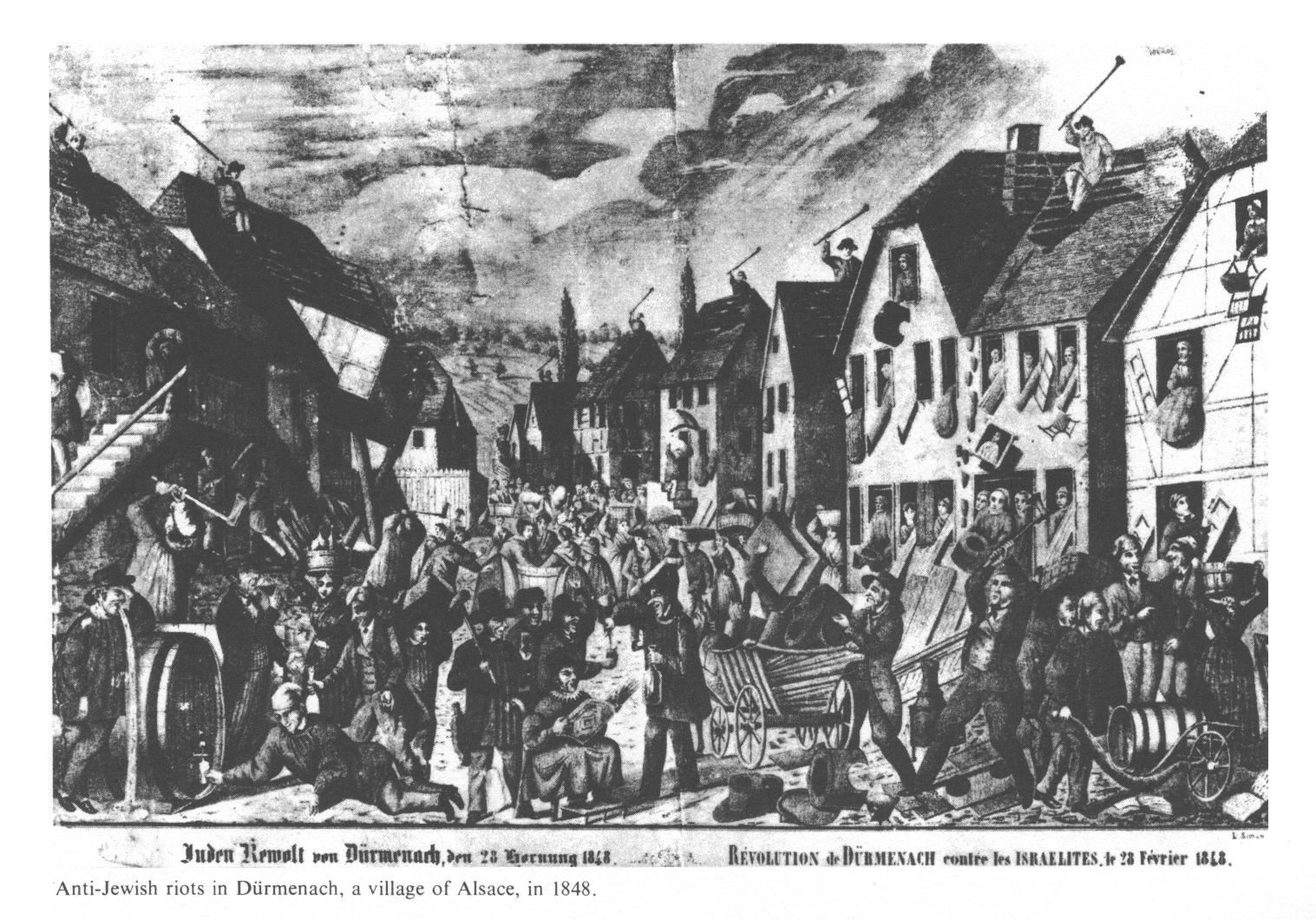
In February 1848, the peasants in Sundgau in Alsace took advantage of the general unrest to attack the Jews, some of whom managed to escape to Switzerland. The incidents spread northward, Jewish houses were pillaged, and the army was called out to restore order.
(from: France, vol. 7, col. 26)
Encyclopaedia Judaica (1971): Alsace, vol. 2, col. 753-754. Anti-Jewish riots in Duermenach, a village of Alsace, on 28 February
1848. [[As it seems in some rural spots the anti-Semitic "Christians" did not at all agree with
religious support for the Jews as the monarch wanted...]]
An Ordonnance, issued on May 17, 1849, supplied French Jewry with a strong constitution as one of the "spiritual families" of the French nation. In that framework the Jews from Alsace and Lorraine became a significant element in French Jewry because of their number and the tenacity of their Jewish religious identification. (col. 755)
The Expansion (1844-1871).
[Migration movements mainly to Paris or "America" - cultural life and structures]
The Jews rapidly adapted themselves to the modern society. They retained strong roots in the villages. In about 1900 there were still some 30 official rabbinical posts in Alsace, apart from those in Strasbourg and Colmar which were the seats of consistorial chief rabbis. However, the Jewish population increased in the large towns, such as Strasbourg, Metz, Nancy, Mulhouse, Colmar, Belfort, Sélestat, and Saverne. A considerable number moved to Paris, or emigrated mainly to North and South America. Many became wealthy through wholesale trade and industry, and soon large numbers entered the liberal professions.
The Jewish communal elementary schools, which after the emancipation increasingly replaced the heder (ḥeder) system [[Jewish religious school to age of 13]] and private teaching, provided a complete education, giving religious and preponderantly secular instruction. Those who could afford it preferred the state secondary schools to the Jewish vocational schools opened in the main towns (Metz, Strasbourg, Mulhouse, and Colmar) in order to direct the young toward handicrafts and agriculture. Jews also distinguished themselves in the universities. Local writers such as Alexandre *Weill (1811-95) of Schirrhoffen and Léon Cahun of Haguenau (1841-1900), achieved some literary fame.
In the rural areas religious life continued nearly a in the past and Alsatian villages provided rabbis for the whole of France, Algeria, and some other countries. A great part of the urban population, however, tended to seek other more unorthodox means in which to express their Jewish faith or Jewish identification. This took the form of a tendency to mild religious reform (opposed only by the leader of French Orthodoxy, the chief rabbi of Colmar Solomon-Wolf *Klein), and of Jewish social activity outside the scope of religion in the narrower sense of the work, such as the founding of Jewish newspapers and periodicals. There were also cases of discreet withdrawals from Judaism and of some notorious conversions, such as those of the Strasbourg-born rabbi David Drach (1791-1865), son-in-law of the chief rabbi of France, E. *Deutz; and the brothers *Ratisbonne, who were the sons of the first president of the Lower Rhine consistory.
Under Germans (1871-1918).
[Migration movement to central and western France - profession liberty in the Third Republic - influx of German Jews into German Alsace-Lorraine]
The annexation to Germany of a part of Lorraine and the whole of Alsace (except Belfort) after the Franco-Prussian War of 1870-71, found the Jews of this region so rooted in French life that many families preferred emigration to accepting German nationality. Thus a number of textile enterprises belonging to Jews were transferred to Normandy (Elbeuf), while the Épinal, *Lyons, Paris, and many others were vastly increased by newcomers from Alsace and Lorraine.
In the climate of opinion of the Third Republic, political activity, as well as the sciences and the arts, were open to Jews. The army also, despite the *Dreyfus affair, was an attractive career for many young Jews of Alsatian origin.
A group of the Jews who had remained in Alsace-Lorraine accepted the new situation and were strengthened by a large influx of Jews from the eastern side of the Rhine. The local community thus also reflected a German orientation but most of the Jews there maintained a distrustful attitude toward Germany and welcomed the return to France in 1918.
[[During World War I the Jews were fighting in every army on all sides and killed each other. Lorraine and Alsace were battlefields and it seems to be strange that there is nothing mentioned about this in this article]].
After 1918.
Although the Concordat with the papacy had been abolished in France in 1905, it was maintained in the recovered territories in order to conciliate the Catholic Church, which continued to receive financial support from the state. For this reason the Jewish consistories, which were administered under the same system, continued as official institutions, and officiating rabbis and ministers received their salary from the state. This situation remained unchanged after World War II. (col. 756)
[[In 1929 was the international stock exchange crash with heavy unemployment, and anti-Semitism by unemployment, and probably there was also a right radical and a royal movement. There is nothing mentioned about this in this article]].
The Nazi Period.
[Evacuation of Jews to central and to southern France - new communities and resistance]
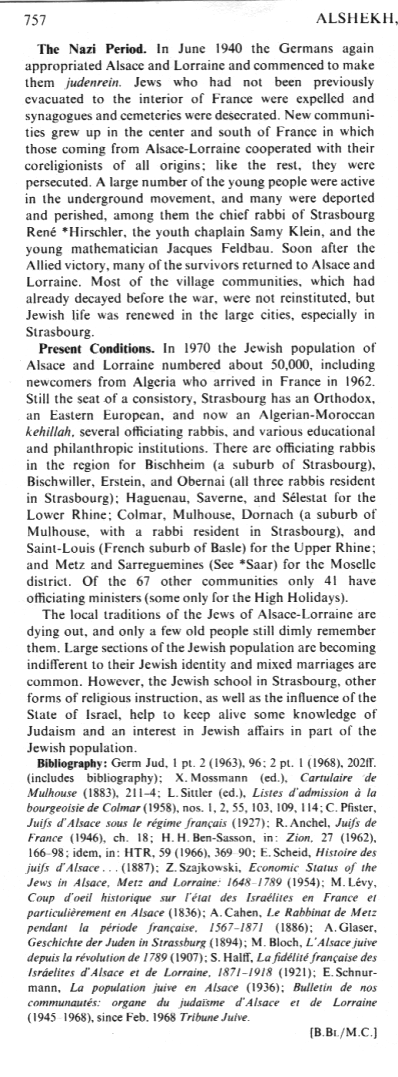
In June 1940 the Germans again appropriated Alsace and Lorraine and commenced to make them judenrein.
[[The "Christian" civilians of Alsace-Lorraine were declared Germans and were draft into the German army (Wehrmacht)]].
Jews who had not been previously evacuated to the interior of France were expelled and synagogues and cemeteries were desecrated. New communities grew up in the center and south of France in which those coming from Alsace-Lorraine cooperated with their coreligionists of all origins, like the rest, they were persecuted.
A large number of the young people were active in the underground movement, and many were deported and perished, among them the chief rabbi of Strasbourg René *Hirschler, the youth chaplain Samy Klein, and the young mathematician Jacques Feldbau. Soon after the Allied victory, many of the survivors returned to Alsace and Lorraine. Most of the village communities, which had already decayed before the war, were not reinstituted, but Jewish life was renewed in the large cities, especially in Strasbourg.
[[Discriminations, badge, ghettos and deportations as any Holocaust numbers are missing in this article. The concentration camps in Alsace-Lorraine are not mentioned. There can also be assumed that many Jews changed names or succeeded in emigrating overseas when they had fled to South of France. There seems to be missing much in this article]].
Present Conditions.
[Influx of Jews from Algeria in 1962 - Orthodox, Eastern European and Algerian-Moroccan Jews - rabbinates]
In 1970 the Jewish population of Alsace and Lorraine numbered about 50,000, including newcomers from Algeria who arrived in France in 1962. Still the seat of a consistory, Strasbourg has an Orthodox, an Eastern European, and now an Algerian-Moroccan kehillah [[congregation]], several officiating rabbis, and various educational and philanthropic institutions.
There are officiating rabbis in the region for Bischheim (a suburb of Strasbourg), Bischwiller, Erstein, and Obernai (all three rabbis resident in Strasbourg); Haguenau, Saverne, and Sélestat for the Lower Rhine; Colmar, Mulhouse, Dornach (a suburb of Mulhouse, with a rabbi resident in Strasbourg), and Saint-Louis (French suburb of Basle) for the Upper Rhine; and Metz and Sarreguemines (See *Saar) for the Moselle district. Of the 67 other communities only 41 have officiating ministers (some only for the High Holidays).
The local traditions of the Jews of Alsace-Lorraine are dying out, and only a few old people still dimly remember them. Large sections of the Jewish population are becoming indifferent to their Jewish identity and mixed marriages are common. However, the Jewish school in Strasbourg, other forms of religious instruction, as well as the influence of the State of [[racist Zionist Free Mason CIA Herzl]] Israel, help to keep alive some knowledge of Judaism and an interest in Jewish affairs in part of the Jewish population.
Teilen / share:
Bibliography.
-- Germ Jud, 1 pt. 2 (1963), 96; 2 pt. 1 (1968), 202 ff. (includes bibliography)
-- X. Mossmann (ed.): Cartulaire de Mulhouse [[Booklet about Mulhouse]] (1883), 211-4
-- L. Sittler (ed.): Listes d'admission à la bourgeoisie de Colmar [[Admission list to bourgeois of Colmar]] (1958), nos. 1, 2, 55, 103, 109, 114
-- C. Pfister: Juifs d'Alsace sous le régime français [[Jews of Alsace under French rule]] (1927)
-- R. Anchel: Juifs de France [[Jews in France]] (1946), ch. 18
-- H. H. Ben-Sasson, in: Zion, 27 (1962), 166-98
-- idem, in: HTR, 59 (1966), 369-90
-- E. Scheid: Histoire des juifs d'Alsace... [[History of the Jews of Alsace]] (1887)
-- Z. Szajkowski: Economic Status of the Jews in Alsace, Metz and Lorraine: 1648-1789 (1954)
-- M. Lévy: Coup d'oeil historique sur l'état des Israélites en France et particulièrement en Alsace [[Historical blink on the Israeli state in France and specially on Alsace]] (1836)
-- A. Cahen: Le Rabbinat de Metz pendant la période française, 1567-1871 [[The Metz rabbinate during the French period]] (1886)
-- A. Glaser: Geschichte der Juden in Strassburg [[History of the Jews in Strasburg]] (1894)
-- M. Bloch: L'Alsace juive depuis la révolution de 1789 [[Jewish Alsace since the revolution in 1789]] (1907)
-- S. Halff: La fidélité française des Israélites d'Alsace et de Lorraine, 1871-1918 [[French fidelity of the Alsace and Lorraine Israelites]] (1921)
-- E. Schnurmann: La population juive en Alsace [[Jewish population in Alsace]] (1936)
-- Bulletin de nos communautés: organe du judaisme d'Alsace et de Lorraine [[Community Journal: Jewry organ of the Alsace and Lorraine]] (1945-1968), since Feb. 1968: Tribune Juive [[Jewish Tribune]]
[B.BL / M.C.]> (col. 757)
Sources
Encyclopaedia Judaica (1971): Alsace, vol. 2, col. 751-752
Encyclopaedia Judaica (1971): Alsace, vol. 2, col. 753-754
Encyclopaedia Judaica (1971): Alsace, vol. 2, col. 755-756
Encyclopaedia Judaica (1971): Alsace, vol. 2, col. 757
Č Ḥ Š Ṭ Ẓ Ž
ā ȧ ć č ḥ ī š ū ž ẓ
^