Encyclopaedia Judaica
Jews in France 02: Crusade persecutions and expulsions
Collaboration libel 1007-1012 because of the Sultan - 1st crusade persecution - 2nd crusade contribution - stake, prison, expulsion - crusade against Albingenses - expulsion from rural spots in 1283 - stake 1288 - general expulsion order in 1306 - expulsion 1322 - Black Death expulsions - general expulsion in 1501 - numbers
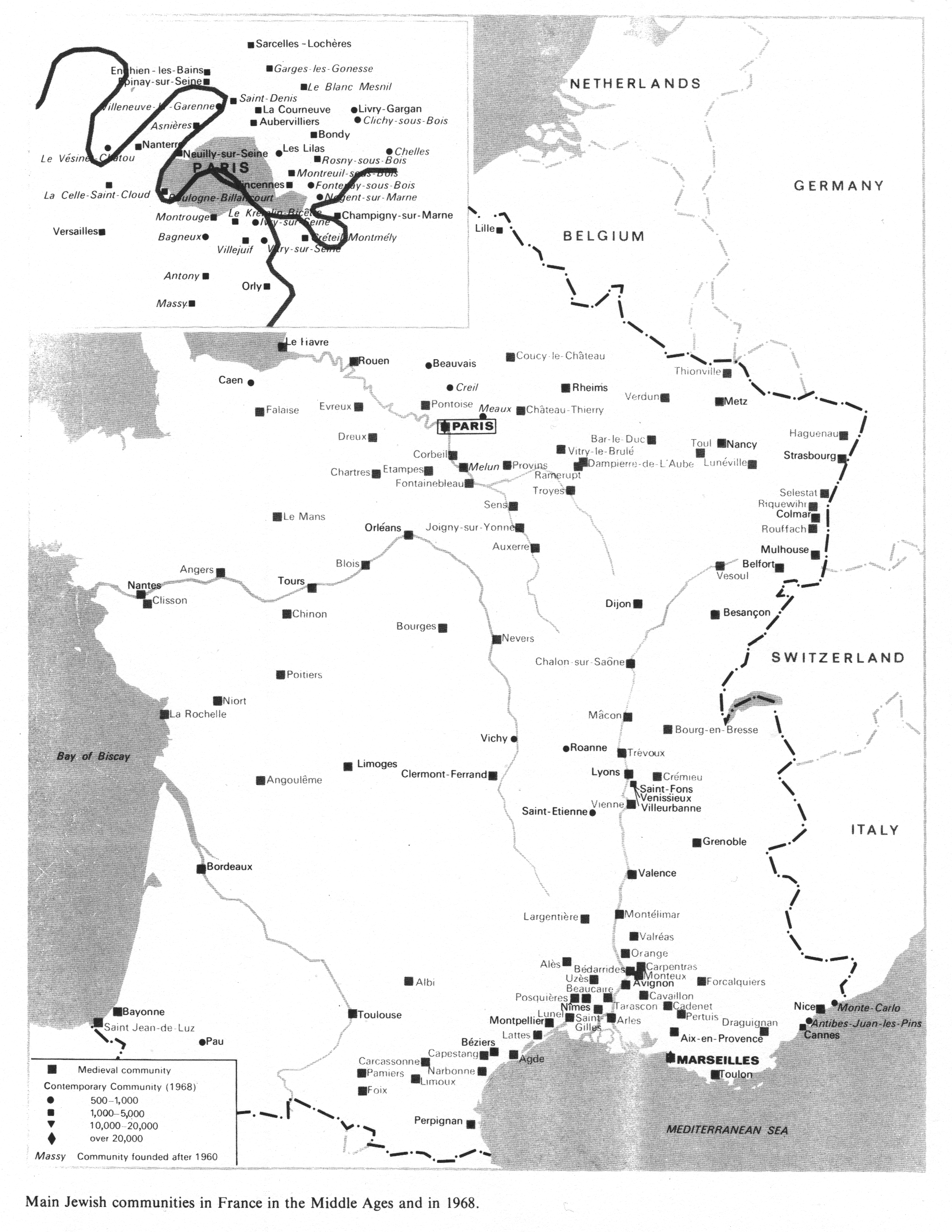
Encyclopaedia Judaica (1971): France, vol. 7, col. 11-12. Map with the
main Jewish communities in France in the Middle Ages and in 1968
from: France; In: Encyclopaedia Judaica 1971, vol. 7
presented by Michael Palomino (2008


| Teilen / share: |
Facebook |
|
Twitter
|
|
|
|
[Upheavals before the Crusades: persecutions 1007-1012 because of collaboration libel with the Sultan]
<The racial change in the situation resulted from the general upheaval which swept across the Christian West from the beginning of the 11th century and paved the way for the Crusades. Two local persecutions, in *Limoges at the end of the tenth and in the early 11th century, may be connected with the general persecution which raged through France from 1007 for at least five years. Launched by the clergy, it was rapidly supported by King Robert II the Pious (996-1031), then propagated by the general Christian population. The pretext for the riots was the accusation that the Jews of Orléans had joined in a plot against Christians with Sultan al-Hakim (al Ḥākim), who had indeed destroyed the Church of the Holy Sepulcher in Jerusalem. Thus the object of universal hatred, the Jews of France were then, if the sources are correct, either expelled from the towns, put to the sword, drowned in the rivers, or put to death in some other fashion [[manner]], the only exceptions being those who accepted baptism. When one of the Jewish notables of France, Jacob b. Jekuthiel, intervened with Pope John XVIII (1004-09), the latter sent a legate to France to put a stop to the persecutions. Those Jews who had been forced to accept baptism immediately returned to Judaism.
A similar situation arose in 1063: the "Spanish crusaders", who had set out to fight the Muslims, began by persecuting the Jews of southern France. On this occasion, however, they met with the opposition of the princes and the bishops, who were congratulated by Pope *Alexander II for their stand.
FROM THE FIRST CRUSADE UNTIL THE GENERAL EXPULSION FROM PROVENCE (1096-1501)
[First Crusade persecutions - heresy decree of Louis VII in 1144]
The First Crusade (1096-99) had little immediate effect on the situation of the Jews, but it was in France that the first murderous persecutions occurred, accompanied by forced conversions in *Rouen and Metz (but not in southern France, as some scholars have asserted recently). Although the brunt of the brutalities was borne by the Jews of Germany, it was in Rouen that the crusaders justified their persecutions of the Jews:
"If it is our desire [so they said] to attack the enemies of God after having covered lengthy distances toward the Orient while before our eyes we have the Jews, a nation whose enmity to God is unequaled, we will then follow a path which leads us backward."
The first written legal act of a king of France which is extant is *Louis VII's decree of 1144 in which he banished from his kingdom those Jews who had been converted to Christianity and later returned to Judaism, that is those who - from the Christian point of view - had "relapsed into heresy".
[Second Crusade: Jewish "contribution" - blood libel and Jews at stake: Blois 1171 - popular rumors and "Christians" educational traditions - wealthy Jews of Paris in prison 1181, confiscations and expulsion 1182 - persecution in Champagne in 1190 - return since 1198]
The Second Crusade (1147-49) gave rise to a controversy between *Bernard of Clairvaux and *Peter of Cluny on the question of the Jews; although they were spared the confiscation of all their belongings, as the abbot of Cluny had recommended in order to finance this expedition, they were nevertheless compelled to make a considerable financial contribution.
France's first *blood libel occurred in *Blois in 1171, when 31 Jews - men, women, and children - were burnt at the stake after a parody of a trial, and in spite of the fact that not even a body was produced as proof of the murder. A series of similar accusations followed in Loches, *Pontoise, Joinville, and Épernay. Although Louis VII declared to the leaders of the Jewish community of Paris when they appealed to him that he regarded the ritual murder accusation as pure invention and promised to prevent the renewed outbreaks of similar persecutions, popular rumors continued to indict the Jews. According to his biographer, King *Philip Augustus (1180-1223), when (col. 13)
only six years old, learned from his playmates that the Jews were in the habit of killing Christian children. The hatred thus nurtured prevailed, and he acted upon it soon after his accession to the throne. In 1181 he had all the wealthy Jews of Paris thrown into prison and freed them only in return for a huge ransom.
In the following year (1182) he decreed their expulsion from the kingdom and the confiscation of their real estate. If the number of Jews affected by this measure was comparatively small, this was the result of the small size of the actual kingdom of France and the lack of royal authority over the nobles of the neighboring provinces, where the exiles found immediate refuge. Such a haven, however, was not always safe from the tenacious hatred of the king of France. Thus, in 1190, he pursued the Jews in Champagne (in *Bray-sur-Seine or in Brie-Comte-Robert) and exterminated a whole community which had the temerity to condemn one of his subjects to death for assassinating a Jew.
Driven by financial considerations, Philip Augustus authorized the return of the Jews to his kingdom in 1198, extorting from them what profit he could. Possibly another concern was also involved: from 1182 Philip Augustus had considerably expanded his territory. In all the lands incorporated within the kingdom, he found Jews living among a population which raised no objection to their presence, and he might have seriously angered the populace by expelling the Jews. Since he tolerated the Jews in the newly acquired parts of his kingdom, their banishment from its heart was no longer justified. Two months after their readmission, the king reached an agreement with Thibaut II, count of Champagne, on the division of their respective rights over the Jews living in their territories.
[Third Crusade - crusade against Albigenses with bad effects also against Jewish communities]
The Third Crusade (1189-92), which had such grave consequences for the Jews of England, did not affect those of France, but the crusade against the *Albigenses in southern France also spelled ruin to the Jewish communities. That of *Béziers, in particular, morned many victims when the town was taken in 1209; the survivors crossed the Pyrenees and reestablished their community in *Gerona.
[Persecutions and expulsions 1226-1270 - Talmud burning in Paris in 1242 - Louis IX and Alphonse of Poitiers financing the Third Crusade by robbing the Jews]
During the reign of *Louis IX (1226-70), severe anti-Jewish persecutions took place in 1236 in the western provinces, in Brittany, Anjou, and Poitou, which were not subject to the direct authority of the monarch. In 1240 Duke Jean le Roux expelled the Jews from Brittany. During the same year the famous disputation on the Talmud took place in Paris. Properly speaking, it was a trial of the Talmud inspired by a bull issued by *Gregory IX in 1239. The verdict had already been given in advance: the Talmud was to be destroyed by fire, a sentence which was carried out in 1242.
In Dauphiné, which was still independent of the kingdom, ten Jews were burned at the stake in *Valréas in 1247 following a blood libel. Anti-Jewish agitation which resulted in the imprisonment of Jews and the confiscation of their belongings spread to several places in Dauphiné. There is no reason to believe that Louis IX had intended to expel the Jews or that he had even issued an order to this effect. Yet his brother, *Alphonse of Poitiers, to whom the king had ceded the government of several provinces, ordered the expulsion of the Jews from Poitou in July 1249.
However, the order was not rigorously applied or it took effect for a brief period only. Nevertheless, the territory governed by Alphonse was the scene of the first local expulsion: from Moissac in 1271. Louis IX and Alphonse of Poitiers rivaled one another in their brutal methods of extorting money from the Jews. The king, ostentatiously scrupulous of benefiting from money earned through the sin of usury, dedicated it to the financing of the Crusade. With the same pious motive Alphonse of Poitiers incarcerated all the Jews of his provinces so that he could lay his hands on (col. 14)
[Expulsion of the Jews from rural localities under Philip III the Bold in 1283 - blood libel in Troyes with Jews at stake in 1288 - expulsions in Gascony and Anjou]
their possessions with greater ease. *Philip III the Bold, who reigned from 1270, was responsible for a widespread migration of the Jews when he forbade them, in 1283, to live in the small rural localities. The accession of *Philip IV the Fair (1285) was ushered in by the massacre of *Troyes, once more following on a blood libel; several notables of the community were condemned and burned at the stake in 1288.
In 1289, first *Gascony (which was an English possession) and then Anjou (governed by the brother of the king of France) expelled the Jews.
In 1291, Philip the Fair hastily published an ordinance prohibiting the Jews expelled from Gascony and England from settling in France.
[[In 1291 the criminal Church lost the last town in Palestine. The Crusader States were gone. As a revenge for the defeat the criminal Church installed the inquisition system over Europe]].
[Host desecration libel in Paris 1290 - general expulsion order of 1306: confiscations and all Jews in prison - asylum in Belgium, Germany, Italy and Spain - fight about the profit]
Although Philip the Fair denied the clergy in general (1288) and the inquisitors in particular (1302) any judicial rights over the Jews, this was not the better to protect them but merely because he objected to sharing his authority in any way. It was therefore probably royal judges who tried the first *host desecration cases brought against several Jews of Paris in 1290. (col. 15)
From 1283, as a result of the prohibition on residing in small places, the communities in the towns grew larger. The total number of Jews continued to increase, and some have estimated that about 100,000 Jews were affected by the expulsion of 1306. (col. 18)
In order to guarantee the greatest financial gain from the expulsion order of 1306, Philip the Fair issued oral instructions only. After the imprisonment of all the Jews (July 22, 1306) and the seizure of their belongings, numerous written ordinances were issued by the royal chancellery in order to secure for the king, if possible, the sum total of the spoils. Over this very question of the Jews, the resurgent royal authority was revealed; indeed, the expulsion order won the successive support of an ever-growing number of lords until its provisions even spread to the territories of those lords who had not been (col. 15)
consulted. As well as in the provinces which still evaded royal authority - Lorraine, Alsace, Franche-Comté, Savoy, Dauphiné, Provence with the principality of *Orange and Comtat Venaissin, the counties of *Roussillon and Cerdagne (Cerdaña) - the Jews banished from France found asylum on the present territories of Belgium, Germany, Italy, and Spain. Philip the Fair granted safe-conducts to a number of Jews to enable them to stay in his kingdom or return to it; they were to assist him in collecting the debts which had been seized. In 1311 they too were "permanently" expelled.
Although the expulsion itself encountered scarcely any objections on the part of the lords, this was far from the case when the king tried to seize all the booty for himself: bitter disagreements often followed, as in Montpellier.
[Decree for coming back in 1315 - new massacres under Philip V the Tall - mania in the population against Jews - expulsion in 1322]
The recovery of all the spoils was still far from complete when *Louis X the Quarreler (1314-16), son and successor of Philip the Fair, considered allowing the Jews to return (May 17, 1315), which actually came into effect before July 28, 1315. A decree of that date, repudiating the "evil advisers" who had incited his father to expel the Jews and justifying Louis' decision to recall them because of the "general clamor of the people", defined the conditions of Jewish residence for a 12-year period.
Under Philip V the Tall (1316-22) anti-Jewish massacres were perpetrated by the "Pastoureaux in 1320, and the Jews of *Toulouse and areas to the west of the town suffered heavily. There the king, his officers, and the church authorities combined in efforts to suppress the movement, principally because it was a serious threat to the social order. Popular mania against lepers spread to the Jews in several places in 1321, particularly in *Tours, *Chinon, and Bourges (or elsewhere in Berry). Without even a legal pretext, Jews were put to death in all these places, 160 in Chinon alone. As well as the confiscation of the belongings of the Jews thus "brought to justice", an immense fine was imposed on the whole of French Jewry. The expulsion - no text of the decree ordaining it remains - took place between April 7 and Aug. 27, 1322.
[Further persecutions and expulsions 1338-1347 - Black Death persecutions in eastern and southeastern France with imprisonment and confiscations - coming back]
In 1338 and 1347 over 25 Jewish communities of Alsace were the victims of persecutions which were limited to the eastern regions. On the other hand, the massacres connected with the *Black Death (1348 and 1349), struck Jewish communities throughout the eastern and southeastern regions, notably in Provence, Savoy, Dauphiné, Franche-Comté, and Alsace. It was only due to the intervention of the pope that the Jews of Avignon and Comtat Venaissin were spared a similar fate. In Franche-Comté, after they had been accused of spreading the plague, the Jews were imprisoned for long periods and their possessions confiscated; they were expelled in 1349, although they reappeared there at the latest in 1355. In that same year Dauphiné was practically incorporated withing the kingdom of France, yet the Jews of this province continued to enjoy their former freedoms and immunities.
[Jewish taxes for financing the depths of the king: Charles V - and new expulsion under Charles VI in 1394]
The crown never revealed the financial motive behind the readmission of the Jews so blatantly as in 1359. *Charles V (1364-80), regent for his father John II the Good who was held prisoner in England, then authorized their return for a period of 20 years simply in order to use the taxes to enable him to pay his father's ransom. Following the example of Louis the Quarreler, he allowed the Jews to reside in France for limited periods only, although in his case the residence periods which had been granted were more faithfully abided by. In 1360 John the Good (1350-64) ratified the authorization granted by his son.
When Charles V succeeded to the throne, he confirmed, in May 1364, the 20 years which were initially granted and prolonged the period by six years, then by a further ten (col. 16)
years in October 1374.
When *Charles VI (1380-1422) took over the government himself, in February 1388 and March 1389, he ratified the prolongations granted by Charles V; he did not ratify either the five or the six years accorded by Louis of Anjou, acting as regent for him (1380-88). Thus, after the decree of Sept. 17, 1394, stipulating that thenceforward the Jews would no longer be tolerated in the kingdom of France, the departure of the Jews became effective in 1395 (between January 15 and March 18), 36 years after the first concession for a new residence period granted by Charles V. Properly speaking, this was not actually an expulsion but rather a refusal to renew the right of residence. However, obviously it resulted in the departure of the Jews from the kingdom of France.
[Charles VI: Pogroms 1380 and 1382 - Jews coming back - decisions of the towns since 1389 - Languedoc rule in 1394 - expulsion of the Jews of Franche-Comté in 1394]
From 1380 the Jews were the victims of bloody persecutions, which followed in the wake of popular risings in several towns of the kingdom, especially in Paris and Nantes. There was a similar occurrence in 1382. Although the king exempted the Jews from returning the pawns which had been stolen from them on this occasion, he also granted a hasty pardon to the rioters.
In 1389 the king allowed the town of Eyrieu the right of deciding for itself whether it would admit the Jews or not; although such a prerogative was subsequently granted to the towns of Alsace in general, this was at that time an exception within the kingdom. There was, however, no reason to regard this as a harbinger of the forthcoming generalized departure of the Jews.
On the contrary, as late as July 15, 1394, the king issued a reasonably favorable decree to the Jews of Languedoc.
When Charles VI terminated the residence of the Jews in his kingdom on September 17, he claimed that there had been "several grave complaints and outcries" concerning "the excesses and misdemeanors which the said Jews had committed and they continued to act in this manner every day against the Christians". He added that investigations had confirmed that the Jews had "committed and perpetrated several crimes, excesses, and offenses", particularly against the Christian faith, but such a justification for his action does not seem plausible. However, on this occasion there was no financial motive behind the expulsion, for it was not accompanied by confiscations. The move therefore remains inexplicable. This time the Jews of Franche-Comté shared the fate of their brothers in the kingdom, although the province did not then belong to the king of France. (col. 17)
[15th and 16th century]
[Dauphiné]
From the second half of the 14th century, the voluntary movement of Jews from Dauphiné assumed ever greater proportions. The dauphin attempted to coax them back by offering fiscal advantages, but without success. By the early 16th century no more Jews lived in Dauphiné.
[Savoy]
In Savoy the situation of the Jews deteriorated throughout the 15th century, especially during the reign of René I the Good (1431-80), was a favorable period for the Jews, aside from a few local incidents, for example in *Aix-en-Provence in 1430.
[General anti-Jewish atmosphere in whole France since 1475 - general expulsion in 1501]
Conditions changed from 1475 on when, for the first time since the Black Death, there were anti-Jewish outbreaks in several places. Between 1484 and 1486 attacks against the Jews occurred in numerous localities (notably in Aix, Marseilles, and Arles). After Provence was incorporated in France (1481), town after town demanded the expulsion of the Jews until the last remaining Jews were hit by a general expulsion order in 1498 which was completely enforced by 1501. There were therefore practically no Jews left within the present borders of France, with the exception of Alsace and Lorraine, Avignon, Comtat Venaissin, and the county of Nice.> (col. 17)
[Numbers]
*Benjamin of Tudela records valuable details on the southern communities of the third quarter of the 12th century. According to his figures - confirmed for Narbonne by other contemporary sources - in six communities there were 1,240 heads of families, that is more than 6,000 souls. Another document of the same period, the list of the martyrs of *Blois, notes there were about 30 families or about 150 souls in this community, which would have been totally unknown if it had not been for the tragedy which befell it. The greatest number and widest dispersion of Jews in France was attained during the third quarter of the 13th century. There were about 150 localities inhabited by Jews in Île-de-France and Champagne, about 50 in the duchy of Burgundy, about 30 in Barrois - in spite of its small area - and many others.
From 1283, as a result of the prohibition on residing in small places, the communities in the towns grew larger. The total number of Jews continued to increase, and some have estimated that about 100,000 Jews were affected by the expulsion of 1306.
Migration resulting from this banishment and the losses during the Black Death - both by the plague itself and in the persecutions which it sparked off - considerably reduced the Jewish population until the middle of the 14th century. There was a slight increase from then on, especially after the authorization to return in 1359. However, after the 1394 / 95 expulsion from the kingdom of France and the subsequent expulsions from the other provinces or voluntary departures due to hostile pressure combined with ever greater fiscal extortions, only about 25,000 Jews at the most remained during the 15th century. By 1501 they numbered a few thousand only. If Catholic missionary activity did achieve some tangible results - due mostly to coercion if not outright violence - this was the least factor in the demographic decline of the Jewish community. (col. 18)
| Teilen / share: |
Facebook |
|
Twitter
|
|
|
|