Encyclopaedia Judaica
Jews in France 08: Holocaust 1940-1944
The Big Flight to South of France of 1940 - German Nazi occupation - discrimination step by step 1940-1942 - structures of the Jewish organizations - the Vichy zone - concentration camps in France and in Africa - resistance and hideouts
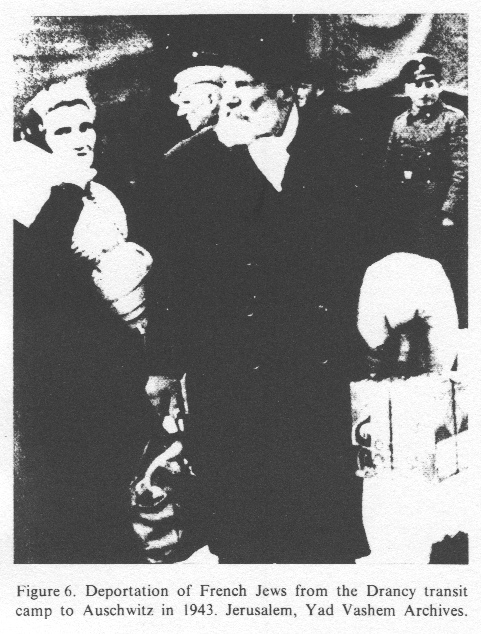
Encyclopaedia Judaica (1971): France, vol. 7, col. 31. Deportation of French Jews from the
Drancy transit camp to Auschwitz in 1943. Jerusalem, Yad Vashem Archives.
from: France; In: Encyclopaedia Judaica 1971, vol. 7
presented by Michael Palomino (2008)


| Teilen / share: |
Facebook |
|
Twitter
|
|
|
|
<Holocaust Period.
[The Big Flight to South of France of 1940]
On May 10, 1940, the Germans invaded France.
[[There was a big movement in France against the Jewish governments. And there was also a bad feeling about the Treaty of Versailles. So, a big part of the French army did not fight but let occupy the country without any fight]].
*Paris fell on June 14. The armistice, which was signed two weeks later, divided France into an unoccupied zone, an occupied zone (subdivided into the "general" and "forbidden" zones and several restricted areas), and into the departments of Nord and Pas-de-Calais attached to the Militaerverwaltung [[military administration]] in Brussels, while Alsace-Lorraine was annexed to the Reich.
[[Add to this South East France was occupied by Italian troops until the defeat of Italy in September 1943. The "Christian" civilians of Alsace-Lorraine were declared Germans and were draft into the German army (Wehrmacht)]].
No official figures exist on the number of Jews living in France in this period, since Jews were not singled out in the census and the documents on official and illegal entry or departure of refugees offer no satisfactory proof. It is estimated that about 300,000 (col. 32)
Jews lived in France prior to the invasion
[[with Jewish refugees from Poland, Netherlands and Belgium, eventually also Czech Jews. There was a big flight movement from the German part of France to the not occupied part of South of France. The future borderlines of parted France probably were published unofficially by secret services]]:
[[...]] Some were from Belgium and the Netherlands, but the majority were refugees from Germany who had arrived in France after the invasion of May-June 1940, there were also about 7,000 German Jews from Baden, Wuerttemberg, the Saar, and the Palatinate [[Pfalz]] expelled to France in the autumn of 1940 during the so-called Buerckel-Aktion, as well as a few hundred Jews from Luxembourg, shipped off to France under similar conditions.
The great majority of these refugees went to the unoccupied southern part of France, where they joined several thousand French Jews who had also fled from the Germans. The cities of Toulouse, Marseilles, Lyons, and Nice thus had large Jewish concentrations, but also smaller towns, such as Limoges and Périgueux, sheltered thousands of Jews. (col. 34) [[...]]
[[see for example: *Bordeaux. Add to this also many non-Jewish Frenchmen had fled to South of France. The towns of South of France were full, and in the towns in the German occupied zone were lots of flats empty for the Germans...]]
[Combination of German Nazi occupation and French anti-Semitism - 85,000-90,000 deported Jews]
The Jews in France suffered from the combined impact of the Nazi "*Final Solution" and from traditional French anti-Semitism. By and large, French anti-Semitism did not tend to physical extermination, but its existence unquestionably helped the Nazis in carrying out their scheme. An estimated 85,000-90,000 Jews were deported (the former figure is more probable); barely 3,000 of these survived. (col. 33)
[[The French police [["police nationale"]] and the French railway SNCF and their staff gave decisive assistance to the deportations]].
In addition, a few thousand Jews were deported or executed for political and resistance activities without, however, having been singled out as Jews by the occupying powers. (col. 33)
[[The general development of the German Nazi occupation in France 1940-1944
During the first days of the German occupation in summer 1940 there was a leisure atmosphere en Paris because there was hardly no traffic. Pedestrians and bicycles had free way in whole Paris. The German soldiers had a favorable exchange rate and purchased and consumed what they could. Lots of French women were serving in German sex business serving German soldiers ("Wehrmachtsbordell") and lots of Frenchmen went to Germany for work for German Mark (Reichsmark) in the hope that there would be a fast victory against Stalin's Soviet Union. The atmosphere in occupied France became harsh with the actions of resistance with explosions and attacks, above all after the German defeat of Stalingrad. The German occupation regime answered with mass shootings as a revenge. During the last years 1943-1945 a big hunger was coming up in France because the German occupation brought all products to the Front against Russia or at least left for the French population only agricultural products without quality. The populations did not know that both sides - the Third Reich as Stalin's Soviet Union - were decisively financed by "US" banks...]]
ANTI-JEWISH MEASURES AND ADMINISTRATION.
[Discrimination of the Jews step by step 1940-1942 - laws, ordinances, and deportations]
The main legal and juridical anti-Jewish measures initiated after the subjugation were:
-- the first Verordnung (Ordonnance) of Sept. 27, 1940, ordering a census of the Jews;
-- the law of the Vichy government (Oct. 4, 1940), on the status of foreign nationals of Jewish "race";
-- the second Verordnung (Oct. 18, 1940), requiring the declaration of Jewish enterprises and appointment of so-called provisional administrators over them;
-- the third Verordnung (April 26, 1941), extending the discriminatory category of "Jew" to groups of persons of Jewish origin who were not of the Jewish faith, and forbidding a number of economic activities;
-- the fourth Verordnung (May 28, 1941), forbidding free negotiation of Jewish-owned capital;
-- an unnumbered Verordnung (Aug. 13, 1941), for the confiscation of radios in Jewish possession;
-- the fifth Verordnung (Sept. 28, 1941), blocking the proceeds from the forced sale of Jewish property;
-- the proclamation of the Militaerbefehlshaber Frankreich (Dec. 14, 1941), announcing inter alia a fine of 1,000,000,000 francs, to be paid by the Jewish population;
-- the execution of 53 Jewish members of the Resistance, and the deportation of 1,000 Jews (in fact, 1,100 Jews were actually deported on March 27, 1942, as a result of the proclamation);
-- the sixth Verordnung (Feb. 7, 1942), establishing a curfew for Jews between 8 p.m. and 6 a.m., as well as forbidding change of residence;
-- the seventh Verordnung (March 24, 1942), enlarging still further the scope of the definition of "the Jews";
-- the eighth Verordnung (May 29, 1942, enforced as from June 1, 1942), ordering all Jews to wear a yellow *badge;
-- and the ninth Verordnung (July 8, 1942), forbidding Jews access to public places, squares, gardens, and sport grounds, and limiting them to one hour daily in which they might make their purchases in shops and food markets. (col.33)
[Discrimination in the Vichy zone]
The German Verordnungen [[Ordonnances]] were valid only in the occupied zone; even after the occupation of the while of France [[after September 1943]] they were not extended to the newly occupied areas. Thus, for instance, the yellow badge never became compulsory in southern France. The statutes, laws, and ordinances of the Vichy government, on the other hand, were valid throughout France, as was the rubber stamp Juif ("Jew") on identity cards. Whereas German measures were directed without exception against all Jews, the Vichy measures mainly affected Jews who were either foreign nationals or stateless, and later Jewish immigrants who had recently become French nationals. French Jews of long standing were generally spared, sometimes by means of the exceptions made in favor of ex-servicemen and individuals of outstanding merit.
[Government structures: French government - Judenrat]
In occupied France, the Gestapo and specifically the Paris extension of *Eichmann's IV B (the latter already functioning in August 1940 and led by SS-Hauptsturmfuehrer Theodor *Dannecker), from Jan. 28, 1941, onward attempted to create a twin structure throughout France (including the unoccupied zone): a French government anti-Jewish agency and an all-French *Judenrat, to act as the French counterpart of the Gestapo's IV B branch and of the *Reichsvereinigung der Juden in Deutschland [[Reich union of Jews in Germany]] respectively. (col. 33)
Their success in these undertakings was relative. After much German pressure, the Vichy government in April 1941 set up the *Commissariat Général aux Questions Juives [[General Office on Jewish Questions]], headed by Xavier *Vallat, an extreme-right member of parliament. Vallat was a French politician and an anti-Semite in the French tradition, according to which Jews were responsible for the very existence of democracy and the Third Republic which were "undermining" France.
[Vichy-France with a Commissariat under the anti-German Xavier Vallat - and under the German friendly Darquier de Pellepoix]
Being disabled ex-serviceman and head of an important extreme-right organization of disabled soldiers, Vallat felt himself obliged to come to the help of Jews belonging to this category. Furthermore, as a Frenchman of the conservative camp, he was near to Pétain and no friend of Germany. He remained one year at the head of the Commissariat and had to leave when declared persona non grata by the German authorities. During this tenure of office, until May 1942, the Commissariat rarely acted outside the occupied zone, and even then limited its work, by and large, to the "aryanization" of Jewish businesses.
Vallat was succeeded by *Darquier de Pellepoix, a rabid anti-Semite, reputed from prewar years to be a Nazi agent. Whereas Vallat was known to be personally honest, Darquier was considered both corrupt and mentally deranged. The Commissariat continued its activities, though without much help from the Vichy government. In a joint maneuver, the Commissariat and the German authorities pressured the Vichy government to bring about the mass cancellation of the naturalizations of foreign Jews (dating back to 1927), but they failed due to the obstinacy first of Pétain and then even of Pierre *Laval.
[Vichy France creating a General Union for Jews]
The Vichy government created an official body called *Union Générale des Israélites de France (UGIF) [[General Union of the Israelites of France]] in 1941 to represent French Jewry during the German occupation. It had two divisions - one in the occupied zone and one in the free one.
DEPORTATIONS AND FORCED LABOR.
[Gestapo against French Jews - French police against non-French Jews - roundups ("Aktionen") - concentration camps - forced labor in France and in North Africa]
In practice, the Germans could not always insist on their policy against all Jews because the Vichy authorities, particularly the police, though prepared to enforce the regulations to persecute "foreign" Jews, were often reluctant to act against French Jews. For that reason, any Aktion against French Jews was executed by the Gestapo itself, whereas the roundups of non-French Jews ordered by the German authorities were carried out by the French police.
In the main roundup, which took place on July 16-17, 1942, in Paris and its suburbs, about 12,884 people of all ages were arrested. Many more "Aktions" took place both before and after the main roundup. One of the most notorious was that of Aug. 15, 1942, carried out entirely by the Vichy police in the unoccupied zone, at which time over 7,000 foreign Jews were arrested and handed over to the Germans. Many of these Jews had not lived in France prior to the war. (col. 34)
[[...]]
The refugees from abroad, except for a small number of particularly well-to-do, were liable to be interned either in detention camps, mainly at
Saint-Cyprien,
Gurs,
Vernet,
Argelès-sur-Mer,
Barcarès,
Agde,
Nexon,
Fort-Barraux, (col. 34)
and Les Milles,
or in smaller so-called Détachements de prestataires de travail, i.e., forced labor detachments. Thousands of foreign Jews who had volunteered in 1939-40 for the French army were not demobilized after the armistice, but kept for a time in similar forced labor battalions, both in continental France and in North Africa (Djerada, Djelfa, and on the Mediterranean-Niger railway project). Their living conditions were hardly better than those of criminals sentenced to terms of hard labor, nor was their work very different.
[Camps for foreign Jews - transit camp Drancy]
There were two main concentration camps for foreign Jews, *Pithiviers and Beaune-la-Rolande near Paris, and a few smaller ones.
*Drancy, a northern suburb, was the main transit camp to *Auschwitz [[and from there to the tunnel systems]].
A few Jews were deported from the Compiègne camp and a few deportation trains left from Pithiviers, Beaune-la-Rolande, and such towns as Angers, Lyons, and Toulouse, but the majority of convoys was dispatched from Drancy.
[[French police [[police nationale]] and the French railway SNCF were willingly collaborating for the deportations]].
Deportations came in several waves, beginning on March 27, 1942, and was largely handled by the military administration. The second deportation during the summer and fall of 1942 followed the main roundup throughout the country; a third wave during the spring of 1943 came after the clearance and destruction of the Vieux-Port quarter of Marseilles; a fourth wave in the fall of 1943 followed the occupation of the former Italian zone, where many Jews had found sanctuary from November 1942 until Sept. 8, 1943, when the Germans entered that zone (southeast France). They rounded up all the Jews they could find, and in Nice alone about 6,000 Jews (out of 25,000) were deported.
[[or]]:
Within five months, 5,000 Jews were caught and deported. A great number of others were martyred in Nice itself. (see: *Nice, vol. 12, col. 1136)
[[The camps and forced labor on the Western Wall ("Westwall") with it's defense systems and rocket bunker systems is missing in this article]].
RESCUE AND RESISTANCE.
[Jewish structures for emigration for overseas - resistance - racist Zionist in resistance groups - assistance for hideouts]
Jewish institutions, such as *HICEM, helped a few of the foreign Jews to emigrate overseas; the French rabbinate arranged for religious and social assistance, carried out in part by rabbis active in the resistance movement, such as René *Kappel and others in the [[racist]] Zionist-oriented groups which recruited considerable numbers of resistance members; other institutions cared for the social and physical well-being of the internees in France.
The traditional Jewish organizations continued their activities mainly in southern France. This was true both for the official framework of religious communities called *Consistoire Israélite [[Israelite Consistory]] and the Fédération des Sociétés Juive de France [[Federation of Jewish Societies of France]] consisting of immigrant Jews. The last carried out extensive activities for mutual aid and, as the persecution became more severe, these were transformed into resistance activities (falsification of identity and ration cards, of addresses, and help to fugitives from deportation).
The Jews of France played an outstanding role in the resistance movements, both in the general movements of all types and political opinion - from the right wing through the Communist and even Trotskyist groups - and within purely Jewish groups, set up through Jewish organizational affinities (e.g., Zionist) or through outside influences (Communist Jewish groups). The [[racist]] Zionist youth movements established a united [[racist]] Mouvement des Jeunesses Sionistes (M.J.S.) [[Young Zionist Movement]], which became the nucleus of the Armée Juive (A.J.) [[Jewish Army]] and later on of the Organisation Juive de Combat (O.J.C.) [[Jewish Fighting Organization]].
Initially, the French-Jewish scout movement was, however, not insensitive to the Vichy ideology and particularly to the myth of Marshal Pétain; but when the deportations commenced in 1942, the myth was dispelled and the scouts played a major part, first in hiding hundreds of children, and then in the armed resistance movement, where together with the Armenia Juive they established the O.J.C. Robert Gamzon (Castor), the national director of the Jewish Boy Scouts of France (Eclaireurs Israélites de France - E.I.F.), largely contributed to this evolution.
[Hideouts of the French population for the Jews against the Pétain policy]
There was never any serious difficulty in hiding children (col. 35)
with French families in the country and even in towns. Nor did adult Jews find it impossible to hide themselves in French villages or families. On the whole, the behavior of the French population toward the persecuted Jews was overwhelmingly positive. Many people, initially in sympathy with Pétain, were no longer so when they saw the yellow badge in the streets, and particularly when they realized that every single Jews - who often became known as such precisely because he wore the badge - including women and even children, was liable to arrest and deportation to an unknown destination. There were very few denunciations of Jews, and they were certainly less frequent than the denunciations of resistance fighters. [[...]]
The rescue of children was by and large initiated by Jews, in which activity the Gentiles of necessity played a main role. A notable role was played by the scouts and *OSE (very often involving the same people), in a lesser measure by *WIZO in the Paris area, and, foremost of all, by communist Jewish groups, which succeeded in creating the Mouvement National contre le Racisme (M.N.C.R.) [[National Movement against Racism]], most of whose active members were non-communist Frenchmen. [[...]]
[French Church with good words - hideouts for Jews in convents and monasteries]
The Catholic Church as such disapproved of application of the anti-Jewish measures and particularly the deportations, although it did not denounce the anti-Jewish decrees as a whole. Alerted by Jewish circles, a number of higher ecclesiastics, such as the future cardinals Saliège and Théas, strongly condemned from the pulpit the deportations of the Jews. Many priests acted similarly, while convents and monasteries offered shelter to Jews, particularly to children. The Church as such did not attempt to proselytize Jewish children. The Protestant churches, numerically very small in France, were even more actively opposed to the persecution of Jews. The Protestant Cévennes area in Central France became a center for active rescue of Jews. [[...]]
[L.ST.]> (col. 36)
[[85,000-90,000 Jews had been deported (col. 33). Unfortunately there are no numbers indicated how many Jews could emigrate or were rescued by hiding or by forged identity papers]].
| Teilen / share: |
Facebook |
|
Twitter
|
|
|
|