|
|
|


Encyclopaedia Judaica
Jews in Grenoble
Jewish settlement - expulsion in 1306 and partly coming back - Black Death persecutions in 1348 with Jews on stake - short re-settlement in 1717 with expulsion - definitive re-settlement since 1791s - resistance center during WW II - Jewish refugees after 1945 and from northern Africa
from: Grenoble; In: Encyclopaedia Judaica 1971, vol. 8
presented by Michael Palomino (2008)

| Teilen / share: |
Facebook |
|
Twitter
|
|
|
|
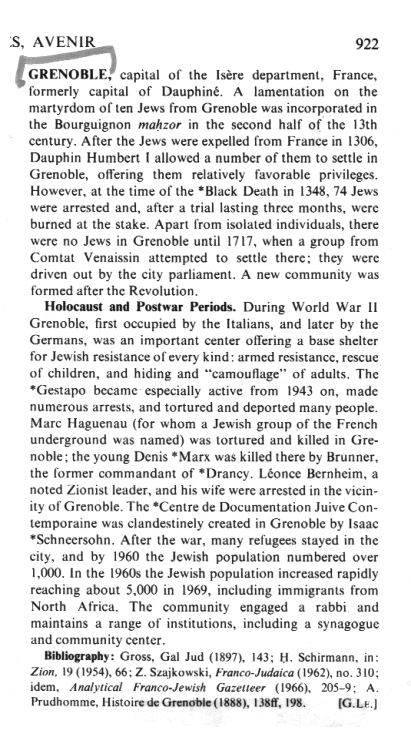
<GRENOBLE, capital of the Isère department, France, formerly capital of Dauphiné.
[Jewish settlement - expulsion in 1306 and partly coming back - Black Death persecution in 1348 with Jews on stake - short re-settlement in 1717 with expulsion - definitive re-settlement since 1791s]
A lamentation on the martyrdom of ten Jews from Grenoble was incorporated in the Bourguignon mahzor (maḥzor) [[prayer book for high holidays]] in the second half of the 13th century.
After the Jews were expelled from France in 1306, Dauphin Humbert I allowed a number of them to settle in Grenoble, offering them relatively favorable privileges.
However, at the time of the *Black Death in 1348, 74 Jews were arrested and, after a trial lasting three months, were burned at the stake.
Apart from isolated individuals, there were no Jews in Grenoble until 1717, when a group from Comtat Venaissin attempted to settle there; they were driven out by the city parliament.
A new community was formed after the Revolution.
Holocaust and Postwar Periods.
[Resistance center for weapons, children and hiding - Nazi occupation with Gestapo and deportations 1943-1944]
During World War II Grenoble, first occupied by the Italians, and later by the Germans, was an important center offering a base shelter for Jewish resistance of every kind: armed resistance, rescue of children, and hiding and "camouflage" of adults. The *Gestapo became especially active from 1943 on [[after the defeat of Italy and the German occupation of the rest of France]], made numerous arrests, and tortured and deported many people. Marc Haguenau (for whom a Jewish group of the French underground was named) was tortured and killed in Grenoble; the young Denis *Marx was killed there by Brunner, the former commandant of *Drancy, Léonce Bernheim, a noted [[racist]] Zionist leader, and his wife were arrested in the vicinity of Grenoble.
The *Centre de Documentation Juive Contemporaine [[Present Jewish Documentation Center]] was clandestinely created in Grenoble by Isaac *Schneersohn.
[Post-war period with Jewish refugees from 1945 and from North Africa]
After the war, many refugees stayed in the city, and by 1960 the Jewish population numbered over 1,000. In the 1960s the Jewish population increased rapidly reaching about 5,000 in 1969, including immigrants from North Africa. The community engaged a rabbi and maintains a range of institutions, including a synagogue and community center.
Bibliography
-- Gross, Gal Jud (1897), 143
-- H. Schirmann, in: Zion, 19 (1954), 66
-- Z. Szajkowski: Franco-Judaica (1962), no. 310
-- idem: Analytical Franco-Jewish Gazetteer (1966), 205-9
-- A. Prudhomme: Histoire de Grenoble (1888), 138 ff., 198
[G.LE.]> (col. 922)
| Teilen / share: |
Facebook |
|
Twitter
|
|
|
|