|
|
|


Encyclopaedia Judaica
Jews in Lyon
Jews since 39 by Caligula - Christians at Jewish religious services - first anti-Jewish agitation since 820 appr. - expulsion in 1420 - new Jews probably from Spain and Portugal - and from other regions of France - cemetery - numbers - rabbis - NS times: Lyon is a "free town" - center of Jewish organizations and racist Zionist organizations - center of resistance against NS government - arrests, torture, deportations, final action at Bron - 1945-1970: immigration from North Africa
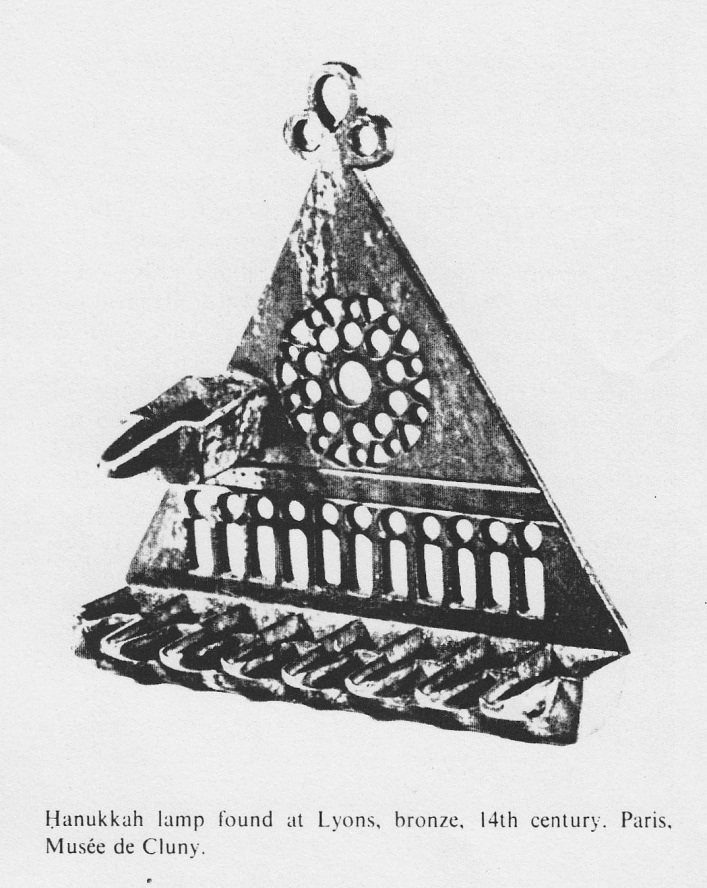
Encyclopaedia Judaica: Jews in Lyon, vol. 11, col. 624, ḥanukkah lamp found at Lyons, bronze, 14th century. Paris, Musé de Cluny
from: Lyon; In: Encyclopaedia Judaica 1971, vol. 11
presented by Michael Palomino (2008)

| Teilen / share: |
Facebook |
|
Twitter
|
|
|
|
<LYON, capital of the Rhône department, E. central France.
[Jews since 39 by Caligula]
According to a medieval Jewish legend one of the three boats loaded with Jewish captives taken at the fall of Jerusalem docked at Lyon. Herod Antipas, tetrarch of Galilee, was exiled to the city by Caligula in 39 C.E. Lyon seems to have had a Jewish population in the second century but little more is known until the beginning of the ninth century when there was a large, prosperous, and powerful Jewish community in the city.
The Jews owned slaves and also employed a number of Christian laborers in their homes and commercial or agricultural enterprises. The wine they produced was sold to Christians too, who also were customers of the Jewish butchers. The Jews, who were among the purveyors to the imperial palace, received luxurious clothing from the ladies of the court as gifts for their wives. Some Jews were employed in public service, especially as collectors of imposts and taxes.
[Christians at Jewish religious services]
Their religious services also appear to have been attended by Christians, who declared that they preferred the preaching of the Jews to that of the Catholic priests. such opinions could only have been an extreme irritant to the bishop. *Agobard, who had hoped to find a receptive ear to the Christian message among the Jews.
[First anti-Jewish agitation since 820 appr.]
A first attempt involving the use of a measure of force - around 820 at leading Jewish children to Christianity encountered determined resistance from the parents and the vigorous intervention of the emperor. *Louis the Pious had to intervene on several other occasions against this troublesome bishop, when necessary dispatching his special envoys in charge of Jewish affairs, the missi or magister Judaeorum.
*Amulo, Agobard's successor, also attempted to oppose the Jews of Lyon, but without success.
In the Middle Ages the Jews lived in the Rue Juiverie at the foot of Fourvière hill. When they were expelled in 1250 they were living in the present rue Ferrachat. for a century Jews only visited Lyon for short periods, but in the second half of the 14th century there (col. 623)
were once more Jewish settlers in the city, contributing toward the municipal taxes, and special officials were appointed with jurisdiction over them.
[Expulsion in 1420]
As the city was not part of the Kingdom of France this new community was not affected by the expulsion order of 1394, but they were expelled some years later, probably in 1420; most of them moved to neighboring Trévoux.
[New Jews probably from Spain and Portugal - and from other regions of France - cemetery]
From the 16th century, Jews reappeared in Lyon sporadically as merchants at the fiars and probably also as correctors of Hebrew printing. A group of Jews arrived in Lyon in 1548 (perhaps from Spain and Portugal), but they too were forced to leave. Apparently Joseph *Nasi opened a bank there for some time, but it was closed down by Henri II. A community was gradually formed, consisting of families from Comtat Venaissin, Alsace, and Bordeaux, but mainly from Avignon.
In 1755, the community officially requested permission to open a cemetery. At first they purchased space in the vaults of the city hospital. Twenty years later they were able to purchase a cemetery at La Guillotière. Nevertheless, the number of Jews remained insignificant, and they had no synagogue or permanent prayer room. [B.BL.]
The community was attached to the *consistory of Marseilles in 1808. With the influx from Alsace and Lorraine the numbers rose to 300 in 1830, and 700 in 1840, the majority living in very modest circumstances and inhabiting two mean quarters in the Rue Lanterne and Rue de la Barre. From 1838 a prosperous industrialist, Samuel Heyman de Ricqulès, was leader of the community: he attempted to endow schools and charitable institutions with the intention of reforming them, but in the face of general hostility he retired after a few years.
[Numbers - the Lyon community and it's rabbis in the region]
The number of Jews grew to 1,000 in 1848
and 1,200 in 1854.
The community acquired the services of a salaried rabbi in 1850 and in 1857 formed its own consistory, which also included Saint-Étienne (116 Jews), Chalon-sur-Saône (125), Besançon (379), and Montbéliard (202). Among its presidents were Solomon *Reinach and Generals Levy and Worms. Solomon *Munk represented Lyon at the Central Consistory. In 1864 the first synagogue was opened, on the Quai Tilsitt. At the beginning of the 20th century, with the arrival of (col. 624)
immigrants from the Mediterranean area, a Sephardi community was formed in the suburb of Saint-Fons. On the eve of World War II Lyon had 500-600 Jewish families.
[M.C.]
Holocaust and Postwar period.
[Lyon is a "free town" - center of Jewish organizations and racist Zionist organizations - center of resistance against NS government - arrests, torture, deportations, final action at Bron]
During the war Lyon, in the hart of France, was a "free" city after the Franco-German agreement (June 1940) and became a refuge for Jewish organizations, particularly the offices of the Central Consistory, and for philanthropic and [[racist Herzl anti-Muslim]] Zionist bodies. Information, official and unofficial, instructions to the Jewish communities in France, protests against anti-Jewish measures, and secret orders of the resistance all emanated from Lyon. A large number of Jewish leaders were arrested there. A center for Jewish studies for refugee intellectuals, to which Léon *Algazi notably contributed, and a reception center for Jewish physicians were set up in the city, on the initiative of *OSE. However, Lyon' most important role in the Occupation was that it provided sanctuary for large numbers of Jews. It was also a large center of the Jewish resistance, which not infrequently operated in total isolation, but sometimes gained the cooperation of Catholic and Protestant bodies, or of the civil and administrative authorities. It was probably in Lyon that Catholic resistance to Nazi persecution was strongest, perhaps as a result of the pastoral letter which Cardinal Gerlier had read on Sept. 6, 1942, in all churches in Lyon and his diocese.
The Nazis [[and their French collaborators, above all French police]] fought ruthlessly against members of the resistance and Jews. The arrests, torture, and deportations reached a peak in August 1944. Prisoners from the "Jewish quarters" in the Monluc Fort prison were taken to Bron airfield to de-mine the area after the bombardment. After the war their remains, 109 bodies of both sexes, were uncovered.
[1945-1970: immigration from North Africa]
After the war many Jewish refugees settled permanently in Lyon, but the community, with an estimated 7,000 Jews was hardly any larger than in 1939. With the city's economic expansion and the influx of immigrants from North Africa, the Jewish population had increased to over 20,000 in 1969. In 1961 one of the first and foremost community centers in France was inaugurated in Lyon. A full-time school was maintained. The various community bodies - consistorial, Sephardi, and Orthodox - worked in close cooperation, and a new synagogue was inaugurated in 1966 in La Duchère, a new quarter of the city. A regional consistory was also founded in 1961. The community institutions included an ORT vocational school.
there were several congregations in the vicinity, notably at Villeurbanne, with a Jewish population of 1,800 and a synagogue built in 1965 with the help of Aktion Suehnezeichen ("Repentance Society"), a group of young Germans anxious to expiate Nazi crimes; and at Saint Fons-Vénissieux, with a Jewish population of about 1,200 industrial workers who settled there from North Africa between the world wars. they maintain a synagogue and community center.
[G.LE.]
Bibliography
-- A. Lévy: Notes about Israelis of Lyon (orig. French: Notice sur les Israélites de Lyon) (1894)
-- idem, in: Jewish Universe (orig. French: Univers Israélite), p.48-49 (1892/93-1893/94)
-- T. Reinach, in: REJ, 50 (1905), Ixxxi-cxi
-- S. Reinach: ibid., 51 (1906), p.245-50
-- B. Blumenkranz: Jews and Christians in occidental world (orig. French: Juifs et Chrétiens dans le monde occidental) (1960), index
-- A. Coville: Investigations about history of Lyon (orig. French: Recherches sur l'histoire de Lyon) (1928), p.538 ff.
-- J. Kling, in: Review about psychology of the peoples (orig. French: Revue de Psychologie des peuples), p.13 (1958), p.199 ff.
-- E. Dreyfus and L. Marx: About Jews of Lyon (orig. French: Autour des Juifs de Lyon) (1958)
-- F. Delpech, in: History books (orig. French: Cahiers d'Histoire) (1959), p.51 ff.
-- H. Amoretti: Lyon ... 1940-1944 (1964), p.142 ff.
-- Z. Szajkowski: Analytical Franco-Jewish Gazetteer (1966), p.252-253
| Teilen / share: |
Facebook |
|
Twitter
|
|
|
|