previous index
Encyclopaedia Judaica
Jews in Vilna (02): WWI - nationalism - Holocaust - Soviets
Vilna as a refugee center in World War I - national institutions 1922-1939 - sovietization 1940 - holocaust in World War II 1941-1944 with mass shootings at Ponary, ghetto fight and partisans - census of 1959 and 1970 - anti-Semitic campaigns since 1948
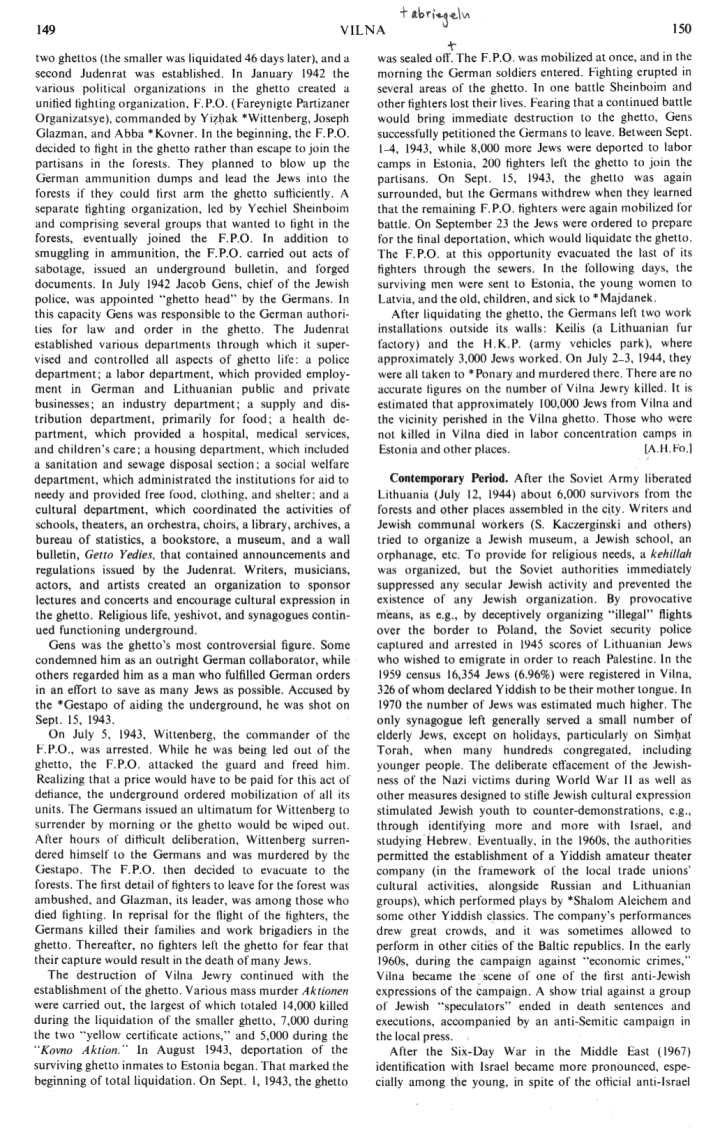
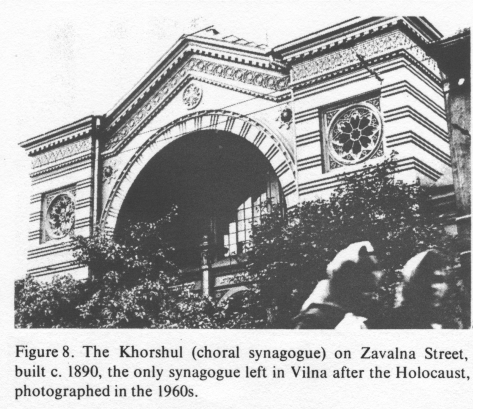
Encyclopaedia Judaica (1971): Vilna, vol.16, col. 145-146, photo 3: the Khorshul (choral synagogue) on Zavalna Street,
built c. 1890, the only synagogue left in Vilna after the Holocaust, photographed in the 1960s
from: Vilna; In: Encyclopaedia Judaica 1971, vol. 16
presented by Michael Palomino (2008)


| Teilen / share: |
Facebook |
|
Twitter
|
|
|
|
[World War I: Vilna as a Jewish refugee center 1914-1917 - the fight for Vilna 1919-1920]
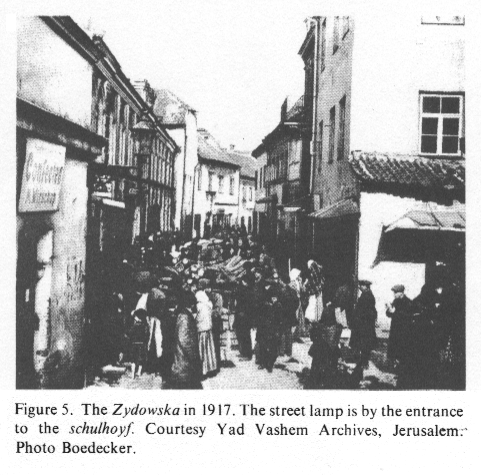
Encyclopaedia Judaica (1971): Vilna, vol.16, col. 141-142, photo 5: the Zydowska in 1917. The street lamp
is by the entrance to the schulhoyf. Courtesy Yad Vashem Archives, Jerusalem. Photo Boedecker
Vilna became a transit center and asylum for Jewish refugees from the vicinity during World War I. Under German occupation lack of food and discriminatory levies [[tax]] on the Jewish population made conditions increasingly difficult. The situation was not improved after the war when the struggle between the Poles and Lithuanians for the possession of Vilna (1919-20) entailed frequent changes of government. In April 1919, 80 Jews were massacred by Polish troops.
[[Military actions or murders by Jews are not mentioned in the article]].
[Jews in Polish Vilna 1922-1939 - cut connection to the Russian market - Jewish national institutions in Vilna]
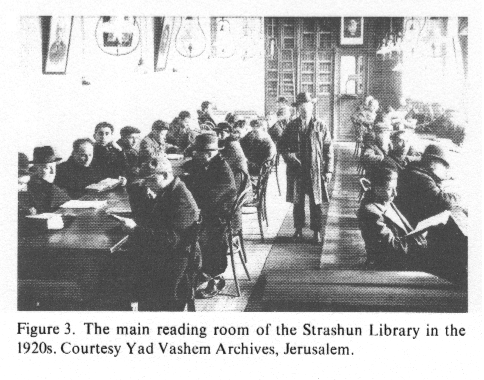
Encyclopaedia Judaica (1971): Vilna, vol.16, col. 141-142, photo 3: the main reading room of the
Strashun Library in the 1920s. Courtesy Yad Vashem Archives, Jerusalem
The interwar period from 1922 to 1939 was a time of fruitful and manifold social and cultural activities for Vilna Jewry, although Vilna, now part of Poland, was affected economically by the severance of its former ties with Russia and Lithuania.
[[There were national laws which permitted the Jews to be an own "nation" so there could be erected "Jewish national" institutions]].
According to the 1921 census, 46,559 Jews were living in Vilna (36.1% of the total population), and in 1931, 55,000 (28.2%). This period saw the establishment of a network of elementary and secondary schools in which Hebrew was either the language of instruction or the principal language, and of Hebrew and Yiddish teachers' seminaries and trade schools. Vilna was a world center for Yiddish culture, and a Yiddish daily and evening press, numerous weekly and other political, literary, educational, and scientific journals were published there.
The Jewish historical and ethnographical society, founded by S. *An-Ski, established a museum and archives in 1919. The *YIVO research institute for Yiddish language and culture was founded in Vilna in 1924. The institute attracted Yiddish scholars and authors, among them Zalman *Rejzen, Max *Weinreich, Z. *Kalmanowicz, and Max *Erik. The Yiddish writer Moshe *Kulbak lived in Vilna. A circle of young Yiddish authors (Yung Vilne) included Abraham *Sutzkever, Shemariah *Kaczerginski, and Hayyim (Ḥayyim) *Grade. Several poems of Zalman *Shneour, who stayed in Vilna for some time, express the glorious place of the city in Jewish life. Among its Hebrew scholars and writers were the linguist M.B. Shneider, S.L. *Zitron, and J.E. *Triwosch.
The strong anti-Semitism rife in Poland in the 1930s was especially noticeable in the university, where the Jewish students often had to organize in self-defense.
[I.K.] (col. 147)
Hebrew Printing. [Zionist press in Vilna 1900-1940]
In 1920 the firm [[the press of Abraham Zevi (Ẓevi) Rosenkranz and Menahem Schriftsetzer]] was bought up by A.L. Shalkowitz (Ben Avigdor). Among smaller presses that of Boris Kletzkin (d. 1938) employed more than 50 workers and printed some newspapers.
The Vilna presses made some very important contributions before being closed down. Romm's famous Mishnayot (vols. 2 and 5) were published in Vilna in 1938, one year before the Nazi invasion of Poland. Their Talmud and other rabbinic standard works continue to be reproduced photographically in a great variety of sizes and editions in Israel and the U.S.
[I.O.L.]
Holocaust Period.
[1939-1940: Vilna is a Jewish refugee center again]
With the outbreak of World War II, Soviet Russia invaded Vilna and in October 1939 ceded it to Lithuania. Jewish refugees from divided Poland - the German-occupied part and the Soviet-occupied one - found refuge in Vilna. Among the refugees were many rabbis (and hasidic (ḥasidic) rabbis), scholars, community and party leaders, as well as Zionists and members of Zionist youth movements who immediately organized into temporary "kibbutzim". By long and tortuous ways (even via the Far East), some succeeded in reaching Erez Israel (Ereẓ Israel).
[June 1940: Soviet occupation and sovietization - all Jewish institutions closed down - Stalin deportations]
In June 1940, Lithuania was annexed to the U.S.S.R. The Soviet authorities closed down Hebrew cultural institutions and [[racist]] Zionist organizations. All Yiddish press was replaced by the Communist Party's organ.
Many Jews - active [[racist]] Zionists, [[socialist]] Bundists, and [[capitalist, Darwinist]] "bourgeois" - were exiled in 1941 into the Soviet interior and many were interned in camps there [[Gulag system]]. Some active Yiddishists, including writers (Z. Rejzen, Joseph Chernikhov, and others), were arrested, deported to Russia, and murdered there.
[[The Big Flight from Barbarossa - the withdrawal of the Red Army with many Jews and Communists before the NS attack in June 1941 - is not mentioned in the article. Probably there were attacks against Jews after the withdrawal of the Red Army even before the German invasion]].
[Vilna under German NS occupation - mass shootings in Ponary]
In June 24, 1941, the Germans entered Vilna and were welcomed by the Lithuanian population with flowers and cheers.
[[The remaining anti-Communist population was glad that the Red Army had gone and that a national regime would be implemented]].
Persecution of Vilna's Jewish population (approximately 80,000) began immediately. Prior to the establishment of the ghetto, about 35,000 Jews were murdered in *Ponary, a wooded area 10 mi. from Vilna. Among them were leaders of the Jewish community and members of the first *Judenrat.
[Ghettos since 6 Sept. 1941 - partisan movement F.P.O. - smuggling, underground press, forged documents]
On Sept. 6, 1941, the remaining Jews were herded into (col. 148)
two ghettos (the smaller was liquidated 46 days later), and a second Judenrat was established. (col. 149)
[[...]]
The destruction of Vilna Jewry continued with the establishment of the ghetto. Various mass murder Aktionen were carried out, the largest of which totaled 14,000 killed during the liquidation of the smaller ghetto, 7,000 during the two "yellow certificate actions", and 5,000 during the "Kovno Aktion" (col. 149)
[[...]]
In January 1942 the various political organizations in the ghetto created a unified fighting organization, F.P.O. (Fareynigte Partizaner Organizatsye), commanded by Yizhak *Wittenberg, Joseph Glazman, and Abba *Kovner. In the beginning, the F.P.O. decided to fight in the ghetto rather than escape to join the partisans in the forests. They planned to blow up the German ammunition dumps and lead the Jews into the forests if they could first arm the ghetto sufficiently. A separate fighting organization, led by Yechiel Sheinboim and comprising several groups that wanted to fight in the forests, eventually joined the F.P.O. In addition to smuggling in ammunition, the F.P.O. carried out acts of sabotage, issued in underground bulletin, and forged documents.
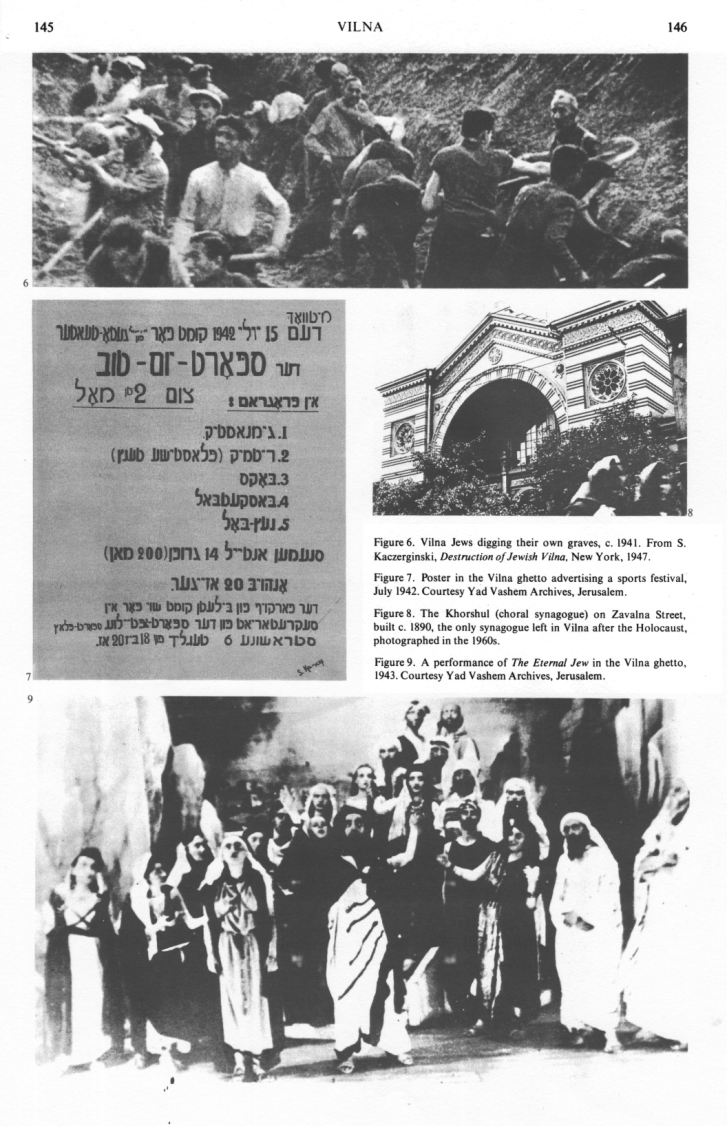
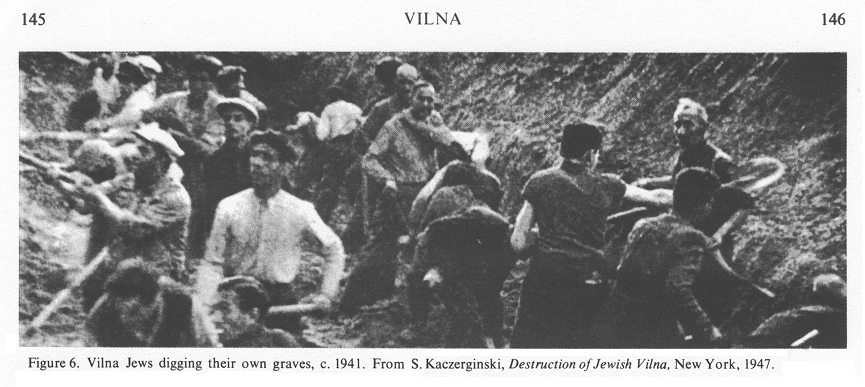
Encyclopaedia Judaica (1971): Vilna, vol.16, col. 145-146, photo 1: Vilna Jews digging their own graves,
c. 1941. From S. Kaczerginski: Destruction of Jewish Vilna; New York, 1947
[The Vilna Ghetto with it's departments under Jacob Gens since July 1942]
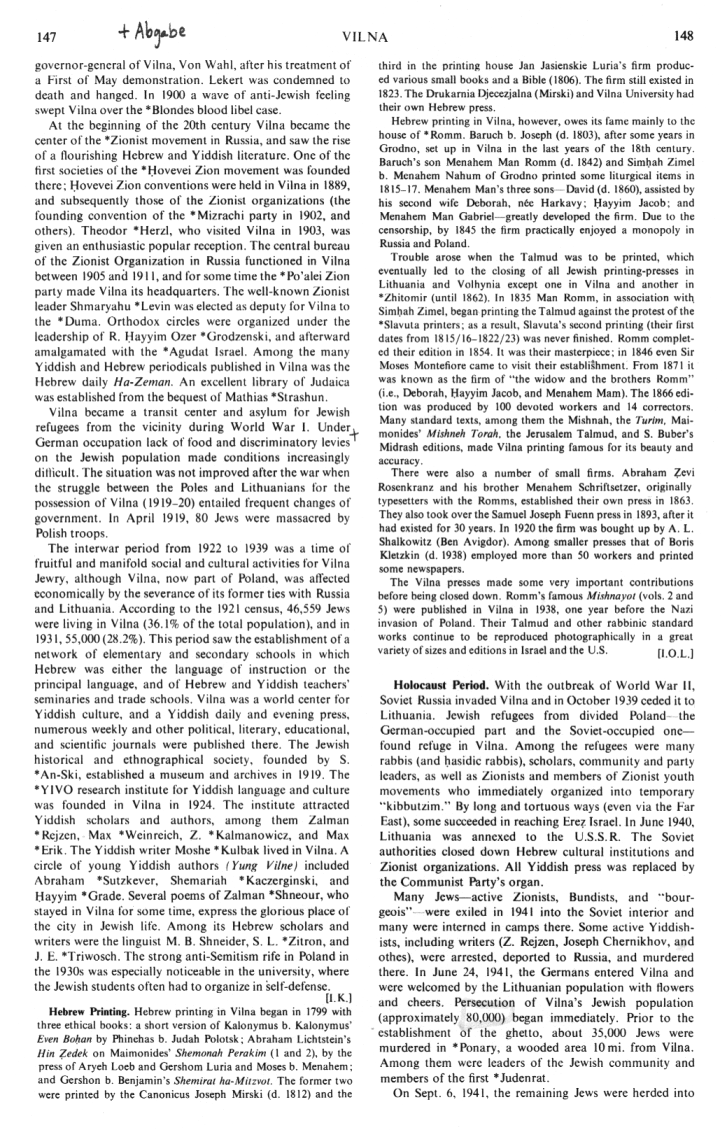
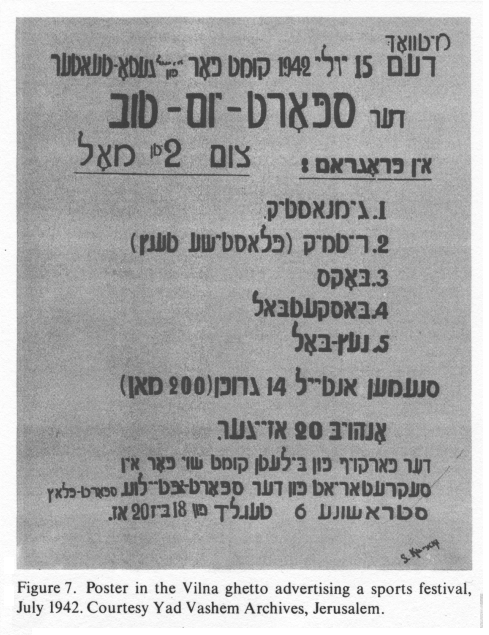
Encyclopaedia Judaica (1971): Vilna, vol.16, col. 145-146, photo 2: poster in the Vilna ghetto advertising
a sports festival, July 1942. Courtesy Yad Vashem Archives, Jerusalem
In July 1942 Jacob Gens, chief of the Jewish police, was appointed "ghetto head" by the Germans.IN this capacity Gens was responsible to the German authorities for law and order in the ghetto. The Judenrat established various departments through which it supervised and controlled all aspects of ghetto life:
-- a police department;
-- a labor department, which provided employment in German and Lithuanian public and private businesses;
-- an industry department
-- a supply and distribution department, primarily for food
-- a health department, which provided a hospital, medical services, and children's care
-- a housing department, which included a sanitation and sewage disposal section
-- a social welfare department, which administrated the institutions for aid to needy and provided free food, clothing, and shelter
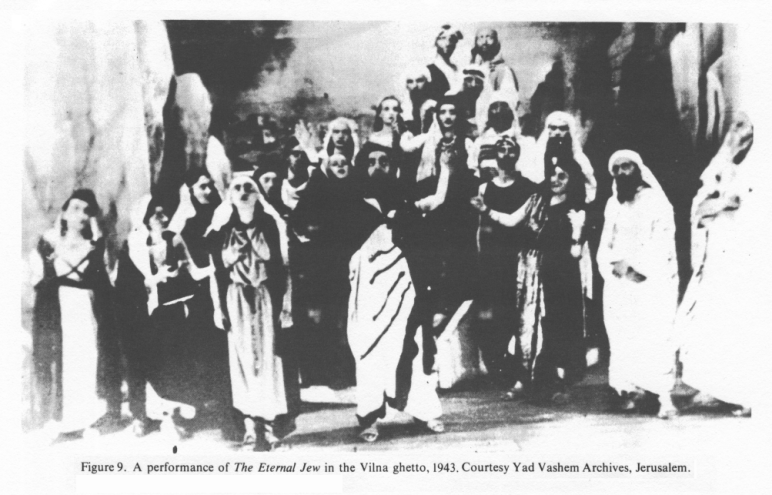
-- and a cultural department, which coordinated the activities of schools, theaters, an orchestra, choirs, a library, archives, a bureau of statistics, a bookstore, a museum, and a wall bulletin, Getto Yedies, that contained announcements and regulations issued by the Judenrat.
Writers, musicians, actors, and artists created an organization to sponsor lectures and concerts and encourage cultural expression in the ghetto. Religious life, yeshivot [[religious Torah schools]], and synagogues continued functioning underground. (col. 149)
[[...]]
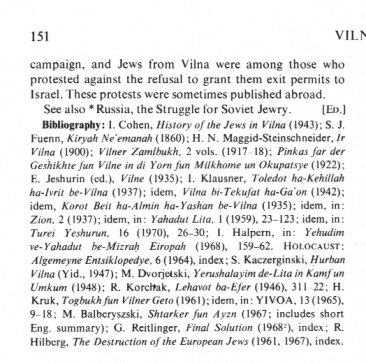
Encyclopaedia Judaica (1971): Vilna, vol.16, col. 145-146, photo 4: a performance of The Eternal Jew
in the Vilna ghetto 1943. Courtesy Yad Vashem Archives, Jerusalem
[The F.P.O. resistance of the ghetto against the NS forces]
On July 5, 1943, Wittenberg, the commander of the F.P.O., was arrested. While he was being led out of the ghetto, the F.P.O. attacked the guard and freed him. Realizing that a price would have to be paid for this act of defiance, the underground ordered mobilization of all its units. The Germans issued an ultimatum for Wittenberg to surrender by morning or the ghetto would be wiped out. After hours of difficult deliberation, Wittenberg surrendered himself to the Germans and was murdered by the Gestapo. The F.P.O. then decided to evacuate to the forests. The first detail of fighters to leave for the forest was ambushed, and Glazman, its leader, was among those who died fighting. In reprisal for the flight of the fighters, the Germans [[and their collaborators]] killed their families and work brigadiers in the ghetto. Thereafter, no fighters left the ghetto for fear that their capture would result in the death of many Jews. (col. 149)
[[...]]
[Since August 1943: deportation of the remaining Jews to Estonia - and the final fight about the ghetto - Gens shot on 15 September 1943 - the last deportation of Jews from Vilna - the last mass shooting in Ponary]
In August 1943, deportation of the surviving ghetto inmates to Estonia began. That marked the beginning of total liquidation. On Sept. 1, 1943, the ghetto (col. 149)
was sealed off. The F.P.O. was mobilized at once, and in the morning the German soldiers entered. Fighting erupted in several areas of the ghetto. In one battle Sheinboim and other fighters lost their lives. Fearing that a continued battle would bring immediate destruction to the ghetto, Gens successfully petitioned the Germans to leave. Between Sept. 1-4, 1943, while 8,000 more Jews were deported to labor camps in Estonia, 200 fighters left the ghetto to join the partisans.
On Sept. 15, 1943, the ghetto was again surrounded, but the Germans withdrew when they learned that the remaining F.P.O. fighters were again mobilized for battle. (col. 150)
Gens was the ghetto's most controversial figure. Some condemned him as an outright German collaborator, while others regarded him as a man who fulfilled German orders in an effort to save as many Jews as possible. Accused by the *Gestapo of aiding the underground, he was shot on Sept. 15, 1943. (col. 149)
On September 23 the Jews were ordered to prepare for the final deportation, which would liquidate the ghetto. The F.P.O. at this opportunity evacuated the last of its fighters through the sewers. In the following days, the surviving men were sent to Estonia, the young women to Latvia, and the old, children, and sick to *Majdanek.
After liquidating the ghetto, the Germans left two work installations outside its walls:
-- Keilis (a Lithuanian fur factory)
-- and the H.K.P. (army vehicles park), where approximately 3,000 Jews worked.
On July 2-3, 1944, they were all taken to *Ponary and murdered there. There are no accurate figures on the number of Vilna Jewry killed. It is estimated that approximately 100,000 Jews from Vilna and the vicinity perished in the villa ghetto. Those who were not killed in Vilna died in labor concentration camps in Estonia and other places.
[A.H.FO.]
Contemporary Period.
After the Soviet Army liberated [[occupated, Gulag system inclusive]] Lithuania (July 12, 1944) about 6,000 survivors from the forests and other places assembled in the city. Writers and Jewish communal workers (S. Kaczerginski and others) tried to organize a Jewish museum, a Jewish school, an orphanage, etc. To provide for religious needs, a kehillah [[congregation]] was organized, but the Soviet authorities immediately suppressed any secular Jewish activity and prevented the existence of any Jewish organization. By provocative means, as e.g., by deceptively organizing "illegal" flights over the border to Poland, the Soviet security police captured and arrested in 1945 scores of Lithuanian Jews who wished to emigrate in order to reach Palestine.
[[The return movement of Jews who had fled to central Russia is not mentioned. Also the number of Jews who had died in the Red Army is not mentioned in the article]].
[Countings 1959 and 1970]
In the 1959 census 16,354 Jews (6.96%) were registered in Vilna, 326 of whom declared Yiddish to be their mother tongue. In 1970 the number of Jews was estimated much higher.
[The struggle for Jewish cultural life since 1948 - anti-Semitic campaigns of the Soviet regime]
The only synagogue left generally served a small number of elderly Jews, except on holidays, particularly on Simhat Torah (Simḥat Torah), when many hundreds congregated, including younger people. The deliberate effacement of the Jewishness of the Nazi victims during World War II as well as other measures designed to stifle Jewish cultural expression stimulated Jewish youth to counter-demonstrations, e.g., through identifying more and more with Israel, and studying Hebrew.
Eventually, in the 1960s, the authorities permitted the establishment of a Yiddish amateur theater company (in the framework of the local trade unions' cultural activities, alongside Russian and Lithuanian groups), which performed plays by *Shalom Aleichem and some other Yiddish classics. The company's performances drew great crowds, and it was sometimes allowed to perform in other cities of the Baltic republics.
In the early 1960s, during the campaign against "economic crimes", Vilna became the scene of one of the first anti-Jewish expressions of the campaign. A show trial against a group of Jewish "speculators" ended in death sentences and executions, accompanied by an anti-Semitic campaign in the local press.
After the Six-Day War in the Middle East (1967) identification with Israel became more pronounced, especially among the young, in spite of the official anti-Israel (col. 150)
campaign, and Jews from Vilna were among those who protested against the refusal to grant them exit permits to [[racist Zionist Free Mason CIA Herzl]] Israel. These protests were sometimes published abroad.
See also *Russia, the Struggle for Soviet Jewry.
[ED.]
| Teilen / share: |
Facebook |
|
Twitter
|
|
|
|
Bibliography
-- I. Cohen: History of the Jews in Vilna (1943)
-- S.J. Fuenn: Kiryah Ne'emanah (1860)
-- H.N. Maggid-Steinschneider:
oo Ir Vilna (1900)
Vilner Zamlbukh, 2 vols. (1917-18)
oo Pinkas far der Geshikhte fun Vilne in di Yorn fun Milkhome un Okupatsye (1922)
-- E. Jeshurin (ed.): Vilne (1935)
-- I. Klausner: Toledot ha-Kehillah ha-Ivrit be-Vilna (1937)
-- idem: Vilna bi-Tekufat ha-Ga'on (1942)
-- idem: Korot Beit ha-Almin ha-Yashan be-Vilna (1935)
-- idem, in: Zion, 2 (1937)
-- idem, in: Yahadut Lita, 1 (1959), 23-123
-- idem, in: Turei Yeshurun, 16 (1970), 26-30
-- I. Halpern, in: Yehudim ve-Yahadut be-Mizrah Eiropah (1968), 159-62
HOLOCAUST
-- Algemeyne Entsiklopedye, 6 (1964), index
-- S. Kaczerginski: Hurban Vilna (Yid., 1947)
-- M. Dvorjetski: Yerushalayim de-Lita in Kamf un Umkum (1948)
-- R. Korchak: Lehavot ba-Efer (1946), 311-22
-- H. Kruk: Togbukh fun Vilner Geto (1961)
-- idem, in: YIVOA, 13 (1965), 9-18
-- M. Balberyszski: Shtarker fun Ayzn (1967; includes short Eng. summary)
-- G. Reitlinger: Final Solution (1968), index
-- R. Hilberg: The Destruction of the European Jews (1961, 1967), index (col. 151)>
Sources
Encyclopaedia Judaica (1971): Vilna, vol.16, col. 145-146, photos
Encyclopaedia Judaica (1971): Vilna, vol.16, col. 147-148
Encyclopaedia Judaica (1971): Vilna, vol.16, col. 149-150
Encyclopaedia Judaica (1971): Vilna, vol.16, col. 151