[Vilna as a "Jerusalem of
Lithuania"]
<VILNA (Pol. Wilno, Lithuanian Vilnius), from 1323
capital of the grand duchy of *
Lithuania;
since 1940 capital of the Lithuanian S.S.R.; called by East
European Jewry, especially in the modern period, the
"Jerusalem of Lithuania" (
Yerushalayim
de-Lita).
The Early Settlement.
[Jews permitted by
Sigismund I since 1527]
In 1527 the townsmen of Vilna obtained from the Polish king,
Sigismund I, the right to debar Jewish settlement there.
However, a number of individual Jewish residents are found
in the middle of the 16th century, including lessees of the
customs, mintmasters, moneylenders, and large-scale
merchants.
In 1551 royal permission was granted to two Jews and their
servants to lease out houses and shops, to do business in
the city as visiting traders, and to engage in pawnbroking.
In the same year Jews were permitted to reside in buildings
owned by members of the ducal council, which lay outside the
municipal jurisdiction.
[Jewish community in Vilna
documented since 1568 - tax regulations]
The first information of an organized Jewish community in
Vilna dates from 1568, when it was ordered to pay the poll
tax. According to tradition, a wooden synagogue was erected
in Vilna in 1573. As early as 1592 the street adjoining the
synagogue was called "Jew's Street". Although in that year a
mob attacked the Jews of Vilna and plundered shops and
houses of the Jews as well as the synagogue, in the
following year Sigismund II renewed the privileges
permitting Jews to engage in all branches of commerce,
distilling, and any crafts not subject to the guild
organizations, but restricting their place of residence in
the city. They were also granted permission to erect a new
synagogue, which was built of stone.
At the same time new (col. 138)
regulations limited to 12 the number of shops under Jewish
ownership which might be open to the street, and they might
be held for a term not exceeding ten years. The Jews were
exempted from payment of the municipal tax but instead were
obliged to pay 300 zlotys annually in peacetime and 500
zlotys in time of war.
During the first half of the 17th century the Vilna
community was augmented by arrivals from *Prague,
*Frankfort, and Polish towns, who included wealthy Jews and
scholars. The number of petty traders and artisans also
increased, and in this period about 3,000 Jewish residents
are recorded out of a total population of some 15,000.
Although the Vilna community, now an important Jewish
entity, claimed the status of a principal community, or
"community head of the courts" (kehillah rosh bet din),
within the organizational framework of the Council of
Lithuania (see *Councils of the Lands), the status was not
conceded until 1652.
[Economic crisis of 1630 -
Jewish regulations in 1634 - Chmielnicki massacres 1648-49
- flight from the Muscovites in 1655 - Russian occupation]
After 1630 the Vilna community suffered from the general
economic deterioration experienced by Lithuanian Jewry, as a
result of which the Council of Lithuania accorded it a
number of economic concessions in 1634. These subjected the
conduct of trade by "residents of the Land of Lithuania
visiting Vilna for the purposes of business" to detailed
regulation. An additional improvement was "permission to the
community of Vilna to undertake business in all the
townlets, villages, boroughs, and settlements" within the
jurisdiction of the other principal communities of
Lithuania.
A further financial burden for Vilna Jewry in 1648-49 was
the aid it gave to fugitives from the *Chmielnicki
massacres. Subsequently, in 1655, Vilna itself was
threatened by the armies of the Muscovites and nearly all
the Jewish inhabitants fled from the city. During the
Russian occupation the Jewish quarter was burned down in the
general conflagration that ensued. Three years later Czar
Alexis endorsed the Vilna municipal charter but banished the
Jews from the city precincts.
[Further riots against the
Jews since 1661]
With the rehabilitation of the community in 1661, the
leadership of Lithuanian Jewry passed to Vilna. The
hostility between the Jews and the townsmen continued,
fanned by the Jesuits and the reaction engendered by the
Counter-Reformation then prevailing throughout the realm. An
assault by townsmen on Jews who mustered for the census of
defenders of the city in 1681 was condemned by King John
Sobieski, who ordered the punishment of the guilty and freed
the Jews from the obligation of the city's defense in the
future. In 1687 a riot was instigated by Jesuit students,
artisans, and shopkeepers, evidently in an attempt to force
the distressed Jews to defray their debts. The material
damage was estimated at 120,000 zlotys. The municipality was
again served a stringent admonishment by the king, and
students and the nobility were forbidden to distrain debts
from Jews.
By 1690 there were 227 Jewish families resident in the
Jewish quarter of Vilna, while a similar number, perhaps
more, were living outside, in areas falling within the
jurisdiction of the magnates or government.
During the Northern War (1700-21) the Swedish invaders
levied heavy taxes on the Vilna community, now so
impoverished it was forced to place ritual objects in pawn
with Christians. In addition, the famine and plague rife in
the city took their toll. After the conflagration of (col.
139)
[[...]]
In 1712 a commission recommended the promulgation of
ordinances by the city council to limit the branches of
trade and crafts practiced by Jews and restrict the area of
Jewish residence. In 1713 the community board (
kahal), the organ of
Jewish self-government, was forced to bring actions against
a number of discriminatory measures passed by the
municipality. (col. 140)
[[...]]
[Vilna-Amsterdam connection
since 1737 - more licenses for Jews since 1738 - and
"Christian" fight against Jewish rights - new restrictions
against the Jews]
1737 the Vilna community turned to Jews abroad for relief,
and its emissaries received a generous response from the
Jews of Amsterdam. The opposition of the Christian merchants
and artisans to the Jews even continued in the 18th century.
(col. 140)
[[...]]
The charters of privileges conferred on Vilna Jewry were
confirmed in 1738 by Augustus III, who extended the license
to open shops to a term of 20 years and enabled Jews to deal
in alcoholic liquors and other commodities. The townsmen,
who lodged an appeal against the grant, managed to obtain a
judgment in 1740 recognizing the 1527 prohibition on Jewish
residence in Vilna, so that the Jews were again faced with
the danger of expulsion. Exhausting negotiations ensued, in
which the wealthy communal leader *Judah b. Eleazar took a
prominent part. The community was forced to consent to a
compromise agreement with stringent terms, including
restrictions on the plying of trade and crafts and on place
of residence. These the Jews were both unwilling and unable
to implement.
Litigation continued until a judgment was pronounced in 1783
which lifted the restriction on the occupations. The
limitation on their place of residence was also abrogated,
excepting two streets still barred to Jewish settlement.
Jews were now made subject to the same tax regulations as
other citizens and the annual poll tax was abolished.
During the uprising against Russia in 1794 a number of Vilna
Jews demonstrated their loyalty to Poland in the fighting
and the
kahal
[[assembly]] made contributions to the participants in the
uprising. Thirty Jews were killed in one of the suburbs
during the siege. After the conquest of the city by the
Russians, however, the Jewish position in commerce and
crafts improved. The Russian government abrogated the
jurisdiction of the municipal court over Jewish citizens and
rescinded the previous enactment of the Polish Sejm. The
1795 census shows 3,613 Jewish poll tax payers in Vilna and
its environs. (col. 140)
Scholarship and Communal
Affairs.
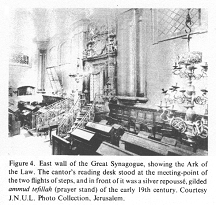
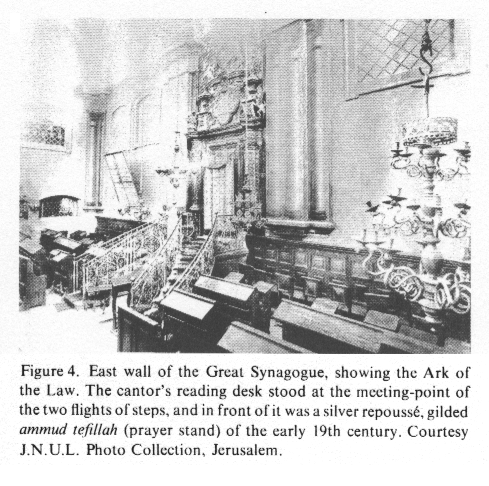
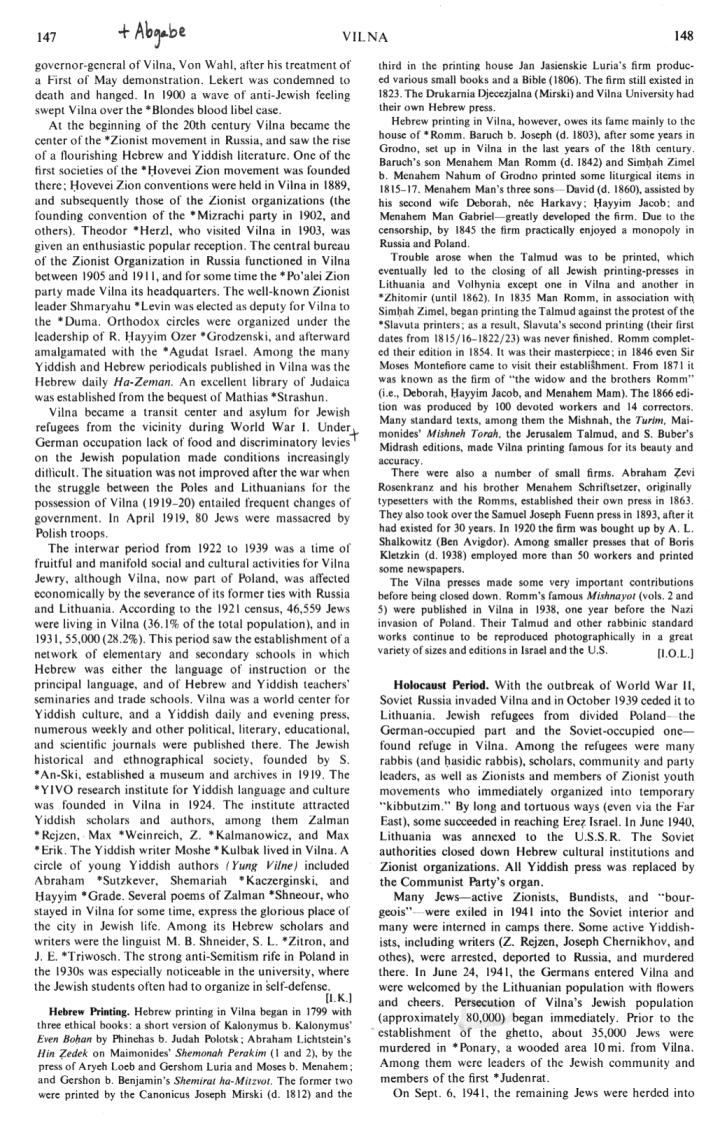
Encyclopaedia Judaica (1971): Vilna, vol.16, col. 141-142,
photo 4: east wall of the Great Synagogue, showing the Ark
of the Law.
The cantor's reading desk stood at the meeting-point of
the two flights of steps, and in front of it was a silver
repoussé,
gilded
ammud tefillah
(prayer stand) of the early 19th century. Courtesy
J.N.U.L. Photo Collection, Jerusalem
Vilna had already become a preeminent center for rabbinical
studies by the beginning of the 17th century. Among scholars
born in Vilna were *Joshua Hoeschel ben Joseph and
*Shabbetai ha-Kohen, who served as
dayyan [[judge]] of the community. The
rabbi of Vilna in the middle of the 17th century was Moses
b. Isaac Judah *Lima. The existence of a
talmud torah is
reported in the second half of the 17th century, when a fund
was also established by a philanthropist for the support of
students. Among the scholars of Vilna in the second half of
the 17th century and the beginning of the 18th were
-- R. Moses, called Kremer, a forefather of Elijah Gaon
-- his son-in-law Joseph, author of
Rosh Yosef, halakhic
and aggadic novellae (Berlin, 1716)
-- R. Baruch Kahana, known as Baruch Harif (Ḥarif)
-- the grammarian Azriel and his two sons Nisan and Elijah
-- and Zevi (Ẓevi) Hirsch *Kaidanover (Kaidany).
Also living in Vilna was the Gordon family of physicians,
one of whom, Jekuthiel *Gordon, studied medicine in Padua
and became influenced by the poet and kabbalist Moses Hayyim
(Ḥayyim) *Luzzatto, Joshua Heshel *Zoref (Ẓoref) of Vilna
was among the crypto-Shabbateans.
From the second half of the 18th century the personality and
activities of *Elijah b. Solomon Zalman, the "Vilna Gaon",
who attracted numerous disciples, had a lasting impact on
Vilna Jewry. The circle thus formed became the most
stimulating religious and spiritual center there and had a
profound influence on Judaism in the sphere of both
halakhah and Kabbalah.
(col. 140)
[Tensions within the Jewish
community of Vilna 1770-1790]
The 1770s and 1780s marked a period of acute social tension
for the Vilna community, expressed in a serious crisis over
the rabbinate. In 1740 *Samuel b. Avigdor was chosen as
rabbi of Vilna - partly because of the contributions to the
community made by his father-in-law Judah b. Eleazar (see
above). The fierce controversy that arose around the
personality, status, and aspirations of Samuel b. Avigdor
continued for 30 years and threatened the basis of communal
autonomy. Diverse social and ideological forces in the
community became implicated in the conflict, as well as
external bodies. The Jewish artisans of Vilna, now a strong
numerical force which remained without representation in
community affairs or the means of exerting influence, took
the side of the rabbi, as did also the Hasidim (Ḥasidim),
who afforded him surreptitious support, while a number of
powerful leaders in the community opposed him.
Non-Jewish elements that entered the arena included the
governor of Vilna, the bishop, and the crown tribunal. The
opposition accused the rabbi of accepting bribes, of unfair
decisions, and other practices. In theory the controversy
terminated with the removal of Samuel b. Avigdor from
office. However, the representatives of the popular faction
turned to the non-Jewish authorities and complained about
the way the
kahal
[[assembly]] was levying taxes. The Gaon of Vilna also
intervened. Simeon b. Wolf, the popular representative who
had been imprisoned by the governor in Nieswiez (Nesvizh),
applied to the Sejm with proposals for amending the
community organization; he also demanded that the
communities should be deprived of their secular authority,
leaving Jewish jurisdiction over religious matters only.
[Jewish Enlightenment
movement in Vilna - and persecution of the Hasidim
(Ḥasidim)]
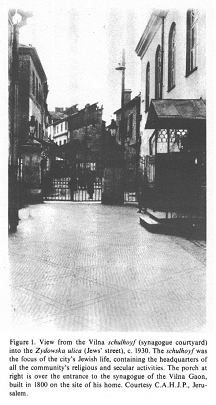
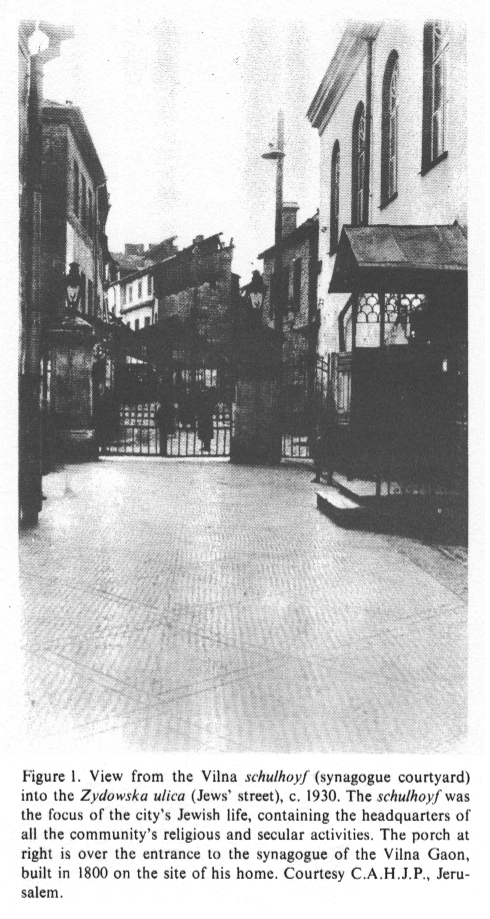
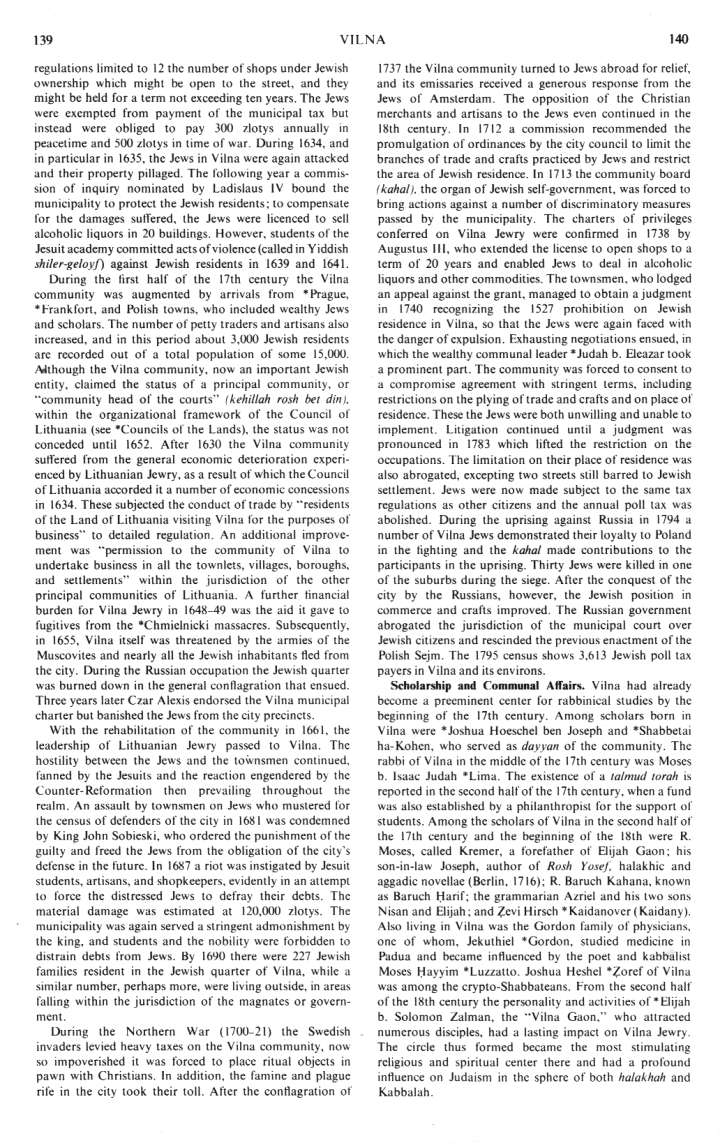
Encyclopaedia Judaica (1971): Vilna, vol.16, col. 141-142,
photo 1: view from the Vilna
schulhoyf (synagogue courtyard) into the
Zydowska ulica
(Jews' street), c. 1930. The
schulhoyf was the focus of the city's
Jewish life, containing the headquarters of all the
community's religious and secular activities. The porch at
right is over the entrance to the synagogue of the Vilna
Gaon, built in 1800 on the site of his home. Courtesy
C.A.H.J.P., Jerusalem
When the Enlightenment (*Haskalah) movement spread to Vilna
it did not encounter strong opposition from the leadership,
and to begin with was largely conservative in character.
About 14 important members of the community subscribed to
the commentary on the Torah, the
Be'ur initiated by Moses *Mendelssohn.
Typical of the first adherents of the movement (
maskilim) were the
physician and author Judah Leib ha-Levi *Hurwitz and Moses
*Meisel, the
shammash
[[salaried servant in a synagogue]] of the community, who
was acquainted with German literature and wrote several
treatises. He had access to the Gaon of Vilna and also
became an adherent of *Habad Hasidism (Ḥabad Ḥasidism).
At the end of the 18th century, under the influence of the
Gaon, Vilna became the center of the way of life and system
of religious study followed by the *
Mitnaggedim [[opponents]] and the focus of
their struggle against Hasidism (Ḥasidism). In 1772 the
kahal [[assembly]]
disbanded the congregation (
minyan) formed in Vilna by the Hasidim
(Ḥasidim) and issued a ban or excommunication against them.
Bitter opposition to Hasidism (Ḥasidism) continued
throughout the lifetime of the Gaon. Nevertheless, groups of
Hasidim (Ḥasidim) still assembled clandestinely in Vilna and
formed their own
minyanim
[[10 or more Jews needed for a worship service]], and after
1790 the movement even found support among members of the
kahal [[assembly]].
Persecution of the Hasidim (Ḥasidim) was renewed when Vilna
passed to Russia in 1795, and after the death of the Gaon
two years later the conflict became more bitter. Members of
the community were forbidden to buy liquor, a major source
of livelihood, from Hasidim (Ḥasidim). The Hasidim (Ḥasidim)
now attempted to break the hegemony wielded by the
kahal [[assembly]], and
the two parties sought the intervention of the Russian
authorities. In 1798 the Vilna
kahal [[assembly]] was prohibited from
imposing fines or corporal punishment for religious
offenses. When the hasidic (ḥasidic) leader *Shneur Zalman
of Lyady was denounced to the authorities and imprisoned,
22 Hasidim (Ḥasidim) from Vilna and its environs were
also incarcerated, although afterward released. The
kahal [[assembly]]
elders and
dayyanim [[judges]]
were dismissed from office in 1799, and the
kahal [[assembly]]
accounts were examined.
A new
kahal [[[assembly]]
was
chosen from among the Hasidim (Ḥasidim), which controlled
the Vilna community for over a year. Subsequently (col. 143)
the two parties became reconciled and a new
kahal [[assembly]] was
elected with representatives of both parties. The Hasidim
(Ḥasidim) were permitted to maintain their own
minyanim
(congregations).
[1799-1802: anti-Jewish
opposition bans Jews from municipal affairs - Napoleon's
troops - czarist rule with new restrictions]
Between 1799 and 1802 an attempt was made by the Jewish
residents of Vilna, according to the census of 1800,
numbering 6,917 taxpayers, to obtain the right to take part
in municipal affairs. A grant to this effect was twice
obtained from the authorities, but the opposition of the
Vilna citizens each time frustrated Jewish representation in
practice.
During the Napoleonic invasion of 1812 Vilna Jewry generally
remained loyal to Russia in spite of the disabilities from
which it suffered. (The provisional Lithuanian government
established in Vilna by the French levied heavy taxes and
war loans on the community, and the troops desecrated the
Jewish cemetery, turning it into a cattle pen and destroying
tombstones). Nevertheless, under Czar *Nicholas I the right
to take part in municipal government was rescinded, and the
autonomy of the
kahal
[[assembly]] was abolished in 1844. The directors (
gabba'im) of the
charitable fund (
ha-zedakah
ha-gedolah) continued to guide communal affairs
unofficially. A visit was paid to Vilna by the
philanthropist Moses *Montefiore in 1846.
[Jewish cultural activities
in Vilna during 19th century]
Vilna's preeminence as the seat of Jewish learning continued
in the 19th century. As an important center of Haskalah, it
attracted many Hebrew writers. When the government commenced
its policy of Russification of the Jews (see *Russia) it
made Vilna a center of its activities. Max *Lilienthal was
sent there in 1842 to encourage the establishment of modern
schools, and in 1847 a government-sponsored *rabbinical
seminary was established. Polish language and culture, which
had influenced the
maskilim
[[followers of the Haskalah, enlightenment Jews,
secularists]] and men of letters at the beginning of the
19th century, was now superseded by Russian. The
maskilim
[[secularists]] of Vilna in this period included Mordecai
Aaron *Guenzburg, Adam ha-Kohen *Lebensohn and his son Micah
Joseph *Lebensohn (Mikhal), Isaac Meir *Dick, Kalman
*Schulman, J.L. *Gordon, Joshua *Steinberg, and Eliakum
*Zunser.
1860-1939. [right of
general settlement in 1861 - anti-Semitic Jacob Brafmann]
The restriction limiting Jewish residence to certain streets
in Vilna was abrogated under *Alexander II in 1861. Untold
harm was wreaked on the Jewish community when the apostate
Jacob *Brafmann arrived in Vilna and conducted a vicious
anti-Jewish propaganda campaign. He was vigorously opposed
by R. Jacob *Barit, head of the yeshivah [[religious Torah
school]] and communal leader.
[Jewish newspaper since
1860 - Jewish Socialists]
In 1860 S.J. *Fuenn began publication of a Hebrew weekly,
Ha-Karmel, with Russian
supplements. Among authors in Vilna who wrote in Russian was
J.L. *Levanda, who occupied a government post there as an
expert on Jewish matters, called "learned Jew".
It was in this period that the first Jewish Socialists in
Russia began to be active in the official rabbinical
seminary, among them Aaron Samuel *Libermann and his
associates.
[Anti-Jewish attacks in
1881]
Anti-Jewish riots took place in 1881 [[when the czar was
murdered and the Jews generally were blamed for that]] when
a band of military conscripts attacked Jewish shops. The
Jewish butchers, who organized themselves to oppose the
attackers, turned them over to the police.
[Villages prohibited to the
Jews - Jewish migration movement to Vilna - emigration
movement]
Owing to the Russian government's prohibition on Jewish
settlement in the villages, many Jews in rural areas had to
move to Vilna. The 1897 census shows 63,831 Jewish
inhabitants, forming 41.5% of the total population. The
congested conditions and increasing unemployment led to
large-scale emigration. Large numbers left for the United
States and South Africa, and a few went to Erez Israel (Ereẓ
Israel).
[Jewish socialists in Vilna
in the 1890s - anti-Semitic wave in 1900 - Lekert's attack
against Von Wahl]
Vilna became an active meeting ground for Jewish Socialists
in the 1890s. A convention of Jewish Social Democrats was
held in 1895, while in 1897 the *Bund labor party held its
founding convention and Vilna became the center of its
activities. (col. 144)
[[...]]
In 1900 a wave of anti-Jewish feeling swept Vilna over the
*Blondes blood libel case. (col. 147)
[[...]]
In 1902 the shoemaker Hirsch *Lekert attempted to shoot the
(col. 144)
governor-general of Vilna, Von Wahl, after his treatment of
a First of May demonstration. Lekert was condemned to death
and hanged.
[Racist Zionism in Vilna]
At the beginning of the 20th century Vilna became the center
of the *Zionist movement in Russia, and saw the rise of a
florishing Hebrew and Yiddish literature.
[[Racist Zionism has the aim to establish a "Greater Israel"
with the borderlines on the Nile in Egypt and on the
Euphrates in Iraq according to 1st book Mose chapter 15
phrase 18. Add to this Herzl's booklet "The Jewish State"
(1896) says that the Arabs will be the slaves of the Jews,
that gold could be found in Palestine as in South Africa,
and that the Arabs could be driven away as the natives in
the "USA" had been driven away. Since 1896 the Arabs are
agitating against this racist Zionist booklet, and also the
majority of the Jews are against this racist Zionist
imperialism, but the racist Jewish organizations are coming
up more and more in WW I and the Arabs are never asked. But
since 1915 the Arabs have weapons from the English side and
the imperialist racist Zionist plan to enslave the Arabs is
not real any more]].
One of the first societies of the *Hovevei Zion (Ḥovevei
Zion) movement was founded there; Hovevei Zion (Ḥovevei
Zion) conventions were held in Vilna in 1889, and
subsequently those of the [[racist]] Zionist organizations
(the founding convention of the *Mizrachi party in 1902, and
others). Theodor *
Herzl
[[a normal racist writer of his time]] who visited Vilna in
1903, was given an enthusiastic popular reception. The
central bureau of the [[racist]] Zionist Organization in
Russia functioned in Vilna between 1905 and 1911, and for
some time the *Po'alei Zion party made Vilna its
headquarters. The well-known Zionist leader Shmaryahu *Levin
was elected as deputy for Vilna to the *Duma. Orthodox
circles were organized under the leadership of R. Hayyim
(Ḥayyim) Ozer *Grodzenski, and afterward amalgamated with
the *Agudat Israel.
Among the many Yiddish and Hebrew periodicals published in
Vilna was the Hebrew daily
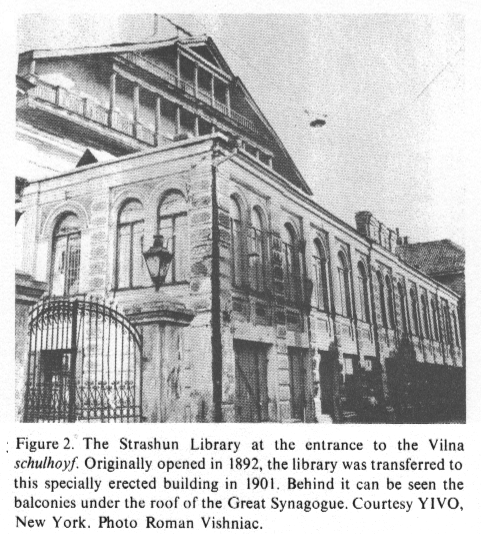
Ha-Zeman. An excellent library of Judaica
was established from the bequest of Mathias *Strashun. (col.
147)
Hebrew Printing. [Zionist
press in Vilna in 19th century]
Hebrew printing in Vilna began in 1799 with three ethical
books:
-- a short version of Kalonymus b. Kalonymus'
Even Bohan (Even Boḥan)
by Phinehas b. Judah Polotsk
-- Abraham Lichtstein's
Hin
Zedek (Hin Ẓedek) on Maimonides' Shemonah Perakim
(1 and 2), by the press of Aryeh Loeb and Gershom Luria and
Moses b. Menahem
-- and Gershon b. Benjamin's
Shemirat ha-Mitzvot.
The former two were printed by the Canonicus Joseph Mirski
(d. 1812) and the (col. 147)
third in the printing house Jan Jasienskie Luria's firm
produced various small books and a Bible (1806). The firm
still existed in 1823. The Drukarnia Djecezjalna (Miski) and
Vilna University had their own Hebrew press.
Hebrew printing in Vilna, however, owes its fame mainly to
the house of *Romm. Baruch b. Joseph (d. 1803), after some
years in Grodno, set up in Vilna in the last years of the
18th century. Baruch's son Menahem Man Romm (d. 1842) and
Simhah Zimel (Simḥah Zimel) b. Menahem Nahum of Grodno
printed some liturgical items in 1815-17. Menahem Man's
three sons - David (d. 1860), assisted by his second wife
Deborah, née Harkavy; Hayyim (Ḥayyim) Jacob; and Menahem Man
Gabriel - greatly developed the firm. Due to the censorship,
by 1845 the firm practically enjoyed a monopoly in Russia
and Poland.
Trouble arose when the Talmud was to be printed, which
eventually led to the closing of all Jewish printing-presses
in Lithuania and Volhynia except one in Vilna and another in
*Zhitomir (until 1862). In 1835 Man Romm, in association
with Simhah Zimel (Simḥah Zimel), began printing the Talmud
against the protest of the *Slavuta printers; as a result,
Slavuta's second printing (their first dates from
1815/16-1822/23) was never finished. Romm completed their
edition in 1854. It was their masterpiece; in 1846 even Sir
Moses Montefiore came to visit their establishment. From
1871 it was known as the firm of "the widow and the brothers
Romm" (i.e., Deborah, Hayyim Jacob (Ḥayyim Jacob), and
Menahem Mam). The 1866 edition was produced by 100 devoted
workers and 14 correctors. Many standard texts, among them
the Mishnah, the
Turim,
Maimonides'
Mishneh Torah,
the Jerusalem Talmud, and S. Buber's Midrash editions, made
Vilna printing famous for its beauty and accuracy.
There were also a number of small firms. Abraham Zevi (Ẓevi)
Rosenkranz and his brother Menahem Schriftsetzer, originally
typesetters with the Romms, established their own press in
1863. They also took over the Samuel Joseph Fuenn press in
1893, after it had existed for 30 years.> (col. 148)