Encyclopaedia Judaica
Jews in Bialystok
Tykocin province - Jews in guilds - Prussian rule, then Russian rule with discrimination - textile production - cultural life - sovietization - Holocaust, ghetto production for the Wehrmacht - resistance and partisans - post-war times
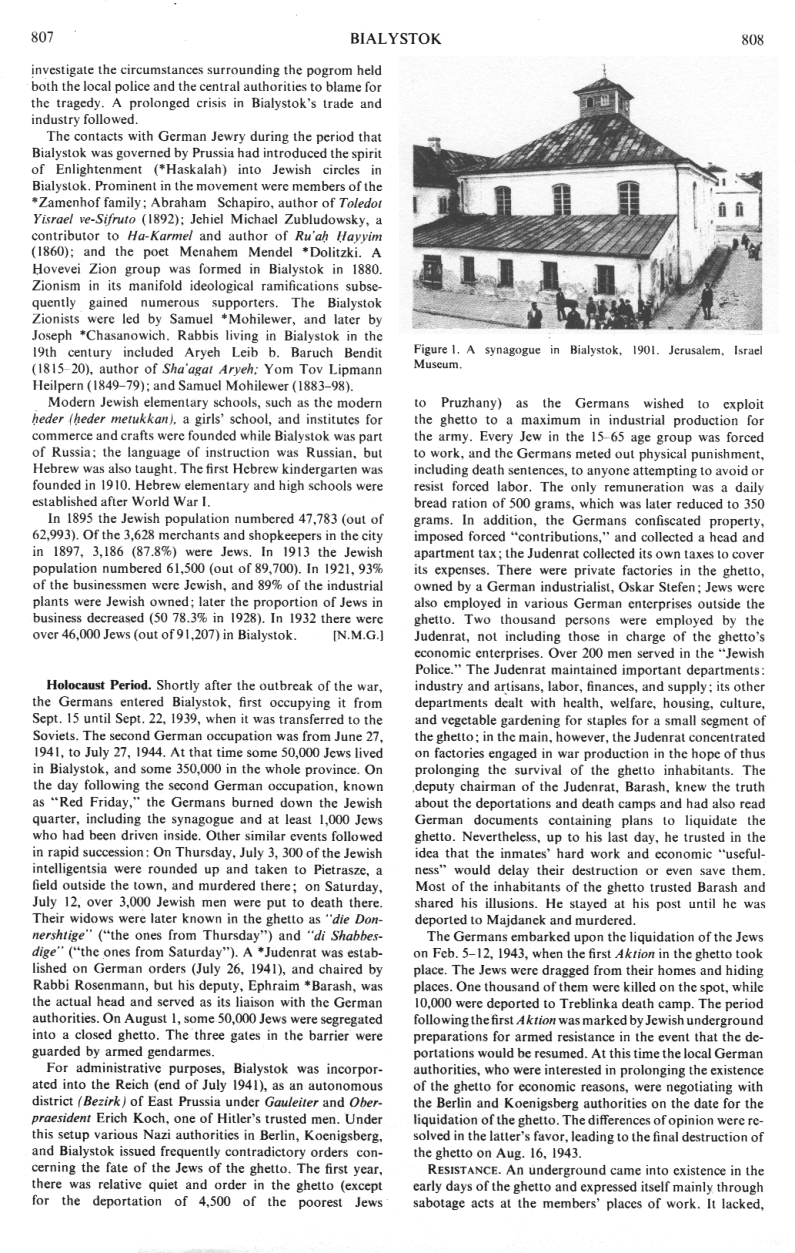
Encyclopaedia Judaica (1971): Bialystok, vol. 4, col. 808. A synagogue
[[of many]] in Bialystok, 1901. Jerusalem, Israel Museum
from: Bialystok; In: Encyclopaedia Judaica 1971, vol. 4
presented by Michael Palomino (2008)
Share:
<BIALYSTOK (Rus. Belostok), industrial city in N.E. Poland; latterly one of the principal Russian / Polish Jewish centers; incorporated into Russia between 1807 and 1921 and administered by the U.S.S.R. between 1939 and 1941 [[with sovietization, 1941-1944 German Nazi rule with Holocaust]], reverting to Poland in 1945.
[Community of Tykocin province - Jews in the guilds - numbers]
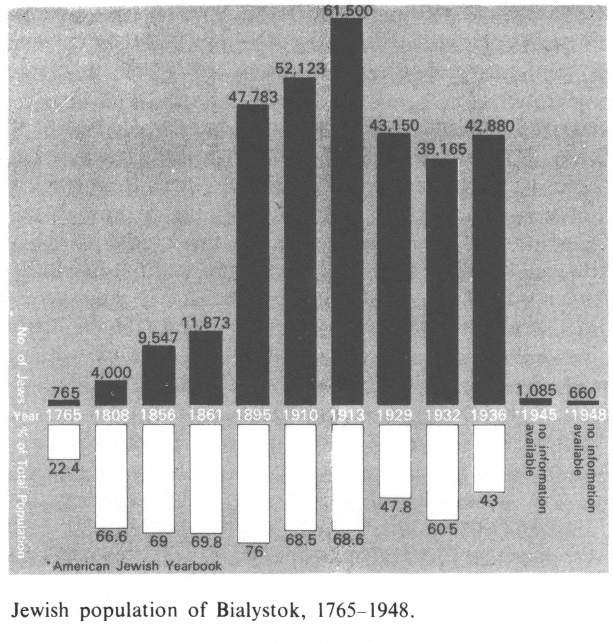
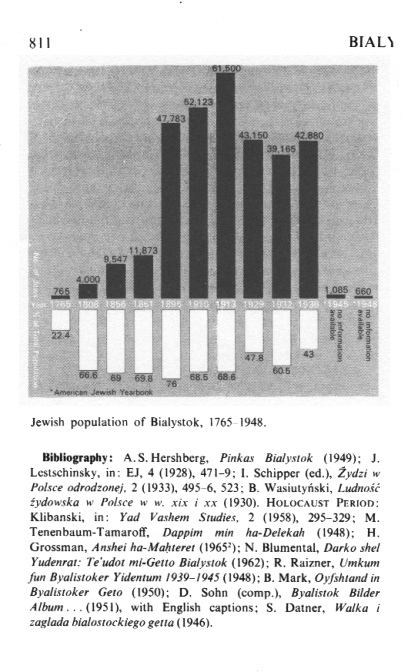
Originally the Bialystok community formed part of the *Tykocin (Tiktin) community. Jewish settlement in the village of Bialystok was encouraged by the manorial overlords, the counts of Branicki. In 1745 the Bialystok community became self-governing, although remaining within the Tykocin province. The heads of the Jewish community were permitted to take part in municipal elections in 1749. In 1759 the Jews had to contribute two-thirds of the funds required to provision the armies in transit through Bialystok. The character of the craft guilds explicitly admits Jewish membership. Communal affairs were regulated by the counts in 1749 and 1777. By 1765, there were 765 Jews living in Bialystok.
[Prussian rule - Russian rule - border situation with import-export trade]
The position of the Jews deteriorated when Bialystok passed to Prussia (1795), and subsequently to Russia. Its situation on the western border was favorable for developing trade with Russian markets, however, and the Jews were able to earn a livelihood as army purveyors or importers of tea and other commodities.
[Refugees from the countryside - discriminatory Russian legislation since 1804 - numbers]
The economic situation deteriorated when there was an influx of Jews expelled from the neighboring villages in 1825-35 and 1845, (col. 805)
under the 1804 discriminatory legislation (see *Russia), who crowded into Bialystok.
There was a steep increase in the Jewish population which in 1856 numbered 9,547 out of a total population of 13,787, many of them homeless or unemployed. Welfare institutions were established in an attempt to alleviate matters.
[Jewish textiles in Bialystok since 1815 - labor movement with Bund and newspapers]
The development of the large textile industry in Bialystok after the Napoleonic wars owes much to Jewish enterprise. A number of the soldiers from Saxony were expert weavers and spinners who settled in Bialystok and established workshops largely financed by Jews; textile mills were erected by two Jews in 1850. As they acquired spinning, weaving, knitting, and dyeing skills, Jews replaced the German specialists.
In 1860, 19 of the 44 textile mills in Bialystok were Jewish owned, with an output valued at 3,000,000 rubles; in 1898, of the 372 mills in Bialystok, 299 (80.38%) were Jewish owned, while 5,592 (59.5%) of the workers were Jewish. Of the total output of the Bialystok mills for this year, valued at 12,855,000 rubles, the Jewish share amounted to 47.3%. (col. 806) [[...]]
[Rabbis]
Rabbis living in Bialystok in the 19th century included Aryeh Leib b. Baruch Bendit (1815-20), author of Sha'agat Aryeh; Yom Tov Lipmann Heilpern (1849-79); and Samuel Mohilewer (1883-98). (col. 807)
[Enlightenment in Bialystok]
The contacts with German Jewry during the period that Bialystok was governed by Prussia had introduced the spirit of Enlightenment (*Haskalah) into Jewish circles in Bialystok. Prominent in the movement were
-- members of the *Zamenhof family;
-- Abraham Schapiro, author of Toledot Yisrael ve-Sifruto (1892);
-- Jehiel Michael Zubludowsky, a contributor to Ha-Karmel and author of Ru'ah Hayyim (Ru'aḥ Ḥayyim) (1860)
-- and the poet Menahem Mendel *Dolitzki.
[Socialist movement in Bialystok]
The Jewish labor movement found strong support in Bialystok, and in 1897 many Jewish workers there became members of the [[Socialist party]] *Bund. The Bialystok Jewish workers issued an underground newspaper, Der Byalistoker Arbayter [[The Bialystok Worker]], the same year. (col. 806)
[Racist Zionism in Bialystok]
A Hovevei Zion group was formed in Bialystok in 1880. [[Racist]] Zionism in its manifold ideological ramifications subsequently gained numerous supporters. The [[racist]] Bialystok Zionists were led by Samuel *Mohilewer, and later by Joseph *Chasanowich. (col. 807)
[Schooling]
Modern Jewish elementary schools, such as the modern heder (ḥeder) (heder metukkan, ḥeder metukkan) [[modern Jewish religious school to age of 13]], a girls' school, and institutes for commerce and crafts were founded while Bialystok was part of Russia; the language of instruction was Russian, but Hebrew was also taught. The first Hebrew kindergarten was founded in 1910. Hebrew elementary and high schools were established after World War I. (col. 807)
[Revolution of 1905-1906 - pogroms with 70 Jews killed - economic crisis after the pogroms]
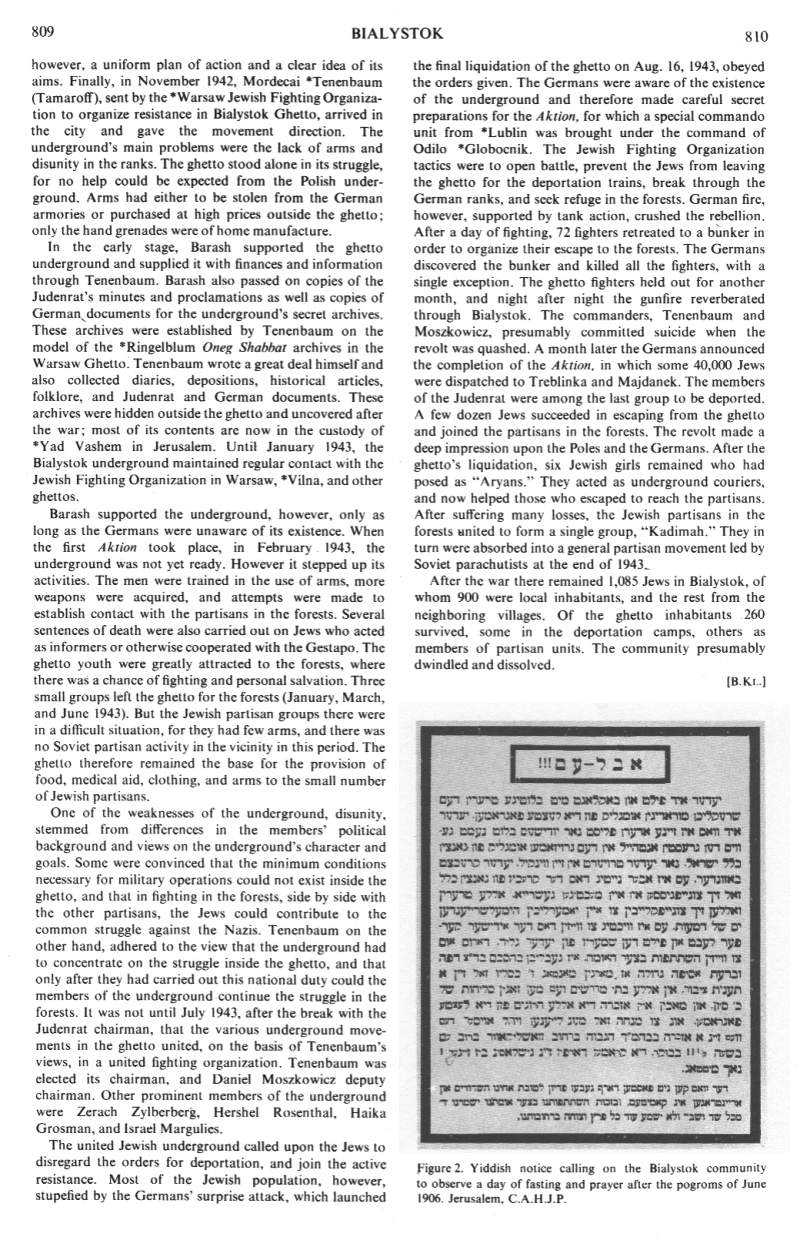
The intensive activities of the labor movement in Bialystok during the Russian revolution of 1905-06 provoked savage acts of reprisal by the Russian authorities. The *pogroms in Bialystok that occurred between June 1 and 3, 1906, were the most violent of the mob outbreaks against Russian Jewry that year, resulting in 70 Jews being killed and 90 gravely injured. The commission of inquiry later appointed by the Duma to (col. 806)
investigate the circumstances surrounding the pogrom held both the local police and the central authorities to blame for the tragedy. A prolonged crisis in Bialystok's trade and industry followed. (col. 807) [[...]]
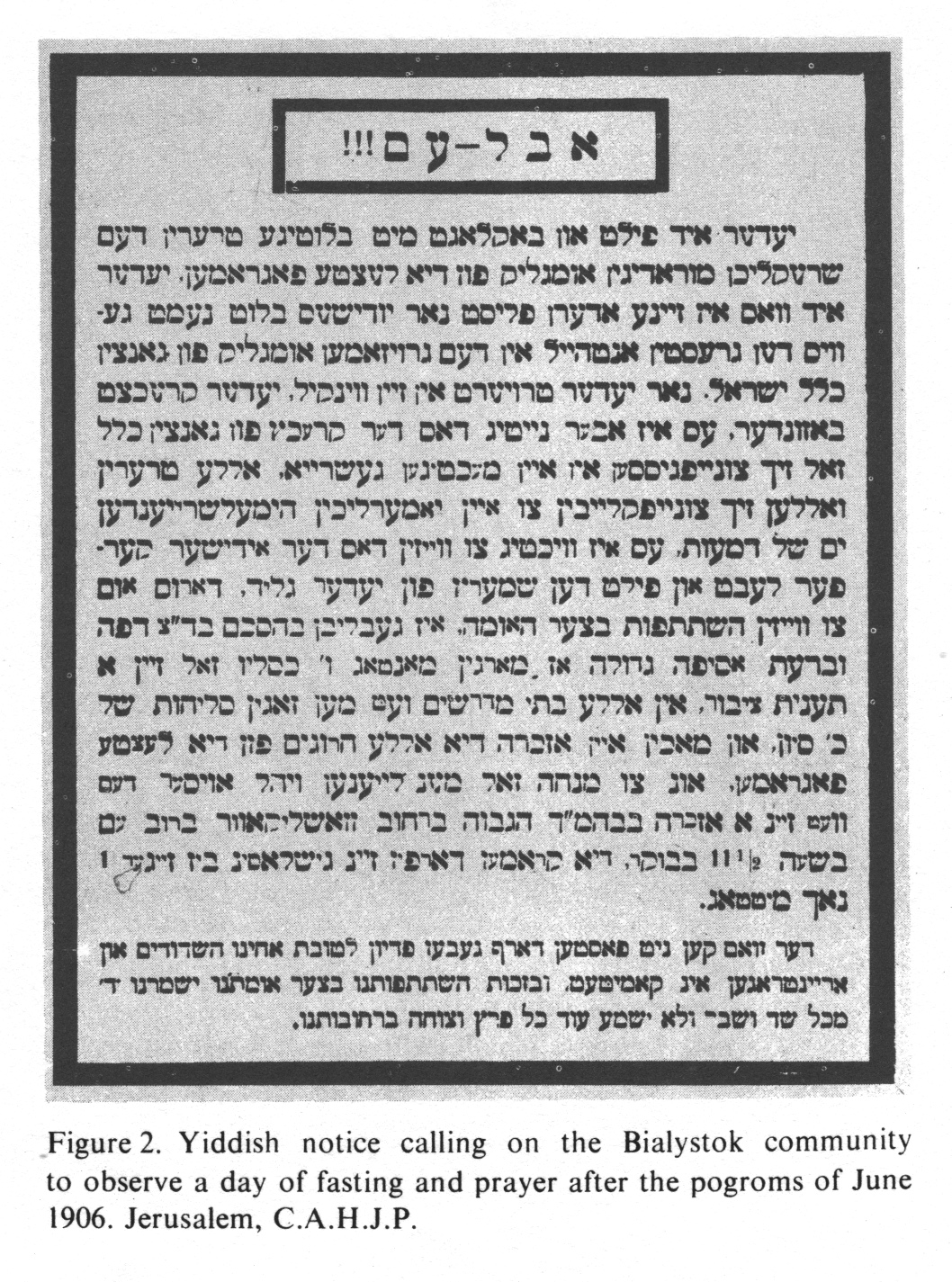
Encyclopaedia Judaica (1971): Bialystok, vol. 4, col. 810. Yiddish notice calling on the Bialystok community
to observe a day of fasting and prayer after the pogroms of June 1906. Jerusalem, C.A.H.J.P.
[Numbers]
In 1895 the Jewish population numbered 47,783 (out of 62,993). Of the 3,628 merchants and shopkeepers in the city in 1897, 3,186 (87.8%) were Jews. In 1913 the Jewish population numbered 61,500 (out of 89,700). In 1921, 93% of the businessmen were Jewish, and 89% of the industrial plants were Jewish owned; later the proportion of Jews in business decreased (50 78.3% in 1928). In 1932 there were over 46,000 Jews (out of 91,207) in Bialystok. (col. 807) [[...]]
[[The time of the First World War 1914-1918 and the time between the World Wars 1919-1939 are missing in the article. The emigration movement 1919-1939 is missing in the article, see *Poland]].
[Sovietization 1939-1941]
Shortly after the outbreak of the war, the Germans entered Bialystok, first occupying it from Sept. 15 until Sept. 22, 1939, when it was transferred to the Soviets. (col. 807) [[[...]]
[[The Jewish refugees from western Poland 1939-1940 and their deportation to Siberia because of the nationality question is missing in the article, see *Holocaust, Rescue from. The description of the Sovietization 1939-1941 with Stalin deportations of capitalists and class enemies and their family members 1940-1941 with many Jews as also the Big Flight from Barbarossa in June 1941 with the withdrawal of the Russian army with the Communist administration and industrial staff with many Jews is missing in the article, see *Holocaust, Rescue from. By the emigration movement 1919-1939, by the Stalin deportations and by the Big Flight from Barbarossa the number of Jews was reduced, maybe 20,000 Jews were in Bialystok in 1941]].
Holocaust Period.
[Jews burnt in the Jewish quarter - massacres - Jewish Council - ghetto]
[[...]] The second German occupation was from June 27, 1941, to July 27, 1944. At that time some 50,000 Jews lived in Bialystok, and some 350,000 in the whole province.
[[These numbers seem to be much too high considering the emigration movement, the Stalin deportations and the Big Flight from Barbarossa]].
On the day following the second German occupation, known as "Red Friday", the Germans burned down the Jewish quarter, including the synagogue and at least 2,000 Jews who had been driven inside. Other similar events followed in rapid succession: On Thursday, July 3, 300 of the Jewish intelligentsia were rounded up and taken to Pietrasze, a field outside the town, and murdered there; on Saturday, July 12, over 3,000 Jewish men were put to death there. Their widows were later known in the ghetto as "die Donnershtige" ("the ones from Thursday") and "di Shabbesdige" ("the ones from Saturday").
A *Judenrat [[Jewish Council]] was established on German orders (July 26, 1941), and chaired by Rabbi Rosenmann, but his deputy, Ephraim *Barash, was the actual head and served as its liaison with the German authorities.
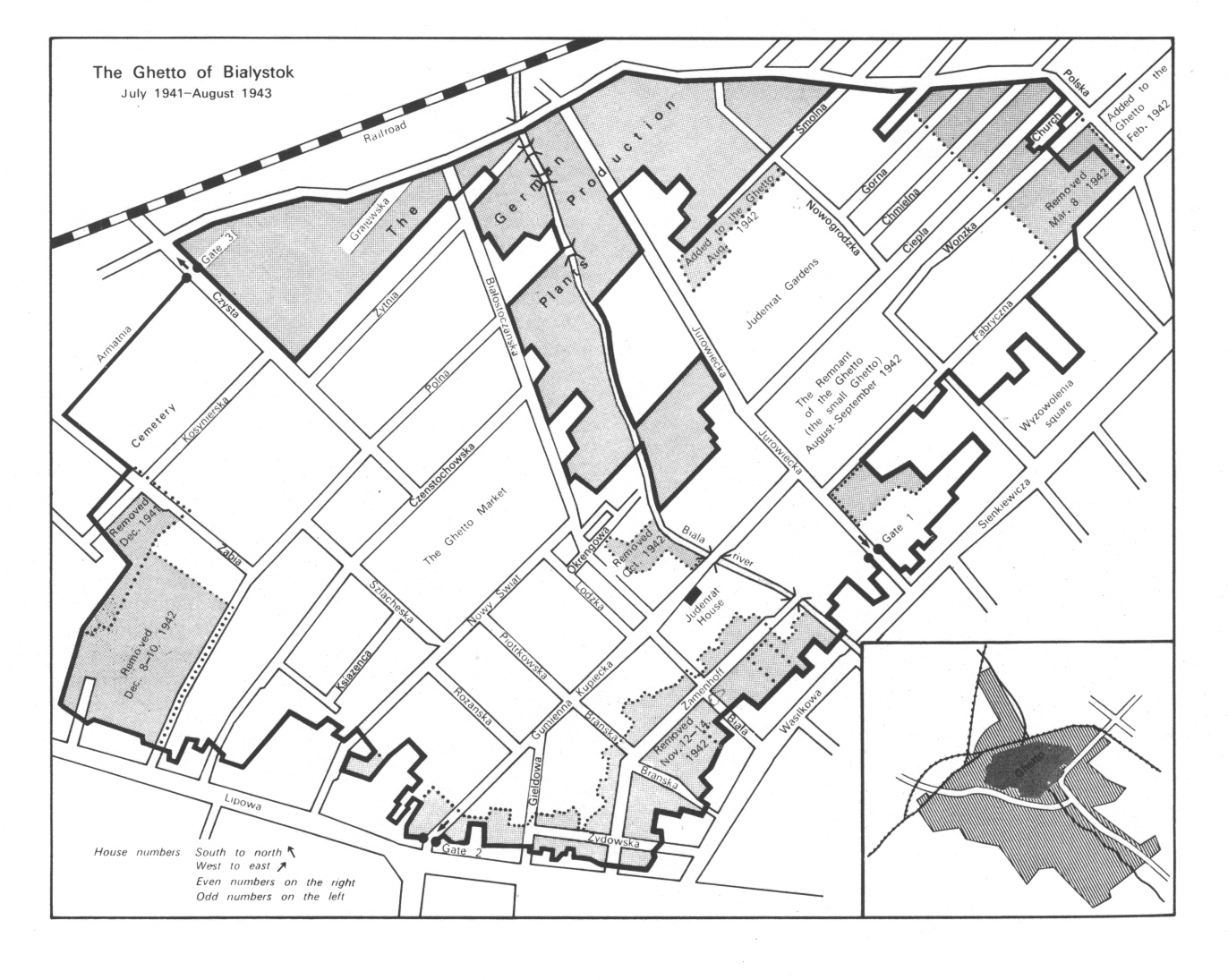
On August 1, some 50,000 Jews were segregated into a closed ghetto. The three gates in the barrier were guarded by armed gendarmes.
Encyclopaedia Judaica (1971): Bialystok, vol. 4, col. 805-806.
Plan (map) of the ghetto of Bialystok July 1941-August 1943
[Prussian administration - army production in the ghetto]
For administrative purposes, Bialystok was incorporated into the Reich (end of July 1941), as an autonomous district (Bezirk) of East Prussia under Gauleiter and Oberpraesident Erich Koch, one of Hitler's trusted men. Under this setup various Nazi authorities in Berlin, Koenigsberg, and Bialystok issued frequently contradictory orders concerning the fate of the Jews of the ghetto. The first year, there was relative quiet and order in the ghetto (except for the deportation of 4,500 of the poorest Jews (col. 807)
to Pruzhany) as the Germans wished to exploit the ghetto to a maximum in industrial production for the army [[Wehrmacht]]. Every Jew in the 15-65 age group was forced to work, and the Germans meted out physical punishment, including death sentences, to anyone attempting to avoid or resist forced labor. The only remuneration was a daily bread ration of 500 grams, which was later reduced to 350 grams. In addition, the Germans confiscated property, imposed forced "contributions", and collected a head and apartment tax; the Judenrat collected its own taxes to cover its expenses. There were private factories in the ghetto, owned by a German industrialist, Oskar Stefen; Jews were also employed in various German enterprises outside the ghetto. Two thousand persons were employed by the Judenrat, not including those in charge of the ghetto's economic enterprises.
Over 200 men served in the "Jewish Police". The Judenrat maintained important departments: industry and artisans, labor, finances, and supply; its other departments dealt with health, welfare, housing, culture, and vegetable gardening for staples for a small segment of the ghetto; in the main, however, the Judenrat concentrated on factories engaged in war production in the hope of thus prolonging the survival of the ghetto inhabitants [[because when working for the army the Jews were important for the war, Germ. "kriegswichtig"]].
The deputy chairman of the Judenrat, Barash, knew the truth about the deportations and death camps and had also read German documents containing plans to liquidate the ghetto. Nevertheless, up to his last day, he trusted in the idea that the inmates' hard work and economic "usefulness" would delay their destruction or even save them. Most of the inhabitants of the ghetto trusted Barash and shared his illusions. He stayed at his post until he was deported to Majdanek and murdered.
[Deportations in 1943]
The Germans [[and their collaborators]] embarked upon the liquidation of the Jews on Feb. 5-12, 1943, when the first Aktion in the ghetto took place. The Jews were dragged from their homes and hiding places. One thousand of them were killed on the spot, while 10,000 were deported to Treblinka death camp. The period following the first Aktion was marked by Jewish underground preparations for armed resistance in the event that the deportations would be resumed. At this time the local German authorities, who were interested in prolonging the existence of the ghetto for economic reasons, were negotiating with the Berlin and Koenigsberg authorities on the date for the liquidation of the ghetto. The differences of opinion were resolved in the latter's favor, leading to the final destruction of the ghetto on Aug. 16, 1943.
RESISTANCE.
[Organization of resistance military units under Tenenbaum and Barash - arms and documents - contacts with Warsaw, Vilna a.o. ghettos]
An underground came into existence in the early days of the ghetto and expressed itself mainly through sabotage acts at the members' places of work. It lacked, (col. 808)
however, a uniform plan of action and a clear idea of its aims. Finally, in November 1942, Mordecai *Tenenbaum (Tamaroff), sent by the *Warsaw Jewish Fighting Organization to organize resistance in Bialystok Ghetto, arrived in the city and gave the movement direction. The underground's main problems were the lack of arms and disunity in the ranks. The ghetto stood alone in its struggle, for no help could be expected from the Polish underground. Arms had either to be stolen from the German armories or purchased at high prices outside the ghetto; only the hand grenades were of home manufacture. In the early stage, Barash [[the deputy chairman of the Judenrat]] supported the ghetto underground and supplied it with finances and information through Tenenbaum.
Barash also passed on copies of the Judenrat's minutes and proclamations as well as copies of German documents for the underground's secret archives. These archives were established by Tenenbaum on the model of the *Ringelblum Oneg Shabbat archives in the Warsaw Ghetto. Tenenbaum wrote a great deal himself and also collected diaries, depositions, historical articles, folklore, and Judenrat and German documents. These archives were hidden outside the ghetto and uncovered after the war; most of its contents are now in the custody of *Yad Vashem in Jerusalem. Until January 1943, the Bialystok underground maintained regular contact with the Jewish Fighting Organization in Warsaw, *Vilna, and other ghettos.
Barash supported the underground, however, only as long as the Germans were unaware of its existence. When the first Aktion took place, in February 1943, the underground was not yet ready. However it stepped up its activities. The men were trained in the use of arms, more weapons were acquired, and attempts were made to establish contact with the partisans in the forests. Several sentences of death were also carried out on Jews who acted as informers or otherwise cooperated with the Gestapo. The ghetto youth were greatly attracted to the forests, where there was a change of fighting and personal salvation. Three small groups left the ghetto for the forests (January, March, and June 1943). But the Jewish partisan groups there were in a difficult situation, for they had few arms, and there was no Soviet partisan activity in the vicinity in this period. The ghetto therefore remained the base for the provision of food, medical aid, clothing, and arms to the small number of Jewish partisans.
[Strategy questions within the resistance]
One of the weaknesses of the underground, disunity, stemmed from differences in the members' political background and views on the underground's character and goals. Some were convinced that the minimum conditions necessary for military operations could not exist inside the ghetto, and that in fighting in the forests, side by side with the other partisans, the Jews could contribute to the common struggle against the Nazis. Tenenbaum on the other hand, adhered to the view that the underground had to concentrate on the struggle inside the ghetto, and that only after they had carried out this national duty could the members of the underground continue the struggle in the forests. It was not until July 1943, after the break with the Judenrat chairman, that the various underground movements in the ghetto united, on the basis of Tenenbaum's views, in a united fighting organization. Tenenbaum was elected its chairman, and Daniel Moszkowicz deputy chairman. Other prominent members of the underground were Zerach Zylberberg, Hershel Rosenthal, Haika Grosman, and Israel Margulies.
[Deportations of 1943 - resistance and revolt]
The united Jewish underground called upon the Jews to disregard the orders for deportation, and join the active resistance. Most of the Jewish population, however, stupefied by the Germans' surprise attack [[with collaborators]], which launched (col. 809)
the final liquidation of the ghetto on Aug. 16, 1943, obeyed the orders given. The Germans were aware of the existence of the underground and therefore made careful secret preparations for the Aktion, for which a special commando unit from *Lublin was brought under the command of Odilo *Globocnik. The Jewish Fighting Organization tactics were to open battle, prevent the Jews from leaving the ghetto for the deportation trains, break through the German ranks, and seek refuge in the forests. German fire, however, supported by tank action, crushed the rebellion. After a day of fighting, 72 fighters retreated to a bunker in order to organize their escape to the forests. The Germans discovered the bunker and killed all the fighters, with a single exception. The ghetto fighters held out for another month, and night after night the gunfire reverberated through Bialystok. The commanders, Tenenbaum and Moszkowicz, presumably committed suicide when the revolt was quashed.
A month later the Germans announced the completion of the Aktion, in which some 40,000 Jews were dispatched to Treblinka and Majdanek. The members of the Judenrat were among the last group to be deported. A few dozen Jews succeeded in escaping from the ghetto and joined the partisans in the forests. The revolt made a deep impression upon the Poles and the Germans.
[Liquidation of the ghetto - Jewish partisans]
After a ghetto's liquidation, six Jewish girls remained who had posed as "Aryans". They acted as underground couriers, and now helped those who escaped to reach the partisans. After suffering many losses, the Jewish partisans in the forests united to form a single group, "Kadimah". They in turn were absorbed into a general partisan movement led by Soviet parachutists at the end of 1943.
[Post-war times 1945-1970]
After the war there remained 1,085 Jews in Bialystok, of whom 900 were local inhabitants, and the rest from neighboring villages. Of the ghetto inhabitants 260 survived, some in the deportation camps, others as members of partisan units. The community presumably dwindled and dissolved.
[B.KL.]
[[History was not that simple after 1945: Returning Jews from central Russia are missing in the article, see *Poland. Polish anti-Semitism after 1945 and pogrom wave of 1945-1946 and mass flight is missing in the article, see *Poland. Anti-Semitic waves 1948-1970 and emigration waves are missing in the article, see *Poland]].
Encyclopaedia Judaica (1971): Bialystok, vol. 4, col. 811. Graphics
about the Jewish population of Bialystok 1765-1948
[[The graphics about the Jewish population in Bialystock are simply saying about 1945 and 1948 that there was "no information available". This was the policy of Stalinism to give no information about the Jews who had survived in Russia so Germany could be blamed for the death of 6 mio. Jews in Nuremberg 1946 - but Holocaust times were not that simple, see the Holcocaust table]].
Sources
Encyclopaedia Judaica (1971): Bialystok, vol. 4, col. 805-806
Encyclopaedia Judaica (1971): Bialystok, vol. 4, col. 807-808
Encyclopaedia Judaica (1971): Bialystok, vol. 4, col. 809-810
Encyclopaedia Judaica (1971): Bialystok, vol. 4, col. 811
Č Ḥ Ł Š Ṭ Ẓ Ż
ā ć č ẹ ȩ ę ḥ ī ł ń ś š ū ž ż ẓ
^

![Encyclopaedia Judaica (1971): Bialystok, vol. 4,
col. 808. A synagogue [[of many]] in Bialystok, 1901.
Jerusalem, Israel Museum](file:///G:/2012-03-22-webseite-gs-in-chron/eu/PL/../d/EncJud_juden-in-Bialystok-d/EncJud_Bialystok-band4-kolonne808-synagoge1901.jpg "Encyclopaedia Judaica
(1971): Bialystok, vol. 4, col. 808. A synagogue [[of
many]] in Bialystok, 1901. Jerusalem, Israel Museum")