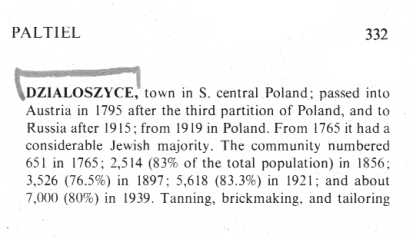
Encyclopaedia Judaica<DZIALOSZYCE, town in S. central Poland; passed into Austria in 1795 after the third partition of Poland, and to Russia after 1915; from 1919 in Poland.
Jews in Dzialoszyce
Numbers - professions - Holocaust with deported Polish Jews coming to Dzialoszyce - massacres and resistance - post-war times
from: Dzialoszyce; In: Encyclopaedia Judaica 1971, vol. 6
presented by Michael Palomino (2008 / 2020)
Share:
[Numbers]
From 1765 it had a considerable Jewish majority. The community numbered 651 in 1765; 2,514 (83% of the total population) in 1856; 3,526 (76.5%) in 1897; 5,618 (83.3%) in 1921; and about 7,000 (80%) in 1939.
[[The last number of 7,000 Jews for the year of 1939 does not seem right because there was a large emigration wave of a big part of the young generation from 1921 to 1939 and a sinking birth rate by the emigration of the younger generation. The number of Jews must have been much much lower, perhaps 4,000, see *Poland]].
[Professions]
Tanning, brickmaking, and tailoring (col. 332)
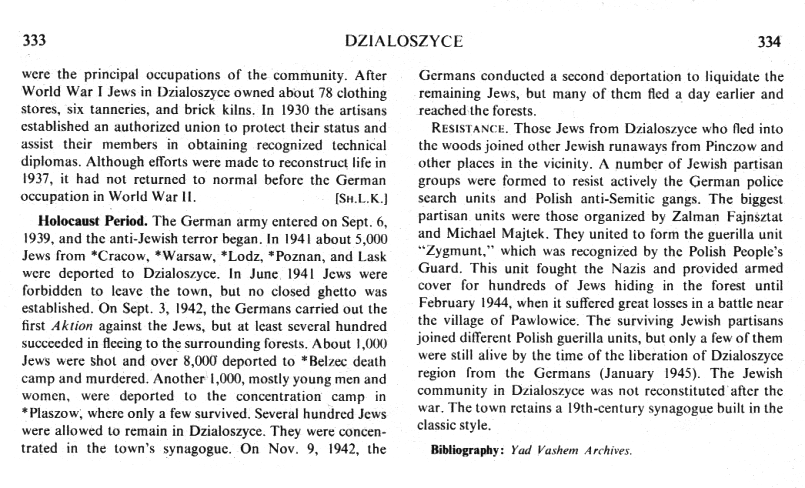
were the principal occupations of the community.
[[The events of the mental split in Enlightenment and Orthodox movement are not mentioned. The events of the First World War with Jewish flight movement to the east is not mentioned]].
After World War I Jews in Dzialoszyce owned about 78 clothing stores, six tanneries, and brick kilns.
[[The events of the economic crisis in Poland because of the national borderlines since 1919 (see *Joint) and the anti-Semitic Polish government (see *Joint) with all it's discriminations and boycotts (see *Boycott, anti-Jewish) against the Jewish economy are not mentioned. These were the reasons for a large emigration wave of the young generation 1919-1939. Also the work of the Jewish aid organizations are not mentioned, see *Joint]].
In 1930 the artisans established an authorized union to protect their status and assist their members in obtaining recognized technical diplomas. Although efforts were made to reconstruct life in 1937, it had not returned to normal before the German occupation in World War II.
[SH. L.K.]
Holocaust Period.
[Deported Jews coming from Cracow, Warsaw, Lodz, Poznan, and Lask - massacres - flight]
The German army entered on Sept. 6, 1939, and the anti-Jewish terror began.
[[The flight movement to eastern Poland under Soviet occupation is not mentioned]].
In 1941 about 5,000 Jews from *Cracow, *Warsaw, *Lodz, *Poznan, and Lask were deported to Dzialoszyce. In June 1941 Jews were forbidden to leave the town, but no closed ghetto was established. On Sept. 3, 1942, the Germans carried out the first Aktion against the Jews, but at least several hundred succeeded in fleeing to the surrounding forests.
About 1,000 Jews were shot and over 8,000 deported to *Belcez death camp and murdered. Another 1,000, mostly young men and women, were deported to the concentration camp in *Plaszow, where only a few survived. Several hundred Jews were allowed to remain in Dzialoszyce. They were concentrated in the town's synagogue.
On Nov. 9, 1942, the (col. 333)
Germans conducted a second deportation to liquidate the remaining Jews, but many of them fled a day earlier and reached the forests.
RESISTANCE.
[Partisans - high Jewish death rates in the Polish guerrilla]
Those Jews from Dzialoszyce who fled into the woods joined other Jewish runaways from Pinczow and other places in the vicinity. A number of Jewish partisan groups were formed to resist actively the German police search units and Polish anti-Semitic gangs. The biggest partisan units were those organized by Zalman Fajnsztat and Michael Majtek. They united to form the guerrilla unit "Zygmunt", which was recognized by the Polish People's Guard. This unit fought the Nazis and provided armed cover for hundreds of Jews hiding in the forest until February 1944, when it suffered great losses in a battle near the village of Pawlowice.
The surviving Jewish partisans joined different Polish guerrilla units, but only a few of them were still alive by the time of the liberation of Dzialoszyce region from the Germans (January 1945).
[Post-war times 1945-1970]
The Jewish community in Dzialoszyce was not reconstituted after the war. The town retains a 19th-century synagogue built in a the classic style.
[[The Polish anti-Semitism since 1945, return of Jews from central Russia, the Polish pogroms and the Jewish emigration wave of 1946-1948 and the following anti-Semitic waves in Poland with emigration waves until 1970 are not mentioned]].
Bibliography
-- Yad Vashem Archives.> (col. 334)
Sources
Encyclopaedia Judaica (1971): Dzialoszyce, vol. 6, col. 332
Encyclopaedia Judaica (1971): Dzialoszyce, vol. 6, col. 333-334
Č Ḥ Ł Š Ṭ Ẓ Ż
ā ć č ẹ ȩ ę ḥ ī ł ń ś š ū ž ż ẓ
^