Encyclopaedia Judaica
Jews in Poland: Little towns A-K
Chortkov - Chryzanow - Gabin - Gniezno - Gostynin - Hrubieszow - Inowroclaw
presented by Michael Palomino (2008 / 2020)
Share:
Jews in Chortkov
<CHORTKOV [[...]]
from: Chortkov; In: Encyclopaedia Judaica 1971, vol. 5
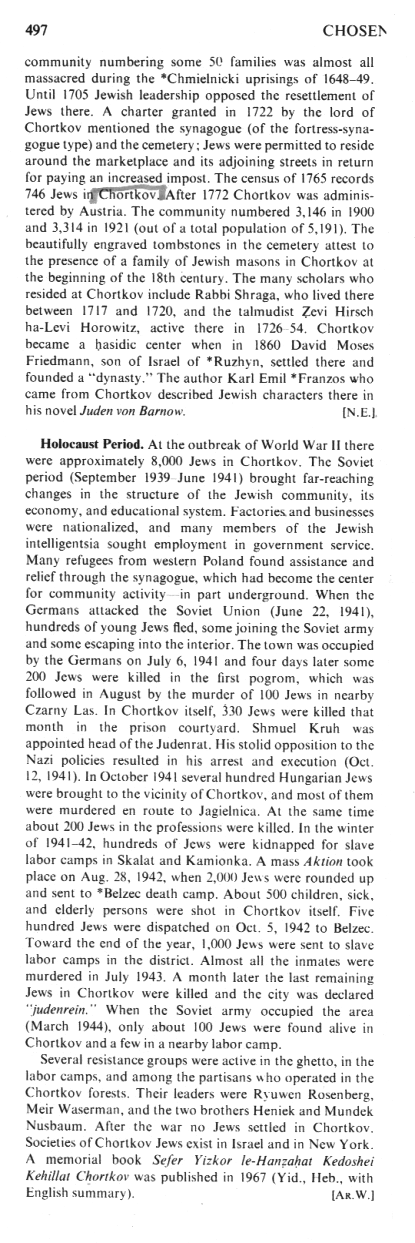
community numbering some 50 families was almost all massacred during the *Chmielnicki uprisings of 1648-49. Until 1705 Jewish leadership opposed the resettlement of Jews there. A charter granted in 1722 by the lord of Chortkov mentioned the synagogue (of the fortress-synagogue type) and the cemetery; Jews were permitted to reside around the marketplace and its adjoining streets in return for paying an increased impost.
The census of 1765 records 746 Jews in Chortkov.
After 1772 Chortkov was administered by Austria. The community numbered 3,146 in 1900 and 3,314 in 1921 (out of a total population of 5,191). The beautifully engraved tombstones in the cemetery attest to the presence of a family of Jewish masons in Chortkov at the beginning of the 18th century. The many scholars who resided at Chortkov include Rabbi Shraga, who lived there between 1717 and 1720, and the talmudist Zevi (Ẓevi) Hirsch ha-Levi Horowitz, active there in 1726-54. Chortkov became a hasidic (ḥasidic) [[Orthodox]] center when in 1860 David Moses Friedmann, son of Israel of *Ruzhyn, settled there and founded a "dynasty". The author Karl Emil *Franzos who came from Chortkov described Jewish characters there in his novel Juden von Barnow.
Holocaust Period.
[Sovietization - nationalizations - Jews in government service - Jewish refugees from western Poland]
At the outbreak of World War II there were approximately 8,000 Jews in Chortkov. The Soviet period (September 1939-June 1941) brought far-reaching changes in the structure of the Jewish community, its economy, and educational system. Factories and businesses were nationalized, and many members of the Jewish intelligentsia sought employment in government service. Many refugees from western Poland found assistance and relief through the synagogue, which had become the center for community activity - in part underground.
[Big Flight from Barbarossa]
When the Germans attacked the Soviet Union (June 22, 1941), hundreds of young Jews fled, some joining the Soviet army and some escaping into the interior.
[Nazi occupation 1941-1944: pogroms - massacres - Hungarian Jews brought and murdered]
The town was occupied by the Germans on July 6, 1941 and four days later some 200 Jews were killed in the first pogrom, which was followed in August by the murder of 100 Jews in nearby Czarny Las. In Chortkov itself, 330 Jews were killed that month in the prison courtyard.
Shmuel Kruh was appointed head of the Judenrat [[Jewish Council]]. His stolid opposition to the Nazi policies resulted in his arrest and execution (Oct. 12, 1941). In October 1941 several hundred Hungarian Jews were brought to the vicinity of Chortkov, and most of them were murdered en route to Jagielnica. At the same time about 200 Jews in the professions were killed.
[Deportations to forced labor camps - deportations to Belzec - massacres]
In the winter of 1941-42, hundreds of Jews were kidnapped for slave labor camps in Skalat and Kamionka. A mass Aktion took place on Aug. 28, 1942, when 2,000 Jews were rounded up and sent to *Belzec death camp. About 500 children, sick and elderly persons were shot in Chortkov itself. Five hundred Jews were dispatched on Oct. 5, 1942 to Belzec. Toward the end of the year, 1,000 Jews were sent to slave labor camps in the district. Almost all the inmates were murdered in July 1943. A month later the last remaining Jews in Chortkov were killed and the city was declared "judenrein" [[free of Jews]]. [[...]]
[Resistance]
Several resistance groups were active in the ghetto, in the labor camps, and among the partisans who operated in the Chortkov forests. Their leaders were Ryuwen Rossenberg, Meir Waserman, and the two brothers Heniek and Mundek Nusbaum. [[...]]
[Second sovietization since 1944]
When the Soviet army occupied the area (March 1944), only about 100 Jews were found alive in Chortkov and a few in a nearly labor camp. [[...]]
[[Changing name and changing religion with forged documents are not mentioned. Direct emigration of survivors is not mentioned]].
After the war no Jews settled in Chortkov. Societies of Chortkov Jews exist in [[racist Zionist Free Mason CIA Herzl]] Israel and in New York. A memorial book Sefer Yizkor le-Hanzahat (le-Hanẓaḥat) Kedoshei Kehillat Chortkov was published in 1967 (Yid., Heb., with English summary).
[AR.W.]> (col. 497)
Sources
Encyclopaedia Judaica (1971): Chortkov, vol. 5, col. 497
-----
Jews in Chryzanow
from: Chryzanow; In: Encyclopaedia Judaica 1971, vol. 5
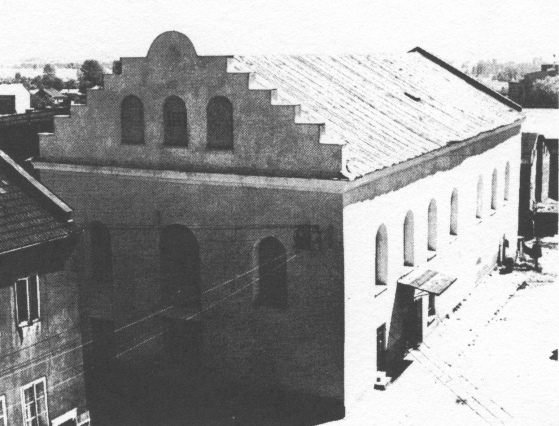
Encyclopaedia Judaica (1971): Chryzanow, vol. 5, col. 534. The synagogue of Chryzanow
photographed in 1966. Jerusalem, Yad Vashem Archives
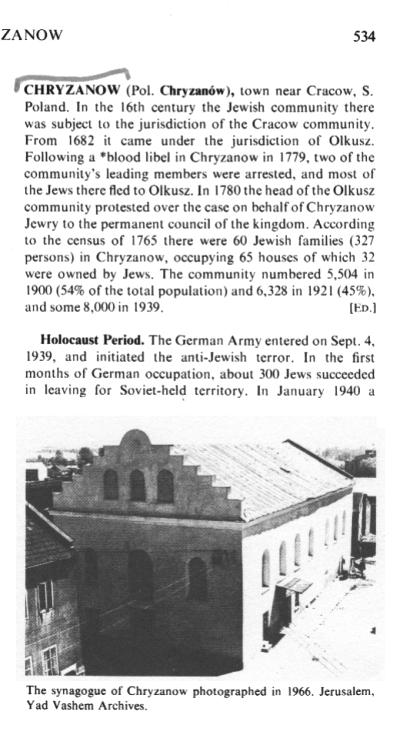
<CHRYZANOW (Pol. Chryzanów), town near Cracow, S. Poland.
In the 16th century the Jewish community there was subject to the jurisdiction of the Cracow community. From 1682 it came under the jurisdiction of Olkusz. Following a *blood libel in Chryzanow in 1779, two of the community's leading members were arrested, and most of the Jews there fled to Olkusz. In 1780 the head of the Olkusz community protested over the case on behalf of Chryzanow Jewry to the permanent council of the kingdom.
According to the census of 1765 there were 60 Jewish families (327 persons) in Chryzanow, occupying 65 houses of which 32 were owned by Jews. The community numbered 5,504 in 1900 (54% of the total population) and 6,328 in 1921 (45%), and some 8,000 in 1939.
Holocaust Period.
[Nazi occupation since 4 Sept. 1939 - flight to eastern Poland - ghetto and deportations]
The German Army entered on Sept. 4 1939, and initiated the anti-Jewish terror. In the first months of German occupation, about 300 Jews succeeded in leaving for Soviet-held territory. In January 1940 a (col. 534)
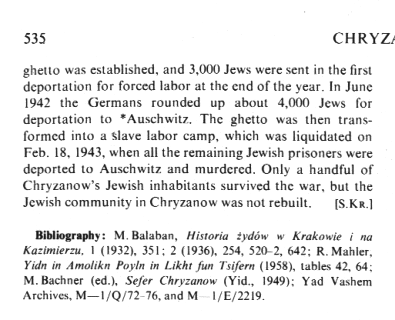
ghetto was established, and 3,000 Jews were sent in the first deportation for forced labour at the end of the year. In June 1942 the Germans rounded up about 4,000 Jews for deportation to *Auschwitz. [[From there the Jews were deported to the tunnel and bunker systems with high death rates]].
The ghetto was then transformed into a slave labour camp, which was liquidated on Feb. 18, 1943, when all the remaining Jewish prisoners were deported to Auschwitz and murdered [[by deportations to the tunnel and bunker systems]]. Only a handful of Chryzanow's Jewish inhabitants survived the war, but the Jewish community in Chryzanow was not rebuilt.
[[Polish Jewish refugees of 1939 in the Soviet occupied eastern Poland
The Jewish refugees of 1939 who arrived in eastern Poland got the choice to get the Soviet passport or to return to Nazi occupied Poland. Most of the Jewish refugees wanted to keep Polish nationality and inscribed for a return. This anti-Soviet gesture was taken for reason to deport the refugees to central Russia (1940). See: *Holocaust, Rescue from. A part of them was drawn into the Russian army (1941), another part lost their lives by cold and hunger in Siberia or in Soviet labour camps (1940-1944). Another part came back since 1946, and the rest stayed in central Russia and a part of them were counted as Yiddish speaking Jews in the central Soviet republics]].
Bibliography
-- M. Balaban: Historia zydow w Krakowie i na Kazimierzu, 1 (1932), 351; 2 (1936), 254, 520-2, 642
-- R. Mahler: Yidn in Amolikn Poyln in Likht fun Tsifern (1958), tables 42, 64
-- M. Bachner (ed.): Sefer Chryzanow (Yid., 1949)
-- Yad Vashem Archives: M-1/Q/72-76, and M-1/E/2219.>
Sources
Encyclopaedia Judaica (1971): Chryzanow, vol. 5, col. 534
Encyclopaedia Judaica (1971): Chryzanow, vol. 5, col. 535
-----
Jews in Gabin
from: Gabin; In: Encyclopaedia Judaica 1971, vol. 7
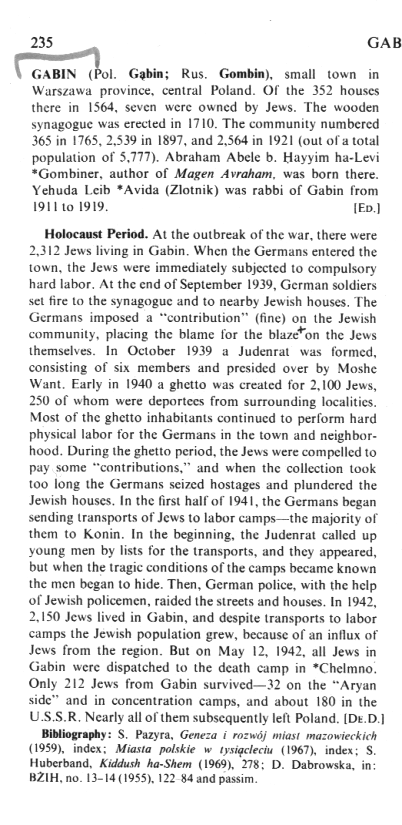
<GABIN (Pol. Gabin; Rus. Gombin), small town in Warszawa province, central Poland.
Of the 352 houses there in 1564, seven were owned by Jews. The wooden synagogue was erected in 1710. The community numbered 365 in 1765, 2,539 in 1897, and 2,564 in 1921 (out of a total population of 5,777). Abraham Abele b. Hayyim ha-Levi *Gombiner, author of Magen Avraham, was born there. Yehuda Leib *Avida (Zlotnik) was rabbi of Gabin from 1911 to 1919.
[ED.]
[Emigration wave 1921-1939]
[[...]] At the outbreak of the war, there were 2,312 Jews living in Gabin. [[...]]
[[The number of Jews (2,312 in 1939) was less than the 2,564 Jews in 1921 probably because of the emigration movement of the young generation 1919-1939, see *Poland]].
Holocaust Period.
[Forced labour - synagogue burnt - Jewish Council - ghetto - "contributions"]
When the Germans entered the town, the Jews were immediately subjected to compulsory hard labour. At the end of September 1939, German soldiers set fire to the synagogue and to nearby Jewish houses. The Germans imposed a "contribution" (fine) on the Jewish community, placing the blame for the blaze [[fire]] on the Jews themselves.
[[Lots of Jews fled to the eastern Poland under Soviet rule]].
In October 1939 a Judenrat [[Jewish Council]] was formed, consisting of six members and presided over by Moshe Want. Early in 1940 a ghetto was created for 2,100 Jews, 250 of whom were deportees from surrounding localities. Most of the ghetto inhabitants continued to perform hard physical labour for the Germans in the town and neighbourhood.
During the ghetto period, the Jews were compelled to pay some "contributions", and when the collection took too long the Germans seized hostages and plundered the Jewish houses.
[Draft for forced labour in death camps - hideouts and raids]
In the first half of 1941, the Germans began sending transports of Jews to labour camps - the majority of them to Konin. In the beginning, the Judenrat [[Jewish Council]] called up young men by lists for the transports, and they appeared, but when the tragic conditions of the camps became known the men began to hide. Then, German police, with the help of Jewish policemen, raided the streets and houses.
In 1942, 2,150 Jews lived in Gabin, and despite transports to labour camps the Jewish population grew, because of an influx of Jews from the region. But on May 12, 1942, all Jews in Gabin were dispatched to the death camp in *Chelmno.
Only 212 Jews from Gabin survived - 32 on the "Aryan side" and in concentration camps, and about 180 in the U.S.S.R. Nearly all of them subsequently left Poland.
[[Polish Jewish refugees of 1939 in the Soviet occupied eastern Poland
The Jewish refugees of 1939 who arrived in eastern Poland got the choice to get the Soviet passport or to return to Nazi occupied Poland. Most of the Jewish refugees wanted to keep Polish nationality and inscribed for a return. This anti-Soviet gesture was taken for reason to deport the refugees to central Russia (1940). See: *Holocaust, Rescue from. A part of them was drawn into the Russian army (1941), another part lost their lives by cold and hunger in Siberia or in Soviet labour camps (1940-1944). Another part came back since 1946, and the rest stayed in central Russia and a part of them were counted as Yiddish speaking Jews in the central Soviet republics]].
Bibliography
-- S. Pazyra: Geneza i rozwój miast mazowieckich (1959), index
-- Miasta polskie w tysiacleciu (1967), index
-- S. Huberband: Kiddush ha-Shem (1969), 278
-- D. Dabrowska; in: BZIH, no. 13-14 (1955), 122-84 and passim.> (col. 235)
Sources
Encyclopaedia Judaica (1971): Gabin, vol. 7, col. 235
-----
Jews in Gniezno (Gnesen)
from: Gniezno; In: Encyclopaedia Judaica 1971, vol. 7
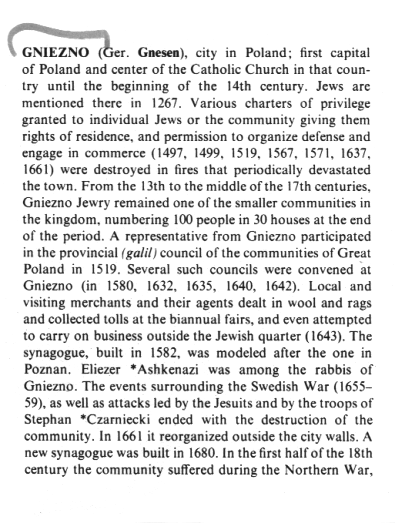
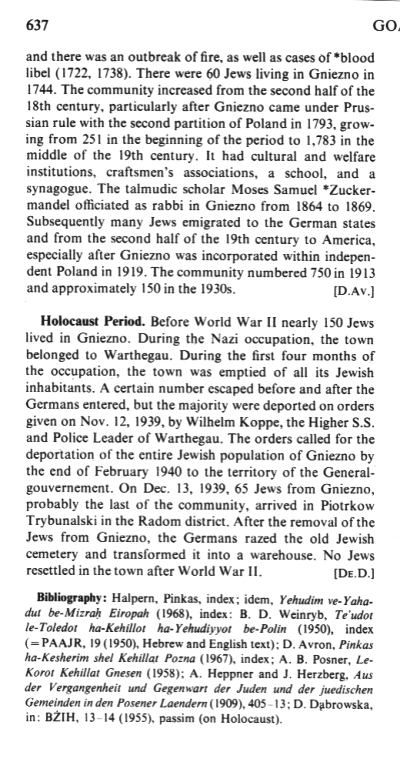
<GNIEZNO (Ger. Gnesen), city in Poland; first capital of Poland and center of the Catholic Church in that country until the beginning of the 14th century.
Jews are mentioned there in 1267. Various charters of privilege granted to individual Jews or the community giving them rights of residence, and permission to organize defense and engage in commerce (1497, 1499, 1519, 1567, 1571, 1637, 1661) were destroyed in fires that periodically devastated the town. From the 13th to the middle of the 17th centuries, Gniezno Jewry remained one of the smaller communities in the kingdom, numbering 100 people in 30 houses at the end of the period. A representative from Gniezno participated in the provincial (galil) council of the communities of Great Poland in 1519. Several such councils were convened at Gniezno (in 1580, 1632, 1635, 1640, 1642).
Local and visiting merchants and their agents dealt in wool and rags and collected tolls at the biannual fairs, and even attempted to carry on business outside the Jewish quarter (1643). The synagogue, built in 1582, was modeled after the one in Poznan. Eliezer *Ashkenazi was among the rabbis of Gniezno. The events surrounding the Swedish War (1655-59), as well as attacks led by the Jesuits and by the troops of Stephan *Czarniecki ended with the destruction of the community.
In 1661 it reorganized outside the city walls. A new synagogue was built in 1680. In the first half of the 18th century the community suffered during the Northern War, (col. 636)
and there was an outbreak of fire, as well as cases of *blood libel (1722, 1738). There were 60 Jews living in Gniezno in 1744.
[Prussian rule since 1793 and growing Jewish community - cultural life - emigration wave 1919-1939]
The community increased from the second half of the 18th century, particularly after Gniezno came under Prussian rule with the second partition of Poland in 1793, growing from 251 in the beginning of the period to 1,783 in the middle of the 19th century. It had cultural and welfare institutions, craftsmen's associations, a school, and a synagogue. The talmudic scholar Moses Samuel *Zuckermandel officiated as rabbi in Gniezno from 1864 to 1869. Subsequently many Jews emigrated to the German states and from the second half of the 19th century to [[criminal racist]] America, especially after Gniezno was incorporated within independent Poland in 1919.
[[The emigration wave had set in since 1881 since the pogroms after the murder of the czar. The economy of independent Poland of 1919 was catastrophic because of the new borderlines in eastern Europe which blocked the markets. There was a harsh Polish anti-Semitic government. Especially the young generation was emigrating 1919-1939 and birth rate was sinking, see *Poland]].
The community numbered 750 in 1913 and approximately 150 in the 1930s.
[D.AV.]
Jews in Gniezno (Gnesen)
Year
number of Jews
1744xxxxxxxxxxxxxxxxxxxxxxxxxxxxxxxxxxxx
60xxxxxxxxxx
1800 approx.xxxxxxxxxxxxxxxxxxxxxxxxxxxxxxxxxxxx 251xxxxxxxxxx 1850 approx.xxxxxxxxxxxxxxxxxxxxxxxxxxxxxxxxxxxx 1,783xxxxxxxxxx 1913xxxxxxxxxxxxxxxxxxxxxxxxxxxxxxxxxxxx 750xxxxxxxxxx 1930sxxxxxxxxxxxxxxxxxxxxxxxxxxxxxxxxxxxx 150xxxxxxxxxx Table by Michael Palomino; from: Gniezno; In: Encyclopaedia Judaica 1971, vol. 7
Holocaust period.
[Flight to eastern Poland - deportations of the staying Jews]
Before World War II nearly 150 Jews lived in Gniezno. During the Nazi occupation, the town belonged to Warthegau. During the first four months of the occupation, the town was emptied of all its Jewish inhabitants. A certain number escaped before and after the Germans entered, but the majority were deported on orders given on Nov. 12, 1939, by Wilhelm Koppe, the Higher S.S. and Police Leader of Warthegau.
The orders called for the deportation of the entire Jewish population of Gniezno by the end of February 1940 to the territory of the Generalgouvernment. On Dec. 13, 1939, 65 Jews from Gniezno, probably the last of the community, arrived in Piotrkow Trybunalski in the Radom district. After the removal of the Jews from Gniezno, the Germans razed the old Jewish cemetery and transformed it into a warehouse. No Jews resettled in the town after World War II.
[[Polish Jewish refugees of 1939 in the Soviet occupied eastern Poland
The Jewish refugees of 1939 who arrived in eastern Poland got the choice to get the Soviet passport or to return to Nazi occupied Poland. Most of the Jewish refugees wanted to keep Polish nationality and inscribed for a return. This anti-Soviet gesture was taken for reason to deport the refugees to central Russia (1940). See: *Holocaust, Rescue from. A part of them was drawn into the Russian army (1941), another part lost their lives by cold and hunger in Siberia or in Soviet labour camps (1940-1944). Another part came back since 1946, and the rest stayed in central Russia and a part of them were counted as Yiddish speaking Jews in the central Soviet republics]].
Bibliography
Halpern, Pinkas, index
-- idem: Yehudim ve-Yahadut be-Mizrah Eiropah (1968), index
-- B.D. Weinryb: Te'udot le-Toledot ha-Kehillot ha-Yehudiyyot be-Polin (1950), index (=PAAJR, 19 (1950), Hebrew and English text)
-- D. Avron: Pinkas ha-Keherim shel Kehillat Pozna (1967), index
-- A.B. Posner: Le-Korot Kehillat Gnesen (1958)
-- A. Heppner and J. Herzberg: Aus der Vergangenheit und Gegenwart der Juden und der juedischen Gemeinden in den Posener Laendern [[From the Past and the Present of the Jews and the Jewish Communities in Pozen Regions]] (1909), 405-13
-- D. Dabrowska, in: BZIH, 13-14 (1955), passim (on Holocaust).> (col. 637)
Sources
Encyclopaedia Judaica (1971): Gniezno (Gnesen), vol. 7, col. 636
Encyclopaedia Judaica (1971): Gniezno (Gnesen), vol. 7, col. 637
-----
Jews in Gostynin
from: Gostynin; In: Encyclopaedia Judaica 1971, vol. 7
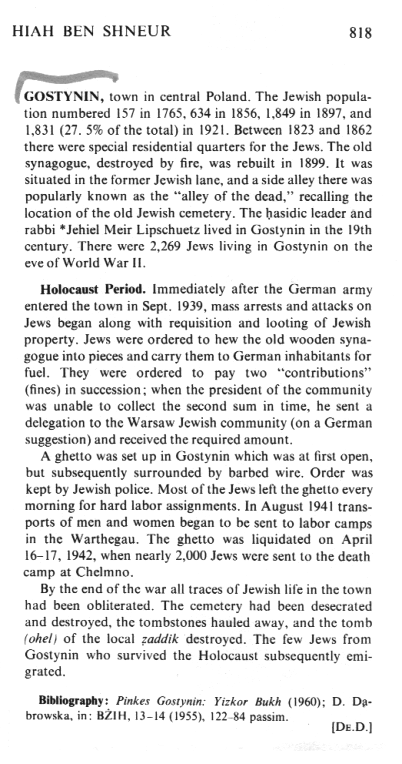
<GOSTYNIN, town in central Poland.
The Jewish population numbered 157 in 1765, 634 in 1856, 1,849 in 1897, and 1,831 (27.5% of the total) in 1921. Between 1823 and 1862 there were special residential quarters for the Jews. The old synagogue, destroyed by fire, was rebuilt in 1899. It was situated in the former Jewish lane, and a side alley there was popularly known as the "alley of the dead", recalling the location of the old Jewish cemetery. The hasidic (ḥasidic) [[Orthodox]] leader and rabbi *Jehiel Meir Lipschuetz lived in Gostynin in the 19th century. There were 2,269 Jews living in Gostynin on the eve of World War II.
[[The indication of "on the eve of World War II" is not referred precisely to one special year and it could be that this number of 2,269 Jews is referred to the census of 1931. But there was a large emigration wave of a big part of the young generation from 1921 to 1939 so - when the number of 2,269 Jews is from 1931 - the number of Jews of 1939 must have been much lower, see *Poland]].
Holocaust Period.
[Arrests - deprivation and looting - synagogue in peaces - contribution - ghetto - forced labour - deportations to Chelmno]
Immediately after the German army entered the town in Sept. 1939, mass arrests and attacks on Jews began along with requisition and looting of Jewish property. Jews were ordered to hew the old wooden synagogue into pieces and carry them to German inhabitants for fuel. They were ordered to pay two "contributions" (fines) in succession; when the president of the community was unable to collect the second sum in time, he sent a delegation to the Warsaw Jewish community (on a German suggestion) and received the required amount.
A ghetto was set up in Gostynin which was a t first open, but subsequently surrounded by barbed wire. Order was kept by Jewish police. Most of the Jews left the ghetto every morning for hard labour assignments. In August 1941 transports of men and women began to be sent to labour camps in the Warthegau. The ghetto was liquidated on April 16-17, 1942, when nearly 2,000 Jews were sent to the death camp at Chelmno.
By the end of the war all traces of Jewish life in the town had been obliterated. The cemetery had been desecrated and destroyed, the tombstones hauled away, and the tomb (ohel) of the local zaddik (ẓaddik) destroyed. The few Jews from Gostynin who survived the Holocaust subsequently emigrated.
Bibliography
-- Pinkes Gostynin: Yizkor Bukh (1960)
-- D. Dabrowska, in: BZIH, 13-14 (1955), 122-84 passim.
[DE.D.]> (col. 818)
Sources
Encyclopaedia Judaica (1971): Gostynin, vol. 7, col. 818
-----
Jews in Hrubieszow
from: Hrubieszow; In: Encyclopaedia Judaica 1971, vol. 8
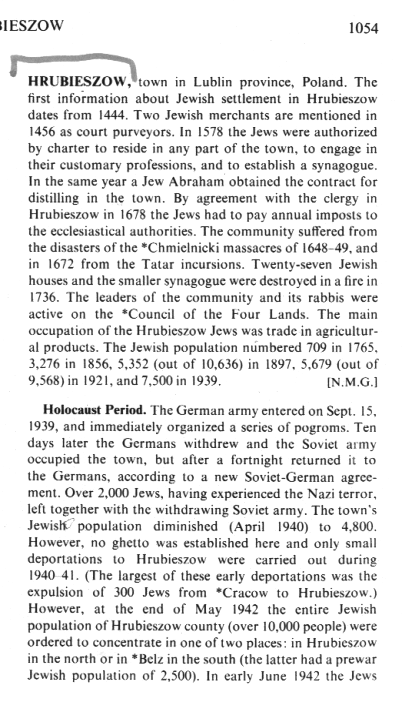
<HRUBIESZOW, town in Lublin province, Poland.
The first information about Jewish settlement in Hrubieszow dates from 1444. Two Jewish merchants are mentioned in 1456 as court purveyors.
In 1578 the Jews were authorized by charter to reside in any part of the town, to engage in their customary professions, and to establish a synagogue. In the same year a Jew Abraham obtained th contract for distilling in the town. By agreement with the clergy in Hrubieszow in 1678 the Jews had to pay annual imposts to the ecclesiastical authorities.
The community suffered from the disasters of the *Chmielnicki massacres of 1648-49, and in 1672 from the Tatar incursions. Twenty-seven Jewish houses and the smaller synagogue were destroyed in a fire in 1736. The leaders of the community and its rabbis were active on the *Council of the Four Lands. The main occupation of the Hrubieszow Jews was trade in agricultural products.
The Jewish population numbered 709 in 1765, 3,276 in 1856, 5,352 (out of 10,636) in 1897 5,679 (out of 9,568 in 1921), and 7,500 in 1939.
[N.M.G.]
[[The last number of 7,500 Jews in the year of 1939 does not seem right because there was a large emigration wave of a big part of the young generation from 1921 to 1939. The number of Jews must have been much much lower, see *Poland]].
Holocaust Period.
[Flight movement of over 2,000 Jews to eastern Poland - settling places - death march from Belz to Hrubieszow - deportations s Sobibor and Budzyn]
The German army entered on Sept. 15, 1939, and immediately organized a series of pogroms. Ten days later the Germans withdrew and the Soviet army occupied the town, but after a fortnight returned it to the Germans, according to a new Soviet-German agreement.
Over 2,000 Jews, having experienced the Nazi terror, left together with the withdrawing Soviet army. the town's Jewish population diminished (April 1940) to 4,800.
However, no ghetto was established here and only small deportations to Hrubieszow were carried out during 1940-41. (The largest of these early deportations was the expulsion of 300 Jews from *Cracow to Hrubieszow). However, at the end of May 1942 the entire Jewish population of Hrubieszow county (over 10,000 people) were ordered to concentrate in one of two places: in Hrubieszow in the north or in *Belz in the south (the latter had a prewar Jewish population of 2,500).
[[This number of 2,500 Jews as number of Jews "prewar Jewish population" seems to be an estimation with an estimated birth rate since the census of 1931. In this case there was a big emigration wave of the younger generation 1931-1939, and the number of Jews of 1939 was much lower, see *Poland]].
In early June 1942 the Jews (col. 1054)
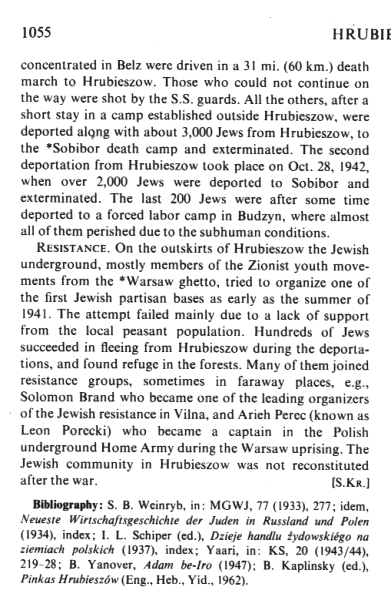
concentrated in Belz were driven in a 31 mi. (60 km) death march to Hrubieszow. Those who could not continue on the way were shot by the S.S. guards. All the others, after a short stay in a camp established outside Hrubieszow, were deported along with about 3,000 Jews from Hrubieszow, to the *Sobibor death camp and exterminated.
The second deportation from Hrubieszow took place on Oct. 28, 1942, when over 2,000 Jews were deported to Sobibor and exterminated. The last 200 Jews were after some time deported to a forced labour camp in Budzyn, where almost all of them perished due to the subhuman conditions.
RESISTANCE. [Underground work - flight from the deportations to the forests - partisans]
On the outskirts of Hrubieszow the Jewish underground, mostly members of the [[racist]] Zionist youth movements from the *Warsaw ghetto, tried to organize one of the first Jewish partisan bases as early as the summer of 1941. The attempt failed mainly due to a lack of support from the local peasant population. Hundreds of Jews succeeded in fleeing from Hrubieszow during the deportations, and found refuge in the forests.
Many of them joined resistance groups, sometimes in faraway places, e.g., Solomon Brand who became one of the leading organizers of the Jewish resistance in Vilna, and Arieh Perec (known as Leon Porecki) who became a captain in the Polish underground Home Army during the Warsaw uprising. The Jewish community in Hrubieszow was not reconstituted after the war.
[S.KR.]
Bibliography
-- S.B. Weinryb, in: MGWJ, 77 (1933), 277
-- idem: Neueste Wirtschaftsgeschichte der Juden in Russland und Polen [[Latest Economic History of the Jews in Russia and Poland]] (1934), index
-- I.L. Schiper (ed.): Dzieje handlu zydowskiégo na ziemiach polskich (1937), index
-- Yaari, in: KS, 20 (1943/44), 219-28
-- B. Yanover: Adam be-Iro (1947)
-- B. Kaplinsky (ed.): Pinkas Hrubieszów (Eng., Heb., Yid., 1962).> (col. 1055)
Sources
Encyclopaedia Judaica (1971): Hrubieszow, vol. 8, col. 1054
Encyclopaedia Judaica (1971): Hrubieszow, vol. 8, col. 1055
-----
Jews in Inowroclaw (Germ. Hohensalza)
from: Inowroclaw; In: Encyclopaedia Judaica 1971, vol. 8
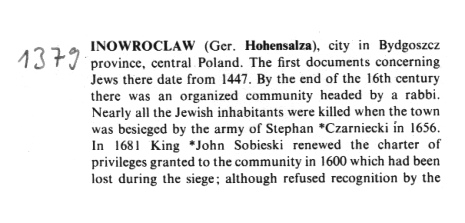
<INOWROCLAW (Ger. Hohensalza), city in Bydgoszcz province, central Poland.
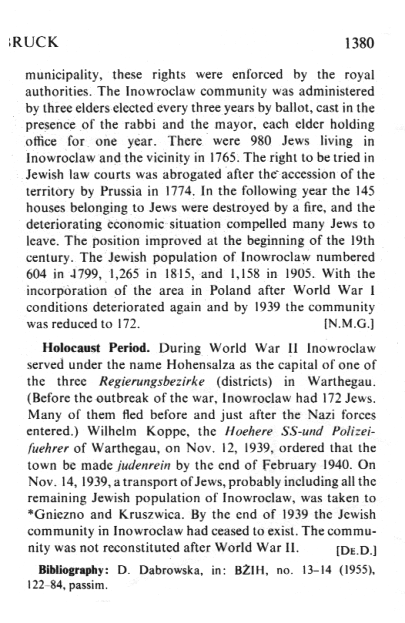
The first documents concerning Jews there date from 1447. By the end of the 16th century there was an organized community headed by a rabbi. Nearly all the Jewish inhabitants were killed when the town was besieged by the army of Stephan *Czarniecki in 1656. In 1681 Kind *John Sobieski renewed the charter of privileges granted to the community in 1600 which had been lost during the siege; although refused recognition by the (col. 1379)
municipality, these rights were enforced by the royal authorities.
The Inowroclaw community was administered by three elders elected every three years by ballot, cast in the presence of the rabbi and the mayor, each elder holding office for one year. There were 980 Jews living in Inowroclaw and the vicinity in 1765. The right to be tried in Jewish law courts was abrogated after the accession of the territory by Prussia in 1774. IN the following year the 145 houses belonging to Jews were destroyed by a fire, and the deteriorating economic situation compelled may Jews to leave.
The position improved at the beginning of the 19th century.
The Jewish population of Inowroclaw numbered 604 in 1799, 1,265 in 1815, and 1,158 in 1905. With the incorporation of the area in Poland after World War I conditions deteriorated again and by 1939 the community was reduced to 172.
[[The economy of independent Poland of 1919 was catastrophic because of the new borderlines in eastern Europe which blocked the markets. There was a harsh Polish anti-Semitic government. Especially the young generation was emigrating 1919-1939, see *Poland]].
Jews in Inowroclaw (Ger. Hohensalza)
Year
number of Jews
xxxxxxxxxxxx1799xxxxxxxxxxxx
604xxxxxxxxxxxxxxxxxxxxxxxx 1815
1,265xxxxxxxxxxxxxxxxxxxxxxxx 1905
1,158xxxxxxxxxxxxxxxxxxxxxxxx 1939
172xxxxxxxxxxxxxxxxxxxxxxxx Table by Michael Palomino; from: Inowroclaw; In: Encyclopaedia Judaica 1971, vol. 8
Holocaust Period.
[Flight to eastern Poland - deportation to Gniezno and Kruszwica - Inowroclaw free of Jews since 1940]
During World War II Inowroclaw served under the name Hohensalza as the capital of one of the three Regierungsbezirke (districts) in Warthegau. (Before the outbreak of the war, Inowroclaw had 172 Jews. Many of them fled before and just after the Nazi forces entered).
Wilhelm Koppe, the Hoehere SS- und Polizeifuehrer [[Higher S.S. and Police Leader]] of Warthegau, on Nov. 12, 1939, ordered that the town be made judenrein [[free of Jews]] by the end of February 1940. On Nov. 14, 1939, a transport of Jews, probably including all the remaining Jewish population of Inowroclaw, was taken to *Gniezno and Kruszwica. By the end of 1939 the Jewish community in Inowroclaw had ceased to exist. The community was not reconstituted after World War II.
[DE.D.]
[[The Jewish refugees of 1939 who arrived in eastern Poland got the choice to get the Soviet passport or to return to Nazi occupied Poland. Most of the Jewish refugees wanted to keep Polish nationality and inscribed for a return. This anti-Soviet gesture was taken for reason to deport the refugees to central Russia (1940). See: *Holocaust, Rescue from. A part of them was drawn into the Russian army (1941), another part lost their lives by cold and hunger in Siberia or in Soviet labour camps (1940-1944). Another part came back since 1946, and the rest stayed in central Russia and a part of them were counted as Yiddish speaking Jews in the central Soviet republics]].
Bibliography
-- D. Dabrowska, in: BZIH, no. 13-14 (1955), 122-84, passim.> (col. 1380)
Sources
Encyclopaedia Judaica (1971): Inowroclaw (Hohensalza), vol. 8, col. 1379
Encyclopaedia Judaica (1971): Inowroclaw (Hohensalza), vol. 8, col. 1380