Encyclopaedia Judaica
Jews in Poland
03: 1772-1914
Unsuccessful reform plans - emancipation since 1862 -
movements and parties with and without assimilation -
anti-Semitism with boycott in 1912
![Encyclopaedia Judaica (1971): Poland,
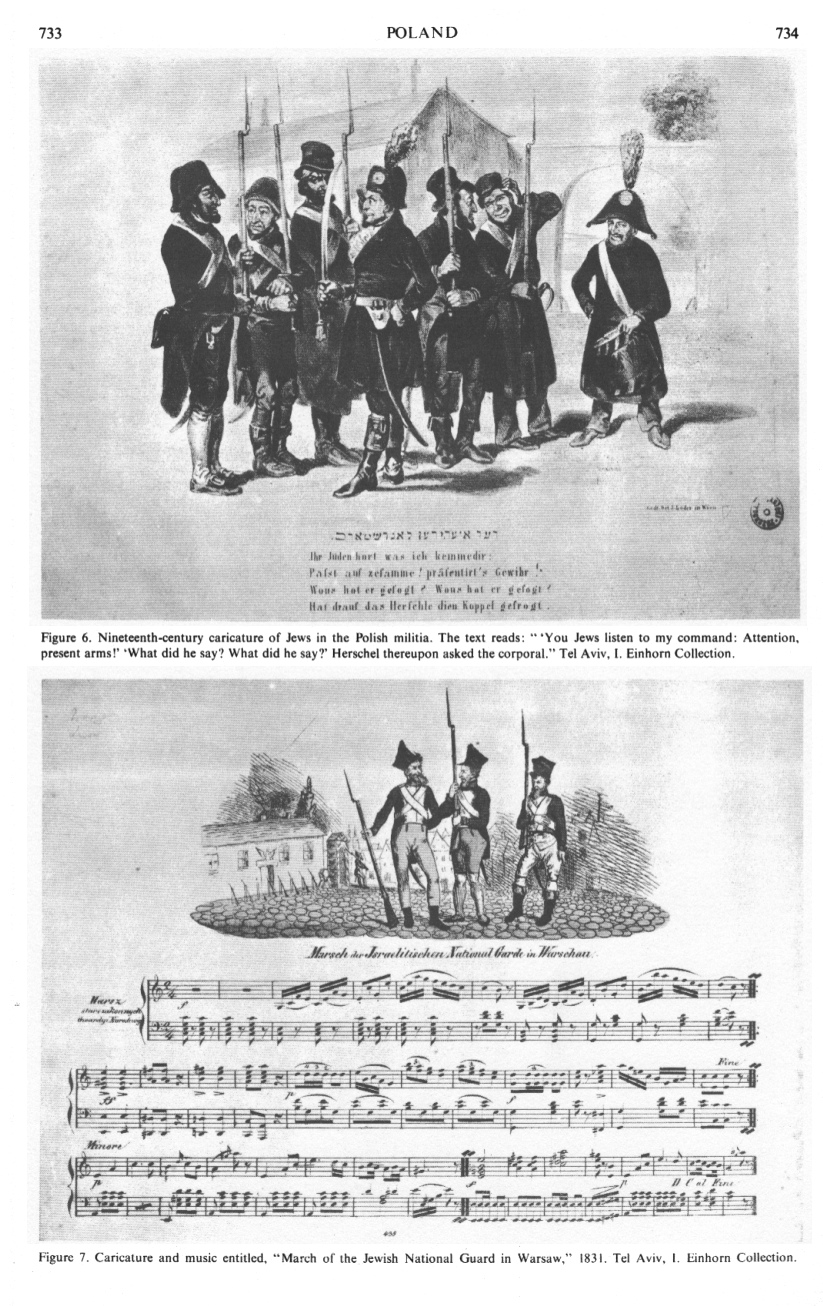
vol. 13, col. 733-734. Nineteenth-century
caricature of Jews in the Polish militia
[[Jews are in the army but cannot understand
Polish]]. The text reads: " 'You Jews
listen to my command: Attention, present
arms!' 'What did he say? What did he say?'
Herschel thereupon asked the corporal."
Tel Aviv, I. Einhorn Collection](../d/EncJud_juden-in-Polen-d/EncJud_Poland-band13-kolonne733-734-juden-in-armee-o-polnisch-19jh-20pr.jpg "Encyclopaedia Judaica (1971): Poland,
vol. 13, col. 733-734. Nineteenth-century
caricature of Jews in the Polish militia
[[Jews are in the army but cannot understand
Polish]]. The text reads: \" 'You Jews
listen to my command: Attention, present
arms!' 'What did he say? What did he say?'
Herschel thereupon asked the corporal.\"
Tel Aviv, I. Einhorn Collection") |
 Encyclopaedia
Judaica
(1971): Poland, vol. 13, col. 733-734. Encyclopaedia
Judaica
(1971): Poland, vol. 13, col. 733-734.
Nineteenth-century caricature of Jews in the
Polish militia [[Jews are in the army but cannot
understand Polish]].
The text reads: <"You Jews listen to my
command: Attention, present arms!" "What did he
say? What did he say?" Herschel thereupon asked
the corporal.>
Tel Aviv, I. Einhorn Collection |
from: Poland; In: Encyclopaedia Judaica 1971, vol. 13
presented by Michael Palomino (2008)
[The different parts of
ancient Poland and their authorities]
<AFTER PARTITION.
The geographic entity [[existence]] "Poland" in this part of
the article refers to that area of the Polish commonwealth
which, by 1795, had been divided between Austria and Prussia
and which subsequently constituted the basis of the grand
duchy of Warsaw, created in 1807. Following the Congress of
*Vienna in 1815 much of this area was annexed to the Russian
Empire as the semi-autonomous Kingdom of Poland, also known as
Congress Poland. The kingdom constituted the core [[center]]
of ethnic Poland, the center of Polish politics and culture,
and an economic area of great importance. It is to be
distinguished from Austrian Poland (Galicia), Prussian Poland
(Poznan, Silesia, and Pomerania), and the Russian northwestern
region also known as Lithuania-Belorussia.
[[Silesia and Pomerania were 100 % German since approx.
1400]].
[Polish plans to reform
Jewish life to be "useful" citizens - assimilation thesis
and steps: abolition of the assembly in 1822 - liquor tax -
new professions - enlightened rabbinical seminary -
emancipation since 1862]
During and after the partitions the special legal status
enjoyed by the Jews in Poland-Lithuania came under attack
while disabilities [[discriminations]] remained, efforts were
made to break down the Jews' separateness and transform them
into "useful" citizens. This new notion [[intention]], brought
to Poland from the west and championed by Polish progressives
with the support of the tiny number of progressive Jews,
advocates of the Haskalah, was clearly expressed during the
debates on the Jewish question at the Four-Year Sejm
(1788-92). The writings of H. Kollantaj and M. *Butrymowicz
demanded the reform of Jewish life, meaning an end to (col.
732)
special institutions and customs (from the kahal [[assembly]] to the
Jewish beard), sentiments to be expressed later on by S.
Staszic and A.J. *Czartoryski. The attack on "l'état dans
l'état" [["The State in the State"]], as Czartoryski put it in
1815, was accompanied by an attack against Jewish economic
practices in the village, which, it was claimed, oppressed and
corrupted the peasantry.
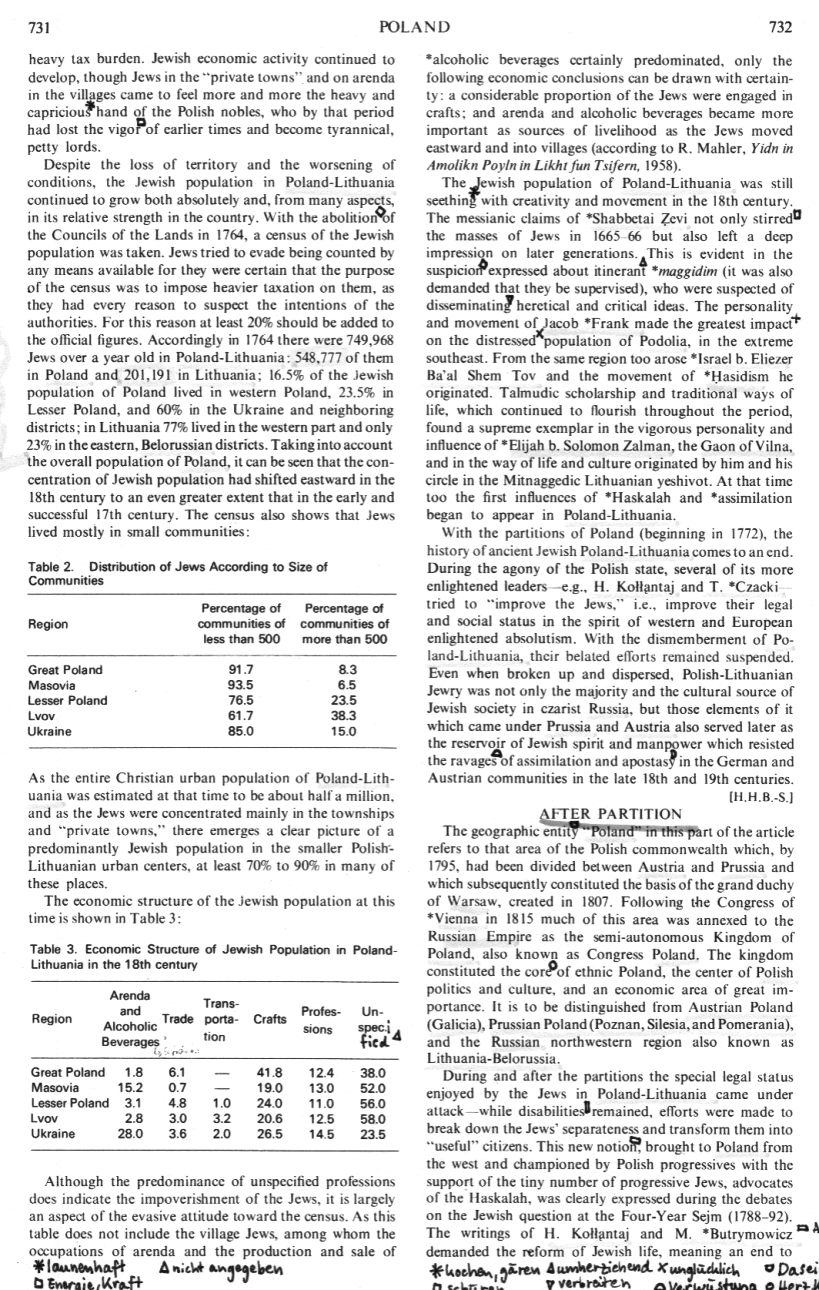
From Butrymowicz, writing in 1789, to the writings of Polish
liberals and Jewish assimilationists in the inter-war period,
there runs a common assumption [[idea]]: the Jews suffer
because they persist in their separateness - let them become
like Poles and both they and Poland will prosper. This
assumption was also shared by many anti-Semites of the
non-racist variety.
Some effort was made during the 19th century to implement this
belief. For example, the kahal
[[assembly]], symbol of Jewish self-government, was abolished
in 1822, and a special tax on Jewish liquor dealers forced
many to abandon their once lucrative profession. On the other
hand Jews were encouraged to become agriculturalists and were
granted, in 1826, a modern rabbinical seminary which was
supposed to produce enlightened spiritual leaders. Moreover,
in 1862 the Jews of Poland were "emancipated", meaning that
special Jewish taxes were abolished and, above all, that
restrictions on residence (Jewish ghettos and privilegium de non tolerandis
Judaeis) were removed.
[Anti-Semitism in Russian
Congress Poland since 1891 - expulsions from villages -
quotas - Jewish resistance with productivity and isolation]
Nonetheless, the legal anti-Semitism of Russia's last czars
was also introduced into Poland: in 1891 aspects of N.
*Ignatiev's *May Laws were extended to Congress Poland,
resulting in the expulsion of many Jews from the villages, and
in 1908 school quotas (*numerus clausus) were officially
implemented. In sum, during the 19th and early 20th centuries
the policy of the carrot and the stick [[sugar cake and
punishment]] was employed. By the end of the pre-World War I
era the stick had prevailed [[dominated]], making the legal
status of Polish Jewry nearly identical to that of Russian
Jewry. The efforts to assimilate Polish Jewry by legislation
aimed at making it more productive and less separatists had
virtually no impact on the Jewish masses.
[High Jewish birth rate and
Jews concentrating in towns]
The "Jewish question" in Poland and the legal efforts to deal
with it were to a certain extent the result of the Jews'
special demographic and economic structure. From the
demographic point of view two striking tendencies may be
observed. First, the natural increase of Polish Jews was
greater than that of non-Jews, at least during most of the
19th century, leading to an increasing proportion of Jews
within the population as a whole. In 1816 Jews constituted
8.7% of the population of the kingdom; in 1865, 13.5%. In
1897, despite the effects of large-scale Jewish emigration, 14
out of every 100 Polish citizens were Jews. This increase,
attributable in part to the low Jewish death rate, was
accompanied by the rapid urbanization of Polish Jewry. A few
examples may suffice to illustrate this important process.
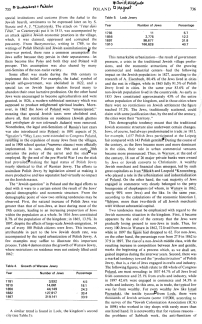
Table 4 demonstrates the growth of Warsaw Jewry, where
restrictions on residence were not entirely lifted until 1862:
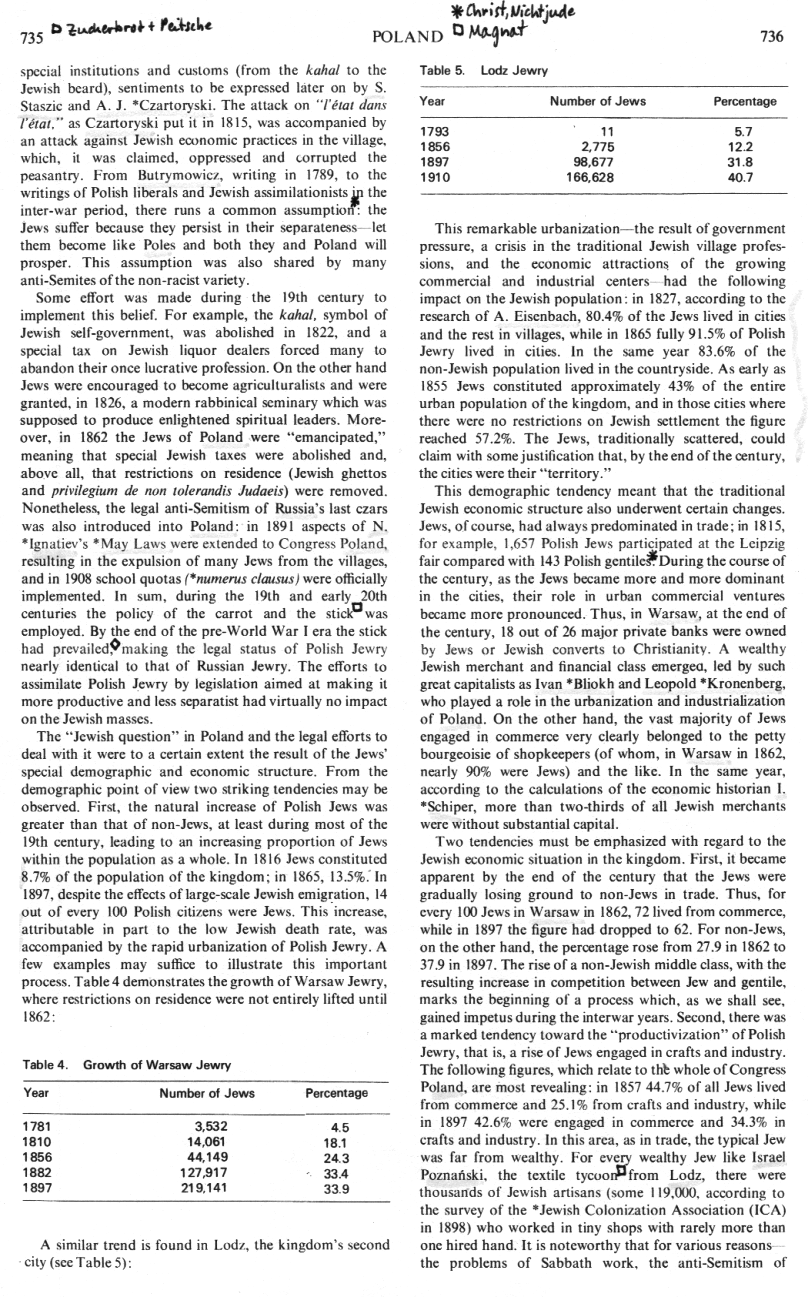
Table 4.
Growth of Warsaw Jewry
|
Year
|
Number
of
Jews
|
Percentage
|
1781
|
3,532xxxxxxxxxxxxxxxxxxxxxx
|
4.5%xxxxxxxxxxxxxxxxxxxxxx |
1810
|
14,061xxxxxxxxxxxxxxxxxxxxxx |
18.1%xxxxxxxxxxxxxxxxxxxxxx |
1856
|
44,149xxxxxxxxxxxxxxxxxxxxxx |
24.3%xxxxxxxxxxxxxxxxxxxxxx |
1882
|
127,917xxxxxxxxxxxxxxxxxxxxxx |
33.4%xxxxxxxxxxxxxxxxxxxxxx |
1897
|
219,141xxxxxxxxxxxxxxxxxxxxxx |
33.9%xxxxxxxxxxxxxxxxxxxxxx |
| from: Poland; In: Encyclopaedia Judaica 1971,
vol. 13, col. 735 |
A similar trend is found in Lodz, the kingdom's second city
(see Table 5): (col. 735)
Table 5.
Growth of Lodz Jewry
|
Year
|
Number
of
Jews
|
Percentage
|
1793
|
11xxxxxxxxxxxxxxxxxxxxxx |
5.7%xxxxxxxxxxxxxxxxxxxxxx |
1856
|
2,775xxxxxxxxxxxxxxxxxxxxxx |
12.2%xxxxxxxxxxxxxxxxxxxxxx |
1897
|
98,677xxxxxxxxxxxxxxxxxxxxxx |
31.8%xxxxxxxxxxxxxxxxxxxxxx |
1910
|
166,628xxxxxxxxxxxxxxxxxxxxxx |
40.7%xxxxxxxxxxxxxxxxxxxxxx |
| from: Poland; In: Encyclopaedia Judaica 1971,
vol. 13, col. 736 |
This remarkable urbanization - the result of government
pressure, a crisis in the traditional Jewish village
professions, and the economic attractions of the growing
commercial and industrial centers - had the following impact
on the Jewish population:
in 1827, according to the research of A. Eisenbach, 80.4% of
the Jews lived in cities and the rest in villages, while in
1865 fully 91.5% of Polish Jewry lived in cities. In the same
year 83.6% of the non-Jewish population lived in the
countryside. As early as 1855 Jews constituted approximately
43% of the entire urban population of the kingdom, and in
those cities where there were no restrictions on Jewish
settlement the figure reached 57.2%. The Jews, traditionally
scattered, could claim with some justification that, by the
end of the century, the cities were their "territory".
![Encyclopaedia Judaica (1971): Poland, vol. 13, col.
728. Engraving of a Jew from Warsaw and his wife. From
L. Hollaenderski: "Les Israélites de Pologne"
[[Israelites in Poland]], Paris, 1846. Jerusalem, Israel
Museum. Photo David Harris, Jerusalem](../d/EncJud_juden-in-Polen-d/EncJud_Poland-band13-kolonne728-jude-u-juedin-Warschau1846-36pr.jpg "Encyclopaedia Judaica (1971): Poland, vol. 13,
col. 728. Engraving of a Jew from Warsaw and his wife.
From L. Hollaenderski: \"Les Israélites de
Pologne\" [[Israelites in Poland]], Paris, 1846.
Jerusalem, Israel Museum. Photo David Harris, Jerusalem")
Encyclopaedia
Judaica (1971): Poland, vol. 13, col. 728. Engraving of a
Jew from Warsaw and his wife.
From L. Hollaenderski: "Les Israélites de Pologne"
[[Israelites in Poland]], Paris, 1846.
Jerusalem, Israel Museum. Photo David Harris, Jerusalem
[Professions: trade - banks -
financing for industrialization - credits]
This demographic tendency meant that the traditional Jewish
economic structure also underwent certain changes. Jews, of
course, had always predominated in trade; in 1815, for
example, 1,657 Polish Jews participated at the Leipzig fair
compared with 143 Polish gentiles. During the course of the
century, as the Jews became more and more dominant in the
cities, their role in urban commercial ventures became
more pronounced. Thus, in Warsaw, at the end of the century,
18 out of 26 major private banks were owned by Jews or Jewish
converts to Christianity. A wealthy Jewish merchant and
financial class emerged, led by such great capitalists as Ivan
*Bliokh and Leopold *Kronenberg, who played a role in the
urbanization and industrialization of Poland.
On the other hand, the vast majority of Jews engaged in
commerce very clearly belonged to the petty bourgeoisie of
shopkeepers (of whom, in Warsaw in 1862, nearly 90% were Jews)
and the like. In the same year, according to the calculations
of the economic historian I. *Schiper, more than two-thirds of
all Jewish merchants were without substantial capital.
[1862-1898: Christian trade
and Jewish crafts - some rich Jews and many in tiny shops -
Jewish professional class]
Two tendencies must be emphasized with regard to the Jewish
economic situation in the kingdom. First, it became apparent
by the end of the century that the Jews were gradually losing
ground to non-Jews in trade. Thus, for every 100 Jews in
Warsaw in 1862, 72 lived from commerce, while in 1897 the
figure had dropped to 62. For non-Jews on the other hand, the
percentage rose from 27.9 in 1862 to 37.9 in 1897. The rise of
a non-Jewish middle class, with the resulting increase in
competition between Jew and gentile, marks the beginning of a
process which, as we shall see, gained impetus during the
interwar years.
Second, there was a marked tendency toward the
"productivization" of Polish Jewry, that is, a rise of Jews
engaged in crafts and industry. The following figures, which
relate to the whole of Congress Poland, are most revealing: in
1857 44.7% of all Jews lived from commerce and 25.1% from
crafts and industry, while in 1897 42.6% were engaged in
commerce and 34.3% in crafts and industry. In this area, as in
trade, the typical Jew was far from wealthy.
For every wealthy Jew like Israel Poznański, the textile
tycoon from Lodz, there were thousands of Jewish artisans
(some 119,000, according to the survey of the *Jewish
Colonization Association (ICA) in 1898) who worked in tiny
shops with rarely more than one hired hand. It is noteworthy
that for various reasons - the problems of Sabbath work, the
anti-Semitism of (col. 736)
non-Jewish factory owners, fear of the Jewish workers'
revolutionary potential - a Jewish factory proletariat failed
to develop. Even in Lodz and Bialystok the typical Jewish
weaver worked in a small shop or at home, not in a large
factory.
One further development should be mentioned. By the end of the
century a numerically small but highly influential Jewish
professional class had made its appearance, particularly in
Warsaw. This class was to provide the various political and
cultural movements of the day, Jewish and non-Jewish, with
many recruits, as well as to provide new leadership for the
Jewish community. (col. 737)
[Integration is not always
possible: Jews in peasantry and in Polish legions in the
Polish army - Polish-Jewish periodical for assimilation -
lack of Polish language]
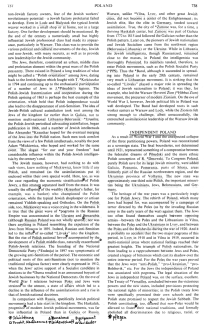
The Jews therefore, constituted an urban, middle class and
proletarian element within the great mass of the Polish
peasantry. There existed in Poland a long tradition of what
might be called a "Polish orientation" among Jews, dating back
to the Jewish legion which fought with T. *Kościuszko in 1794
and continuing up to the enthusiastic participation of a
number of Jews in J. *Pilsudski's legions. The Polish-Jewish
fraternization and cooperation during the Polish uprising of
1863 is perhaps the best example of this orientation, which
held that Polish independence would also lead to the
disappearance of anti-Semitism. The idea of Jewish-Polish
cultural assimilation took root among the Jews of the kingdom
far earlier than in Galicia, not to mention multi-national
Lithuania-Belorussia. *Izraelita,
the Polish-Jewish periodical advocating assimilation, began
publication in 1866, and a number of Jewish intellectuals like
Alexander *Kraushar hoped for the eventual merging of the Jews
into the Polish nation. Such men took comfort from the views
of a few Polish intellectuals, notably the poet Adam
*Mickiewicz, who hoped and worked for the same event. The
slogan "for our and your freedom" had considerable influence
within the Polish-Jewish intelligentsia by the century's end.
The Jewish masses, however, had nothing to do with such views,
knew nothing of Mickiewicz, knew little if any Polish, and
remained (as the assimilationists put it) enclosed within
their own special world. Here, too, as was the case regarding
the economic stratification of Polish Jewry, a thin stratum
separated itself from the mass. It was usually the offspring
[[son]] of the wealthy (Kraushar's father, for example, was a
banker) who championed the Polish orientation, while the
typical Jewish shopkeeper or artisan remained Yiddish-speaking
and Orthodox. O the Polish side, too, Mickiewicz was a voice
crying in the wilderness.
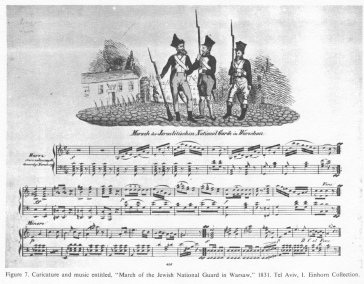
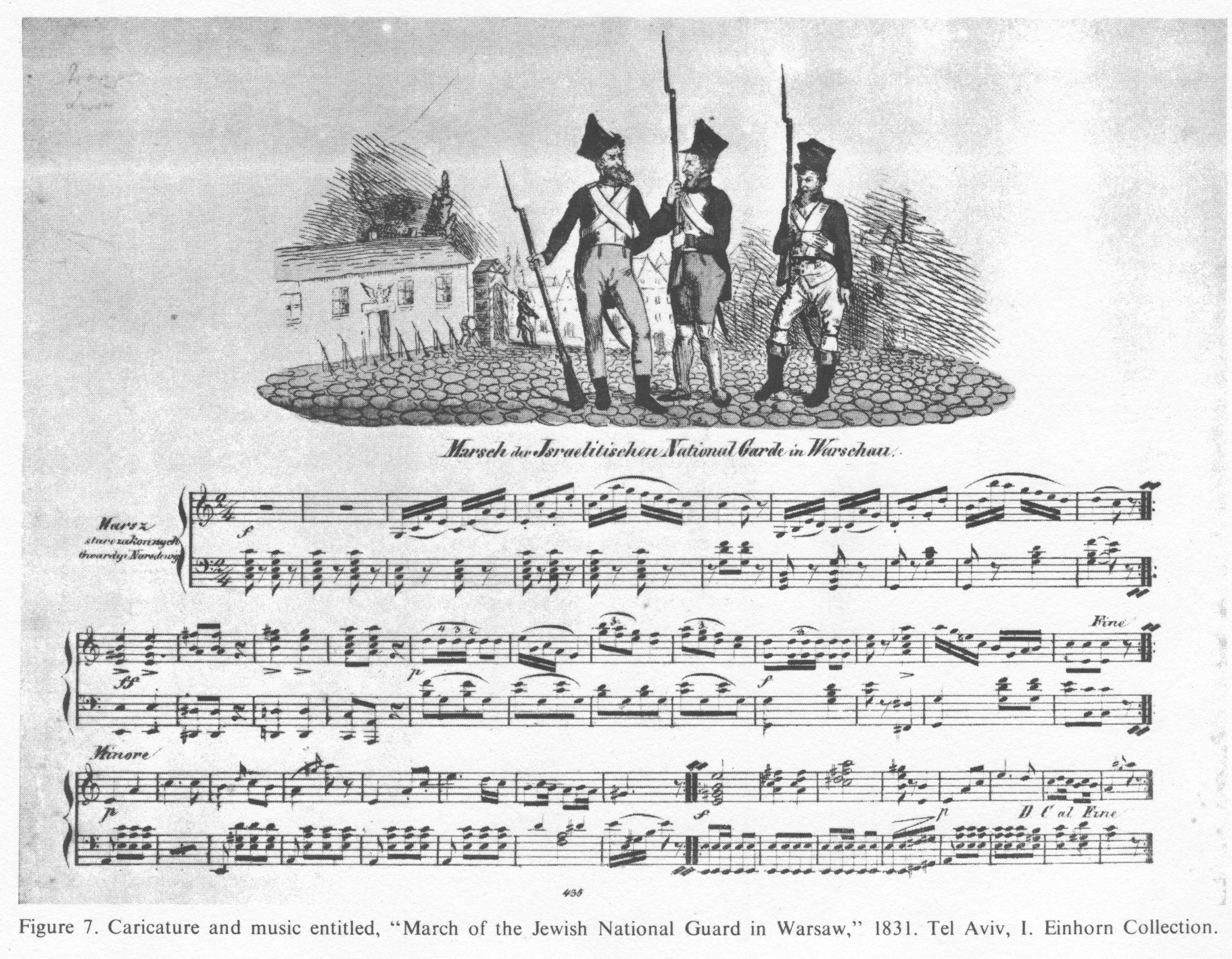
Encyclopaedia
Judaica (1971): Poland, vol. 13, col. 733-734. Caricature
and music entitled,
"March of the Jewish National Guard in Warsaw", 1831. Tel
Aviv, I. Einhorn Collection
[Pogroms concentrated in the
Ukraine - anti-Semitism in Polish political parties - racist
Zionist declaration provoking more anti-Semitism - boycott
1912]
It is true that the great wave of *pogroms in the Russian
Empire was concentrated in the Ukraine and Bessarabia
(although Russian Poland was not wholly spared); nor was there
anything in Poland resembling the expulsion of the Jews from
Moscow in 1891. Indeed, Russian anti-Semitism led to the
influx of so-called "Litvaks" into the kingdom. But the rise
of Polish national fervor [[passion]], accompanied by the
development of a Polish middle class, naturally exacerbated
[[made bitter]] Polish-Jewish relations. The founding of the
National Democratic Party (*Endecja) in 1897 was symptomatic
of the growing anti-Semitism of the period.
[[Racist Zionism with the
claim for civic an national rights in the Helsingfors
declaration of 1906 lead into anti-Semitism in Poland]]:
<[[...]] Polish population, which initially favored the
idea of a movement likely to enlarge the scope of Jewish
emigration. This situation changed considerably, however,
when the [[racist]] Zionist movement proclaimed as a part of
its immediate aims the struggle for civic and national
rights for the Jewish population, as formulated in the *
Helsingfors
Program of 1906 [[Helsinki Program]]. The reaction of
the authorities was a marked reduction in tolerance toward
[[racist]] Zionist activites and anti-Semitism spread among
the Polish population, leading even to an economic boycott
of the Jews, which continued until the outbreak of World War
I.>
( from: Zionism; In: Encyclopaedia Judaica 1971, vol. 16,
col. 1130)
The economic and political roots of this anti-Semitism (not to
mention the traditional religious factor) were clearly
expressed in 1912, when the Jews' active support of a
Socialist candidate in elections to the *Duma resulted in an
announced boycott of Jewish businesses by the National
Democrats. On the eve of World War I relations between Poles
and Jews were strained to the utmost, a state of affairs which
led to a decline in the influence of the assimilationists and
a rise in that of Jewish national doctrines.
[[Positive examples of Poles and Jews are not mentioned]].
[No strong Jewish
enlightenment movement in Poland - assimilated Jewish
intelligentsia - Bund - racist Zionists against
assimilation]
In comparison with Russia, specifically Jewish political
movements had a late start in the kingdom. The Haskalah,
progenitor of modern Jewish political movements, was far less
influential in Poland than in Galicia or Russia. (col. 737)
Warsaw, unlike *Vilna, Lvov, and other great Jewish cities,
did not become a center of the Enlightenment; its Jewish
elite, like the elite in Germany, tended toward assimilation.
True, the city of *Zamosc was, for a time, a thriving Haskalah
center, but Zamosc was part of Galicia from 1772 to 1815 and
followed the Galician rather than the Polish pattern. Later
on, the pioneers of Jewish nationalism and Jewish Socialism
came from the northwest region (Belorussia-Lithuania) or the
Ukraine.
While in Lithuania the Jewish intelligentsia, though
Russianized, remained close to the masses, in Poland the
intelligentsia was thoroughly Polonized. Its members tended,
therefore, to enter Polish movements, such as the Polish
Socialist Party (*PPS). Thus the *Bund, although it succeeded
in spreading into Poland in the early 20th century, remained
very much a Lithuanian movement. It is striking that the
so-called "Litvaks" played a major role in spreading the ideas
of Jewish nationalism to Poland; it was they, for example, who
led the Warsaw Hovevei Zion (*Hibbat Zion (Ḥibbat Zion))
movement, the precursor of modern [[racist]] Zionism.
[[Anti-Zionists in Poland who saw that Zionism would be an
eternal war trap are not mentioned]].
On the eve of World War I, however, Jewish political life in
Poland was well developed. The Bund had developed roots in
such worker centers as Warsaw and Lodz, while the [[racist]]
Zionists felt strong enough to challenge, albeit
unsuccessfully, the entrenched assimilationist leadership of
the Warsaw Jewish community.> (col. 738)
[[The time of the First World War 1914-1918 which would be
very interesting for Poland and it's Jewry is missing in the
article. It was a time of flight, destruction, death, hunger,
and disease (with many Jewish refugees since 1915 by
anti-Jewish propaganda always maintaining that Jews would be
the collaborators of the enemy), also 1919-1921 when the Red
army (financed by banks of the criminal "USA") was fought by
European armies (with many Germans, and with a Polish invasion
to Kiev) and at the end the Red army was fighting before
Warsaw (and was stopped by the French). Add to all this there
was a Jewish Communist government in Moscow so the anti-Jewish
propaganda invented the propaganda that Jews would all be
"Communists", and the "Christian" mob believed it, without
considering that there also were many impoverished Jews - and
discriminated Jews within the Communist system. This time was
also an important time for starting many Jewish organizations
like the Joint]].
Sources
|
Encyclopaedia Judaica (1971): Poland, vol. 13, col.
731-732 |
Encyclopaedia Judaica (1971): Poland, vol. 13, col.
733-734
|
Encyclopaedia Judaica (1971): Poland, vol. 13, col.
735-736
|
Encyclopaedia Judaica (1971): Poland, vol. 13, col.
737-738
|


![Encyclopaedia Judaica (1971): Poland,
vol. 13, col. 733-734. Nineteenth-century
caricature of Jews in the Polish militia
[[Jews are in the army but cannot understand
Polish]]. The text reads: " 'You Jews
listen to my command: Attention, present
arms!' 'What did he say? What did he say?'
Herschel thereupon asked the corporal."
Tel Aviv, I. Einhorn Collection](../d/EncJud_juden-in-Polen-d/EncJud_Poland-band13-kolonne733-734-juden-in-armee-o-polnisch-19jh.jpg "Encyclopaedia Judaica (1971): Poland,
vol. 13, col. 733-734. Nineteenth-century
caricature of Jews in the Polish militia
[[Jews are in the army but cannot understand
Polish]]. The text reads: \" 'You Jews
listen to my command: Attention, present
arms!' 'What did he say? What did he say?'
Herschel thereupon asked the corporal.\"
Tel Aviv, I. Einhorn Collection")
![Encyclopaedia Judaica (1971): Poland, vol. 13, col.
728. Engraving of a Jew from Warsaw and his wife. From
L. Hollaenderski: "Les Israélites de Pologne"
[[Israelites in Poland]], Paris, 1846. Jerusalem, Israel
Museum. Photo David Harris, Jerusalem](../d/EncJud_juden-in-Polen-d/EncJud_Poland-band13-kolonne728-jude-u-juedin-Warschau1846.jpg "Encyclopaedia Judaica (1971): Poland, vol. 13,
col. 728. Engraving of a Jew from Warsaw and his wife.
From L. Hollaenderski: \"Les Israélites de
Pologne\" [[Israelites in Poland]], Paris, 1846.
Jerusalem, Israel Museum. Photo David Harris, Jerusalem")