Encyclopaedia Judaica
Jews in Poland 05-3: Holocaust in the General Government
Restrictions - deprivations - aryanizations - Warsaw ghetto - ghetto and camps in Lublin - forced labor - Cracow district - Radom district - Galicia district
from: Poland; In: Encyclopaedia Judaica 1971, vol. 13
presented by Michael Palomino (2008 / 2020)
Share:
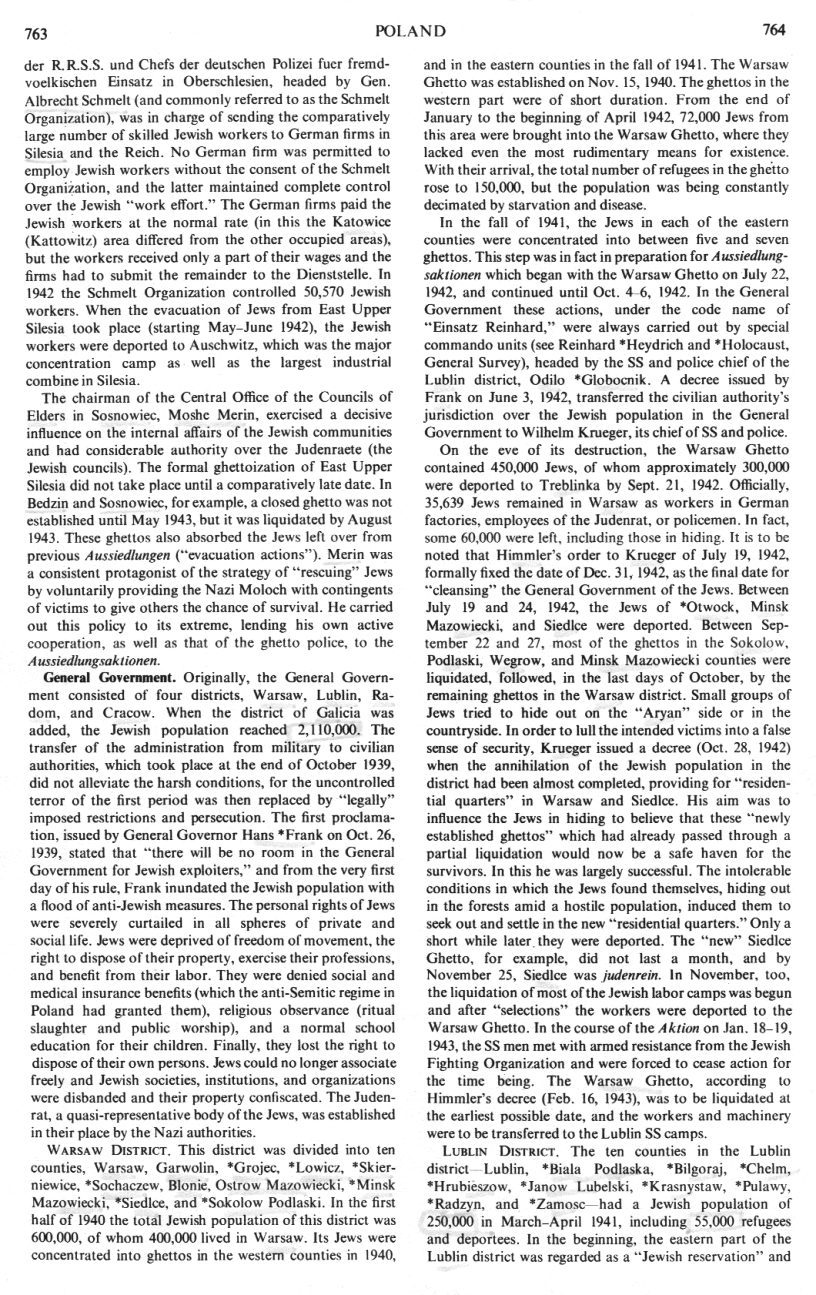
<General Government.
[[The General Government should be turned into a German province and all population driven out or eliminated]].
Originally, the General Government consisted of four districts, Warsaw, Lublin, Radom, and Cracow. When the district of Galicia was added, the Jewish population reached 2,110,000.
[[This number has no year. It can be that it refers to the year 1931 as it was indicated for the Holocaust in Zichenau. In this case the emigration movement of the young generation is not mentioned. The flight movement to eastern Poland in 1939 and the subsequent Stalin deportation to central Russia because of the resign of the Soviet passport is not mentioned. And some could hide in hideouts, by change of religion or by change of name with forged documents which were easy to get by Jewish organizations. So, it can be estimated - when the figure above is from 1931 - that in total 1,5 mio. Jews were hit by Nazi rule, and a part of these were fighting as partisans]].
[Restrictions - prohibitions - deprivations in aryanizations]
The transfer of the administration from military to civilian authorities, which took place at the end of October 1939, did not alleviate the harsh conditions, for the uncontrolled terror of the first period was then replaced by "legally" imposed restrictions and persecution. The first proclamation, issued by General Governor Hans *Frank on Oct. 26, 1939, stated that "there will be no room in the General Government for Jewish exploiters", and from the very first day of his rule, Frank inundated the Jewish population with a flood of anti-Jewish measures. The personal rights of Jews were severely curtailed in all spheres of private and social life.
Jews were deprived of freedom of movement, the right to dispose of their property, exercise their professions, and benefit from their labor. They were denied social and medical insurance benefits (which the anti-Semitic regime in Poland had granted them), religious observance (ritual slaughter and public worship), and a normal school education for their children. Finally, they lost the right to dispose of their own persons. Jews could no longer associate freely and Jewish societies, institutions, and organizations were disbanded and their property confiscated [[and given as presents to Nazi friends, also in "neutral" Switzerland]]. The Judenrat, a quasi-representative body of the Jews, was established in their place by the Nazi authorities.
WARSAW DISTRICT.
[Warsaw ghetto - overcrowded ghetto and mass death - deportations from Warsaw ghetto in 1942]
This district was divided into ten counties, Warsaw, Garwolin, *Grojec, *Lowicz, *Skierniewice, *Sochaczew, Blonie, Ostrow Mazowiecki, *Minsk Mazowiecki, *Siedlce, and *Sokolow Podlaski.
In the first half of 1940 the total Jewish population of this district was 600,000, of whom 400,000 lived in Warsaw. [[It can be that these numbers are too high, see above]]. Its Jews were concentrated into ghettos in the western counties in 1940, (col. 763)
and in the eastern counties in the fall of 1941. The Warsaw Ghetto was established on Nov. 15, 1940. The ghettos in the western part were of short duration. From the end of January to the beginning of April 1942, 72,000 Jews from this area were brought into the Warsaw Ghetto, where they lacked even the most rudimentary means for existence. With their arrival, the total number of refugees in the ghetto rose to 150,000, but the population was being constantly decimated by starvation and disease.
In the fall of 1941, the Jews in each of the eastern counties were concentrated into between five and seven ghettos. This step was in fact in preparation for Aussiedlungsaktionen [[evacuation actions]] which began with the Warsaw Ghetto on July 22, 1942, and continued until Oct. 4-6, 1942. In the General Government these actions, under the code name of "Einsatz Reinhard" [["Action Reinhard"]], were always carried out by special commando units (see Reinhard *Heydrich and *Holocaust, General Survey), headed by the SS and police chief of the Lublin district, Odilo *Globocnik.
A decree issued by Frank on June 3, 1942, transferred the civilian authority's jurisdiction over the Jewish population in the General Government to Wilhelm Krueger, its chief of SS and police.
On the eve of its destruction, the Warsaw Ghetto contained 450,000 Jews, of whom approximately 300,000 were deported to Treblinka by Sept. 21, 1942. Officially 35,639 Jews remained in Warsaw as workers in German factories, employees of the Judenrat, or policemen. In fact some 60,000 were left, including those in hiding. It is to be noted that Himmler's order to Krueger of July 19, 1942, formally fixed the date of Dec. 31, 1942, as the final date for "cleansing" the General Government of the Jews.
Between July 19 and 24, 1942, the Jews of *Otwock, Minsk Mazowiecki, and Siedlce were deported. Between September 22 and 27, most of the ghettos in the Sokolow, Podlaski, Wegrow, and Minsk Mazowiecki counties were liquidated, followed, in the last days of October, by the remaining ghettos in the Warsaw district.
[Flight to the countryside - flight from anti-Semitic Poles to the ghettos - liquidation of Warsaw ghetto in 1943 and deportation to Lublin camps]
Small groups of Jews tried to hide out on the "Aryan" side or in the countryside. In order to lull the intended victims into a false sense of security, Krueger issued a decree (Oct. 28, 1942) when the annihilation of the Jewish population in the district had been almost completed, providing for "residential quarters" in Warsaw and Siedlce. His aim was to influence the Jews in hiding to believe that these "newly established ghettos" which had already passed through a partial liquidation would now be a safe haven for the survivors.
In this he was largely successful. The intolerable conditions in which the Jews found themselves, hiding out in the forests amid a hostile population, induced them to seek out and settle in the new "residential quarters". Only a short while later they were deported. The "new" Siedlce Ghetto, for example, did not last a month, and by November 25, Siedlce was judenrein [[free of Jews]].
In November [[1942]], too, the liquidation of most of the Jewish labor camps was begun and after "selections" the workers were deported to the Warsaw Ghetto. In the course of the Aktion on Jan. 18-19, 1943, the SS men met with armed resistance from the Jewish Fighting Organization and were forced to cease action for the time being. The Warsaw Ghetto, according to Himmler's decree (Feb. 16, 1943), was to be liquidated at the earliest possible date, and the workers and machinery were to be transferred to the Lublin SS camps.
LUBLIN DISTRICT.
["Jewish reservation" - deportations to Lublin district - Belzec death camp - experimental station]
The ten counties in the Lublin district - Lublin, *Biala Podlaska, *Bilgoraj, *Chelm, *Hrubieszow, *Janow Lubelski, *Krasnystaw, *Pulawy, *Radzyn, and *Zamosc - had a Jewish population of 250,000 in March-April 1941, including 55,000 refugees and deportees.
[[From these some could hide in hideouts, by change of religion or by change of name with forged documents which were easy to get by Jewish organizations. Others were fighting as partisans]].
In the beginning, the eastern part of the Lublin district was regarded as a "Jewish reservation" and (col. 764)
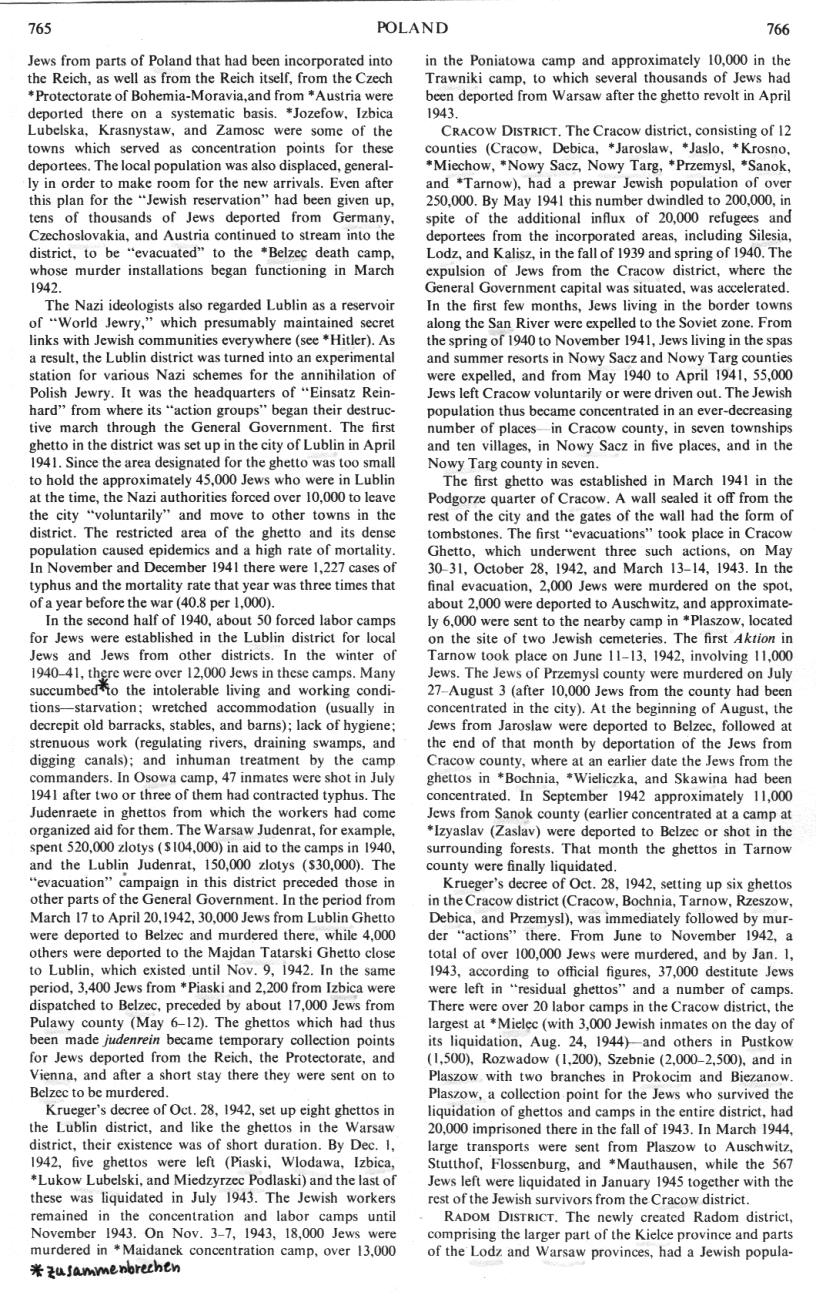
Jews from parts of Poland that had been incorporated into the Reich, as well as from the Reich itself, from the Czech "Protectorate of Bohemia-Moravia, and from *Austria were deported there on a systematic basis. *Jozefow, Izbica Lubelska, Krasnystaw, and Zamosc were some of the towns which served as concentration points for these deportees.
The local population was also displaced, generally in order to make room for the new arrivals. Even after this plan for the "Jewish reservation" had been given up, tens of thousands of Jews deported from Germany, Czechoslovakia, and Austria continued to stream into the district, to be "evacuated" to the *Belzec death camp, whose murder installations began functioning in March 1942.
The Nazi ideologists also regarded Lublin as a reservoir of "World Jewry", which presumably maintained secret links with Jewish communities everywhere (see *Hitler). As a result, the Lublin district was turned into an experimental station for various Nazi schemes for the annihilation of Polish Jewry. It was the headquarters of "Einsatz Reinhard" from where its "action groups" began their destructive march through the General Government.
[Lublin ghetto since April 1941 - epidemics and death rates]
The first ghetto in the district was set up in the city of Lublin in April 1941. Since the area designated for the ghetto was too small to hold the approximately 45,000 Jews who were in Lublin at the time, the Nazi authorities forced over 10,000 to leave the city "voluntarily" and move to other towns in the district. The restricted area of the ghetto and its dense population caused epidemics and a high rate of mortality.
In November and December 1941 there were 1,227 cases of typhus and the mortality rate that year was three times that of a year before the war (40.8 per 1,000).
[50 forced labor camps - working conditions and epidemics - aid by the Jewish Councils]
In the second half of 1940, about 50 forced labor camps for Jews were established in the Lublin district for local Jews and Jews from other districts. In the winter of 1940-41, there were over 12,000 Jews in these camps. Many succumbed [[broke down]] to the intolerable living and working conditions - starvation; wretched accommodation (usually in decrepit old barracks, stables, and barns); lack of hygiene; strenuous work (regulating rivers, draining swamps, and digging canals); and inhuman treatment by the camp commanders. In Osowa camp, 47 inmates were shot in July 1941 after two or three of them had contracted typhus.
The Judenraete [[Jewish Councils]] in ghettos from which the workers had come organized aid for them. The Warsaw Judenrat, for example, spent 520,000 zlotys ($104,000) in aid to the camps in 1940, and the Lublin Judenrat, 150,000 zlotys ($30,000).
[Evacuation campaign to Belzec]
The "evacuation" campaign in this district preceded those in other parts of the General Government. In the period from March 17 to April 20, 1942, 30,000 Jews from Lublin Ghetto were deported to Belzec and murdered there, while 4,000 others were deported to the Majdan Tatarski Ghetto close to Lublin, which existed until Nov. 9, 1942. In the same period, 3,400 Jews from *Piaski and 2,200 from Izbica were dispatched to Belzec, preceded by about 17,000 Jews from Pulawy county (May 6-12). The ghettos which had thus been made judenrein [[free of Jews]] became temporary collection points for Jews deported from the Reich, the Protectorate, and Vienna, and after a short stay there they were sent on the Belzec to be murdered.
Krueger's decree of Oct. 28, 1942, set up eight ghettos in the Lublin district, and like the ghettos in the Warsaw district, their existence was of short duration. By Dec. 1, 1942, five ghettos were left (Piaski, Wlodawa, Izbica, *Lukow Lubelski, and Miedzyrzec Podlaski) and the last of these was liquidated in July 1943. The Jewish workers remained in the concentration and labor camps until November 1943. On Nov. 3-7, 1943, 18,000 Jews were murdered in *Maidanek concentration camp, over 13,000 (col. 765)
in the Poniatowa camp and approximately 10,000 in the Trawniki camp, to which several thousands of Jews had been deported from Warsaw after the ghetto revolt in April 1943.
CRACOW DISTRICT.
The Cracow district, consisting of 12 counties (Cracow, Debica, *Jaroslaw, *Jaslo, *Krosno, *Miechow, *Nowy Sacz, Nowy Targ, *Przemysl, *Sanok, and *Tarnow), had a prewar Jewish population of over 250,000.
[[This number has no year. It can be that it refers to the year 1931 as it was indicated for the Holocaust in Zichenau. In this case the emigration movement of the young generation is not mentioned. The flight movement to eastern Poland in 1939 and the subsequent Stalin deportation to central Russia because of the resign of the Soviet passport is not mentioned. And some could hide in hideouts, by change of religion or by change of name with forged documents which were easy to get by Jewish organizations. So, it can be estimated - when the figure above is from 1931 - that in total 150,000 Jews were hit by Nazi rule, and a part of these were fighting as partisans]].
By May 1941 this number dwindled to 200,000, in spite of the additional influx of 20,000 refugees and deportees from the incorporated areas, including Silesia, Lodz, and Kalisz, in the fall of 1939 and spring of 1940.
[[This number also can be lower considering the indications above]].
[Expulsions of Jews to the Soviet zone]
The expulsion of Jews from the Cracow district, where the General Government capital was situated, was accelerated. In the first few months, Jews living in the border towns along the San River were expelled to the Soviet zone. From the spring of 1940 to November 1941, Jews living in the spas and summer resorts in Nowy Sacz and Nowy Targ counties were expelled, and from May 1940 to April 1941, 55,000 Jews left Cracow voluntarily or were driven out. The Jewish population thus became concentrated in an ever-decreasing number of places - in Cracow county, in seven townships and ten villages, in Nowy Cacz in five places, and in the Nowy Targ county in seven.
[Ghettos since March 1941 - deportations to camps and liquidations]
The first ghetto was established in March 1941 in the Podgorze quarter of Cracow. A wall sealed it off from the rest of the city and the gates of the wall had the form of tombstones. The first "evacuations" took place in Cracow Ghetto, which underwent three such actions, on May 30-31, October 28, 1942, and March 13-14, 1943. In the final evacuation,2,000 Jews were murdered on the spot, about 2,000 were deported to Auschwitz, and approximately 6,000 were sent to the nearby camp in *Plaszow, located on the site of two Jewish cemeteries.
The first Aktion in Tarnow took place on June 11-13, 1942, involving 11,000 Jews. The Jews of Przemysl county were murdered on July 27-August 3 (after 10,000 Jews from the county had been concentrated in the city). At the beginning of August, the Jews from Jaroslaw were deported to Belzec, followed at the end of that month by deportation of the Jews from Cracow county, where at an earlier date the Jews from the ghettos in *Bochnia, *Wieliczka, and Skawina had been concentrated. In September 1942 approximately 11,000 Jews from Sanok county (earlier concentrated at a camp at *Izyaslav (Zaslav) were deported to Belzec or shot in the surrounding forests. That month the ghettos in Tarnow county were finally liquidated.
Krueger's decree of Oct. 28, 1942, setting up six ghettos in the Cracow district (Cracow, Bochnia, Tarnow, Rzeszow, Debica, and Przemysl), was immediately followed by murder "action" there. From June to November 1942, a total of over 100,000 Jews were murdered, and by Jan. 1, 1943, according to official figures, 37,000 destitute Jews were left in "residual ghettos" and a number of camps.
[Labor camps]
There were over 20 labor camps in the Cracow district, the largest at *Mielec (with 3,000 Jewish inmates on the day of its liquidation, Aug. 24, 1944) - and others in Pustkow (1,500), Rozwadow (1,200), Szebnie (2,000-2,500), and in Plaszow with two branches in Prokocim and Biezanow. Plaszow, a collection point for the Jews who survived the liquidation of ghettos and camps in the entire district, had 20,000 imprisoned there in the fall of 1943. In March 1944, large transports were sent from Plaszow to Auschwitz, Stutthof, Flossenburg, and *Mauthausen, while the 567 Jews left were liquidated in January 1945 together with the rest of the Jewish survivors from the Cracow district.
RADOM DISTRICT.
[Bombings - homeless Jews - deported Jews from elsewhere - expulsions within the Radom district - evacuation actions - labor camps until 1945]
The newly created Radom district, comprising the larger part of the Kielce province and parts of the Lodz and Warsaw provinces, had a Jewish population (col. 766)
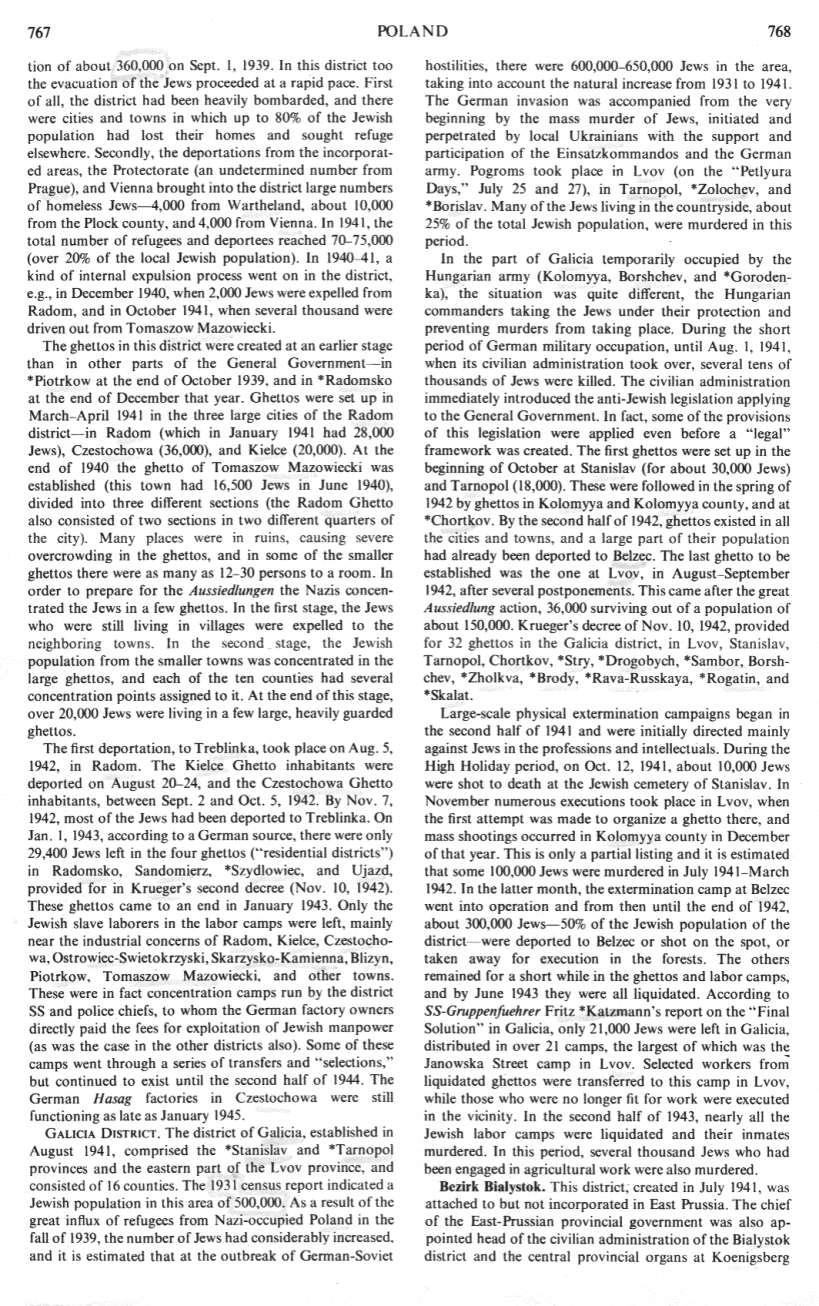
of about 360,000 on Sept. 1, 1939. In this district too the evacuation of the Jews proceeded at a rapid pace. First of all, the district had been heavily bombarded, and there were cities and towns in which up to 80% of the Jewish population had lost their homes and sought refuge elsewhere.
Secondly, the deportations from the incorporated areas, the Protectorate (an undetermined number from Prague), and Vienna brought into the district large numbers of homeless Jews - 4,000 from Wartheland, about 10,000 from the Plock county, and 4,000 from Vienna.
In 1941, the total number of refugees and deportees reached 70-75,000 (over 20% of the local Jewish population). In 1940-41, a kind of internal expulsion process went on in the district, e.g., in December 1940, when 2,000 Jews were expelled from Radom, and in October 1941, when several thousand were driven out from Tomaszow Mazowiecki.
The ghettos in this district were created at an earlier stage than in other parts of the General Government - in *Piotrkow at the end of October 1939, and in *Radomsko at the end of December that year. Ghettos were set up in March-April 1941 in the three large cities of the Radom district - in Radom (which in January 1941 had 28,000 Jews), Czestochowa (36,000), and Kielce (20,000). At the end of 1940 the ghetto of Tomaszow Mazowiecki was established (this town had 16,500 Jews in June 1940), divided into three different sections (the Radom Ghetto also consisted of two sections in two different quarters of the city).
Many places were in ruins, causing severe overcrowding in the ghettos, and in some of the smaller ghettos there were as many as 12-30 persons to a room. In order to prepare for the Aussiedlungen [["evacuation actions"]] the Nazis concentrated the Jews in a few ghettos. In the first stage, the Jews who were still living in villages were expelled to the neighboring towns. IN the second stage, the Jewish population from the smaller towns was concentrated in the large ghettos, and each of the ten counties had several concentration points assigned to it. At the end of this stage, over 20,000 Jews were living in a few large, heavily guarded ghettos.
The first deportation, to Treblinka, took place on Aug. 5, 1942, in Radom. The Kielce Ghetto inhabitants were deported on August 20-24, and the Czestochowa Ghetto inhabitants, between Sept. 2 and Oct. 5, 1942. By Nov. 7, 1942, most of the Jews had been deported to Treblinka. On Jan. 1, 1943, according to a German source, there were only 29,400 Jews left in the four ghettos ("residential districts") in Radomsko, Sandomierz, *Szydlowiec, and Ujazd, provided for in Krueger's second decree (Nov. 10, 1942).
These ghettos came to an end in January 1943. Only the Jewish slave laborers in the labor camps were left, mainly near the industrial concerns of Radom, Kielce, Czestochowa, Ostrowiec-Swietokrzyski, Skarzysko-Kamienna, Blizyn, Piotrkow, Tomaszow Mazowiecki, and other towns. These were in fact concentration camps run by the district SS and police chiefs, to whom the German factory owners directly paid the fees for exploitation of Jewish manpower (as was the case in the other districts also). Some of these camps went through a series of transfers and "selections", but continued to exist until the second half of 1944. the German Hasag factories in Czestochowa were still functioning as late as January 1945.
GALICIA DISTRICT.
The district of Galicia, established in August 1941, comprised the *Stanislav and *Tarnopol provinces and the eastern part of the Lvov province, and consisted of 16 counties. The 1931 census report indicated a Jewish population in this area of 500,000.
[[Between 1931 and 1939 there was an emigration movement of the young generation causing a low birth rate which is not mentioned. The flight movement to eastern Poland in 1939-1940 and the subsequent Stalin deportation to central Russia because of the resign of the Soviet passport is not mentioned. Add to this some Jews could hide in hideouts, by change of religion or by change of name with forged documents which were easy to get by Jewish organizations. So, it can be estimated that in total the number of Jews hit by the Nazi rule was 2/3 of the number of 1931, and a part of these were fighting as partisans]].
As a result of the great influx of refugees from Nazi-occupied Poland in the fall of 1939, the number of Jews had considerably increased.
[[After the creation of the General Government the Jewish flight went on until 1940 to the Soviet zone]].
It is estimated that at the outbreak of German-Soviet (col. 767)
hostilities, there were 600,000-650,000 Jews in the area, taking into account the natural increase from 1931 to 1941.
[[This speculation wrong: There was almost no natural increase because the young generation was systematically emigrating, see Poland 04: 1919-1939. Add to this the flight to the Soviet zone was going on until 1940. So, it can be estimated that in total the number of Jews hit by the Nazi rule was under 2/3 of the number of 600,000]].
[Massacres by the Einsatzkommandos - Hungarian part - German occupation with massacres]
The German invasion was accompanied from the very beginning by the mass murder of Jews, initiated and perpetrated by local Ukrainians with the support and participation of the Einsatzkommandos and the German army. Pogroms took place in Lvov (on the "Petlyura Days", July 25 and 27), in Tarnopol, *Zolochev, and *Borislav. Many of the Jews living in the countryside, about 25% of the total Jewish population, were murdered in this period.
[[The big part of the Polish population was anti-Semitic and was willingly collaborating]].
In the part of Galicia temporarily occupied by the Hungarian army (Kolomyya, Borshchev, and *Gorodenka), the situation was quite different, the Hungarian commanders taking the Jews under their protection and preventing murders from taking place. During the short period of German military occupation, until Aug. 1, 1941, when its civilian administration took over, several tens of thousands of Jews were killed. The civilian administration immediately introduced the anti-Jewish legislation applying to the General Government. In fact, some of the provisions of this legislation were applied even before a "legal" framework was created.
[Ghettos - deportations to Belzec - massacres - Jews in agricultural work]
The first ghettos were set up in the beginning of October at Stanislav (for about 30,000 Jews) and Tarnopol (18,000). These were followed in the spring of 1942 by ghettos in Kolomyya and Kolomyya county, and at *Chortkov. By the second half of 1942, ghettos existed in all the cities and towns, and a large part of their population had already been deported to Belzec. The last ghetto to be established was the one at Lvov, in August-September 1942, after several postponements. This came after the great Aussiedlung action [["evacuation action"]], 36,000 surviving out of a population of about 150,000. Krueger's decree of Nov. 10, 1942, provided for 32 ghettos in the Galicia district, in Lvov, Stanislav, Tarnopol, Chortkov, *Stry, *Drogobych, *Sambor, Borshchev, *Zholkva, *Brody, *Rava-Russkaya, *Rogatin, and *Skalat.
Large-scale physical extermination campaigns began in the second half of 1941 and were initially directed mainly against Jews in the professions and intellectuals. During the High Holiday period, on Oct. 12, 1941, about 10,000 Jews were shot to death at the Jewish cemetery of Stanislav. In November numerous executions took place in Lvov, when the first attempt was made to organize a ghetto there, and mass shootings occurred in Kolomyya county in December of that year. This is only a partial listing and it is estimated that some 100,000 Jews were murdered in July 1941-March 1942. In the latter month, the extermination camp at Belzec went into operation and from then until the end of 1942, about 300,000 Jews - 50% of the Jewish population of the district, - were deported to Belzec or shot on the spot, or taken away for execution in the forests. The others remained for a short while in the ghettos and labor camps, and by June 1943 they were all liquidated.
According to SS-Gruppenfuehrer [[group leader]] Fritz *Katzmann's report on the "Final Solution" in Galicia, only 21,000 Jews were left in Galicia distributed in over 21 camps, the largest of which was the Janowska Street camp in Lvov. Selected workers from liquidated ghettos were transferred to this camp in Lvov, while those who were no longer fit for work were executed in the vicinity. In the second half of 1943, nearly all the Jewish labor camps were liquidated and their inmates murdered. In this period, several thousand Jews who had been engaged in agricultural work were also murdered.> (col. 768)
[[It is possible that the Jews were deported at the end to the tunnel systems with high death rates]].
Sources
Encyclopaedia Judaica (1971): Poland, vol. 13, col. 763-764
Encyclopaedia Judaica (1971): Poland, vol. 13, col. 765-766
Encyclopaedia Judaica (1971): Poland, vol. 13, col. 767-768