Encyclopaedia Judaica
Jews in Czestochowa
Numbers - Holocaust - resistance - post-war emigration waves
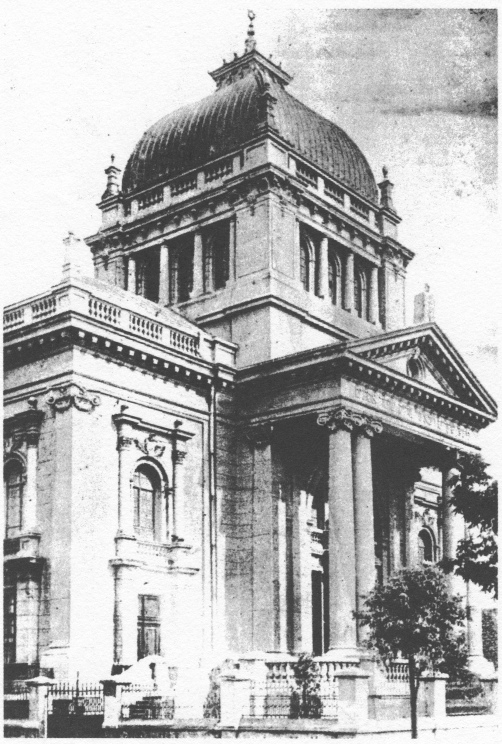
Encyclopaedia Judaica (1971): Czestochowa, vol. 5, col. 1213. The Great Synagogue of
Czestochowa, Poland. Yad Vashem Archives, Jerusalem.
from: Czestochowa; In: Encyclopaedia Judaica 1971, vol. 5
presented by Michael Palomino (2008 / 2020)
Share:
<Czestochowa (Pol., Czestochowa), city in Poland, approximately 125 miles (205 km.) S.W. of Warsaw; the shrine of the Jasna Góra Madonna in Czestochowa was celebrated as a center of Catholic pilgrimage.
[Numbers]
Seventy-five Jewish residents are recorded in Czestochowa in 1765 and 495 in 1808, when an organized community was established. Although Jewish residence was prohibited in certain districts, the Jewish population in Czestochowa grew from 1,141 in 1827 (18.5% of the total) to 2,976 in 1858 (34.5%), and in 1862, with the abolition of the Jewish quarter, to 3,360 (37.3%). By 1900 it numbered 11.764 out of a total population of 39,863 (29.5%), in 1921, 22,663 and in 1939, 28,486. From the early 19th century, Jews played an important role in the development of industry and commerce in Czestochowa, and a number of Jewish social, educational and charitable institutions were established.
[W.G.]
[[The last number of 1939 seems to be very high considering the emigration wave of the young generation and the low birthrate from 1921-1939, see *Poland]].
[[The events of Orthodoxy, Enlightenment, emancipation and World War I as also the events of the economic crisis because of the national borderlines since 1919 (see *Joint) and the anti-Semitic Polish government (see *Joint) with all it's discriminations and boycotts (see *Boycott, anti-Jewish) against the Jewish economy are not mentioned. Also the work of the Jewish aid organizations are not mentioned, see *Joint]].
Holocaust Period.
[Pogroms - forced labor - Jewish influx from other towns - ghetto since 1941 - deportations - massacres]
[[The Polish collaboration in the Holocaust is not mentioned in the article. The flight movement to eastern Poland under Soviet rule is never mentioned in this article. By this numbers seem to be much too high in the article]].
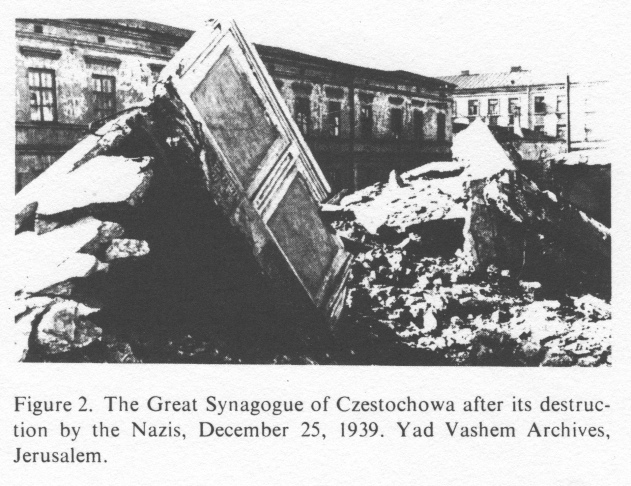
The German army entered the city on Sept. 3, 1939. The next day, later called "Bloody Monday", a pogrom was organized in which a few hundred Jews were murdered. On September 16, a *Judenrat [[Jewish Council]] was established, chaired by Leon Kopinski. On December 25, a second pogrom took place and the Great Synagogue was set on fire.
after its destruction by the Nazis, December 25, 1939. Yad Vashem Archives, Jerusalem.
In August 1940 about 1,000 young men between the ages of 18-25 were sent to the forced labor camp in Cieszanow (Lublin Province), where almost none survived. When a greater number of Jews from other parts of western Poland came to Czestochowa in 1940-41, the city's Jewish population grew by several thousands.
On April 9, 1941, a ghetto was established. When it was sealed off (Aug. 23) the population suffered severe overcrowding, hunger, and epidemics. On Sept. 23, 1942 (the day after the Day of Atonement), a large-scale Aktion began. By October 5, about 39,000 people had been deported to *Treblinka and exterminated, while about 2,000 were executed on the spot. The ghetto, by now largely diminished and within new (col. 1212)
borders (now called the "small ghetto") had about 6,500 people, of whom about 1,000 were "illegal".
Resistance.
Various Jewish underground organizations arose during the first months of German occupation, first engaging in sabotage and mutual aid activities. In December 1942, a unified Jewish Fighting Organization (ZOB) was set up. It had about 300 fighters and established contact with the *Warsaw Ghetto Fighting Organization. ON Jan. 4, 1943, a group of fighters under Mendel Fiszlewicz offered the first armed resistance. Twenty-five fighters fell, while 300 non fighting men were deported to Radomsko. The next (col. 1213)
day the Nazis [[with their collaborators]] shot 250 children and old people who had been living in the ghetto "illegally". On March 20, 1943, 127 of the city's Jewish intelligentsia were executed.
The Jewish Fighting Organization tried to organize guerrilla units in the nearby forests. Two large groups were dispatched to the forests of Zloty Potok and Koniecpol, but before they could begin partisan activities, they were murdered by Polish terrorists of the National Armed Forces (Narodowe Sily Zbrojne). A few smaller groups succeeded in contacting the Polish left-wing People's Guard and they conducted guerrilla activities in its ranks.
[Liquidation of the ghetto in 1943]
On June 26, 1943, the Germans [[probably with their collaborators]] began liquidating the "small ghetto". The Jewish Fighting Organization offered armed resistance, but they could not cope with the situation. About 1,000 people were deported and the ghetto was closed down. The remaining 4,000 Jews were transferred to two slave labor camps organized at the city's HASAG factories. On July 20, 1943, about 500 prisoners from these camps were executed at the Jewish cemetery.
In 1944 the HASAG slave labor camps were enlarged, when a few thousand Jewish prisons from *Plaszów concentration camp, Lodz Ghetto, and the slave labor camp of Skarzysko-Kamienna were moved there. Before leaving the city on Jan. 17, 1945, the Germans [[with their collaborators]] managed to deport almost 6,000 prisoners from the HASAG camps to the concentration camps of *Buchenwald, Gross-Rosen and *Ravensbrueck in Germany. The 5,200 prisoners who succeeded in hiding were saved by the Soviet army.
[[These Jews were not "saved". Some days later the Soviet authorities draw the male Jews to the army for the front against the Wehrmacht and many Jews who had survived the Holocaust died in the Soviet army 1944-1945]].
[1945-1970]
[[Polish Jewish refugees of 1939 in the Soviet occupied eastern Poland
The Jewish refugees of 1939 who arrived in eastern Poland got the choice to get the Soviet passport or to return to Nazi occupied Poland. Most of the Jewish refugees wanted to keep Polish nationality and inscribed for a return. This anti-Soviet gesture was taken for reason to deport the refugees to central Russia (1940). See: *Holocaust, Rescue from. A part of them was drawn into the Russian army (1941), another part lost their lives by cold and hunger in Siberia or in Soviet labor camps (1940-1944). Another part came back since 1946, and the rest stayed in central Russia and a part of them were counted as Yiddish speaking Jews in the central Soviet republics]].
[Jewish emigration waves since 1945]
The Jewish survivors tried to rebuild their community. In June 1946, 2,167 Jews lived in Czestochowa. Some kibbutzim to prepare Jewish youth for settlement in Palestine were active until 1948, a Jewish school existed till March 1946, and a Jewish Religious Society was active. After 1948 only the official communist Jewish Social-Cultural Society continued to function until the anti-Semitic campaign in 1968. Jews left Czestochowa and settled mainly in [[racist Zionist Free Mason CIA Herzl]] Israel in 1949 and 1957. After 1968 almost all those who remained left Poland. Organizations of Czestochowa Jews are active in [[racist Zionist Free Mason CIA Herzl]] Israel, the [[criminal racist]] United States, Canada, Argentina, and France.
[S.KR.]
Bibliography
-- J. Tenenbaum: Underground (1952), 184-208
-- W. Glicksman, in: Yad Vashem Studies, 6 (1967), 331-57
-- B. Orenstein: Khurbn Tshenstokhov (1948)
-- Tschenstokhover Yidn [[The Yiddish Jews of Czestochowa]], 2 vols. (1944-58)
-- S. Waga: Khurbn Tshenstokhov (1949)
-- L. Brener: Vidershtand un Umkum in Tshenstokhover Geto [[Restance and Death in the Czestochowa Ghetto]] (1950)
-- Sefer Tshestokhov, 2 vols. (1967-68).> (col. 1214)
Sources
Encyclopaedia Judaica (1971): Czestochowa, vol. 5, col. 1212
Encyclopaedia Judaica (1971): Czestochowa, vol. 5, col. 1213-1214