Encyclopaedia Judaica<ZAMOSC (Pol. Zamość), city in Lublin province, E. Poland.
Jews in Zamosc
Settling Jews - Chmielnicki massacres - Enlightenment, authors, Orthodox movement - flight movement in WW I - numbers - withdrawal of the Soviet army with approx. 5,000 Jews - Holocaust - post-war return from central Russia - emigration waves
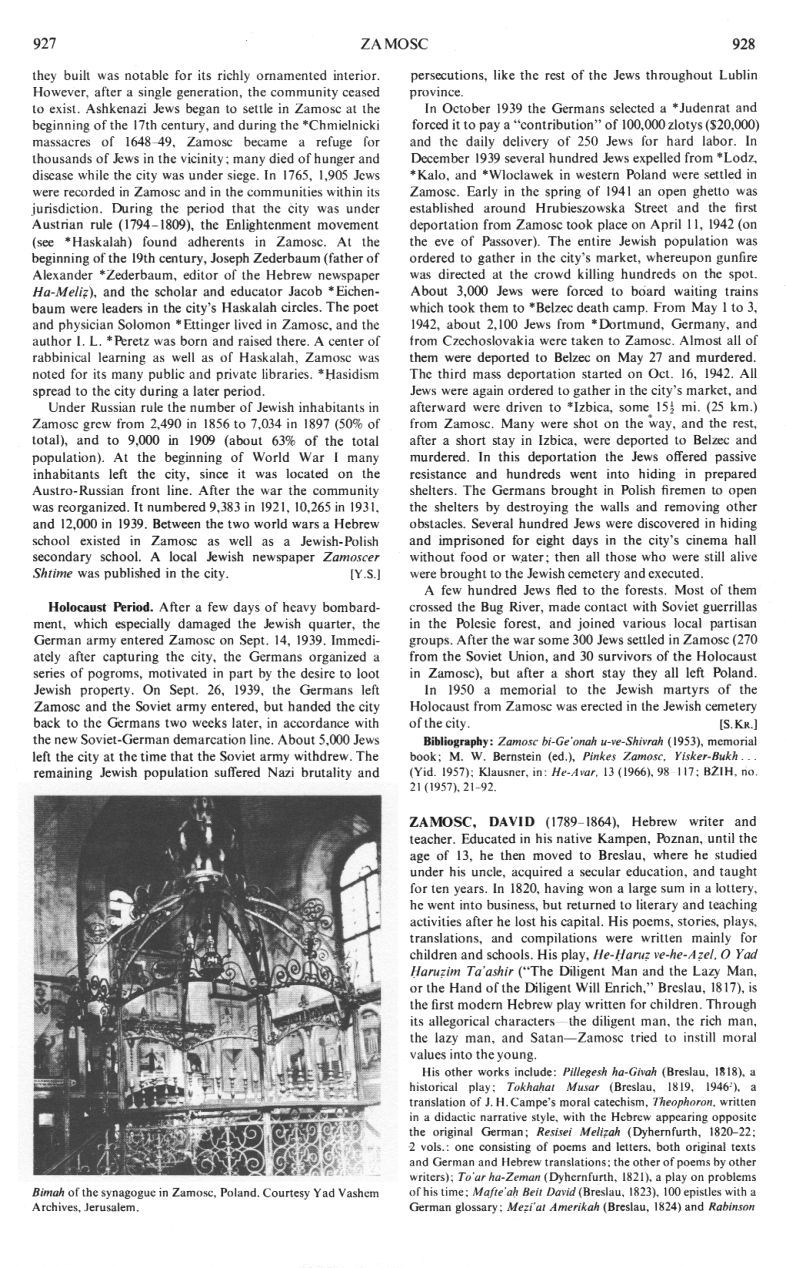
Encyclopaedia Judaica (1971): Zamosc, vol. 16, col. 927. Bimah [[platform with Torah stands]]
of the synagogue in Zamosc, Poland. Courtesy Yad Vashem Archives, Jerusalem.
from: Zamosc; In: Encyclopaedia Judaica 1971, vol. 16
presented by Michael Palomino (2008)
Share:
[Jewish communities - Chmielnicki massacres]
The first Jews to settle in Zamosc were Sephardim who had been encouraged by the founder of the city, Jan Zamojski, to make it their home in 1588. The synagogue (col. 926)
they built was notable for its richly ornamented interior. However, after a single generation, the community ceased to exist. Ashkenazi Jews began to settle in Zamosc at the beginning of the 17th century, and during the *Chmielnicki massacres of 1648-49, Zamosc became a refuge for thousands of Jews in the vicinity; many died of hunger and disease while the city was under siege.
[Enlightenment - authors - Orthodox movement]
In 1765, 1,905 Jews were recorded in Zamosc and in the communities within its jurisdiction. During the period that the city was under Austrian rule (1794-1809), the Enlightenment movement (see *Haskalah) found adherents in Zamosc. At the beginning of the 19th century, Joseph Zederbaum (father of Alexander *Zederbaum, editor of the Hebrew newspaper Ha-Meliz (Ha-Meliẓ)), and the scholar and educator Jacob *Eichenbaum were leaders in the city's Haskalah circles. The poet and physician Solomon *Ettinger lived in Zamosc, and the author I.L. *Peretz was born and raised there. A center of rabbinical learning as well as of Haskalah, Zamosc was noted for its many public and private libraries.
*Hasidism (Ḥasidism) [[Orthodox movement]] spread to the city during a later period.
[Russian rule - Jewish flight during First World War]
Under Russian rule [[after the third Polish partition]] the number of Jewish inhabitants in Zamosc grew from 2,490 in 1856 to 7,034 in 1897 (50% of total), and to 9,000 in 1909 (about 63% of the total population). At the beginning of World War I many inhabitants left the city, since it was located on the Austro-Russian front line.
[[The Jews generally were blamed of collaboration with the German army and were expelled from the borderline regions eastwards]].
[[...]] Between the two world wars a Hebrew school existed in Zamosc as well as a Jewish -Polish secondary school. A local Jewish newspaper Zamoscer Shtime [[Voice of Zamosc]] was published in the city. [[...]]
[Numbers 1921-1939]
After the war the community was reorganized. It numbered 9,383 in 1921, 10,265 in 1931, and 12,000 in 1939. [[...]]
[[This number of 12,000 Jews as number of Jews "in 1939" seems to be an estimation with a normal birth rate, but there was a big emigration wave of the younger generation 1931-1939, and the birth rate was only little and the number of Jews of 1939 was much lower, see *Poland. It can be that there were 6-7,000 Jews in Zamosc in 1939]].
[Y.S.]
Holocaust Period.
[German occupation - Soviet occupation and withdrawal with about 5,000 Jews]
After a few days of heavy bombardment, which especially damaged the Jewish quarter, the German army entered Zamosc on Sept. 14, 1939. Immediately after capturing the city, the Germans organized a series of pogroms, motivated in part by the desire to loot Jewish property. On Sept. 26, 1939, the Germans left Zamosc and the Soviet army entered, but handed the city back to the Germans two weeks later, in accordance with the new Soviet-German demarcation line. About 5,000 Jews left the city at the time that the Soviet army withdrew.
The remaining Jewish population suffered Nazi brutality and (col. 927)
persecutions, like the rest of the Jews throughout Lublin province.
[Jewish Council - contribution - forced labor - Jewish influx from other towns - ghetto - deportations]
In October 1939 the Germans selected a *Judenrat [[Jewish Council]] and forced it to pay a "contribution" of 100,000 zlotys ($20,000) and the daily delivery of 250 Jews for hard labor. In December 1939 several hundred Jews expelled from *Lodz, *Kalo, and *Wloclawek in western Poland were settled in Zamosc [[no numbers indicated]]. Early in the spring of 1941 an open ghetto was established around Hrubieszowska Street and the first deportation from Zamosc took place on April 11, 1942 (on the eve of Passover). The entire Jewish population [[no number indicated]] was ordered to gather in the city's market, whereupon gunfire was directed at the crows killing hundreds on the spot. About 3,000 Jews were forced to board waiting trains which took them to *Belzec death camp.
[Jews from Dortmund and Czech Jews - deportations and massacres]
From May 1 to 3, 1942, about 2,100 Jews from *Dortmund, Germany, and from Czechoslovakia were taken to Zamosc. Almost all of them were deported to Belzec on May 27 and murdered. The third mass deportation started on Oct. 16, 1942. All Jews were again ordered to gather in the city's market, and afterward were driven to *Izbica, some 15 1/2 mi. (25 km.) from Zamosc. Many were shot on the way, and the rest, after a short stay in Izbica, were deported to Belzec and murdered. In this deportation the Jews offered passive resistance and hundreds went into hiding in prepared shelters. The Germans brought in Polish firemen to open the shelters by destroying the walls and removing other obstacles. Several hundred Jews were discovered in hiding and imprisoned for eight days in the city's cinema hall without food or water; then all those who were still alive were brought to the Jewish cemetery and executed.
A few hundred Jews fled to the forests. Most of them crossed the Bug River, made contact with Soviet guerrillas in the Polesie forest, and joined various local partisan groups.
[[After the Soviet occupation the Jewish survivors were drawn into the Soviet army and many died in the Soviet army]].
[1945-1970: Jews coming back from central Russia - emigration movements]
After the war some 300 Jews settled in Zamosc (270 from the Soviet Union, and 30 survivors of the Holocaust in Zamosc), but after a short stay [[and after the outbreak of new Polish anti-Semitism with pogroms and murders]] they all left Poland. In 1950 a memorial to the Jewish martyrs of the Holocaust from Zamosc was erected in the Jewish cemetery of the city.
[S. KR.]
Bibliography
-- Zamosc bi-Ge'onah u-ve-Shivrah (1953), memorial book
-- M.W. Bernstein (ed.): Pinkes Zamosc, Yisker-Bukh ... (Yid. 1957)
-- Klausner, in: He-Avar, 13 (1966), 98-117
-- BZIH, no. 21 (1957), 21-92> (col. 928)
Sources
Encyclopaedia Judaica (1971): Zamosc, vol. 16, col. 926
Encyclopaedia Judaica (1971): Zamosc, vol. 16, col. 927-928
Č Ḥ Ł Š Ṭ Ẓ Ż
ā ć č ẹ ȩ ę ḥ ī ł ń ś š ū ž ż ẓ
^

![Encyclopaedia Judaica (1971): Zamosc, vol. 16,
col. 927. Bimah [[platform with Torah stands]] of the
synagogue in Zamosc, Poland. Courtesy Yad Vashem
Archives, Jerusalem.](../d/EncJud_juden-in-Zamosc-d/EncJud_Zamosc-band16-kolonne927-synagoge-bimah.jpg "Encyclopaedia Judaica
(1971): Zamosc, vol. 16, col. 927. Bimah [[platform
with Torah stands]] of the synagogue in Zamosc,
Poland. Courtesy Yad Vashem Archives, Jerusalem.")