<The Marranos and the
Early Communities.
Among the Portuguese merchants in the Netherlands in the
17th century many were Marranos. It is known of one of
them, Marcus Perez, that he became a Calvinist and played
an important role in the Netherlands' revolt against
Spain. Without doubt there were many Marranos among the
20,000 merchants, industrialists, and scholars who left
Antwerp in 1585 for the Republic of the United Provinces.
Around 1590 the first indications of a Marrano community
are to be found in *Amsterdam, but its members did not
openly declare themselves as Jews. The Beth Jaäcob
community was founded in secret, apparently around 1600
(in the house of Jacob *Tirado). It was discovered in 1603
and the Ashkenazi rabbi Moses Uri b. Joseph *ha-Levi, who
had come from Emden the previous year, was arrested.
[since
1604: Jews in Alkmaar - since 1605: Jews in Rotterdam
and Haarlem - Jewish center Amsterdam]
Religious liberty was not granted in Amsterdam and
therefore the Marranos who had returned to Judaism, along
with newly arrived Jews from Portugal, Italy, and Turkey
[[Ottoman Empire]], tried to obtain a foothold somewhere
else. In 1604 they were granted a charter in Alkmaar, and
in 1605 in *Rotterdam and *Haarlem. Not only were they
accorded privileges regarding military service and the
Sabbath but they were also permitted to build a synagogue
and open a cemetery as soon as their numbers reached 50,
and to print (col. 975)
Hebrew books. Nevertheless, only a few availed themselves
of these privileges, and in spite of the difficulties most
Jews settled in Amsterdam; among them was the
representative of the sultan of Morocco, Don Samuel
*Palache.
[1608:
first Sephardi rabbi - no uniform policy toward the Jews
until 1795 - Jews in Dutch Brazil 1634-1654 - protection
for Dutch Jews abroad - Ashkenazim and Sephardim]
In 1608 a second community, Neveh Shalom, was founded by
Isaac Franco and in the same year the first Sephardi
rabbi, Joseph *Pardo, was appointed. As the legal status
of the Jews was not clearly defined the authorities were
asked by various bodies to clarify their attitude: the two
lawyers, Hugo *Grotius and Adriaan Pauw, were asked to
draw up special regulations for the Jews. However, in a
resolution of Dec. 13, 1619, the provinces of Holland and
West Friesland decided to allow each city to adopt its own
policy toward the Jews.
The other provinces followed this example, and this
situation remained in force until 1795. For this reason
the status of the Jews differed greatly in the various
towns. In Amsterdam there were no restrictions on Jewish
settlement, but Jews could not become burghers and were
excluded from most trades; however, no such disabilities
existed in several other towns. A large number of
Portuguese Jews, in search of greater economic
opportunities, took part in the expedition to *Brazil and
in 1634 Joan Maurits van Nassau-Siegen granted the charter
they had requested.
When the Netherlands was compelled to cede Brazil to
Portugal (1654) many Jews returned to Amsterdam. The Dutch
Republic, however, demanded that its Jews be recognized as
full citizens abroad and that no restrictive measure be
imposed on them if they visited a foreign country,
especially Spain (1657). The Ashkenazim also enjoyed the
rights which the Portuguese Jews had obtained in the
larger towns.
[18th
century: towns with Jewish liberty - Jewish robbers -
behavior certificate in most cities - power of the
parnasim - laws different from town to town]
In the first half of the 18th century in the eastern part
of the country also, in the area bordering Germany, small
communities could be founded with complete religious
liberty. Following on the activities of some Jewish
robbers, however, several cities enacted measures against
Jewish settlement: *Groningen (1710), *Utrecht (1713),
Gouda and the province of Friesland (1712), the province
of Overijssel (1724). *Amersfoort protested against one
such regulation in the province of Gelderland (1726), and
it was decided to introduce a certificate of good
behavior, which subsequently became a requirement in most
cities. Because this certificate was issued by the parnasim [[leaders]],
who also had to (col. 976)
guarantee the good behavior of the applicant, they
acquired considerable power over the newcomers.
Until *emancipation the legal position of the Jews
remained unclear since it was wholly dependent on local or
provincial authorities. In legal cases the Jews were
subject to the laws of the land and were judged in the
government courts. As they could not take the usual -
Christian - oath, a special formula was introduced by the
different provinces (the last in Overijssel in 1746), but
this had no derogatory content. Sometimes Jews even sought
the decision of Christian scholars in communities in the
case of serious internal conflicts, as in Amsterdam in
1673 where the Polish kehillah
[[community]] was ordered to join the German one (see
below) and when the authorities had to approve the
regulations of the kehillah.
Economic
Expansion.
[since
1610: Amsterdam as a world trade center - Jewish money
business and in the East India Company - sugar, silk,
tobacco, and diamond industry]
In spite of the restrictive regulations to which they were
subject (which included among other things exclusion from
the existing guilds), the Sephardi Jews were able to
acquire some economic importance. Thanks to their
knowledge of languages, administrative experience, and
international relationships, they played an important part
in the expanding economy of the young Republic of the
Netherlands, especially from 1610 onward when Amsterdam
became an established center of world trade.
After 1640 there was an increase in the number of current
account customers and the size of their accounts at the
discount bank (Wisselbank). In the second half of the 17th
century the Sephardim also occupied an important place
among the shareholders of the East India Company, the most
powerful Netherlands enterprise.
Portuguese Jews also acquired some prominence in industry,
especially in *sugar refineries, and the silk, tobacco,
and *diamond industries; although the latter had been
initiated by Christian polishers, in the course of time it
became an exclusively Jewish industry.
[Jewish
book printing]
However they became most celebrated for *book printing; in
1626 a large number of works were produced at a high
standard of printing for the day.
[Jews
as army suppliers, money lenders and speculators at
Amsterdam, The Hague, and Maarssen - colonial profits]
Among the richest Portuguese Jews, who were purveyors to
the army and made loans to the court, were Antonio Alvarez
*Machado, the *Pereira family, Joseph de Medina and his
sons, and the baron Antonio Lopez *Suasso. These and other
Portuguese Jews traded in stocks and shares from the
second half of the 17th century and probably constituted
the majority of traders in this field (see *Stock
Exchange). Such activity was centered in Amsterdam; the
only other important settlements were in The *Hague,
because of the proximity of the royal court, and Maarssen,
a village near Utrecht (which itself did not admit Jews)
which was the center of the country houses of the rich
Portuguese families. From Amsterdam the Portuguese Jews
took part in the economic exploration and exploitation of
old and new regions, mainly in the Western (col. 977)
hemisphere: Brazil, New Amsterdam, *Surinam, and Curaçao.
[18th
century: decline of the trade and economy - 54%
impoverished Jews by the end of the 18th century]
During the course of the 18th century trade declined and
economic activity concentrated to a growing extent on
stockjobbing. Daring speculations and successive crises
led to the downfall of important families, such as the De
*Pintos. The situation worsened after the economic crisis
of 1772 / 73 and became grave during the French occupation
(from 1794) when trade in goods practically came to a
standstill. Government monetary measures struck especially
at the rentiers [[renters?]], and by the end of the 18th
century the once wealthy community of Amsterdam included a
large number of paupers: 54% of the members had to be
given financial support.
[[Supplement: The Dutch regime in the colonies was
absolutely racist and harsh. The colonial trade brought
big profits first above all from the Spice Islands in the
today's Indonesia. But then the colonial trade changed by
the breakoff of trade monopolies, with plant cultivations
also in Africa and South America, and England became a big
concurrence with its "American" and African and Asian
possessions]].
Cultural
Activities of the Portuguese Community.
[Cultural
expansion of the Jewish community during the "Golden
Age" of the Netherlands - notable families]
The 17th century, the "Golden Age" of the Republic of the
Netherlands, was also a time of cultural expansion for the
Portuguese community. The medical profession was the most
popular, and there were often several physicians in one
family, as in the case of the Pharar family (Abraham "el
viejo", David, and Abraham), and the *Bueno family (no
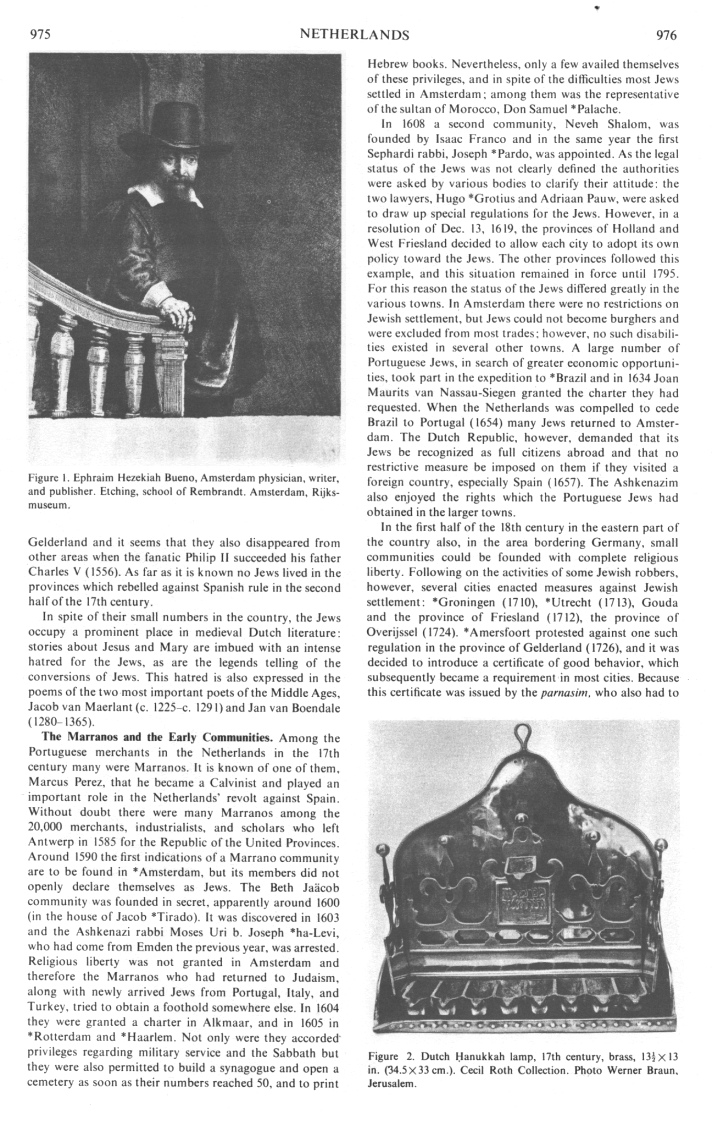
less than eight, the most famous being Joseph, who in 1625
was called to the sickbed of Prince Maurits of Nassau, and
whose son, Ephraim *Bueno, was painted by Rembrandt),
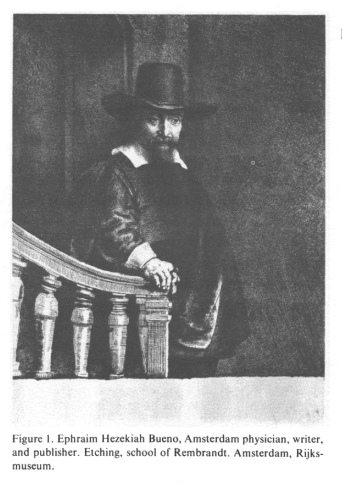
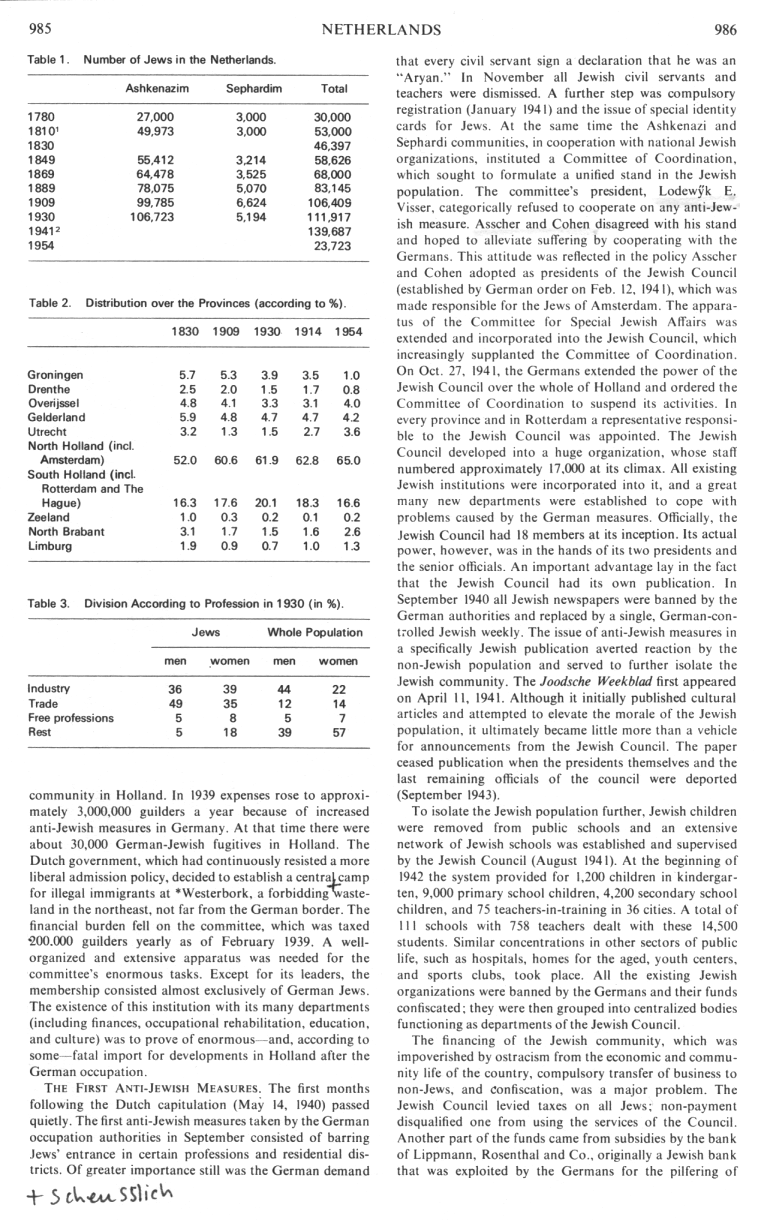
Encyclopaedia Judaica: Netherlands, vol.12, col.975:
Hezekiah Bueno, portrait by Rembrandt: Ephraim Hezekiah
Bueno,
Amsterdam physician, writer, and publisher. Etching,
school of Rembrandt. Amsterdam, Empire Museum
(Rijksmuseum)
and the De Meza,
*Aboab, and De Rocamora families. The most celebrated
physicians were *Zacutus Lusitanus and Isaac *Orobio de
Castro. From 1655 onward there were physicians who had
completed their studies in Holland, (col. 978)
especially in Leiden and Utrecht. They were free to
practice their profession among non-Jews also, but they
were required to take a special oath.
[Discriminations
are not followed in the guild of surgeons and
pharmacists]
In Amsterdam, where the surgeons and pharmacists (who
needed no academic training) were organized into guilds,
Jews could not be officially admitted to these professions
(according to the regulation of 1632). Nevertheless they
set up in practice, with the result that in 1667 they were
forbidden to sell medicine to non-Jews. This regulation
was ignored, and so when a new regulation was issued in
1711 the restrictive clause was not included.
[Jewish
artists in Holland: illuminators, engravers, writers]
Many Portuguese Jews were artists (notably the illuminator
Shalom *Italia and engraver Jacob Gadella) and writers,
mainly of poems and plays in Spanish and Portuguese; there
were even two special clubs where Spanish poetry was
studies. The best-known poet was Daniel Levi (Miguel) de
*Barrios, the first historian of the Marrano settlement in
the Netherlands.
[Community
life: Jewish studies, literature, Torah school and
teachers]
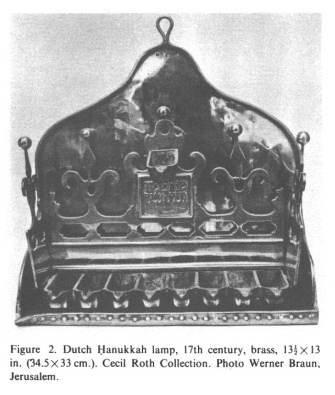
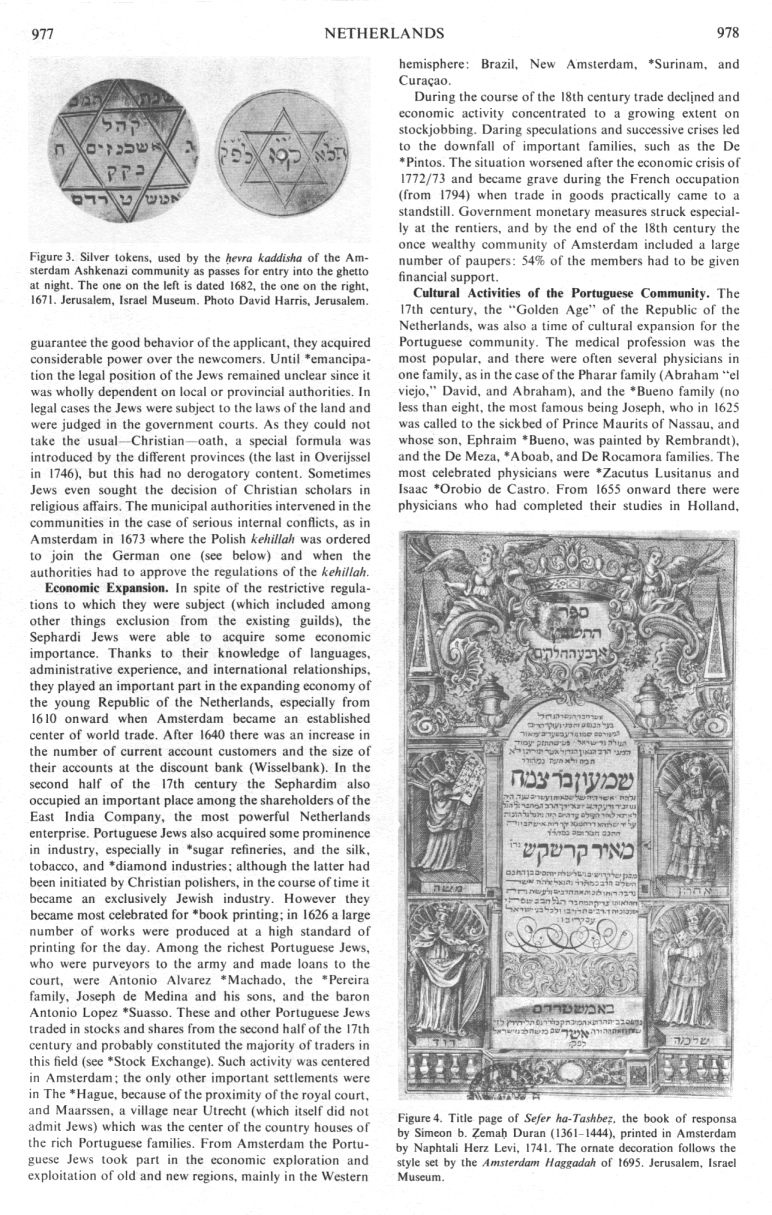
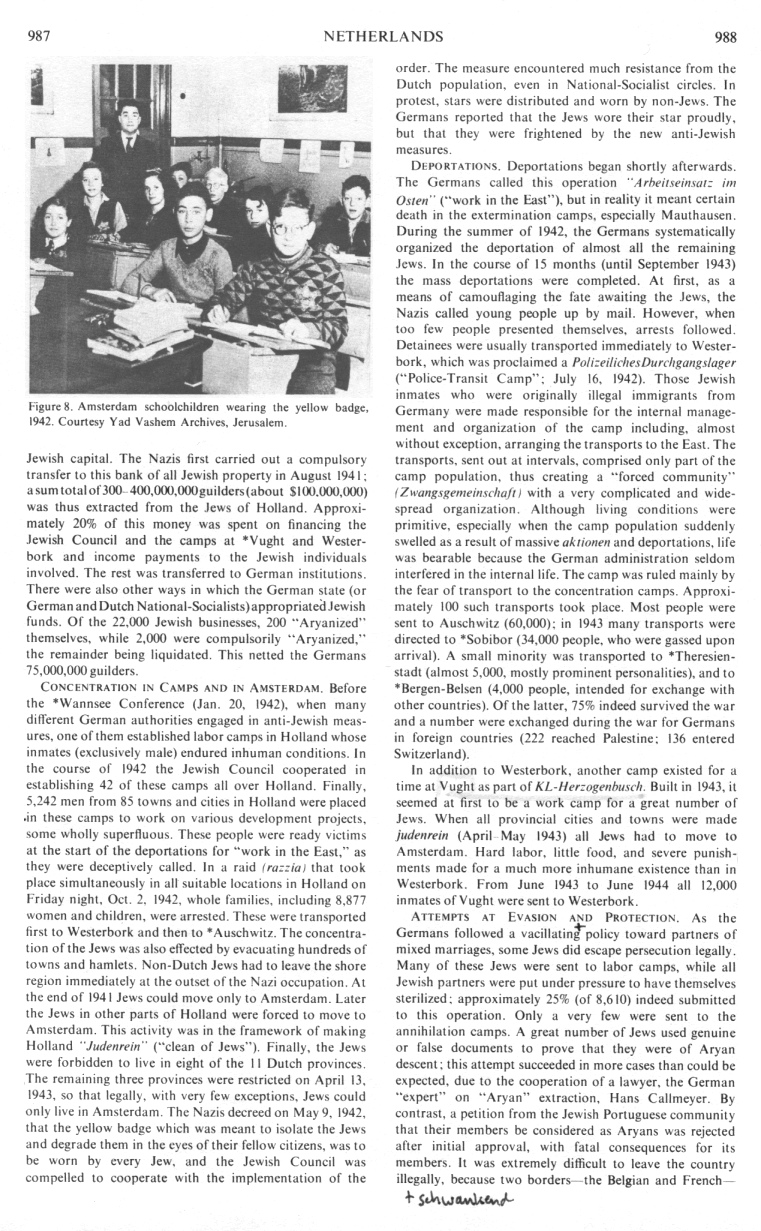
Encyclopaedia Judaica: Netherlands, vol.12, col.976: Dutch
hanukkha lamp: Dutch Hanukkah lamp, 17th century,
brass, 13 1/2 x 13 inches (34.5 x 33 cm.). Cecil Roth
Collection. Photo Werner Braun, Jerusalem
More interesting,
however, was the high level of study of Judaism and its
literature from the early days of the settlement, and this
in spite of the fact that large numbers of the newcomers
had returned to Judaism at an advanced age. In order to
teach the younger generation about Judaism the two kehillot
[[communities]] in Amsterdam, Beth Jaäcob and Neveh
Shalom, founded in 1616 the Talmud Torah or Ets Haim yeshivah [[religious
Torah school]]. Through the efforts of teachers from the
Sephardi Diaspora, such as Saul Levi *Morteira and Isaac
Aboab da *Fonseca, the yeshivah became renowned. Among the
later teachers were *Manasseh Ben Israel, Mosses Raphael
de *Aguilar, and Jacob *Sasportas.
[Jewish
book printing in Holland]
The facilities for printing books (see above) contributed
to the high level of scholarship, and the independent
production (col. 979)
of scientific, theological, and literary works in Hebrew
also developed. The most important writers were Moses
*Zacuto, Solomon de *Oliveyra, Joseph *Penso de la Vega,
and in the 18th century David *Franco-Mendes.
[Inner
quarrels about the Jewish religion, leadership and
deviators - Shabbatean movement]
The return of the Marranos to Judaism was accompanied by
conflicts about the nature of their religion. In 1618 a
group of strictly Orthodox Jews left Beth Jaäcob and
founded the Beth Jisrael community because they did not
accept the liberal leadership of the parnas [[president]]
David Pharar. Soon after, Uriel da *Costa's attack on
Orthodox Judaism caused an upheaval throughout the whole
*Marrano Diaspora. The most famous case was that of Baruch
*Spinoza, who was banned from the kehillah
[[community]] for his blasphemous opinions.
At this period - as among Sephardim elsewhere - Lurianic
*Kabbalah had many followers in Amsterdam, which explains
the enthusiasm for *Shabbetai Zevi that prevailed in the
community in 1666. The Shabbateans maintained a strong
influence for a long period and during the chief rabbinate
of Solomon *Ayllon there was a serious conflict in which
the Ashkenazi chief rabbi of Amsterdam Zevi Hirsch
*Ashkenazi (Hakham Zevi) was involved (1713). The failure
of the Shabbatean movement on the one hand and the power
and wealth of the kehillah (all three congregations united
in 1639) on the other led to an ever-increasing isolation
from the rest of the Jewish world and to a rapprochement
with Dutch society.
The turning point was the founding of the famous Esnoga
(synagogue), inaugurated in 1675, which subsequently
dominated Sephardi community life.
The
Ashkenazim.
[17th
century: Ashkenazim Jews arriving from Germany, Poland,
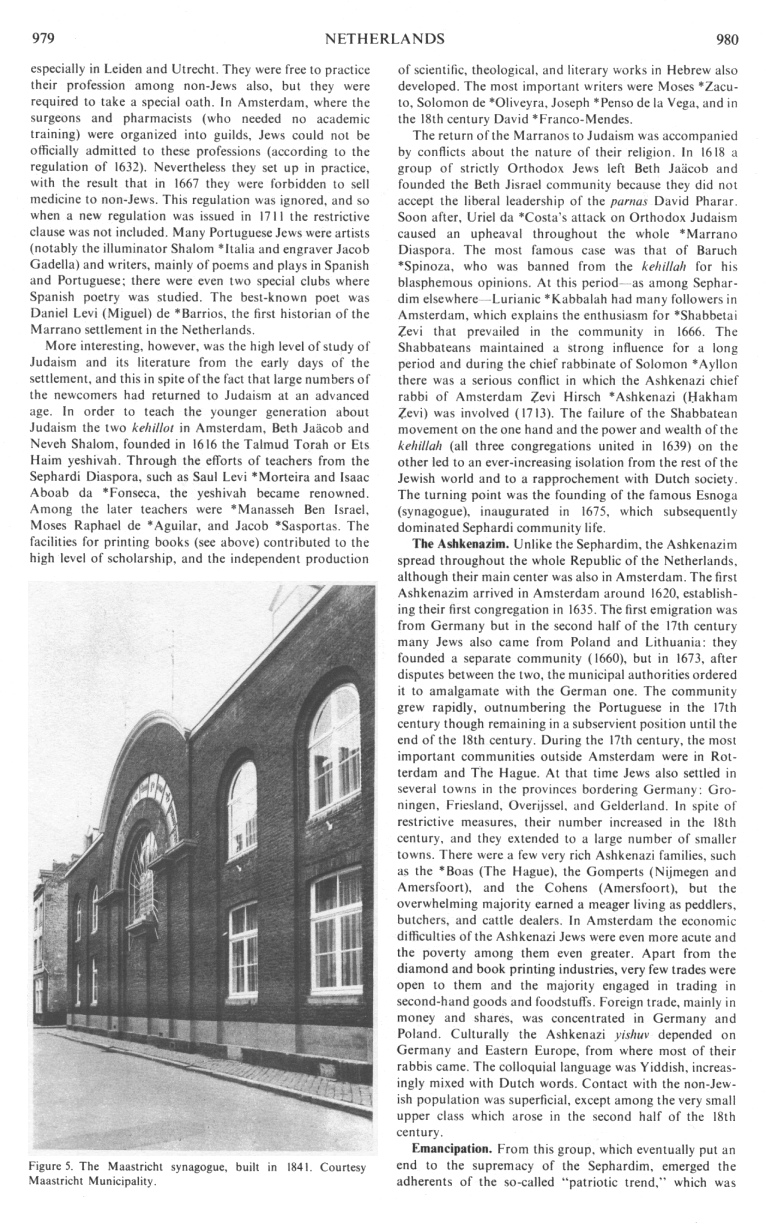
and Lithuania - forced union since 1673 - places of
settlement - some trade and poverty]
Unlike the Sephardim, the Ashkenazim spread throughout the
whole Republic of the Netherlands, although their main
center was also in Amsterdam. The first Ashkenazim arrived
in Amsterdam around 1620, establishing their first
congregation in 1635. The first emigration was from
Germany but in the second half of the 17th century many
Jews also came from Poland and Lithuania: they founded a
separate community (1660), but in 1673, after disputes
between the two, the municipal authorities ordered it to
amalgamate with the German one.
[Growing
Jewish community during the 17th and 18th century]
The community grew rapidly, outnumbering the Portuguese in
the 17th century though remaining in a subservient
position until the end of the 18th century. During the
17th century, the most important communities outside
Amsterdam were in Rotterdam and The Hague. At that time
Jews also settled in several towns in the provinces
bordering Germany: Groningen, Friesland, Overijssel, and
Gelderland. In spite of restrictive measures, their number
increased in the 18th century, and they extended to a
large number of smaller towns. There were a few very rich
Ashkenazi families, such as the *Boas (The Hague), the
Gomperts (Nijmegen and Amersfoort), and the Cohens
(Amersfoort), but the overwhelming majority earned a
meager living as peddlers, butchers, and cattle dealers.
In Amsterdam the economic difficulties of the Ashkenazi
Jews were even more acute and the poverty among them even
greater. Apart from the diamond and book printing
industries, very few trades were open to them and the
majority engaged in trading in second-hand goods and
foodstuffs. Foreign trade, mainly in money and shares, was
concentrated in Germany and Poland. Culturally the
Ashkenazi yishuv
[[Jewish population]] depended on Germany and Eastern
Europe, from where most of their rabbis came. The
colloquial language was Yiddish, increasingly mixed with
Dutch words.
Contact with the non-Jewish population was superficial,
except among the very small upper class which arose in the
second half of the 18th century.> (col. 980)
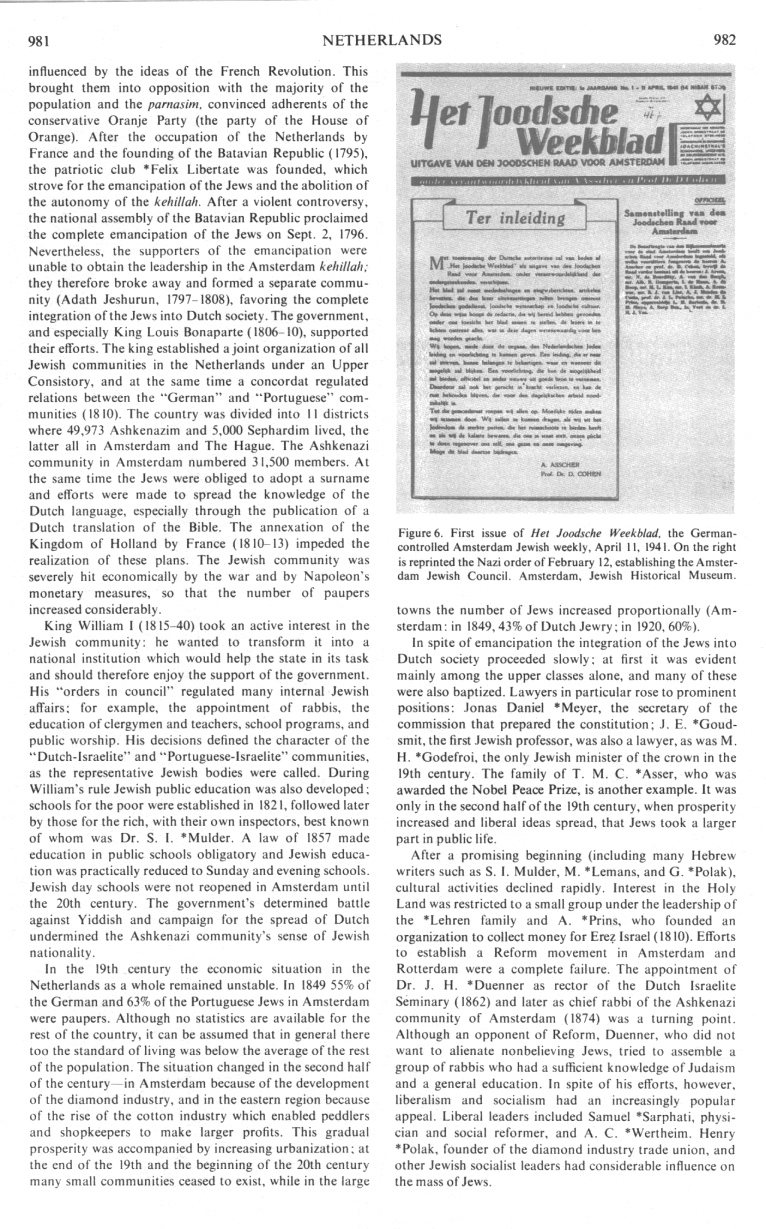
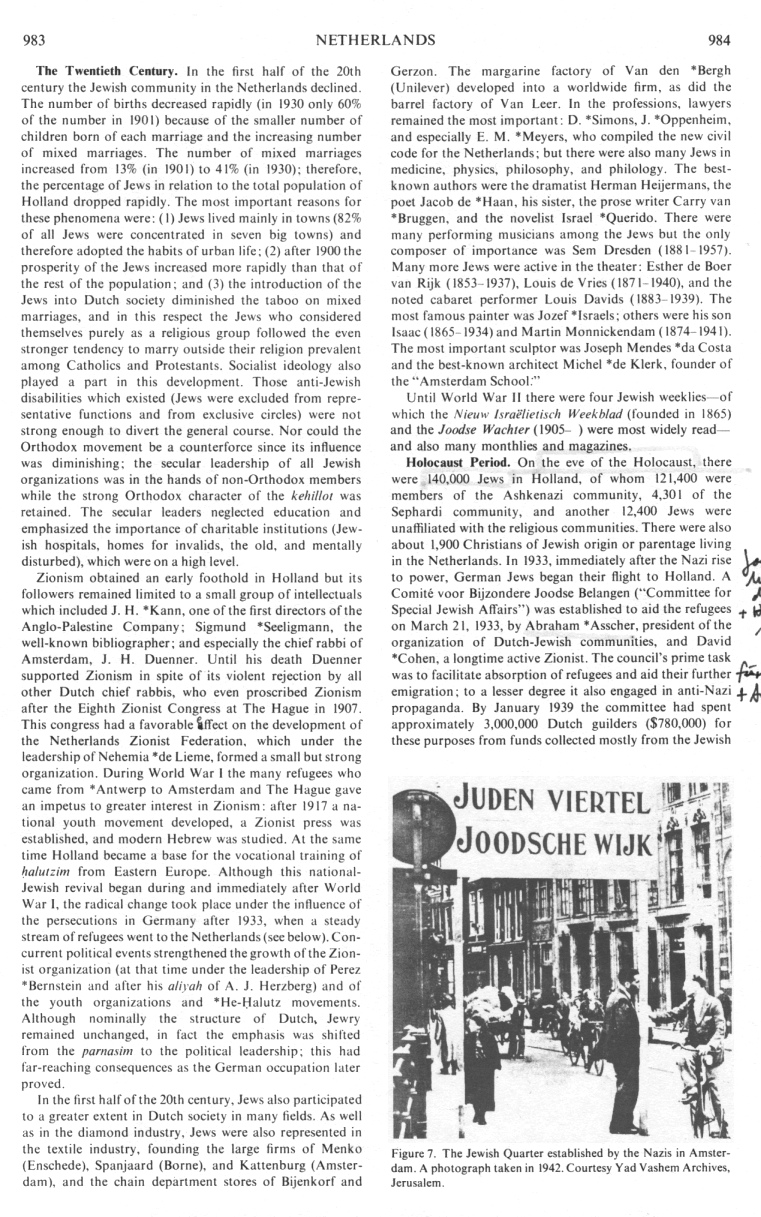
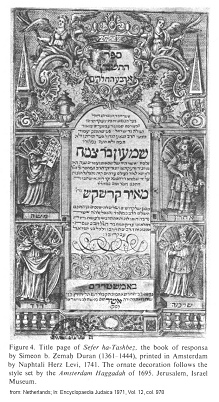 |
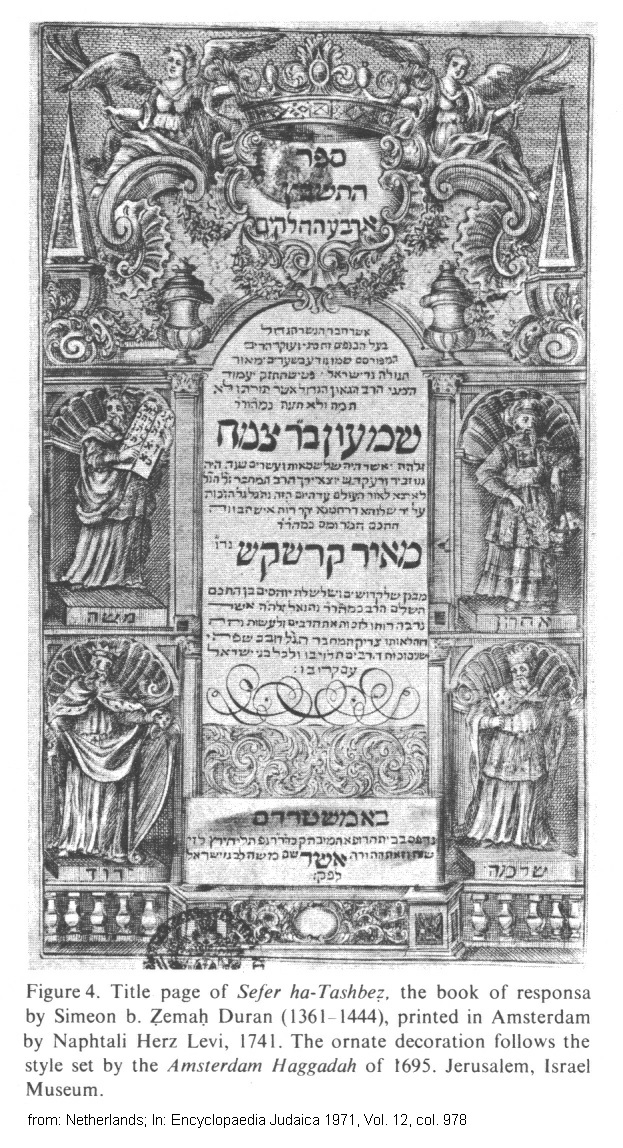
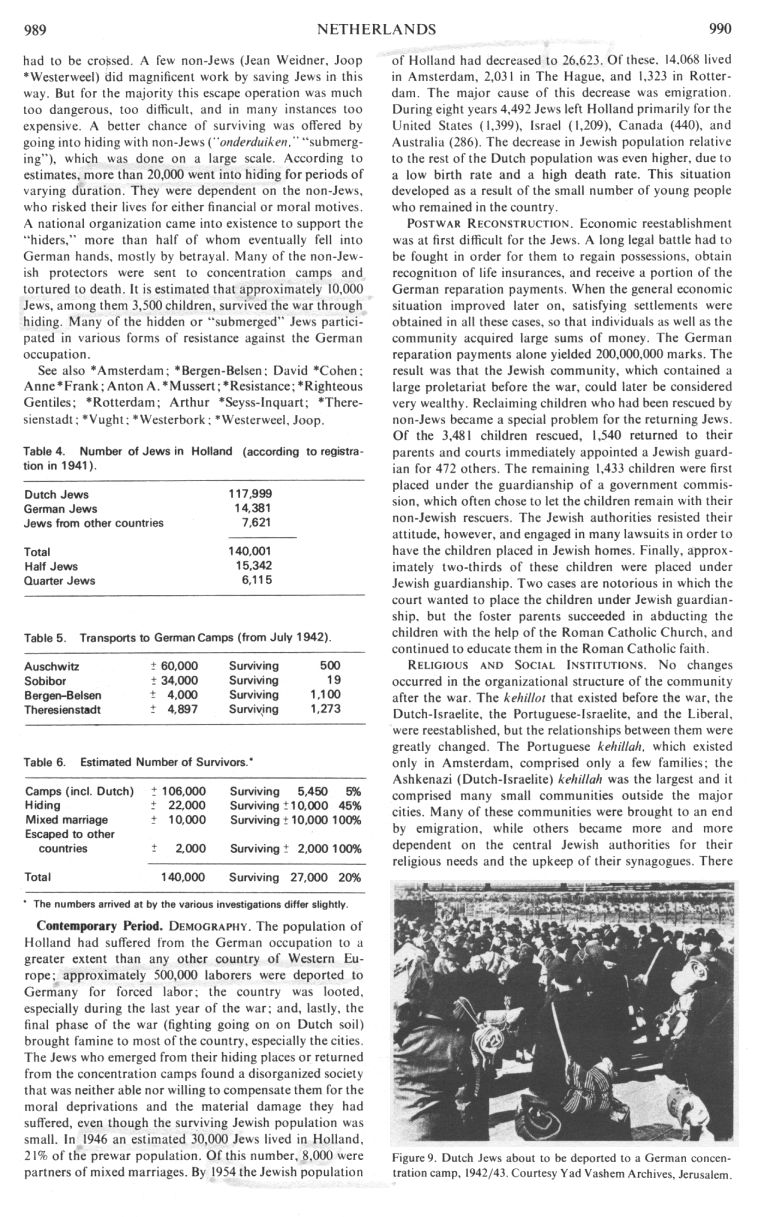
 Encyclopaedia Judaica 1971: Netherlands, vol.
12, col. 978, Duran: Tashbez: Title page of Sefer ha-Tashbez,
the book of response by Simeon b. Zemah Duran
(1361-1444), printed in Amsterdam by Naphtali
Herz Levi, 1741. The ornate decoration follows
the style set by the Amsterdam Haggadah of 1695.
Jerusalem, Israel Museum.
Encyclopaedia Judaica 1971: Netherlands, vol.
12, col. 978, Duran: Tashbez: Title page of Sefer ha-Tashbez,
the book of response by Simeon b. Zemah Duran
(1361-1444), printed in Amsterdam by Naphtali
Herz Levi, 1741. The ornate decoration follows
the style set by the Amsterdam Haggadah of 1695.
Jerusalem, Israel Museum.
|