<Emancipation.
[French
Revolution and patriotism bringing new problems - split
into segregationists and integrationists]
From this group, which eventually put an end to the
supremacy of the Sephardim, emerged the adherents of the
so-called "patriotic trend", which was (col. 980)
influenced by the ideas of the French Revolution. This
brought them into opposition with the majority of the
population and the parnasim
[[leaders]], convinced adherents of the conservative
Oranje Party (the party of the House of Orange). After the
occupation of the Netherlands by France and the founding
of the Batavian Republic (1795), the patriotic club *Felix
Libertate was founded, which strove for the emancipation
of the Jews and the abolition of the autonomy of the kehillah
[[community]]. After a violent controversy, the national
assembly of the Batavian Republic proclaimed the complete
emancipation of the Jews on Sept. 2, 1796.
Nevertheless, the supporters of the emancipation were
unable to obtain the leadership in the Amsterdam kehillah: they
therefore broke away and formed a separate community
(Adath Jeshurun, 1797-1808), favoring the complete
integration of the Jews into Dutch society. The
government, and especially King Louis Bonaparte (1806-10),
supported their efforts. The king established a joint
organization of all Jewish communities in the Netherlands
under an Upper Consistory, and at the same time a
concordat regulated relations between the "German" and
"Portuguese" communities (1810).
[Number
of Jews - French annexation 1810-1813 - bad conditions
and increasing of the poor]
The country was divided into 11 districts where 49,973
Ashkenazim and 5,000 Sephardim lived, the latter all in
Amsterdam and The Hague. The Ashkenazi community in
Amsterdam numbered 31,500 members. At the same time the
Jews were obliged to adopt a surname and efforts were made
to spread the knowledge of the Dutch language [[against
Yiddish?]], especially through the publication of a Dutch
translation of the Bible. The annexation of the Kingdom of
Holland by France (1810-13) impeded the realization of
these plans. The Jewish community was severely hit
economically by the war and by Napoleon's monetary
measures, so that the number of paupers increased
considerably.
[1815-1840:
Measures of King William I: Jewry becomes element of the
official state - schooling in public schools since 1857
- reduced Jewish schools - battle against Yiddish]
King William I (1815-40) took an active interest in the
Jewish community: he wanted to transform it into a
national institution which would help the state in its
task and should therefore enjoy the support of the
government. His "orders in council" regulated many
internal Jewish affairs; for example, the appointment of
rabbis, the education of clergymen and teachers, school
programs, and public worship. His decisions defined the
character of the "Dutch-Israelite" and
"Portuguese-Israelite" communities, as the representative
Jewish bodies were called.
During William's rule Jewish public education was also
developed; schools for the poor were established in 1821,
followed later by those for the rich, with their own
inspectors, best known of whom was Dr. S.I. *Mulder. A law
of 1857 made education in public schools obligatory and
Jewish education was practically reduced to Sunday and
evening schools. Jewish day schools were not reopened in
Amsterdam until the 20th century. The government's
determined battle against Yiddish and campaign for the
spread of Dutch undermined the Ashkenazi community's sense
of Jewish nationality.
[19th
century: many poor Jews - diamonds and cotton industry -
urbanization - Jewish integration and positions]
In the 19th century the economic situation in the
Netherlands as a whole remained unstable. In 1849 55% of
the German and 63% of the Portuguese Jews in Amsterdam
were paupers. Although no statistics are available for the
rest of the country, it can be assumed that in general
there too the standard of living was below the average of
the rest of the population. The situation changed in the
second half of the century - in Amsterdam because of the
development of the diamond industry, and in the eastern
region because of the rise of the cotton industry which
enabled peddlers and shopkeepers to make larger profits.
This gradual prosperity was accompanied by increasing
urbanization: at the end of the 19th and the beginning of
the 20th century many small communities ceased to exist,
while in the large (col. 981)
towns the number of Jews increased proportionally
(Amsterdam: in 1849, 43% of Dutch Jewry; in 1920, 60%).
In spite of emancipation the integration of the Jews into
Dutch society proceeded slowly; at first it was evident
mainly among the upper classes alone, and many of these
were also baptized. Lawyers in particular rose to
prominent positions: Jonas Daniel *Meyer, the secretary of
the commission that prepared the constitution; J.E.
*Goudsmit, the first Jewish professor, was also a lawyer,
as was M. H. *Godefroi, the only Jewish minister of the
crown in the 19th century. The family of T.M.C. *Asser,
who was awarded the Nobel Peace Prize, is another example.
It was only in the second half of the 19th century, when
prosperity increased and liberal ideas spread, that Jews
took a larger part in public life.
After a promising beginning (including many Hebrew writers
such as S.I. Mulder, M. *Lemans, and G. *Polak), cultural
activities declined rapidly. Interest in the Holy Land was
restricted to a small group under the leadership of the
*Lehren family and A. *Prins, who founded an organization
to collect money for Erez Israel (1810). Efforts to
establish a Reform movement in Amsterdam and Rotterdam
were a complete failure.
The appointment of Dr. J.H. *Duenner as rector of the
Dutch Israelite Seminary (1862) and later as chief rabbi
of the Ashkenazi community of Amsterdam (1874) was a
turning point. Although an opponent of Reform, Duenner,
who did not want to alienate non believing Jews, tried to
assemble a group of rabbis who had a sufficient knowledge
of Judaism and a general education. In spite of his
efforts, however, liberalism and socialism had an
increasingly popular appeal. Liberal leaders included
Samuel *Arphati, physician and social reformer, and A.C.
*Wertheim. Henry *Polak, founder of the diamond industry
trade union, and other Jewish socialist leaders had
considerable influence on the mass of Jews. (col. 982)
[[Diamond digging has it's base on racism against the
Blacks which is not mentioned]].
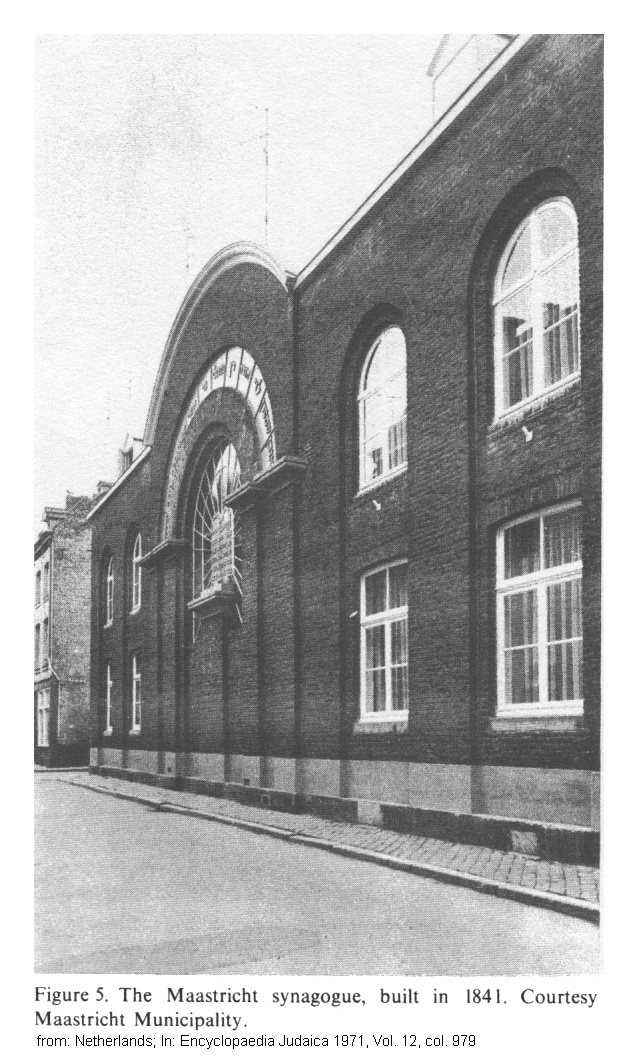
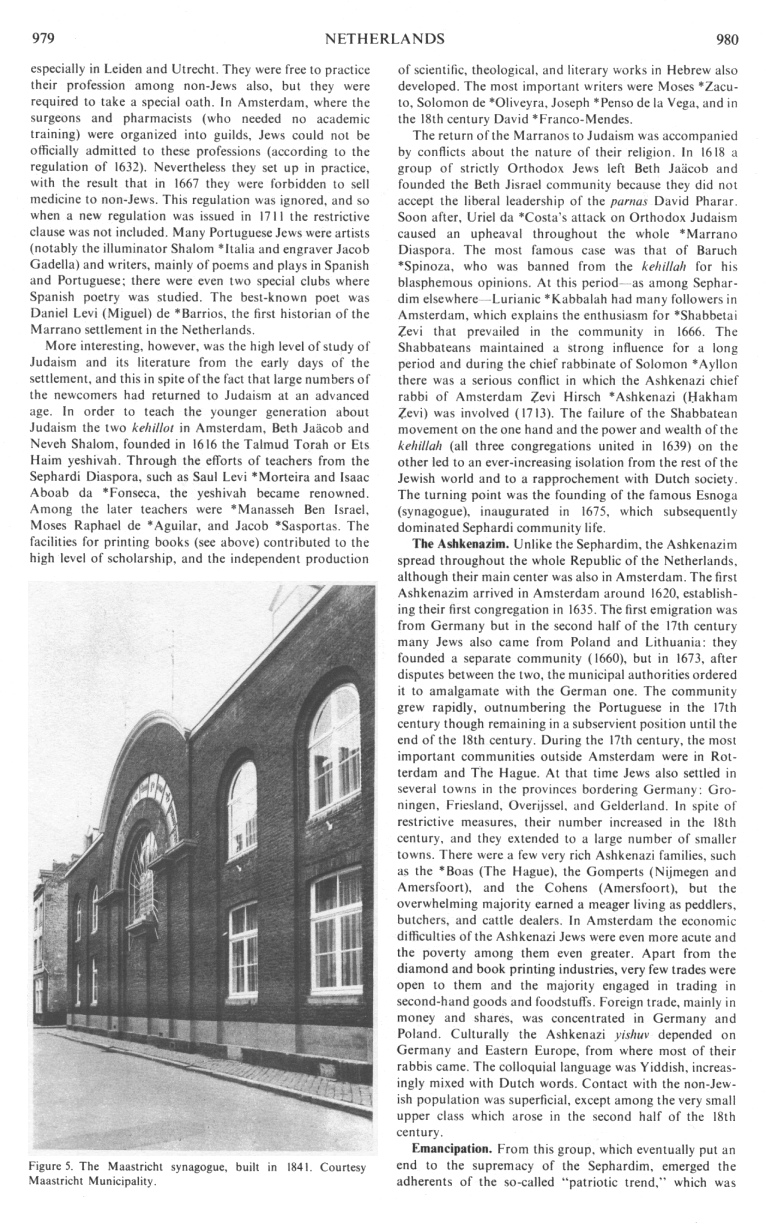
Encyclopaedia Judaica 1971: Netherlands, vol. 12, col. 979., synagogue of Maastrich, built in 1841