<Holocaust Period.
[Numbers
of Jews 1933: 140,000 Jews]
On the eve of the Holocaust, there were 140,000 Jews in
Holland, of whom 121,400 were members of the Ashkenazi
community, 4,301 of the Sephardi community, and another
12,400 Jews were unaffiliated with the religious
communities. There were also about 1,900 Christians of
Jewish origin or parentage living in the Netherlands.
[since
1933: enforced Zionism by German refugees - Committee
for Special Jewish Affairs - Westerbork]
In 1933, immediately after the Nazi rise to power, German
Jews began their flight to Holland.> (col. 984)
<The radical change took place under the influence of
the persecutions in Germany after 1933, when a steady
stream of refugees went to the Netherlands (see below).
Concurrent political events strengthened the growth of the
Zionist organization (at that time under the leadership of
Perez *Bernstein and after his aliyah of A.J. Herzberg) and of the
youth organizations and *He-Halutz movements. Although
nominally the structure of Dutch, Jewry remained
unchanged, in fact the emphasis was shifted from the parnasim [[leaders]]
to the political leadership; this had far-reaching
consequences as the German occupation later proved.>
(col. 983)
<A Comité voor Bijzondere Joodse Belangen ("Committee
for Special Jewish Affairs") was established to aid the
refugees on March 21, 1933, by Abraham *Asscher, president
of the organization of Dutch-Jewish communities, and David
*Cohen, a longtime active Zionist. The council's prime
task was to facilitate absorption of refugees and aid
their further emigration; to a lesser degree it also
engaged in anti-Nazi propaganda.
By January 1939 the committee had spent approximately
3,000,000 Dutch guilders ($780,000) for these purposes
from funds collected mostly from the Jewish (col. 984)
community in Holland. In 1939 expenses rose to
approximately 3,000,000 guilders a year because of
increased anti-Jewish measures in Germany. At that time
there were about 30,000 German-Jewish fugitives in
Holland.
The Dutch government, which had continuously resisted a
more liberal admission policy, decided to establish a
central camp for illegal immigrants at *Westerbork, a
forbidding wasteland in the northeast, not far from the
German border. The financial burden fell on the committee,
which was taxed 200,000 guilders yearly as of February
1939. A well-organized and extensive apparatus was needed
for the committee's enormous tasks. Except for its
leaders, the membership consisted almost exclusively of
German Jews. The existence of this institution with its
many departments (including finances, occupational
rehabilitation, education, and culture) was to prove of
enormous - and, according to some - fatal import for
developments in Holland after the German occupation.>
(col. 985)
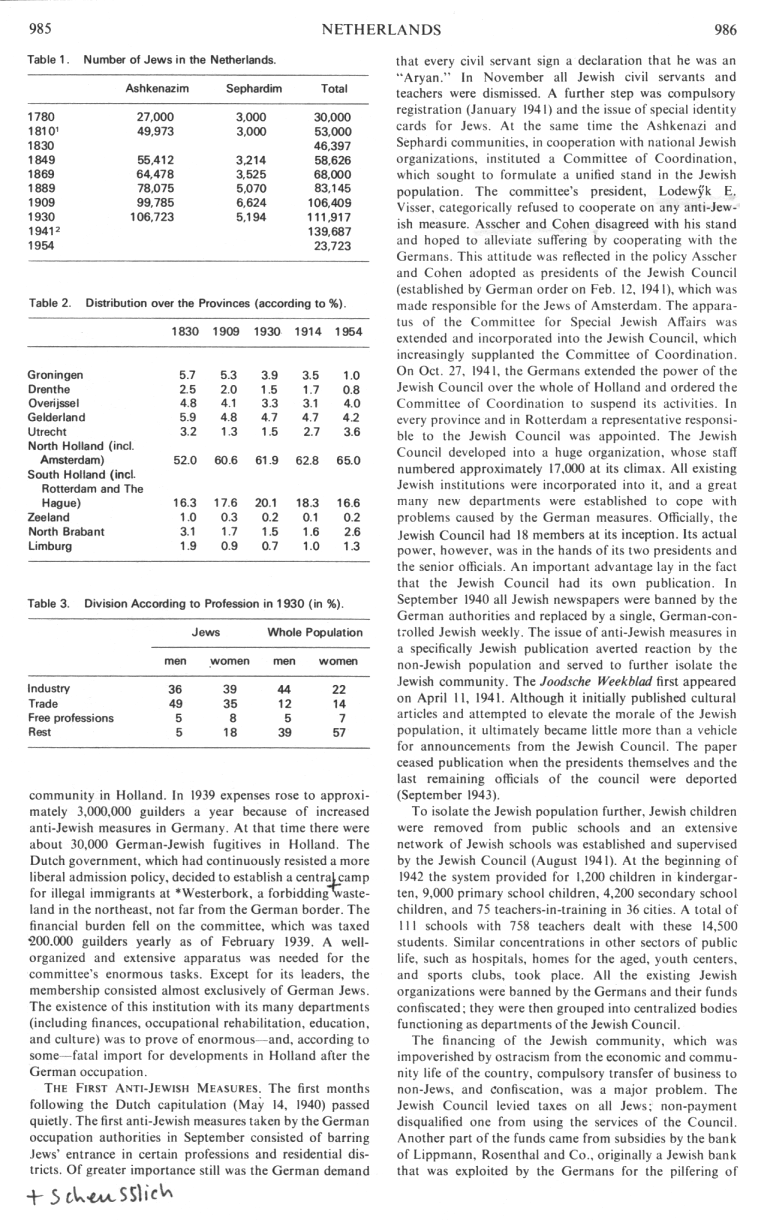
Table 1. Number of Jews in the
Netherlands
|
|
sssAshkenazimsss
|
sssSephardimsss
|
ssssssTotal
|
1780
|
27,000
|
3,000
|
30,000ssssss
|
1810
|
49,973
|
3,000
|
53,000ssssss |
1830
|
|
|
46,397ssssss |
1849
|
55,412
|
3,214
|
58,626ssssss |
1869
|
64,478
|
3,525
|
68,000ssssss |
1889
|
78,075
|
5,070
|
83,145ssssss |
1909
|
99,785
|
6,624
|
106,409ssssss |
1930
|
106,723
|
5,194
|
111,917ssssss |
1941
|
|
|
139,687ssssss |
1954
|
|
|
23,723ssssss |
| from: Netherlands; In:
Encyclopaedia Judaica 1971, Vol. 12, col. 985 |
Table 2. Distribution [[of the Jews]
over the Provinces [[in Holland]] (according
to %)
|
|
1830
|
1909
|
1930 [[1914?]]
|
1914 [[1930?]]
|
1954
|
Groningen
|
5.7%
|
5.3%
|
3.9%
|
3.5%
|
1.0%
|
Drenthe
|
2.5%
|
2.0%
|
1.5%
|
1.7%
|
0.8%
|
Overijssel
|
4.8%
|
4.1%
|
3.3%
|
3.1%
|
4.0%
|
Gelderland
|
5.9%
|
4.8%
|
4.7%
|
4.7%
|
4.2%
|
Utrecht
|
3.2%
|
1.3%
|
1.5%
|
2.7%
|
3.6%
|
North
Holland (incl. Amsterdam)
|
52.0%
|
60.6%
|
61.9%
|
62.8%
|
65.0%
|
South
Holland (incl. Rotterdam and The Hague)
|
16.3%
|
17.6%
|
20.1%
|
18.3%
|
16.6%
|
Zeeland
|
1.0%
|
0.3%
|
0.2%
|
0.1%
|
0.2%
|
North
Brabant
|
3.1%
|
1.7%
|
1.5%
|
1.6%
|
2.6%
|
Limburg
|
1.9%
|
0.9%
|
0.7%
|
1.0%
|
1.3%
|
| from: Netherlands; In:
Encyclopaedia Judaica 1971, Vol. 12, col. 985 |
Table 3. Division [[of the Jews in
Holland]] According to Profession in 1930 (in
%)
|
|
Jews
|
Whole
Population
|
|
men
|
women
|
men
|
women
|
Industry
|
36%
|
39%
|
44%
|
22%
|
Trade
|
49%
|
35%
|
12%
|
14%
|
Free
professions
|
5%
|
8%
|
5%
|
7%
|
Rest
|
5%
|
18%
|
39%
|
57%
|
from: Netherlands; In:
Encyclopaedia Judaica 1971, Vol. 12, col. 985
|
<THE FIRST ANTI-JEWISH MEASURES.
[1940-1945:
German NS occupation: persecution of the Jews by
profession and residential restrictions]
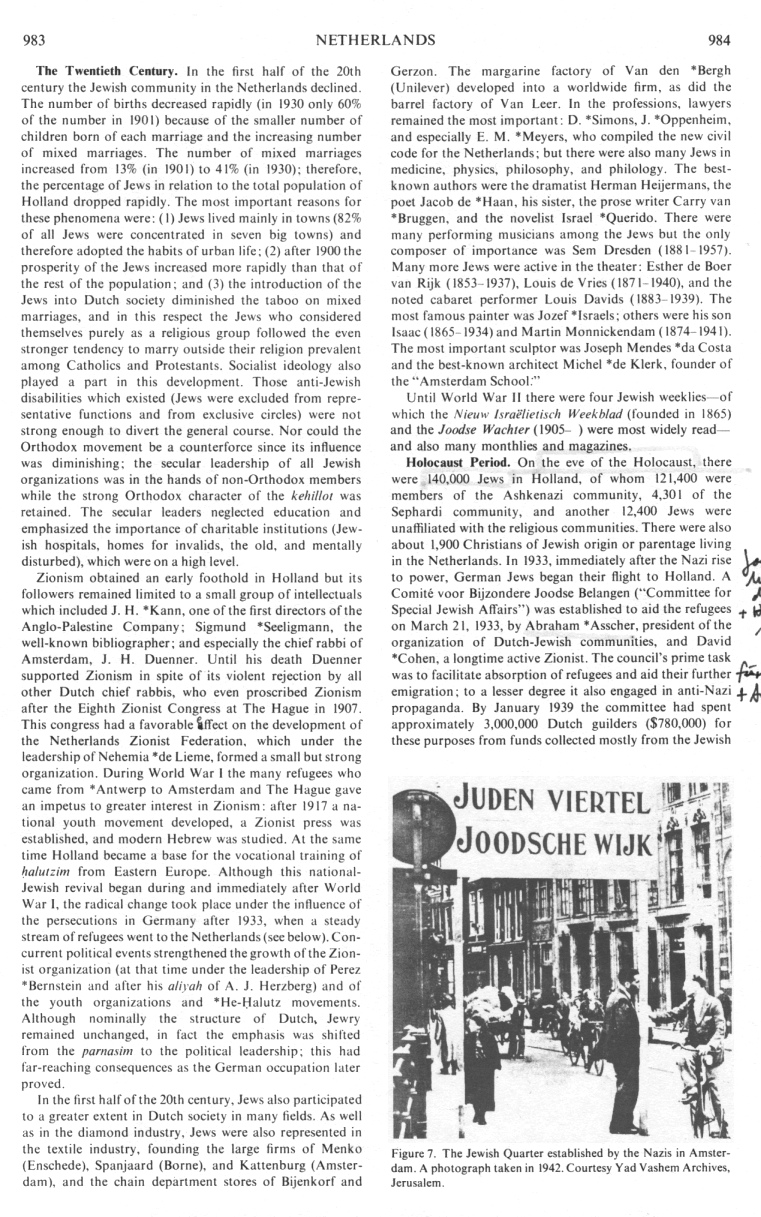
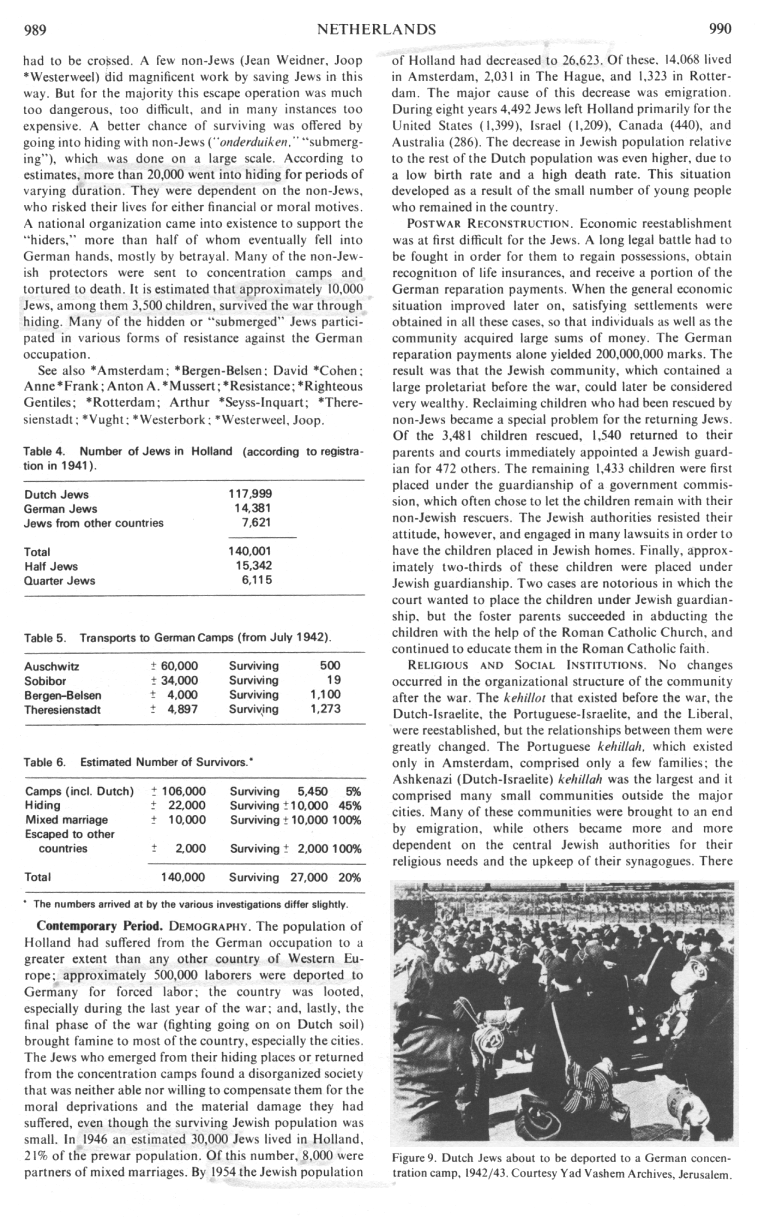
![Encyclopaedia
Judaica 1971: Netherlands, vol. 12, col.984, Jewish
quarter established by the Nazis [[and their
collaborators]] in Amsterdam. A photograph taken in
1942. Courtesy Yad Vashem Archives, Jerusalem](EncJud-juden-in-NL-d/EncJud_NL-band12-kolonne984-judenviertel-1942.jpg "Encyclopaedia Judaica 1971: Netherlands, vol. 12,
col.984, Jewish quarter established by the Nazis [[and
their collaborators]] in Amsterdam. A photograph taken
in 1942. Courtesy Yad Vashem Archives, Jerusalem")
Encyclopaedia Judaica 1971: Netherlands, vol. 12, col.984,
Jewish quarter established by the Nazis [[and their
collaborators]]
in Amsterdam. A photograph taken in 1942. Courtesy Yad
Vashem Archives, Jerusalem
The first months
following the Dutch capitulation (May 14, 1940) passed
quietly. The first anti-Jewish measures taken by the
German occupation authorities in September consisted of
barring Jews' entrance in certain professions and
residential districts. Of greater importance still was the
German demand (col. 985)
that every civil servant sign a declaration that he was an
"Aryan". In November all Jewish civil servants and
teachers were dismissed. A further step was compulsory
registration (January 1941) and the issue of special
identity cards for Jews.
[Coordination
committee - Jewish Council since 12 Feb. 1941 - Joodsche
Weekblad 1941-1943]
At the same time the Ashkenazi and Sephardi communities,
in cooperation with national Jewish organizations,
instituted a Committee of Coordination, which sought to
formulate a unified stand in the Jewish population. The
committee's president, Lodewÿk E. Visser, categorically
refused to cooperate on any anti-Jewish measure. Asscher
and Cohen disagreed with his stand and hoped to alleviate
suffering by cooperating with the Germans. This attitude
was reflected in the policy Asscher and Cohen adopted as
presidents of the Jewish Council (established by German
order on Feb. 12, 1941), which was made responsible for
the Jews of Amsterdam. The apparatus of the Committee for
Special Jewish Affairs was extended and incorporated into
the Jewish Council, which increasingly supplanted the
Committee of Coordination.
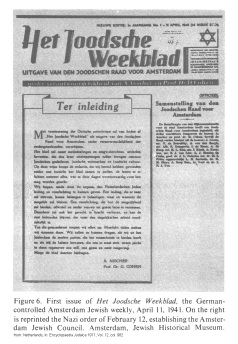
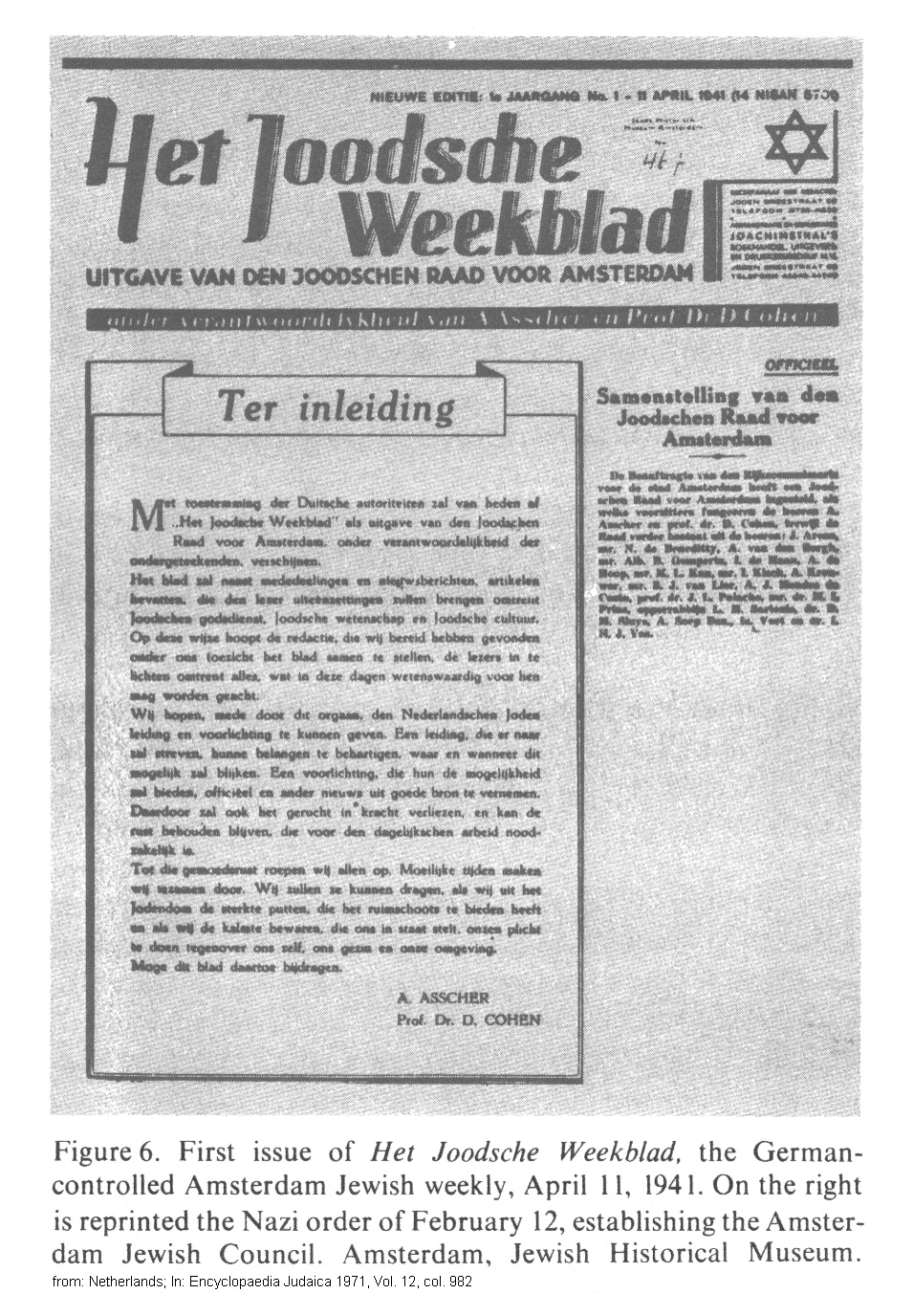
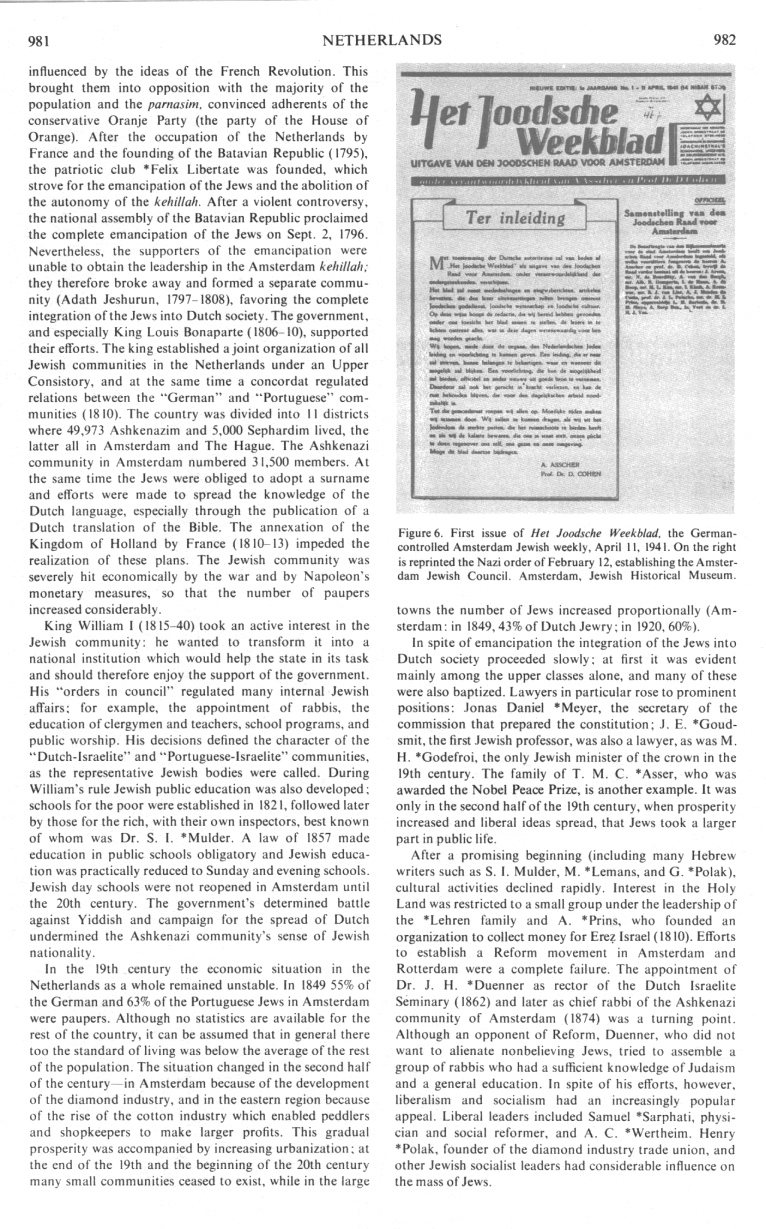
 Encyclopaedia
Judaica 1971: Netherlands, vol. 12, col. 982, "Joodsche
Weekblad" ("Jewish Weekly"), first issue of 11 April 1941
Encyclopaedia
Judaica 1971: Netherlands, vol. 12, col. 982, "Joodsche
Weekblad" ("Jewish Weekly"), first issue of 11 April 1941
On Oct. 27, 1941, the
Germans extended the power of the Jewish Council over the
whole of Holland and ordered the Committee of Coordination
to suspend its activities. In every province and in
Rotterdam a representative responsible to the Jewish
Council was appointed. The Jewish Council developed into a
huge organization, whose staff numbered approximately
17,000 at its climax. All existing Jewish institutions
were incorporated into it, and a great many new
departments were established to cope with problems caused
by the German measures.
Officially, the Jewish Council had 18 members at its
inception. Its actual power, however, was in the hands of
its two presidents and the senior officials. An important
advantage lay in the fact that the Jewish Council had its
own publication. In September 1940 all Jewish newspapers
were banned by the German authorities and replaced by a
single, German-controlled Jewish weekly. The issue of
anti-Jewish measures in a specifically Jewish publication
averted reaction by the non-Jewish population and served
to further isolate the Jewish community. The Joodsche Weekblad
first appeared on April 11, 1941. Although it initially
published cultural articles and attempted to elevate the
morale of the Jewish population, it ultimately became
little more than a vehicle for announcements from the
Jewish Council. The paper ceased publication when the
presidents themselves and the last remaining officials of
the council were deported (September 1943).
[Establishment
of Jewish kindergarten and Jewish schools - Jewish
hospital, homes for the aged - Jewish youth centers,
Jewish sports clubs]
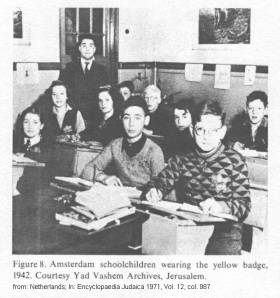
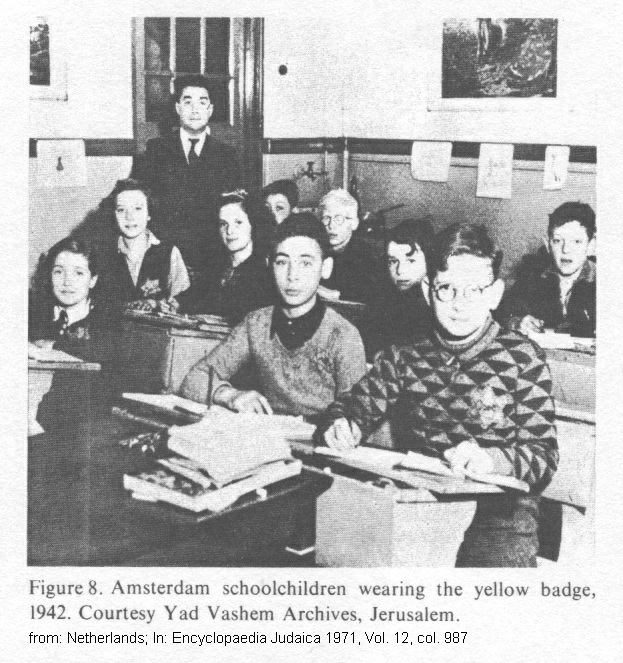
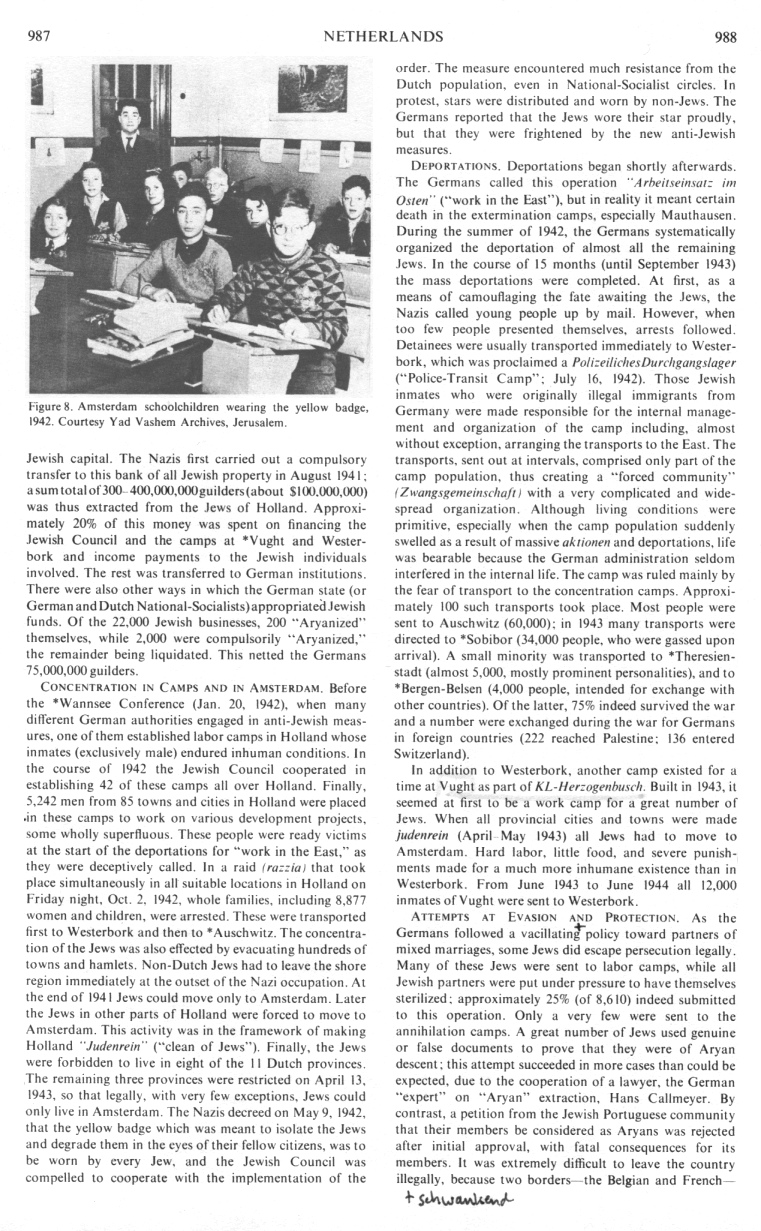
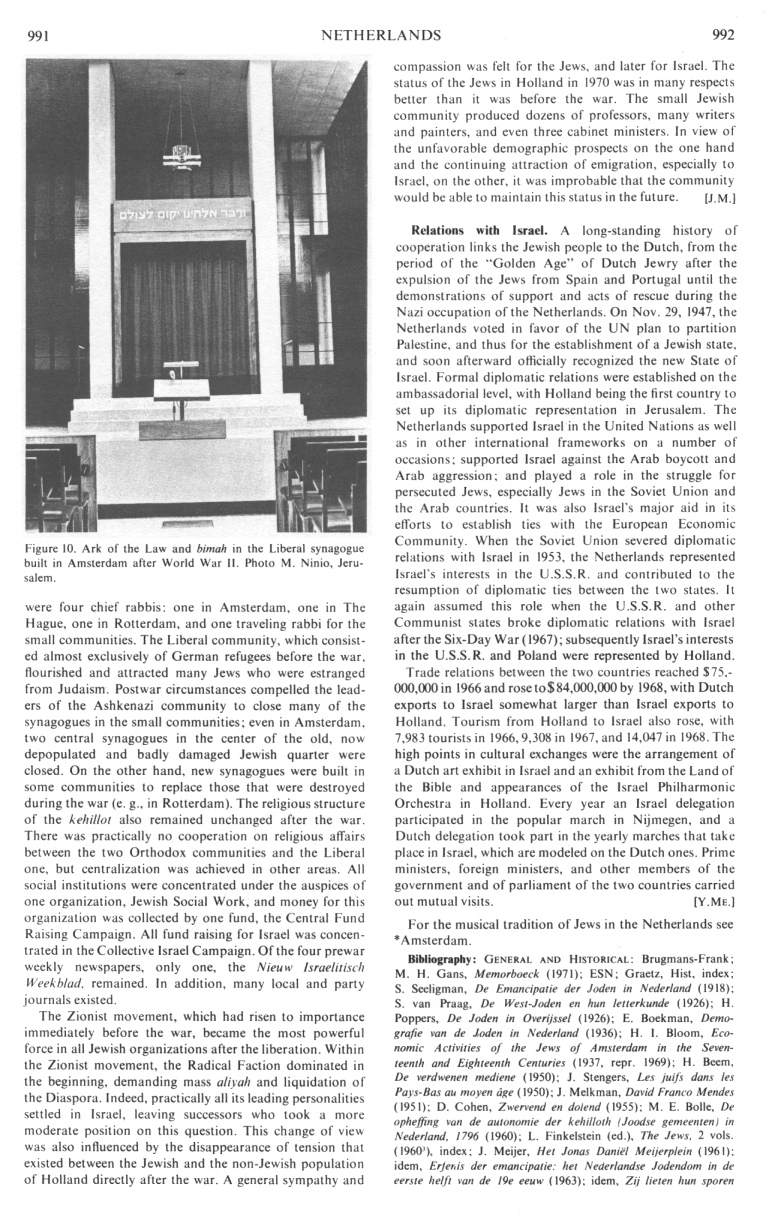
Encyclopaedia
Judaica 1971: Netherlands, vol. 12, col. 987, school class
with Jewish star 1941
To isolate the Jewish
population further, Jewish children were removed from
public schools and an extensive network of Jewish schools
was established and supervised by the Jewish Council
(August 1941). At the beginning of 1942 the system
provided for 1,200 children in kindergarten, 9,000 primary
school children, 4,200 secondary school children, and 75
teachers-in-training in 36 cities. A total of 111 schools
with 758 teachers dealt with these 14,500 students.
Similar concentrations in other sectors of public life,
such as hospitals, homes for the aged, youth centers, and
sports clubs, took place. All the existing Jewish
organizations were banned by the Germans and their funds
confiscated; they were then grouped into centralized
bodies functioning as departments of the Jewish Council.
[Finance
questions of the Dutch Jewish Council - robbery of Dutch
Jewish property and capital - aryanizations]
The financing of the Jewish community, which was
impoverished by ostracism from the economic and community
life of the country, compulsory transfer of business to
non-Jews, and confiscation, was a major problem. The
Jewish Council levied taxes on all Jews; non-payment
disqualified one from using the services of the Council.
Another part of the funds came from subsidies by the bank
of Lippmann, Rosenthal and Col, originally a Jewish bank
that was exploited by the Germans for the pilfering of
(col. 986)
Jewish capital. The Nazis first carried out a compulsory
transfer to this bank of all Jewish property in August
1941: a sum total of 300-400,000,000 guilders (about
$100,000,000) was thus extracted from the Jews of Holland.
Approximately 20% of this money was spent on financing the
Jewish Council and the camps at *Vught and Westerbork and
income payments to the Jewish individuals involved. The
rest was transferred to German institutions.
There were also other ways in which the German state (or
German and Dutch National-Socialists) appropriated Jewish
funds. Of the 22,000 Jewish businesses, 200 "Aryanized"
themselves, while 2,000 were compulsorily "Aryanized", the
remainder being liquidated. This netted the Germans
75,000,000 guilders.
[[Swiss banks played a big role in the Nazi financial
transactions, and the Hitler regime gave Jewish businesses
to its "friends" for a song, and also "neutral" Swiss
industrials accepted these bribes]].
CONCENTRATION IN CAMPS AND IN AMSTERDAM.
[42
labor camps all over Holland with 5,242 Jewish inmates -
deportations - "evacuations"]
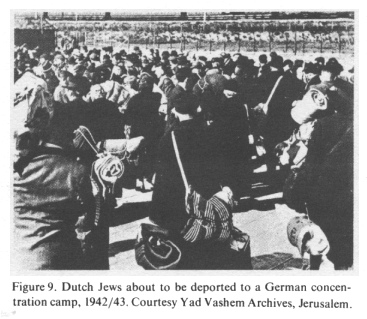
Before the *Wannsee Conference (Jan. 20, 1942), when many
different German authorities engaged in anti-Jewish
measures, one of them established labor camps in Holland
whose inmates (exclusively male) endured inhuman
conditions. In the course of 1942 the Jewish Council
cooperated in establishing 42 of these camps all over
Holland. Finally, 5,242 men from 85 towns and cities in
Holland were placed in these camps to work on various
development projects, some wholly superfluous. These
people were ready victims at the start of the deportations
for "work in the East", as they were deceptively called.
In a raid (razzia)
that took place simultaneously in all suitable locations
in Holland on Friday night, Oct. 2, 1942, whole families,
including 8,877 women and children, were arrested. These
were transported first to Westerbork and then to
*Auschwitz.
The concentration of the Jews was also effected by
evacuating hundreds of towns and hamlets. Non-Dutch Jews
had to leave the shore region immediately at the outset of
the Nazi occupation. At the end of 1941 Jews could move
only to Amsterdam. Later the Jews in other parts of
Holland were forced to move to Amsterdam. This activity
was in the framework of making Holland "Judenrein" ("clean
of Jews").>
Details: Addition from Jerry Meents, Dutch
Jew in Holland (12 years old in 1942 and Dutch Holocaust
survivor):
-- from September 16, 1941 on Jews were not allowed to
travel any more without permission
-- and from November 7, 1941, Jews were not allowed any
more to move to another apartment without permission, in
Amsterdam and in other cities
-- not all Jewish people were forced to move to Amsterdam,
but Jewish people from about 20 towns or cities were
directly deported to Westerbork or Vught, without living
in Amsterdam before [Meents 01]
<Finally, the Jews were forbidden to live in eight of
the 11 Dutch provinces. The remaining three provinces were
restricted on April 13, 1943, so that legally, with very
few exceptions, Jews could only live in Amsterdam.>
[since
9 May 1942: Jewish badge - protest badge against the
badge]
<The Nazis decreed on May 9, 1942, that the yellow
badge which was meant to isolate the Jews and degrade them
in the eyes of their fellow citizens, was to be worn by
every Jews, and the Jewish Council was compelled to
cooperate with the implementation of the (col. 987)
order. The measure encountered much resistance from the
Dutch population, even in National-Socialist circles. In
protest, stars were distributed and worn by non-Jews. The
Germans reported that the Jews wore their star proudly,
but that they were frightened by the new anti-Jewish
measures.
DEPORTATIONS.
[Call-up
for deportation - arrests - detainees from Westerbork
transported to the East - Vught]
Deportations began shortly afterwards. The Germans called
this operation "Arbeitseinsatz
im Osten" ("work in the East"), but in reality it
meant certain death in the extermination camps, especially
Mauthausen.
[[There were 1,000s of victims in quarries and in the
tunnel constructioning for the underground weapon
production, for the "Underground Reich"]].
During the summer of 1942, the Germans systematically
organized the deportation of almost all the remaining
Jews.
[[There is no indication if also non-Aryans (half Jews,
quarter Jews, and 3/4 Jews) were deported]].
In the course of 15 months (until September 1943) the mass
deportations were completed. At first, as a means of
camouflaging the fate awaiting the Jews, the Nazis called
young people up by mail. However, when too few people
presented themselves, arrests followed. Detainees were
usually transported immediately to Westerbork, which was
proclaimed a Polizeiliches
Durchgangslager ("Police-Transit Camp"; July 16,
1942).
Those Jewish inmates who were originally illegal
immigrants from Germany were made responsible for the
internal management and organization of the camp
including, almost without exception, arranging the
transports to the East. The transports, sent out at
intervals, comprised only part of the camp population,
thus creating a "forced community" (Zwangsgemeinschaft)
with a very complicated and widespread organization.
Although living conditions were primitive, especially when
the camp population suddenly swelled as a result of
massive aktionen
[[actions]] and deportations, life was bearable because
the German administration seldom interfered in the
internal life. The camp was ruled mainly by the fear of
transport to the concentration camps.
Approximately 100 such transports took place. Most people
were sent to Auschwitz (60,000); in 1943 many transports
were directed to *Sobibor (34,000 people, who were gassed
upon arrival).
[[Gassing probably is not right, but after the resolution
to install underground weapon production in the Reich the
detainees were deported back to the Reich working in the
big sites and tunnel systems with mass death in the tunnel
systems]].
Details: Addition from Jerry Meents, Dutch
Jew in Holland (12 years old in 1942 and Dutch Holocaust
survivor):
-- Sobibor did not employ Dutch Jews for work [[so Dutch
Jews for Sobibor were deported to Sobibor but then were
distributed to other camps as it seems]]
-- only one Dutch lady, Selma Wijnberg, worked in Sobibor
and survived, and another lady from Holland (Ilana Safran,
but she was not a Dutch citizen) also worked in Sobibor
and also survived
-- there were 17 other Dutch survivors from Sobibor,
however they were only from an hour to 4 hours in or
outside of Sobibor and were picked to work in other camps
[Meents 01]
A small minority was transported to *Theresienstadt
(almost 5,000, mostly prominent personalities), and to
*Bergen-Belsen (4,000 people, intended for exchange with
other countries). Of the latter, 75% indeed survived the
war and a number were exchanged during the war for Germans
in foreign countries (222 reached Palestine; 136 entered
Switzerland).
In addition to Westerbork, another camp existed for a time
at Vught as part of KL-Herzogenbusch.
Built in 1943, it seemed at first to be a work camp for a
great number of Jews. When all provincial cities and towns
were made judenrein
(April-May 1943) all Jews had to move to Amsterdam. Hard
labor, little food, and severe punishments made for a much
more inhumane existence than in Westerbork. From June 1943
to June 1944 all 12,000 inmates of Vught were sent to
Westerbork.
ATTEMPTS AT EVASION AND PROTECTION.
[Rescue
by mixed marriages - sterilizations of partners]
As the Germans followed a vacillating policy toward
partners of mixed marriages, some Jews did escape
persecution legally. Many of these Jews were sent to labor
camps, while all Jewish partners were put under pressure
to have themselves sterilized; approximately 25% (of
8,610) indeed submitted to this operation. Only a very few
were sent to the annihilation camps.
[Rescue
by false Aryan descent certificates by German "expert" -
many Jews saved]
A great number of Jews used genuine or false documents to
prove that they were of Aryan descent; this attempt
succeeded in more cases than could be expected, due to the
cooperation of a lawyer, the German "expert" on "Aryan"
extraction, Hans Callmeyer. By contrast, a petition from
the Jewish Portuguese community that their members be
considered as Aryans was rejected after initial approval,
with fatal consequences for its members.
[Rescue
by illegal flight - or by hiding with non-Jews]
It was extremely difficult to leave the country illegally,
because two borders - the Belgian and French - (col. 988)
had to be crossed. A few non-Jews (Jean Weidner, Joop
*Westerweel) did magnificent work by saving Jews in this
way. But for the majority this escape operation was much
too dangerous, too difficult, and in many instances too
expensive. A better chance of surviving was offered by
going into hiding with non-Jews ("onderduiken", "submerging"), which was
done on a large scale. According to estimates, more than
20,000 went into hiding for periods of varying duration.
They were dependent on the non-Jews, who risked their
lives for either financial or moral motives.
A national organization came into existence to support the
"hiders", more than half of whom eventually fell into
German hands, mostly by betrayal. Many of the non-Jewish
protectors were sent to concentration camps and tortured
to death. It is estimated that approximately 10,000 Jews,
among them 3,500 children, survived the war through
hiding. Many of the hidden or "submerged" Jews
participated in various forms of resistance against the
German occupation.
See also *Amsterdam; *Bergen-Belsen; David *Cohen; Anne
*Frank [[ballpen]]; Anton A. *Mussert; *Resistance;
*Righteous Gentiles; *Rotterdam; Arthur *Seyss-Inquart;
*Theresienstadt; *Vught; *Westerbork; *Westerweel,
Joop.> (col. 989)
Table 4. Number of Jews in Holland
(according to registration in 1941)
|
Dutch
Jews
|
117,999xxxxxxx
|
German
Jews
|
14,381xxxxxxx |
Jews
from other countries
|
7,621xxxxxxx |
|
|
Total
|
140,001xxxxxxx |
Half
Jews
|
15,342xxxxxxx |
Quarter
Jews
|
6,115xxxxxxx |
|
|
[[Total
with Half Jews and Quarter Jews, non-Aryans
|
161,458]]xxxxxx |
from: Netherlands; In:
Encyclopaedia Judaica 1971, Vol. 12, col. 989
|
Table 5. Transports to German Camps
(from July 1942)
|
Auschwitz
|
± 60,000xxxxx |
Surviving
|
500xxxxx
|
Sobibor
|
± 34,000xxxxx |
Surviving
|
19xxxxx |
Bergen-Belsen
|
± 4,000xxxxx |
Surviving
|
1,100xxxxx |
Theresienstadt
|
± 4,897xxxxx |
Surviving
|
1,273xxxxx |
| from: Netherlands; In:
Encyclopaedia Judaica 1971, Vol. 12, col. 989 |
[[There were many Auschwitz detainees transported to the
tunnel systems and died in the tunnel systems ("Underground
Reich"), and some survived]].
Table 6. Estimated Number of Survivors*
|
Camps
(incl. Dutch)
|
±
106,000
|
Surviving
|
5,450
|
5%
|
Hiding
|
±
22,000
|
Surviving
|
±
10,000
|
45%
|
Mixed
marriage
|
±
10,000
|
Surviving
|
±
10,000
|
100%
|
Escaped
to other countries
|
±
2,000
|
Surviving
|
±
2,000
|
100%
|
|
|
|
|
|
Total
|
140,000
|
Surviving
|
27,000
|
20%
|
* The numbers arrived at
by the various investigations differ slightly.
|
| from: Netherlands; In:
Encyclopaedia Judaica 1971, Vol. 12, col. 989 |
[[Half Jews, quarter Jews and 3/4 Jews are missing in this
table]].
[[Supplement:
Famine 1944-1945
At the end of World
War II there was an immense starvation in Holland because
Holland converted into a battlefield, and because the NS
occupation took all products to the Reich and to the
Eastern Front]].
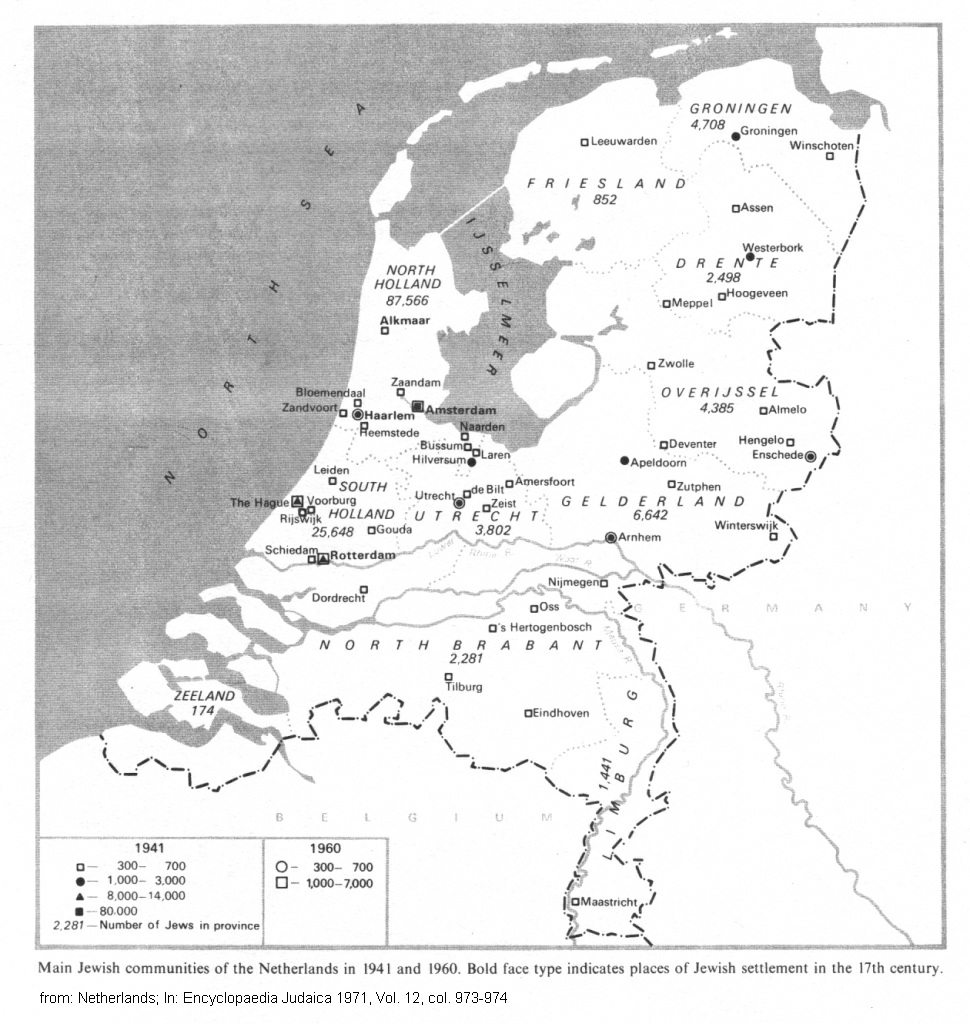
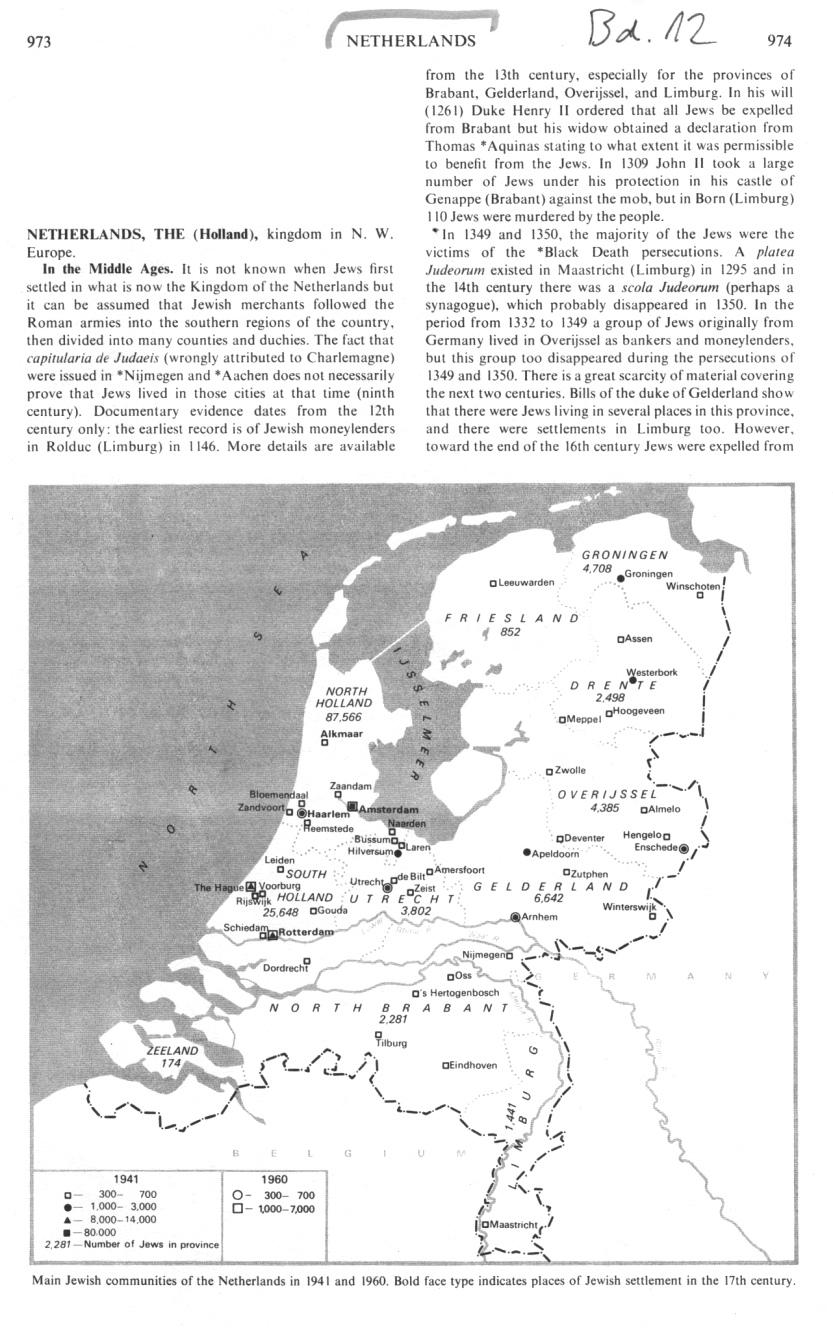
| Details of the map with the
Jewish settlements of 1941 and 1960 |
Encyclopaedia
Judaica 1971: Netherlands, vol. 12, col. 973-974,
map of the Jewish settlements 1941 and 1960 |
Little Jewish settlements in 1941 (300-700):
Leeuwarden, Winschoten, Assen, Alkmaar, Meppel,
Hoogeveen, Zwolle, Zaandam, Bloemendaal,
Zandvoort, Reemstede, Naarden, Bussum, Laren,
Almelo, Deventer, Hengelo, Zutphen, Amersfoort, de
Built, Leiden, Voorburg, Rijswijk, Schiedam,
Zeist, Winterswijk, Schiedam, Dordrecht, Nijmegen,
Oss, Hertogenbosch,Tilburg, Eindhoven, Maastricht
Jewish settlements in 1941 (1,000-3,000):
Groningen, Westerbork, Hilversum, Apeldoorn,
Haarlem, Utrecht, Arnheim, Enschede
Jewish settlements in 1941 (8,000-14,000): The
Hague, Rotterdam
Jewish settlements in 1941 (80,000): Amsterdam
-----
Jewish settlements in 1960 (300-700): Haarlem,
Utrecht, Enschede, Arnhem
Jewish settlements in 1960 (1,000-7,000):
Amsterdam, The Hague, Rotterdam |