Contemporary Period.
DEMOGRAPHY.
[Whole
Dutch population]
The population of Holland had suffered from the German
occupation to a greater extent than any other country of
Western Europe; approximately 500,000 laborers were
deported to Germany for forced labor; the country was
looted especially during the last year of the war; and,
lastly, the final phase of the war (fighting going on on
Dutch soil) brought famine to most of the country,
especially the cities.
[Decreasing
Jewish population 1945-1954 by emigration, mixed
marriages, and low birth rate]
The Jews who emerged from their hiding places or returned
from the concentration camps found a disorganized society
that was neither able nor willing to compensate them for
the moral deprivations and the material damage they had
suffered, even though the surviving Jewish population was
small. In 1946 an estimated 30,000 Jews lived in Holland,
21% of the prewar population. Of this number, 8,000 were
partners of mixed marriages.
By 1954 the Jewish population (col. 989)
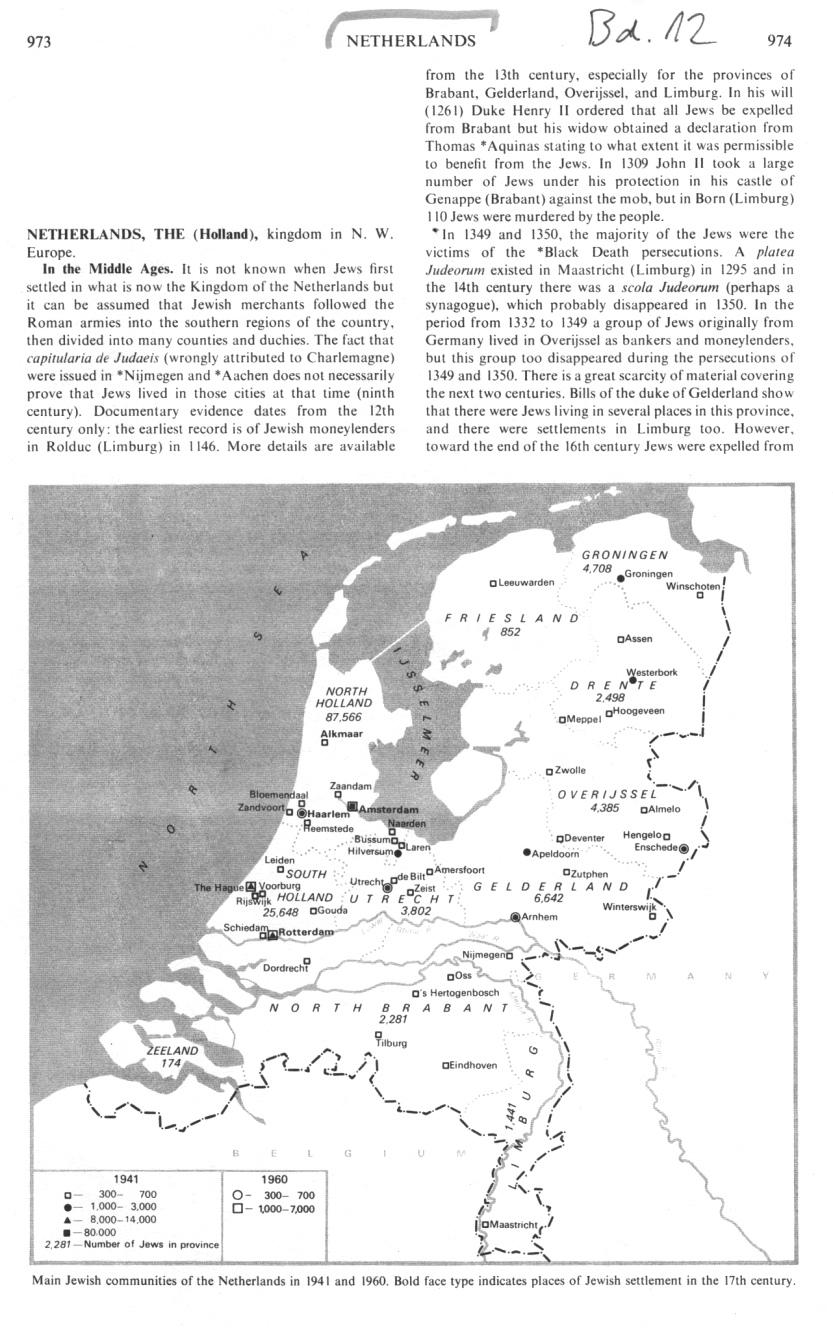
of Holland had decreased to 26,623. Of these, 14068 lived
in Amsterdam, 2,031 in The Hague, and 1,323 in Rotterdam.
The major cause of this decrease was emigration. During
eight years 4,492 Jews left Holland primarily for the
United States (1,399), Israel (1,209), Canada (440), and
Australia (286). The decrease in Jewish population
relative to the rest of the Dutch population was even
higher, due to a low birth rate and a high death rate.
This situation developed as a result of the small number
of young people who remained in the country.
POSTWAR RECONSTRUCTION.
Economic reestablishment was at first difficult for the
Jews. A long legal battle had to be fought in order for
them to regain possessions, obtain recognition of life
insurances, and receive a portion of the German reparation
payments.
[[Supplement:
The role of Swiss banking for the German Nazi bosses
Swiss banks with the bourse at Zurich were one of the main
banking centers to convert Dutch Jewish commercial papers
into cash for the German Nazi bosses which was hidden
after 1945 by the president of the bourse of Zurich who
became a prosecuting attorney at the Federal Supreme Court
of Switzerland, Mr. Georg Leuch. This was done
deliberately by Swiss Nazi clique to give the ancient
president of the bourse the post of the administration of
the stolen Dutch Jewish money. Leuch was ordered to
negotiate with the Dutch side himself and to protect
Switzerland from the shame...
In: Beat Balzli: Treuhänder des Reichs. Die Schweiz und
die Vermögen der Naziopfer. Eine Spurensuche, Werd-Verlag
1997, p. 207-218
The same Swiss Nazi clique took the money from Jewish
number bank accounts from Jews who did not come back after
the war, dead or alive on other continents
In: Jean Ziegler: Die Schweiz, das Gold und die Toten]].
When the general economic situation improved later on,
satisfying settlements were obtained in all these cases,
so that individuals as well as the community acquired
large sums of money. The German reparation payments alone
yielded 200,000,000 marks. The result was that the Jewish
community, which contained a large proletariat before the
war, could later be considered very wealthy.
[Problems
with Jewish children rescued by non-Jews]
Reclaiming children who had been rescued by non-Jews
became a special problem for the returning Jews. Of the
3,481 children rescued, 1,540 returned to their parents
and courts immediately appointed a Jewish guardian for 472
others. The remaining 1,433 children were first placed
under the guardianship of a government commission, which
often chose to let the children remain with their
non-Jewish rescuers. The Jewish authorities resisted their
attitude, however, and engaged in many lawsuits in order
to have the children placed in Jewish homes. Finally,
approximately two-thirds of these children were placed
under Jewish guardianship. Two cases are notorious in
which the court wanted to place the children under Jewish
guardianship, but the foster parents succeeded in
abducting the children with the help of the Roman Catholic
Church, and continued to educate them in the Roman
Catholic faith.
RELIGIOUS AND SOCIAL INSTITUTIONS.
[Changes
in the Jewish community and reconstruction of
synagogues]
No changes occurred in the organizational structure of the
community after the war. The kehillot [[communities]] that existed
before the war, the Dutch-Israelite, the
Portuguese-Israelite, and the Liberal, were reestablished,
but the relationships between them were greatly changed.
The Portuguese kehillah,
which existed only in Amsterdam, comprised only a few
families; the Ashkenazi (Dutch-Israelite) kehillah was the
largest and it comprised many small communities outside
the major cities. Many of these communities were brought
to an end by emigration, while others became more and more
dependent on the central Jewish authorities for their
religious needs and the upkeep of their synagogues. There
(col. 990)
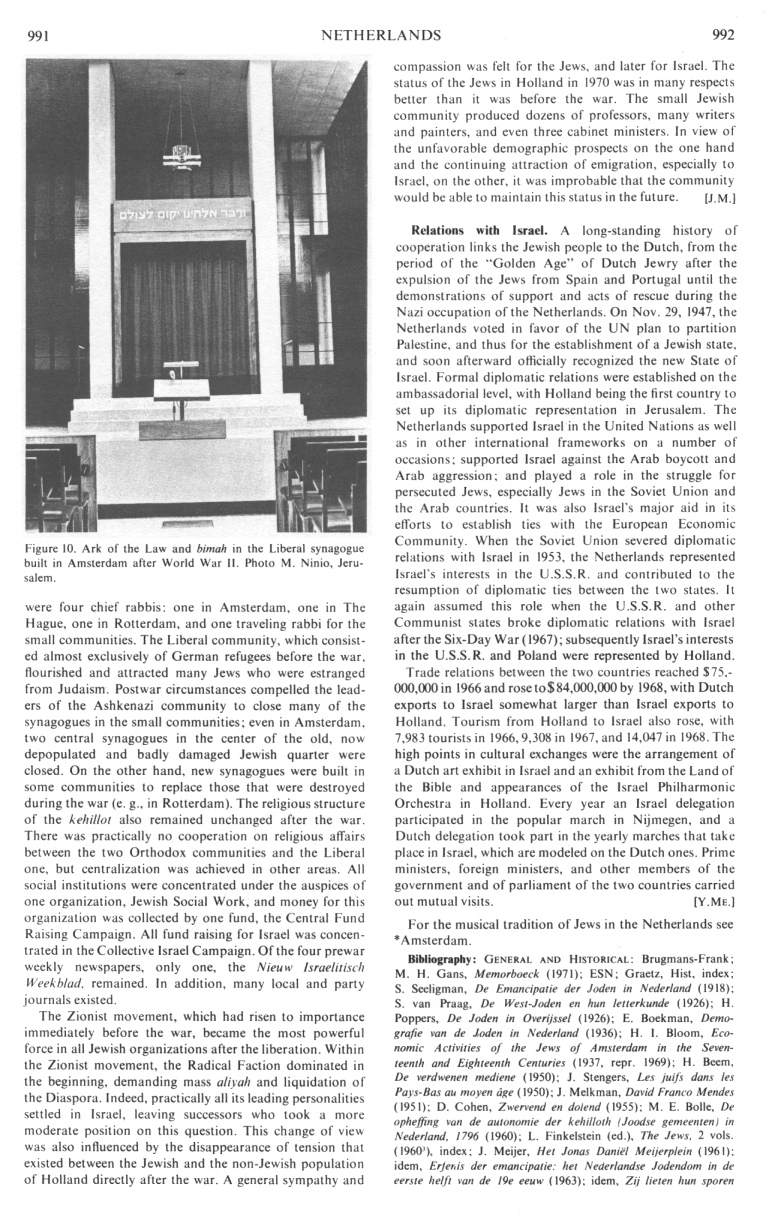
were four chief rabbis: one in Amsterdam, one in The
Hague, one in Rotterdam, and one traveling rabbi for the
small communities. The Liberal community, which consisted
almost exclusively of German refugees before the war,
flourished and attracted many Jews who were estranged from
Judaism. Postwar circumstances compelled the leaders of
the Ashkenazi community to close many of the synagogues in
the small communities; even in Amsterdam, two central
synagogues in the center of the old, now depopulated and
badly damaged Jewish quarter were closed. On the other
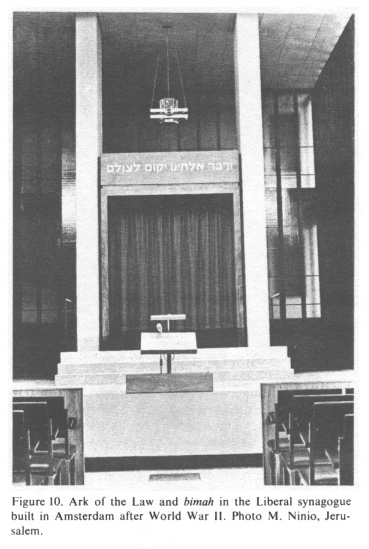
hand, new synagogues were built in some communities to
replace those that were destroyed during the war (e.g., in
Rotterdam).
[Structure
of the community - fund raising for Herzl Israel -
newspapers]
The religious structure of the kehillot [[communities]] also remained
unchanged after the war. There was practically no
cooperation on religious affairs between the two Orthodox
communities and the Liberal one, but centralization was
achieved in other areas. All social institutions were
concentrated under the auspices of one organization,
Jewish Social Work, and money for this organization was
collected by one fund, the Central Fund Raising Campaign.
All fund raising for Israel was concentrated in the
Collective Israel Campaign.
Of the four prewar weekly newspapers, only one, the Nieuw Israelitisch Weekblad,
remained. In addition, many local and party journals
existed.
[Herzl
Zionist movement - stop of tensions in Holland - Jews in
arts and policy since 1945]
The Zionist movement, which had risen to importance
immediately before the war, became the most powerful force
in all Jewish organizations after the liberation. Within
the Zionist movement, the Radical Faction dominated in the
beginning, demanding mass aliyah and liquidation of the Diaspora.
[[All Arabs of Palestine should be driven away as the
natives in the "USA" had been driven away. The Arab
anti-Semitism and the oil power of the Arab states was
never considered in the Herzl program for a "Jewish
State". So the Jews were driven in a new war trap]].
Indeed, practically all its leading personalities settled
in Israel, leaving successors who took a more moderate
position on this question. This change of view was also
influenced by the disappearance of tension that existed
between the Jewish and the non-Jewish population of
Holland directly after the war. A general sympathy and
(col. 991)
compassion was felt for the Jews, and later for Israel.
The status of the Jews in Holland in 1970 was in many
respects better than it was before the war. The small
Jewish community produced dozens of professors, many
writers and painters, and even three cabinet ministers. In
view of the unfavorable demographic prospects on the one
hand and the continuing attraction of emigration,
especially to Israel, on the other, it was improbable that
the community would be able to maintain this status in the
future.
[J.M.]
Relations
with Israel.
[Recognition
of Herzl Free Mason CIA Israel - Dutch diplomacy for
Israeli interests]
A long-standing history of cooperation links the Jewish
people to the Dutch, from the period of the "Golden Age"
of Dutch Jewry after the expulsion of the Jews from Spain
and Portugal until the demonstrations of support and acts
of rescue during the Nazi occupation of the Netherlands.
On Nov. 29, 1947, the Netherlands voted in favor of the UN
plan to partition Palestine, and thus for the
establishment of a Jewish state, and soon afterward
officially recognized the new State of Israel [[which was
found without borderline definitions and on a racist legal
base against all Arabs, above all against all
Palestinians, according to Herzl]].
Formal diplomatic relations were established on the
ambassadorial level, with Holland being the first country
to set up its diplomatic representation in Jerusalem. The
Netherlands supported Israel against the Arab boycott and
Arab aggression; and played a role in the struggle for
persecuted Jews, especially Jews in the Soviet Union and
the Arab countries.
[[Supplement: The Jewish invasion was the first aggression
with defended "overnight settlements" and fights against
the Palestinian population since 1918.
In: History; In: Encyclopaedia Judaica 1971, Vol. 8, col.
759]]
It was also Israel's major aid in its efforts to establish
ties with the European Economic Community. When the Soviet
Union severed diplomatic relations with Israel in 1953,
the Netherlands represented Israel's interests in the
U.S.S.R. and contributed to the resumption of diplomatic
ties between the two states. It again assumed this role
when the U.S.S.R. and other Communist states broke
diplomatic relations with Israel after the Six-Day War
(1967); subsequently Israel's interests in the U.S.S.R.
and Poland were represented by Holland.
[[Supplement:
Israel and Soviet Union
When Herzl Free Mason Israel joint with the CIA since
1948, Stalin felt surrounded by the "USA" and its
satellites. He damned all Jews in the Soviet Union because
Israel had not become a Soviet satellite and did not the
Jews leave the country. Since 1948 different general
persecution waves against the Jews were performed by the
Soviet press and the Soviet justice as collective
punishment for actions of Herzl Free Mason CIA Israel.
In: Benjamin Pinkus: The Soviet Government and the Jews,
passim]].
[Economic
relations between Herzl Free Mason CIA Israel and
Holland]
Trade relations between the two countries reached
$75,000,000 in 1966 and rose to $84,000,000 by 1968, with
Dutch exports to Israel somewhat larger than Israel
exports to Holland. Tourism from Holland to Israel also
rose, with 7,983 tourists in 1966, 9,308 in 1967, and
14,047 in 1968. The high points in cultural exchanges were
the arrangement of a Dutch art exhibit in Israel and an
exhibit from the Land of the Bible and appearances of the
Israel Philharmonic Orchestra in Holland. Every year an
Israel delegation participated in the popular march in
Nijmegen, and a Dutch delegation took part in the yearly
marches that take place in Israel, which are modeled on
the Dutch ones. Prime ministers, foreign ministers, and
other members of the government and of parliament of the
two countries carried out mutual visits.
[Y.ME.]
For the musical tradition of Jews in the Netherlands see
*Amsterdam.> (col. 992)
[[Supplement: After 1945 Holland was not such an innocent
country as it is presented here. The funds of the "US"
Marshall plan were misused for the war against the
independence of Indonesia 1946-1950, and Indonesian people
suffered big harm of this war of the racist Dutch
government]].