<Holocaust Period.
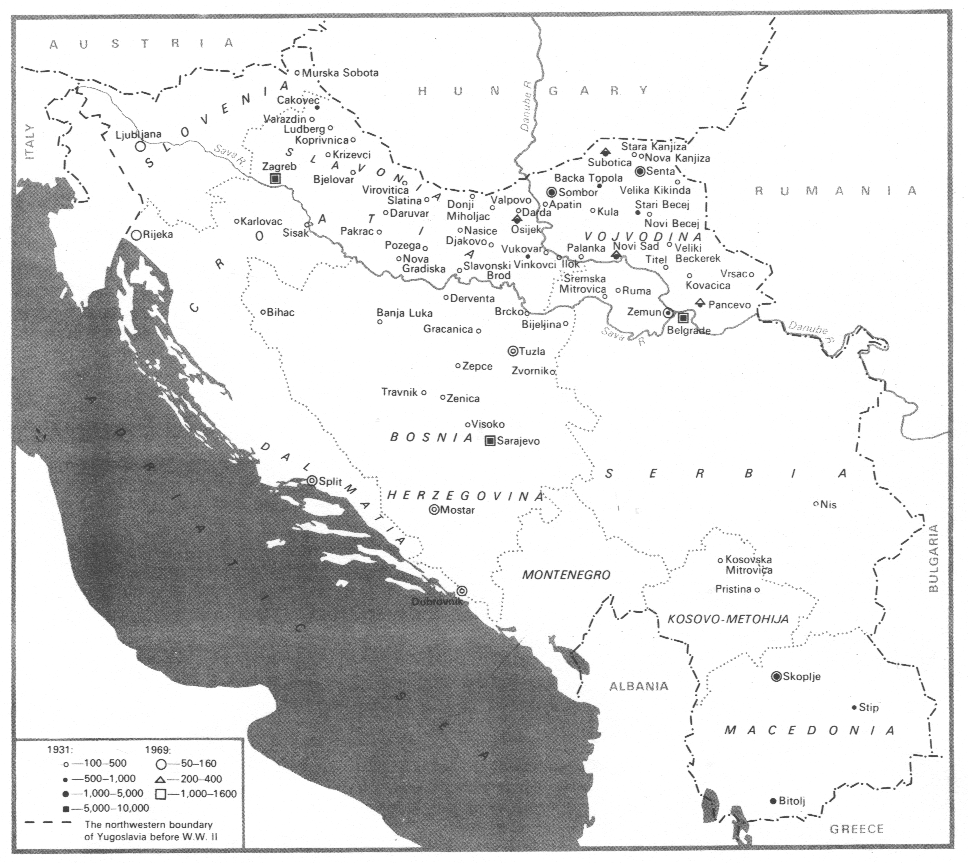
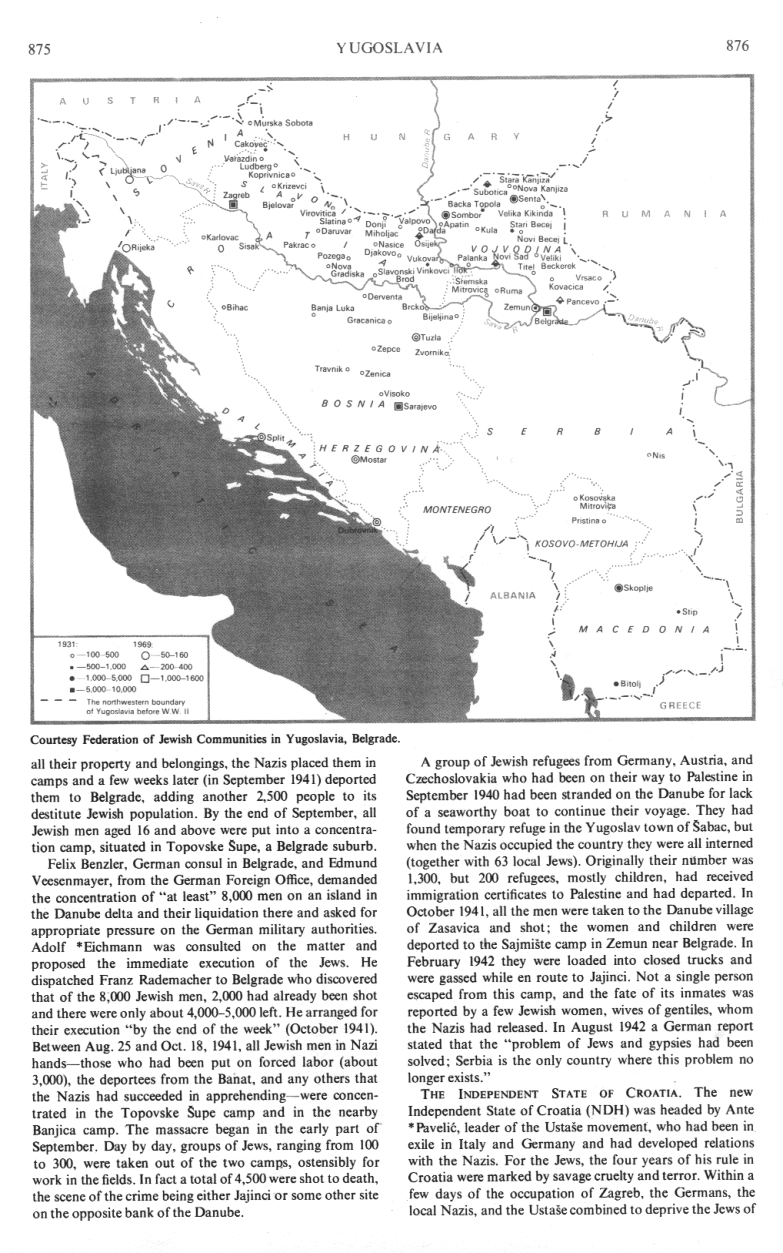
[Partition of Yugoslavia in April 1941]
In April 1941, Yugoslavia was occupied by
German,Hungarian, Italian, and Bulgarian troops. It was
divided into several parts:
-- Serbia and the Banat came under direct German military
administration
-- Hungary reoccupied some of the areas it had ceded to
newly formed Yugoslavia after World War I
-- Bulgaria took over Macedonia
-- and Italy extended its rule over Dalmatia and
Montenegro.
Most of the remaining territory - Croatia, Bosnia, and
Herzegovina - was formed into a new "Independent State of
Croatia".
SERBIA
AND THE BANAT. [German occupation]
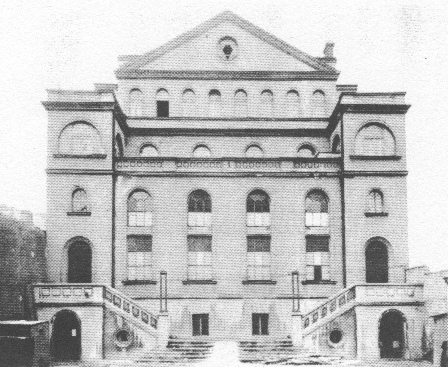
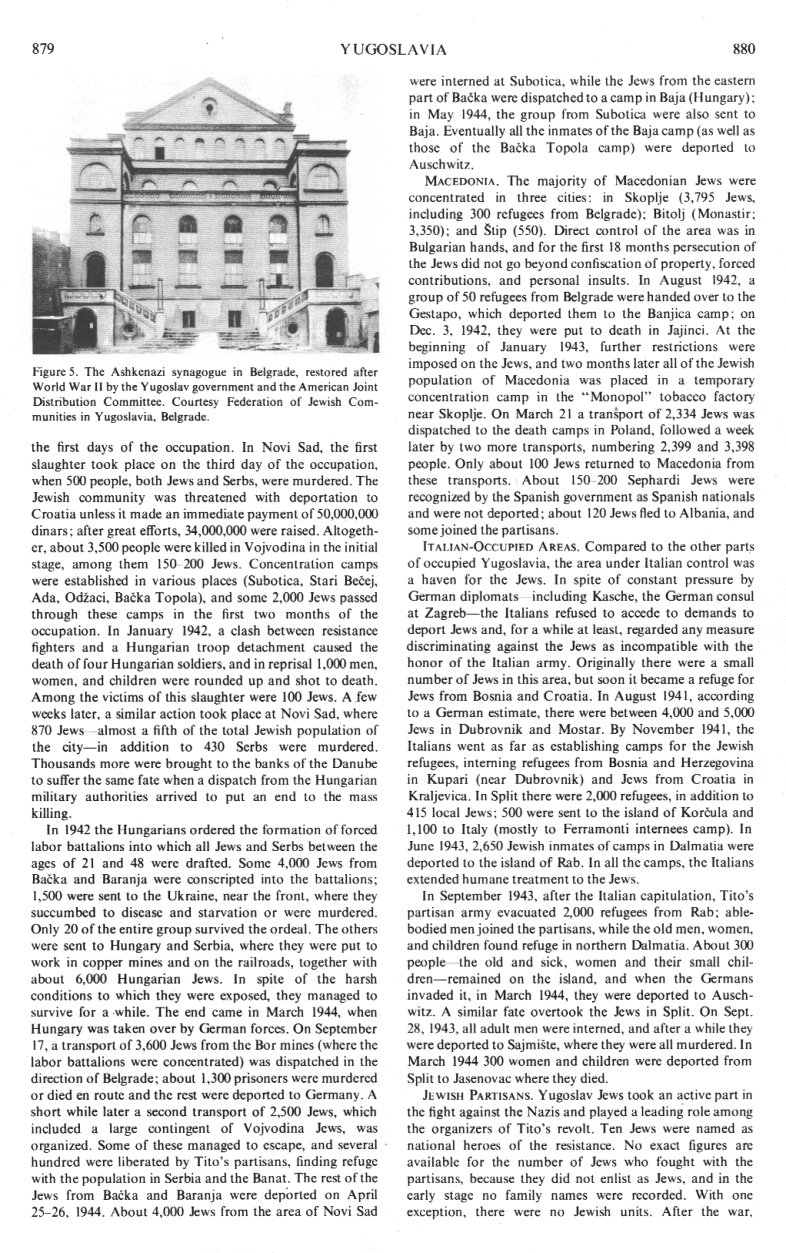
The Ashkenazi synagogue in Belgrade,
restored after World War II by the Yugoslav government and
the American Joint
Distribution Committee. Courtesy Federation of Jewish
Communities in Yugoslavia, Belgrade
On the day after the occupation of Belgrade (April 13,
1941), German troops, assisted by "Volksdeutsche"
(local Germans), ransacked the Jewish shops. Within a
week, the Jews were ordered to register with the police,
and eventually 9,145 Jews, out of a total prewar
population of about 12,000, were registered. The Jews were
removed from public service. The yellow *badge was
introduced, and Jews were drafted into forced labor. About
3,500 to 4,000 males from the age of 14 to 60 were forced
to clear the buildings that had been razed by the
bombardment, while women aged 16 to 40 were given menial
tasks in the German military installations.
A special police detachment was formed to deal with the
Jewish population. A "Jewish Organization" (Jevrejska
Zajednica) was created to attend to the needs of the
Jewish population. The Nazis forced the organization to
collect contributions from the Jews and provide hostages
to ensure Jewish compliance with their orders.
After the German invasion of the U.S.S.R. [[with the
collaborators]], the occupation regime became even
harsher. In one incident alone, at the end of July, 120
Jewish hostages were shot to death (in the village of
Jajinci, near Belgrade).
In the Banat, which had a large German minority, the
situation was worse. After robbing the Jews of (col. 874)
all their property and belongings, the Nazis [[and their
collaborators, e.g. of the local population]] placed them
in camps and a few weeks later (in September 1941)
deported them to Belgrade, adding another 2,500 people to
its destitute Jewish population. By the end of September,
all Jewish men aged 16 and above were put into a
concentration camp, situated in Topovske Supe (Šupe), a
Belgrade suburb.
[Massacre
on Jews of the Topovske Supe (Šupe) camp in September
1941: Jajinci region on the Danube - further massacres
in Zasavica - gassing by gas lorry]
Felix Benzler, German consul in Belgrade, and Edmund
Veesenmayer, from the German Foreign Office, demanded the
concentration of "at least" 8,000 men on an island in the
Danube delta and their liquidation there and asked for
appropriate pressure on the German military authorities.
Adolf *Eichmann was consulted on the matter and proposed
the immediate execution of the Jews. He dispatched Franz
Rademacher to Belgrade who discovered that of the 8,000
Jewish men, 2,000 had already been shot and there were
only about 4,000-5,000 left. He arranged for their
execution "by the end of the week" (October 1941). Between
Aug. 25 and Oct. 18, 1941, all Jewish men in Nazi hands -
those who had been put on forced labor (about 3,000), the
deportees from the Banat, and any others that the Nazis
had succeeded in apprehending - were concentrated in the
Topovske Supe (Šupe) camp and in the nearby Banjica camp.
The massacre began in the early part of September. Day by
day, groups of Jews, ranging from 100 to 300, were taken
out of the two camps, ostensibly for work in the fields.
In fact a total of 4,500 were shot to death, the scene of
the crime being either Jajinci or some other site on the
opposite bank of the Danube. (col. 875)
A group of Jewish refugees from Germany, Austria, and
Czechoslovakia who had been on their way to Palestine in
September 1940 had been stranded on the Danube for lack of
a seaworthy boat to continue their voyage. They had found
temporary refuge in the Yugoslav town of Sabac (Šabac),
but when the Nazis occupied the country they were all
interned (together with 63 local Jews). Originally their
number was 1,300, but 200 refugees, mostly children, had
received immigration certificates to Palestine and had
departed. In October 1941, all the men were taken to the
Danube village of Zasavica and shot; the women and
children were deported to the Sajmiste (Sajmište) camp in
Zemun near Belgrade. IN February 1942 they were loaded
into closed trucks and were gassed while en route to
Jajinci. Not a single person escaped from this camp, and
the fate of its inmates was reported by a few Jewish
women, wives of gentiles, whom the Nazis had released. In
August 1942 a German report stated that the "problem of
Jews and gypsies had been solved; Serbia is the only
country where this problem no longer exists."
THE
INDEPENDENT STATE OF CROATIA. [Ustase terror with
anti-Jewish law and depriving property - fines and
destroyed Jewish cemeteries - concentration camps and
extermination camp near Jasenovac in Croatia]
The new Independent State of Croatia (NDH) was headed by
Ante *Pavelic (Pavelič), leader of the Ustase (Ustaše)
movement, who had been in exile in Italy and Germany and
had developed relations with the Nazis. For the Jews, the
four years of his rule in Croatia were marked by savage
cruelty and terror. Within a few days of the occupation of
Zagreb, the Germans, the local Nazis, and the Ustase
(Ustaše) combined to deprive the Jews of (col. 876)
their property and their status. Nuremberg-style laws were
enacted as early as April 30, 1941, followed by the
removal of Jews from all public posts and the introduction
of the yellow badge. On August 27, a decree was issued
expropriating all Jewish-owned real estate, and two months
later the Jews were ordered to hand over all other
valuables in their possession. In Osijek, a levy of
20,000,000 dinars was imposed upon the Jews within three
days of the occupation of the city; in Zagreb, the Ustase
(Ustaše) arrested the wealthy Jews in May and kept them
hostage until a ransom equivalent to 100 kilograms of gold
was provided for their release. Synagogues, cultural
institutions, and even Jewish cemeteries were razed by the
Ustase (Ustaše) as soon as it came to power.
Early in May 1941, the first concentration camp was
established in the Danica factory, in the village of
Drinja, near Koprivnica. Mass arrests of Jews were stepped
up after the outbreak of the German-Soviet war (June
1941), and a number of additional concentration camps were
established in Jasenovac, Stara Gradiska (Gradiška),
Loborgrad, and Djakovo. A temporary camp, at Jadovna near
Gospic (Gospič), served as one of the early extermination
camps.
By July 1941 all the inmates of the Danica camp had been
murdered, and by August the inmates at the Jadovna camp
had suffered the same fate. The main, and most notorious,
of the Croatian concentration camps was situated near
Jasenovac, a town on the Zagreb-Belgrade railroad. This
camp remained in existence throughout the period of
Croatian "independence", and tens of thousands of people
were murdered there, among them about 20,000 Jews. It was
to these camps that the Jews of Croatia proper were
deported. Exact figures are not available, but it is
estimated that by the end of 1942, 5,000 Jews had been
deported. Further deportations took place as late as 1944.
The Jewish communities continued to exist, although they
were now largely made up of persons with only one Jewish
parent, who were protected by law; Jewish partners of
mixed marriages were also saved from deportation due to
the efforts of the Catholic Church, and especially the
papal nuncio. (About 1,000 such persons survived in
Croatia).
Bosnia and Herzegovina, which were incorporated into
"independent" Croatia, had a prewar Jewish population of
about 14,000. When the Germans occupied Sarajevo (April
17, 1941), one of their first acts was to set fire to the
Sephardi synagogue in the city, the finest structure of
its kind in the Balkan countries. They were assisted in
this act of vandalism by local Muslims, who, under the
influence of their spiritual leaders, were generally
hostile to the Jews and willingly collaborated with the
Nazis.
[Bosnian
Muslim division "Handjar" (Sword)]
Hajj Amin al-Husseini (Hājj Amīn al-Husseini), the
ex-mufti of Jerusalem, went especially from Berlin to
Sarajevo in order to give his blessing to the Bosnian
Muslim division named "Handjar" (Sword), which was among
the Croatian puppet state's contributions to the German
war machine. This division effectively fought on the
eastern front against the Soviet Union, incorporated in
the ranks of the Wehrmacht.
[Deportations,
massacres, and flights]
In the wake of an act of sabotage that occurred at the end
of July, nine of the leading Jews of Sarajevo and 12
prominent Serbs were arrested, and within a few days the
police announced their execution by a firing squad. Mass
deportations began on September 3, when 500 Jews were
dispatched to a camp at Kruscica (Kruščica) near Travnik;
a second transport to the same location took place a few
days later. On Oct. 19, 1941, in celebration of "Germany
Day", 1,400 Jews were arrested in Sarajevo. Although the
community commissars (a Serb and a Muslim) succeeded in
getting a few of the Jews released, the community as a
whole was panic-stricken and made strenuous efforts to
escape. About 1,600 made their way to Italian-occupied
Mostar. The largest roundup of Jews was organized by the
Germans on Nov. 15-16, 1941, when 3,000 (col. 877)
Jews were deported to Jasenovac. Women and children from
Bosnia and Herzegovina were taken to the Loborgrad and
Djakovo camps. By the end of August 1942, some 9,000 Jews
had been deported, and lony 120 were left. In the fall of
1941 the Kruscica (Kruščica) camp was liquidated, the men
being sent to Jasenovac and the women to Loborgrad. A year
later, the Loborgrad camp suffered a similar fate, and
those who had survived the first year were now dispatched
to the Auschwitz death camp [[and from there probably to
the tunnel systems with high death rates]].
The Jewish community of Osijek had been tricked by the
Ustase (Ustaše) into building its own ghetto in a factory
near the village of Tenje. When the job was completed, the
Jews of Osijek and the surrounding area were crowded into
the factory, where they lived for a period of two months.
In August 1942, the surviving inmates were transported to
Jasenovac and Auschwitz [[and from there probably to the
tunnel systems with high death rates]].
By April 1945, only a little over 1,000 Serbs and Jews
were still alive in the Jasenovac camp. On April 22 they
were all crowded into a single factory building to await
their death. In a final desperate effort, some 600 of the
prisoners broke the gates and attacked the Ustase (Ustaše)
guard; for most of the, the effort was in vain, and only
80 saved their lives, among them 20 Jews. The Stara
Gradiska (Gradiška) camp, a "branch" of Jasenovac,
"specialized" in women and children, and no less than
6,000-7,000 children, according to one report, were put to
death there. The German consul in Zagreb, Siegfried
Kasche, and police attaché Hans Helm reported to Berlin on
April 18, 1944 that "Croatia is one of the countries in
which the Jewish problem has been solved".
VOJVODINA
(BACKA (BAČKA) AND BARANJA). [Concentrations camps and
labor battalions - deportations and flight]
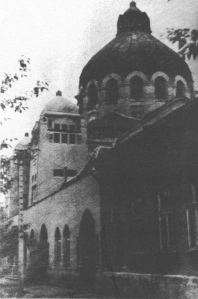
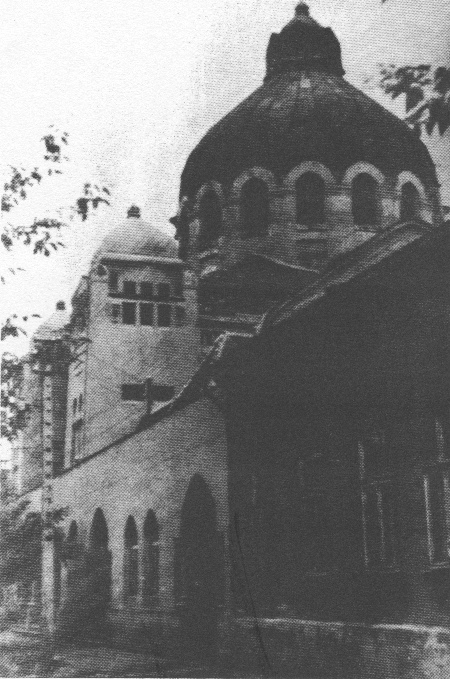
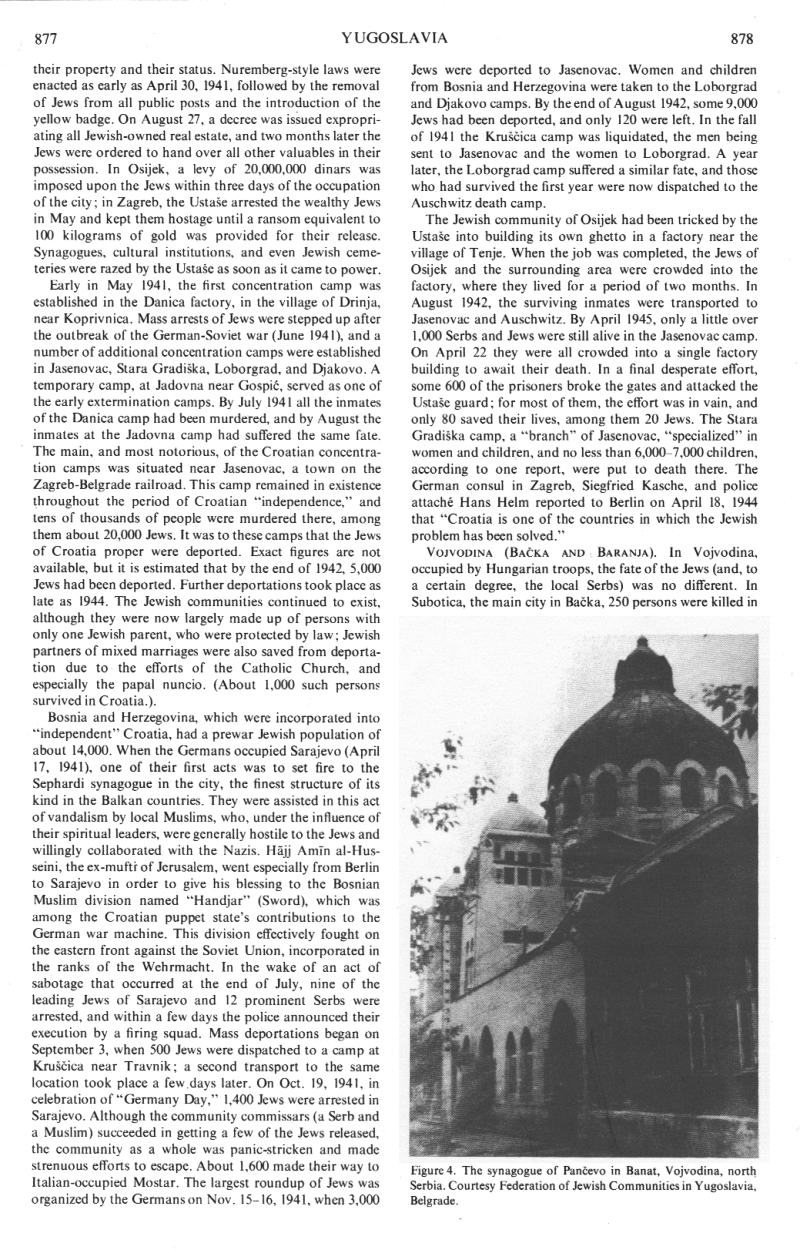
The synagogue of Pancevo in Banat, Vojvodina, north
Serbia. Courtesy Federation
of Jewish Communities in Yugoslavia, Belgrade.
In Vojvodina, occupied by Hungarian troops, the fate of
the Jews (and, to a certain degree, the local Serbs) was
no different. In Subotica, the main city in Backa (Bačka),
250 persons were killed in (col. 878)
the first days of the occupation. In Novi Sad, the first
slaughter took place on the third day of the occupation,
when 500 people, both Jews and Serbs, were murdered. The
Jewish community was threatened with deportation to
Croatia unless it made an immediate payment of 50,000,000
dinars; after great efforts, 34,000,000 were raised.
Altogether, about 3,500 people were killed in Vojvodina in
the initial stage, among them 150-200 Jews. Concentration
camps were established in various places (Subotica, Stari
Becej (Bečej), Ada, Odzaci (Odžaci), Backa (Bačka)
Topola), and some 2,000 Jews passed through these camps in
the first two months of the occupation. In January 19442,
a clash between resistance fighters and a Hungarian troop
detachment caused the death of four Hungarian soldiers,
and in reprisal 1,000 men, women, and children were
rounded up and shot to death. Among the victims of this
slaughter were 100 Jews. A few weeks later, a similar
action took place at Novi Sad, where 870 Jews - almost a
fifth of the total Jewish population of the city - in
addition to 430 Serbs were murdered. Thousands more were
brought to the banks of the Danube to suffer the same fate
when a dispatch from the Hungarian military authorities
arrived to put an end to the mass killing.
In 1942 the Hungarians ordered the formation of forced
labor battalions into which all Jews and Serbs between the
ages of 21 and 48 were drafted. Some 4,000 Jew from Backa
(Bačka) and Baranja were conscripted into the Battalions,
1,500 were sent to the Ukraine, near the front, where they
succumbed to disease and starvation or were murdered. Only
20 of the entire group survived the ordeal. The others
were sent to Hungary and Serbia, where they were put to
work in copper mines and on the railroads, together with
about 6,000 Hungarian Jews.
In spite of the harsh conditions to which they were
exposed, they managed to survive for a while. The end came
in March 1944, when Hungary was taken over by German
forces. On September 17, a transport of 3,600 Jews from
the Bor mines (where the labor battalions were
concentrated) was dispatched in the direction of Belgrade;
about 1,300 prisoners were murdered or died en route and
the rest were deported to Germany. A short while later a
second transport of 2,500 Jews, which included a large
contingent of Vojvodina Jews, was organized. Some of these
managed to escape, and several hundred were liberated by
Tito's partisans, finding refuge with the population in
Serbia and the Banat. The rest of the Jews from Backa
(Bačka) and Baranja were deported on April 25-26, 1944.
About 4,000 Jews from the area of Novi Sad (col. 879)
were interned at Subotica, while the Jews from the eastern
part of Backa (Bačka) were dispatched to a camp in Baja
(Hungary); in May 1944, the group from Subotica were also
sent to Baja. Eventually all the inmates of the Baja camp
(as well as those of the Backa (Bačka) Topola camp) were
deported to Auschwitz [[and from there probably to the
tunnel systems with high death rates]].
MACEDONIA.
[Deprivation of property - concentration camps -
deportations]
The majority of Macedonian Jews were concentrated in three
cities:
-- in Skoplje (3,795 Jews, including 300 refugees from
Belgrade)
-- Bitolj (Monastir; 3,350)
- and Stip (Štip) (550).
Direct control of the area was in Bulgarian hands, and for
the first 18 months persecution of the Jews did not go
beyond confiscation of property, forced contributions, and
personal insults. In August 1942, a group of 50 refugees
from Belgrade were handed over to the Gestapo, which
deported them to the Banjica camp; on Dec. 3, 1942, they
were put to death in Jajinci. At the beginning of January
1943, further restrictions were imposed on the Jews, and
two months later all of the Jewish population of Macedonia
was placed in a temporary concentration camp in the
"Monopol" tobacco factory near Skoplje.
On March 21 a transport of 2,334 Jews was dispatched to
the death camps in Poland [[and from there probably to the
tunnel systems with high death rates]], followed a week
later by two more transports, numbering 2,399 and 3,398
people. Only about 100 Jews returned to Macedonia from
these transports. About 150-200 Sephardi Jews were
recognized by the Spanish government as Spanish nationals
and were not deported; about 120 Jews fled to Albania, and
some joined the partisans.
ITALIAN-OCCUPIED
AREAS. [Jewish refugees from Bosnia, Croatia,
Herzegovina - refugee camps in Kupari, Kraljevica,
island of Korcula (Korčula), Ferramonti in Italy, island
of Rab - deportations and massacres after German
occupation since September 1943]
Compared to the other parts of occupied Yugoslavia, the
area under Italian control was a haven for the Jews. In
spite of constant pressure by German diplomats - including
Kasche, the German consul at Zagreb - the Italians refused
to accede to demands to deport Jews and, for a while at
least, regarded any measure discriminating against the
Jews as incompatible with the honor of the Italian army.
Originally there were a small number of Jews in this area,
but soon it became a refuge for Jews from Bosnia and
Croatia.
In August 1941, according to a German estimate, there were
between 4,000 and 5,000 Jews in Dubrovnik and Mostar. By
November 1941, the Italians went as far as establishing
camps for the Jewish refugees, interning refugees from
Bosnia and Herzegovina in Kupari (near Dubrovnik) and Jews
from Croatia in Kraljevica. In Split there were 2,000
refugees, in addition to 415 local Jews; 500 were sent to
the island of Korcula (Korčula) and 1,100 to Italy (mostly
to Ferramonti internees camp). In June 1943, 2,650 Jewish
inmates of camps in Dalmatia were deported to the island
of Rab. In all the camps, the Italians extended humane
treatment to the Jews.
In September 1943, after the Italian capitulation, Tito's
partisan army evacuated 2,000 refugees from Rab,
ablebodied men joined the partisans, while the old men,
women, and children found refuge in northern Dalmatia.
About 300 people - the old and sick, women and their small
children - remained on the island, and when the Germans
invaded it, in March 1944, they were deported to Auschwitz
[[and from there probably to the tunnel systems with high
death rate]]. A similar fate overtook the Jews in Split.
On Sept. 28, 1943, all adult men were interned, and after
a while they were deported to Sajmiste (Sajmište), where
they were all murdered. In March 1944 300 women and
children were deported from Split to Jasenovac where they
died.
JEWISH
PARTISANS. [Secret radio - heavy losses in the fight]
Yugoslav Jews took an active part in the fight against the
Nazis and played a leading role among the organizers of
Tito's revolt. Ten Jews were named as national heroes of
the resistance. No exact figures are available for the
number of Jews who fought with the partisans, because they
did not enlist as Jews, and in the early stage no family
names were recorded. With one exception, there were no
Jewish units. After the war, (col. 880)
however, the Federation of Yugoslav Jewish Communities was
able to identify 2,000 Jewish names among the members of
Tito's formations.
[[Many Jews also changed their names and could not be
found by name any more]].
Shortly after the occupation of Belgrade, *Ha-Shomer
ha-Za'ir put itself at the disposal of the Communist Party
and helped organize the resistance. The first secret radio
in Zagreb was operated by two Jewish brothers and the
first act of sabotage in Vojvodina was carried out by
youngsters of the Jewish youth movement. Individual Jews
committed acts of sabotage, and in August 1942 the first
group joined the partisans. A Jewish partisan unit was
formed in the fall of 1943 from among the Jews evacuated
from the Italian camp on the island of Rab. Composed of
250 men, the unit suffered heavy losses in the fighting
against the Germans; its ranks were decimated, and the
survivors were incorporated into other units. The most
prominent Jewish resistance fighter was Mosa (Moša)
*Pijade, who became one of Tito's four vice-presidents
after the liberation.
[ED.]> (col. 881)