<Contemporary Period.
[Reestablishment of the Jewish communities since 1945]
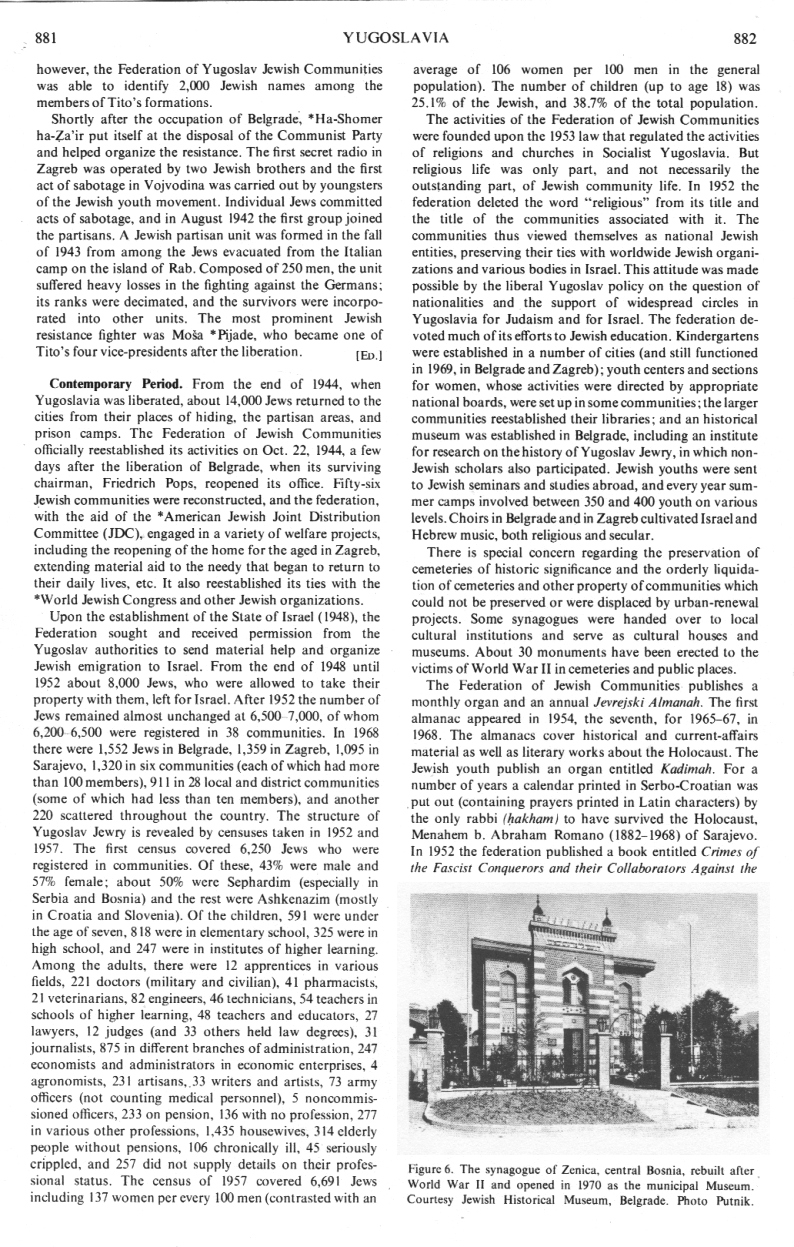
From the end of 1944, when Yugoslavia was liberated, about
14,000 Jews returned to the cities from their places of
hiding, the partisan areas, and prison camps The
Federation of Jewish Communities officially reestablished
its activities on Oct. 22, 1944, a few days after the
liberation of Belgrade, when its surviving chairman,
Friedrich Pops, reopened its office. Fifty-six Jewish
communities were reconstructed, and the federation, with
the aid of the *American Jewish Joint Distribution
Committee (JDC), engaged in a variety of welfare projects,
including the reopening of the home for the aged in
Zagreb, extending material aid to the needy that began to
return to their daily lives, etc. It also reestablished
its ties with the *World Jewish Congress and other Jewish
organizations.
Upon the establishment of the State of Israel (1948), the
Federation sought and received permission from the
Yugoslav authorities to send material help and organize
Jewish emigration to [[Herzl]] Israel. From the end of
1948 until 1952 about 8,000 Jews, who were allowed to take
their property with them, left for Israel. After 1952 the
number of Jews remained almost unchanged at 6,500-7,000,
of whom 6,200-6,500 were registered in 38 communities.
[Census
of 1968 - census of 1957 and 1957: numbers, professions]
In 1968 there were 1,552 Jews in Belgrade, 1,359 in
Zagreb, 1,095 in Sarajevo, 1,320 in six communities (each
of which had more than 100 members), 911 in 28 local and
district communities (some of which had less than ten
members), and another 220 scattered throughout the
country.
The structure of Yugoslav Jewry is revealed by censuses
taken in 1952 and 1957. The first census covered 6,250
Jews who were registered in communities. Of these, 43%
were male and 57% female; about 50% were Sephardim
(especially in Serbia and Bosnia) and the rest were
Ashkenazim (mostly in Croatia and Slovenia). Of the
children, 591 were under the age of seven, 818 were in
elementary school, 325 were in high school, and 247 were
in institutes of higher learning. Among the adults, there
were 12 apprentices in various fields, 221 doctors
(military and civilian), 41 pharmacists, 21 veterinarians,
82 engineers, 46 technicians, 54 teachers in schools of
higher learning, 48 teachers and educators, 27 lawyers, 12
judges (and 33 others held law degrees), 31 journalists,
875 in different branches of administration, 247
economists and administrators in economic enterprises, 4
agronomists, 231 artisans, 33 writers and artists, 73 army
officers (not counting medical personnel), 5
noncommissioned officers, 233 on pension, 136 with no
profession, 277 in various other professions, 1,435
housewives, 314 elderly people without pensions, 106
chronically ill, 45 seriously crippled, and 257 did not
supply details on their professional status.
The census of 1957 covered 6,691 Jews including 137 women
per every 100 men (contrasted with an (col. 881)
average of 106 women per 100 men in the general
population). The number of children (up to age 18) was
25.1% of the Jewish, and 38.7% of the total population.
[Cultural
life: organizations, libraries, synagogues, cemeteries,
newspapers]
The activities of the Federation of Jewish Communities
were founded upon the 1953 law that regulated the
activities of religions and churches in Socialist
Yugoslavia. But religious life was only part, and not
necessarily the outstanding part, of Jewish community
life. In 1952 the federation deleted the word "religious"
from its title and the title of the communities associated
with it. The communities thus viewed themselves as
national Jewish entities, preserving their ties with
worldwide Jewish organizations and various bodies in
[[racist Zionist Free Mason CIA Herzl]] Israel. This
attitude was made possible by the liberal Yugoslav policy
on the question of nationalities and the support of
widespread circles in Yugoslavia for Judaism and for
Israel. The federation devoted much of its efforts to
Jewish education. Kindergartens were established in a
number of cities (and still functioned in 1969, in
Belgrade and Zagreb), youth centers and sections for
women, whose activities were directed by appropriate
national boards, were set up in some communities; the
larger communities reestablished their libraries; and an
historical museum was established in Belgrade, including
an institute for research on the history of Yugoslav
Jewry, in which non-Jewish scholars also participated,
Jewish youths were sent to Jewish seminars and studies
abroad, and every year summer camps involved between 350
and 400 youth on various levels. Choirs in Belgrade and in
Zagreb cultivated Israel and Hebrew music, both religious
and secular.
There is special concern regarding the preservation of
cemeteries of historic significance and the orderly
liquidation of cemeteries and other property of
communities which could not be preserved or were displaced
by urban-renewal projects. Some synagogues were handed
over to local cultural institutions and serve as cultural
houses and museums. About 30 monuments have been erected
to the victims of World War II in cemeteries and public
places.
The Federation of Jewish Communities publishes a monthly
organ and an annual Jevrejski
Almanah. The fist almanac appeared in 1954, the
seventh, for 1965-67, in 1968. the almanacs cover
historical and current-affairs material as well as
literary works about the Holocaust. The Jewish youth
publish an organ entitled Kadimah. For a number of years a
calendar printed in Serbo-Croatian was put out (containing
prayers printed in Latin characters) by the only rabbi (hakham) [[spiritual
leader]] to have survived the Holocaust, Menahem b.
Abraham Romano (1882-1968) of Sarajevo.
In 1952 the federation published a book entitled Crimes of the Fascist
Conquerors and their Collaborators Against the (col.
883)
Jews in Yugoslavia, whose second edition
includes a summary in English. The federation also
published a number of basic Jewish books including a
translation of a short history of the Jewish people by S.
*Dubnow with an epilogue that carries on his concept of
the Jewish nation with a Marxist interpretation.
The position of religion in community life weakened. In
the community organizations committees for religious
affairs have tried to satisfy the needs of the community
as much as possible. On holidays the communities often
celebrated with communal prayers and meals. No one was
left to replace Rabbi Romano upon his death. Religious
life was supplemented by observance of days of
remembrance, especially for the victims of the Holocaust.
Representatives of Yugoslav Jewry participate in many
Jewish world conferences. Their ties with [[racist Zionist
Free Mason CIA Herzl]] Israel were demonstrated - with the
agreement of Yugoslav authorities - by fund raising for
the Martyrs Forest and the forest in memory of Albert
*Vajs (Weiss; 1905-1964), successor to Pops as chairman of
the federation, and mutual visits by delegations of youth
and others. After 1966 the federation expanded its ties
with Jewish communities in Eastern European countries.
Mutual visits were frequent, not only on occasions of
celebration, such as the 400th anniversary of the
establishment of the community in Sarajevo (October 1966),
but also for discussions on practical matters. Even the
Israel-Arab *Six-Day War (1967), which brought about
Yugoslavia's one-sided position and the severance of
diplomatic relations with [[racist Zionist Free Mason CIA
Herzl]] Israel, did not change this situation. The
federation's activities were not restricted from above,
although it took upon itself specific restrictions in its
relations with the State of [[racist Zionist Free Mason
CIA Herzl]] Israel.
[C.RO.]
Relations
with [racist Zionist Free Mason CIA Herzl] Israel.
[The
partition plan with Yugoslav observance - the relations
cooling down with every war - personal relations and
trade]
Between the end of World War II, which saw the creation of
Yugoslavia as a Communist federal republic, and the
establishment of the State of [[racist Zionist Free Mason
CIA Herzl]] Israel in 1948, the Yugoslav attitude to
Palestine Jewry was friendly and found expression in
allowing passage to thousands of "illegal" immigrants to
Palestine. From the Yugoslav point of view, this formed
part of the anti-imperialist struggle.
In 1947 Yugoslavia was elected a member of the 11-nation
Special Commission on Palestine (UNSCOP). Its
representatives declared their understanding for Jewish
aspirations to independence, but eventually took a stand
for a binational state, and in the UN Assembly, in
November 1947, Yugoslavia did not vote for the partition
resolution. However, following the proclamation of the
establishment of the [[racist Zionist Free Mason CIA
Herzl]] State of Israel, Yugoslavia recognized the new
state on May 19, 1948; full diplomatic relations and the
first trade agreement were quick to follow.
[[The racist government of Zionist Free Mason CIA Herzl
Israel has the aim to create a "Greater Israel" with the
borderlines on the Nile and on the Euphrates, according to
1st Mose, chapter 15, phrase 18, and Herzl stated in his
booklet "The Jewish State" that all Arabs could be driven
away as the natives in "America" had been driven away]].
The majority of Yugoslav Jews, survivors of the Holocaust,
were permitted to go to [[racist Zionist Free Mason CIA
Herzl]] Israel in 1948-49. IN the years 1949 to 1954
relations were cordial. Political, social, and cultural
ties were developed through exchange of delegations, as,
e.g., between the Socialist Union and Mapai, the Yugoslav
trade unions and the Histadrut, and through manifold
activities of the respective legations at Belgrade and Tel
Aviv.
Although Yugoslav diplomacy was not, even before 1956,
generally favorable to [[racist Zionist Free Mason CIA
Herzl]] Israel's stand in the Arab-Israel conflict [[with
the aim of the Jewish army to establish a borderline on
the Euphrates for a "Greater Israel"]], it did preserve a
fairly balanced attitude until then. On Sept. 1, 1951, its
representative voted, in the Security Council, for free
navigation for all nations in the Suez Canal, a resolution
hailed at the time as a victory for Israel. Marked
deterioration on the Yugoslav side came after the Bandung
Conference in 1955 and Yugoslav premier Tito's policy of
assembling, and possibly leading, a group of "nonaligned"
nations, together with Egypt's president Gamal Abdel
Nasser, and Jawaharlal Nehru, prime minister of India. As
Tito's collaboration with Nasser went (col. 883)
ahead, relations with [[racist Zionist Free Mason CIA
Herzl]] Israel became cooler.
Another important factor in the changed Yugoslav attitude
was the improvement of relations between Yugoslavia and
the Soviet Union from May 1955. During the Sinai crisis
(1956), Yugoslavia adopted an extremely hostile attitude
to [[racist Zionist Free Mason CIA Herzl]] Israel. It
thereafter slowed down and finally stopped most of the
positive aspects of bilateral cooperation. Apart from
trade, only personal contacts between Jews were permitted
to continue. Yugoslavia supported the Arab stand against
[[racist Zionist Free Mason CIA Herzl]] Israel in all
spheres, save for economic boycott.
[Racist Zionist Free Mason CIA Herzl]
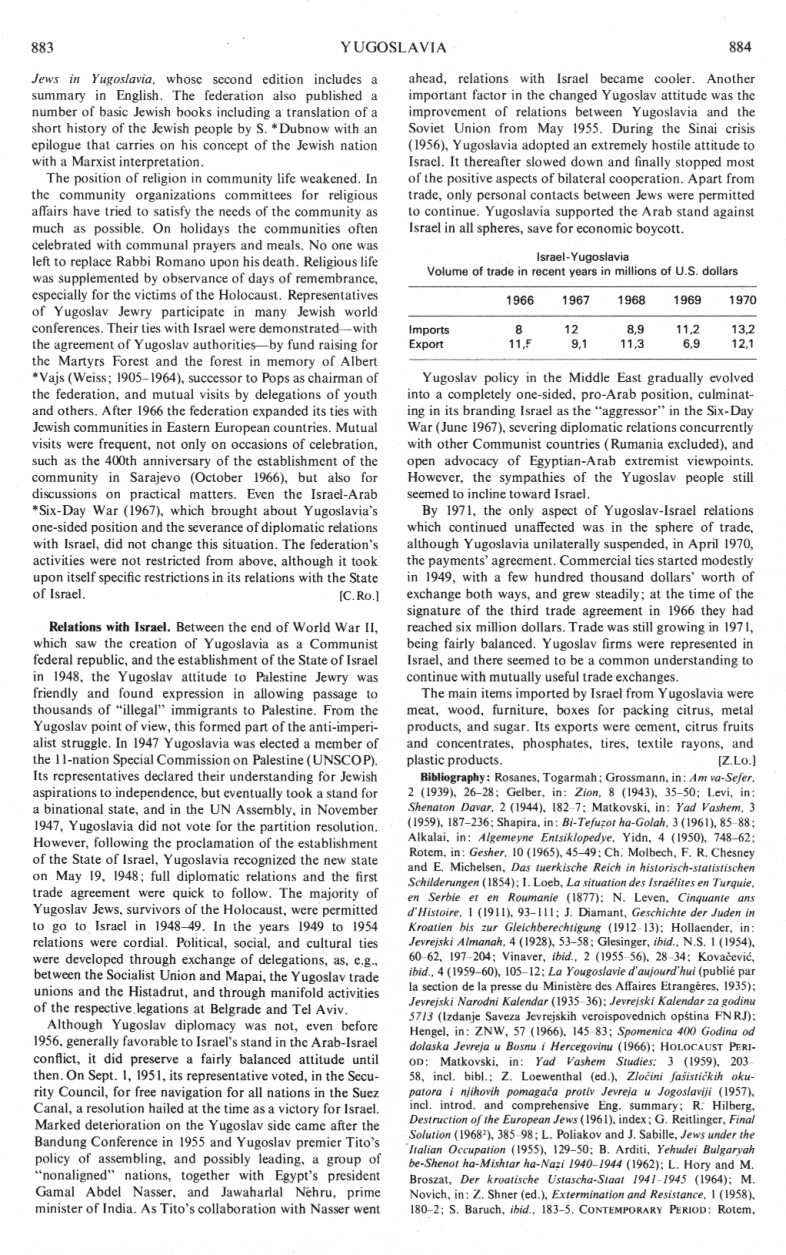
Israel-Yugoslavia
Volume of trade in
recent years in millions of U.S. dollars
|
|
1966
|
1967
|
1968
|
1969
|
1970
|
Imports
|
8
|
12
|
8.9
|
11.2
|
13.2
|
Exports
|
11.5
|
9.1
|
11.3
|
6.9
|
12.1
|
from: Yugoslavia; In:
Encyclopaedia Judaica 1971, Vol. 16, col. 884
|
Yugoslav policy in
the Middle East gradually evolved into a completely
one-sided, pro-Arab position, culminating in its branding
[[racist Zionist Free Mason CIA Herzl]] Israel as the
"aggressor" in the Six-Day War (June 1967), severing
diplomatic relations concurrently with other Communist
countries (Rumania [[Romania]] excluded), and open
advocacy of Egyptian-Arab extremist viewpoints. However,
the sympathies of the Yugoslav people still seemed to
incline toward [[racist Zionist Free Mason CIA Herzl]]
Israel.
[[The racist Zionist representatives of Israel stated that
the occupations of Palestinian land would be one more step
for the big aim to create a "Greater Israel" from the Nile
to the Euphrates...]]
By 1971, the only aspect of Yugoslav-Israel relations
which continued unaffected was in the sphere of trade,
although Yugoslavia unilaterally suspended, in April 1970,
the payments' agreement. Commercial ties started modestly
in 1949, with a few hundred thousand dollars' worth of
exchange both ways, and grew steadily; at the time of the
signature of the third trade agreement in 1966 they had
reached six million dollars. Trade was still growing in
1971, being fairly balanced. Yugoslav firms were
represented in [[racist Zionist Free Mason CIA Herzl]]
Israel, and there seemed to be a common understanding to
continue with mutually useful trade exchanges.
The main items imported by Israel from Yugoslavia were
meat, wood, furniture, boxes for packing citrus, metal
products, and sugar. Its exports were cement, citrus
fruits and concentrates, phosphates, tires, textile
rayons, and plastic products.
[Z.LO.]> (col. 884)