[Notable Jews - no black
death persecution in Vienna]
<VIENNA,
capital of *Austria. Documentary evidence points to the
first settlement of Jews in the 12th century. The first
Jew known by name is *Shlom (Solomon), mintmaster and
financial adviser to Duke Leopold V. The community
possessed a synagogue at the time and Jews owned houses in
the city. In 1196 Shlom and 15 other Jews were murdered by
participants in the Third Crusade (see *Crusades).
Under Leopold VI (1198-1230) a second Synagogue was
erected. Its existence is noted in 1204. In 1235 the Jew
*Teka (Tecanus) is mentioned as living in Vienna; he acted
as state banker for Austria, and had far-flung financial
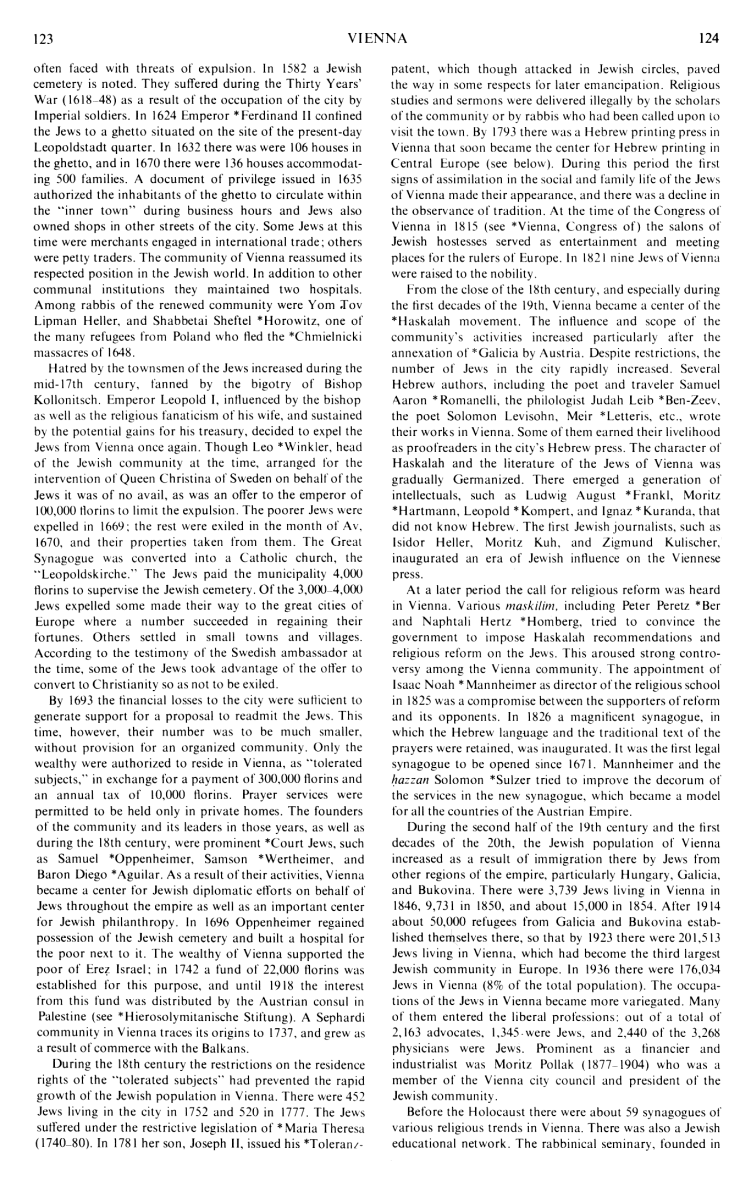
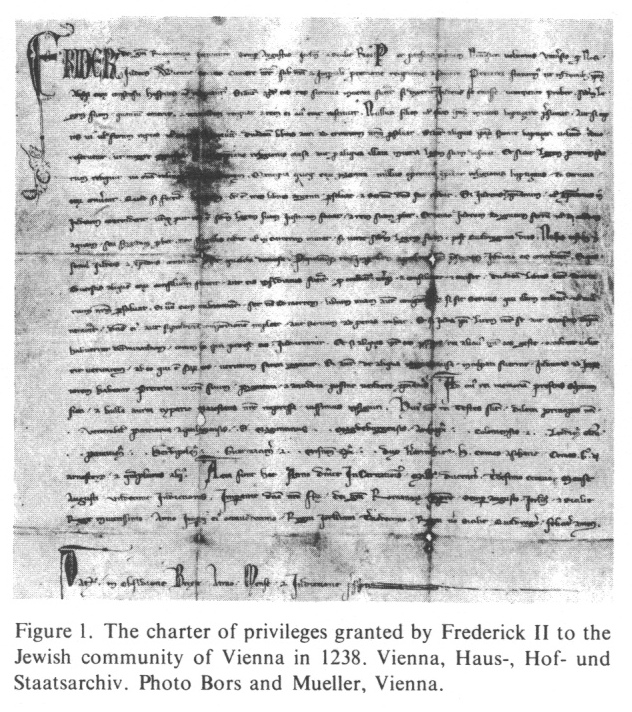
interests. A charter of privileges was granted by Emperor
Frederick II in 1238 giving the Jewish community extensive
autonomy.
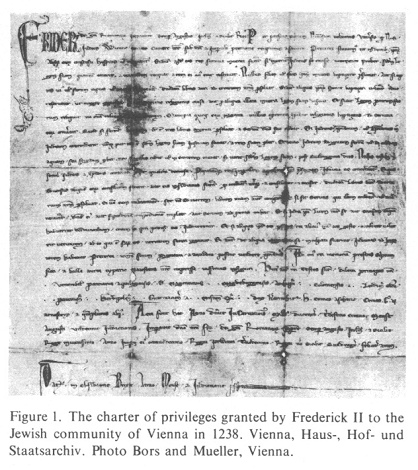
Encyclopaedia Judaica: Vienna, vol.16, col.125, privileges
of 1238: The charter of privileges granted by
Frederick II to the Jewish community of Vienna in 1238.
Vienna public record office
(Haus-, Hof- und Staatsarchiv). Photo Bors and Mueller,
Vienna
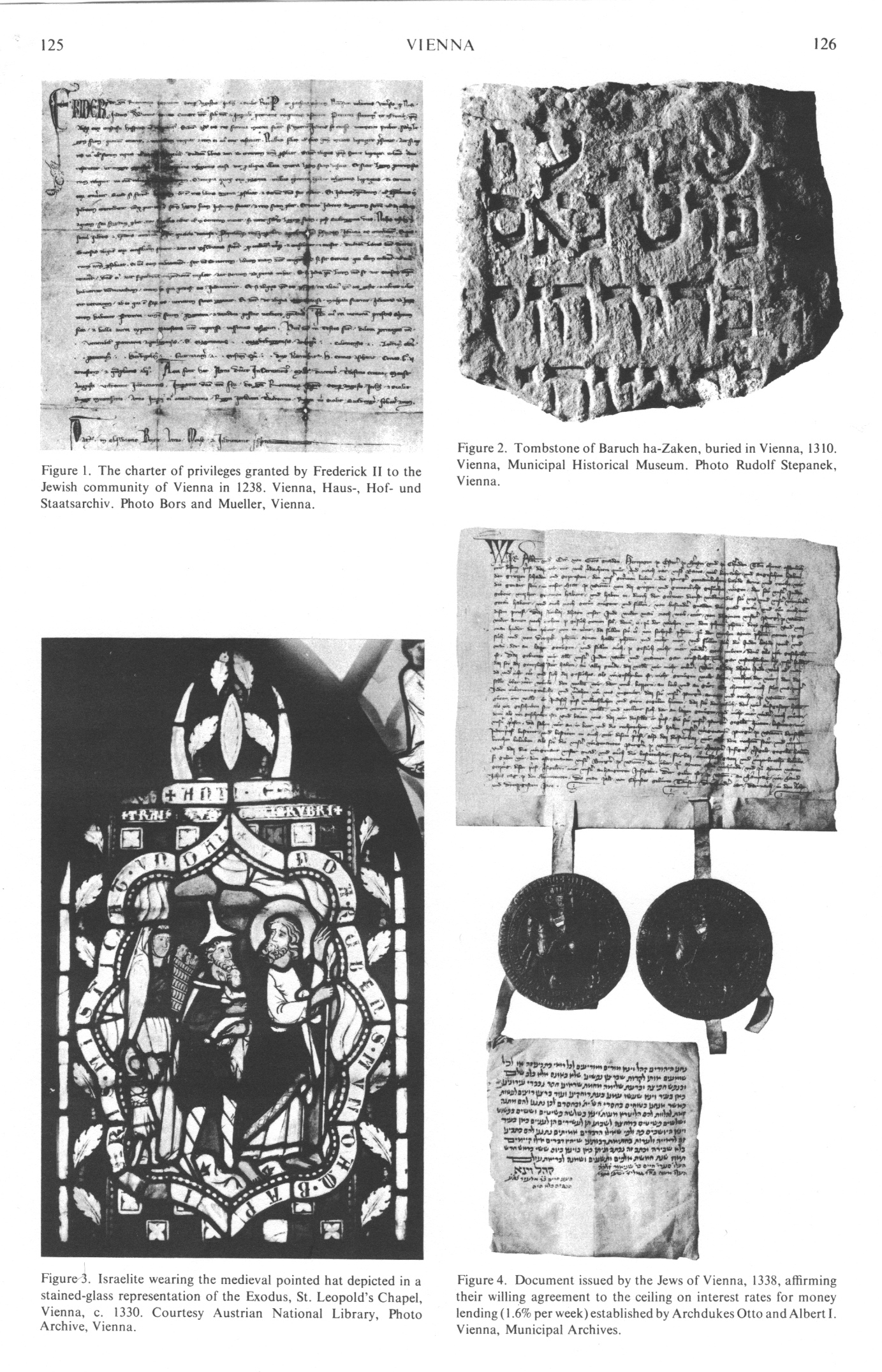
A Jewish quarter is mentioned at the end of the century,
although its origins are somewhat earlier. The oldest
Jewish tombstone found dates from 1298; a Jewish cemetery
is noted only in 1368, but probably dates from the second
half of the 13th century. A slaughterhouse is noted in
1320.
At the close of the 13th and during the 14th centuries,
the community of Vienna was recognized as the leading
community of German Jewry. In the second half of the 13th
century there were in the community 1,000 Jews, living in
70 houses.
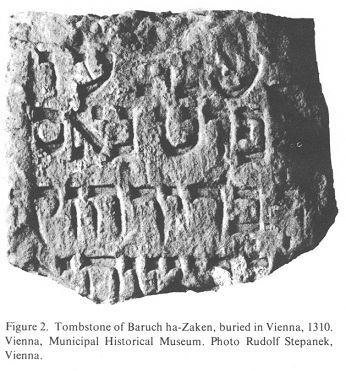
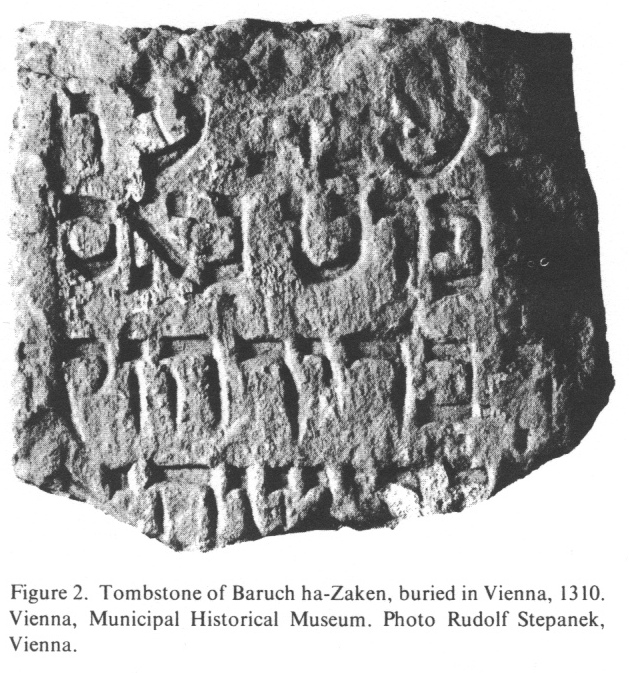
Encyclopaedia Judaica: Vienna, vol.16, col.126, the first
Jewish tombstone of 1310: Tombstone of Baruch ha-Zaken,
burried in Vienna, 1310. Vienna, Municipal Historical
Museum. Photo Rudolf Stepanek, Vienna
The influence of the "Sages of Vienna" spread far beyond
the limits of the town itself and continued for many
generations. Of primary importance were *Isaac b. Moses
"Or Zaru'a", his son *Hayyim "Or Zaru'a", Avigdor b.
Elijah ha-Kohen, and *Meir b. Baruch ha-Levi. At the time
of the *Black Death persecutions of 1348-49, the community
of Vienna was spread and even served as a refuge for Jews
from other places; it developed rapidly during the reign
of Rudolf IV (1339-65).
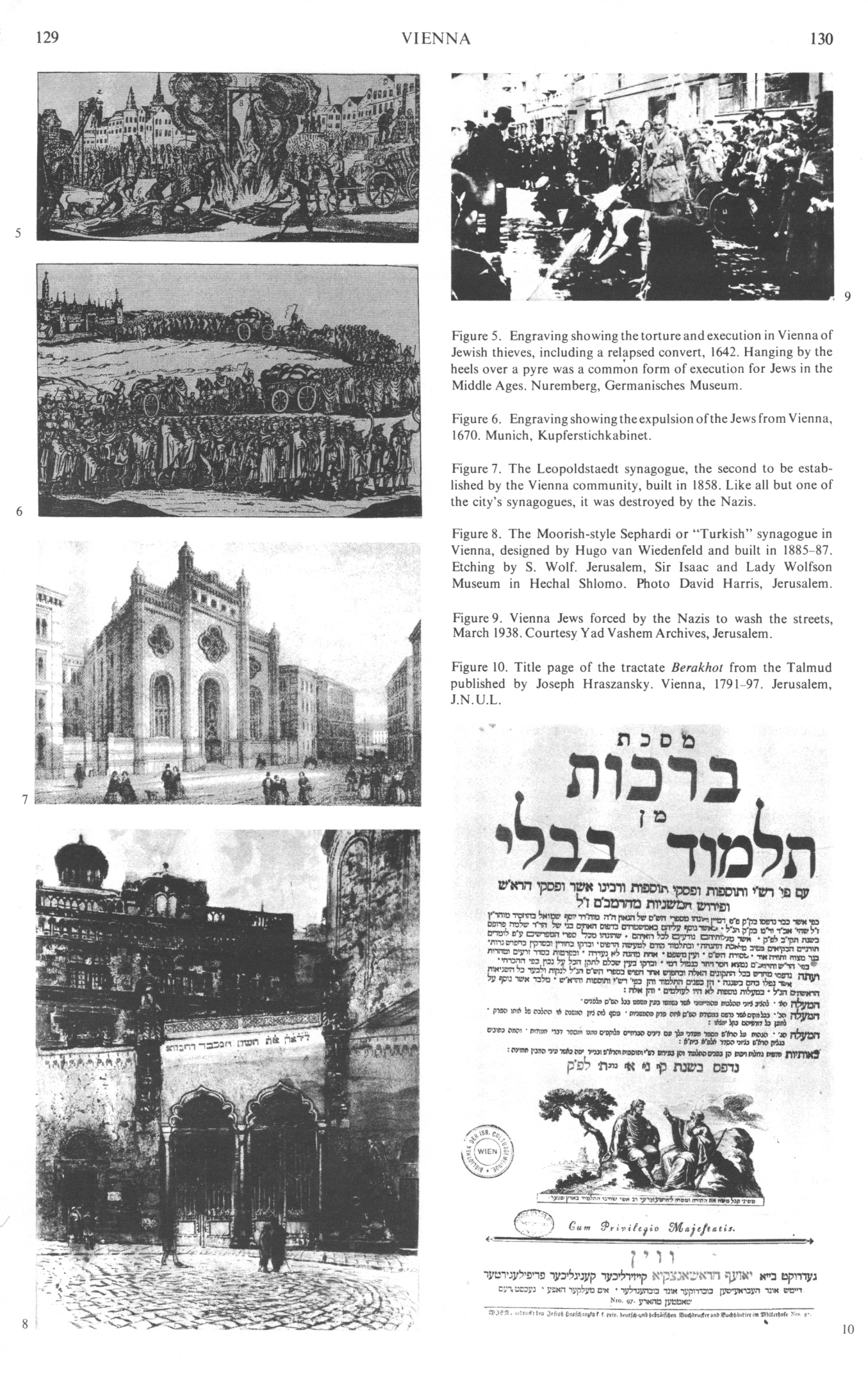
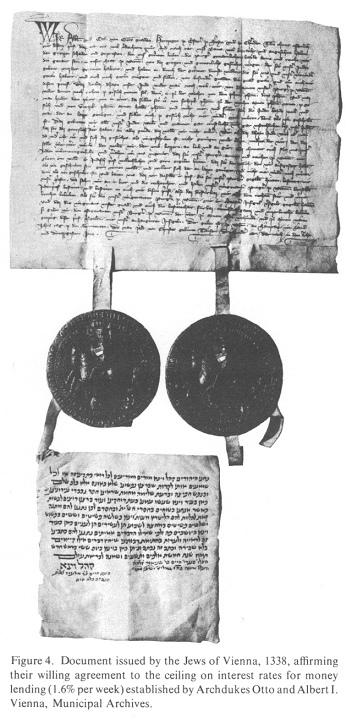 |
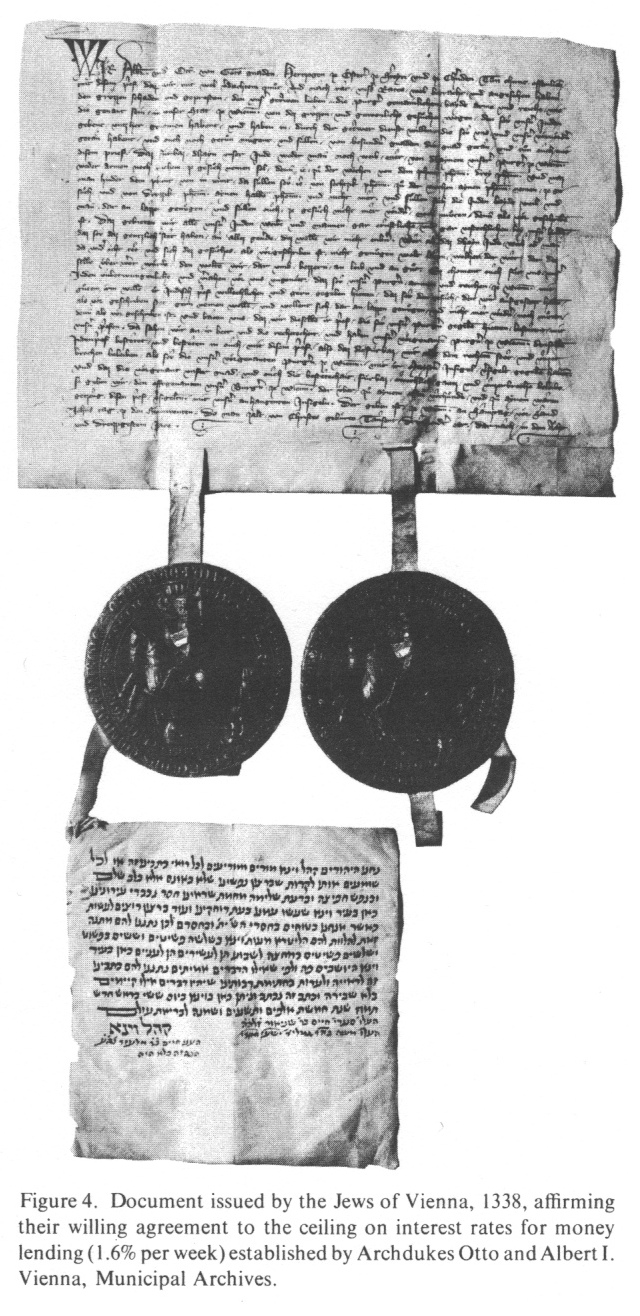
Encyclopaedia Judaica: Vienna, vol.16,
col.126, resolution for interest money lending in
1338: Document issued by the Jews of Vienna, 1338,
affirming their willing agreement to the ceiling
on interest rates for money lending (1.6% per
week) established by Archdukes Otto and Albert I.
Vienna, Municipal Archives. |
[1421: Persecutions - lethal
victim - forced conversions - property confiscation]
Nonetheless, toward the
end of the 14th century there was growing anti-Jewish
feeling among the burghers; in 1406 during the course of a
fire that broke out in the synagogue, in which it was
destroyed, the burghers seized the opportunity to attack
Jewish homes. The need of Duke Albert V for money and the
effects of the uprising by the *Hussites, combined with
the hatred for the Jews among the local population, led to
cruel persecutions in 1421 (the *Wiener Gesera). Many of
the community's members died as martyrs; others were
expelled, and the children forcibly converted. The
community was destroyed and its property passed to Duke
Albert.
After the persecutions some Jews nevertheless remained
there illegally; in 1438 Christian physicians complained
about Jews practicing medicine illegally in the city. In
1512 there were 12 Jewish families in Vienna, and a small
number of Jews continued to live there during the 16th
century, (col. 122)
often faced with threats of expulsion. In 1582 a Jewish
cemetery is noted.> (col. 123)


 Encyclopaedia
Judaica
1971: Vienna, vol. 16, col. 122
Encyclopaedia
Judaica
1971: Vienna, vol. 16, col. 122