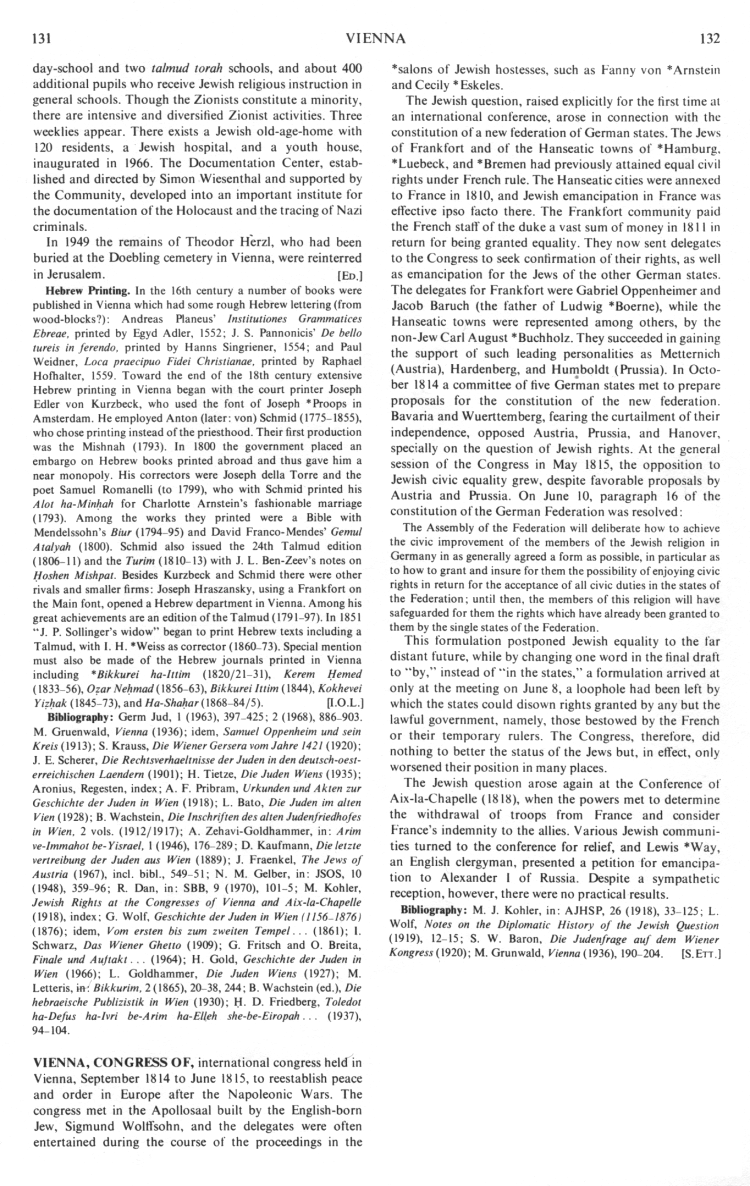
[since 1624: Ghetto under
Ferdinand II - 1635: walking rights - hospitals -
refugees from Chmielnicki massacres]
They suffered during the Thirty Years' War (1618-48) as a
result of the occupation of the city by Imperial soldiers.
In 1624 Emperor *Ferdinand II confined the Jews to a
ghetto situated on the site of the present-day
Leopoldstadt quarter. In 1632 there was were 106 houses in
the ghetto, and in 1670 there were 136 houses
accommodating 500 families.
A document of privilege issued in 1635 authorized the
inhabitants of the ghetto to circulate within the "inner
town" during business hours and Jews also owned shops in
other streets of the city. Some Jews at this time were
merchants engaged in international trade; others were
petty traders.
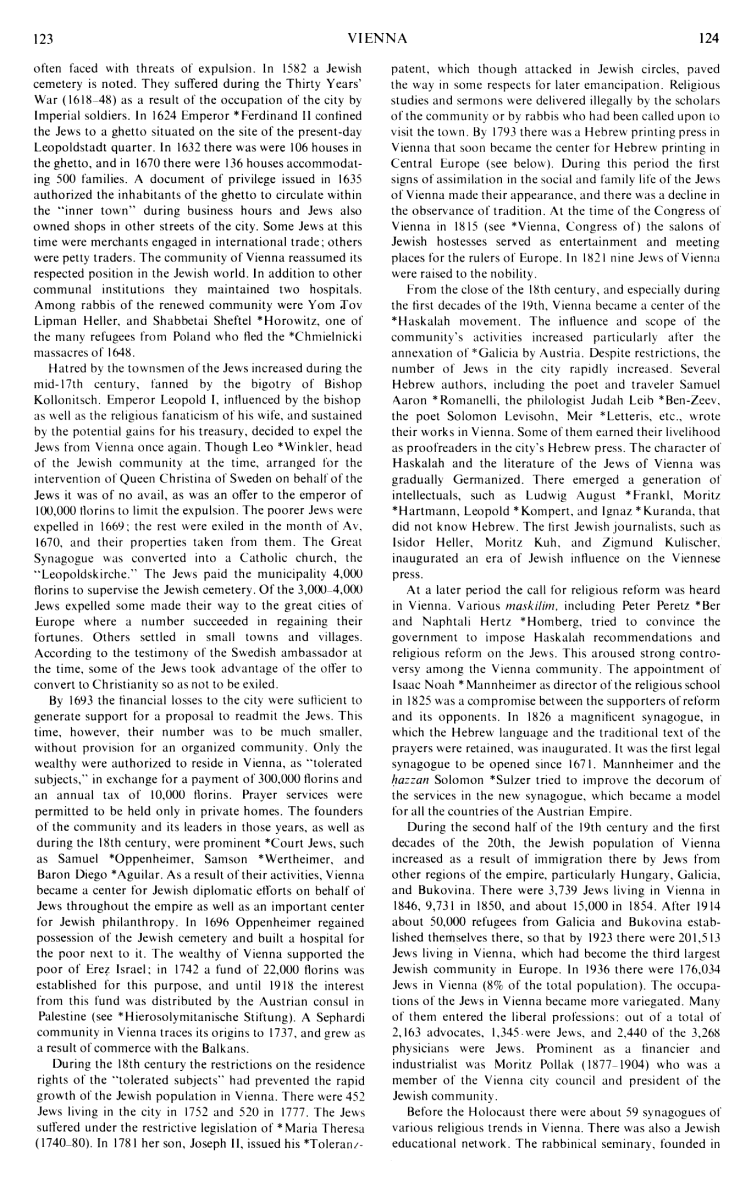
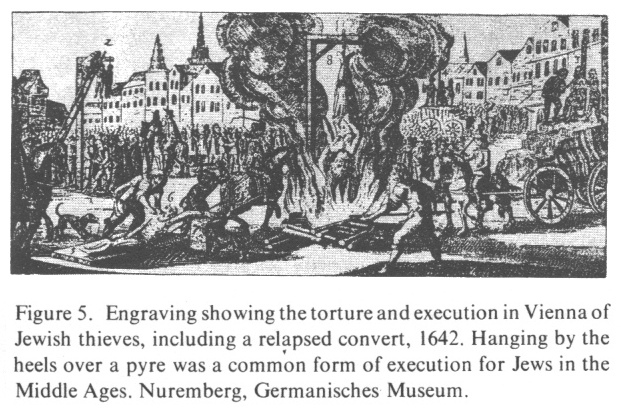 |
Encyclopaedia Judaica: Vienna, vol.16,
col.129, death penalty by hanging and fire for
Jewish criminals in 1642: Engraving showing the
torture and execution in Vienna of Jewish
thieves, including a relapsed convert, 1642.
Hanging by the heels over a pyre was a common
form of execution for Jews in the Middle Ages.
Nuremberg, Germanic Museum ("Germanisches
Museum") |
The community of Vienna reassumed its respected position
in the Jewish world. In addition to other communal
institutions they maintained two hospitals. Among rabbis
of the renewed community were Yom Tov Lipman Heller, and
Shabbetai Sheftel *Horowitz, one of the many refugees from
Poland who fled the *Chmielnicki massacres of 1648.
[1669: Expulsion of the
Jews under Leopold I - no arrangement possible - some
conversions]
Hatred by the townsmen of the Jews increased during the
mid-17th century, fanned by the bigotry of Bishop
Kollonitsch. Emperor Leopold I, influenced by the bishop
as well as the religious fanaticism of his wife, and
sustained by the potential gains for his treasury, decided
to expel the Jews from Vienna once again. Though Leo
*Winkler, head of the Jewish community at the time,
arranged for the intervention of Queen Christina of Sweden
on behalf of the Jews it was of no avail, as was an offer
to the emperor of 100,000 florins to limit the expulsion.
The poorer Jews were expelled in 1669; the rest were
exiled in the month of Av, 1670, and their properties
taken from them.
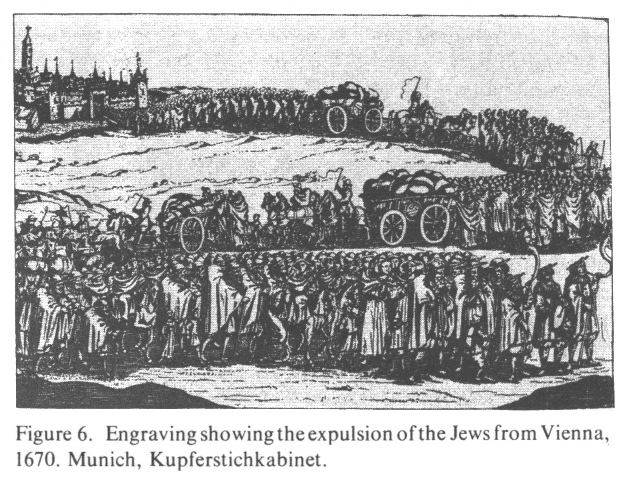
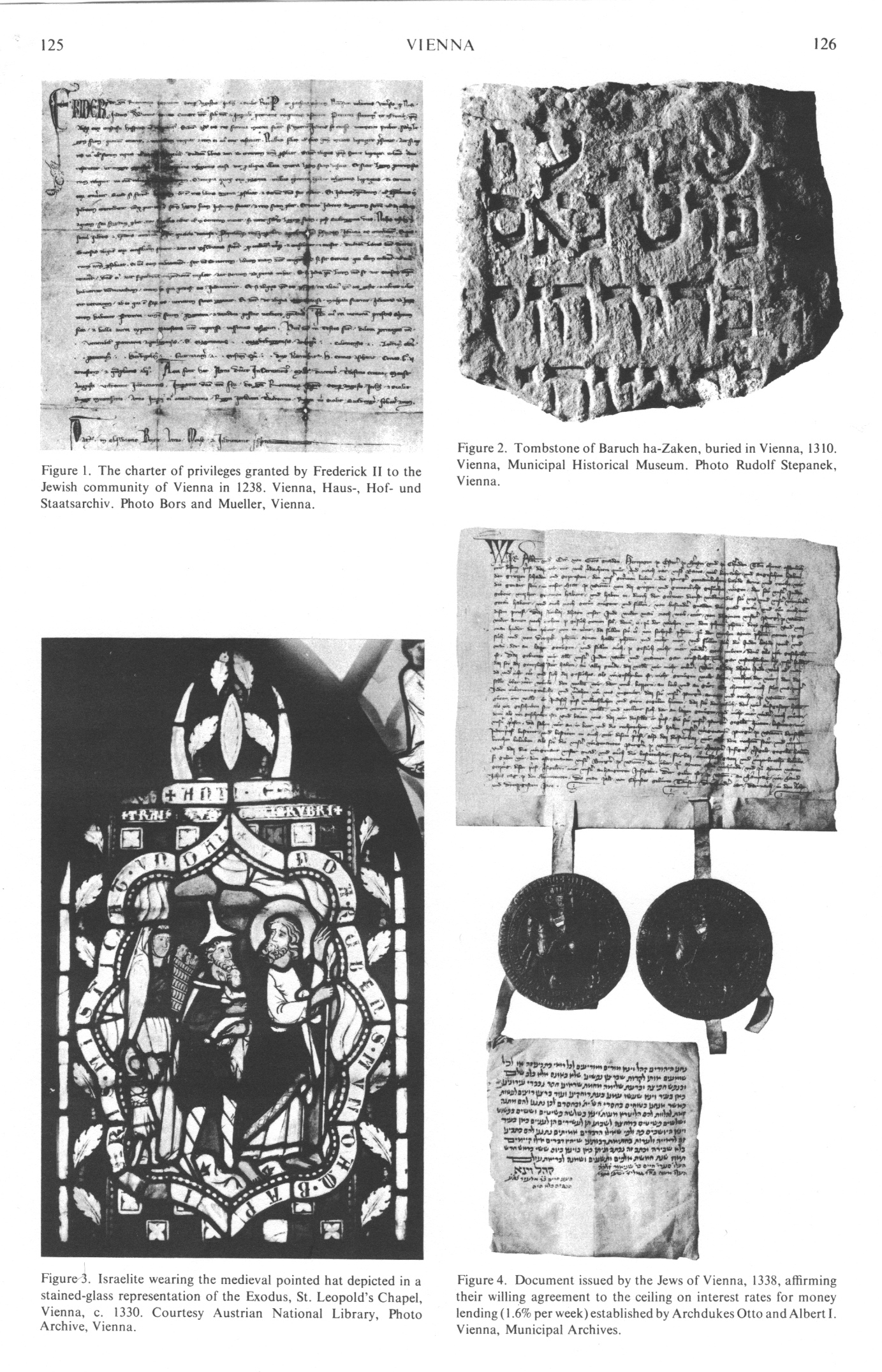
Encyclopaedia Judaica: Vienna, vol.16, col.129,
expulsion and treck in 1670: Engraving showing the
expulsion
of the Jews from Vienna, 1670. Munich, print room
("Kupferstichkabinett")
The Great Synagogue was converted into a Catholic church,
the "Leopoldskirche". The Jews paid the municipality 4,000
florins to supervise the Jewish cemetery. Of the
3,000-4,000 Jews expelled some made their way to the great
cities of Europe where a number succeeded in regaining
their fortunes. Others settled in small towns and
villages. According to the testimony of the Swedish
ambassador at the time, some of the Jews took advantage of
the offer to convert to Christianity so as not to be
exiled.
[1693: Rich Jews allowed
to settle in Vienna - high taxation]
By 1693 the financial losses to the city were sufficient
to generate support for a proposal to readmit the Jews.
This time, however, their number was to be much smaller,
without provision for an organized community. Only the
wealthy were authorized to reside in Vienna, as "tolerated
subjects", in exchange for a payment of 300,000 florins
and an annual tax of 10,000 florins. Prayer services were
permitted to be held only in private homes. The founders
of the community and its leaders in those years, as well
as during the 18th century, were prominent *Court Jews,
such as Samuel *Oppenheimer, Samson *Wertheimer, and Baron
Diego *Aguilar.
As a result of their activities, Vienna became a center
for Jewish diplomatic efforts on behalf of Jews throughout
the empire as well as an important center for Jewish
philanthropy. In 1696 Oppenheimer regained possession of
the Jewish cemetery and built a hospital for the poor next
to it.
[Hierosolymitian
foundation for Jews in Palestine 1742-1918 - Sephardi
community since 1737]
The wealthy of Vienna supported the poor of Erez Israel;
in 1742 a fund of 22,000 florins was established for this
purpose, and until 1918 the interest from this fund was
distributed by the Austrian consul in Palestine (see
*Hierosolymitanische Stiftung [[Hierosolymitian
foundation]]). A Sephardi community in Vienna traces its
origins to 1737, and grew as a result of commerce with the
Balkans.
[Anti-Semitic legislation
under Maria Theresa 1740-1780 - Toleranzpatent under
Joseph II since 1781 - Hebrew printing press since 1793]
During the 18th century the restrictions on the residence
rights of the "tolerated subjects" had prevented the rapid
growth of the Jewish population in Vienna. There were 452
Jews living in the city in 1752 and 520 in 1777. The Jews
suffered under the restrictive legislation of *Maria
Theresa (1740-80). In 1781 their son, Joseph II, issued
his *Toleranzpatent, (col. 123)
which though attacked in Jewish circles, paved the way in
some respects for later emancipation. Religious studies
and sermons were delivered illegally by the scholars of
the community or by rabbis who had been called upon to
visit the town.
By 1793 [[Napoleon time]] there was a Hebrew printing
press in Vienna that soon became the center for Hebrew
printing in Central Europe (see below). During this period
the first signs of assimilation in the social and family
life of the Jews of Vienna made their appearance, and
there was a decline in the observance of tradition.>
(col. 124)
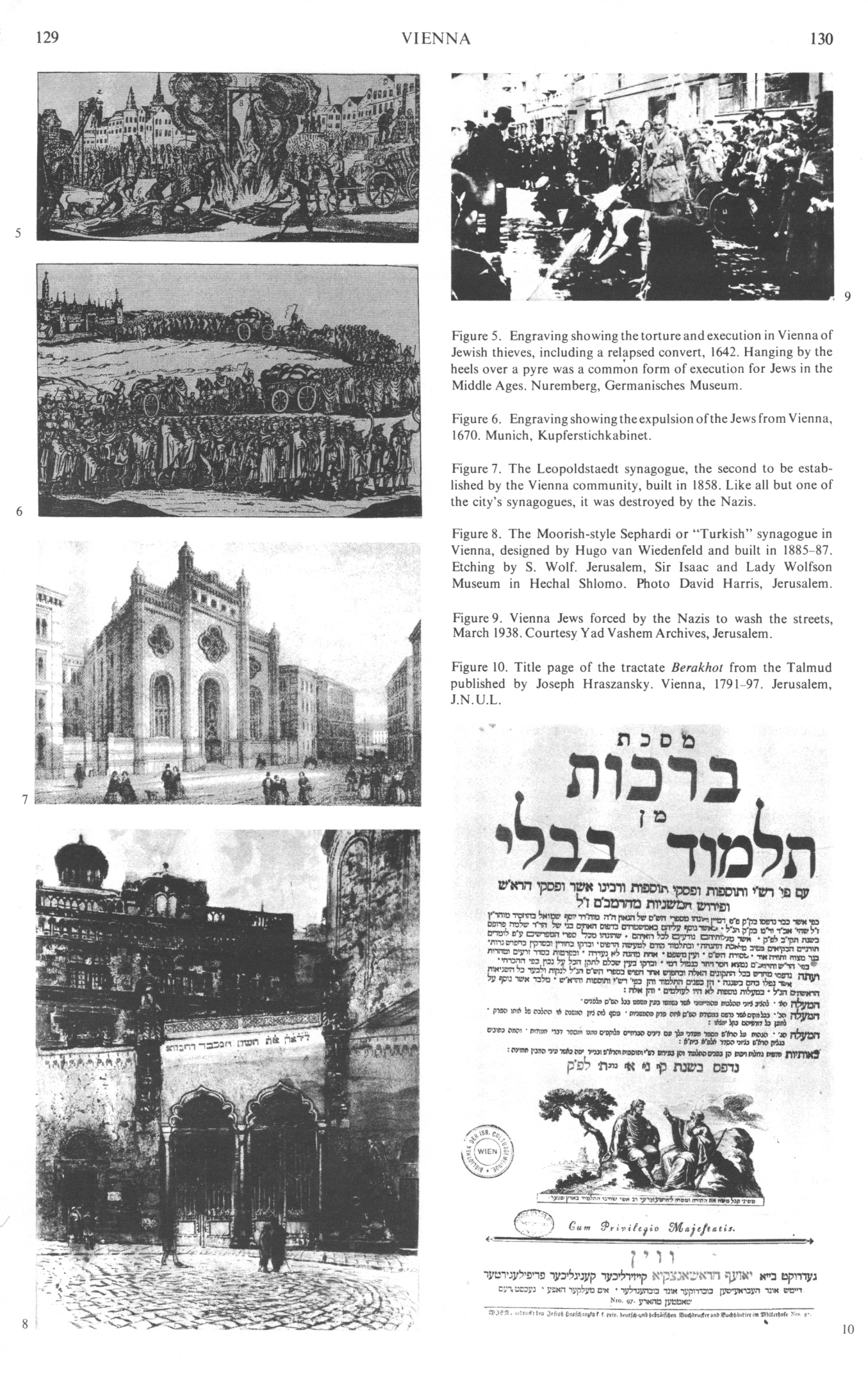
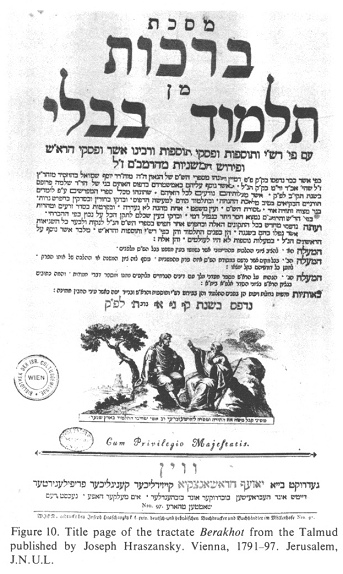 |
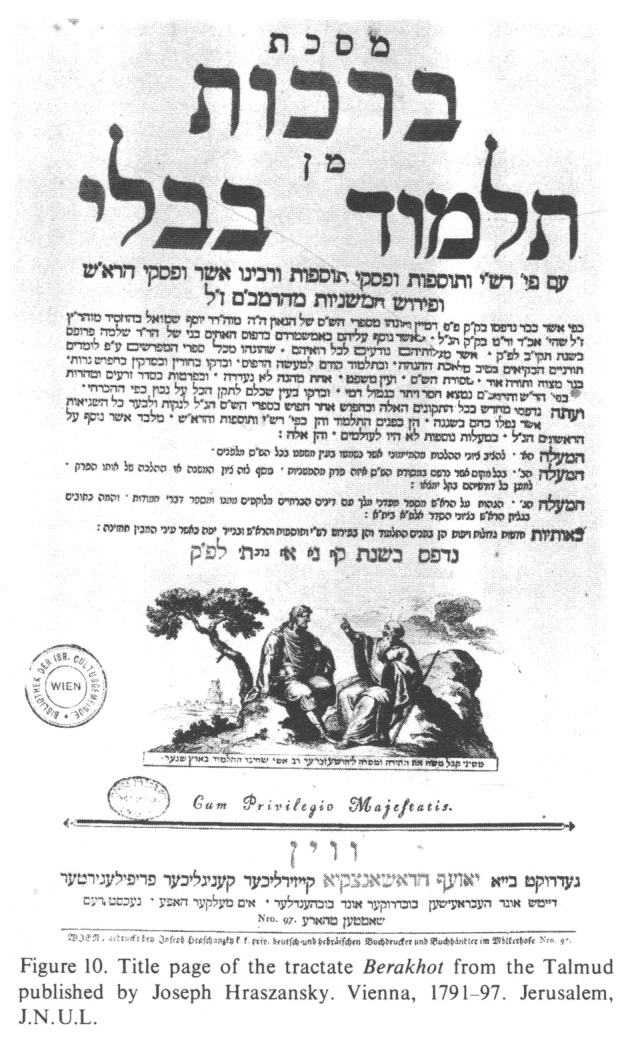
Encyclopaedia Judaica: Vienna, vol.16,
col.130, Talmud 1797: Title page of the tractate
"Berakhot" from the Talmud published by Joseph
Hraszansky. Vienna, 1791-97. Jerusalem, J.N.U.L. |
<Hebrew Printing.
In the 16th century a number of books were published
in Vienna which had some rough Hebrew lettering (from
wood-blocks?):
-- Andreas Planeus' Institutiones Grammatices Ebreae,
printed by Egyd Adler, 1552
-- J.S. Pannonicis' De bello tureis in ferendo, printed by
Hanns Singriener, 1554
-.- and Paul Weidner: Loca praecipuo Fidei Christianae,
printed by Raphael Hofhalter, 1559.
Toward the end of the 18th century extensive Hebrew
printing in Vienna began with the court printer Joseph
Edler von Kurzbeck, who used the font of Joseph *Proops in
Amsterdam. He employed Anton (later: von) Schmid
(1775-1855), who chose printing instead of the priesthood.
Their first production was the Mishnah (1793). In 1800 the
government placed an embargo on Hebrew books printed
abroad and thus gave him a near monopoly. His correctors
were Joseph della Torre and the poet Samuel Romanelli (to
1799), who with Schmid printed his
Alot ha-Minah for
Charlotte Arnstein's fashionable marriage (1793).
Among the works they printed were a Bible with
Mendelssohn's
Biur
(1794-95) and David Franco-Mendes'
Gemul Atalyah (1800).
Schmid also issued the 24th Talmud edition (1806-11) and
the
Turim
(1810-13) with J.L. Ben-Zeev's notes on
Hoshen Mishpat.
Besides Kurzbeck and Schmid there were other rivals and
smaller firms: Joseph Hraszansky, using a Frankfort on the
Main font, opened a Hebrew department in Vienna. Among his
great achievements are an edition of the Talmud (1791-97).
In 1851 "J.P. Sollinger's widow" began to print Hebrew
texts including a Talmud, with I.H. *Weiss as corrector
(1860-73). Special mention must also be made of the Hebrew
journals printed in Vienna including
*Bikkurei ha-Ittim (1820/21-31),
Kerem Hemed
(1833-56),
Ozar Nehmad
(1856-63),
Bikkurei
Ittim (1844),
Kokhevei
Yizhak (1845-73), and
Ha-Shahar (1868-84/5).> (col. 131)


 Encyclopaedia
Judaica
1971: Vienna, vol. 16, col. 122
Encyclopaedia
Judaica
1971: Vienna, vol. 16, col. 122