<The Holocaust. (1) 1938-1939.
The liquidation of Austrian Jewry began with the
Anschluss (annexation) to Germany on March 13, 1938
[[war of flowers: The population was cheering the
Wehrmacht and throw only flowers to the German
soldiers]].
[[Percecution of the
Jews in Austria: 181,778 or 220,000 persons counted as
Jews - deprivation of rights]
According to the Israelitische Kultusgemeinde
[[Israelite cult community]], the Jewish community of
Vienna, there were at the time 181,778 Jews in Austria,
of whom 91.3% (165,946) were living in Vienna. According
to Himmler's statistics however, the number of Austrian
Jews persecuted under the *Nuremberg Laws [[with
non-Aryans: half Jews, quarter Jews, and 3/4 Jews]]
reached 220,000; in addition, tens of thousands of
persons of Jewish descent were affected by the racial
laws.
The new Nazi regime immediately introduced decrees and
perpetrated acts of violence of an even greater scope
and cruelty than those then practiced in the Reich
itself. The Jews were denied basic civil rights, and
they and their property were at the mercy of organized
and semi-organized Nazi gangs. The activities of Jewish
organizations and congregations were forbidden.
[Imprisonments -
attacks against Jewish intelligentsia and property
owners]
Many Jewish leaders were imprisoned, and several were
murdered in *Dachau Concentration Camp. A fine of
800,000 schillings ($30,800) was imposed on the Jewish
communities. At the same time, the first pogroms took
place in Vienna and in the provinces, and synagogues,
including the Great Synagogue of Vienna, were desecrated
and occupied by the German army.
The main victims of systematic terrorization were the
Austrian Jewish intelligentsia and property owners. The
former were immediately banned from any public activity,
from educational and scientific institutions and from
the arts. Many of them - including Sigmund Freud, Stefan
Zweig, and Hermann *Broch - were among the first
Austrian Jewish refugees. The biggest property owners
were arrested by the Gestapo and forced to turn over
their property. Some of those who refused were murdered
and many others were sent to Dachau, where they were
either killed or committed (col. 898)
suicide. In addition, street attacks and brutal
persecution became daily occurrences in lives of
Austrian Jews of all social classes. In March alone, 311
cases of suicide were registered in the Viennese
community, and in April, 267. During these two months,
at least 4,700 Jews escaped from Austria.
[Deportations - Jewish
stream to Vienna - emigration - vocational training
for emigration - Jewish schooling]
Systematic deportation of Jews and the confiscation of
their property began in several Austrian provinces.The
ancient Jewish communities of *Burgenland were deported
over the Czech border. A group of 51, who were returned
to Austria, was sent up and down the Danube for four
months and denied entry to all the countries bordering
on the river.
As a result of the persecutions, a stream of Jews from
the provinces, most of them destitute, began to flow to
Vienna. In May 1938 the Viennese Jewish community
renewed its activities and several of its leaders
were released from prison in order to help organize mass
emigration which the Nazi authorities encouraged. The
Zionist Palestine Office in Vienna was permitted to
organize both legal and "illegal" emigration to
Palestine. In the same month, the Nuremberg Laws were
officially enforced in Austria.
In August 1938, under *Eichmann's aegis, the
"Zentralstelle fuer juedische Auswanderung" was
established in Vienna. This organization was to be
responsible for the "solution of the Jewish problem" in
Austria. Its "efficient" methods of persecution and
deportation were later copied in Germany and in several
of the Nazi-occupied countries.
A special body, the Vermoegensverkehrsstelle [[asset
transfer office]], was responsible for the transfer of
Jewish property to non-Jews. With the help of the major
Jewish welfare organizations in the world, the community
and the Palestine Office were able to assist in the
emigration of thousands of Jews. The importance of this
aid grew with the straitened circumstances of Austrian
Jewry; as against 25% of the emigrants who needed
financial assistance in May and July 1938, 70% needed
assistance in July and August 1939. Between July and
September 1938 emigration reached a monthly average of
8,600.
Hundreds of training courses were organized to prepare
emigrants for new occupations in the countries of
immigration. (In Vienna these had 31,306 participants up
to the end of 1939). thousands of young people received
agricultural training at the farm owned by the
*He-Halutz Zionist movements (in August 1939, there were
1,801 people in 18 training camps) and *Youth Aliya
wards received special agricultural and technical
training.
The community also took care of those whose education
had been interrupted by their expulsion from educational
institutions, and of the thousands of Jews whose
livelihoods had been taken from them and who were in
urgent need of assistance.
[5 Oct. 1938: New
anti-Semitic riots - 10 Oct. 1938: deportation of
Czech Jews - 28 Oct. 1938: deportation of Polish Jews]
In October 1938 anti-Semitic riots again broke out and
Jews were once more deported from various places. On the
eve of the Day of Atonement (October 5) thousands of
Jewish families were evicted from their homes in certain
districts of Vienna and elsewhere, and ordered to leave
the country, though this decree was subsequently
canceled through the intervention of Eichmann.
On October 10, Hitler gave personal instructions "to act
for the deportation of 27,000 Viennese Jews of Czech
nationality". On October 28, thousands of Jews who were
Polish nationals were deported into the no-man's-land on
the German-Polish border. Of these, only 1,300 were able
to cross the frontier. The rest remained in Austria as
stateless persons (see *Germany).
[10 Nov. 1938:
Kristallnacht - 1/3 of the fine is imposed on Austrian
Jews]
During the pogroms of November 10 (see *Kristallnacht),
approximately 8,000 Jews were arrested, and of these
5,000 were sent to Dachau. Six hundred and eighty others
committed suicide or were murdered that single night. In
Vienna alone, 42 synagogues were burned and 4,038 Jewish
shops were looted. Almost all Jewish homes were
destroyed and cemeteries desecrated. Synagogues were
also destroyed in Graz, Salzburg, Klagenfurt, (col. 899)
Linz, Innsbruck, Baden, Eisenstadt, Berndorf, and Bad
Voeslau. In Linz, all the Jewish inhabitants were
arrested, and all Jews in the district were ordered to
move to Vienna within three days. One-third of the fine
of a billion marks ($83,300,000) imposed on the whole of
the German Reich Jewry was levied on Austrian Jews.
During the November Pogroms employees of the Jewish
community and the Palestine Office were released from
prison and ordered to continue organizing emigration.
Shortly afterward, they began publication of the
official Jewish newspaper, Juedisches Nachrichtenblatt [[Jewish
News]], under the supervision of the Gestapo. The paper
appeared until the end of 1943, and was intended to
inform the Jewish public of official decrees.
[April 1939: All Jews
of Vienna are living in "Jewish streets" - August
1939: 66,260 Jews in Austria]
Most of those arrested during the pogroms were released
before the end of April 1939, having agreed to leave the
country as soon as possible. At the end of April 1939,
under a special law, almost all Austrian Jews were
evicted from their homes, and most were gathered into
certain streets in selected districts of Vienna.
By the eve of World War II 109,060 had succeeded in
emigrating and only 66,260 Jews were left in Austria.
Only 438 still lived outside Vienna while whole regions,
such as Salzburg and Carinthia were devoid of Jews. With
the exception of isolated cases, all were deprived of a
livelihood and all 25,898 factories and places of
business belonging to Jews had been confiscated and
shut.
[September 1939: 17,000
Jewish visas cancelled - concentration camps -
deportations]
With the outbreak of war in September 1939 emigration
opportunities lessened, and 17,000 Jews possessing entry
visas to enemy countries were forbidden to use them. In
the new wave of arrests, hundreds of Austrian Jews were
sent to concentration camps. All Jews lived under
martial law and additional restrictions were imposed
upon them. On October 20, 922 Viennese Jews were exiled
to Nisko on the San River. (Some of the Nisko deportees
succeeded in crossing the border into the Soviet Union;
the remaining 152 were returned to Vienna in April
1940).
In November 1939 Eichmann informed the leaders of the
community that all Jews who did not emigrate within one
year would be exiled to occupied Poland. During the
first four months of the war, 11,240 Jews succeeded in
emigrating to neutral countries.
[End of 1939: 53,403
Jews in Austria - further vocational training and
Jewish schooling - 24,000 aged and infirm]
Of the 53,403 persons registered with the Viennese
community at the end of 1939 45,140 were dependent on
social welfare. However, the community continued to
arrange technical training in preparation for
emigration, and 5,017 children of school age studied in
its 14 educational institutions. Among the community's
projected activities for 1940 was its own gradual
dissolution, so that, by the end of that year, it would
be merely an institution for the care of 24,000 aged and
infirm, who were unable to emigrate.
[[Holocaust]]
(2) 1940-1945
[1941: Deportations]
Between February and March 1941, desperate attempts to
continue limited emigration resulted in the deportation
of 5,000 Jews to five places in the *Lublin district. It
is assumed that all met their death within the year,
being murdered either locally or in the gas chambers of
*Belzec. [[Probably it was mass shooting]].
From October to the beginning of November another 5,486
Jews were deported to the *Lodz Ghetto. After the
official prohibition on emigration, there remained
approximately 40,000 Austrian Jews. Very few could leave
the country after this date.
[1938-1941: Emigration
figures]
Of the 128,500 who had emigrated up to that time 30,800
had gone to England, 24,600 to other European countries,
28,600 to the United States, 9,200 to Palestine, and
39,300 to 54 other countries. At the end of 1941, with
the Nazi occupation of territories in the Soviet Union,
3,000 Austrian Jews were deported to the ghettos of
Riga, Minsk, and Kovno; many were put to death upon
arrival in the vicinity of these ghettos.
[1942: Evacuation
program for the remnant - dissolution of the cult
community - new council of the elderly]
After the Wannsee Conference, Eichmann announced to the
Viennese community his general Aussiedlung ("evacuation") program
under which 3,200 more Austrian Jews were (col. 900)
deported to Riga, 8,500 to Minsk, and 6,000 to Izbica
and several other places in the Lublin region. This last
group was almost entirely exterminated. Between June and
October, 13,900 people were deported to *Theresienstadt,
most of them aged 65 and over. On Oct. 10, 1942, the
last transport of 1,300 persons left for Theresienstadt.
The Viennese Jewish community was officially dissolved
on Nov. 1, 1942. There still remained 7,000 Jews in
Austria (about 8,000 according to the Nuremberg Laws).
The majority were spared because they were married to
non-Jews. All able-bodied persons were compelled to do
forced labor. The Aeltestenrat der Juden in Wien
[[Council of Jewish Elders of Vienna]] was formed to
replace the Israelitische Kultusgemeinde. It represented
Austrian Jewry in dealing with the authorities, and was
responsible for running the Jewish hospital, the home
for the aged, the soup kitchen, and burying the dead.
This council was headed by Josef Loewenherz until the
end of the war.
[1943-1945:
Deportations - Jews in Vienna - Hungarian Jews]
Isolated deportation continued from January 1943 until
March 1945, and consisted of not more than a hundred
persons in each transport. At least 216 Jews were sent
to *Auschwitz and 1,302 Jews to Theresienstadt. Most of
the victims were former communal workers, and Jews whose
non-Jewish spouses had died.
In the summer of 1943, there were still approximately
800 Jews left in Vienna. They had gone underground and
were secretly helped by members of the community and the
Budapest Jewish rescue committee (Va'adat ha-Hazzalah).
A few managed to escape to Hungary, but many others were
caught by the Gestapo and sent to Auschwitz. Some
managed to stay underground until Vienna fell to the
Soviet Army.
In July and December 1944, approximately 60,000
Hungarian Jews were deported to Vienna and Lower
Austria, to be employed by the Nazis in building
fortifications. A few were permitted to receive
treatment at the Vienna Jewish hospital. Just before
Vienna was liberated, (col. 901)
1,150 were deported to Theresienstadt. During the last
months of the war, thousands of Jewish evacuees from
various concentration camps crossed Austria. A few
remained in Vienna and the Vienna district or [?] were
transferred to Austrian camps. The remnant of the
Viennese Jewish community organized itself into a
committee to save the victims, and extended help to them
in conjunction with the International Red Cross and
Jewish welfare organizations. A report by the Red Cross
representative described the last synagogue in the Third
Reich located in the cellar of the Viennese Jewish
hospital.
[Survivors]
Of the approximately 50,000 Jews deported from Austria
to ghettos and extermination camps only 1,747 returned
to Austria at the end of the war. (The largest group of
survivors, which numbered 1,293, was liberated from the
Theresienstadt Ghetto).
[Captivations 1940]
Among the Austrian victims of the Holocaust there were
over 20,000 Austrian Jews who had migrated to other
European countries later conquered by the Nazis.
[Number of the victims:
70,000 estimated]
The number of Austrian Jewish victims of the Holocaust
is estimated at 70,000. One of the largest and most
terrible of concentration camps, *Mauthausen, where
thousands of European Jews met their death, was situated
in Austria. A large part in the campaigns to exterminate
European Jewry was played by Austrian Nazis, including
Eichmann, *Globocnik, *Kaltenbrunner and Hitler himself.
After the war, a documentation committee was set up in
Vienna for the tracing and prosecution of Nazi war
criminals.
[D.K.]> (col. 902)
[[Supplement: Intense
anti-Semitism in Austria and the reasons
In Austria several feelings against the Jews came
together which were element of the propaganda:
-- collapse of the stock market of 1873 and government
help for Jewish banks but not for Austrian citizens
-- collapse of Austria-Hungary of 1918 and Jewish
dominance in important parts of the Austrian economy
1918-1938
-- Jewish communism since 1918 in Russia and some Jewish
communist republics 1918-1919 in Europe
-- collapse of the stock market of 1929 and general
accusations and no help of the government to Austrian
citizens.
The regime of hunger was an important element to agitate
against the Jews, and in Austria this happened several
times, more than in Germany. Add to this the Austrian
Nazis possibly felt obliged to Hitler because Hitler was
Austrian too]].


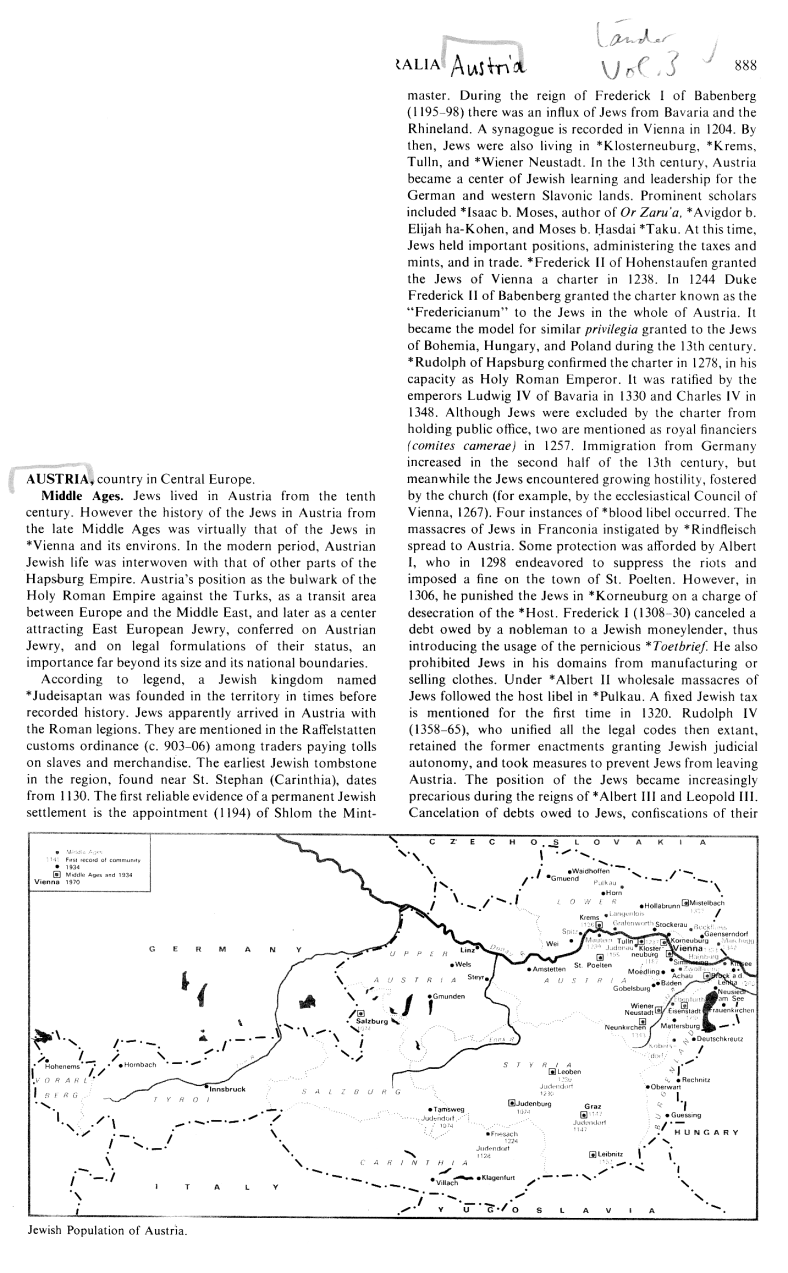
 Encyclopaedia
Judaica
1971: Austria, vol. 3, col. 887-888
Encyclopaedia
Judaica
1971: Austria, vol. 3, col. 887-888