from:
-- Austria; In: Encyclopaedia Judaica 1971, vol. 3
-- Neo-Nazism; In: Encyclopaedia Judaica 1971, Vol. 12
Postwar Period.
(from: Austria; In: Encyclopaedia
Judaica 1971, vol. 3)
[1945-1953: DPs in
Austria]
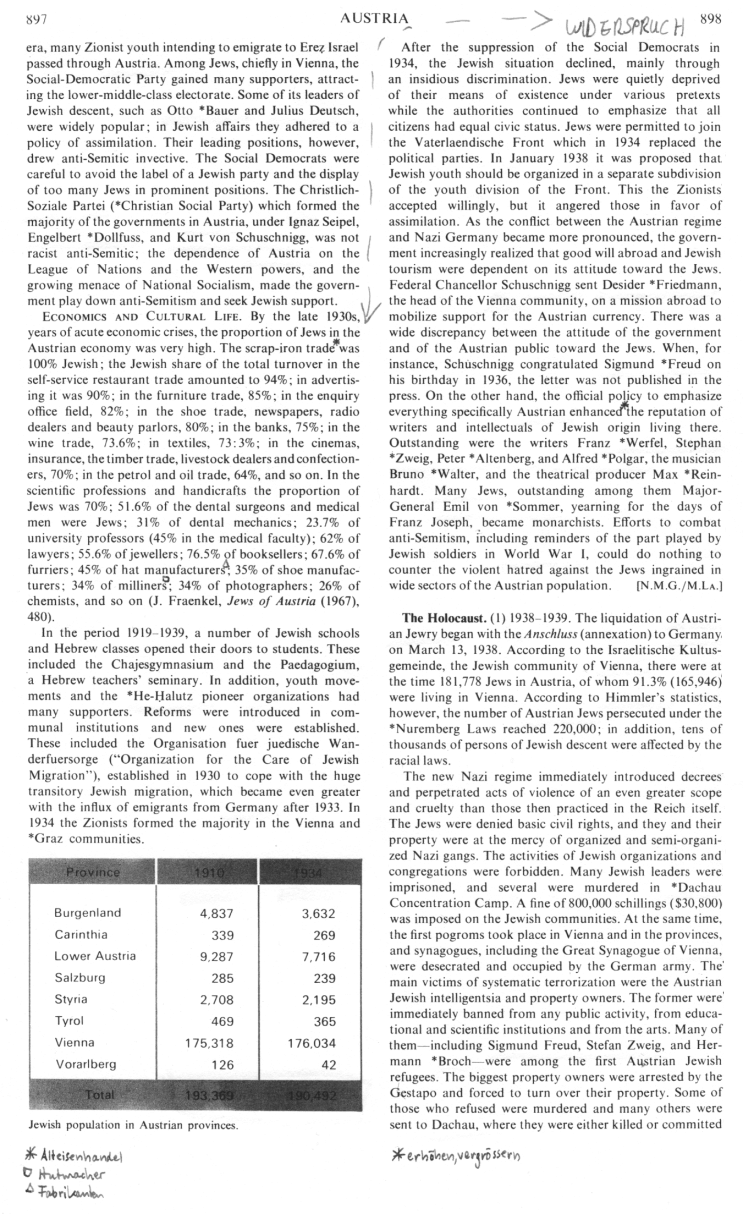
At the end of World War II, however, there were many
displaced persons in Austria, most of them from Hungary.
They had been sent to Austrian concentration camps during
the last two years of the war. Their number was then
estimated at about 20,000. Though some returned to their
countries of origin after the liberation, post-war Austria
had one of the largest concentrations of still unsettled
Jewish displaced persons. It was the main transit country
for Jewish refugees from Poland, Hungary, Rumania
[[Romania]], and other East European countries, on their
way to Italy and other Mediterranean countries, or to the
main concentration of refugees in the American Zone of
Germany. The number of displaced persons reached its peak
in late 1946, when it was estimated at 42,500, of whom
over 35,000 were in the American-occupied area of Austria,
i.e., in the western part of the country.
The number then dropped, as a result of the flow of
refugees to the coast, and particularly as a result of
mass emigration following the establishment of the State
of Israel. By 1953 only 949 refugees were left in
displaced persons camps.
[1950 and 1965: Numbers
of Jews in Austria - Austria is transit country for
migrating Jews]
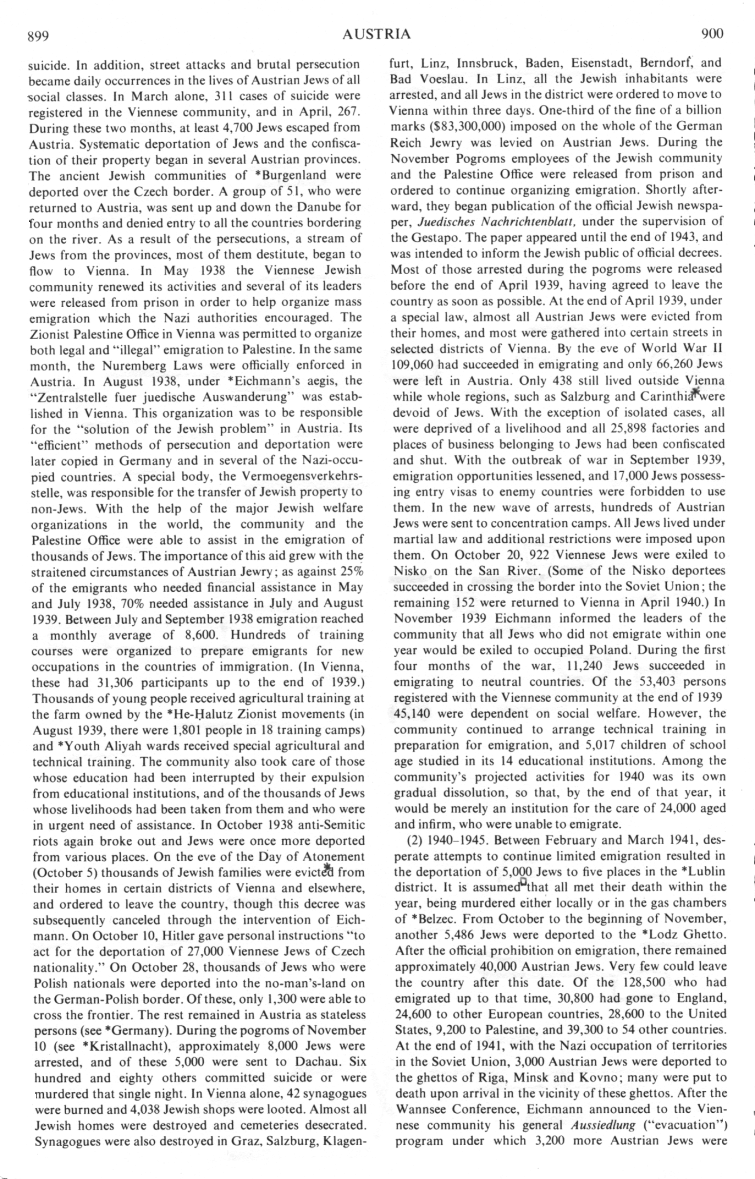
The number of Jews living in communities rose with the
return of several thousand Jews from camps in Eastern
Europe, from the countries to which they had fled (mainly
Great Britain, China, and Palestine), and from their
hiding-places. A small percentage of displaced persons
settled in Austrian towns. The number of Jews in these
communities reached a peak in 1950 with 13,396 registered.
As in the past, the large majority lived in Vienna
(12,450), and the rest in the capitals of the provinces
(Laender) of Graz, Linz, Salzburg, and Innsbruck.
From 1950 their number began to decrease. In 1965, 9,537
persons were registered as members of the community, of
whom 8,930 lived in Vienna. It is estimated that another
2,000 Jews, not registered as community members, lived in
the country. Thereafter the number of Jews remained more
or less stable, with a slight tendency to fall. The
ancient communities of Burgenland, on the Austro-Hungarian
border, which before the Anschluss [[annexation]] had numbered
about 4,000 persons, were not rebuilt.
In 1968 nearly 65% of Austrian Jewry were aged 50 and
over. Austria became a country of transit for (col. 902)
The Jewish migration from Eastern Europe to Israel and the
West. In general, these travelers spent only a few days in
Austria, in camps in and around Vienna. However, after the
Hungarian Revolution of 1956, about 20,000 Jewish refugees
fled to Austria. Most continued on their way after a short
while, between 200 and 300 remaining in Austria.
[since 1945:
anti-Semitism and emancipation of Jews in Austria -
claim settlement in 1962]
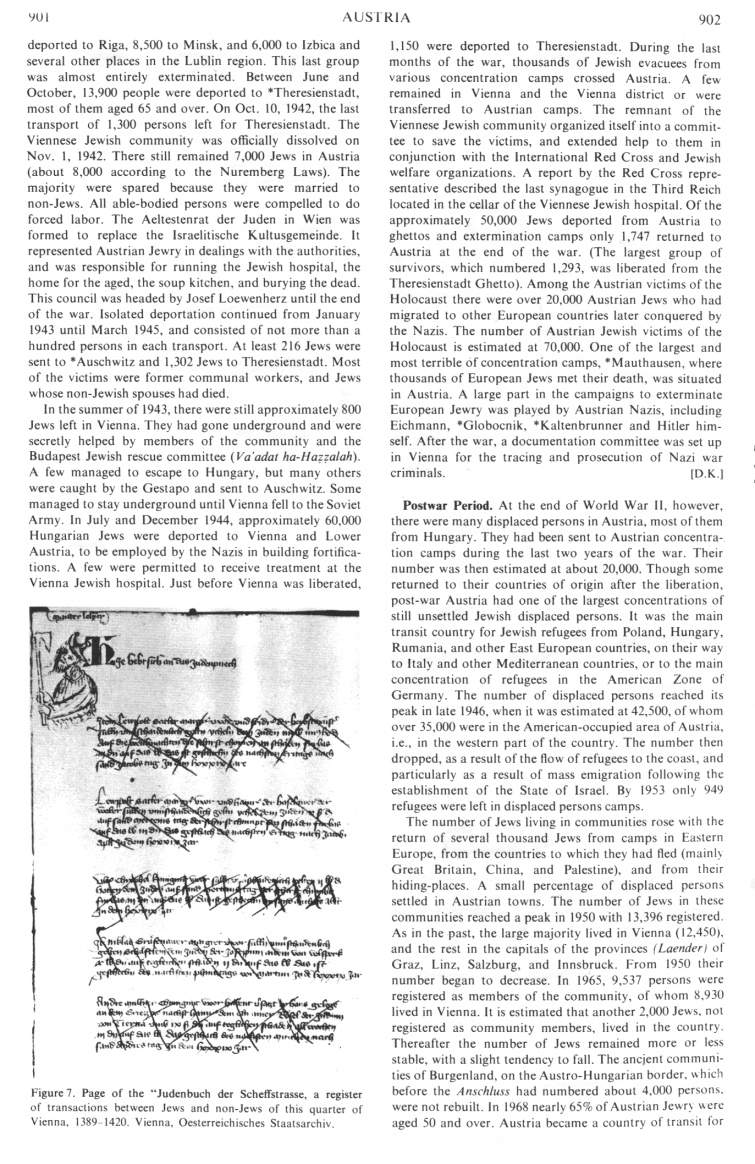
The tradition of anti-Semitism was not uprooted in Austria
nor confined to ex-Nazis or Neo-Nazis, who found sanctuary
in the Freiheit (Freedom) Party. Only a few months after
the end of World War II, a leader of the large Christian
Party (the People's Party), Leopold Kunschak, declared
that he had always been anti-Semitic. This did not prevent
his being elected president of the parliament. The
universities were often the scene of anti-Semitic
demonstrations; there have even been cases of professors
boasting about their Nazi past.
[since 1945: Neo-Nazism in Austria]
(from: Neo-Nazism; In: Encyclopaedia Judaica 1971, Vol.
12)
<In Austria, Neo-Nazism lacked the organizational
framework of a sufficiently numerous following to qualify
as a politically relevant force. Among the minuscule
groupings more or less openly committed to propagating
Nazi ideas and extolling Nazi achievements, Theodor
Soucek's Sozialorganische
Bewegung Europas (SOBRE, [[Social Organic
Movement of Europe]]) was perhaps the most noteworthy in
the early 1950s. It tried to coordinate efforts of Nazi
collaborators and sympathizers in the former occupied
territories to revitalize the Hitlerian "new order" in the
context of the then emerging Europe. SOBRE enjoyed the
support of Konrad Windisch, one of the founders of the Bund Heimattreuer Jugend
(BHJ, [[Confederation of Youth loyal to their home]]),
whose initials HJ (for Hitler
Jugend [[Hitler Youth]]) proclaimed its
ideological lineage and (col. 955)
identification. Despite the insignificance of these
movements, residual anti-Semitism and subliminal Nazi
sympathies seemed to be more widespread in Austria than in
Germany, thus the marked reluctance of Austrian
authorities to prosecute and of juries to convict such war
criminals and Eichmann aides as Murer, Novak, or Raiakovic
and the parsimoniousness of Austrian restitution.>
(col. 956)
The official attitude toward Nazi criminals, when brought
to trial, was generally lenient; among the cases that
aroused international indignation was the acquittal of the
brothers Johann and Wilhelm Mauer, accused of mass murder
in the Stanislaw ghetto. Public pressure caused their
retrial and sentence. There was an anti-Semitic campaign
against Bruno *Kreisky, a leader of the Social Democratic
Party, of Jewish origin, who served for several years as
foreign minister. After an election (victory in 1970
Kreisky became federal chancellor (prime minister), the
first Jew to hold this high office.
Negotiations between the executive committee for Jewish
claims on Austria, headed by Nahum *Goldmann, and the
Austrian Government started in 1953, but the process of
legislation on the return of property and the payment of
(col. 903)
indemnification to victims of Nazi persecution was
concluded only in 1962 and was considered inadequate.
[New Jewish community in
Vienna]
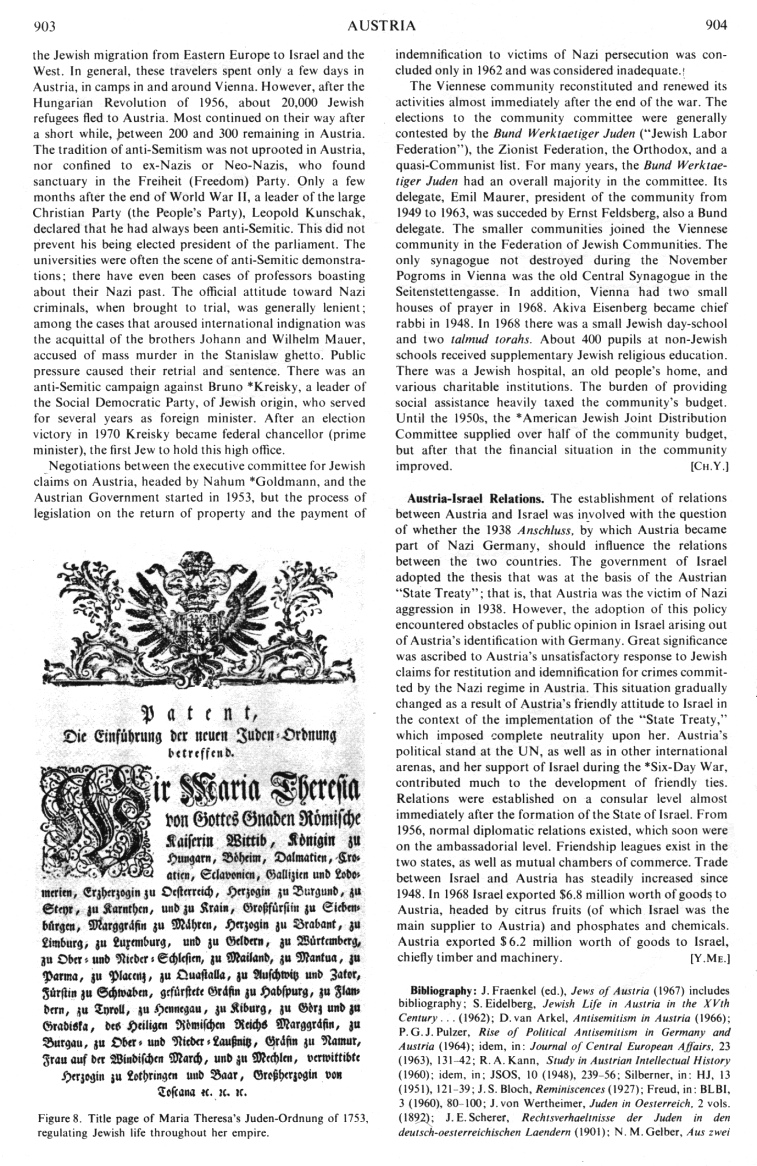
The Viennese community reconstituted and renewed its
activities almost immediately after the end of the war.
The elections to the community committee were generally
contested by the Bund
Werktaetiger Juden ("Jewish Labor Federation"),
the Zionist Federation, the Orthodox, and a
quasi-Communist list. For many years, the Bund Werktaetiger Juden
had an overall majority in the committee. Its delegate,
Emil Maurer, president of the community from 1949 to 1963,
was succeeded by Ernst Feldsberg, also a Bund delegate.
The smaller communities joined the Viennese community in
the Federation of Jewish Communities.
The only synagogue not destroyed during the November
Pogrom in Vienna was the old Central Synagogue in the
Seitenstettengasse. In addition, Vienna had two small
houses of prayer in 1968. Akiva Eisenberg became chief
rabbi in 1948. In 1968 there was a small Jewish day-school
and two talmud torahs.
About 400 pupils at non-Jewish schools received
supplementary Jewish religious education. There was a
Jewish hospital, and old people's home, and various
charitable institutions. The burden of providing social
assistance heavily taxed the community's budget.
Until the 1950s, the *American Jewish Joint Distribution
Committee supplied over half of the community budget, but
after that the financial situation in the community
improved.
[CH.Y.]> (col. 904)
<Austria-Israel
Relations.
[The agreement that
Austria had been a "victim" by Nazi German violence]
The establishment of relations between Austria and Israel
was involved with the question of whether the 1938
Anschluss [[annexation]] by which Austria became part of
Nazi Germany, should influence the relations between the
two countries. The government of Israel adopted the thesis
that was at the basis of the Austrian "State Treaty"; that
is, that Austria was the victim of Nazi aggression in
1938.
[[This is one of the biggest political lies in Europe. The
Wehrmacht did not one single shoot and people cheered to
the German soldiers]].
However, the adoption of this policy encountered obstacles
of public opinion in Israel arising out of Austria's
identification with Germany. Great significance was
ascribed to Austria's unsatisfactory response to Jewish
claims for restitution and indemnification for crimes
committed by the Nazi regime in Austria.
This situation gradually changed as a result of Austria's
friendly attitude to Israel in the context of the
implementation of the "State Treaty", which imposed
complete neutrality upon her. Austria's political stand at
the UN, as well as in other international arenas, and her
support of Israel during the *Six-Day War, contributed
much to the development of friendly ties. Relations were
established on a consular level almost immediately after
the formation of the State of Israel. From 1956, normal
diplomatic relations existed, which soon were on the
ambassadorial level. Friendship leagues exist in the two
states, as well as mutual chambers of commerce. Trade
between Israel and Austria has steadily increased since
1948. In 1968 Israel exported $6.8 million worth of goods
to Austria, headed by citrus fruits (of which Israel was
the main supplier to Austria) and phosphates and
chemicals. Austria exported $6.2 million worth of goods to
Israel, chiefly timber and machinery.
[Y.ME.]> (col. 904)
Bibliography
-- J. Fraenkel (ed.): Jews of Austria (1967) includes
bibliography
-- S. Eidelberg: Jewish Life in Austria in the XVth
Century ... (1962)
-- D. van Arkel: Antisemitism in Austria (1966)
-- P.G.J. Pulzer: Rise of Political Antisemitism in
Germany and Austria (1964)
-- idem, in: Journal of Central European Affairs, 23
(1963), 131-42
-- R.A. Kann: Study in Austrian Intellectual History
(1960)
-- idem, in: JSOS, 10 (1948), 239-56
-- Silberner, in: JH, 13 (1951), 121-39
-- J.S. Bloch: Reminiscences (1927)
-- Freud, in: BLBI, 3 (1960), 80-100
-- J. von Wertheimer: Juden in Oesterreich, 2 vols. (1892)
-- J.E. Scherer: Rechtsverhaeltnisse der Juden in den
deutsch-oesterreichischen Laendern (1901)> (col.
903-904)
[[-- Encyclopaedia Judaica: Neo-Nazism]]


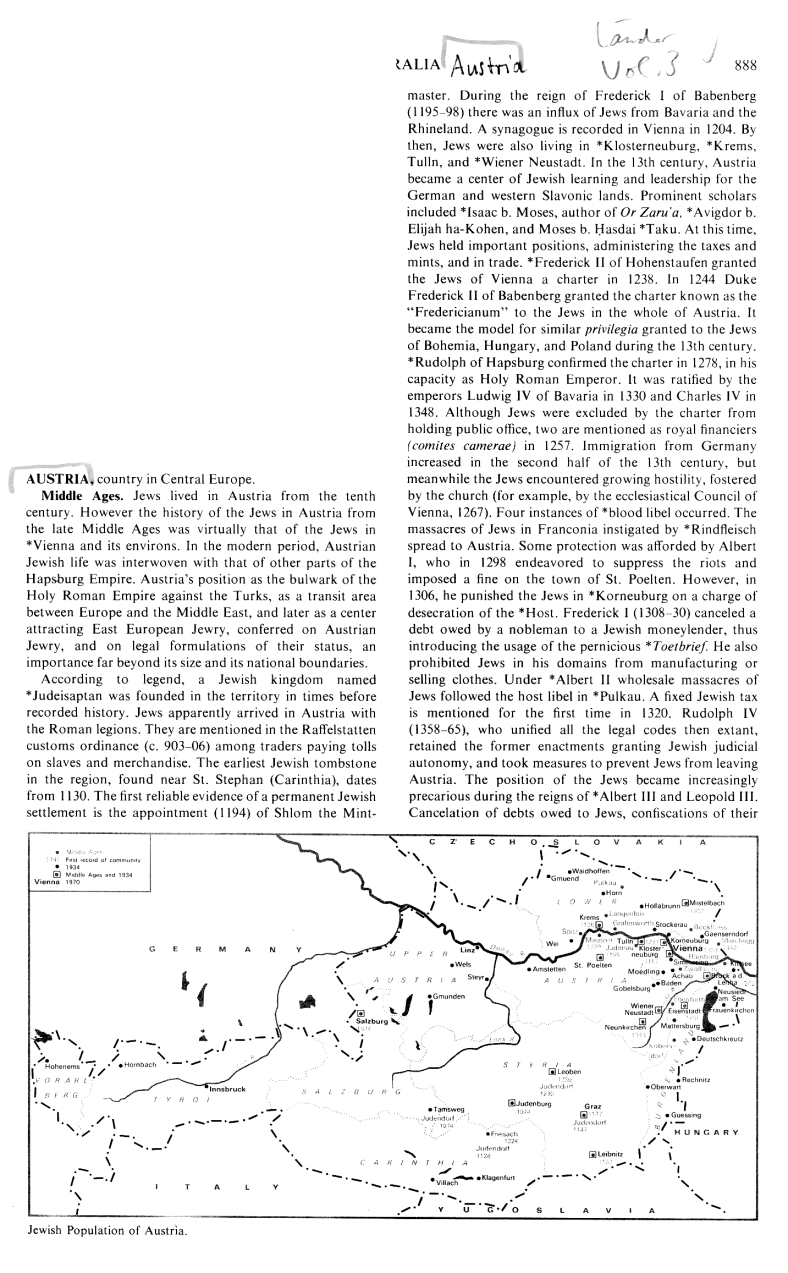
 Encyclopaedia
Judaica
1971: Austria, vol. 3, col. 887-888
Encyclopaedia
Judaica
1971: Austria, vol. 3, col. 887-888