<PORTUGAL,
southwesternmost country of continental Europe, in the
Iberian Peninsula.
[Jewish legend about Jews
since 70 C.E. - proved Jewish existence by 300 C.E.]
Jewish settlement in the area began prior to Portugal's
emergence as a nation. A tradition among the Sephardi Jews
ascribes their arrival in Iberia to Roman times, in the wake
of the destruction of the Temple in 70 C.E. and subsequent
dispersion toward Europe. The existence of a significant
Jewish settlement on the peninsula by 300 C.E. is apparent
from the edicts of *Elvira which proscribe "taking food with
the Jews" and single out the Jewish group in a number of
dicta.
James *Finn endeavored to make a case for dating the initial
Jewish involvement in the area as early as 900 B.C.E., based
on reports of two ancient Hebrew inscriptions, one
mentioning *Amaziah, king of Judah, and a second marking the
grave of King Solomon's treasurer, *Adoniram.
[12th century: Jewish
communities in the towns and in Jewish quarters]
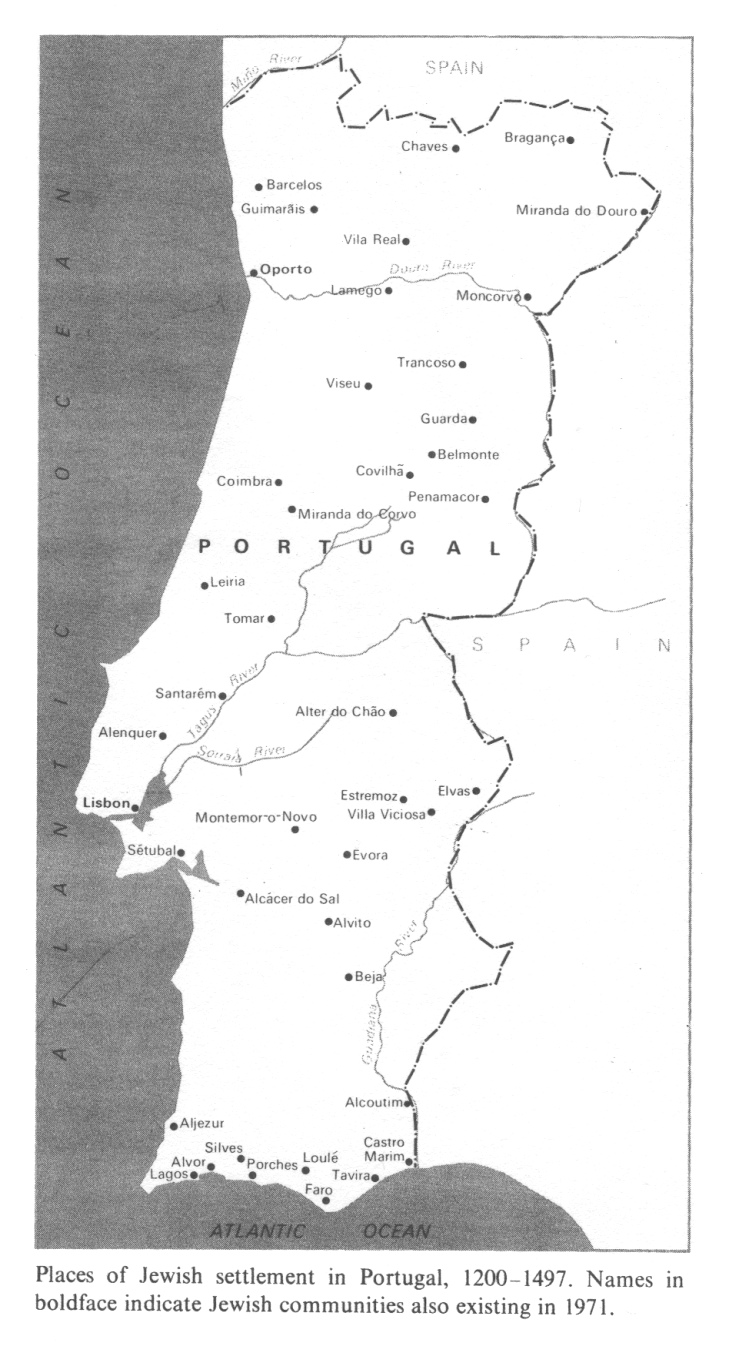
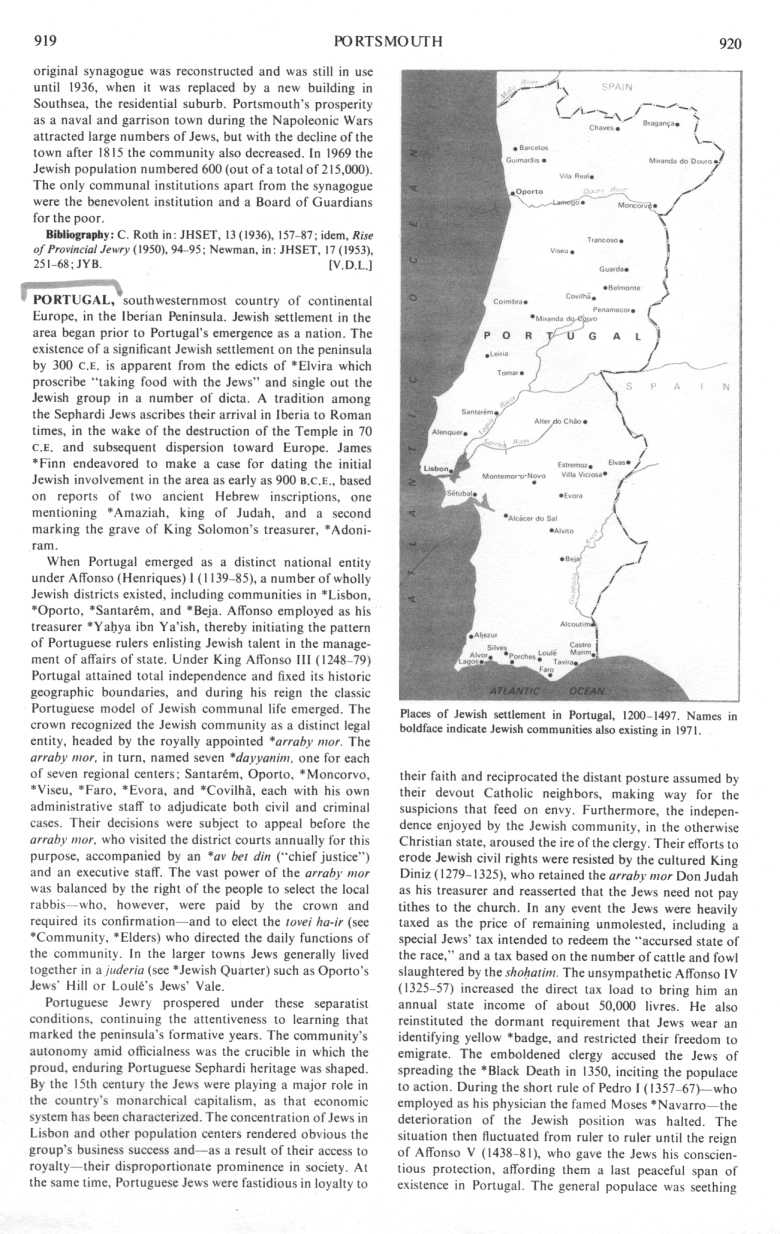
| The Jewish communities 1200-1497 |
Encyclopaedia
Judaica 1971: Portugal, vol. 13, col. 919-920,
map of Jewish communities 1200-1497
|
Porto region:
Chaves, Bragança, Barcelos, Guimarãis, Miranda
do Douro, Vila Real, Oporto, Lamego, Moncorvo;
xxxxxxxxxxxxxxxxxxxxxxxxxxxxxxxxxxxxxxxxxxxxxxxxxxxxxxxxxxxxxxxxxxxxxxxxxxxxxxxxxxxxxxxxx
Middle Portugal: Trancoso, Viseu, Guarda,
Belmonte, Covilhã, Coimbra, Penamacor, Miranda
do Corvo, Leiria, Tomar;
Lisbon Region: Santarém, Alter do Chão,
Alenquer, Lisbon, Elvas, Estremoy, Villa
Viciosa, Montemor-o-Novo, Sétubal, Evora,
Alcácer do Sal, Alvito, Beja, Alcoutim, Aljezur;
Southern coast: Lagos, Alvor, Silves, Porches,
Loulé, Faro, Tavira, Castro Marim.
|
When Portugal emerged as a distinct national entity under
Affonso (Henriques) I (1139-85), a number of wholly Jewish
districts existed, including communities in *Lisbon,
*Oporto, *Santarém, and *Beja. Affonso employed as his
treasurer *Yahya ibn Ya'ish, thereby initiating the pattern
of Portuguese rulers enlisting Jewish talent in the
management of affairs of state. Under King Affonso III
(1248-79) Portugal attained total independence and fixed its
historic geographic boundaries, and during his reign the
classic Portuguese model of Jewish communal life emerged.
[Structure of the Jewish
communities in Portugal: the arraby mor]
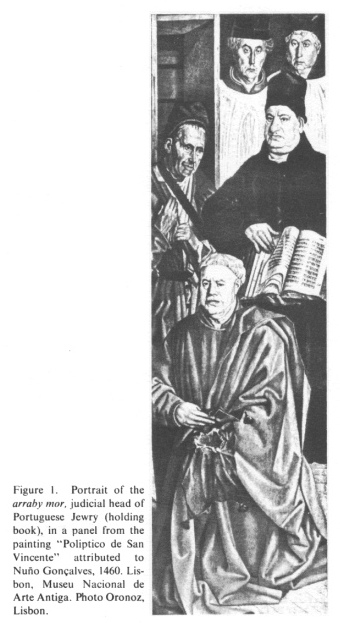
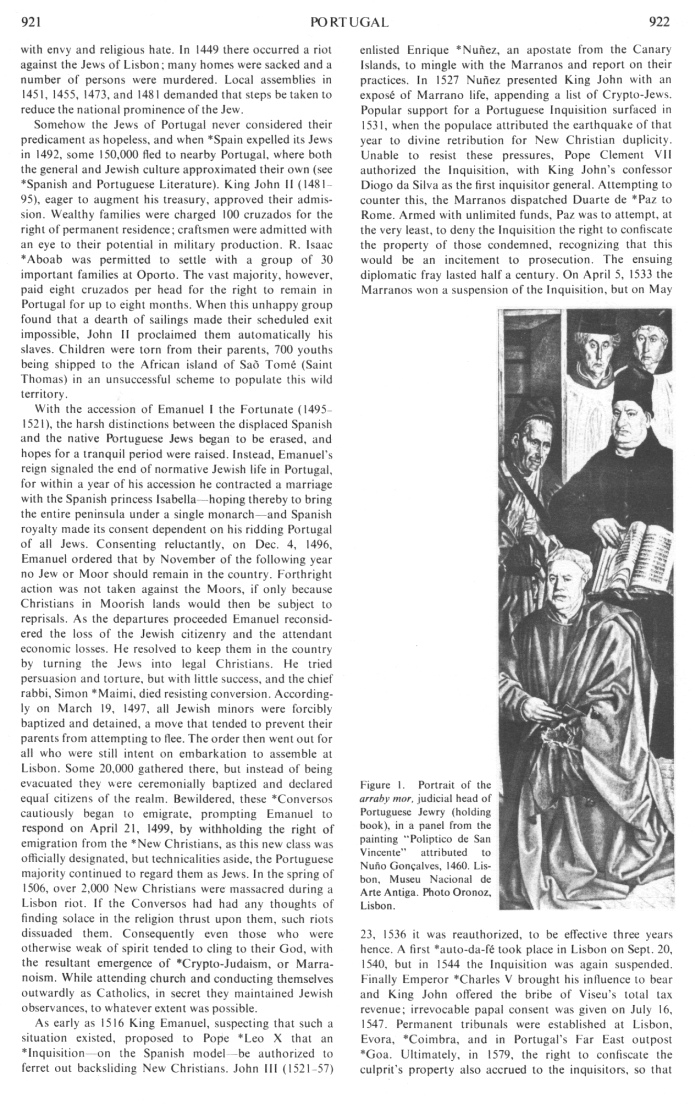
Encyclopaedia Judaica: Portugal, vol.13, col.922: Arraby
mor: Portrait of the arraby mor, judicial head of
Portuguese Jewry
(holding book), in a panel from the painting "Poliptico de
San Vincente" attributed to Nuño Gonçalves, 1460. Lisbon,
National Museum of Antique Art ("Museu Nacional de Arte
Antiga). Photo Oronoz, Lisbon.
The crown recognized the Jewish community as a distinct
legal entity, headed by the royally appointed
*arraby mor. The
arraby mor, in turn,
named seven
*dayyanim,
one for each of seven regional centers; Santarém, Oporto,
*Moncorvo, *Viseu, *Faro, *Evora, and *Covilhã, each with
his own administrative staff to adjudicate both civil and
criminal cases. Their decisions were subject to appeal
before the
arraby mor,
who visited the district courts annually for this purpose,
accompanied by an
*av bet
din ("chief justice") and an executive staff.
The vast power of the
arraby
mor was balanced by the right of the people to
select the local rabbis - who, however, were paid by the
crown and required its confirmation - and to elect the
tovei ha-ir (see
*Community, *Elders) who directed the daily functions of the
community. In the larger towns Jews generally lived together
in a
juderia (see
*Jewish Quarter) such as Oporto's Jews' Hill or Loulé's
Jews' Vale.
Portuguese Jewry prospered under these separatist
conditions, continuing the attentiveness to learning that
marked the peninsula's formative years. The community's
autonomy amid officialness was the crucible in which the
proud, enduring Portuguese Sephardi heritage was shaped.>
(col. 919)
Sources
|
Encyclopaedia Judaica 1971: Portugal, vol. 13,
col. 919-920 |
Encyclopaedia Judaica 1971: Portugal, vol. 13,
col. 921-922 |
Encyclopaedia Judaica 1971: Portugal, vol. 13,
col. 923-924 |
Encyclopaedia Judaica 1971: Portugal, vol. 13,
col. 925-926 |