Encyclopaedia Judaica
Jews in Portugal 02:
14th and 15th century
Envy and anti-Jewish law with taxes and Jewish badge
- influx of Spanish Jews - forced conversions -
emigration movement
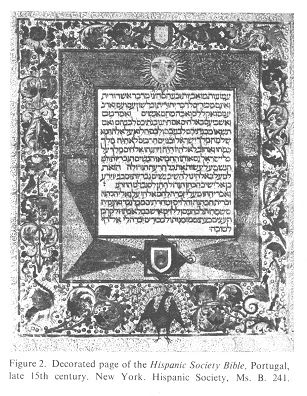

Encyclopaedia
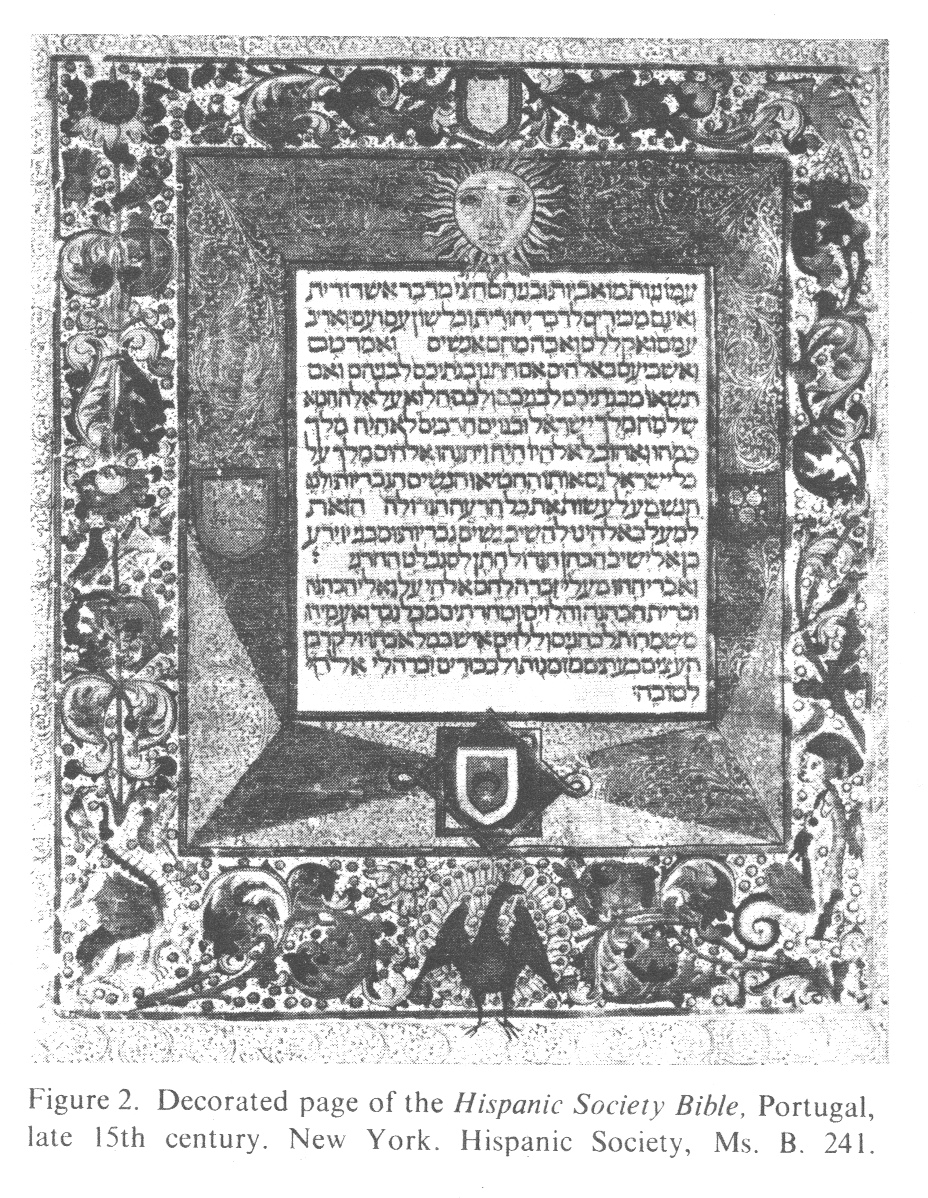
Judaica 1971: Portugal, vol. 13, col. 923, Bible with
Hebrew letters, 15th century
from: Portugal; In: Encyclopaedia Judaica 1971, vol. 13
presented by Michael Palomino (2008)
[15th century: Jewish
factor in the state machinery - envy and actions of the
church against the Jewish rights - taxes]
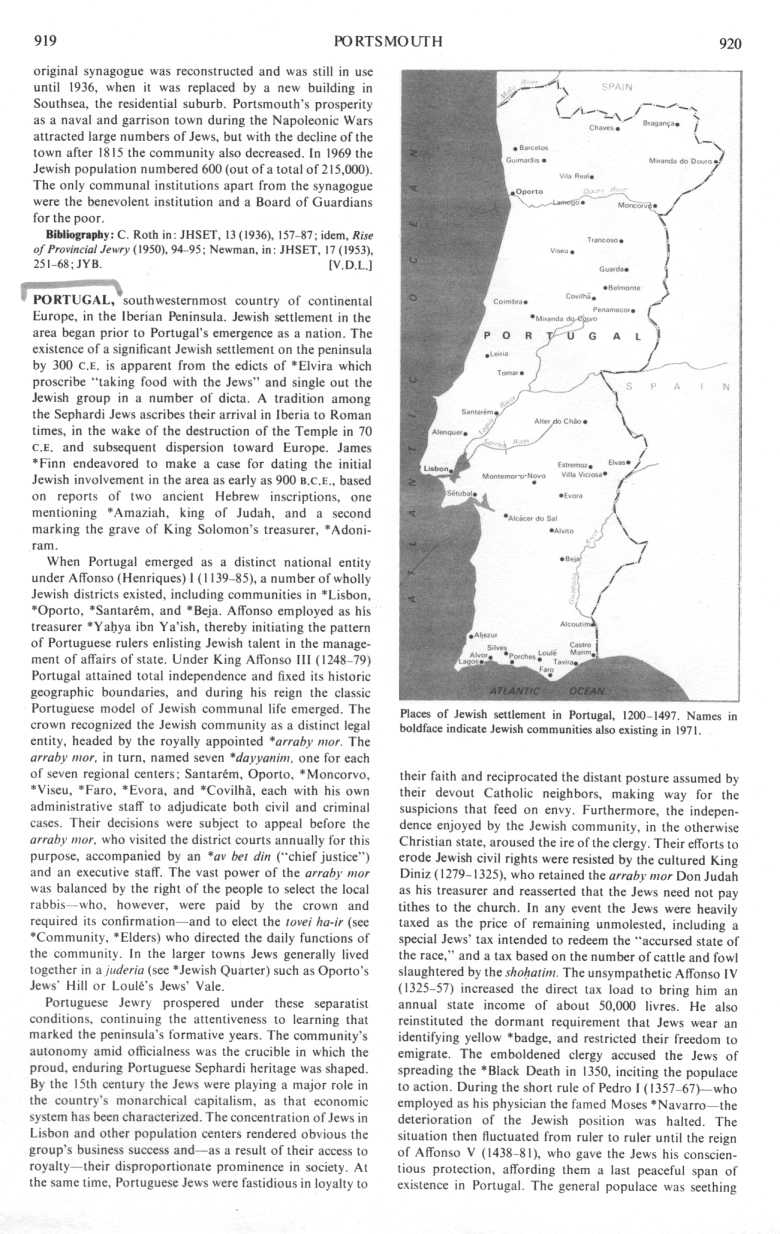
<By the 15th century the Jews were playing a major role
in the country's monarchical capitalism, as that economic
system has been characterized. The concentration of Jews in
Lisbon and other population centers rendered obvious the
group's business success and - as a result of their access
to royalty - their disproportionate prominence in society.
At the same time, Portuguese Jews were fastidious in loyalty
to (col. 919)
their faith and reciprocated the distant posture assumed by
their devout Catholic neighbors, making way for the
suspicions that feed on envy. Furthermore, the independence
enjoyed by the Jewish community, in the otherwise Christian
state, aroused the ire of the clergy. Their efforts to erode
Jewish civil rights were resisted by the cultured King Diniz
(1279-1325), who retained the
arraby mor Don Judah as his treasurer and
reasserted that the Jews need not pay tithes to the church.
In any event the Jews were heavily taxed as the price of
remaining unmolested, including a special Jews' tax intended
to redeem the "accursed state of the race", and a tax based
on the number of cattle and fowl slaughtered by the
shohatim [[ritual
slaughter]].
[King Affonso IV: further
special taxes, Jewish badge, and restrictions of movement
for the Jews - criminal church blames the Jews for the
Black Death - changing kings]
The unsympathetic Affonso IV (1325-57) increased the direct
tax load to bring him an annual state income of about 50,000
livres. He also reinstituted the dormant requirement that
Jews wear an identifying yellow *badge, and restricted their
freedom to emigrate. The emboldened clergy accused the Jews
of spreading the *Black Death in 1350, inciting the populace
to action. During the short rule of Pedro I (1357-67) - who
employed as his physician the famed Moses *Navarro - the
deterioration of the Jewish position was halted.
[Protection under Affonso V
- but pogroms and "Christian" assemblies with appeals to
reduce the Jewish influence]
The situation then fluctuated from ruler to ruler until the
reign of Affonso V (1438-81), who gave the Jews his
conscientious protection, affording them a last peaceful
span of existence in Portugal.
The general populace was seething (col. 920)
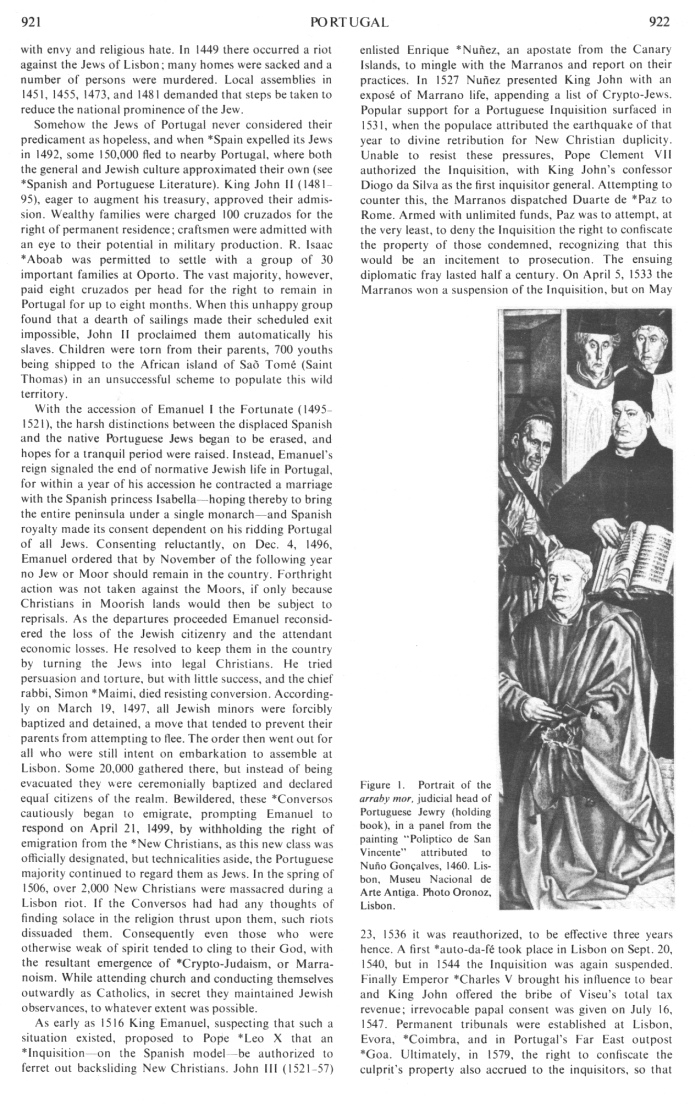
with envy and religious hate. In 1449 there occurred a riot
against the Jews of Lisbon; many homes were sacked and a
number of persons were murdered. Local assemblies in 1451,
1455, 1473, and 1481 demanded that steps be taken to reduce
the national prominence of the Jew.
[1492: Influx of some
150,000 Jews from Spain - taxes for the stay under King
John II - slavery and deportations to Saint Thomas]
Somehow the Jews of Portugal never considered their
predicament as hopeless, and when *Spain expelled its Jews
in 1492, some 150,000 fled to nearby Portugal, where both
the general and Jewish culture approximated their own (see
*Spanish and Portuguese Literature). King John II (1481-95),
eager to augment his treasury, approved their admission.
Wealthy families were charged 100 cruzados for the right of
permanent residence; craftsmen were admitted with an eye to
their potential in military production. R. Isaac *Aboab was
permitted to settle with a group of 30 important families at
Oporto. The vast majority, however, paid eight cruzados per
head for the right to remain in Portugal for up to eight
months.
When this unhappy group found that a dearth of sailings made
their scheduled exit impossible, John II proclaimed them
automatically his slaves. Children were torn from their
parents, 700 youths being shipped to the African island of
Saõ Tomé (Saint Thomas) in an unsuccessful scheme to
populate this wild territory.
[King Emanuel I the
Fortunate: Marriage with Spanish princess Isabella -
anti-Semitic resolutions for expulsion - Jews are leaving
- new strategy to prevent the losses for the state -
forced baptism - emigration movement]
With the accession of Emanuel I the Fortunate (1495-1521),
the harsh distinctions between the displaced Spanish and the
native Portuguese Jews began to be erased, and hopes for a
tranquil period were raised. Instead, Emanuel's reign
signaled the end of normative Jewish life in Portugal, for
within a year of his accession he contracted a marriage with
the Spanish princess Isabella - hoping thereby to bring the
entire peninsula under a single monarch - and Spanish
royalty made its consent dependent on his ridding Portugal
of all Jews.
Consenting reluctantly, on Dec. 4, 1496, Emanuel ordered
that by November of the following year no Jew or Moor should
remain in the country. Forthright action was not taken
against the Moors, if only because Christians in Moorish
lands would then be subject to reprisals. As the departures
proceeded Emanuel reconsidered the loss of the Jewish
citizenry and the attendant economic losses. He resolved to
keep them in the country by turning the Jews into legal
Christians. He tried persuasion and torture, but with little
success, and the chief rabbi, Simon *Maimi, died resisting
conversion.
Accordingly on March 19, 1497, all Jewish minors were
forcibly baptized and detained, a move that tended to
prevent their parents from attempting to flee. The order
then went out for all who were still intent on embarkation
to assemble at Lisbon. Some 20,000 gathered there, but
instead of being evacuated they were ceremonially baptized
and declared equal citizens of the realm.
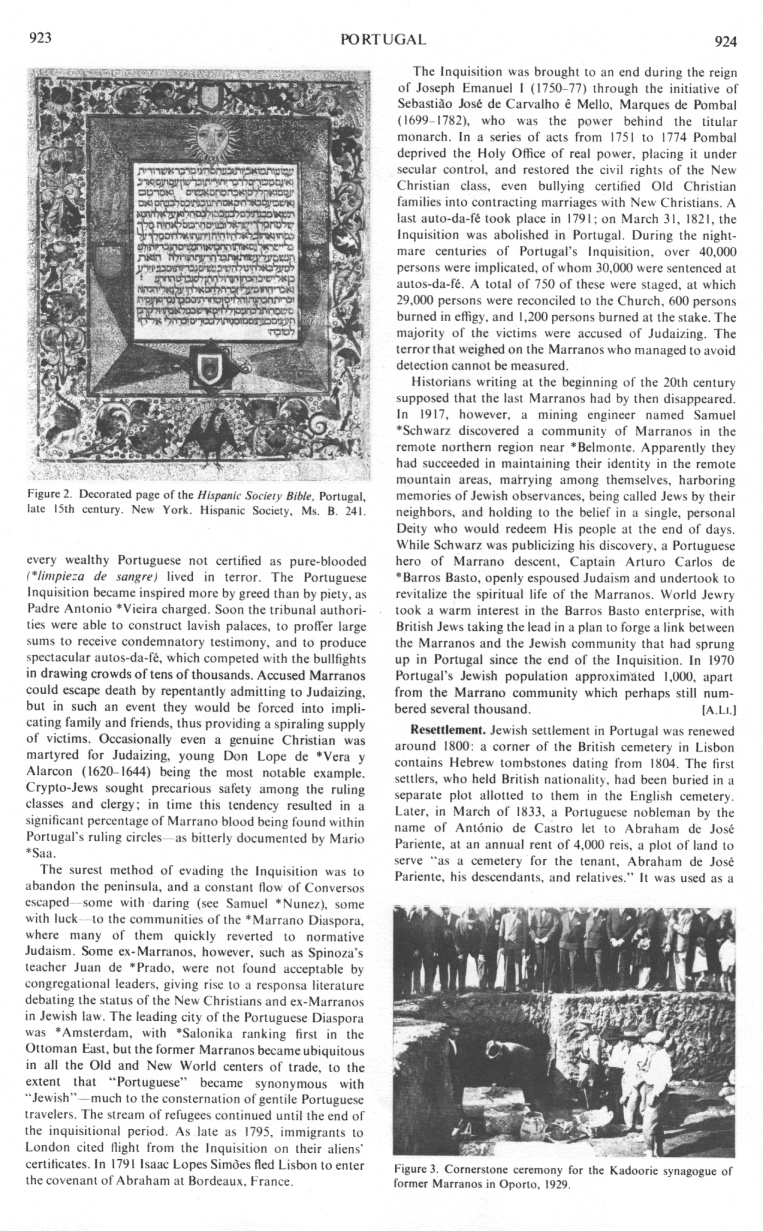
Bewildered, these *Conversos cautiously began to emigrate,
prompting Emanuel to respond on April 21, 1499, by
withholding the right of emigration from the *New
Christians, as this new class was officially designated, but
technicalities aside, the Portuguese majority continued to
regard them as Jews.> (col. 921)
Sources
|
Encyclopaedia Judaica 1971: Portugal, vol. 13,
col. 919-920 |
Encyclopaedia Judaica 1971: Portugal, vol. 13,
col. 921-922 |
Encyclopaedia Judaica 1971: Portugal, vol. 13,
col. 923-924 |
Encyclopaedia Judaica 1971: Portugal, vol. 13,
col. 925-926 |