Encyclopaedia Judaica
Jews in Portugal 04:
1800-1933
Jewish resettlement - detection of an old Marrano
community - conversion trend
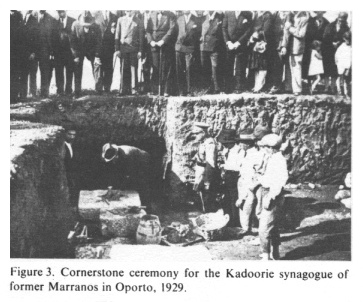
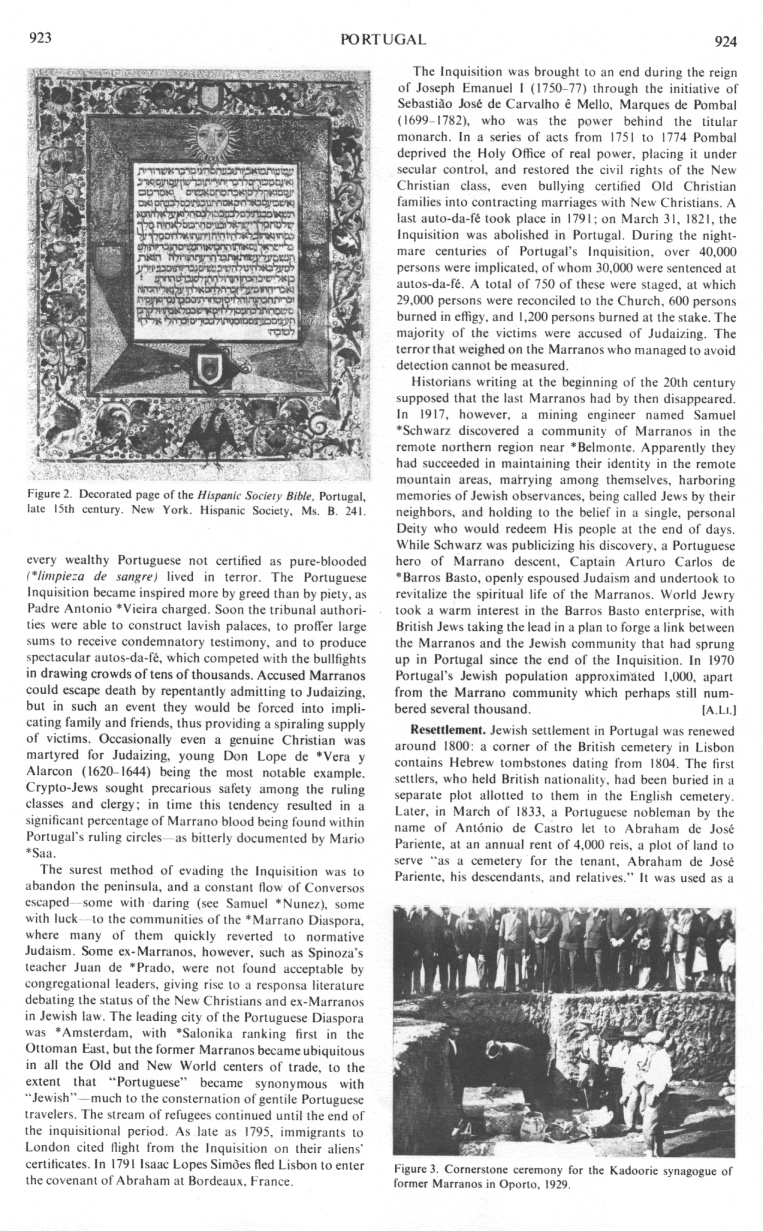
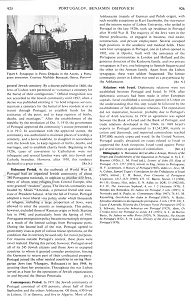
Encyclopaedia Judaica: Portugal, vol13, col.924: ceremony
for building a synagogue: cornerstone ceremony
for the Kadoorie synagogue of former marranos in Oportor,
1929
from: Portugal; In: Encyclopaedia Judaica 1971, vol. 13
presented by Michael Palomino (2008)
<Resettlement.
[British Jews coming to
Portugal - Jewish tombstones since 1804]
Jewish settlement in Portugal was renewed around 1800: a
corner of the British cemetery in Lisbon contains Hebrew
tombstones dating from 1804. The first settlers, who held
British nationality, had been buried in a separate plot
allotted to them in the English cemetery. Later, in March of
1833, a Portuguese nobleman by the name of António de Castro
let to Abraham de José Pariente, at an annual rent of 4,000
reis, a plot of land to serve "as a cemetery for the tenant,
Abraham de José Pariente, his descendants, and relatives."
It was used as a (col. 924)
general Jewish cemetery. By a decree published in 1868, the
Jews of Lisbon were permitted to "construct a cemetery for
the burial of their coreligionists". Official recognition
was not accorded to the Jewish community until 1892, when a
decree was published entitling it "to hold religious
services, maintain a cemetery for the burial of Jews
resident in or in transit through Portugal, to establish
funds for the assistance of the poor, and to keep registers
of births, deaths, and marriages." After the establishment
of the republic by the revolution of Oct. 5, 1910, the
government of Portugal approved the community's statute
presented to it in 1912. In accordance with the approved
statute, the community was authorized to maintain places of
worship, a cemetery, and a
hevra kaddisha, to slaughter in accordance
with the Jewish law, to keep registers of births, deaths,
and marriages, and to establish charity funds.> (col.
925)
[1917: Detection of a
community of Marranos - action of Barros Basto]
Historians writing at the beginning of the 20th century
supposed that the last Marranos had by then disappeared. In
1917, however, a mining engineer named Samuel *Schwarz
discovered a community of Marranos in the remote northern
region near *Belmonte. Apparently they had succeeded in
maintaining their identity in the remote mountain areas,
marrying among themselves, harboring memories of Jewish
observances, being called Jews by their neighbors, and
holding to the belief in a single, personal Deity who would
redeem His people at the end of days. While Schwarz was
publicizing his discovery, a Portuguese hero of Marrano
descent, Captain Arturo Carlos de *Barros Basto, openly
espoused Judaism and undertook to revitalize the spiritual
life of the Marranos. World Jewry took a warm interest in
the Barros Basto enterprise, with British Jews taking the
lead in a plan to forge a link between the Marranos and the
Jewish community that had sprung up in Portugal since the
end of the Inquisition.> (col. 924)
[since 1920s: often
conversions to Catholicism]
Beginning in the 1920s, cases of conversion to Catholicism
were not infrequent and several families were split into
Jewish and Catholic branches.> (col. 925)
Sources
|
Encyclopaedia Judaica 1971: Portugal, vol. 13,
col. 919-920 |
Encyclopaedia Judaica 1971: Portugal, vol. 13,
col. 921-922 |
Encyclopaedia Judaica 1971: Portugal, vol. 13,
col. 923-924 |
Encyclopaedia Judaica 1971: Portugal, vol. 13,
col. 925-926 |