Encyclopaedia Judaica
Jews in Portugal 03:
Inquisition and Jews at stake
Massacre of 1506 enforces secret Judaism - criminal
Catholic Church struggles for an Inquisition - Jews at
stake - Inquisition law until 1821
from: Portugal; In: Encyclopaedia Judaica 1971, vol. 13
presented by Michael Palomino (2008)
[1506: 2,000 New Christians
massacred - secret Judaism is enforced]
In the spring of 1506, over 2,000 New Christians were
massacred during a Lisbon riot. If the Conversos had had any
thoughts of finding solace in the religion thrust upon them,
such riots dissuaded them. Consequently even those who were
otherwise weak of spirit tended to cling to their God, with
the resultant emergence of *Crypto-Judaism, or Marranoism.
While attending church and conducting themselves outwardly
as Catholics, in secret they maintained Jewish observances,
to whatever extent was possible.
[Efforts for an Inquisition
- Jewish ambassador Duarte de Paz in Rome against the
Inquisition]
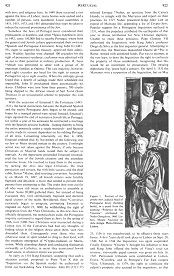
As early as 1516 King Emanuel, suspecting that such a
situation existed, proposed to Pope *Leo X that an
*Inquisition - on the Spanish model - be authorized to
ferret out backsliding New Christians. John III (1521-57)
(col. 921)
enlisted Enrique *Nuñez, an apostate from the Canary
Islands, to mingle with the Marranos and report on their
practices. In 1527 Nuñez presented King John with an exposé
of Marrano life, appending a list of Crypto-Jews. Popular
support for a Portuguese Inquisition surfaced in 1531, when
the populace attributed the earthquake of that year to
divine retribution for New Christian duplicity.
Unable to resist these pressures, Pope Clement VII
authorized the Inquisition, with King John's confessor Diogo
da Silva as the first inquisitor general. Attempting to
counter this, the Marranos dispatched Duarte de *Paz to
Rome. Armed with unlimited funds, Paz was to attempt, at the
very least, to deny the Inquisition the right to confiscate
the property of those condemned, recognizing that this would
be an incitement to prosecution. The ensuing diplomatic fray
lasted half a century. On April 5, 1533 the Marranos won a
suspension of the Inquisition, but on May 23, 1936 it was
reauthorized, to be effective three years hence.
[Jewish property
confiscated and Jews at stake by the Inquisition]
A first *auto-da-fé took place in Lisbon on Sept. 20, 1540,
but in 15444 the Inquisition was again suspended. Finally
Emperor *Charles V brought his influence to bear and King
John offered the bribe of Viseu's total tax revenue;
irrevocable papal consent was given on July 16, 1547.
Permanent tribunals were established at Lisbon, Evora,
*Coimbra, and in Portugal's Far East outpost *Goa.
Ultimately, in 1579, the right to confiscate the culprit's
property also accrued to the inquisitors, so that (col. 922)
every wealthy Portuguese not certified as pure-blooded (
*limpieza de sangre)
lived in terror.The Portuguese Inquisition became inspired
more by greed than by piety, as Padre Antonio *Vieira
charged. Soon the tribunal authorities were able to
construct lavish palaces, to proffer large sums to receive
condemnatory testimony, and to produce spectacular
autos-da-fé, which competed with the bullfights in drawing
crowds of tens of thousands. Accused Marranos could escape
death by repentantly admitting to Judaizing, but in such an
event they would be forced into implicating family and
friends, thus providing a spiraling supply of victims.
Occasionally even a genuine Christian was martyred for
Judaizing, young Don Lope de *Vera y Alarcon (1620-1644)
being the most notable example. Crypto-Jews sought
precarious safety among the ruling classes and clergy; in
time this tendency resulted in a significant percentage of
Marrano blood being found within Portugal's ruling circles -
as bitterly documented by Mario *Saa.
[The emigration from
Portugal to Amsterdam, Salonika, and other places]
The surest method of evading the Inquisition was to abandon
the peninsula, and a constant flow of Conversos escaped -
some with daring (see Samuel *Nunez), some with luck - to
the communities of the *Marrano Diaspora, where many of them
quickly reverted to normative Judaism. Some ex-Marranos,
however, such as Spinoza's teacher Juan de *Prado, were not
found acceptable by congregational leaders, giving rise to a
response literature debating the status of the New
Christians and ex-Marranos in Jewish law. The leading city
of the Portuguese Diaspora was *Amsterdam, with *Salonika
ranking first in the Ottoman East, but the former Marranos
became ubiquitous in all the Old and New World centers of
trade, to the extent that "Portuguese" became synonymous
with "Jewish" - much to the consternation of gentile
Portuguese travelers.
The stream of refugees continued until the end of the
inquisitional period. As late as 1795, immigrants to London
cited flight from the Inquisition on their aliens'
certificates. In 1791 Isaac Lopes Simões fled Lisbon to
enter the covenant of Abraham at Bordeaux, France. (col.
923)
[1791: Last auto-da-fé -
1821: Inquisition abolished - balance of the Inquisition:
1,200 persons burnt]
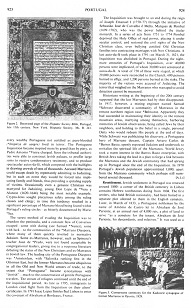
The Inquisition was brought to an end during the reign of
Joseph Emanuel I (1750-77) [[?]] through the initiative of
Sebastião José de Carvalho ê Mello, marques de Pombal
(1699-1782), who was the power behind the titular monarch.
In a series of acts from 1751 to 1774 Pombal deprived the
Holy Office of real power, placing it under secular control,
and restored the civil rights of the New Christian class,
even bullying certified Old Christian families into
contracting marriages with New Christians. A last auto-da-fé
took place in 1791: on March 31, 1821, the Inquisition was
abolished in Portugal.
During the nightmare centuries of Portugal's Inquisition,
over 40,000 persons were implicated, of whom 30,000 were
sentenced at autos-da-fé. A total of 750 of these were
staged, at which 29,000 persons were reconciled to the
Church, 600 persons burned in effigy, and 1,200 persons
burned at the stake. The majority of the victims were
accused of Judaizing. The terror that weighed on the
Marranos who managed to avoid detection cannot be
measured.> (col. 924)
Sources
|
Encyclopaedia Judaica 1971: Portugal, vol. 13,
col. 919-920 |
Encyclopaedia Judaica 1971: Portugal, vol. 13,
col. 921-922 |
Encyclopaedia Judaica 1971: Portugal, vol. 13,
col. 923-924 |
Encyclopaedia Judaica 1971: Portugal, vol. 13,
col. 925-926 |