<SPAIN,
country in S.W. Europe.
[Jews in Spain - the
legends since biblical times]
According to various legends, there were Jews living in
Spain in biblical times, but no proof exists in support of
such stories. Most probably, the first group of Jews
settled there under the Roman Empire and the communities
grew rapidly. A tombstone inscription attests the presence
of Jews in Adra (the ancient Abdera) in the third century
C.E. They thus witnessed the conversion of the inhabitants
of the Peninsula to Christianity, which is probably why
the Council of *Elvira (305) attempted to effect or
maintain a separation between the members of the two
faiths by forbidding Christians to live in the houses of
Jews, or to eat in their company, or to bless the produce
of their fields.
Under Visigothic Rule.
[The court in Toledo and
the Catholic Visigothic kings]
The weakening of the empire and the arrival of the
Visigoths changed the face of Spain. From their court in
Toledo they attempted to restore the shattered Hispanic
unity, initially on the religious plane, through the
conversion of their king Reccared, originally an Arian, to
Catholicism (587). Subsequently, in the political sphere,
King Sisebut (612-21) broke down the last Byzantine
stronghold in Spain. It is therefore hardly surprising
that the *Church councils of Toledo, which were as much
political as religious assemblies, should have played so
important a role in the Visigothic state, and thus in the
determination of its policy toward the Jews.
[Forced Catholicism -
forced conversions or expulsion under King Sisebut -
more tolerance under King Swintila - reversion law under
King Sisenand - anti-Jewish law under King Chintila]
As in the case of all other subjects, the policy was to
have them adopt Catholicism, which had by then become the
state religion. Reccared approved the decision of the
third Council of Toledo (589) laying down that the
children of a mixed Jewish-Christian marriage should be
baptized by force. Going even further, Sisebut inaugurated
a policy of forcible conversion of all the Jews in the
kingdom. From 613 they were ordered to be baptized or
leave the kingdom. Thousands of Jews then left Spain,
while others were converted.
Most of the latter, however, took the opportunity of
returning to Judaism under the rule of his more tolerant
successor Swintila (621-31). They were joined at this time
by a number of exiles returning to Spain.
At that period the official Church doctrine on conversion
was formulated: Jews must not be baptized by force, and
the fourth Council of Toledo (633) accepted this. King
Sisenand (631-36) supported this attitude but, like the
council, insisted that those Jews who had been converted
by Sisebut and reverted to Judaism under Swintila must
return to Christianity.
However, this relatively moderate attitude was revoked
again under King Chintila (636-39) who compelled the sixth
Council of Toledo (638) to adopt a resolution proclaiming
that only Catholics might reside in the kingdom of Spain;
he even anathematized those of his successors who did not
hold to his decrees against the Jews. (col. 220)
Numerous Jews accepted baptism and signed a declaration
that they would respect Christian rites; others chose
exile.
[King Chindaswinth:
tolerance - King Recceswinth: prohibition of Jewish laws
- dominating Jewish law]
Under Chintila's successor, Chindaswinth (641-49), the
application of these laws had been neglected to such an
extent that his successor, Recceswinth (649-72) complained
to the eighth Council of Toledo (653) about the presence
of Jews in the kingdom. Probably some of the exiles had
come back and some of the converts had returned to
Judaism. The king commanded that they be brought back
within the fold of Christianity, by force if necessary.
Those who had relapsed had to sign a new declaration,
promising to be good Catholics, to reject all Jewish
rites, and to execute themselves those of their erring
brethren who backslid into Judaism.
However, they were permitted to abstain from eating pork,
which they abhorred. The king decided not to drive the
unconverted Jews to the font but to make it impossible for
them to practice Judaism by prohibiting circumcision and
forbidding them to celebrate the Sabbath and the
festivals. However, these ordinances were honored more in
the breach than in the observance and, thanks to various
allies, even among the clergy, the Jews were able to
survive in Spain; so much so that the tenth Council of
Toledo had to remind Christians that they were obliged to
observe the laws relating to the Jews.
[King Wamba expelling
some Jews - King Erwig: forced baptism - expelled Jews -
punished helpers - clergy as anti-Jewish instrument of
the king]
The next king, Wamba (672-80), expelled the Jews from
Narbonne and probably also from Septimania (then part of
Spain), but they did not all leave the Visigothic kingdom.
They were there when Erwig (680-87) convoked the 12th
Council of Toledo to obtain in spite of the traditional
ruling of the Church, the forced baptism of the Jews.
Within a year every Jew had to forswear Judaism, accept
baptism for himself and his family, and pledge his
fidelity to the Christian faith. Those who refused were to
be penalized by having their belongings seized, by
corporal punishment, and finally by exile.
Similar penalties were to be imposed on those who,
baptized or not, observed Jewish rites. The priests were
to gather all the Jews in the churches to read out to them
the text of the law so that none could claim he was
unaware of it. Any noble who helped the Jews to evade
these laws was to lose his rights over the Jews and pay a
heavy fine.
The execution of the laws was the task of the clergy, the
king reserving several penalties for them if they were lax
in carrying out his orders. Yet the Jews continued to
Judaize and even to attack Christianity on some occasions
for the king could not count on the assistance of his
people in carrying out the whole of his anti-Jewish
policy.
[King Egica: forced
baptism and enticements to become a Christian -
anti-Jewish laws - forced sale of slaves, land, and good
- prohibition of trade with Christians]
His successor, Egica (687-702), reversed his attitude,
restating once more the prescription on forced baptism and
suppressing those disqualifications which oppressed
converted Jews, while at the same time increasing the
benefits to be gained from becoming Christian. He passed
several measures tending to impoverish the Jews and make
it impossible for them to buy protection from powerful
nobles. They were forced to sell, at a price fixed by the
king, all slaves, buildings, lands, and vineyards which
they had acquired from Christians. On pain of perpetual
servitude and confiscation of their goods, they were
forbidden to conduct commercial transactions with
Christians or overseas. At the same time their taxes were
considerably increased.
[Rumors that Jews would
welcome the Muslim invaders - Jews given into hands of
Christian "masters" - slavery]
In spite of its ratification by the 16th Council of Toledo
(693), this policy was unsuccessful. Soon it was rumored
that the persecuted Jews were thinking of appealing to the
Muslim invaders, who had shown themselves to be decidedly
more tolerant than the Visigoths. Alarmed, Egica convened
a 17th council on Nov. 9, 694, accusing the Jews of
treason and demanding that the severest measured be taken
against them. Declared as slaves and their possessions
confiscated, all the Jews of Spain were given into the
hands of Christian masters in various (col. 221)
provinces. Their masters were charged to see that they did
not practice Jewish rites and to take their children to be
brought up from the age of seven by Christian tutors and
later married to Christians. Those Jews who were able to,
escaped; the rest were taken into servitude.
[S.SCH.]> (col. 222)


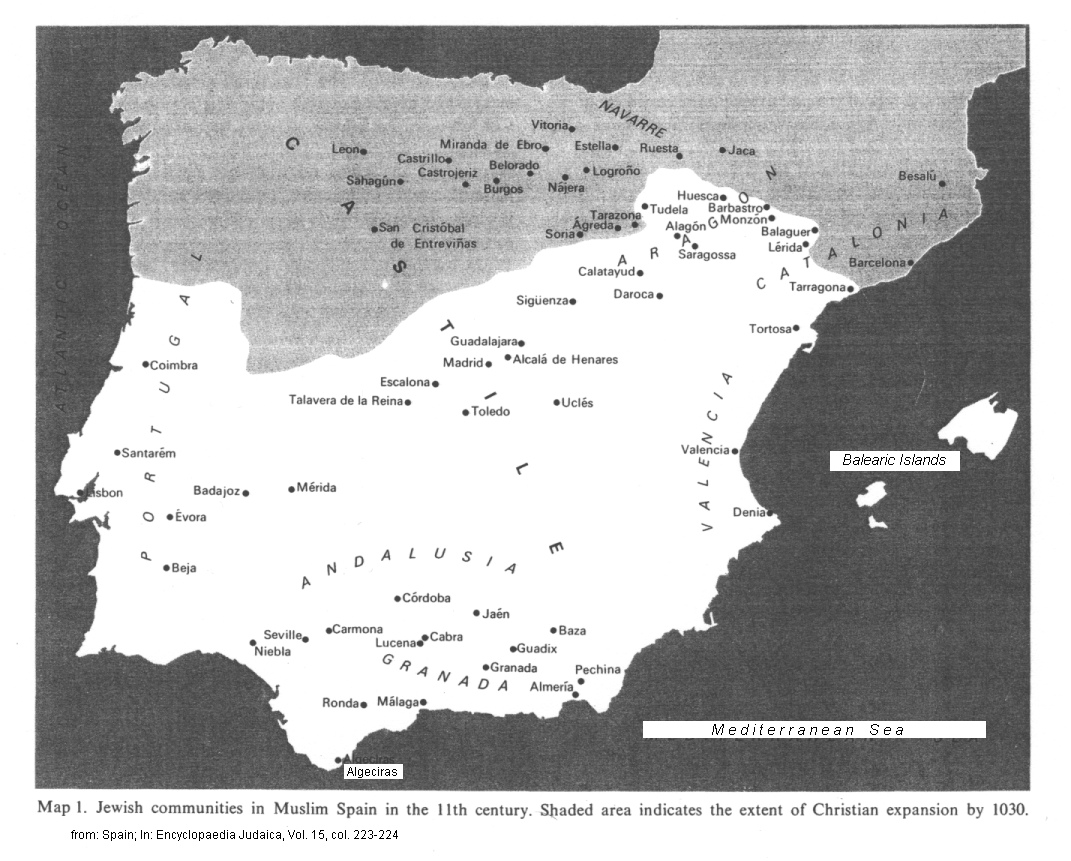
Encyclopaedia Judaica 1971: Spain, vol. 15, col. 223-224, map of the Jewish communities of the 11th century