Under the Republic of Turkey (from 1923).
[[There is no indication in the Encyclopaedia Judaica
about World War I and about the Greek invasion under the
order of the League of Nations and the national fight
under Atatürk against the Greek army 1919-1923]].
[National Turkish state and Ataturk's measures
- Turkish and French - no Herzl Zionism allowed -
secularization of all schools in 1932]
The national and secular nature of the Turkish state,
which was created by Kemal Ataturk, severely affected
the position of the Jews in Istanbul. As mentioned, the
laws giving religious autonomy to the Jewish community
were allowed to lapse and the millet system [[Ottoman minority
protection system]] was abolished.
Matters such as personal status (e.g., marriage) were
under civil jurisdiction. the community lost the right
to levy its own taxes, causing communal institutions to
depend for support on voluntary contributions. The
measures of secularization affected not only the Jews
but, in general, all non-Muslims. In accord with this
policy Turkish became the language of instruction in the
schools instead of French (which was used in the
"Alliance Israélite Universelle schools as throughout
the Middle East and North Africa); the use of French was
allowed to continue for a time in the upper forms. The
government proscribed the affiliation of any local
groups with foreign organizations. Jews, therefore, were
prohibited from being represented on such international
Jewish bodies as the World Zionist Organization, the
World Jewish Congress, etc.
In 1932 the schools in Turkey were secularized, in
accordance with the character of the state, and
religious instruction was prohibited.
[1942: non-Muslim tax regulation - many
non-Muslims are ruined]
As other non-Muslim subjects, the Jews of Istanbul were
most severly affected by the imposition of the capital
levy (varlik vergisi) of 1942. Many of those who could
not meet these levy payments were compelled to sell
their property or have it auctioned.
[[In 1944 the tax regulation was abolished and the
depths were abolished also, see *Turkey.
And: Istanbul was an important stopover of Jewish
refugees driven and organized by secret Jewish Zionist
Herzl organizations from Eastern Europe over the Black
Sea to Herzl Israel or overseas, which is not
indicated]].
Contemporary Period (from 1948)
[New tolerance since 1949 - Jewish schools,
Jewish students - Jewish positions - emigrations to
Herzl Israel]
In 1949 the Turkish National Assembly passed a law which
granted the Jewish community autonomy in its internal
affairs. This law had been proposed by the Jewish
delegate in the house of representatives, Solomon Adato.
Religious instruction, which until then had been
restricted exclusively to the synagogues, was permitted
in schools as part of the normal (col. 1095)
curriculum. A large number of Jews attended the
government schools and continued their studies at the
universities. The general educational standard of the
Jews of Istanbul was improved as a result of the
powerful influence of the Alliance Israélite
Universelle. Jewish physicians, lawyers, and engineers
of the community played an important role in the life of
the country and Jews were also well represented in its
commerce. They were rarely employed in the civil
services.
The number of Jews in Istanbul estimated at 55,000 in
1948, dropped to 32,946 and 30,831 in the 1955 and 1965
censuses as a result of the large-scale emigration to
the State of [[Herzl]] Israel. In 1970 an estimated
30,000 Jews lived in Balat, Hasköy, Ortaköy, and other
quarters. The wealthy lived in the Per'a and Sisli
neighborhoods.
Table. Number of Jews in Istanbul
|
Year
|
number of Jews
|
1906 approx.
|
100,000
|
1948
|
55,000
|
1955
|
32,946
|
1965
|
30,831
|
Table by Michael
Palomino; from: Istanbul; In: Encyclopaedia
Judaica 1971, Vol. 9, col. 1095 and 1096
|
[[A considerable part of the Jewish emigrants who
emigrated to Herzl Free Mason CIA Israel remigrated back
to Turkey because of several reasons: The conditions in
Turkey had ameliorated, see *Turkey
after
1945 (Vol. 15, col. 1460), or what the
Encyclopaedia Judaica is not saying: The conditions in
Herzl Free Mason CIA Israel were bad for the Sephardi
Jews from Turkey and they had to live in desert tent
camps for years, because Ashkenazi Jews from Central and
Eastern Europe had first priority in Herzl Israel. So,
lots of Turkish Jews came back]].
[Structures of the Jewish community in Istanbul
after 1945]
The Achgaha ("congregation") in the above-mentioned and
six other quarters elects a committee which constitutes
the members of the city's general community council.
This is comprised of 60 men, including a few members of
the Ashkenazi congregation. The general council elects
the president of the community and administrative and
religious committees.
Each congregation also has a rabbi. The The council's
income is derived from dues, synagogue contributions,
and donations. By 1950 the general council numbered only
42 members, since for several years new members were not
elected to replace those who had died or emigrated. In
1950 elections were held to fill the 18 vacancies.
Samuel Abrevaya was elected president of the community,
and held the post until his death in 1953. He was
succeeded by Henri Soriano and, later, Israel Menase.
Until 1953 Istanbul Jewry had no official chief rabbi
recognized by the authorities. In that year R. Raphael
Saban was chosen.
[Situation 1968]
In 1968 the following institutions were supervised by
the community's general council: the Or Hayyim Hospital
(built in 1885); an orphanage; the Zedakah u-Marpe
charitable organization (founded in 1918), which was
responsible for the education of underprivileged
students; (col. 1096)
an old-age home (founded in 1899); a Mahzikei Torah
organization, which provided training one day a week for
cantors and mohalim
[[ritual experts in circumcision]]; and the Mishneh
Torah association, which helped poor students.
In 1968 the community also had three elementary schools
and a high school. In 1966 the attendance figures at
these schools were 950 pupils, most of them poor, since
the wealthy Jews preferred to send their children to
foreign schools. There were also Jewish youth
organizations in Istanbul in 1968, such as Ne'oemanei
Zion, Amical, and others, some of which undertook a
certain amount of Hebrew education.
For further information, see *Turkey.
[H.J.C.]> (col. 1097)
[Jewish
printing in Istanbul in gradual decline]
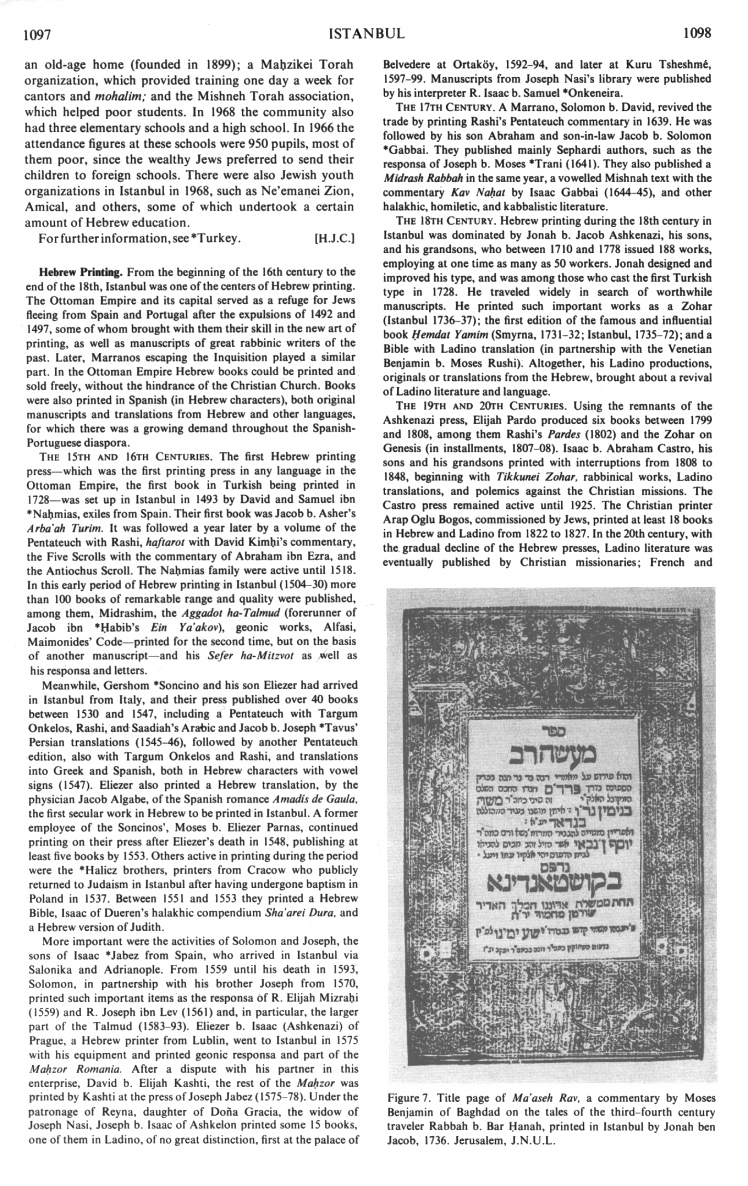
<In the 20th century, with the
gradual decline of the Hebrew presses, Ladino literature
was eventually published by Christian missionaries;
French and (col. 1098)
English literature in Ladino was published by Greek and
Armenian printers.
[A.H. / J.GEL.]