<Cultural, Religious, and Social Life.
[Close of the Hebrew press in 1944 - chief
rabbis]
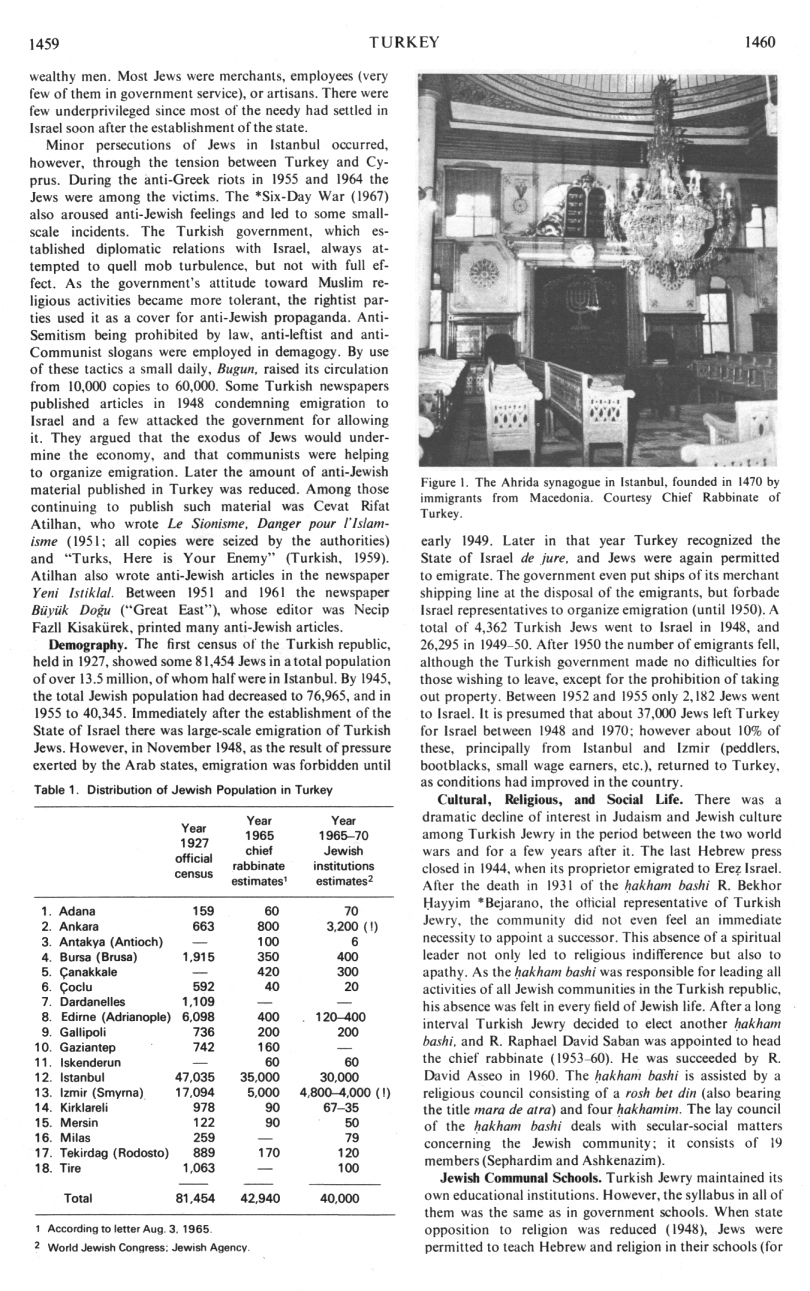
There was a dramatic decline of interest in Judaism and
Jewish culture among Turkish Jewry in the period between
the two world wars and for a few years after it. The
last Hebrew press closed in 1944, when its proprietor
emigrated to Erez Israel.
After the death in 1931 of the hakham bashi [[chief rabbi]] R. Bekhor
Hayyim *Bejarano, the official representative of Turkish
Jewry, the community did not even feel an immediate
necessity to appoint a successor. This absence of a
spiritual leader not only led to religious indifference
but also to apathy. As the hakham bashi was responsible for
leading all activities of all Jewish communities in the
Turkish republic, his absence was felt in every field of
Jewish life. After a long interval Turkish Jewry decided
to elect another hakham
bashi, and R. Raphael David Saban was appointed
to head the chief rabbinate (1953-60). He was succeeded
by R. David Asseo in 1960. The hakham bashi is assisted by a
religious council consisting of a rosh bet din
[[court]] (also bearing the title mara de atra) and
four hakhamim
[[wise men]]. The lay council of the hakham bashi deals
with secular-social matters concerning the Jewish
community; it consists of 19 members (Sephardim and
Ashkenazim).
Jewish Communal Schools.
[No Zionism - Turkish and Ladino - Hebrew only
for prayers permitted]
Turkish Jewry maintained its own educational
institutions. However, the syllabus in all of them was
the same as in government schools. When state opposition
to religion was reduced (1948), Jews were permitted to
teach Hebrew and religion in their schools (for (col.
1460)
following the prayers). The Turkish government forbade
all Zionist activity as well as the existence of
organizations with centers abroad which propagated
non-Turkish nationalism. Since most Jewish children
attended school, illiteracy fell, and almost all of them
spoke Turkish, although most of them also spoke Ladino.
Istanbul had four Jewish communal schools and one high
school (founded in 1922 as Lycée Juif [[Jewish grammar
school]] by the *Bnai Brith Lodge). The Turkish language
was the compulsory medium of instruction in all state
schools, and in private schools at the primary level.
The Jewish schools obtained permission to give one
course in elementary Hebrew, needed for reciting the
prayers, but not to give instruction in Jewish history
and literature.
[Alphabet question 1928 - Ladino newspapers in
Latin scripture - Jewish publications in Turkish or
French - young Jewish generation is not Jewish fanatic
any more - mixed marriages]
Abraham *Galanté was one of the enthusiastic supporters
of the spread of Turkish and one of the sponsors of
replacing the Arabic script by the Latin alphabet
(1928). Ladino periodicals, which had previously
appeared in Hebrew script, began to be printed in Latin
characters. Two of them in Istanbul, Shalom (edited by
Avram Leyon) and La
Vera Luz (edited by Eliezer Menda), survived; a
third, Étoile du
Lévant [["Levantene Star"]], published in
French, ceased in 1948. The monthly periodical (later a
quarterly) Hamenorah
[["The candlestand"]] published by the B'nai
B'rith (1923-38) and edited by David Marcus in three
languages (Hebrew, Ladino, and French), carried many
important articles concerning the history of Ottoman
Jewry.
Present-day Jewish writers published their works in
Turkish or French. The Jewish poet Joseph Habib *Gerez
wrote in Turkish and described the glories of Istanbul.
The library of the chief rabbinate was little used, and
Italian Jews made efforts to promote interest in
religion and culture. The Turkish authorities have not
hindered Jews from religious observance. Nevertheless,
most of the younger generation in the 1960s was not
observant, and some young people were entirely ignorant
of Judaism. The number of marriages to non-Jews
increased.
[Jewish institutions: rabbinical seminary since
1955 - religious schools with Hebrew lessons]
Turkish Jewry also had a rabbinical seminary (see below)
located in Istanbul. There were about 2,000 pupils in
these institutions. The Mahazikei Torah
institutions provided (col. 1461)
religious instruction (and elementary Hebrew language
courses) in the evenings and Sunday mornings (Sunday
being the official rest day in the Turkish republic) for
Jewish boys and girls who attended the Turkish state
schools where no Hebrew was taught. The Mahazikei Torah
also trained religious functionaries: hazzanim
[[cantors]], shohatim [[ritual slaughterers]], mohalim
[[circumcisers]].
The rabbinical seminary was established in Istanbul in
1955, and about 50 students were registered in the
mid-1960s, some of whom were awarded rabbinic
ordination. After years of general decline in Jewish
life this indicated noticeable progress and a reaction
to the general apathy in Jewish education.
By 1971 Izmir had the second largest Jewish community in
modern Turkey, with between approximately 2,000 and
4,000 Jewish inhabitants. It had two Jewish elementary
schools and a secondary one. Other communities were too
small to have their own schools.
The usual Jewish philanthropic and social institutions
also exist in Istanbul and Izmir: orphanages, hospitals,
assistance for poor, etc., all supervised by the Türkiye
Hahambashiliği, the chief rabbinate of Turkey (letter
from the hakham bashi
dated Aug. 3, 1965).
<Contemporary
Situation.
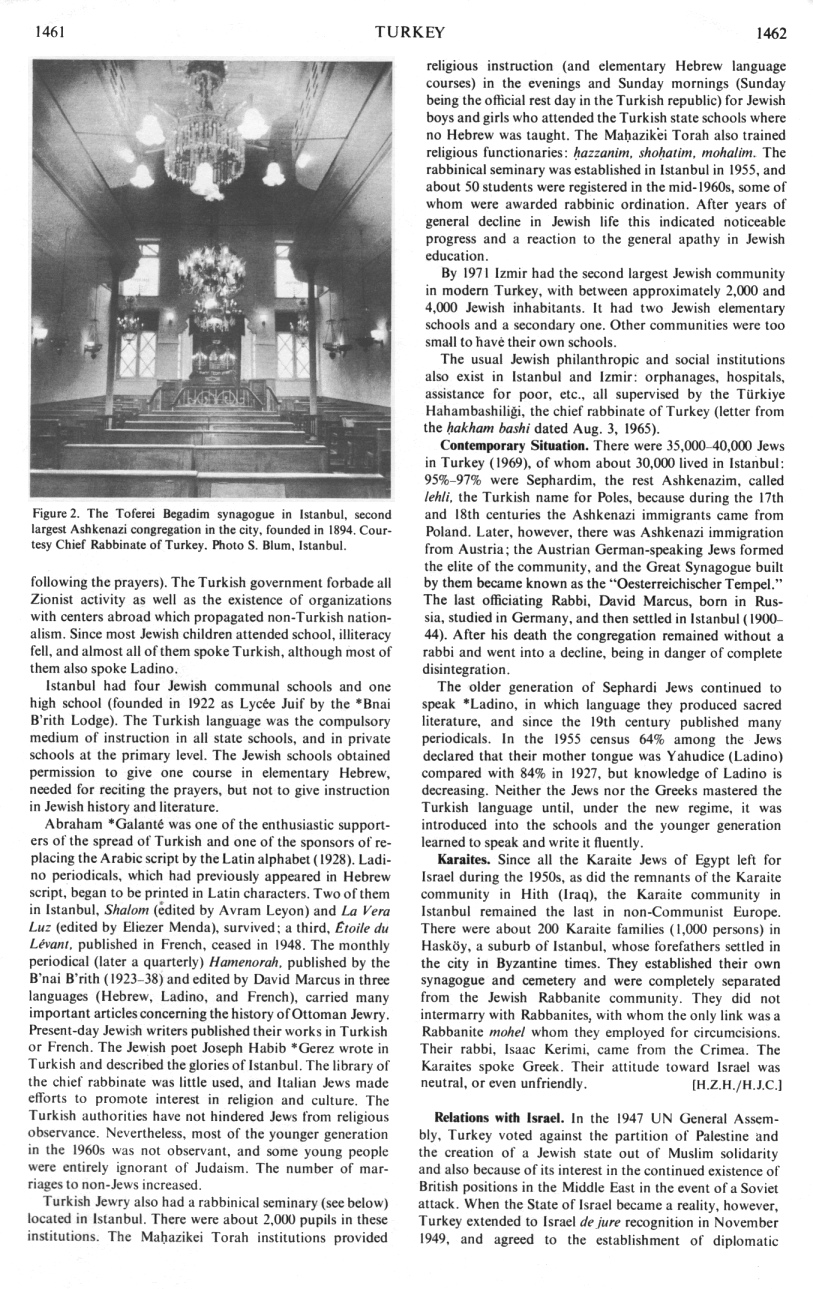
There were 35,000-40,000 Jews in Turkey (1969), of whom
about 30,000 lived in Istanbul: 95%-97% were Sephardim,
the rest Ashkenazim, called lehli, the Turkish name for Poles,
because during the 17th and 18th centuries the Ashkenazi
immigrants came from Poland. Later, however, there was
Ashkenazi immigration from Austria; the Austrian
German-speaking Jews formed the elite of the community,
and the Great Synagogue built by them became known as
the "Oesterreichischer Tempel" [["Austrian Temple"]].
The last officiating Rabbi, David Marcus, born in
Russia, studied in £Germany, and then settled in
Istanbul (1900-44). After his death the congregation
remained without a rabbi and went into a decline, being
in danger of complete disintegration.
[Language situation: more Turkish, less Ladino]
The older generation of Sephardi Jews continued to speak
*Ladino, in which language they produces sacred
literature, and since the 19th century published many
periodicals. In the 1955 census 64% among the Jews
declared that their mother tongue was Yahudice (Ladino)
compared with 84% in 1927, but knowledge of Ladino is
decreasing. Neither the Jews nor the Greeks mastered the
Turkish language until, under the new regime, it was
introduced into the schools and the younger generation
learned to speak and write it fluently.
Karaites.
Since all the Karaite Jews of Egypt left for Israel
during the 1950s, as did the remnants of the Karaite
community in Hith (Iraq), the Karaite community in
Istanbul remained the last in non-Communist Europe.
There were about 200 Karaite families (1,000 persons) in
Hasköy, a suburb of Istanbul, whose forefathers settled
in the city in Byzantine times. They established their
own synagogue and cemetery and were completely separated
from the Jewish Rabbinate community. They did not
intermarry with Rabbanites with whom the only link was a
Rabbanite mohel
whom they employed for circumcisions. Their rabbi, Isaac
Kerimi, came from the Crimea. The Karaites spoke Greek.
Their attitude toward Israel was neutral, or even
unfriendly.
[H.Z.H. / H.J.C.]> (col. 1462)
[[It seems the Karaites understood that a Herzl Free
Mason CIA Israel with a colonial program against the
Arabs cannot be good for worldwide Jewry. So they said
no to the Zionist project]].