

Encyclopaedia Judaica
Jews in Russia 04: World War I, revolutions of 1917 an civil war massacres
Allegations, deportations and mass flight 1915 - socialist revolution and communist revolution 1917 - Balfour declaration and racist Zionist power coming up - civil war with anti-Semitic armies and massacres - Jewish self-defense
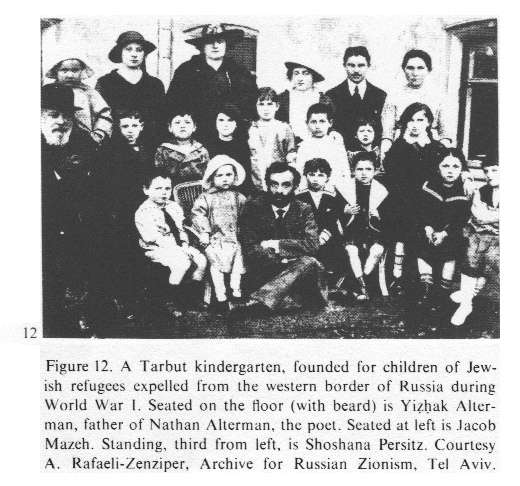
Encyclopaedia Judaica (1971): Russia, vol. 14, col. 447-448, a Tarbut kindergarten, founded for children
of Jewish refugees expelled from the western border of Russia during WW I
from: Russia; In: Encyclopaedia Judaica 1971, vol. 14
presented by Michael Palomino (2008)

| Teilen / share: |
Facebook |
|
Twitter
|
|
|
|
WORLD WAR I. [The criminal German and Austrian Emperors]
[[Addition: The war reason of World War I - the Germanization of whole Europe by stupid Germany and Austria and criminal German Emperors Wilhelm II and Emperor Franz Josef I - is never mentioned in this article. Since Hitler's accession to power the streets and places in stupid Germany and Austria are renamed after Emperors like Wilhelm II Franz Josef I and the stupid Germans and Austrians are not giving up the habit to admire their criminal Emperors. Wilhelm II and Franz Josef I are not the only criminal Emperors who are glorified by German and Austrian street and square names...]]
[1914-1915: The futile Jewish hopes for emancipation - the anti-Semitic generals blame the Jews for Russian defeats - trials, deportations and expulsions]
<Russian Jewry, while regarding World War I with some fear, felt that their participation in the defense of Russia would bring about the abolition of their second-class status. The course of events did not however justify this anticipation [[speculation]]. The mobilization affected about 400,000 Jews of whom approximately 80,000 served at the front. The battle lines passed through the Pale of Settlement in which millions of Russian Jews lived.
In the region of the Russian front and its nearby hinterland [[back-up area]] there was a military regime under the control of a group of anti-Semitic generals (Prince Nikolai Nikolayevich; Januszkiewicz). With the first defeats of the Russian army, the supreme command (col. 455)
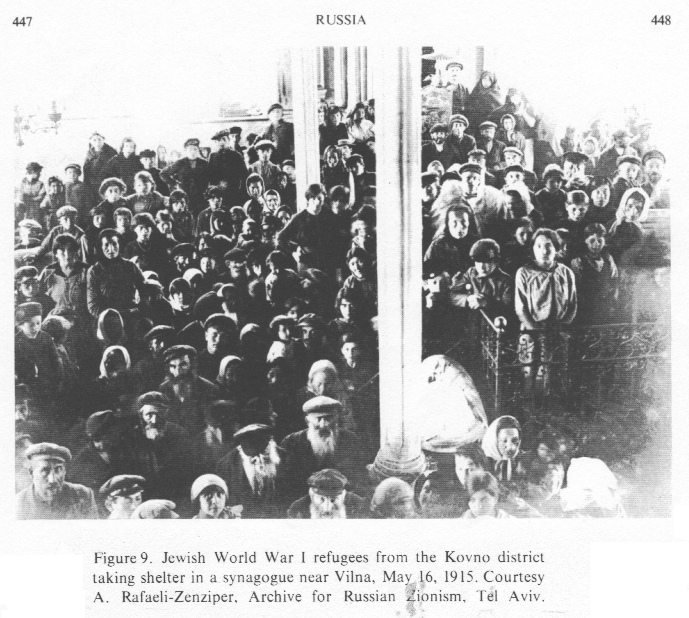
found it expedient [[useful]] to impute [[give]] responsibility for their reversals [[moves backwards]] to the Jews, who were accused of treason and spying for the Germans. Espionage trials were held and hostages were taken and sent to the interior of Russia. This was followed by mass expulsions of Jews from towns and townlets near the front line. These reached their height with the general expulsion of the Jews from northern Lithuania and Courland in June 1915.
Encyclopaedia Judaica (1971): Russia, vol. 14, col. 447-448, Jewish World War I refugees from
Kovno district taking shelter in a synagogue near Vilna, 16 Mai 1915
[1915: Prohibition of Hebrew writing - protest in Europe and "America" - Russian concessions because of financial questions - Jewish mass flight to central Russia - Jewish relief organization YEKOPO - desertion - Jewish speculation activity]
In July 1915 the use of Hebrew characters in printing and writing was prohibited. The Hebrew and Yiddish press and literature were thus silenced. The attacks on the Jews aroused public opinion in Europe and America against the Russian government whose serious military and financial situation compelled it to take Western opinion into account as this was hindering Russia from obtaining loans in the Western countries.
In the summer of 1915 most of the restrictions on Jewish residence were abolished de facto, though not de jure, and thousands of Jewish refugees from Poland and Lithuania streamed toward the interior of Russia.
From the outset of the war Jewish communal workers established a relief organization for Jewish war victims known as *YEKOPO. In conjunction with the existing Jewish societies, it assisted the refugees by providing shelter, food, and employment for them and by the establishment of schools for their children. Communal workers of every class participated in this activity, which awakened the feeling of national unity within the masses.
The suffering and persecutions led Jews to attempt to evade military service and desert from the hostile army, and, in the difficult conditions caused by the mass of refugees and defeat, speculation in food and other commodities became rife [[widespread]] among Jews. The non-Jewish population and the army reacted by intensified hatred toward them.
[1915: Russian Jews partly under German and Austrian law]
The extensive conquests of Germany and Austria in 1915 brought approximately 2,260,000 Jews (40% of Russian Jewry) under the military rule of the advancing armies, thus freeing them from czarist oppression while separating them from the the Jews who remained under the czar. In 1917 there were 3,440,000 Jews in the region which remained under Russian control; of these, about 700,000 lived outside the former Pale of Settlement. These upheavals brought about cultural and social changes.
The conscription of great numbers of Jewish youths into the Russian army and the suppression of the Jewish press and the literature accelerated the process of russification among the Jews there. In contrast, the Jewish masses of Poland, Lithuania, the eastern Ukraine, and Belorussia, which formed the most deep.rooted element, as well as the great Jewish cultural centers of Warsaw and Vilna, were torn from Russian Jewry. This also affected the greater part of the Hasidim [[Orthodox Jews]]. (col. 456)
THE FEBRUARY REVOLUTION (1917). [Jewish revolutionary group - enforced Zionist movement with training centers and new organizations]
Revolution: The nine months following the February Revolution of 1917 constituted a brief springtime in the history of Russian Jewry. The Provisional Government abolished all the restrictions affecting the Jews on March 16, 1917, as one of its first measures. Jews were immediately given the chance to hold office in the government administration, to practice at the bar, and rise in the army ranks. All at once opportunity opened up to them for free development in every sphere of life, both as citizens of the state and as a national group. The hatred of the Jews, which had served as a political weapon in the hands of the ancient regime, became incompatible with the Revolution and was forced underground.
Naturally the Jews supported the Revolution and participated in the active political life which began to flourish in the country. There were Jews in all the democratic and socialist parties at all levels, from the leadership to the rank and file. The leaders of the (col. 456)
Constitutional Democratic Party (Kadets) included the jurist M. *Vinawer; among the Socialist Revolutionaries there was O. *Minor, who was elected mayor of Moscow, and I.N. *Steinberg, who later became commissar for justice in the first Soviet government headed by *Lenin; other leaders included: among the Mensheviks, J. *Martov, and F.I. *Dan; and among the Bolsheviks, L. Trotsky, Y.M. Sverdlov, L.B. *Kamenev, and G. *Zinoviev. Many Jews led the revolutionaries in the provinces, which were poor in intellectual forces.
[Racist] Zionists: Despite their numbers in the general revolutionary movement, these revolutionaries were only a minute section of the vast numbers of Russian Jews who remained attached to their national and religious culture and society. This adhesion [[steadiness]] was expressed by the tremendous progress made by the Zionist movement in 1917. In May 1917 the seventh conference of the [[racist]] Zionist of Russia, representing 140,000 members, was held in Petrograd. Youth groups under the mane of *He-Halutz, who prepared themselves to settle in Erez Israel, were formed in many towns and townlets.
The Zionists also promoted an intensive cultural activity. The Hovevei Sefat Ever ("Lovers of the Hebrew Language") society founded under the czarist regime, became the *Tarbut society. In Moscow a Hebrew daily, *Ha-Am, was published and Hebrew publishing houses financed by the wealthy arts patrons Stybel (Stybel Publishing) and Zlatopolsky-Persitz (Omanut Publishing) were established. Training colleges for teachers and kindergarten teachers were founded, as well as elementary and secondary schools. The first steps were taken for the establishment of a Hebrew theater, *Habimah. In all the elections which were held during that year by the general and Jewish institutions, the [[racist]] Zionists and related groups headed the Jewish lists, leaving the Bund and other Jewish parties far behind. (col. 457)
[October 1917: communist revolution]
[...] Leon Trotsky, who organized the military coup of the October Revolution of 1917, was the creator of the Red Army which included among its prominent commanders a number of Jews (of whom the most celebrated were General Jonah *Yakir, Jan Gamarnik, and Y. Uborevich). Jewish youth enthusiastically joined the Red Army and took a part in its organization. Many Jews reached the higher military ranks and played an important role in the formation of the Red Army. [...] (col. 460)
[[The Trotsky revolution was financed with bankers money from the "USA" and from the German Emperor. The Czarist family which never developped the countryside and let the people in illiteracy and without electricity was mostly shot. The German Emperor calculated with a chaos and an easy German invasion in chaotic Russia also by the help of the "freed" east European nations]].
[November 1917: Zionist hopes by Balfour declaration - the false promise - Jewish national enthusiasm - Jews in the Russian revolutionary army - self-defense and anarchy]
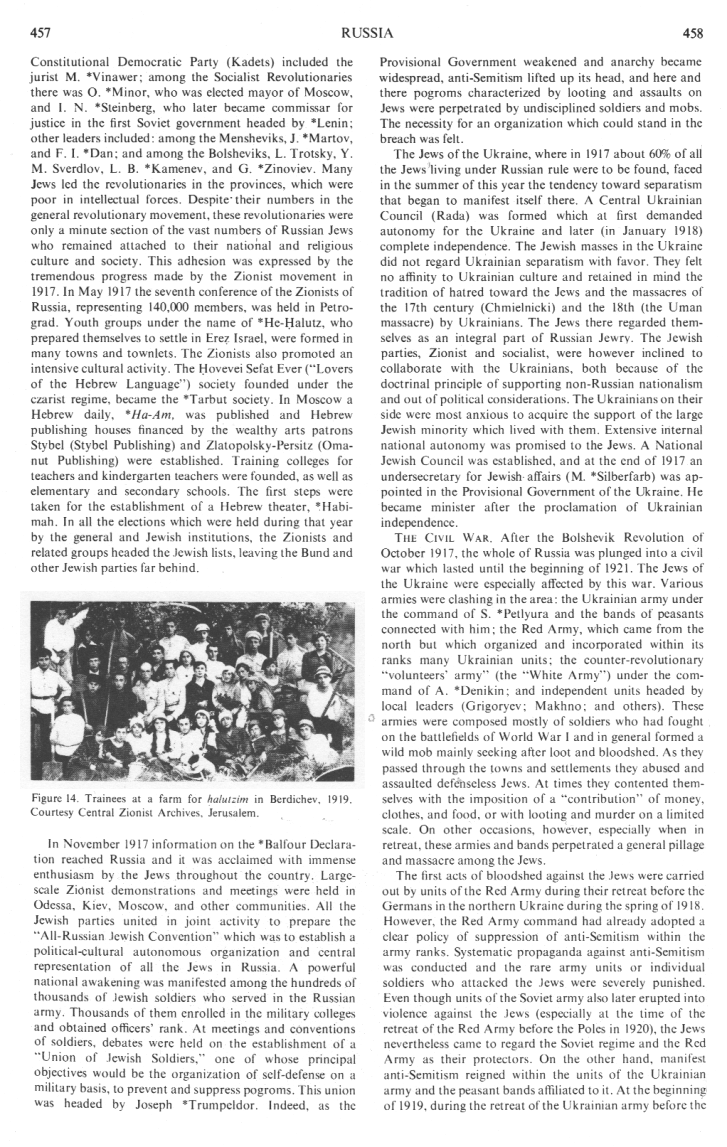
Encyclopaedia Judaica (1971): Russia, vol. 14, col. 457, [[racist Zionist]] pioneer training for halutzim (ḥalutzim) [[racist Zionist
"pioneers" for the war against the Arabs in Palestine]] in Berdichev, 1919. Courtesy Central Zionist Archives, Jerusalem
In November 1917 information on the *Balfour Declaration reached Russia and it was acclaimed with immense enthusiasm by the Jews throughout the country.
[[Addition: The Balfour Declaration of the English statesman Balfour said that Jews had the right for a homestead in Palestine. The Arabs were not mentioned and the declaration was a racist product of colonialism. Add to this the Arabs had got weapons from the English to fight Turkey, and on top of this historically the Jews have their roots in today Iraq and not in Palestine. But the Palestine fantasy was getting stronger and stronger now by the false English promise]]:
Large scale Zionist demonstrations and meetings were held in Odessa, Kiev, Moscow, and other communities. All the Jewish parties united in joint activity to prepare the "All-Russian Jewish Convention" which was to establish a political-cultural autonomous organization and central representation of all the Jews in Russia.
A powerful national awakening was manifested among the hundreds of thousands of Jewish soldiers who served in the Russian army. Thousands of them enrolled in the military colleges and obtained officers' rank. At meetings and conventions of soldiers, debates were held on the establishment of a "Union of Jewish Soldiers", one of whose principal objectives would be the organization of self-defense on a military basis, to prevent and suppress pogroms. This union was headed by Joseph *Trumpeldor. Indeed, as the (col. 457)
Provisional Government weakened and anarchy became widespread, anti-Semitism lifted up its head, and here and there pogroms characterized by looting and assaults on Jews were perpetrated by undisciplined soldiers and mobs. The necessity for an organization which could stand in the breach [[gap]] was felt.
[1917: independence of Ukraine - the parliament "Rada" - promised Jewish autonomy]
The Jews of the Ukraine, where in 1917 about 60% of all the Jews living under Russian rule were to be found, faced in the summer of this year the tendency toward separatism that began to manifest itself there. A Central Ukrainian Council (Rada) was formed which at first demanded autonomy for the Ukraine and later (in January 1918) complete independence.
The Jewish masses in the Ukraine did not regard Ukrainian separatism with favor. They felt no affinity to Ukrainian culture and retained in mind the tradition of hatred toward the Jews and the massacres of the 17th century (Chmielnicki) and the 18th (the Uman massacre) by Ukrainians.
The Jews there regarded themselves as an integral part of Russian Jewry. The Jewish parties, [[racist]] Zionist and socialist, were however inclined to collaborate with the Ukrainians, both because of the doctrinal principle of supporting non-Russian nationalism and out of political considerations. The Ukrainians on their side were most anxious to acquire the support of the large Jewish minority which lived with them. Extensive internal national autonomy was promised to the Jews. A National Jewish Council was established, and at the end of 1917 an undersecretary for Jewish affairs (M. *Silberfarb) was appointed in the Provisional Government of the Ukraine. He became minister after the proclamation of Ukrainian independence.
THE CIVIL WAR. [Chaos and destruction after Bolshevik October revolution - Jews blamed and sacked]
[[This "civil war" was not only a "civil war" but it was organized by western powers to defeat the Red Army and communism. But communism was financed by "American" banks as well...]]
After the Bolshevik Revolution of October 1917, the whole of Russia was plunged into a civil war which lasted until the beginning of 1921. The Jews of the Ukraine were especially affected by this war. Various armies were clashing in the area: the Ukrainian army under the command of S. *Petlyura and the bands of peasants connected with him; the Red Army, which came from the north but which organized and incorporated within its ranks many Ukrainian units; the counter-revolutionary "volunteers' army" (the "White Army") under the command of A. *Denikin [[with all support of western European countries]]; and independent units headed by local leaders (Grigoryev; Makhno; and others).
These armies were composed mostly of soldiers who had fought on the battlefields of World War I and in general formed a wild mob mainly seeking after loot and bloodshed. As they passed through the towns and settlements they abused and assaulted defenseless Jews. At times they contented themselves with the imposition of a "contribution" of money, clothes, and food, or with looting and murder on a limited scale. On other occasions, however, especially when in retreat, these armies and bands perpetrated a general pillage and massacre among the Jews.
The first acts of bloodshed against the Jews were carried out by units of the Red Army during their retreat before the Germans in the northern Ukraine during the spring of 1918. However, the Red Army command had already adopted a clear policy of suppression of anti-Semitism within the army ranks. Systematic propaganda against anti-Semitism was conducted and the rare army units or individual soldiers who attacked the Jews were severely punished.
Even though units of the Soviet army also later erupted into violence against the Jews (especially at the time of the retreat of the Red Army before the Poles in 1920), the Jews nevertheless came to regard the Soviet regime and the Red Army as their protectors.
[Beginning of 1919: Massacres on the Jews by the Ukrainian army ant peasant bands]
On the other hand, manifest anti-Semitism reigned within the units of the Ukrainian army and the peasant bands affiliated to it. At the beginning of 1919, during the retreat of the Ukrainian army before the (p.458)
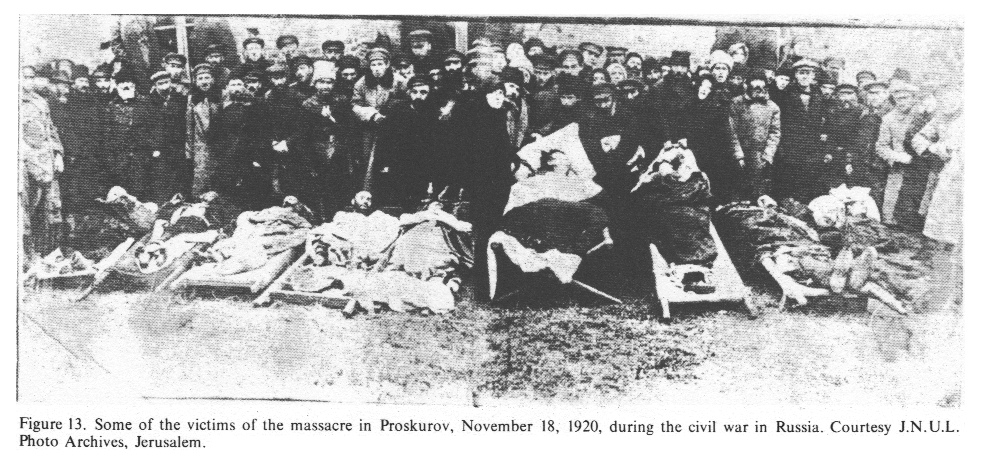
Red Army, the regular army units systematically massacred the Jews with bestial savagery in Berdichev, Zhitomir, *Proskurov (leaving about 1,700 dead within a few hours), and other places. The Jewish autonomous organs in the Ukraine and the Jewish minister in the Ukrainian government could not obtain the punishment of the army commanders responsible for these pogroms. This convincingly proved to all the regular and irregular units of the Ukrainian army that lawlessness was licensed in regard to Jews.
["Soviet" grain confiscations - peasants attack the Jews as "communists"]
The policy of grain confiscation from the peasants adopted by the Soviets in those years encouraged anti-Soviet movements among the peasants. The Jews, inhabitants of the towns and townlets, were identified with Soviet rule, and the bands of peasants occasionally perpetrated systematic massacres of Jews when they gained control, often for a very short while, of the localities where Jews were living (Trostyanets, Tetiyev, etc.).
["White Army" with massacres on the Jews on the way to Moscow (summer 1919) and again during the retreat (end of 1919)]
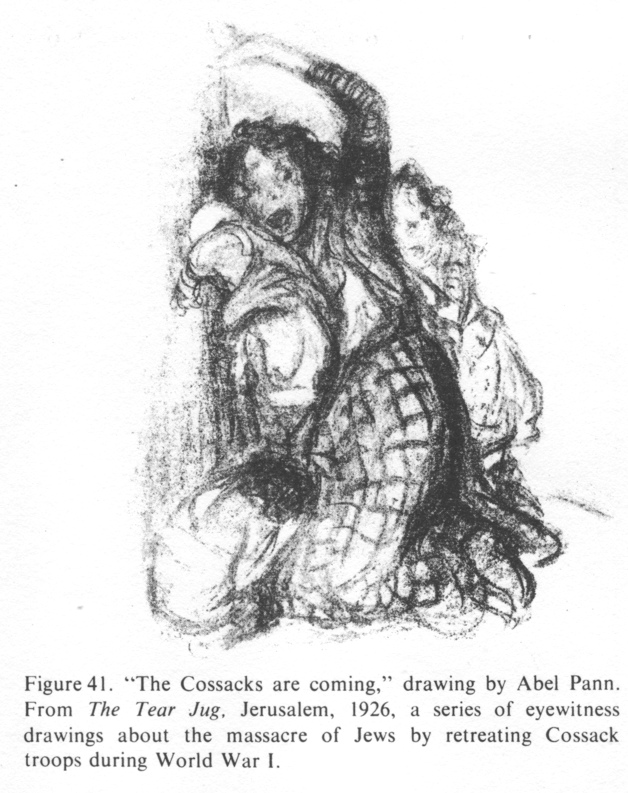
During the summer of 1919 the "White Army" began to advance from the Don region toward Moscow. This army, which was composed of battalions of officers and Cossacks, was saturated with anti-Semitism and one of its slogans was the old slogan of czarist anti-Semites:
"Strike at the Jews and save Russia!"
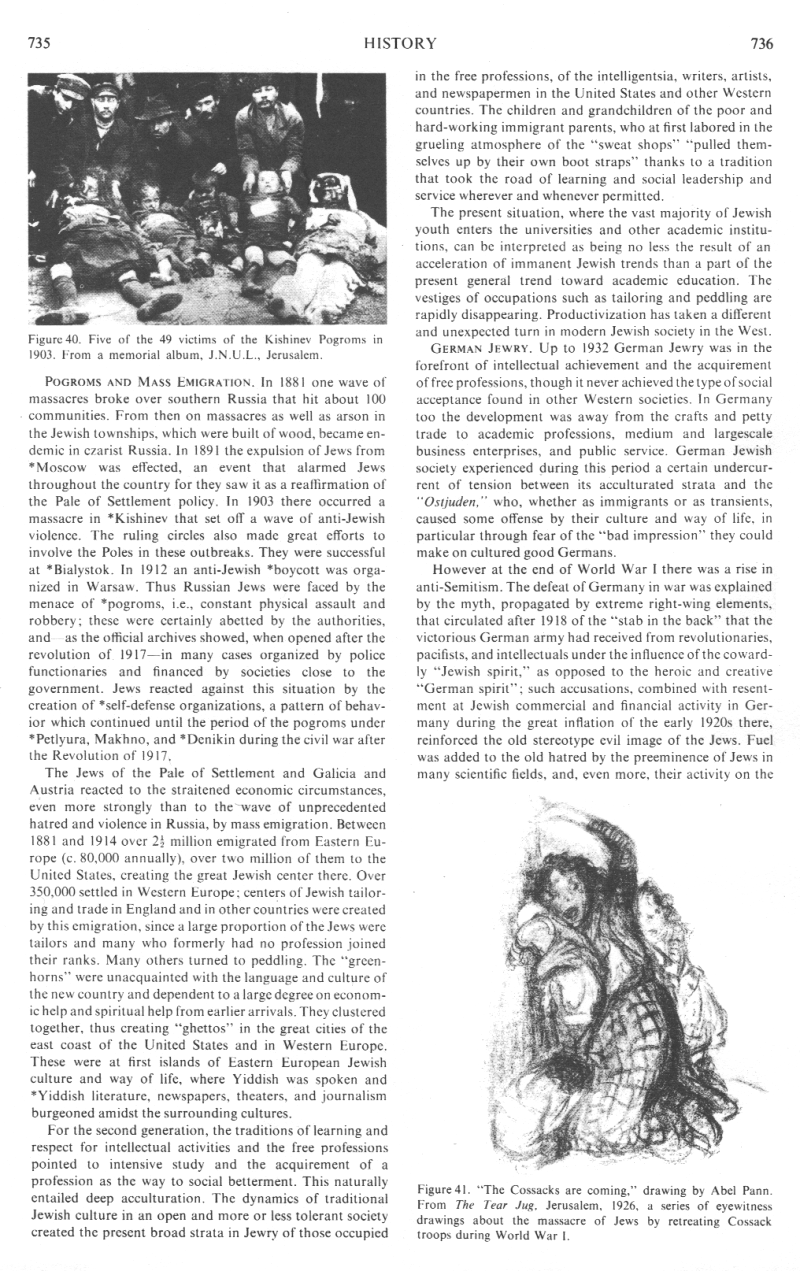
Encyclopaedia Judaica (1971): History, vol. 8, col. 736: Jewish children fearing Cossack invasion 1919
"The Cossacks are coming", drawing by Abel Pann. From "The Tear Jug", Jerusalem, 1926, a series of eyewitness drawings about the massacre of Jews by retreating Cossack troops during World War I
Its way northward became a succession of pillage, rape, brutality, and slaughter which reached its climax in the massacre of the Jews at Fastov (with 1,500 dead). Their attacks on the Jews were even more severe at the time of their disorderly retreat southward at the end of 1919. It is difficult to assess the losses suffered by Ukrainian Jewry in these pogroms. S. Dubnow estimated that 530 communities had been attacked. More than 1,000 pogroms were perpetrated in these communities. There were more than 60,000 dead and several times this number of wounded.
[Massacres by the Polish army in Western Ukraine and BSSR - general suspicion Jew = communist]
In the western Ukraine and Belorussia [[Belarus]] the suffering of the Jews was caused mainly by the Polish army. Although pogroms did not take place, the Jews were terrorized and hundreds were executed without trial as "suspects" of Communist affiliation (Pinsk 1919, etc.). The Ukrainian and Russian "volunteer" units (under General Balachowicz-Bulak) which fought with the Poles also attacked the Jews.
[1917-1921: Jewish self-defense against local bands - communist support - and no support any more when the Jewish self-defense converted into Zionist troops]
During those years Jewish self-defense units were formed in many places in the Ukraine.
Encyclopaedia Judaica (1971): Russia, vol. 14, col. 447-448, [[racist]] Zionist soldiers from the western front convening in Minsk, 17 December 17 1917, mainly to discuss Jewish self-defense
These efforts were however local. They were successful in several large towns and in a few townlets only. At the beginning of the civil war, a "Jewish Fighting Battalion" led by a nucleus of demobilized soldiers and officers was formed in Odessa. This battalion obtained many arms and saved the Jews of Odessa from pogroms. The defense units of the small towns managed to protect the Jews from small local bands, but were powerless when confronted by army units or large bands of peasants.
Occasionally the attackers took cruel vengeance against the inhabitants for the resistance offered by their youth when they entered the locality (the *Pogrebishche massacre).
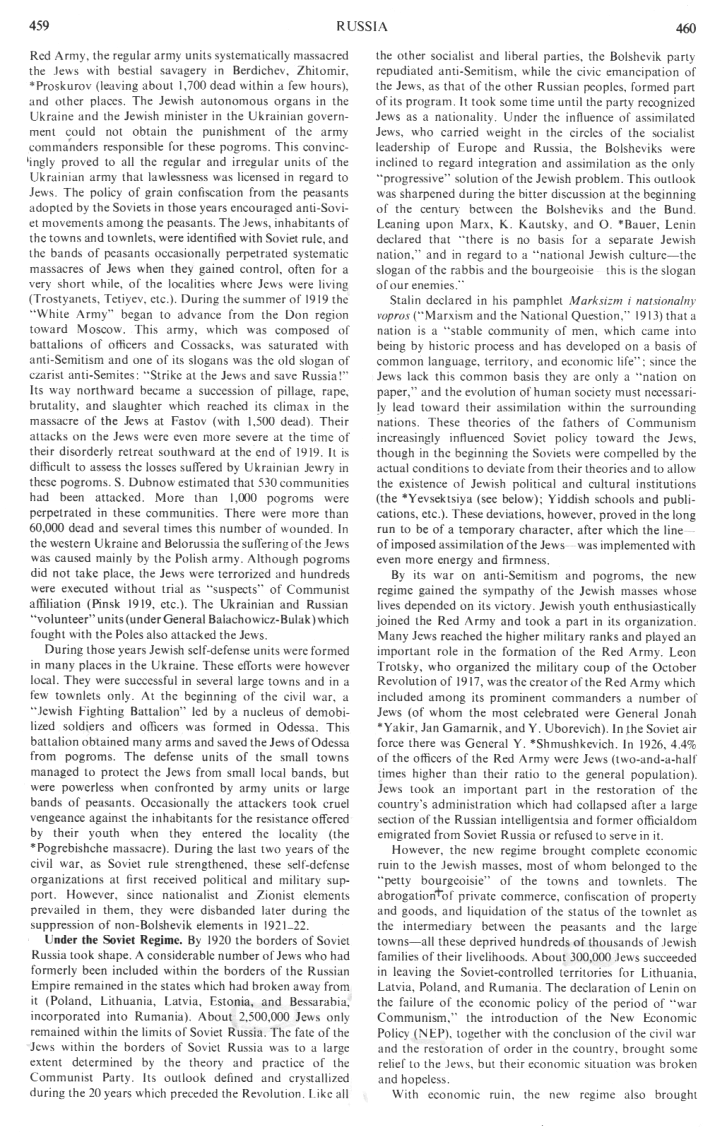
Encyclopaedia Judaica (1971): Russia, vol. 14, col. 449-450, some of the victims of the massacre in Proskurov, 18 November 1920, during the civil war in Russia
During the last two years of the civil war, as Soviet rule strengthened, these self-defense organizations at first received political and military support. However, since nationalist and Zionist elements prevailed [[dominated]] in them, they were disbanded later during the suppression of non-Bolshevik elements in 1921-22.>
![Encyclopaedia Judaica (1971): Russia, vol. 14,
col. 457, [[racist Zionist]] pioneer training for
halutzim (ḥalutzim) [[racist Zionist
"pioneers" for the war against the Arabs in
Palestine]] in Berdichev, 1919. Courtesy Central
Zionist Archives, Jerusalem](EncJud_Russia-d/EncJud_Russia-band14-kolonne457-pionierausbildung-Berdichev-1919.jpg "Encyclopaedia
Judaica (1971): Russia, vol. 14, col. 457, [[racist
Zionist]] pioneer training for halutzim (ḥalutzim)
[[racist Zionist \"pioneers\" for the war
against the Arabs in Palestine]] in Berdichev, 1919.
Courtesy Central Zionist Archives, Jerusalem")
![Encyclopaedia Judaica (1971): Russia, vol. 14,
col. 447-448, [[racist]] Zionist soldiers from the
western front convening in Minsk, 17 December 17 1917,
mainly to discuss Jewish self-defense](EncJud_Russia-d/EncJud_Russia-band14-kolonne447-448-zion-soldatentreffen-Minsk-1917.jpg "Encyclopaedia Judaica (1971): Russia, vol. 14,
col. 447-448, [[racist]] Zionist soldiers from the
western front convening in Minsk, 17 December 17 1917,
mainly to discuss Jewish self-defense")
| Teilen / share: |
Facebook |
|
Twitter
|
|
|
|
Sources
Encyclopaedia Judaica (1971): Russia, Vol. 14, col. 455-456
Encyclopaedia Judaica (1971): Russia, vol. 14, col. 457-458
Encyclopaedia Judaica (1971): Russia, vol. 14, col. 459-460
Encyclopaedia Judaica (1971): History, vol. 8, col. 735-736
<< >>
^