Content
Chapter 1. Three accusers
1.1. Librarian Harduinus:
assorting council's documents (p.13)
-- librarian Jean Hardouin (Harduinus) in Paris
-- recognizes the FAKE Council documents of the
FAKE Church
1.2. The linguist Baldauf:
proving that all works of Antiquity are a
FAKE with stave rhymes (alliteration) and
end rhymes (p.16)
-- Mr. Baldauf in Basel stated clearly: the
works of "authors of Antiquity" contain
rhymes+rhymed endings which existed only from
about 1100
-- Charlemagne is a LIE - all horror tales are a
LIE
-- Criminal "Humanists" of the gay drug Vatican
invent the writers of "antiquity"
-- "Humanist" writing offices all over Europe
are composing the "Middle Ages"
Book: "History and Criticism" volume 2: "Greeks"
and "Romans" (1902)
1.3 Kammeier created the
word "Big Action": investigation of writing
and data: ALL documents are a FAKE (p.20)
-- Mr. Wilhelm Kammeier with the investigation
of the INVENTED documents
-- All documents and charters of the FAKE
"Middle Ages" are FAKE
-- The "Big Action" of the cr. Vatican is
recognized: The ENTIRE Middle Ages are a FAKE
Summary:
1. Hardouin (Harduinus: Research on the FAKE
Council documents)
2. Baldauf (Linguistic Research with FAKE
Antiquity: stave rhyme and end rhyme)
3. Kammeier (research with fake certificates /
deeds)
Chapter 2: The
blood witnesses
INVENTED martyrs of the “Christian” church in
INVENTED Rome (p.25)
|
|
|
Chapter
3: Humanists
The "Humanist" monks of the Vatican are
INVENTING authors and are INVENTING stories,
dramas, hero epic tales, etc.
Examples:
3.1. The FAKE Roswitha and
her FAKE Works (p.31)
-- FAKE Roswitha of Gandersheim (10th century):
with perfect comedies and dramas in perfect
Latin, including a report from a brothel
-- No predecessors, no circle of friends, no
successors
-- The forger is Mr. Conrad Celtes - and a
"Latin teacher"
-- Classic plagiarism, stolen comedy "Abraham",
stolen legend "Pelagius", and a Father Florez
steals a legend from FAKE Roswitha for Spain
-- The stolen celebratory speech by Widukind is
copied from somewhere - Ligurinus is copied from
Mr. Otto of Freising, "Epos de bello Saxonico"
is copied from Lambert of Hersfeld
3.2 The FAKE poet Apuleius
(p.39)
The erotic poetry "The Golden Donkey"
("The Golden Ass") with the romance 'Cupid and
Psyche'
3.3 Nicholas Cusanus
(Cusanus) (1401-1464): a mathematician,
physicist and “rediscoverer” (p.43)
-- Mathematician, physicist, he called for a new
calendar after the defeat of Constantinople in
1454
-- He was also a “rediscoverer”, possibly also a
forger and faker
3.4. Conspiracy? (p.43)
-- the FORGED Donation of Constantine (4th
century)
-- FAKE letters from a FAKE pope on a FAKE
journey in 1132
-- Niemitz's conclusion: Europe from 800 to 1400
was tolerant and multi-religious
3.5. The FAKE Tacitus and
his FAKE Germania (p.45)
in an impossible Latin like Sallust
|
It is clearly stated on the back of the book "The Big
Action" (orig. German: "Die Grosse Aktion"): Many
characters are purely "fictional".
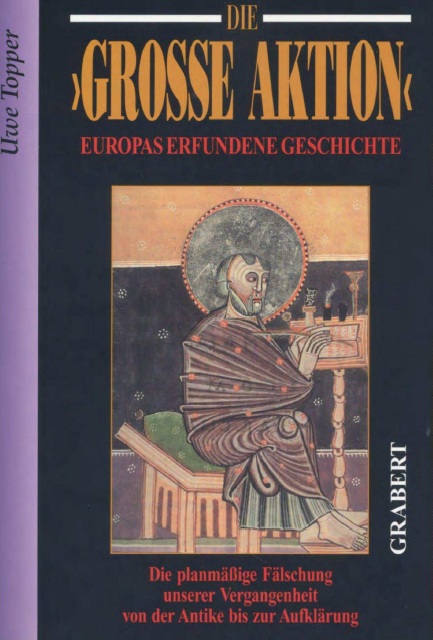
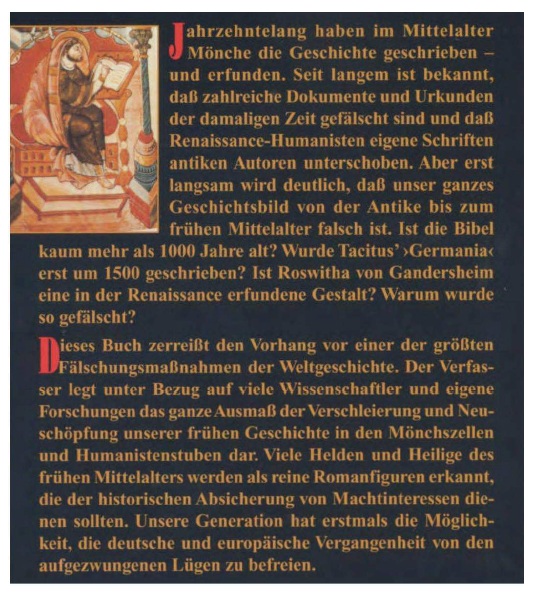
Book "The Great Action" - Book cover [0a] - Book
text on the back [0b]
-- The great heroes of history are "straw men" or
"inflated balloons" -- false hero worship is like religion
with ancestor cult, idolatry, and these false heroes
should be toppled from their pedestals, but each
individual must do this for themselves (p. 9)
Kammeier has virtually remained unknown
--
Kammeier was the first to claim a "
Great
Action", and Uwe Topper provides evidence for
this: the High Middle Ages and Renaissance are falsified
-- Kammeier was rejected for a long time -- the deeds of
kings and emperors in the Middle Ages are "beautiful and
ugly novels" (p. 9)
Example: Lies about FAKE Charlemagne
-- the allegations about the butcher Charlemagne with 4000
murdered things at a "banquet" or mass murder of 130,000
Saracens by drowning in the river Ebro are lies - moreover
the fantasy god has stopped the sun to commit the Saracen
murder - THESE ARE ALL LIES (p.10)
-- such mass murders have to be recognized as "fairy tales
and lies, propaganda and spins" [of the criminal gay drug
Vatican - just for spreading fear] (p.10)
-- Uwe Topper is a member of history circles such as
"Berliner Geschichtssalon; Leaps in time (Zeitensprünge),
Efodon and others" with discussions and suggestions (p.11)
UWE TOPPER
Uwe Topper, born in 1940 in Breslau, lived for three
decades as a freelance writer and artist in South Asia,
North Africa, and Western Europe. Numerous academic
articles and lectures, as well as several popular science
books in German and Spanish, have made him well-known.
They cover topics in anthropology, art history, and the
history of religions. Uwe Topper has been living in Berlin
since 1992.
Topper's books in German:
-- The Legacy of the Giants (German: Das Erbe der
Giganten); Edition Walter, Olten 1977
-- The Sufis in the Maghreb (German: Die Sufis im
Maghreb); Edition Eugen Diederichs, Cologne 1984
-- Tales of the Berbers (German: Märchen der Berber);
Eugen Diederichs Verlag, Cologne 1986
-- Rebirth (German: Wiedergeburt); Edition of pocket books
Rowohlt, Reinbeck 1988
-- Earth Inquiry (German: Erdbefragung); Edition Droemer
Mr. Th. Knaur, Munich 1988
-- Sufis and Saints in the Maghreb (German: Sufis und
Heilige im Maghreb); Edition Eugen Diederichs, Munich 1991
-- The Last Book (German: Das letzte Buch); Edition
Heinrich Hugendubel, Munich 1993
Topper's bookds in Spanish:
-- Rock Art, Provincial Disputation of Cadiz (ESP orig.:
Arte Rupestre, Disputación provincial de Cádiz) 1988
-- Popular Tales of the Berbers (ESP orig.: Cuentos
Populares de los Berberes); Miraguano Editions, Madrid
1993 (p.286)
Chapter 1: 3 Accusers
1.1. Librarian Harduinus: [he assorted
the documents of the Church's councils - nothing
matches]
-- librarian Jean Hardouin (Harduinus)
in Paris
-- recognizes the FAKE Council documents of the FAKE
Church
Librarian Jean Hardouin (Harduinus): Analyst and
Scholar in Ancient History: Fantasy Jesus and "Last
Supper" on a Thursday
-- Jesuit Jean Hardouin (Harduinus), born in 1646 in
Brittany, librarian and teacher in Paris, became a member
of the "Order of Jesus" in 1666, from 1683 he became head
of the royal French library, was a historian, knew ancient
languages, archaeology, numismatics, chronology and
philosophy of history, published recognized writings
-- he published the speeches of Temistius in 1684 -- he
wrote about Horace and numismatics,
-- in 1695 he published an investigation of the day of the
death of the fantasy Jesus (p.13) and said that the Last
Supper was on a Thursday, "according to the Galilean
custom", and not on a Friday (p.14)
Hardouin: Council Acts Published
-- in 1687 he was given the task to rearrange all the acts
of the Council from the 1st century to Hardouin, to take
dogmatic points of view into account, to prepare prints,
King Louis XIV took over the costs, and in 1715 after 28
years this analysis was finished (14)
-- critics' groups like Jansenists etc. mistrusted
Hardouin and blocked the release of the acts of the
Council for 10 years until 1725 (p.14)
-- Hardouin 1723: critical edition of the natural history
of Pliny (p.14)
-- [officially] Hardouin led a flawless way of life (p.14)
Hardouin with the truth about "ancient" authors: they
are NOT ancient
-- Hardouin mentioned again and again that ancient
authors, e.g. Cassiodorus, Isidore of Seville, St. Justin
martyrs etc., are "written many centuries later", e.g. in
a justification of his letter to a saint Chrysostom to the
monk Caesar - letter from 1690 (p.14)
Hardouin gets only tentative approval
-- Hardouin's colleagues knew about the forgeries but
didn't want to let the scandal open, so it received hardly
any approval (p.14)
-- Hardouin said clearly that almost all "ancient"
writings were forgeries of monks from the 13th century,
except Cicero, satyrs of Horaz, natural history of Pliny,
Georgica of Virgil (p.14)
-- and Hardouin recognized more forgeries: works of art,
stone inscriptions, coins, council acts before the 16th
century, the Greek translation of the Old Testament, the
Greek original version of the New Testament, all this was
recognized by Hardouin as a forgery and "are also said to
have been composed very late" (orig. German: "sollen
ebenfalls sehr spät abgefasst sein" (p.15)
-- Hardouin said that the fantasy Jesus and his fantasy
apostles had "preached in Latin" - and the sheep could not
do anything "because the arguments were watertight" and he
enjoyed a "high reputation" (p.15)
-- but then, his order gave him a warning and Hardouin
made lukewarm "revocations" (p.15)
-- Death in 1729, many followers, many opponents,
fanatical written disputes, he referred to the forgery of
church documents as a "secret conspiracy against the true
faith!", and one of the main perpetrators was to be
Archonten
Severus (13th century).
-- Hardouin had his list of church fathers with their
writings that they had forged - and he cursed the forgers,
including a "
holy Augustine"
(p. 15)
-- The common people soon created the slogan "Hardouin
System", which clearly articulated what the Jesus fantasy
believers in the Vatican had perpetrated (p. 15)
-- After his death, society relaxed, enjoyed the FAKE
texts, integrated them, or discarded them entirely.
-- An opponent of Hardouin was a Jesus Fantasy bishop Mr.
Huet, who believed that Hardouin could have
had a comfortable life if he had not been so critical
("Hardouin worked hard for 40 years to destroy his good
reputation, but he did not succeed.") (p. 15)
-- Another opponent of Hardouin claimed that Hardouin was
"too learned" and could not lie (p. 15), or too "vain" (p.
16)
-- Other scholars made only jokes about the truths of
Hardouin (p. 16), claiming also that Hardouin wanted to
destroy the [Jesus FAKE] faith per se, along with the
"pagan writers" (p. 16)
-- And there was also a censorship action by the French
Parliament: Some works of Hardouin were banned (p. 16),
however, a Jesuit in Strasbourg published the "Preface to
a Critique of Ancient Writers" in London (printed in
1766), which is banned in France, and today (2000) can
hardly be found (p. 16)
-- The arguments of Hardouin could "never really be
completely neutralized" (p. 16)
-- Hardouin could consistently prove FAKE coins, it was
him that introduced stricter criteria in historical
science (p. 16).
1.2. The linguist Baldauf: [proving that
all works of Antiquity are a FAKE with stave rhymes
(alliteration) and end rhymes]
-- Mr. Baldauf in Basel stated clearly:
the works of "authors of Antiquity" contain
rhymes+rhymed endings which existed only from about 1100
-- Charlemagne is a LIE - all horror tales are a LIE
-- Criminal "Humanists" of the gay drug Vatican invent
the writers of "antiquity"
-- "Humanist" writing offices all over Europe are
composing the "Middle Ages"
stave rhyme, with end rhyme
(p.17)
The book by Robert Baldauf "History and Criticism"
(orig. German: "Historie und Kritik")
-- Robert Baldauf (1881-1918 [web01]) was the second
critic of the FAKE Vatican chronology, he was a linguist,
around 1900 professor at the University of Basel (p.16)
"History and criticism" volume 1: The FAKE
Charlemagne (1903)
-- Robert Baldauf published a book about the official
FAKE-chronology: "
History and criticism"
(orig. German: "Historie und Kritik"), the 1st volume
about the FAKE-Charlemagne was published in Leipzig
(1903): Gesta Caroli magni (= Deeds of Charlemagne) (p.16)
-- The data of FAKE Charlemagne were allegedly written
down by the
monk "Notker" (9th century) in
the
monastery of St. Gall (p.16) [book by
Baldauf:
"The Monk of St. Gall" (orig. German: "Der
Mönch von St. Gallen") (1903)]
-- This cannot be quite right, because the St. Gallen
manuscript of Notker contains words with Romanic or Greek
origin which did not exist at the alleged time of
Charlemagne (p.16)
-- A pupil of Notker is said to have been
Ekkehart
IV, who is said to have written texts in the
11th century, but the texts are so "strikingly similar"
with those of Notker, (p.16) that it must have been about
the same person (p.17)
Horror tales about Charlemagne
-- A
monk (Notker) of St. Gallen reports
that the FAKE-Charlemagne
had beheaded the youth of
the Slavic peoples (p.17)
-- The annals of
Einhart report that the
FAKE-Charlemagne had
4500 Saxons executed
near Verden an der Aller (p.17)
(see in "History and Criticism" p.147)
Charlemagne "the Great" FAKE:
--
There were no baths: There are stories
told in baths - but for installing baths in Europe the
contact to the Islamic Orient is a precondition which did
not exist in around 800 (p.17)
--
Inquisition did not exist: there are
stories about Inquisition with "divine" water torture,
which did not exist in around 800 (p.17)
--
Notker without "Iliad": the monk
"Notker" (9th century) from St. Gallen claims to have
known Homer's "Iliad", but Homer's "lliad" was
"rediscovered" only in around 1600
Addendum: The Mossad Wikipedia describes the
publication of the FAKE "Iliad"
In 1488 was the first Ililas publication in Europe, the
manuscripts are said to be "lost" - in 1566 the
publication in Paris followed:
"In 1488 the editio princeps (
link)
was published by Demetrios Chalkokondyles (
link)
in Florence (
link)
on the basis of several now lost, inaccurate manuscripts,[
122]
and in 1566, Henricus Stephanus' (
link)
important edition was published in Paris under the title
"Poetae Graeci Principes Heroici Carminis"."
[Wikipedia web02 - translation]
--
FAKE Homer+FAKE-Bible combined:
moreover, Mr. Notker is mixing scenes from the FAKE
"Homer" with scenes from the FAKE "Bible" (p.17)
-- Baldauf then analyzes this connection in another volume
(p.17)
Bible FAKE with "Iliad"
-- Large parts of the Old Testament are closely
"connected" with chivalric novels and with the
FAKE-"Iliad" (p.17)
-- One can clearly assume that the Old Testament was
created at the time of the FAKE "Iliad" (p.17)
Topper Quote (translation):
"It turns out that large parts of the Bible, especially
the "history books" of the Old Testament, are so closely
intertwined with the chivalric novels and the Iliad that a
common time of origin becomes probable." (p.17)
Book: "History and Criticism" volume 2:
"Greeks" and "Romans" (1902)
"Rediscoveries" of "writers of Antiquity" in the 15th
century - St. Gallen 1416 - faker Mr. Plautus in Vulgar
Latin
-- Mr.
Baldauf analyzes "Greeks" and
"Romans", thereby he finds "quite astonishing facts"
(p.17)
-- The "rediscovery" of classical texts in the 15th
century is connected with "strange details" (p.17)
-- In the monastery of
St. Gall the
"humanists" are said to have made their "findings" in
1416, but there are heaps of "contradictions, darknesses,
unexplained things" (p.17)
-- There is said that a certain Mr.
Quintilian
(p.17) had criticized a certain Mr.
Plautus
being suspected of being a forger: "The Muses would speak
the language of Plautus if they wanted to speak." (p.17)
-- Plautus was writing in "
Vulgar Latin",
and that was "completely unthinkable" for the year 200
before 0 (p.17)
-- The forgers have even woven jokes into their forgeries,
e.g. with
Einhard, when a session at table
of the FAKE-Charlemagne is described, how he converses
with FAKE-"Roman" poets (p.17)
"Writers of the Antiquity" with stave rhymes and end
rhymes from the FAKE High Middle Ages from Germany
-- Mr.
Baldauf states in the analysis of
the "classical-antique poets" that the stylistic devices
are "not at all antique", "but typically German",
with
stave rhyme, with end rhyme (p.17)
-- Already the analysis of Mr.
J.v.Müller
resulted in a highly "dainty" rhyming in the Casina
prologue of
Quintilian (p.17)
-- Baldauf presents yet another Latin poetry in the German
end rhyme style (p.18)
-- with all this, the final rhyme is only valid in the
FAKE-High Middle Ages for the Romanesque poetry by the
troubadours
(p.18)
Baldauf with Hardouin - and Baldauf has his own
philological justifications for the Greek FAKES
-- Hardouin [in Paris] still wanted to recognize "Horace"
as genuine, but Baldauf did not want to do so anymore
(p.18)
-- Probably Baldauf knew Hardouin's analyses from 200
years earlier, but he did not adopt the theological
reasons, but he developed his own philological
argumentation (p.18)
-- Baldauf realizes that FAKE Horace and FAKE Ovid are
quite similar, so they must have had at least the same
source (p.18):
Topper Quote:
"
Baldauf recognizes the inner dependence
between Horace and Ovid and says (p.33) to the question of
how this "quite evident merging of the statements of
ancient authors" is to be explained: "Some find it quite
harmless and unsuspicious, others at least proceed
logically and assume a common source from which the
respective authors had taken the content." (p.18)
Strange: The great authors of antiquity did not know
each other - originals are all said to have disappeared
--
Baldauf states by quoting
E.
Wölfflin that the "classical" Latin authors
obviously
did NOT know each other, "did not
take note of each other at all" (p.18)
-- Baldauf states that 1) there are only reconstructions
of writings here, 2) that the actual authors of these
poems are UNknown, or 3) then there is still a "third"
possibility: "
»Or would a third
one be possible?
« asks Baldauf"
[that a gang of fakers of the cr. gay drug Vatican had
faked the authors of Antiquity pretending a FAKE PAST as a
diversionary tactic for the sheep] (p.18)
Language analysis by Baldauf: "Ancient Greeks and
Romans" with the stave rhyme of troubadours - with
Italian spelling (!)
--
Baldauf proves the
stave rhyme of
the "High Middle Ages", compared it with the
"genuine German
Muspilli" and asks: "How
does such a late poet as
Horace come to
have stave rhymes (German: Stabreime)?" (p.19)
-- The FAKE-Horace has not only German elements but also
Italian spelling in it, there is
an "h"
inserted,
vowels are exchanged
etc. (p.19)
-- Officially these "mistakes" are always blamed on the
copyists: "but it must have been only the evil copyists!"
(p.19 - Baldauf volume 2 p.66)
Language analysis by Baldauf: The FAKE Caesar and the
FAKE "Gallic War" - with German rhythms, stave rhymes
and end rhymes
-- The
FAKE Caesar with the
FAKE
"Gallic War" has just such
stave rhymes
as "inappropriate stylistic features": "It is literally
teeming with these forms" (p.19 - Baldauf volume 2 p.83)
-- After the analysis of the last 3 books of the FAKE
"Gallic War" and 3 books of the "Civil War" Baldauf
thinks: all "these rhyme plays", and for the 8th book of
the "Gallic War" (Bellum Alexandrinum and Bellum Africae),
written by an
A. Hirtius, counts the same,
and they all seem to be by the same author: All this [was
written] "by
one and the same hand"
(German: "eine einzige Hand") (p.19)
FAKE Caesar and FAKE "Gallic War": Druids like Egyptian
priests - rhythms, end rhymes, stave rhymes - criminal
"humanists" falsified all authors of the "Antiquity"
-- The FAKE-"Gallic War" describes
druids among the
Celts, but they resemble the
Egyptian
priests, "a very strange parallelism!", says
Borber
in 1847" (p.19)
-- Baldauf complains: In "ancient stories" there are
always such "parallelisms", and "They are called:
plagiarisms!"
(p.19 - Baldauf: Volume 2 p.84)
-- So, the many
rhythms, end rhymes and stave
rhymes in the "Poems of Antiquity" were a
"normal stylistic device" [of the German writing culture
from the FAKE HIGH middle ages] (p.19 - Baldauf Volume 2
p.97)
-- Baldauf concludes: All the "ancient" poets were written
almost simultaneously in one single century: "Homer,
Aeschylus, Sophocles, Pindar, Aristotle", they are "
children
of a century", and they were certainly written
NOT in Greece (Hellas), but
in Italy of the
14th/15th century etc. (p.19)
Criminal humanists in Italy have fabricated the
"Antiquity" and the FAKE Bible - and humanist writers'
groups across Europe have invented the "Middle Ages"
-- Mr. Baldauf concludes:
Romans and Greeks did not
exist; rather, they are all
fabrications
by "Italian humanists". Topper comments on
Baldauf:
"Their homeland surely was not ancient Hellas, but Italy
of the 14th/15th centuries. Our Romans and Hellenes were
the Italian humanists." (p.19)
[And when "humanists" falsify history, it is anything but
"human", but a global crime for misleading the masses -
penal code].
Baldauf states it clearly:
-- the criminal Vatican with "humanism" falsifies the
authors of "Antiquity" of the FAKE Greeks and of the FAKE
Romans: on papyrus, on parchment, on ore, on stone (p.20)
-- the criminal Vatican with "humanism" also falsifies the
FAKE Bible (p.20)
Topper quote (translation):
"I would like to quote his concluding words [the words
of Baldauf] (p. 97 f.):
»Let us draw conclusions:
The claim is that the old poets like Homer,
Aeschylus, Sophocles, Pindar, Aristotle had
lived in long temporal distances, but we have to regroup
them closer together. They are all surely children
of one century. Their homeland, however, has
been certainly not ancient Greece, but Italy of
the 14th/15th century. Our Romans and
Hellenes were the Italian humanists.' (p. 19)
Once again: the history of the Greeks and Romans written
on
papyrus and parchment is entirely that
which is written on
ore, stone, etc. - for
the most part, [this is] a brilliant fraud of Italian
humanism. . .
Italian humanism has gifted the earth
with the written fixed [FANTASY] world of antiquity
and the [FANTASY] Bible, and in conjunction
with humanists from other countries,
the [FANTASY]
history of the early Middle Ages [was composed].
The period of humanism has not been a receptive time of
scholarly gathering zeal, but rather a world of the most
original, productive, and
most monstruous
intellectual [criminal faking] activity: this
path lasted more than half a millennium for which he was
the guide.
These assertions sound adventurous, more than strange. But
they can be proven. Some of the evidence is presented
here, others will follow, until humanism is recognized in
its innermost essence. It would be foolish to have just
normal life leaving out all the thesis presented here.
«" (p.20)
-- The criminal Vatican with "Humanism" has its "Humanist"
writing groups all over Europe, where the Middle Ages are
invented (p.20)
-- They have spent their time only with forgery, with "the
most inherent, productive, monstrous intellectual activity
- for over half a millennium" (p.20)
-- The "innermost essence" of "Humanism" is FORGERY (p.20)
-- According to Topper, Mr. Baldauf could publish only 2
volumes. Topper:
"To my knowledge, Baldauf has not succeeded in publishing
any further volumes besides the two mentioned" (p.20)
-- And Topper suspects: Perhaps one can still find
manuscripts for additional volumes, where surely more
surprises can be found (p.20).
"that his manuscripts, if they can be found, may still
contain many surprises." (p.20)
Topper quote:
"To my knowledge, Mr. Baldauf has not succeeded in
publishing any additional volumes besides the two
mentioned. Regarding the structure of the work, which also
includes the
very late drafting of the [FANTASY]
Bible, it can be said that his manuscripts, if
they can be found, may still contain many surprises." (p.
20)
1.3 Kammeier created the word "Big
Action": [investigation of writing and data: ALL
documents are a FAKE]
-- Mr. Wilhelm Kammeier with the
investigation of the INVENTED documents
-- All documents and charters of the FAKE "Middle Ages"
are FAKE
-- The "Big Action" of the cr. Vatican is recognized:
The ENTIRE Middle Ages are a FAKE
The 4 basic required data for a valid document /
charter: Who to whom, when and where
-- Mr. Wilhelm Kammeier was a lawyer, lastly a school
teacher in Thuringia in Central Germany, he died
impoverished in the 1950s (p.20)
-- He dealt with the "documents of the Middle Ages",
whereby "deeds / charters" (e.g. for donations or
privileges) must "fulfill four main requirements": who -
to whom - when - and where (p.20):
"They must show
who issued this deed to whom, when
and where." (S.20)
-- The authors of the FAKE documents have omitted many
details (p.20)
-- Often the "full date" is missing, i.e. the year or the
day or both" (p.20) - without a date, a document is
"legally
worthless" (p.20)
Mr. Harry Bresslau with "Handbook of Document
Teaching: Deeds in the FAKE "Middle Ages" often have NO
date or have an IMPOSSIBLE date
--
Mr. Kammeier examined e.g. the
multi-volume edition [Handbook of Document Teaching -
German: Handbuch der Urkundenlehre - 2 volumes] by
Mr.
Harry Bresslau (Berlin 1889 to 1931) (p.21)
-- Bresslau still thought that many documents were genuine
(vol. II, p.442ff), but from the 9th to the 11th century
"some document writers" had a deficiency in the
"mathematical sense", "also in the Imperial [Papal]
Chancellery ("auch in der [Päpstlichen] Reichskanzlei")"
(p.21).
Quote Topper:
"Presenting examples he makes clear how things worked at
that time: from January of the 12th regnal year of Emperor
Lothar I (corresponding to 835 AD), the dating jumps in
February to the 17th regnal year of the same emperor, but
only retains this until March and from May onwards brings
the 18th regnal year for more than two and a half years.
Under Otto I, two charters were issued with “anno
incarnationis 976”, although they belong to the years 955
and 956, etc. Such errors are also frequent in the papal
chancellery." (S.21)
-- Bresslau looks for excuses for the date errors and
concludes, however - quote Topper on Bresslau:
"There remain an excessive number of documents with
completely impossible dating." (S.21)
(original German: "Es bleiben übermäßig viele
Urkunden mit völlig unmöglicher Datierung." (S.21)
-- Mr. Bresslau does not recognize the forgeries but
thinks that if errors appear again and again, they are
"proof of the authenticity of the documents" (p.21)
-- Even if many documents show dates that were "added
later" (p.21)
-- It was only Mr. Kammeier who recognized
the
whole document forgery of the FAKE Middle Ages
first (p.21)
Topper quote:
"But he [
Bresslau] does not think of forgery
- on the contrary: If mistakes are repeated several times,
these are [for him] evidence of the authenticity of the
documents! And this is even the case, although many dates
have been added later or are presented in a way that does
not allow us to recognize it anymore, but also does not
exclude it, as he himself knows. With all his zeal, this
highly educated man could not elevate himself sufficiently
above the subject he had studied to be able to question
it. That has only been accomplished by
Kammeier."
(p. 21)
Bruno Krusch on the FAKE charters of the FAKE "Middle
Ages":
--
Bruno Krusch (born 1880) published a
chapter "Studies about Frankonian Diplomatics" ("Studien
zur fränkischen Diplomatik")" (1937) in his work "Studies
about Christian Medieval Chonology" ("Studien zur
christlich-mittelalterischen Chronologie" - 2 vols.,
Berlin 1938) (p.278)
-- In this chapter "Studies about Frankonian Diplomatics"
(1937) Mr. Krusch states that in certain documents "some
letters are missing": Krusch: "The gap is left empty", but
this could have been done intentionally in order to enter
later beneficiaries (p.22)
-- He complains about "massive [...] forged and falsified
documents" - "silly forgeries" with "unbelievable year
counts" (p.22)
-- Already
Mr. Henschen and
Mr.
Papebroch recognized the document on the
privilege of
Chlodovech I as a forgery in
the 17th century (p.22)
-- A "diploma" from
King Chlothar III for
Bze
is a "crude forgery" (p.22)
-- The "
collection of documents Chronicon Besuense"
is a "forgery of the 12th century" (p.22 - Krusch: p.9)
Karl August Friedrich Pertz (1828-1881) with a
collection of Merovingian documents / deeds /
certificates / charters
-- In 1872,
Pertz published a collection of
documents (p.22)
Supplement: The edition of the Merovingian charters was
criticized to such an extent that the charters of the
Carolingians were not published
The Mossad Wikipedia reports (translation):
"The highlight of his independent work for the MGH was to
be the publication of the charters of the kings of the
Merovingians. When [the first volume] appeared in 1870, it
was heavily criticized (especially by Theodor Sickel -
link) [
2]
and this maneuver enabled his father's long-time critics
to overthrow him as the sole and all-determining editor.
The edition [of the second volume] of the charters of the
Carolingians up to 840 prepared by Karl Pertz, which was
to appear in 1871, was thus also shattered [
3]."
-- Bruno Krusch praised Pertz's first volume because he
recognized many forgeries: 97 Merovingian charters and 24
Hausmeier charters were supposed to be "genuine", but 95
Merovingian charters and 8 Hausmeier charters were
recognized as FAKE (p.22)
-- Krusch said that one should continue like this and all
document researchers should finally recognize and
eliminate all forgeries (p.22)
-- Krusch then recognizes even more forgeries in Pertz's
work: with "invented palaces, cuckoo's eggs in style,
false dates" (p.22)
-- Kammeier then finally recognizes ALL documents as FAKE
(p.22)
1991: Niemitz about Kammeier with the book “Kammeier,
critically honored”: NO originals or common models
available - all MA documents are FAKE
--
Mr. Hans-Ulrich Niemitz publishes an
article about the work of Kammeier in 1991 (p.22):
"Kammeier, critically honored" (orig. German: “Kammeier,
kritisch gewürdigt”), in the review:
Prehistoric-Early-History (orig. German:
Vorzeit-Frühzeit-Gegenwart) 3-4/91, p.92 (Gräfelfing)
(p.279) - and it remains clear: Kammeier's conclusion that
ALL documents are a FAKE remains, because any original is
MISSING (p.22):
Topper on Niemitz:
“Indeed, there is no original manuscript of any important
document or literary work of the Middle Ages, not even the
”common model" on which the various copies are based
(p.22). The family trees of the surviving copy chains show
this with persistent stubbornness. In view of such a large
number, this can no longer be attributed to chance.
Kammeier draws the conclusion: “The many allegedly lost
”common templates“ never actually existed.” ([In: The Fake
of German History (orig. German: Die Fälschung der
deutschen Geschichte) - reprint] 1980, p. 138) (p.23)
-- Kammeier clearly stated the thesis that the German
emperors and kings lived without residences, i.e. without
palaces or castles, sometimes they were “in two places at
the same time” or “they passed too long distances in too
short a time”, the calendars (‘itineraries’) of the
emperors and kings are a “random back and forth” (p.66ff)
(p.23)
-- Many charters are without date, or without place, or
without recipient, with
Henry II a good 33%
are in this way, with
Conrad II almost 50%
(p.23)
-- Such documents cannot be used in court, so they do not
seem to have been produced for a “practical purpose” [but
for decorative purposes or something] (p.23)
-- Surprisingly, the forged documents are not isolated
cases, but almost the rule, because “there are almost no
genuine documents” (p.23)
-- In the case of forged documents, sometimes is even
changing the writing within the document (p.23)
Quote Topper: Kammeier stated:
"
There are almost no genuine documents. The
forgeries are often extremely poorly executed, and
sometimes even the writing itself is not correct." (S.23)
-- there are documents where old text was scraped off
parchment and new text was written over it (so-called
“palimpsest”) - in those cases, the “forgers' guild”
apparently simulated “genuine” parchments for the
documents (p.23)
-- Topper concludes: “This much is certain: the
contradictions between the individual documents are
absolutely true.” (S.23)
-- Kammeier says clearly: All these FAKE documents should
“pretend history”, “fill a gap” (p.23), should “anchor
ideological foundations [...]” (p.23-24) - but legally the
FAKE documents are “
worthless” (p.24)
-- Errors did not matter to the forgers, after the first
date errors
the dateline remained “open”
and waited for a “general guideline” [maybe they waited
for a calendar reform with a new recalculation] (p.24)
-- Kammeier invents the term “
The Big Action”,
and the backdating of the documents was never completed,
so the date lines remained empty (p.24)
“The Great Action”: rushed and hasty
-- Topper believes that this poetry of the “Big Action”
was executed hastily and in a hurry WITHOUT a plan, and
that “thinking a plan into it” afterwards is “impossible”
for him (p.24)
-- one of the earliest “humanist” [fakers] was
Nikolaus
Kusanus, and all "
Jesuits"
participated in the “creation of history”, which is
supposed to block the masses' view of the true past
(p.24). Quote Topper (translation):
“
From the earliest humanists like Nicholas Cusanus
to the Jesuits, there has been a creation of
history that affects us all because it is blocking our
view of what really happened.” (S.24)
Summary:
1. Hardouin (Harduinus: Research on the
FAKE Council documents)
2. Baldauf (Linguistic Research with FAKE Antiquity:
stave rhyme and end rhyme)
3. Kammeier (research with fake certificates / deeds /
charters because of 4 points and scripture analysis)
-- Mr. Topper clearly means that NONE of the "three
prosecutors presented here" wanted to discover forgeries,
but step by step each of the three had to recognize more
and more that all documents are a FAKE (p.24)
-- With Mr. Topper's work it was exactly the same for him:
More and more documents turned out to be fake: "I felt the
same way myself." (p.24)
Loss of truth research
-- Documents and works of the truth researchers have
sometimes even been lost, because
-- The cr. Gay Drugs Vatican Church forced researchers to
"retract" (p.24)
-- The state power or the Church has issued "prohibitions"
(p.24)
-- There were "accidents" (something is said to have
happened in "Lacunza" [without description what]) (p.24)
-- Truth-seekers ("truth promoters") are also impoverished
and lose their works through "simple poverty" (p.24)
-- This is how "testimonials of the accusers" are
destroyed (p. 24)
Chapter 2: The blood witnesses
INVENTED martyrs of the “Christian” FAKE
church in INVENTED Rome
Slogan: “Ave, Deo, morituri te salutant.” (“Hail,
[Fantasy] God, the consecrated to death are giving you a
salute!")
FAKE martyr: Ignatius
-- The FAKE pacifist
Ignatius is said to
have converted lions to vegetarian animals in an arena in
about the FAKE year of 115 (after FAKE Jesus) by raising
his right hand, and so the lions would have turned back to
the exit and Ignatio would have survived (p.25).
-- but perhaps he was also eaten (p.25)
-- or Ignatius is a FAKE from the 12th century in a
“novel” (p.25)
-- or Ignatius was invented in the 15th-16th century as a
historical figure (p.25)
FAKE martyrs of the FAKE Church is a principle
-- The fakers of the cr. Vatican have invented many
martyrs, “indeed tens of thousands” (p.25) [and the
Fantasy Jesus is such an invented martyr, but he is a
special type with the
code 33 of the Freemasons,
and this code 33 is REAL just as the criminal satanic
Freemasons are unfortunately REAL]
-- Topper claims: Perhaps there were martyrs, but then
they were “not Christians” (p.25)
-- “Christians” with a “raised hand” in an arena is
IMPOSSIBLE, because the audience in FAKE Rome wanted to
see fights with gladiators, with spear, throwing net etc.
(p.26)
-- Moreover, “Christians” in a lion ascension squad would
rather pray to the FANTASY God with the proclamation that
they will arrive at the top in a moment (p.26).
Heaps of documents about FAKE martyrs - but first there
was the “underworld” for the dead, and only from about
1200 onwards the idea of a “heaven” came
-- There are countless FAKE acts about FAKE martyrs,
mostly about "Christians" who had to fight against lions
or crocodiles and always lost and were eaten - or who
"fell" with a raised right hand ("right hand gesture")
"against other believers" - then they experienced the
immediate ascension (p.26)
-- the problem here is that the idea of "
heaven"
for the dead only exists since the end of the FAKE Middle
Ages, because before, the idea was dominating that the
dead went to the "
underworld" (p.26)
Quote Topper (translation):
"If I may add one more thing: The files of the martyrs
(yes, files, official) fill volumes of books that would no
longer fit in my room. So many! And all documents are
describing Christians who were eaten by lions or eaten by
crocodiles in the arenas or fell in the battle with the
right hand gesture against people of other faiths. And
then, they went straight to
heaven, which
only exists in this form since the end of the Middle Ages.
Before that, they went to the
underworld -
if at all. As a good Christian, you "slept" until the Last
Judgement came." (S.26)
The “Christian” poets of the FAKE martyrs: “Origenes”
with 21 secretaries: 7 young men - 7 older men - 7
virgins
-- All these “martyr stories” are FAKE of the “Church
fathers” [from the cr. forger Vatican] (p.26)
-- Such a forger was a Mr. “
Origen” [Latin:
Origenes] (the name fits: “
the
original one”), and according to
Euseb
(Church History VI, 23) he had exactly “21 secretaries at
his disposal” who wrote down the dictated fantasies of
Origen: “wrote down everything that the holy man
dictated.” (S.26)
-- They were divided into
groups of seven
and served 8 hours each, and Origen “did not sleep,
otherwise he would never have been able to dictate the
enormous number of books that are attributed to him today
(6000 copies, plus the
Hexapla, a sixfold
[Fantasy]
Bible, which also comprises 25
volumes in the modern edition; he also traveled a lot).”
(S.26)
-- There were 7 young men in the morning, in the afternoon
7 “mature men, and then seven virgins (that was probably
the night shift).” (S.26)
-- Correction was probably never made, because 7 people
are controlling themselves [the code 7 should already
regulate this] (p.26)
[-- and 7 virgins during the night is just a nice bumbum
session, a kinky lust orgy being payed by the Vatican]
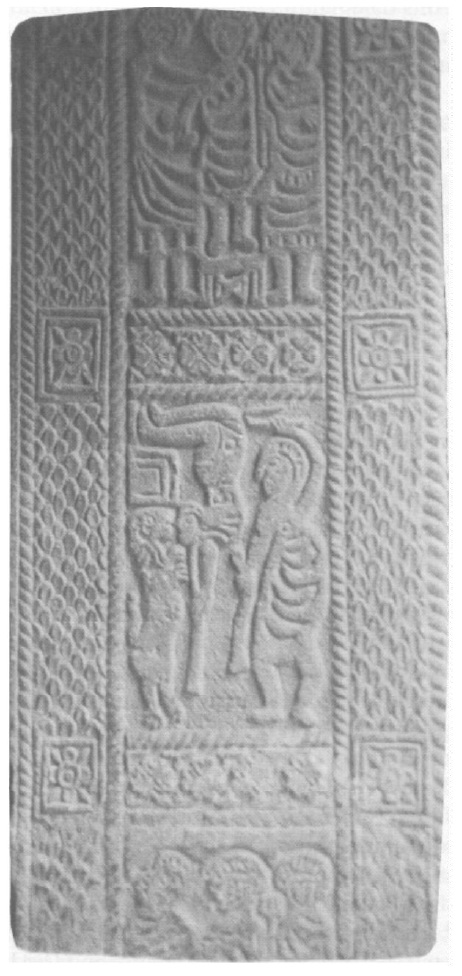
Spain Asturias: FAKE stone relief with FAKE martyr
miracle from the FAKE Middle Ages [kap2 photo1]
"Martyr miracle: Stone relief at the entrance of the
church of San Miguel de Lillo in Asturias, allegedly
consecrated in 842. The relief is said to have been
created after a Byzantine model from the 6th century
(Photo: U. Topper). (p.27)
-- So it's all a hoax, and the martyr fantasies are pure
moral sermons: “to make an example of them” (p.28)
-- All other faith groups are supposed to be “pagans”,
many "pagans" are supposed to have killed “Christian
martyrs”, and this is supposed to give the cr. Church now
the right to “kill all pagans”, e.g.: “kill witches by
drowning, burning Giordano Bruno or expel Jews.” (S.28)
[And you can see here again how the cr. Church is acting:
They INVENT that "Christians" have been killed, and for
that then they COMMIT genocides against other religions -
genocide is the principle of the Church - see Europe and
colonialism in Latin "America", Africa and Asia - and the
terror mission with cross, corpse and alcoholism is not
forbidden to this day].
-- The martyr fantasies are supposed to describe events
from the 1st, 2nd or 3rd century, although there were
hardly any “Christians” in Italy at that time, they only
existed from the 11th century, in Byzantium “100 years
earlier”, where they were “recruited from Gnosticism”
(p.28)
Topper quote (translation):
"For what purpose was this done? They invented founding
fathers of faith and
martyrs [were INVENTED]
to set an example with them. If those were killed by
pagans then, then should be now
the right to kill
pagans, this means:
killing witches by
drowning, to burn Giordano Bruno, or to expel Jews.
The inventor of martyrs is thus the Inquisition [of the
Papacy]. The Holy Inquisition.
This [Inquisition] was installed or reformed by a pious
pope around 1460, namely by
Silvio de Piccolomini
as
Pius II. (Pius = pious).
Pius
I, the Holy One (he died in 157 as a
martyr),
probably never existed [and is another FAKE martyr]; he is
as invented as the other martyrs.
With these martyrs and founding fathers of faith, an
entire era has been filled,
as if there had already
been Christians in the 1st, 2nd, or 3rd century. They
only existed for us from the 11th century onwards. In
Byzantium, it looked somewhat more civilized, as they
existed there a hundred years earlier.
They were not even freely invented there, but recycled
from scrap metal: recruited from Gnosis." (p.28)
The martyrs of the FAKE Inquisition - it is not even
clear when the FAKE Inquisition began - earliest mention
1215
--
Ratzinger claims: Inquisition began in 1542:
Cardinal Ratzinger said on Jan. 22, 1998 that the
Inquisition was installed in 1542 and that the 4500
volumes of the Inquisition up to 1903 have now been
“released for the public” (p.28)
--
Topper says: Inquisition began in 1310:
According to Topper, however, Inquisition began much
earlier, e.g. with the burning of women in Paris on May
31, 1310 with victim
Marguerite Porete,
whose book "Mirror of the simple souls" (orig. French:
“Miroir des simples âmes”) “had already been publicly
burned before” (p.28)
-- Inquisitor General is said to have been William of
Paris, his neighbor was “Master Eckehart”, he knew about
it (p.28)
--
Steiger+Heinsohn mean: Inquisition began in 1360:
Otto Steiger and G. Heinsohn published a book "The
destruction of the wise women" (orig. German: “Die
Vernichtung der weisen Frauen”) in 1985 and on page 23,
they named the period from 1360 to 1700 for the
Inquisition (p.28)
--
Meyers Lexicon says: The Inquisition already
existed in 1215: At the
Lateran Council
of 1215, the Inquisition is said to have
already existed: “public presentation, murder by fixing in
a wall, punishment forcing the victims to galley ships,
burning (of living humans as well as dead bodies recovered
from graves [corpses of "heretics" who died becaus of the
"Christian" torture in the prison already were thrown onto
the pyre]) etc.”. - Popular uprisings, on the other hand,
had no sense (p.29) - In 1535 there was a
pyre in
Paris murdering people in the fire, this “bad
habit existed there until 1772, in
Switzerland
until 1782”
-- In
Italy, the Inquisition is said to
have lasted
from 1235 to 1859, when people
were also sentenced to galley service, the last victims
was a Protestant couple in 1852 (p.29)
[Supplement: The mass
robbery of the criminal Catholic Church by the
Inquisition
With the Inquisition there came bullying, defamation,
torture, and coerced FAKE confessions that became
normal, and collective punishment was applied to the
entire families. In this way, nearly all possessions and
properties of the Christian states came into the hands
of the Church through confiscation - it was only
Napoleon who dealt with the criminal Church and the
posters with the family names of the condemned were
removed from the churches. But bullying and defamation
of criminal Christians for destroying existences of
truthers and logic thinking people is going on against
all other cultures. This happens to this day
against all other cultures because the criminal Catholic
Church has not given up its claim to world domination
inventing a line of Tordesillas from 1494 to today -
otherwise the criminal NATO would have nothing to do any
more. This is the crux for the end of the Christian World
War for a FANTASY Jesus and a Christian FANTASY God -
Mother Earth has long taken over large parts of the world
population and thus the world is becoming increasingly
stable WITHOUT church - and Fantasy Moses or Fantasy
Muhammad are not needed either - Status: July 20, 2025].
The FAKE Ignatius (Ignatius of Antioch) and his FAKE
letters - invented by “humanists” in the 16th century
-- The
FAKE Ignatius of Antioch was once a
FAKE disciple of the
FAKE apostle John,
together with the
FAKE bishop Polycarp
(p.29)
-- The FAKE Ignatius was FAKE bishop of the Syrian FAKE
church of Antioch and was FAKE deported to Rome in the
year 110 (others say in the year 116) and executed there
because of his FAKE faith (p.29)
-- On the way he meets many FAKE bishops and he is allowed
to FAKE write many FAKE letters, 6 to FAKE churches in
Asia Minor and one to FAKE bishop Polycarp (p.29)
-- These FAKE letters of FAKE Ignatius are said to be the
only early Christian FAKE letters, “immensely precious”,
because they fill the time between the FAKE Jesus with the
FAKE New Testament (NT) and the Church FAKE Fathers of the
FAKE Church with their early FAKE Jesus fantasy
theologians (p.29)
-- So imagine: These FAKE letters of FAKE Ignatius: Topper
quote, “They are the only truly Christian witness for the
entire second century.” (S.29)
-- The FAKE letters of the FAKE Ignatius are formulated in
the “baroque style”, Ignatius testifies his faith
according to the Council of Nicaea, “which took place only
210 years later” (p.29)
-- The FAKE Ignatius defends the FAKE death on the
FAKE-cross of the FAKE Jesus against “dissenters” (p.29)
-- The FAKE Ignatius claims that the FAKE Mary remained a
FAKE virgin (“immaculate”) even after giving birth and
that she gave birth to the FAKE son of the Fantasy God
(p.29)
-- The FAKE Ignatius describes in his FAKE letters the
structures of the Jesus Fantasy church [in the state of
about 1450] (p.29)
-- The FAKE Ignatius claims that the FAKE prophets of
Judaism existed: “confirms the Old Testament prophets as
non-Jews and pre-Christians” (p.29)
-- The FAKE Ignatius fights heresies [other beliefs of the
world] that arose much later, etc. But on the whole he
says nothing that could be considered (p.29)
-- The FAKE Ignatius gives his FAKE comments on the FAKE
Pauline Epistles, describes the FAKE Last Supper, and
lying priests like to learn to reproduce his lies (p.30)
-- The contradictions in the FAKE-letters of FAKE Ignatius
are gigantic, and the Church FAKE authority then simply
redefines the Ignatius FAKE letters 100 to 300 years later
inventing another author, the FAKE Ignatius should then be
a lie (p.30)
-- In reality, the FAKE Ignatius letters are to be placed
in the 16th century. Topper (translation): “Today I don't
care which humanist of the 16th century forged these
letters.”
-- There was once a Jesus Fantasy Abbot
Mr. Drioux,
Abbé, who published a book in 1873: "Elementary overview
of church history" (orig. French: "Précis élémentaire
d'Histoire ecclésiastique"; Paris 1873) (p.276)
-- In this book, Mr. Drioux says that the FAKE-Ignatius
had arrived in Rome, wanted to be taken immediately to the
amphitheater, where everyone was already waiting for him -
he heard the roaring of the lions - but he only became
stronger in his Jesus Fantasy faith, he pretended
happiness and a peaceful joy - then 2 lions came, ate him
up immediately and his big Fantasy bones, which remained,
were collected by the Jesus Fantasy believers of Fantasy
Rome and kept as “precious treasure” (p.30)
-- Topper thinks that the fantasy bones were perhaps then
sold, and maybe also deportation to the amphitheater
without any judgment does not seem possible and true
either - so the cr. Vatican deceives the whole world with
novels and “letters” being “presented as facts” (p.30)
General questions: WHAT really happened before 1400?
WHO falsified “Antiquity” and the “Middle Ages”?
-- There is the question about what really happened before
the year 1400 on the Planet when “Antiquity” and “Middle
Ages” are only INVENTION (p.30)
-- “Antiquity” and the “Middle Ages” have been INVENTED by
Jesus Fantasy monks and Jesus Fantasy theologians and
“their writing groups” (p.30)
-- You can find it out by analyzing the FAKE books of FAKE
“antiquity” (p.30)
Chapter 3: Humanists
The "Humanist" monks of the Vatican are
INVENTING authors and are INVENTING stories, dramas,
hero epic tales, etc.
-- Uwe Topper now presents some examples of criminal
"Humanists" who participated in the INVENTION of
"Antiquity" and the "Middle Ages" (p. 31)
-- Criteria for analysis are
1. the time of origin
2. the literary genre and
3. the method how the forgery was detected and exposed.
(p. 31)
Historical fabricators presented in Topper's book:
--
FAKE-Roswitha of Gandersheim (10th
century): with perfect comedies and dramas in perfect
Latin, including a report from a brothel (p. 31)
--
FAKE-Apuleius: The erotic poem "The
Golden Donkey" with the romance "Amor and Psyche" (p. 31)
--
FAKE-Tacitus with the FAKE Germania in a
Latin that does not even exist (p. 31)
Mentioned literature
-- Book by Joseph Aschbach: Roswitha and Conrad Celtes
(orig. German: Roswitha und Conrad Celtes); 2nd edition
1868
-- FAKE Apuleius: The Golden Donkey (The Golden Ass)
-- the translation of the “Golden Donkey” ("The Golden
Ass") into German was made by Nikolaus von Wyle in 1480 -
revised by August Rode in 1783, republished in 1923 (p.41)
-- Essay by Franz Brunhölzl (1971): On the Problem of the
Cassinese Classical Heritage (orig. German: Zum Problem
der Casinenser Klassikerüberlieferung - essay Marburg
Scholar Society (Marbuger Gel. Gesellschaft) nr. 3,
Munich) (1975); [In]: History of Latin Literature of the
Middle Ages (Geschichte der lateinischen Literatur des
Mittelalters) (Munich)
-- Book by Nikolaus Kusanus (Cusanus): Analisationof
Quran: Cribratio Alkorani ("Viewing the Quran" - German:
"Sichtung des Korans“, 3 books) (S.42 and [web05])
-- Book by Nikolaus Kusanus (Cusanus): "Calendar
Improvement" (Reparatio kalendarii, 1436)
-- Essey by Lorenzo Valla (secretary of the pope): about
the FAKE of the "Donation of Constantine" (orig. German:
Über die Fälschung der "Konstantinischen Schenkung") -
printed by Ulrich from Hutten in 1519 (p.43)
-- Book by Heribert
Illig: The Invented Middle Ages (orig. German: Das
erfundene Mittelalter) 1996
-- Book by
Hans-Ulrich Niemitz: Kammeier, critically honored
(orig. German: Kammeier, kritisch gewürdigt) 1991
-- Speech by Uwe Topper: "Who
actually invented the Germans?" (orig. German:
"Wer hat eigentlich die Germanen erfunden?") -
Hambourg 1996, printed in June 1996
-- Book by Ludwig
Pralle: The Re-discovery of Tacitus (orig. German: Die
Wiederentdeckung des Tacitus); Fulda 1952
-- Book by Eduard Norden: The Germanic prehistory in
Tacitus' Germania (orig. German: Die germanische
Urgeschichte in Tacitus Germania); 1920
-- Book by Eduard Norden: Ancient Germania (orig. German:
Alt-Germanien) 1934
-- Book by Arno Mauersberger: Tacitus Germania 1980
-- Book by Siegfrid Fischer-Fabian: The first Germans
(orig. German: Die ersten Deutschen); Munich 1975
-- Book by Max Oberbreyer: The Germania of Cornelius
Tacitus (orig. German: Die Germania des Cornelius Tacitus
-- Book by Franz Brunhölzl: About the problem of Cassino
classic tradition (orig. German: Über das Problem der
Casinoer Klassikerüberlieferung) 1971
-- Book by Robert Baldauf with his language research:
History and critics (orig. German: Historie und Kritik)
1902
-- Book by E.
Koestermann: Little
essays (orig. German: Kleine Schriften); 3rd ed., Leipzig
1970
3.1. The FAKE Roswitha and her FAKE Works
-- FAKE Roswitha of Gandersheim (10th
century): with perfect comedies and dramas in perfect
Latin, including a report from a brothel
-- No predecessors, no circle of friends, no successors
-- The forger is Mr. Conrad Celtes - and a "Latin
teacher"
-- Classic plagiarism, stolen comedy "Abraham", stolen
legend "Pelagius", and a Father Florez steals a legend
from FAKE Roswitha for Spain
-- The stolen celebratory speech by Widukind is copied
from somewhere - Ligurinus is copied from Mr. Otto of
Freising, "Epos de bello Saxonico" is copied from
Lambert of Hersfeld
The FAKE Roswitha of Gandersheim with UNpossibilities
-- Is also said to have been called
Hrotsuit
"in an old way", is said to have lived 935-973 [she is
said to have died at the age of 38], she is said to have
been a German Jesus fantasy nun in the monastery of
Gandersheim
near Braunschweig [today Lower Saxony,
Germany] (p.31)
-- Is INVENTED by the “Humanists” as the “first German
woman poet”, with FAKE books in Medieval Latin (p.31)
-- The literary lexicons (especially Walter Killys 1990)
cannot find any references to Roswitha of Gandersheim in
other literature, she “lives” only through her “own
writings” - her FAKE Latin teacher is said to have been
the FAKE abbess
Gerberg (940-1001)
(p.31-32)
-- They [the “Humanists” of the Vatican crown] have
WRITTEN “9 famous legends and dramas” to FAKE Roswitha
until the year 959 - at the age of 24 years - and the
FAKE-Latin teacher was at most 19 years old then (p.32)
[Can all this be real? NO]
The INVENTED literature of FAKE Roswitha of
Gandersheim
-- the
literary lexicon of Killys describes
that the works of FAKE Roswitha would be “burlesque martyr
stories” (p.32)
-- There is an “unusual legend” from Córdoba (Spain), told
by an “eyewitness”: A 10-year-old boy
Pelagius
remained steadfast “Christian” and resisted sexual abuse
by the
Caliph Abder-Rahman (‘III’), so the
boy preferred “martyrdom” (p.32)
-- There is an "unusual legend" describing a
FAKE
Calimachus, who also expressed his FAKE
sexuality on FAKE dead bodies (p.32)
-- There are also “
classically rhymed dramas”
[stave rhyme and end rhyme, which only appear in the “High
Middle Ages”] with an alliance with the devil, or there
was an early Dr. Faustus [copy of Goethe's “Faust”?]
(S.32)
-- There are "
hetaera dramas", and there is
a work about a
brothel with "betrayal of
virginity" with
Abraham and Pahnutius
(supposedly the names stand for "The Circumcised" and "The
Uncircumcised") -- then the Fantasy god has to "intervene
himself", sends abstemious monks to the brothel for
"conversion" (p.32)
-- The last INVENTED work for FAKE Roswitha is a
FAKE "
Revelation of John" in 35
hexameters (p.32)
-- FAKE-Roswitha repeatedly emphasizes "that as a woman
she could not write as well as a man" (p.32)
[-- Why then did FAKE Roswitha write "
9 famous
legends and dramas" at the age of 24???].
-- FAKE Roswitha is said to have written "flawless Latin"
(!), which points to "late Middle Ages" [13th century]
(p.33)
-- FAKE Roswitha wrote a “
heroic epic”,
there “she celebrates the glory of her patrons by singing
[...] in panegyric verses” (Panegyrikus=Festrede in
“Antiquity” [web03]), the FAKE Emperor Otto I. and the
FAKE Emperor Otto II. with "many details of the Ottonian
[FAKE] family [...] information that we cannot find
anywhere else today"
-- [the history inventors from the cr. Vatican] claim that
this FAKE work would be a "historical source" (p.33 )
-- [the history inventors] claim that FAKE Roswitha was a
"widely read writer", but the FAKE dramas have only been
performed since the 20th century (p.33)
-- The "
rediscovery" and presentation of her
"splendid manuscript of her works" happened "in
1493
(or actually 1501) by the "widely traveled humanist
Konrad
Celtes (Pickel) - with "dramas and elogies" in
the best Latin, a FAKE nun who had presented [forbidden]
sexuality as a topic - that fitted into the Renaissance,
and just a short time later, translations into German and
"enthusiastic hymns of praise for this FAKE find" followed
(p.33)
-- The situation seems IMpossible that FAKE Roswitha had
no FAKE predecessors, no FAKE poet friends or FAKE pupils
(p.33) [the fakers forgot to fake literature friends and
pupils...]
Supplement: A list of FAKE works by FAKE Roswitha can be
found on Mossad Wikipedia:
https://en.wikipedia.org/wiki/Hrotsvitha
[The photo shows the perfect FAKE writing of a text by
FAKE Roswitha]:
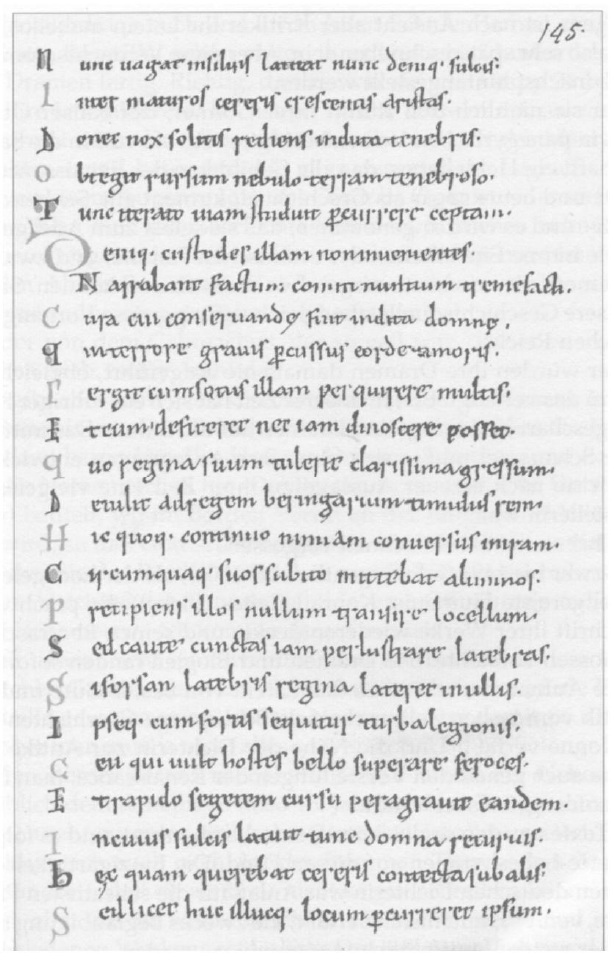
Work of the forging Humanist historians of the Vatican:
FAKE Fantasy of a FAKE Roswitha about an escape of a
FAKE Queen Adelheid [chap3 photo1]
Roswitha about the escape of Queen Adelheid (from: L.
Stacke, German History, Bielefeld-Leipzig 1896, Plate
145) (p.34)
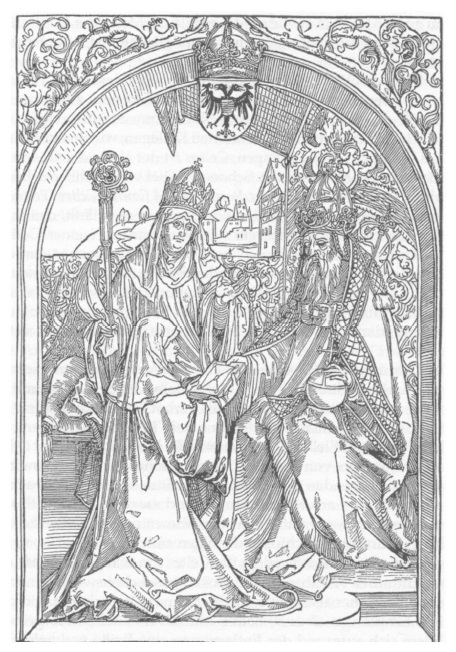
Fantasy woodcut of Mr. Dürer: showing Fantasy Roswitha
handing over Fantasy works about Fantasy kings [chap3
photo2]
"Roswitha presents her works to Otto the Great and
Archbishop Wilhelm
of Mainz," woodcut by Dürer for the first printed
edition
of Roswitha's works, published in 1501 by Konrad Celtes.
From:
L. Stacke, German History, Bielefeld—Leipzig 1896, p.
327) (p. 35)
-- The Vatican Humanists celebrated FAKE Roswitha as "the
greatest poetess of the Germans" despite all the
IMpossibilities - resistance only arose around 1850
through
Joseph Aschbach (he also was an
expert on Arabia), who recognized the connection between
FAKE Roswitha and the "Humanist"
Konrad Celtes,
who probably wrote all of works of FAKE Roswitha. Aschbach
publishes a small booklet "Roswitha and Conrad Celtes"
with over 50 pages.
Supplement: Joseph Aschbach (1801-1882) was a
grammar school teacher in Frankfurt am Main and then a
university professor in Bonn and Vienna
https://en.wikipedia.org/wiki/Joseph_Aschbach
Topper quote (translation):
"It was not until the middle of the 19th century that a
German
historian (and, by the way, an outstanding
Arabist) was protesting and tore apart the veil
surrounding this nun's mystery:
Joseph Aschbach
explains to his astonished colleagues how
Roswitha
and
Konrad Celtes are connected; Celtes is
the father of history, Roswitha is his brainchild
[invented person]. Even the title of Aschbach's little
book sounds like a romance novel: Roswitha and Conrad
Celtes." (S.36)
Quote from Mossad-Wikipedia (translation):
"Aschbach's work "Roswitha and Konrad Celtes" was a big
surprise for the society, in which he attempted to prove
that the Panegyric (
link)
[festival speech] on [FAKE] Emperor Otto the Great (
link),
previously generally attributed to [FAKE] Roswitha of
Gandersheim, was not her work but a poem by Konrad Celtes
(
link),
i.e. from the 16th century. However, this view was proven
to be an untenable hypothesis by the historians Rudolf
Köpke (
link)
and Georg Waitz." (
link)
[The Vatican history inventors have their agents against
truthers!]
-- According to Topper, Mr. Celtes is said to have written
his works under the pseudonym "Roswitha" for the
Enlightenment for the liberation of women from the
"Christian [...] yoke" - the forgery is therefore said to
have had "honorable backgrounds" (p.36)
-- Topper writes something about "Charitas" and says that
the FAKE Latin teacher probably "collaborated" on the FAKE
works, but that "remains unclear", in any case these are
"ingenious texts in Latin" - and the Catholic "church
leadership" then [when there was no Vatican yet] banned
FAKE Roswitha from writing as punishment for her truths
about life in the brothel etc. (p.36)
-- According to Topper, the “
rewriting of the
Revelation of John” could have been written by
the FAKE nun, but all other works with “
salacious
(erotic) situations” (according to Aschbach's
words) are probably not, but these works are from other
authors, namely:
1. by
Celtes - who himself also published
“erotic poetry” under his own name (p.36)
2. by
Pollichius
3. by some other members of Celtes' circle of friends "
Rhine
Brothers" (German: "Rheinische Brüder") (p.36)
-- Aschbach then examined the
original codex of
FAKE Roswitha from the 10th century
(pp.36-37), which is kept in
Munich,
whereby Celtes himself made "improvements and additions"
(p.37)
-- The examination of the works of FAKE Roswitha for
typeface, parchment, ink etc. is missing in Aschbach -
because what ink was like in the 10th century was unknown
at the time (p.37)
-- In terms of form [type of literature], the works are
NOT from a FAKE Roswitha in the 10th century, and in terms
of content, the works are from the
16th century
(p.37)
-- There are also
letters by Celtes
(printed in Aschbach's book in the second edition), where
Celtes announces the works of "Roswitha" since 1492, "he
was collecting materials and encouraging friends to help"
- the works of FAKE Roswitha were completed and presented
to the public in
1501 (p.37)
-- Suddenly there should be an outstanding woman writer
with dramatic poetry in Germany, without a previous
development (p.37-38), and this is IMPOSSIBLE (p.37-38)
Topper quote (translation):
“If the dramas were genuine, ”the beginnings of dramatic
poetry in Germany would have to be set half a (p.37)
millennium earlier than is currently assumed". (p.38 -
Aschbach: p. 15)
-- [Wilhelm]
Wackernagel (1806-1869 -
Professor from Berlin at the University of Basel [web10])
([book of] 1848 [cannot be found]) also believes that the
works of FAKE Roswitha were certainly not written in the
“Middle Ages”
Wackernagel quote (translation):
“that the dramas of Roswitha cannot be regarded as a fact
in the development of German or Latin literature of the
Middle Ages.” (S.38)
Aschbach found out that the works of Roswitha are a
FAKE (plagiatism)
-- The comedy “
Abraham” is by author
Rosweid
from the book "
Leyendas de los padres antiguos"
(“Erzväterlegenden”), printed in Latin in Nuremberg 1478,
published in German in Augsburg 1488 (p.38 - Aschbach:
p.17)
-- The legend of “
Pelagius” is full of
contradictions and IMpossibilities (Muslims pray to golden
statues, a homo incident is described etc.) (p.38)
-- A legend of FAKE Roswitha is said to have been copied
later by
Father Florez and is presented in
his own “collection of legends of saints” being called "
Holy
Spain" (ESP orig.: “
España sagrada”)
(p.38)
-- the 6th legend of FAKE Roswitha (the “
Faust
legend”) is typically Renaissance (p.38)
The style of FAKE Roswitha is based on FAKE “ancient
masters”
-- The works of FAKE Roswitha are stylistically oriented
towards
FAKE Ovid, FAKE Terence and FAKE Plautus,
who in the “10th c.” were still “completely unknown”
(p.38)
-- The
verse and rhyme technique was in the
“10th century” still UNknown (p.38)
-- Sometimes
Greek expressions flash up,
which are “unthinkable” for a Jesus Fantasy nun in the
10th century (p.38)
-- The authority [cr. Vatican] simply waits until the
truther dies, and then the matter is “over” for them [cr.
Vatican] and all lies will continue as before (p.38)
-- The
literature lexicons are censored [by
the Vatican] and literature experts do not pay attention
to Aschbach's analysis [or are blackmailed not to say
anything] (p.39)
-- Aschbach published the
2nd edition in 1868
- he was not only a professor in
Vienna,
but was elevated to “
knighthood” in 1870 and
his scientific works were thus honored - but some of his
colleagues did not want to believe him [and defended the
wonder of the world that PERFECT dramas in PERFECT Latin,
including brothel truths, should have been available from
a NUN] (p.39)
-- Aschbach still says on page 113: The glorifying poems
for the FAKE emperor Otto I are from the early days of
“Humanism”, “much talk, few facts”, are based on “old
sources” (p.39)
-- The ceremonial speech "Panegyricus" is copied from
Widukind (p.39)
-- Günther Ligurinus is copied from
Otto of
Freisingen (p.39)
-- The "Epos of beautiful Saxony" (Latin: "Epos de bello
Saxonico") is copied from
Lambert von Hersfeld
(p.39)
-- Aschbach concludes: "In this way, it was possible to
deceive even experts and men of science." (p.39 -
Aschbach: p.113)
And now, see how ALL is a FAKE:
Unfortunately, Aschbach did not also examine FAKE
Widukind, and there are also IMpossibilities with FAKE
Otto von Freisingen: "with 14 years to be a provost ,
abbot of a monastery at 18, bishop at 23". FAKE Lambert of
Hersfeld, however, is already clearly defined by Aschbach
as a forger. They were all known BEFORE FAKE Roswitha,
[but apparently not so well known as to expose FAKE
Roswitha or her forgers immediately] (p.39).
3.2 The FAKE poet Apuleius and his work
"The Golden Donkey" (with the romance: "Cupid and
Psyche")
-- The FAKE poet Apuleius [ca.123-170] was totally
"unknown", today he is "famous" (p.39)
Supplement: Mossad Wikipedia means that the FAKE
Apuleius would be "world literature" from the FAKE Roman
Empire
Quote Mossad-Wikipedia
(https://de.wikipedia.org/wiki/Apuleius) - translation:
"Apuleius (also Apuleius Madaurensis, Apuleius of Madaura
or Apuleius of Madauros; * around 123 in Madauros (
link),
today's village of M'Daourouch in north-eastern Algeria; †
probably after 170) was a Roman-Numidian writer, orator
and philosopher (Middle Platonist) of antiquity. Apuleius
owes his lasting fame to his main work, the Latin novel
"Metamorphoses", also known as The Golden Donkey, which is
considered part of world literature."
-- He is credited with an INVENTED defensive treatise "
De
Magia" ("On Magic") (pp.39-40)
-- His FAKE main work is said to be the erotic story "
The
Golden Donkey", with autobiographical
elements, an "orientalizing fairy tale collection", and
such did not even exist in his time, therefore, this is "a
bold new creation" (p.40)
Supplement: “The Golden Donkey” (lat. Asinus aureus,
also titled like "The Golden Ass") contains the story
“Cupid and Psyche” (the Fantasy Love God with a king's
daughter)
-- The novel “
The Golden Donkey” (Lat.:
Asinus aureus) is multi-layered, enigmatic, “sophisticated
narrative technique”, “skillful concealment of
intentions”, incorporating the “
tale of Cupid and
Psyche”, “love affair between the god "Cupid"
[God of Love] and the king's daughter ”Psyche", has been a
constant inspiration for poets, writers, painters,
sculptors, composers and choreographers, classical
scholars [scientists of "Antiquity"], literary theorists,
psychoanalysts and legal historians since the Renaissance.
[A “donkey” is NOT mentioned].
-- According to the
British Encyclopedia,
the Latin style of Apuleius is “strange and has a strong
antiquarian coloring” (p.40).
-- A “precursor play” by
Lukios of Patrae
is claimed, but it is rather a ‘parallel’, a “parody of
the typical medieval novels and cannot be older than
these.” (S.40)
-- The entire work of the “Golden Donkey” (strange
translation indicate: "The Golden Ass") is said to exist
in a single manuscript and to date from the 11th century,
copied from a model from 395 in Rome and corrected in
Constantinople in 397, then the model “returned to Italy”
(p.40 - Brunnhölz 1971: p.116)
Essay by Franz Brunhölzl (1971): On the Problem of the
Cassinese Classical Heritage (orig. German: Zum Problem
der Casinenser Klassikerüberlieferung - essay Marburg
Scholar Society (Marbuger Gel. Gesellschaft) nr. 3,
Munich) (1975); [In]: History of Latin Literature of the
Middle Ages (Geschichte der lateinischen Literatur des
Mittelalters) (Munich) (p. 276)
-- The “
rediscovery” of the erotic Golden
Donkey (Golden Ass) took place in
1480,
until then the work is said to have been “completely
unknown” (p.40)
--
Tacitus is in the same codex: "The
Annals and Histories of Tacitus are also contained in the
same manuscript, the "only codex", and only there." (S.40)
-- the real poet of the erotic golden donkey (golden ass)
could have been a “
Greek refugee” after the
expulsion from Byzantium (1453), since the
FAKE Apuleius claims to be a "Greek" and to have taught
himself Latin: “and learned Latin only late and without
instruction” (p.40)
-- there are “
unique linguistic creations”
which, according to Topper, are “an effective means of
distracting critically thinking readers” (p.40)
-- another example is the FAKE
Aelian (
Aelianus
170-222 [web04]), who is presented as a
FAKE Roman
writing in “
Attic Greek” (p.40)
--
FAKE Apuleius and FAKE Aelianus have one
thing in common:
They hate tyrants, and
expressing this is only possible in “
Humanism”
(p.40)
--
Apuleius was a rebel with “new word
creations, his own language style and his own novella
technique”, used folkloristic elements as a completely new
element (p.40), used an African fairy tale in a central
place (p.40-41) - demons are presented as “good beings”
(p.41)
-- another FAKE work by FAKE Apuleius is “
Metamorphoses”,
supposedly first published “anonymously” in FAKE Rome,
later ‘attributed’ to FAKE Apuleius (p.41) -
Boccaccio
copied from it and incorporated elements into his “
Decameron”
- but the process could also have been the other way round
p.41)
Giovanni Boccaccio, Italian "writer" of "Humanism"
1313-1375 [web08]
-- the translation of the “Golden Donkey” ("The Golden
Ass") into German was made by
Nikolaus von Wyle
in 1480 - revised by
August Rode in 1783,
republished in 1923 (p.41)
-- Such erotic literature is only possible in “Humanism”
from the 15th century onwards, the story is "funny" and
full of “biting mockery” (p.41)
-- The "
rediscovery" of the FAKE Apuleius
took place in
1475 by [a "Humanist"]
Poggio
(p.41)
[Supplement:
There are many people "Poggio", here is one but the
numbers do not fit with 1475:
Giovanni Francesco Poggio Bracciolini (lat.:
Poggius Florentinus): Italian "Humanist" writer 1380-1459
[web09]
-- The FAKE Apuleius in his work "Golden Donkey" ("Golden
Ass") also incites against "witches and their arts", but
the witch trials were according to Topper "from 1450"
[other authors say clearly, witch trials
began in 1250 appr.] (p.41)
-- The FAKE Apuleius also plays with names with allusions
and the names of the FAKE "ancient writers" are mentioned
as well as the FAKE of "ancient mythology" always
interwoven, a "typical syncretistic manner of the
humanists" (p.41)
-- Some scenes are based on the Orient: "orientalizing"
(p.41) [the contact of "Christianity" with the Orient
officially exists only from 1099 since the Crusades]
-- Some scenes are from the FAKE Church with "Amen" or
"Lord's Supper", translations are different, one time
"turban" or another time "braided cap" is translated etc.
(p.41)
-- The final chapter of the "Golden Donkey" is a
"celebrated speech honoring to the [FAKE] Church", also
"archaizing" and "Egyptianizing", this was the spirit of
the "Renaissance", on a "Field of Mars in Rome", a "joyful
vision of the future" [and all is a FAKE including
FANTASY-Jesus] (p.41)
-- the FAKE “
St. Augustine” (placed around
400) mentions the “Golden Donkey” (also: "Golden Ass") of
FAKE Apuleius, at the same time considering FAKE Apuleius
“
a magician”, so that perhaps that is why
FAKE Apuleius wrote a FAKE defense treatise “
De
Magia” (“On Magic”) (p.41)
[Thesis: The forger of Apuleius and Augustin could be THE
SAME].
3.3 Nicholas Cusanus (1401-1464): a
mathematician, physicist and “rediscoverer”
-- Mathematician, physicist, he called for
a new calendar after the defeat of Constantinople in
1454
-- He was also a “rediscoverer”, possibly also a forger
and faker
--
Nikolaus Kusanus (Nikolaus von Kues) was
allegedly a creative "Humanist" (p.42), in the end he was
a Jesus Fantasy cardinal and bishop of Tyrol [Innsbruck?]
(p.43)
-- The statement that he is said to have been a
fisherman's son of a Moselle fisherman has been proven as
INVENTED by Sigrid Hunke (p.43 - Hunke: Europe's own
religion (orig. German: Europas eigene Religion), 2nd
edition 1983: p.272)
Supplement: Mossad Wikipedia says that he
came from the Moselle-Rhineland: “ *1401 in Kues an der
Mosel (
link),
today Bernkastel-Kues (
link);
† August 11, 1464 in Todi, Umbria (
link)
[...] German philosopher, theologian, cardinal,
mathematician and physicist ” [web05]
--
Kusanus was a pioneer with a
groundbreaking
cosmos model, a model for
Copernicus [1473-1543],
Galileo
[1564-1642] and
[Giordano] Bruno
[1548-1600] (p.42), and it seems that contemporaries of
Kusanus did not read his pioneering work, but only the
generation after him, [strange] (p.42)
-- He wrote an
analysis of the Koran:
Cribratio Alkorani (“
Sighting of the Koran”,
three books) (p.42 and [web05]), which is said to have
been written after the Muslim occupation of Constantinople
after 1454 [web05]
-- As well as a “
Calendar Improvement”
(German: Kalenderverbesserung" - orig. Latin: Reparatio
kalendarii, 1436), 150 years before the introduction of
the Gregorian calendar (p.42) [when 1000 years were
invented with the maneuver "J" - "I" - "1" - see Christoph
Pfister: Die Matrix der alten Geschichte]
-- In his "
Sighting of the Koran" he incites
against the "pagans" (all those who are not "Christians")
and he stated that because of the defeat of Constantinople
the FAKE Church was in need of reform in terms of
"calendar and spirit of the time", the Jesus Fantasy
Church was simply "weak [...] against the Muslims" (p.42)
-- The suggestion is only taken up a generation later by
Regiomontanus
(
Johannes Müller (1436-1476) [web06]), who
developed a calendar correction (p.42) [where 1000 years
were invented for installing a FAKE Antiquity and FAKE
Middle Ages].
Supplement: Nikolaus Cusanus was one of the
"rediscoverers" of the works of FAKE "Antiquity"
https://de.wikipedia.org/wiki/Nikolaus_von_Kues
Mossad Wikipedia quote (translation):
"Among the manuscripts with works of ancient writers that
he discovered was one that contained twelve previously
unknown comedies by
Plautus (
link)
and one with the first six books of the
Annals
(
link)
of
Tacitus (
link)."
[Mossad Wikipedia web05].
[Conclusion: Perhaps Cusanus was one of the FAKERS of the
works of FAKE "Antiquity" that he had "found" - this may
be a PRINCIPLE of finding the FAKERS].
Which works are by Cusanus and which are not?
[-- apparently many works were also "attributed" to
Cusanus]
-- the evidence for the authenticity of Kusanus' works
"already fills many volumes" (p.43)
-- there is a lack of research (p.43)
3.4. Conspiracy?
-- the FORGED Donation of Constantine (4th
century)
-- FAKE letters from a FAKE pope on a FAKE journey in
1132
-- Niemitz's conclusion: Europe from 800 to 1400 was
tolerant and multi-religious
Facts about the FAKE Donation of the FAKE Constantine
-- The Donation of Constantine is a FAKE, was exposed by
"Humanists
Lorenzo Valla (Secretary of the
Pope),
Piccolomini (later Pope Pius II),
and
Nicholas of Cusa" (p. 43)
--
Ulrich von Hutten had
Valla's
work printed in 1519 (p. 43)
-- The Greek text of the "Donation" was apparently written
by "Latins" in
Rome (p. 43)
-- A FAKE Emperor
Constantine supposedly
granted territory to the FAKE Vatican [Vatican does not
exist before 1407] and recognized the supremacy of the
FAKE Church of Rome in FAKE Rome (p. 43)
--
Humanists believe that the FAKE donation
was forged in the
8th century (p. 43)
-- Topper claims that the forgery originated shortly
before the
schism of 1056 "and sealed the
split of the churches - Rome from Byzantium" (p. 43 -
Illig: The Invented Middle Ages - orig. German: Das
erfundene Mittelalter (1996): p. 142 f.)
-- According to Topper,
the reason for placing the
forgery in the 8th century is solely for the
propaganda that there existed already a "Catholic Church"
at that time (p. 43)
-- The forgery operation of the "Big Action" also included
deliberate temporal misplacements [to make the church
appear "bigger"], and the "gigantic conspiracy theory" [by
the criminal Gay-Drug-Vatican] is unfortunately true
[it is ALL a lie] (
Niemitz: Kammeier,
critically honored (orig. German: Kammeier, kritisch
gewürdigt - 1991)
The following example is a good example how the criminal
monks and bishops of the Vatican are FAKING things:
Facts about FAKE letters from the FAKE pope on a FAKE
journey in 1132
-- Niemitz provides in his book "Kammeier, critically
honored" another example of a mega INVENTION: The "letters
of recommendation" from the pope on a journey from France
to Lombardy in 1132 were supposed to "document" the
journey, but cannot be taken seriously, because out of 80
letters, only on 3 of them is a date indicated, not even
the first letter has got a date, making 77 letters
historically "worthless", a "nonsense" (p.44)
-- The letters depict "the past", but then depict
"projected events", in order to "historically validate the
Papal journey as well as other mentioned events" (p.44)
-- Niemitz concludes at the end of his work "Kammeier,
critically honored" (1991, p.31) (translation):
"The Church which was united at the beginning of the 15th
century organizes a large forgery operation by destroying
or altering all documents, so that the documents that have
come down to us tell a false history. This operation
cannot be without contradictions in the documents which
distribute in many different countries (respectively they
were created decentrally)." Here, a lot of data was forged
to keep a "pseudo-history relatively free of
contradictions" (p. 44).
-- As a result, historians today always have "work" to
find out what might be true and what is not (p. 44)
-- Or many contradictions are intentionally composed so
that the masses are unsafe and a "control" of history
becomes impossible (p. 44).
Niemitz with "Counterproposal of Medieval History"
-- The chronology gets lost and one wonders what the truth
was, while Niemitz already presents a "Counterproposal of
Medieval History" (p. 44):
Niemitz's conclusion: Europe from 800 to 1400 was
tolerant and multi-religious
Between 800 and 1400, the truth looks as follows:
-- There was NO Pope, NOR Universal Church, NOR any
Vatican - all Jesus Fantasy churches were organized
regionally - many people had other religions (which were
broadly referred to as "pagans" [or non-believers] or
"free thinkers" [or even called dissenters] by the cr.
Vatican Church) [those with different beliefs were to be
considered "worthless" - this discrimination against other
religions is working partially until today - 2025].
-- Regional hierarchies are forming with Jesus Fantasy
bishops and Jesus Fantasy dogmas
-- And now Niemitz clearly concludes that the Vatican wars
against dissenters ("wars against heretics"), the
Crusades, and the Investiture Controversy must be
classified quite differently (p. 45).
3.5. The FAKE Tacitus and his FAKE
Germania - in impossible Latin analogous to Sallust
Speech by Uwe Topper in 1996 at Hamburg: Tacitus = FAKE
-- Uwe Topper gave a lecture in May 1996 in Hamburg "
Who
actually invented the Germanic tribes?" (orig.
German: "Wer hat eigentlich die Germanen erfunden?" -
printed in June 1996) - a "lecture that describes the
Germania
of
Tacitus as a forgery exposed" - but the
historians who would have been concerned with it then
quickly disappeared from the hall: "But precisely
those who should have listened attentively were sprinting
away in the other direction." (p.45)
-- The German weekly review
Mirror (German:
Spiegel - issue no.44 of Oct 28, 1996)
presented an article as an answer: with 12 pages of new
knowledge about the "Germans" [in Zionist manner to
demonize everything German] with the title "The Germans —
our barbarian ancestors" with documentary proofs - without
analyzing whether they are real or not (p.45)
-- Unfortunately the Spiegel had NO IDEA about the
analysis work about the falsified sources of
Hardouin,
Baldauf, Kammeier and about the chronology
research (p.45)
-- The inner circle of friends of Topper was divided: some
protested that who portrayed the Germanic peoples as
INVENTED would hurt "a holy feeling" (p.45)
-- The input for more reasoning was misunderstood by some
because of the wrong headline, not the existence of the
Germanic tribes as such, but only the
"Germanic
image" should be revised (p.45)
The works of FAKE Tacitus are INVENTED - details
-- with the analyses of
Baldauf and Kammeier,
Topper attempted in his 1996 lecture to prove that the
works of
FAKE Tacitus are forgeries
"commissioned by
Pope Pius II. between 1430
and 1470" (p.45)
-- Before 1420, such texts are UNKNOWN (p.45)
-- the "re-discoverer"
Nicholas of Cusa
[Cusanus] (1401-1464) is said to have been involved in the
transaction of the Tacitus manuscript
from Hesse to
Rome (p.45 - book of Ludwig Pralle (1952): The
Re-discovery of Tacitus (Fulda): p.70ff.)
-- But Cusanus apparently was not interested in the FAKE
Tacitus texts, but probably he was aware of the forgery
(p.45)
The FAKE-Germania by FAKE-Tacitus: NOT a gift to the
Germans - prose writers with "their own language style"
with heaps of "difficulties"
-- The
FAKE-Germania is praised for example
by the philologist
Eduard Norden as an
identity-creating "gift" (p.45 - Norden: Die germanische
Urgeschichte in Tacitus Germania 1920), and such praise
for the FAKE-Germanie is repeated again and again (p.45 -
book by Siegfried Fischer-Fabian: The first Germans -
orig. German: Die ersten Deutschen (Munich 1975): p.204)
-- In fact, the FAKE Tacitus with the FAKE Germania is NOT
a gift, but was fabricated by a
catholic monk
on behalf of the cr. gay drug Vatican in the 15th century
to
fight the German emperors (p.46)
-- There can be NO question of a fame of the FAKE Tacitus
in the FAKE "Antiquity": "little appreciated and little
read", the level to the FAKE Cicero and FAKE Livius was
simply too high - the FAKE Tacitus has a
"strange"
language - offers
heaps of
"difficulties" for the translation (p.46 -
book by
Arno Mauersberger: Tacitus Germania
1980, p.17)
-- the FAKE-Tacitus is a "
prose writer", it
is a
degeneration of the language style
(p.47 - book by Max Oberbreyer: The Germania of
Cornelius Tacitus (orig. German: Die Germania des
Cornelius Tacitus 1910, p.4)
-- In short: The FAKE Tacitus had a "
very own style
of speech", says Topper (p.47)
-- Before the beginning of the "rediscovery" actions,
which began in
1427 with
Poggio,
there is only "one single reference to the Germania text,
and this is in the case of a monk of the same monastery in
which the "minor writings" of Tacitus were later
falsified, in
Rudolf of Fulda (Yearbooks,
2nd part, on the year 852), as well as in his description
of the transfer of the bones of St. [FAKE]-Alexander to
Wildeshausen
(completed by
Meginhart, see the book
of Mr. Pralle "
The Re-discovery of
Tacitus" p. 46), where some notes from the
[FAKE]-Germania are assigned to the
Saxons."
(p.47)
It is possible
-- that the students of Hrabanus used a separate source
-- that Rudolf's legend of saints was only written in the
15th century (suggestion by Kammeier)
-- that instead of the town of Fulda, also the town of
Hersfeld could be the place of forgery (p. 47)
-- the forgery workshop for the FAKE-Germania was
therefore located in
Hesse in
Fulda
or Hersfeld, and strangely, in the
FAKE-Germania, the
Hessians ("Chatten") are
rated much better than the other "Germanic barbarians" -
the Hessians are described as a particularly independently
organized people (p. 47).
The FAKE-Tacitus and the FAKE-Agricola in England
-- The Mr. FAKE Tacitus also composed a national work for
England with "Agricola" (p. 47)
[-- the FAKE father-in-law of the FAKE Tacitus "Gnaeus
Iulius Agricola" was supposed to have been "commander and
governor in Britain [...] (40 – 93)" (p. 47)
-- but the contradictions are so blatant that both works
of FAKE Tacitus - Germania and Agricola - are called into
question (p. 47).
The "rediscovery" of the FAKE-Tacitus at Monte Cassino
in 1370
-- The "
rediscovery" was "accomplished" by
Boccaccio
in
1370 in the Jesus Fantasy Monastery
Monte
Cassino, the only manuscript discovered so far
(p.47)
--
Monte Cassino was all in all the second
most important place of forgery of the humanists, which
was "in loose exchange" with the place of forgery of
Fulda,
whereby the manuscript in Monte Cassino differed by an
"own style of "Benaventanian" minuscule" (p.47 - book by
Franz Brunhölzl: On the problem of the Cassino Classic
tradition 1971 (orig. German: Zum Problem der Casinenser
Klassikerüberlieferung), p.111ff.)
-- Not even the name was right, because "Tacitus" was the
invention of a humanist in the 15th century, before those
times, the works were defined as by
Gaius
or
Publius Cornelius (p.47)
-- In 1515, the FAKE Tacitus was printed and the Annals
were merged with the Historiae (p.47 - Brunhölzl ibid.
p.140)
Robert Baldauf: ALL "ancient authors" are INVENTED by
"Humanists" - the "rediscoveries"
--
Robert Baldauf with his language
research (book: History and Critics (orig. German:
Historie und Kritik, 1902) concluded that
all
"ancient authors" are INVENTED by "Humanists"
(p.47-48)
-- the first one was the papal secretary
Poggio
Bracciolini (1380-1459) who traveled a lot
around and was able to "rediscover" many "old manuscripts"
in monasteries, "especially in German monasteries in the
basement" (p.48)
-- Poggio was also present at the
Council of
Constance 1414-1418 and at the same time
visited the
libraries of the monasteries of St.
Gall, Weingarten, Einsiedeln and Reichenau and
made a lot of "rediscoveries" (p.48) - 1419-1423 he was in
England and made new "finds" again (p.48)
The FAKE Tacitus and its "variations" - with a trip
from Hersfeld to Rome and "lost first copies"
-- A monk in the Hessian monastery of
Hersfeld
was commissioned by
Poggio to copy the
works of
Tacitus - "after a few years the
parchment codex was ready in form of three books of
Tacitus, called "Smaller Writings" (orig. German:
"kleinere Schriften" - compared to the Annals and
Histories) was ready" - now followed the "humanist"
Kusanus,
who after long negotiations between the monastery of
Hersfeld
and the
Vatican sold the FAKE-Tacitus in
Rome,
where they "did not appear until about
1455"
- there is said to be a long correspondence about this
sale and other documents, published in the book of
Mr.
Pralle (p.48)
-- In Rome 3 copies were made, in
1460 the
"priceless precious parchment scroll" is said to
have
suddenly been lost (p.48), and also the copies
"
disappeared", of which there were 3 copies,
but they "did not agree with each other at all" - so the
trace is blurred, research is blocked and "the old age and
the long tradition are made credible" (p.48)
The FAKE-Germania - the foreword of the Jesus Fantasy
pope - this is a book for preaching of "Germanness"
between the Rhine and the Don
-- The FAKE Germania was printed in
Venice
in 1470 and was the basis for Germanism until
Baldauf
came with his analytic works (book: History and Criticism
1902) (p.48)
-- In
1473 the book of FAKE Germania was
printed a second time in Nuremberg [in Latin?] without
becoming famous first (p.48)
-- Rumors say that the Jesus Fantasy pope
Pius II
wrote a commentary on the FAKE Germania in 1458 (p.48) -
but the printing of the commentary took place only after
his death in
1496 in Leipzig (p.48-49), and
only now the FAKE Germania became a well-known book [in
the Jesus Fantasy monastery schools for learning Latin]
(p.49)
-- In
Alsace, Mr.
Wimpfeling
used the edition of 1496 'to preach Germanness in Alsace'
(p. 49).
[-- Mossad Wikipedia states: "Jakob Wimpfeling (also
Wimpheling, Wympfeling; born July 27, 1450 in Schlettstadt
(
link);
died November 17, 1528, same place) was a Catholic priest,
poet, educator, and historian of German Humanism." (
link)
[web07]
-- Wimpfeling's "work" of preaching Germanness through the
FAKE Germania was often copied in Alsace and also in Baden
(p. 49).
[-- In Alsace this preaching work of Germanness was
important against France - this was a heavy political
affair - and one can imagine that such Germanness sermons
also took place in other border regions and that the
neighboring states had no pleasure of that at all...]
-- The first German commentary on the FAKE-Germania came
from
Ulrich von Hutten in 1502 (p. 49).
-- The intention of the Jesus Fantasy pope was to win the
Germans over for himself, and the success came with his "
commentary",
in this way the population meant that the FAKE Tacitus was
true, they increasingly identified with him, culminating
in the formulation "
gift of the kind fairy"
(German: "Geschenk der gütigen Fee") [quote of Mr. Norden]
(p. 49).
-- With the FAKE Germania, a "
Germanic space
and people between the
Rhine and Don River"
was defined - as a counterweight against English interests
in continental Europe, which constantly threatened to
annihilate the Catholic extremist French population [the
Jesus Fantasy pope liked them most] (p.49)
-- However, the invention of a "Germanic identity" north
of the FAKE-Limes in the first centuries AD is rather
"pure wishful thinking" - there only thing that is true in
the FAKE Germania are the "
impenetrable forests"
north of the Limes, the "Latin curtain" (pp.49-50) - and
the Germanic identity only emerged in the "High Middle
Ages" (p.50)
-- the FAKE-Limes later became a temporary dividing line
between the Reformation and the Roman Catholic Church
(p.50).
Conservative, loyal historians defend the FAKE Germania
The conservative historians loyal to the party line did
not accept that the FAKE Germania was supposed to be a
FANTASY and came up with counter-evidence, because the
content should be true
-- with
bog corpses, with "Roman stone reliefs"
with side hair knots of the Suebi etc. (p.50)
-- with the
Angrivarian Wall, a 10m wide
and several meters high earth wall, "
rediscovered"
only in the 20th century (p.50)
-- with
boat shapes (p.50)
-- with
Nerthus wagons which were not
common in northern Germany until the 15th century (p.50)
-- with
iron spearheads which are confirmed
by archaeologists even today [as of 2000] - they must have
been known to the Hessian INVENTOR forging monk himself
(p.50)
Truthers do NOT need this FAKE Germania
-- Mr.
Siegfried Fischer-Fabian wrote the
book "The First Germans" (Munich 1975), in which he
remarks that the FAKE Germania is full of "
ethnological
wandering motifs", and peppered with
falsified, ancient historiography - he was right (p.50)
-- In the FAKE-Germania it is described how to brew beer -
maybe it was meant as a greeting to Rome, as if Rome had
no beer (p.50)
-- Something DOES NOT fit together: "Wild barbarian"
Germans are supposed to "live in cities and have writing"
(p.50)
-- Something DOES NOT fit together:
Steel swords of
the Hyrcanians are described [at the Caspian
Sea] (p.50)
-- In 1902, after the death of the Jesus Fantasy pope
Pius
II, "eight parchment sheets were found at
Castle
Ancona, where he had died, which
were said to belong to a
Tacitus manuscript
from the 9th century' (p. 51)
-- And in Ancona, they also found a clay tile with the
words "CIS RHENUM" ("at the other side of the Rhine").
This tile was supposed to support the FAKE Germania to
make
territorial claims against France - but the
tile was immediately recognized as a forgery (Koestermann,
E. (1970): Little essays (orig. German: Kleine Schriften -
3rd ed., Leipzig) (p.51)
Strange Latin of the FAKE Tacitus with
"inconsistencies"- the Latin style of Sallust - the
tactic of varied names - FAKE Bible has the same
-- The FAKE-Tacitus is full of "linguistic
inconsistencies" with many expressions
"which are not possible in classical Latin" (p.51)
-- The "language form" seems "Italian"
(p.51)
-- For some words the meaning is disputed since then
like the term "Decumates agri", which is
not Latin at all (Eduard Norden: Alt-Germanien 1934)
-- Kammeier said that only parts of the FAKE-Germania
were forged (Die Verfalsifikation der Germania des
Tacitus 1935), apparently he did not know the linguistic
analysis of Baldauf (p.51)
-- Kammeier also said that FAKE-Plinius
and FAKE-Livius had not written anything about the
Germanic tribes, and their texts in the FAKE Tacitus
would appear distorted (p.51) and the purpose was not to
commit oneself (p.51-52): The only Germanic god name "of
interest" was "Tuiston", which occurs in 5
variations (p.52)
-- According to Kammeier, the Latin at FAKE Tacitus is
like the FAKE Sallust, "up to the choice
of words" (p.52).
The tactic of not committing oneself and presenting
heaps of variations of names also occurs in the FAKE
Bible (p.52).
[But also Sallust is a FAKE]:
The FAKE-Sallust (86-35/34 v.0)
https://de.wikipedia.org/wiki/Sallust
"Gaius Sallustius Crispus (German: Sallust; * 1 October
86 BC in Amiternum; † 13 May 35 or 34 BC in Rome) was a
Roman historian and politician. "
[The question is: WHO faked it?]


