|
|
|


The criminal gay drug Vatican is also a faking company
5.1. FAKE king lists claiming that Spanish "Christianity" is based on the Fantasy grandson of Fantasy Noah -
The FAKE Reconquest in Spain
5.2. Fantasy Peter and Fantasy Paul are said to have commissioned 7 Fantasy priests to "missionize" Spain - has NEVER taken place -- false chronology of Hieronymus Higuera "Cronicones" - uncovered by Nicolas Antonio, Gaspar Ibañez+Gregorio Mayans --
5.3. Churches in Spain did not exist until the 11th century, the old halls are from indigenous cults or Gothic-Arians --
5.4. FAKE "Christian" tombstones in Spain to claim a FAKE past --
5.5. FAKE gold coins of the Goths in Spain to claim a FAKE past
from: The Big Action. Europe's invented history. The Systematic Falsification of Our Past from Antiquity to the Enlightenment --
orig. German: Die Grosse Aktion. Europas erfundene Geschichte. Die planmässige Fälschung unserer Vergangenheit von der Antike bis zur Aufklärung --
Edition Grabert -- ISBN 3-87847-172-6 -- Tübingen 1998; 2nd edition 2000
Commented edition
presented by Michael Palomino (2025 - translation 2025)
| Share: |
Facebook |
|
Twitter
X |
|
|
|
Content
Chapter 5: Spain
5.1. FAKE king lists claiming that Spanish "Christianity" is based on the Fantasy grandson of Fantasy Noah
The FAKE Reconquest in Spain
5.1.A. Fantasy King lists - it begins with a Fantasy grandson of a Fantasy Noah
5.1.B. Pedro de Medina: FAKE chronicle of Spain (Seville 1548)
5.1.C. The FALSE pride of a FAKE past
5.1.D. Supplement: what does 'cultural height' mean?
5.2. Fantasy Peter+Fantasy Paul are said to have commissioned 7 Fantasy priests to "missionize" Spain - has NEVER taken place
The criticism of the fabricated story of Antonio (1617-1684)
5.2.A.B.C. The FAKE chronology of Spain INVENTED by Hieronymus Higuera from 1611/1619: "Cronicones" ("Mega-Chronology") - exposed - the FAKE "Tables of Granada" - false pride spreads - the original from Fulda is MISSING
-- Logician + analyst Nicolas Antonio (founder of the "Spanish Library" - 1617-1684)
-- Logician + analyst Gaspar Ibañez, margrave consort of Mondéjar (1628-1708), aristocrat, historian
-- Logician + analyst Gregorio Mayans y Siscar (jurist + royal librarian of Madrid - 1699-1781)
5.2.D. Gregorio Mayans y Siscar (1699-1781) uncovers further writings
5.2.E. Principle: INVENTED persecution of Christians and INVENTED "Christian" martyrs - a "Christian" system of the criminal Vatican
5.2.F. The case of the INVENTED "Saint Lawrence" - the Fantasy of the flight of the parents from Tarsus to Spain - the awarding of the Fantasy birthplace
5.2.G. Criminal Catholics in Spain faking coins, medals, inscriptions, and manuscripts - so that the FAKE Bible and the descent from the Fantasy Noah match (!) - "archaeologist" Augustin Sales complains to Mayans about Don Lorenzo + Goltzius + Higuera
5.2.H. The principle: "Impeccable CV" and "high position" are prerequisites in the criminal Church to be a respectable forger
5.2.I. The forger Lucas Holstenius - a jurist as head librarian in the criminal Vatican - FAKE documents about "African Councils"
5.2.J. With Mayans (1699-1781), more forgeries come to light: Cesaraugustano - "Primitive Spain" - letters - "historian Mr. Rasis"
5.2.K. The royal Church even enlists Jewish and Muslim authors for claiming a "Christian Spain" BEFORE the Muslim occupation
5.2.L. The Church dictatorship in Spain is removed by Antonio (founder of the "Spanish Library" - 1617-1684) - with the help of Portugal
5.2.M. The INVENTED Berossos (Berosos) and an INVENTED chronology of Syria - and an INVENTED Julius Africanus = chronologies of the FAKE Bible
5.3. The "first Church" in Hispania (Spain and Portugal, Iberian Peninsula) - legends
Churches in Spain did not exist until the 11th century, the old halls are from indigenous cults or Gothic-Arians
5.3.A. The call for analysis and research from the Second Vatican Council of 1963 - book by Miguel de Oliveira "Legend and History" ("Lenda e Historia" - 1964)
5.3.B. Book by Jesus Fantasy pastor Miguel de Oliveira "Legend and History" (1964): The FAKE Bible with the imaginary Paul on an imaginary trip to Spain - Muslim sources mention "apostolic men" in Spain - 7 Fantasy bishops get orders from Fantasy Paul and Fantasy Peter - a FAKE martyr book from Lyon (806) - a "History of Spain" by Ramón Menéndez Pidal
5.3.C. The legend of the Jesus Fantasy apostle Santiago seems unnecessary
5.3.D. The Legend of a Fantasy "Saint Beatus" - the legend of a Fantasy "Apostle James"
5.3.E. Oliveira is exposinig one chronicle after another
5.4. FAKE "Christian" tombstones in Spain to claim a FAKE past
5.4.A. Fake some tombstones in Spain for securing the INVENTED early "Christianization" + to justify the "Reconquest" against the Muslims that have never been in Spain
5.4.B. Spanish Jesus Fantasy church buildings? These are the halls of the Spanish native people (Northern Spain) or Gothic halls (Catalonia)
5.5. Gothic coins: FAKE gold coins of the Goths in Spain to claim a FAKE past
Gold coins suddenly "detected" - but there are no silver coins
5.5.A. Faking coins for supporting Fantasy chronologies
5.5.B. The finding of coins of 1891 in La Capilla (Sevilla): It is claimed that 904 Gothic gold coins were found, but only 250 are confirmed - only 68 became known - only 43 were photographed - further findings - without any context
5.5.C. Asturias 11th century: normal coins were spread in normal quantities
5.5.D. IT'S ALL A LIE in Spain
Mentioned literature (books)
in the order of appearance in the work:
-- Uwe Topper: The Legacy of Giants (orig. German: Das Erbe der Giganten - 1977) (p. 77)
-- Pedro de Medina: Chronicle of Spain (German: Chronik von Spanien - [orig. Spanish] - Seville 1548)
-- Gregorio Mayans: "Critique of Fantastic Stories, posthumous work of Don Nicolas Antonio" (Valencia 1742) (p. 279)
(orig. ESP: Censura de Historias fabulosas, obra posthuma de Don Nicolas Antonio)
-- Heinrich Gelzer: Sextus Julius Africanus and Byzantine Chronography (Leipzig 1880/1898 - Hildesheim 1978) (p. 277)
(orig. German: Sextus Julius Africanus und die Byzantinische Chronolographie)
-- Miguel de Oliveira: "Legend and History" (orig. PORT: "Lenda e Historia" - Lisbon 1964) (p. 87, 279)
-- a Fantasy martyr book from Lyon (806 after Fantasy-Christ) [Title?] claims that 7 bishops were commissioned and consecrated by the two Fantasy apostles Peter and Paul to "convert" Spain (p. 89)
-- Alois Heiss: General description of the Visigothic royal coins in Spain; F: Description géneral des monnaies des rois Wisigoths d'Espagne (Paris 1872; reprint 1976); General description of the Hispano-Christian coins from the Arab invasion (orig. ESP: Descripción general de las monedas hispano-cristianas desde la invasiónde los Arabes) (Vol. I, Zaragoza 1962) (p.277)
-- Book by Xavier Barral i Altet: The circulation of coins of the Suebi and Visigoths (F orig.: La circulation des monnaies Suèves et Visigotiques - Munich 1976) (p.275)
Chapter 5: The Reconquest in Spain
The reconquest in Spain — 77
The critique of the fabricated History of Antonio - 79
In best company - 83
The "first Church" in Hispania - 87
Fake Tombstones? - 90
Coins of the Visigoth - 94
5.1. The Fake Reconquest in Spain
5.1.A. Fantasy King lists - it begins with a Fantasy grandson of a Fantasy Noah
5.1.B. Pedro de Medina: FAKE chronicle of Spain (Seville 1548)
5.1.C. The FALSE pride of a FAKE past
5.1.D. Supplement: what does 'cultural height' mean?
5.1.A. Fantasy king lists in Spain with Fantasy biblical names - it begins with the Fantasy grandson Tubal of a Fantasy Noah - the biblical Fantasy figures are "sacred" and must not be questioned (!) - imperial claims on Southern Italy
-- The "Renaissance" in Spain was characterized by a forger mentality, just like in the rest of Europe - forgers in Spain included Pedro de Medina, Juan Viterbo, and Gerónimo de la Concepción (p. 77)
-- They invented "history books and geography works," well structured to make them seem "authentic" (Book by Topper: The Heritage of the Giants - German: Das Erbe der Giganten (1977), Chap. 22) (p. 77)
-- Many of their indications are archaeologically proved, but the king lists of Spain are lies, not only those, but also the Greek, Roman, or Chaldean king lists (p. 77)
-- "All dates and proper names of these "rulers" are pure fantasies" - Topper himself only recognized that after years of false belief (p. 77)
-- The first king of Spain is said to have been a Fantasy Thubal after the FAKE flood, in the year 2102 before Fantasy Christ, "he repopulated the land and gave culture to it." (p. 77)
-- "There follow city founders and religion founders with resonant names, horsemen leaders and science promoters in colorful succession, with the usual throne disputes, conquest campaigns, and exiles" [the standard pattern of "drama"] (p. 77)
-- "Familiar names also appear such as [Fantasy] Hercules and [Fantasy] Hesperus and finally the [Fantasy] rebel Caco, who makes an intermezzo from 1303 to 1267 before 0 and - apart from the dating - has almost a historical character" (p. 77)
-- As one can still admire the ruins of the ancient cities of Spain today, the historical imagination in Spain gets a certain "real" touch (p. 77)
-- An Italian mentality is commenting such historical fantasies: "Si non e vero e ben trovato" - "If it is not true, it is well invented." (p. 77)
[Supplement: Catholics are mostly alcoholics with limited thinking ability
They drink a bottle of wine a day and eat a paella a week, that's the rhythm in Catholic Spain - that's how the alcoholic Catholic everyday life is right - history is not so important, just consider this factor. The same applies to Italy with a bottle of Jesus Fantasy wine per day as a blood cult - and with one polenta per week - and the rest doesn't really matter...]
Continue with Topper:
-- Spain has ruins of whole cities and castles (p.77-78) - in the "Renaissance in the 16th century" - also called "Cinquecento" [500 ->> the years of 1500] - they were searched for treasures and glorified (p.78)
-- A Fantasy Thubal is said to have been the grandson of the Fantasy Noah (p.78)
-- The Fantasy kings in Spain must be pious "Christians" with the Fantasy Bible in their hands, everything else is IMPOSSIBLE - so, for the Fantasy kings Fantasy Bible names are chosen (p.78)
-- A Fantasy Hercules from Greece is said to have traveled to Spain (to the 'Westland'), with this maneuver, the Fantasy Hercules should be confirmed - "too conspicuous" (p. 78)
Topper quote (translation):
"The strange name of connection, Thubal, grandson of Noah, should have made me suspicious already. In Catholic Spain, a biblical name is the only possible form of connection to world history, and a royal list must somehow be embedded in it. Or the mention of Hercules, who according to Greek legend traveled to the West. Such cross-confirmations are too conspicuous." (p. 78)
-- The Spanish Fantasy royal lists go analogously with the Fantasy lists in other countries: "Manetho from Egypt, Berossus from Chaldea, Eusebius, etc." (p. 78)
Topper quote (translation):
"In 1977 I wrote (p. 412): »The sources for this (for this representation of prehistory of the Iberian Peninsula) are as reliable as all other historical writings: Manetho from Egypt, Berossus from Chaldea, Eusebius, etc.« Just as reliable, namely worthless, as I must recognize today." (p. 78)
AND: FAKE chronologies for imperial claims on Southern Italy
-- There was an "obsession" with recognizing "ancient ancestors" and attributing to oneself a "great past," along with imperial claims, for example, on Southern Italy - just read the work of Professor from Alcalá, Pedro de Medina, who published a large "work of history" in 1540 (p.78). [Now one must find out which work Topper meant. I think it refers to the "Chronicle of Spain" from 1548].
5.1.B. Supplement: Pedro de Medina (1493–1567) with a FAKE Chronicle of Spain (1548)
-- Pedro de Medina was a Spanish cosmographer, author of "Arte de navegar" ("Art of Navigation") [web01]
-- His printed works include a whole list on the Mossad Wikipedia - now one has to guess which book Topper meant that makes claims on Southern Italy. The following 3 books are possible:
-- Works. Book of the Greatness and Remarkable Things of Spain. Book of Truth
(ESP orig.: Obras. Libro de las grandezas y cosas memorables de España. Libro de la Verdad) 1944
-- Book of the Greatness and Remarkable Things of Spain. Now newly written and collected by Maestro Pedro de Medina, resident of Seville.
(ESP orig.: Libro de grandezas y cosas memorables de España. Agora nuevo fecho y recopilado por el Maestro Pedro de Medina vezino de Sevilla) 1595
-- Chronicle of Spain (Seville, 1548) (ESP orig.: Crónica de España (Sevilla, 1548) [web02]
The original list of works by Pedro de Medina in Spanish [web02]:
Obras impresas
- Obras. Libro de las grandezas y cosas memorables de España. Libro de la verdad, ed. de Ángel González Palencia, Madrid: CSIC, 1944.
- Arte de navegar en que se contienen todas las reglas, declaraciones, secretos y auisos a que la buena navegación son necessarios, y se deuen saber hecha por el maestro Pedro de Medina, Valladolid, en casa de Francisco Fernández de Córdoba, 1545, muy reimpreso y traducido. Hay facsímil de Madrid: Patronato del Inst. Nacional del Libro Español, 1945, y una edición electrónica facsímil en Obras clásicas de Náutica y Navegación, Madrid, Fundación Histórica Tavera, 1998, CD-Rom.
- Libro de grandezas y cosas memorables de España. Agora nuevo fecho y recopilado por el Maestro Pedro de Medina vezino de Sevilla, Sevilla, Dominico de Robertis, 1548. Hay facsímil: Madrid, Instituto de España y Biblioteca Nacional, 1994, acompañada de introducción en separata de M.ª del Pilar Cuesta Domingo; y otra de Maxtor de la edición alcalaína de 1666 por Pedro de Robles y Juan de Villanueva. Ampliado y reeditado en 1595 por Diego Pérez de Mesa: Primera y segunda parte de las Grandezas y cosas notables de España, en casa de Juan Gracián, 1595. disponible a Google books
- Crónica de España (Sevilla, 1548)
- Libro de la verdad, donde se contienen dozientos dialogos que entre la verdad y el hombre se contractan sobre la conuersion del pecador, Sevilla, 1549). Está incluido en las Obras de 1944.
- Regimiento de navegación, en que se contienen las reglas, declaraciones y avisos del libro del Arte de navegar, Sevilla: Juan Canella, 1 de diciembre de 1552.
- Hispaniae Tabula Geographica (Sevilla, 1560).
- Crónica de los excelentes señores duques de Medina Sidonia (1561).
- Regimiento de navegación compuesto por el maestro Pedro de Medina. Contiene las cosas que los pilotos han de saber para bien navegar: y los remedios y avisos que han de tener para los peligros que navegando les pueden suceder, Sevilla: en las casas de Simón Carpintero, 1563. Hay edición moderna: Regimiento de navegación. Compuesto por el Maestro Pedro de Medina (1563). Ahora nuevamente publicado por el Instituto de España en edición facsímile. 2 Tomos: Original y Transcripción Madrid, Instituto de España, 1964, 2 vols.
5.1.C. The false pride from the FAKE past - must be recognized
Continuing with Uwe Topper:
-- In the analysis, one can clearly see that nothing fits together or everything is composed, thus it is "useless" (p.78)
-- The Fantasy stories of the Renaissance fakers are showing a 'self-confidence' to the masses as a basis for "our current cultural height" (p.78)
5.1.D. Supplement: What does "cultural height" mean?
"Cultural height" = colonialism with firearms + cannons, deforestation for shipbuilding, extremely so in Spain and Portugal (!) - slavery, mass murder, cultural destruction of indigenous peoples, gold theft, silver theft, thus financing universities and world banks that only finance new wars again?!
-- the Fantasy stories of the Renaissance provoke a false pride and a sense of superiority over all indigenous cultures that still live naturally with the planet.
Uwe Topper summarizes it like this: One should be aware of how this false pride came about:
"After the first disappointment — precisely a disillusionment — I see no reason to condemn or disdain the Great Action. But I just have to see how all this came about and how it has shaped me to this day." (p.78)
5.2. The criticism of the fabricated History of Antonio [1617-1684]
5.2.A.B.C. The FAKE chronology of Spain INVENTED by Hieronymus Higuera from 1611/1619: ESP: "Cronicones" ("Mega-Chronology") - exposed - the FAKE "Tables of Granada" - false pride spreads - the original from Fulda (Germany!) is MISSING
-- Logician + analyst Nicolas Antonio (founder of the "Spanish Library" - 1617-1684)
-- Logician + analyst Gaspar Ibañez, margrave consort of Mondéjar (1628-1708), aristocrat, historian
-- Logician + analyst Gregorio Mayans y Siscar (jurist + royal librarian of Madrid - 1699-1781)
5.2.D. Gregorio Mayans y Siscar (1699-1781) uncovers further writings
5.2.E. Principle: INVENTED persecution of Christians and INVENTED "Christian" martyrs are a "Christian" system of the criminal Vatican for presenting "Christians" as victims
5.2.F. The case of the INVENTED "Saint Lawrence" - the Fantasy of the flight of the parents from Tarsus to Spain - the definition of Fantasy birthplaces
5.2.G. Criminal Catholics in Spain faking coins, medals, inscriptions, and manuscripts - so that the FAKE Bible and the descent from the Fantasy Noah match (!) - "archaeologist" Augustin Sales complains to Mayans about Don Lorenzo + Goltzius + Higuera
5.2.H. The principle: A "perfect curriculum vitae" is needed and "high positions" are a precondition in the criminal Church to be a respectable forger
5.2.I. The forger Lucas Holstenius - a jurist as a boss of a library in the criminal Vatican - FAKE documents about "African Councils"
5.2.J. With Mayans (1699-1781), more forgeries come to light: Cesaraugustano - "First Spain" ("España primitiva") - letters - "historian Mr. Rasis"
5.2.K. The royal Church even enlists Jewish and Muslim authors for claiming a "Christian Spain" BEFORE the Muslim occupation
5.2.L. The Church dictatorship in Spain is removed by Antonio (founder of the "Spanish Library" - 1617-1684) - with the help of Portugal
5.2.M. The INVENTED Berossos (Berosos) and an INVENTED chronology of Syria - and an INVENTED Julius Africanus = chronologies of the FAKE Bible
5.2.A. The historical forger-Jesuit Hieronymus Higuera from Toledo with his "Mega-Chronology" ("Cronicones") of Spain 1611 / 1619 - 1652 exposed, publicly exposed in 1742
-- One of the "humanistic" fakers in Spanish historiography is the "highly esteemed and well-educated Jesuit Hieronymus Romanus de la Higuera from Toledo (1538-1611)" - supposed to be "easily to detect" (p.79)
-- Andalusia was "Christianly" occupied in 1492 only and historical forgery was brought to "prosperity" there (p.79)
-- Those who could forge history beautifully were accepted into the "high organizations" of the Jesus Fantasy Church, in the case of Hieronymus Higuera, he got an offer in 1563 to join the "Order of [Fantasy] Jesus", finally joining in 1590 (p.79)
-- Hieronymus Higuera wrote a "large historical work, the 'Cronicones' [the 'Mega-Chronology'], which was long circulated in manuscript form before being printed in 1611 - according to some sources in 1619 (p.79)
-- The vast majority of the elite believed every word of it for 40 years, then the fraud was detected in 1652, but this fraud was not published until 90 years later in 1742 in Valencia (p. 79)
Topper quote (translation):
"Almost all the famous people of his time, in Spain as well as in other Catholic countries, regarded the work as genuine and praised it extensively. Reprints were published in 1627 in Cádiz and Lyon, in 1640 in Madrid, and even later. Because it received so much attention, there is a wealth of information available in all sorts of adaptations that can no longer be filtered out today. Yet the fraud was "already" uncovered in 1652, but was only published in Valencia in 1742." (p. 79)
[Addition: "Cultural Height"
The "cultural height", the great colonial plunder in Latin America, had already occurred: for 250 years - the native population of the Caribbean and coastal regions had already been EXTERMINATED and in the Andes at least reduced and threatened with extinction - the mass murder through hunger, cold, mines, and extortion was so immense that the mines were short of "workers" (!) - a very "Christian" behavior - see the report by Uolla and Juan 1748, published 1826, session 12 - Link (ESP): http://www.am-sur.com/am-sur/peru/corr-Ulloa-1826/ESP/012-sesion-12-minerales+agricultura.html
5.2.B. The "Mega-Chronology" "Cronicones" by Hieronymus 1611 / 1619 - the spiritual boon for false pride - the printing houses spread the Spanish chronology lie
-- Hieronymus Higuera claimed to have received a "manuscript" from the monastery of Fulda [Germany!] containing texts about the time of the Visigoths [???] - the "writers" are said to have been "several Spanish church writers":
-- "Flavius Lucius Dextrus, son of the saint Pacian, whom Saint Jerome (Hieronymus) counted among the Church Fathers;
-- Marcus Maximus, Bishop of Saragossa, whom Saint Isidore of Seville listed as one of the 'Famous';
-- Luitprand of Pavia, widely known at the time;
-- Saint Braulio, Bishop of Saragossa and closest friend of Saint Isidore;
-- Tajon, a contemporary of the same;
-- Valderedo and Heleca and other bishops of Saragossa."
[All these persons should be "holy bishops", so, their inventions must also be "holy" - and in this way, money could be made...]
-- with this gigantic FAKE story [which directly referred to the FAKE Bible], the masses were now "beneficially" manipulated, and Spain should have been "Christian" for 3000 years already [with reference to the Fantasy Noah] - well, these fantasies were eagerly believed by the Catholic Christian masses (p. 79).
Topper quote (translation):
"The history of the Spanish Church before the "Reconquista" was perfectly described here in a beautiful way, it was balm on the souls having a first general continuous Christian history of Iberia - better it was not possible." (p. 79)
-- Hieronymus Higuera INVENTED saints and martyrs without end (p.79-80) - INVENTED bishops and synods without end (p.80)
-- The bishop of Segorbe [region of Valencia] - Juan Bautista Nrez - recognized the forgery immediately, but he died 3 years after his discovery and Hieronymus created a "new version which avoided many mistakes of the first one" [so the fake was even "better" now!] (p.80)
-- This is how the "Cronicones" (the "Mega Chronology") came into being, these were no longer consecutive texts, but a "list of dates" with many more possibilities of falsification (p.80).
Topper quote (translation):
"First there were only fragments, with which the Cronicones were fabricated. Instead of continuous texts, the work now presented itself as a list of events with years, and in this concise shape, faking was much easier. The information was cleverly mixed with other lies that were circulating at the time and were willingly believed." (p.80)
[Addition: The systematic lies of the inventors with holy cross, holy wine, 'holy spirit'
Catholics and Protestants lied equally, in this point, they agreed, the poet-monks with their holy Fantasy cross and holy Fantasy wine standing for Fantasy blood of a Fantasy Jesus - the "holy spirit" during being drunk may have contributed many inventions to it...]
5.2.C. The "Mega Chronology" of 1611/1619 is discovered - critics Gaspar Ibañez and Gregorio Mayans alongside Nicolas Antonio - the FAKE "Tables of Granada" - the ORIGINAL from Fulda is MISSING - condemnation in 1682 by Pope Innocent XI
-- Gaspar Ibañez, Count of Mondéjar [region of Madrid - 1628-1708], wrote two essays against chronological fraud - but could not stop the chronology lie (p. 80)
-- The publication of the "Mega Chronology" by Hieronymus was in Latin, and the original from Fulda is said to have been written in Gothic, this is all complete "nonsense" - there were critics, but they could not prevail (p. 80)
-- The vast majority of the elite and the population fed their souls with the lied Hieronymus chronology "as a document of inestimable value" - "like relics" - "partly out of opportunism, partly out of ignorance" - this later noted Mr. Gregorio Mayans y Siscar [1699-1781] (p. 80)
[Addition: enlightener Mayans in Spain 1699-1781
This Mr. Mayans is one to remember - he is a significant enlightener in Spain, as far as that was even possible:
Mossad-Wikipedia writes (translation):
https://de.wikipedia.org/wiki/Gregorio_Mayans_y_Siscar
"Gregorio Mayans y Siscar (* May 9, 1699 in Oliva; † December 21, 1781 in Valencia) was a Spanish lawyer, historian, philologist, Romanist and Hispanist. Mayans studied law in Valencia and Salamanca. From 1723 he taught law in Valencia, but was ousted from this position in 1730 and went to Madrid as royal librarian. From 1740 he lived as a scholar in Oliva and maintained a correspondence across Europe, which was published in 25 volumes. Mayans is among the significant figures of the Spanish Enlightenment.
In 1763 he was elected as a foreign member of the Göttingen Academy of Sciences."
[However, he could not prevent colonialism, this was too secret (the report by Uolla&Juan was published only in 1826...)]
[Supplement: enlightener Gaspar Ibañez in Spain 1628-1708
The partner of Mayans was Gaspar Ibañez. Mossad-Wikipedia writes (translation):
https://es.wikipedia.org/wiki/Gaspar_Ib%C3%A1%C3%B1ez_de_Segovia
"Gaspar Ibáñez de Segovia Peralta y Mendoza, margrave consort of Mondéjar (born at Madrid, June 5, 1628 - died at Mondéjar, September 1, 1708), was an aristocrat (from the Mendoza family by marriage alliance) and an eminent Spanish historian and bibliophile].
[The list with the perpetrator and the detectives:
-- Hieronymus Higuera (inventor of the "Giant Chronology" (Cronicones) with Noah's grandson as the forefather of Spain): 1538-1611
-- Nicolas Antonio (founder of the "Spanish Library"): 1617-1684
-- Gaspar Ibañez (Count of Mondéjar) 1628-1708
-- Gregorio Mayans y Siscar (jurist in Valencia, then royal librarian in Madrid): 1699-1781]
Continuing with Topper:
-- Gregorio Mayans [royal librarian in Madrid - 1699-1781] was the editor of the later works of the "highly decorated humanist" Nicolas Antonio (born 1617 in Seville, died 1684 in Madrid) (p. 80)
-- the matter is about the book "Critique of Fantastic Stories, posthumous work of Don Nicolas Antonio" (ESP: Censura de Historias fabulosas, obra posthuma de Don Nicolas Antonio) (Valencia 1742) (p. 279)
-- "Nicolas Antonio [founder of the "Spanish Library" - 1617-1684] was the founder of the fundamental "Spanish Library" which is still today a base for Spanish culture - and he possessed, besides a truly comprehensive knowledge, also 30,000 volumes [private library]." (p. 80)
-- Nicolas Antonio was a clear logician who recognized the chronological fraud of Hieronymus Higuera and also had the courage to say this in public - he was ultimately able to prevail against the romantic "enthusiasts" who still wanted to believe in Higuera - especially together with other scholars such as Gaspar Ibañez (Count of Mondjar - 1628-1708) and his "ecclesiastical writings". The main reason: The original of the Codex from Fulda was missing (p. 80).
Topper quote (translation):
"Starting in 1652, he [Mayans] began to criticize the Chronicones of Higuera and informed his colleagues about it. At first, he was not clear that these were entirely fabricated stories, but believed that the originals from Fulda had only been altered. Some equally famous individuals, such as Thomas de Vargas, tried to refute this and save Higuera's forgery. They often claimed that the accounts were dogmatically correct and fit perfectly into the historical picture. Furthermore, Higuera and his collaborators were exemplary scholars of the highest reputation.
In his critique of the fabricated stories, Antonio then demonstrated with great precision that Higuera's history book is a fairy tale book (p. 80). Some scholars, like Count von Mondjar in his ecclesiastical writings, agreed with this opinion, especially because no original of the Fulda codex was discoverable." (p. 81)
[So, it was all a LIE again - with copies that conform to the "spirit of the times" - this is how certain religious circles always profit and maintain POLITICAL power to stay in the WRONG position - just think of the Nuremberg Trials of the Zionists, which were managed only with copies...]
-- What was crucial here was the time gap of 90 years until the "Critique" ("Censura") of Antonio was printed, because by then the chronological lies in society had already solidified: "The damage could no longer be undone" and "a separation of sources" was no longer thinkable, but the fairy tales of lies were rated to be elements of national history (p. 81).
Topper quote (translation):
"But this 'Critique' (Censura) of Antonio was only printed 90 years later, and by then the damage could no longer be undone. This chronology was just so beautiful to believe and it was printed - and it was just one of "many other inventions of this century" - and all kinds of lies were believed, so this chronology was just one of them. Therefore, a separation of sources was recognized as the most urgent task.
This, of course, can no longer be carried out; but quite the opposite is the case: There is a way of argumentation justifying the invented stories - as for example the fake stories of an Isidor or of a Mr. Braulio - so the lies are presented as undeniable facts."
Topper Zitat:
"Eine eigens von König Philipp II. zur Prüfung dieser Bleitafeln eingesetzte Kommission bescheinigte 1596 und noch einmal 1597 deren Echtheit." (S.81)
[Aber die Bleitafeln wurden der Öffentlichkeit weiterhin NICHT gezeigt (!) - so läuft die Vatikan-Diktatur...].
-- "Mayans [he was a royal librarian in Madrid - 1699-1781] provides a detailed biography of Nicolas Antonio [founder of the "Spanish Library" - 1617-1684] and is giving indications about the faker Mr. Higuera [forger of the "Giant Chronology" - 1538-1611], who supposedly also wrote the truth at times, such as about the "Mozarabs" (p.81) (Jesus Fantasy Christians who had to adapt to the Muslim Mohammed Fantasy rule in Spain and Andalusia [web03])
-- The texts from Fulda for the "Giant Chronology" were forged on lead tablets, then they were "found" in Granada in 1595 - they were greatly glorified under the term "the tablets of Granada" - but they were never shown in public (!) (p.81)
Topper quote (translation):
"To cover the forged Fulda texts, tablets and books in lead had already been found in Granada in 1595, but never shown publicly. Everyone simply believed in this fortunate finding, which confirmed many names and claims of the forgery." (p.81)
-- King Philip II (1527-1598 [web04]) appointed a "commission" - this "commission" concluded of course that the lead tablets should be "authentic" (p.81).
Topper quote (translation):
"A commission specifically appointed by King Philip II to examine these lead tablets certified their authenticity in 1596 and again in 1597." (p.81)
[But the lead tablets were still NOT shown to the public (!) - that's how the Vatican dictatorship operates misleading the sheep...].
[Supplement: The commission and the contexts: false loyalty to the FAKE Bible and the cr. Vatican with the Tordesillas Line
The commission members were likely well bribed and made good money with their lies judging in a way that was already predetermined,
1. to save the "national honor" of not having fallen for a fraud, and
2. to avoid new work in historical research - because
3. after all, Spain at that time was one of the richest countries in the world due to gold and silver robbery from Latin "America" and could not afford to have a historical problem with a Fantasy that relied on the FAKE grandson of the FAKE Noah in the Jesus Fantasy Bible from the cr. Vatican - and:
4. Spain acquired half of the globe with a "line of Tordesillas" in 1494 in the name of the Fantasy Jesus of the lying Vatican - meaning: The Fantasy story of Hieronymus from Spain probably also honored the great gift of the royal Vatican, to terrorize half the globe with Spanish weapons, crosses, and Fantasy corpses AND real corpses (wars), and to enjoy the luxury from the gold and silver deliveries arriving from Latin "America" - at that time little to nothing was known about the "Christian" genocide of the natives of Latin "America", or the indigenous people, who mostly lived in harmony with Mother Earth and their divine worlds without wars, were murdered as "cannibals" - the Spanish "Christian" genocide only became known at the royal court in 1749 with Juan and Uolla - publicly accessible to the whole world only in 1826 in London - link (ESP) (!)
5. Conclusion: The FANTASIE chronology of Hieronymus was an additional facade of false pride to cover up criminal colonialism - and this facade should not be shaken (!)]
Continuing with Topper:
-- The doubts about the "Mega Chronology" could not be eliminated - King Philip III of Spain (1578-1621) convened new commissions in 1604 and 1609 - under Philip IV (1605-1656) "the game repeated itself", and it was only in 1652 that the Jesus Fantasy Church defined the content of the lead tablets as "heretical [not because of the false chronology, but] because the doctrine had since changed" (p. 81)
-- Suddenly, the "Tablets of Granada [...] were sharply condemned by Pope Innocent XI in 1682" - the "Mega Chronology" was henceforth out of the game - and Mayans [1699-1781] could only come to the same conclusion (p. 81)
-- Furthermore, there are said to have been tablets in copper as well (p. 81)
Topper quote (translation):
"The wording of the Tablets of Granada - there were also some in copper - was sharply condemned by Pope Innocent XI in 1682. Therefore, Mayans can now also classify them as forgeries." (p. 81)
5.2.D. Gregorio Mayans y Siscar (1699-1781) reveals further forgeries
-- The "Chronicle of Auberto Hispalense" (Haubertus), published in 1667 by Gregor Argaiz from Logrollo, turned out to be a forgery - the faker was Lupian Zapata (p.81), "a highly regarded priest and writer," who enjoyed the island of Ibiza until his death in 1667 (p.82)
-- Only after his death the logicians come up with evidence for many other forged works (p.82) [the "esteemed Jesus Fantasy priest" was simply too "holy" - too "overzealous"?]
-- It is assumed that further forgeries in Spain have remained UNdiscovered to this day (as of 2000), regarding the FAKE-ancient times (p.82)
-- Topper in general: "The exposure of the forged Church Fathers reads partly like a crime novel" (p.82)
-- Mayans [1699-1781] examined "35 letters of Antonio and his colleagues" - with heaps of Fantasies - all falsified: "In the "old" manuscripts authors are quoted who lived 300 years later" (p.82)
5.2.E. Principle: INVENTED Christian persecution and INVENTED "Christian" martyrs - a "Christian" system of the criminal Vatican
-- In Spain, as in almost everywhere in Europe, countless Christian persecutions and Jesus Fantasy martyrs were invented to create false heroes [just like Jesus is a FAKE hero and FAKE martyr] (p.82)
Topper quote (translation):
"As we have already seen, martyrs and the persecution of Christians as a reason for them are indispensable for ecclesiastical historiography." (p.82)
-- Another maneuver was minting FAKE coins and attributing them to a Roman Fantasy emperor - for example, a mint maker in 1637 minted "Roman coins" with the inscription "CHRISTIANORUM SUPERSTITIONE DELETA" ("The superstition of Christians has been destroyed") claiming that the coins were from a Roman Fantasy emperor Diocletian (p.82)
Topper quote (translation):
"In order to credibly charge Diocletian with such cruelties, in 1637 a coin maker created beautiful Roman [Fantasy] coins with the inscription: CHRISTIANORUM SUPERSTITIONE DELETA ("The superstition of the Christians has been destroyed") and showed them to prominent scholars, who did not immediately realize the hoax, but once again supported the Diocletianic persecution of Christians – an absolute focal point of Catholic 'historical painting'. (p.82)
[IT'S ALL A LIE - where could the coin maker have possibly found these Roman FAKE coins - and there should be similar coins in Italy, right?]
5.2.F. The Case of the INVENTED "Saint Lawrence" - the Fantasy of the escape of the parents from Tarsus to Spain - the definition of the imaginary birthplace
-- In Valencia, a "Saint Lawrence" was invented; his parents are said to have fled from Tarsus from the Roman Fantasy Emperor Diocletian - the only problem is: The FANTASY persecution of Christians in Tarsus (Asia Minor) took place 58 years LATER than the birth of "Saint Lawrence" in the year 226 after Fantasy Christ (!) (p. 82)
-- This uncoordinated Fantasy is said to originate from a "Saint Donatus", invented by a Juan Bautista Ballester in 1672, at the order of "a certain Lorenzo Mattheu" (p. 82)
Topper quote (translation):
"Saint Lawrence is the idol of Valencia in Spain. Every city would like to claim him; even Naples and Rome are vying for the honor that he saw the light of the world within their walls. This was in the year of salvation 226. His parents may have come from Huesca (Spain) and fled from Emperor Diocletian's persecution of Christians (which is said to have occurred 58 years later in the provincial city of Tarsus in Asia Minor) to Valencia, as Saint Donatus writes, who was invented by a certain Lorenzo Mattheu in 1672 based on the guidelines of his friend Juan Bautista Ballester." (p. 82)
-- The "Christian" Jesus Fantasy masses enthusiastically embraced this Fantasy legend, that a couple had fled from the Fantasy Diocletian to Spain and had a child there, but the birthplace was not yet determined - in the end, Zaragoza won - and corresponding coins were minted (p. 82).
Topper quote (translation):
"As this legend was immediately received with enthusiasm, the Bollandists who had to clarify it were left with the only option of awarding the birthplace of Saint Lawrence to the highest bidder. Johannes Pinius, who was entrusted with this task, decided on Saragossa, although after the exclusion of Huesca and Valencia, there had been Córdoba and Capua in Italy in the closer running." (p. 83)
-- The 'application for the birthplace of Saint Lorenz' presumably involved high bribes - "costly application for the birthplace of Saint Lorenz" (!) - and also connected to that was a "golden cup" with the Fantasy Jesus at the Fantasy Last Supper (p. 83).
[One lie follows another - this is how the Catholic mentality operates, so that enlightenment has NO chance to unveil the truth…]
Topper quote (translation):
"With the costly application for the birthplace of Saint Lorenz, an old golden [Fantasy] cup (chalice) was connected being presented as the [Fantasy] cup with which [a certain Fantasy] Jesus had presented his [Fantasy] wine during the last [Fantasy] supper." (p.83)
5.2.G. Cr. Catholics in Spain faking coins, medals, inscriptions, and manuscripts - so that the FAKE Bible and the descent from the Fantasy Noah are consistent (!) - "archaeologist" Mr. Augustin Sales complains to Mayans about Don Lorenzo + Goltzius + Higuera
-- Forging coins, medals, inscriptions, and manuscripts was a "perfectly normal business" for monks, bishops, or priests, to entertain or impress the illiterate masses (pp. 82-83).
[This means: The illiterate masses had NO CHANCE, and those who wanted to learn to read and write had to go to the Jesus-fantasy-monastic schools, where the forgers ruled, and the students were also often encouraged to become forger-monks themselves (!)].
Topper quote (translation):
"Coins and medals were minted, inscriptions and old manuscripts were forged (p. 82), which had to be repeatedly uncovered as forgeries, something that not at all completely successful. [...] Many of the better pieces probably still are presented in European museums today. The supposedly late antiquity manuscript of Donatus even indirectly reveals the dispute over the coins, thus it was only completed in 1673." (p. 83)
-- Augustin Sales, born in 1526 in Würzburg, died in 1583 in Brussels, is said to have been the "first professional archaeologist of the "modern era" - he came from a Dutch artist family (p. 83)
[-- Augustin Sales is hardly detectable on the internet - in the scientific Google search engine "Google Scholar," there are a few works that are mentionening him - link]
-- Augustin Sales (1526-1583) is said to have written a letter to Mayans on July 19, 1741, in which he complained about a coin maker named Hubert Goltzius (1526-1583 [web07]), who "produced numerous coins and medals for Spanish cities" (p. 83)
-- But Mr. Sales (1526-1583) himself is also considered a forger with large "coin catalogs" - according to Topper, in 1566 he even became "a honorary citizen of Rome" - he was to be an "authority" through his fanciful historical works "from Caesar to Charles V." etc. wow wow wow !!! (p. 83)
Topper quote (translation):
"This first professional archaeologist of modern times came from a famous Dutch artist family, born in 1526 in Würzburg and died in 1583 in Brussels. With his historical writings and coin catalogs, he gained great fame, became a honorary citizen of Rome in 1566, and is still regarded as an authority through his books, especially the historical work "From Caesar to Charles V and Monuments of Roman-Greek Antiquity" (orig. German: Von Cäsar bis Karl V. und Monumente des römisch-griechischen Altertums - Antwerp 1645)." (p. 83)
[Conclusion: Mr. Sales himself was a faker and is now denouncing others as fakers with his archaeological experiences, perhaps in order to eliminate faker competition].
In the letter [which seems unreliable due to data collision], Mr. Sales said to Mr. Mayans:
-- Don Lorenzo invented the "holy Donato" in 1672-1673, and he is "famous", but the forgeries should be publicly denounced (p. 83)
-- Goltzius and Higuera are equally famous forgeries, with "dignified positions" and "flawless lifestyles", but even these forgeries should not be "let pass" (p. 83).
Topper quote (translation):
"Sales now believes that one should not accept the forgeries also when they were written by celebrities like Don Lorenzo who had invented the holy Saint Donato in 1672-1673, indicating that their great reputation is not enough for a justification, nor those fakes of Goltzius or Higuera, even though they all held dignified positions and led impeccable lives (Mayans, p. 703)." (p. 83)
5.2.H. The principle: "Impeccable curriculum vitae (CV)" and "high position" are prerequisites in the cr. Church to be a respectable forger
-- Now, the forger principle comes up: When a person is rated as a "holy church ruler" AND has an "impeccable CV" could be a forger with respect so nobody had the courage to protest (p. 83).
Topper quote (translation):
"I would like to take a step further: Only the impeccable behavior and the high position enabled them to perpetrate the fraud. No one else could have done it. In that respect, high regard is not a reason against accusation, but an additional moment of suspicion." (p. 83)
5.2.I. The faker Mr. Lucas Holstenius - a lawyer as Library Director in the Vatican - FAKE documents about "African Councils"
-- Mr. Lucas Holstenius (born in 1596 in Hamburg - died in 1661 in Rome in the Vatican) had an "impeccable biography" with studies starting at 22 in Italy and Sicily - then he returned to Hamburg, but despite his Italian education, he struggled to establish himself. He went to London and Oxford in 1622, then to Paris in 1624 (p. 83) - and there the "decisive" moment for his "career" came: He became a Fantasy Catholic of a Fantasy Jesus moving to Rome in 1627 with Cardinal Barberini, was appointed a Jesus Fantasy cardinal there, and was also made the "Director of the Vatican Library" - and this was his "life's work" (p. 84)
-- His work also involved converting certain princes to the fanciful Jesus Vatican Catholicism (p. 84)
[In the criminal Vatican, there is not only a gigantic library with forged documents, but also large halls in the basement for satanic rituals and children's games. Such statements come from Swiss Vatican soldiers who have worked there: organizing children for the Vatican and brothel group sex and killing children for rituals etc.].
So, we know what the Vaticanis are doing in their leisure time. Mr. Lucas Holstenius:
-- Secretly he was also a poet and forger writing heaps of works, which were only found after his death in his belongings (estate) - having their "effect" after his death only. Among other things, the following could be "found":
-- A martyr story of Perpetua and Felicitas in the style of the martyr fakes of the monastery of Monte Cassino (p. 84)
-- The "Sufferings of Boniface" [FAKE?]
-- A life description of Pythagoras [FAKE?] (Rome 1630)
-- A "Publication of many classical and church historical [FAKE] authors" (p. 84).
-- Holstenius also had 114 of his letters printed and sold as a book [fake or not?] (p. 84).
[Addition: Let’s check what Mossad-Wikipedia says about Holstenius:
from: https://de.wikipedia.org/wiki/Lukas_Holste
Translation:
"Lukas Holste, Latinized as Lucas Holstenius (born on September 27, 1596 in Hamburg; died on February 2, 1661 in Rome) was a humanist scholar, librarian, and geographer."
Among other things, Holste was also a certified lawyer and knew how to forge "late antique and medieval church law sources." Wikipedia is unaware and writes naively:
"In addition to the works published during his lifetime, two of Holste's most important works were published posthumously. In 1662, a compilation titled Collectio Romana bipartita was published, an edition he compiled from numerous manuscripts of late antique and medieval Church law sources, including many previously unpublished papal letters and canonical collections (e.g., the editio princeps [first edition] of the Collectio Thessalonicensis (link German)). His edition of the "Liber diurnus" was only published in the 18th century, which Holste had worked on until shortly before his death and which had mostly already been printed in 1661. [3]
He did not leave his private library of over 3000 volumes to the Biblioteca Vaticana, of which he had been the head for so long, but to the Biblioteca Angelica (link), a library run by the Order of Augustinians (link) that had been publicly accessible since 1605 and was regarded as a center for science and research." (estate: June 10, 2025)]
And now comes the question of "African Councils." Topper describes:
-- Holstenius [1596-1661] supposedly also collected documents of the "African Councils" (p.84)
-- The logically thinking Nicolas Antonio - (the founder of the "Spanish Library" - 1617-1684 - see p.80) was clearly mistrusting mentioning Holstenius in a letter to Juan Lucas Cortés (a jurist from Seville, heavily involved in public discussions - 1624-1701 [web08]) (being mentioned in Mayans' collection on September 5, 1663, p.646):
-- The collection of the "African Councils" had supposedly "threatened" Spain (p.84)
-- The documents were in a miserable condition, making printing impossible (p.84)
-- the Jesus Fantasy Cardinal Barberini actually wanted the printing, but it was not possible (p.84)
Topper quote (translation):
"Mr. Nicolas Antonio mentions Holstenius in a letter (September 5, 1663; in Mayans' collection, p. 646) to Juan Lucas Cortés:
"But the collection of the African councils, with which he (Holstenius) threatened us (sic!), was not in a condition that would have allowed for publication, although [the Jesus Fantasy] Cardinal Barberini is making every effort not to lose anything that could be distilled from his papers." (p. 84)
-- One can certainly conclude that Antonio was considering these remnant documents of "African councils" just as a nothing (p. 84)
-- It seems strange that many Jesus Fantasy "Church Fathers" from "North Africa" and many Jesus Fantasy councils are supposed to have taken place "in North Africa", where hardly anything can be verified - the Saracens had destroyed all documents well (p. 84)
Topper quote (translation):
"It is indeed a striking thing that many [Jesus Fantasy] Church Fathers and [Jesus Fantasy] councils were located in North Africa to make them more credible or to minimize verifiability; and after all, the "Saracen storm" had destroyed all testimonies of this early Church obviously well." (p.84)
-- Jurist Juan Lucas Cortés (Seville - 1624-1701) also acted as a messenger: He delivered a letter from the Arabist Juan Duran de Torres (also: Ioannis Duran de Torres) dated May 26, 1660, to the library founder Antonio [1617-1684] (in the Mayans collection dated May 26, 1660)
-- In the letter, Mr. Torres complains that he received no indication about Holstenius from Antonio, although Holstenius was supposed to be "the first" of a "school of science" - but Antonio probably knew that Holstenius was a great forger... (p.84)
Topper quote (translation):
"This letter recipient, Juan Lucas Cortés, delivered a letter from the Arabic scholar Juan Duran de Torres (dated May 26, 1660; in Mayans, p. 671) to Antonio, which is enlightening, as it directly follows the polite, even cordial greetings with: »So it surprises me that you haven't given me any indication about Monsignore Holstenius, the foremost of this scientific school in my opinion.« Antonio certainly knew who the forgers were, and did not want to lie." (p. 84)
-- Not everyone was convinced of a codex of Holstenius, for instance, Gelzer was not (p. 84)
-- Book by Heinrich Gelzer: Sextus Julius Africanus and Byzantine Chronography (orig. German: Sextus Julius Africanus und die Byzantinische Chronolographie - Leipzig 1880/1898 - Hildesheim 1978) (p. 277)
Topper quote (translation):
"That Gelzer was actually convinced of the non-existence of a Holstenius codex, I will demonstrate later." (p. 84)
-- damit korrigiert Mayans den Antonio, der den "Geschichtsschreiber Rasis" noch mehrfach zitierte (S.85)
-- bei "Geschichtsschreiber Rasis" fallen viele Datenkollisionen auf, teilweise "um ganze Jahrhunderte falsch" (S.85)
5.2.J. With Mr. Mayans (1699-1781), further forgeries are uncovered: Mr. Cesaraugustano - "First Spain" ("España primitiva") - letters - "Historian Mr. Rasis"
With Mr. Mayans [royal librarian in Madrid - 1699-1781], further forgeries are revealed:
-- Pedro Cesaraugustano from Saragossa wrote a "Crónicon" - it's a FAKE (p. 84-85)
-- The early Jesus Fantasy Church history for Spain "First Spain" (orig. ESP: "España primitiva") - it's a FAKE (p. 85)
-- Numerous letters from bishops and popes - they are a FAKE (p. 85)
-- Arabic texts of the "Historian Mr. Rasis" - they are a FAKE; the "Historian Mr. Rasis" never existed - but the "Doctor Mr. Rasis" did (p. 85)
-- With this, Mr. Mayans corrects Antonio, who quoted the FAKE "Historian Mr. Rasis" multiple times (p. 85)
-- In the works of "Historian Mr. Rasis", many data collisions are noticeable, partially "wrong by entire centuries" (p. 85)
[The eternally-drunk church with its holy alcohol-wine is nothing but TRASH. See the quote from Topper about more forgeries being detected]:
Topper quote (translation):
"Mr. Mayans also lets several other texts slide down the drain: The Crónicon of Pedro Cesaraugustano (also from Zaragoza) (p.84) is just as forged as the famous "Prehistory of Spain" ("España primitiva"), an early [Jesus Fantasy] Church history of Spain, as well as numerous letters from [Jesus fantasy] bishops and popes [who are always drunk by their holy alcoholic wine], and even Arabic texts like that of the "historian Mr. Rasis", who never existed in contrast to the well-known doctor Rasis. Although Antonio still believed in him and quoted him twice in his counter-evidence, this Arab, invented by the [alcoholic Jesus Fantasy] Church two centuries earlier, is no longer convenient and is cut out from the big cake. He also brought too many anachronisms, sometimes whole centuries wrong!" (p.85)
5.2.K. The cr. Church even enlists Jewish and Muslim authors to assert a "Christian Spain" BEFORE the Muslim occupation
-- Jewish and Islamic authors (Arabists and Hebraists) must serve as evidence for the "Christian presence" in Spain (p.85)
-- The Catholic historiographers are thus deceiving the world simulating a "Christian world" prior to the "Islamic era in Spain" [but they were Berbers] (p.85)
-- Some of these authors have been exposed as forgeries and "disappeared" (p.85) [as the Arabs never invaded Spain but the Berbers]
-- The fictional Rufus Festus Avieno from the "Late Antiquity" is still accepted for a long time: Reports from Toledo are filtered out by Mayans, while reports from the coast remain (p.85)
Topper quote (translation):
"Their main task to simulate a Catholic church during and before the Islamic [Berber] period in Spain was fulfilled by them [by the Jewish and Muslim authors] anyway; this could no longer be eliminated from the mentality, even if some authors had fallen into disgrace and had disappeared as forgeries. But a "late antique" text about the Spanish coasts, that of Rufus Festus Avienus (a scholarly compilation by humanists), he continues to defend, only correcting it by discarding the many believed reports about Toledo that do not fit well with a coastal account." (p. 85)
-- Mr. Mayans continues to accept many FAKE "church fathers", Fantasy saints and Fantasy bishops - Fantasy "Santiago remains the first [Fantasy] bishop of Spain, and [Fantasy] Isidore of Seville was the son of noble Goths." (p.85)
-- Fantasy is ruling, so (p.85)
-- Antonio already doubted the Berosos, whose collection had in fact been collected and supplemented in the year 698 by a Mr. Julian Lucas (p.85)
-- Juan Tamayo wrote a "Martyr's Book" in 6 volumes, Antonio considers it "COMPLETELY INVENTED" (p.85)
Topper quote (translation):
"It was already doubted by Antonio that the so important Berosos had been collected and supplemented by a Julian Lucas in the year 698 in Toledo; he even considers the six-volume Martyr Book of his opponent Juan Tamayo to be completely invented." (p.85)
-- Antonio also appealed to delete the Fantasy saint martyr Martha with a memorial day on September 20, because she was "neither saint nor martyr" but just a "sinful Jewess" (pp. 85-86)
Topper quote (translation):
"And: »One must erase the memory of the holy martyr Martha, who is celebrated on September 20, because she was neither saint nor martyr, but sinful and Jewish«, says Antonio in the index." (p. 86)
-- According to Antonio, Mr. Jean Bolland (Holland and Belgium - 1596-1665 [web10]) also INVENTED "saints" - he was in correspondence with him with letters (p.86)
-- Antonio also clearly thinks that books and writings of Dinysius Areopagita were falsified by Apollinar, the wrong attribution is said to have happened at the FAKE "Conference of Constantinople 532" (p.86)
-- The FANTASY attribution was invented to make the FANTASY conference of Constantinople appear to be genuine: "which thereby gains once again in historicity" (p.86)
-- Thus some passages of the "Church Fathers" have to be corrected accordingly, for example with Origenes and Damascenus (p.86)
Topper quote (translation):
"Even the great Bolland has inveted false saints attributing them to others! Antonio must know this, he was in correspondence with him. The works of Saint Dionysius the Areopagite are now considered to have been forged by Apollinar. They are said to have been attributed to him at the [FAKE] "Council of Constantinople 532" (which thus gains further credibility). According to this clarification, Antonio believes that some passages in the texts of the Church Fathers, such as those of Origenes and Damascenus, must now be eliminated. I am no longer surprised by all of this; the only thing that astonishes me is the openness with which it is presented." (p.86)
5.2.L. Church dictatorship in Spain is dismantled by Antonio (founder of the "Spanish Library" - 1617-1684) - with the help of Portugal
-- One wonders why Higueras was not detected immediately - but it took an Antonio to come [founder of the "Spanish Library" - 1617-1684] presenting his evidence - on 750 pages - which was only printed about 100 years after its creation - with a dedication to King John V of Portugal - perhaps a Spanish publisher received a monetarian support from Portugal for the printing (p.86)
Topper quote (translation):
"A work of 750 pages written in double columns in octavo format, which could only be printed about a century after it was created! The dedication to King John V of Portugal suggests that foreign money was involved, otherwise we might still not know today what was forged." (p.86)
-- Mayans [1699-1781] wrote his revelation book in the year 1759 [a book by Mayans from 1759 is not to be found on the Internet - Status June 11, 2025] (p. 86)
-- in Portugal lived the analyst and logician Tomás da Encarnaçao - he published a "great church history" in 1776 in Coimbra [Central Portugal] with "a list of all known forgeries to that date" (Volume I, p. 73) - but he was hardly taken seriously by later scholars, who continued to willingly present the many forgeries as truth (!) (p. 86)
[This is a typically Catholic-alcoholic behavior: LEARN NOTHING, but only drinking WINE and saying the FANTASY sermon are important, NOT the truth!]
Topper quote (translation):
"Portugal seems to have been a step ahead of Spain at that time — as it is today [year 2000] — in matters of enlightenment. Seventeen years after the publication of Mayans' exposé in 1759, a major ecclesiastical history by Tomás da Encarnação was published in Coimbra, which contains a list of all known forgeries up to that point (Vol. I, 73). However, later scholars have hardly remembered this list." (p. 86)
[Supplement: Tomás da Encarnação
-- he is hardly findable on the internet
-- a Church history by Tomás da Encarnação in 4 volumes is mentioned (buy on Amazon [web12]), published between 1759 and 1762:
ENGL orig.:
"Tomás da Encarnação da Costa e Lima (1723–1784), future Bishop of Olinda, published the four volumes of the erudite "Historia Ecclesiae Lusitanae Per Singula Saecula ab Evangelio promulgato" between 1759 and 1762." [web11]
[There is a lack of research for this list of forgers. And now one has to imagine that in Latin "America" the investigations were downplayed, and millions of Latinos are still living completely in the WRONG fantasies of the Catholic-drunk Church being blackmailed: when you don't pay the 10% and when you read the wrong book, then all your family will be destroyed by defamations. And the criminal drunk pastors and bishops in Latin "America" are still "working" like this - in collaboration with the police and prosecution service - making noise during day and night - I have videos of this how they attacked my life like this in Peru and did never want to accept Mother Earth. This was from 2016 to 2020 and again in 2025. Alcoholics remain alcoholichs for ever - THIS is the real Church].
5.2.M. The INVENTED Berossos (Berosos) and an INVENTED chronology of Syria - and an INVENTED Julius Africanus = chronology of the FAKE Bible
-- Mr. Konrad Celtes ("Humanist" in Germany and Austria, 1459-1508 [web13]) strongly rejects the chronology of Berossos, and Antonio (founder of the "Spanish Library" - 1617-1684) does so as well, only a bit more cautiously (p. 87)
The Mossad-Wikipedia writes naively (translation):
https://de.wikipedia.org/wiki/Berossos
"[FAKE]-Berossos (rarely Berosos, Akkadian Bêl-re'ušunu, Latinized Berossus) was a Babylonian [FAKE] priest of the god Bēl-Marduk who lived in the late 4th / early 3rd century B [Fantasy] C, and one of the most significant [FAKE] priest-astronomers of [the INVENTED] antiquity. He is known as the [FAKE] author of a historical [FAKE] work in Greek and sometimes is incorrectly referred to the [FAKE] founder of Hellenistic astrology, which invented horoscope astrology. [1]"
-- A FAKE Berossos was a Syrian priest of the god "Bel" in Babylon - he dedicated a "Greek historical work" to King Antiochus "the Redeemer" (280-261 before Fantasy Christ) (p.86) with a national chronology "From the Beginning of the Universe to Darius the Great" in which he integrated the priestly chronicles of the temple (pp.86-87)
-- Of course the 3 original books are "lost" and are quoted "in short quotations" by FAKE Josephus, FAKE Euseb, FAKE Vitruvius and possibly in FAKE Seneca and FAKE Pliny (Plinius) (p.87)
Topper quote (translation):
"To show that even our enlightened century has not come much further, I would like to make a remark about Berosos who is mentioned several times. He is also called Berossos and there are more similar versions of his name - he lived as a priest of Bel in Babylon. To the Syrian king Antiochus, "the Redeemer" (280-261 B. [Fantasy] C.), he dedicated a [FAKE] Greek historical work, which presents the [FAKE] history of the country from the very beginning to Darius the Great using the priestly [FAKE] chronicles of the priests (p.86). If this does not make you mistrusty, stick to the tradition: The three books are lost and have only survived in brief quotations in [FAKE] Josephus, [FAKE] Euseb and [FAKE] Vitruvius, possibly in [FAKE] Seneca and [FAKE] Pliny. We now know this form of preservation well enough." (p.87
-- To this day (as of 2000), Berossos is still cited, but he is INVENTED (p. 87)
-- According to Topper, the INVENTED Berossos is a "connected work" to connect FAKE Babylon with FAKE ancient history: There are arranged "10 pagan kings appear in parallel with the 10 Jewish patriarchs" [the half perfect number: 2x10] - a FAKE "Xisuthros" is supposed to correspond to the FAKE "Noah" - and thus the INVENTIONS reinforce each other hoping for "historical recognition" (p. 87)
-- The FAKE Berosos INVENTS 10 kings before the "Flood", who are said to have ruled over 432,000 years (p. 87) [according to Däniken these are aliens who can live that long]
-- Mr. Heinrich Gelzer is rating all this as "all nonsense and fabrication" (II, p. 26) (p. 87)
-- Book by Heinrich Gelzer: Sextus Julius Africanus and the Byzantine Chronography (1880 / 1898 / 1978) (p.277)
(orig. German: Sextus Julius Africanus und die Byzantinische Chronographie)
-- the INVENTED Julius Africanus (160/170-240 [web14]) considers Berosos as "completely worthless in historical respect", as well as the chronology of Manetho (pharaoh-priest in Lower Egypt [web15]) which describes [with his chronology] only a few millennia (p.87)
Mossad-Wikipedia doesn't even know where this Iulius Africanus had lived and naively writes:
https://de.wikipedia.org/wiki/Sextus_Iulius_Africanus (as of June 11, 2025)
Translation:
"(Sextus)[1] Iulius Africanus (* around 160/170; † after 240) was a [Jesus Fantasy] Christian scholar and the founder of [Jesus Fantasy] Christian world chronicle [with the year 0 for Fantasy birth of Fantasy Jesus]. There is hardly any reliable knowledge about the life of Iulius Africanus. It is assumed that he possibly came from Jerusalem. He was apparently very learned, spoke at least Latin and Greek, perhaps also some Hebrew."
[This means: These forgeries from Babylon were the basis for the FAKE Bible (!)].
The chaos from Babylon according to Topper's quote (translation):
"The contemporaries of Konrad Celtes had already forbidden the Berosos fantasies, and the Spaniard Antonio had also expressed himself in this sense – albeit cautiously. Only today people are more trusting and quote this "historical source" as if that Bel priest had existed. For me, Berosos is a typical "connective work" linking Babylon with Hellas. By having the ten pagan kings appear parallel to the ten Jewish patriarchs and Xisuthros corresponding to Noah, a unified legend is created that has chances of historical recognition.
Berosos assigns a total of 432,000 years to the ten kings before the flood. Mr. Gelzer calls this straight out "all nonsense and fables" (II, p. 26). Julius Africanus considered Berosos (as well as Manetho, who had managed with just a few millennia) completely worthless historically. He did not know the chronicle in the original, either. Compared to the "original" Euseb, Synkellos arbitrarily changed the pieces from Berossos (here with two "s") (II, p. 203).
The motif is always the same: fragments of texts were taken which were misunderstood constructing a tradition that circulated in a fabulous form, and then a corresponding parallel story was created to support each other." (p.87)
5.3. The "first Church" in Hispania [Spain+Portugal - Iberian Peninsula]
5.3.A. The call for analysis and research from the Second Vatican Council of 1963 - book by Miguel de Oliveira "Legend and History" ("Lenda e Historia" - 1964)
-- At the Second Vatican Council of 1963, the Holy Vatican urged "all Catholics" to examine the "saint legends" and to strike out all "saints (p. 87) who are known hardly or not at all and only by their names, as they are likely invented" (pp. 87-88)
-- A pastor from Portugal - Miguel de Oliveira - wrote a book "Legend and History" (Portuguese: "Lenda e Historia" - Lisbon 1964) (pp. 87, 279)
[-- Oliveira was an analytical capacity in Portugal - the book "Legend and History" ("Lenda e História") is available in libraries, for example in the Open Library link - can be purchased for 10 euros - link - or also for 36 euros - link]
[Addition: Data about Miguel de Oliveira (1897-1968): He was a "virtuous Jesus Fantasy priest" - a lifelong enlightener as a journalist, newspaper editor, historical analyst, book author - author of many lexicon articles - in 1964 published the book "Legends and History" [pdf (Portuguese) - web17]
Biography of P. Avelino de Jesus da Costa; In: Portuguese History Magazine - Volume XI - Volume I (Excerpt: first 4 pages)
Translation:
"On February 2 and 8, 1968, our renowned collaborator Miguel Augusto de Oliveira passed away in Lisbon, who was born in the region of Válega in the city of Ovar, where he suffered martyrdom on December 15, 1897.
As I have already stated (2), the famous and virtuous [Jesus Fantasy] priest earned significant merits for the [Jesus Fantasy] Church and Portuguese culture as a teacher at the priest seminary of Porto (1920-25), as editor-in-chief of the newspaper "Novidades" (1925-32), as an editor of the same newspaper, and as a literary censor of the editorial office of the [publishing house] "União Gráfica" (1932-68), where he proved himself to be a capable journalist and writer. Miguel de Oliveira was also a notable spiritual speaker and lecturer, who spoke at major celebrations and various congresses.
This multiplicity of activities did not prevent Mgr Miguel de Oliveira from dedicating himself to historical research, the first work of which - "Válega. Historical and Descriptive Memories" (orig. Port.: "Válega. Memória histórica e descritiva" - he published between 1921-23, while he was a professor of history at the seminary of Porto.
His positions at [the newspaper] "Novidades" and [at the publishing house] "União Gráfica" forced him to take a temporary break from historical work, which he could only resume in 1935. [He was probably a too logically minded truther].
From that point on, he published (almost annually) historical studies in small monographs, in more detailed books, all of which are of great interest. Regardless of whether they are the result of direct source research or an in-depth examination and objective critique of what others have already written, his studies, whether originals or summaries, are distinguished by their clarity and scientific rigor and often offer a new perspective on the issues discussed.
It is the unquestionable merit of the author that he opens new horizons for other researchers and also prevents the misrepresentation of “truth” in certain matters [p.390]. His studies "Days of the Week in Portuguese" (orig. Port.: "Dias da semana em português") and "The Origins of the Cistercian Order in Portugal" (orig. Port.: "Origens da Ordem de Cister em Portugal") belong to the first category.
When M. de Paiva Boleo and Wilhelm Giese, professors at the universities of Coimbra [Central Portugal] resp. Hamburg, discussed the origin of the peculiar nomenclature of the days of the week in Portuguese, with the former attributing it to a distant influence and the latter to an Arabic influence, they were provided with new data by J. Pedro Machiaidb, Moins. Miguel de Oliveira contributed with the aforementioned work, which was expanded in "The Portuguese Hemerorumia" (orig. Port.: "A hemerorúmia portuguesa"), showing that the Portuguese designation was a "simple version of the ecclesiastical nomenclature."
[The work of Oliveira]
"Origins of the Cistercian Order in Portugal" (orig. Port.: "Origens da Ordem de Cister em Portugal") (3) not only corrected irreparable mistakes but also gave a new direction to the work of the famous French Cistercian Dom Maur Cocheril when he first came to Portugal in 1952 to study the fragments of medieval music that I had collected and photographed on microfilm. The reading of this work by Mgr. Miguel de Oliveira sparked such an interest in the exploration of the Cistercian Order on the Iberian Peninsula that he is now the best expert in this field, to which he has published numerous valuable works (4).
To support the second statement, I would like to remind you that the Apostolic [Jesus Fantasy] Nunciature and the Patriarchate of Lisbon directed all inquiries from abroad for information about the diocese to Monsignor Miguel de Oliveira. His high valued responses "prevented the repetition of errors about our history or the perception that we were considered a Spanish province." Under this criterion falls also his collaboration with the German Encyclopedias Lexikon of research about [Fantasy] Saint Mary and the "Lexikon for [Jesus Fantasy] Theology and Church", in which he wrote the articles "Portuguese Marian Shrines" and "Portuguese Dioceses," "Portugal," etc.
The same counts for some of the thousands [p.391] of articles he wrote in over 25 years for the 40 volumes of the Great Portuguese and Brazilian Encyclopedia.
Miguel de Oliveira's historical works were well received and highly regarded, and his proposals were generally followed, with the exception of his work on "Ourique in Spain". In 1951, he was appointed a corresponding member of the Portuguese Academy of History, and on April 27, 1956, he was elected as a member.
In his hagiography (Saint research [web18]), one can sometimes notice an exaggerated criticism as a reaction to deeply rooted traditions which are sometimes very contradictory.
When he was still alive, I had the opportunity to express my dissatisfaction with his articles about the [Jesus Fantasy] saints of Lisbon, Veríssimo, Máxima, and Júlia, as well as 'Santa Iria and Santarém' (5).
I wrote to him about the first one on June 19, 1964: 'Thank you for your book "Lenda e História" (Legend and History), which I enjoyed like all your other works. However, I find your criticism of the holy martyrs of Lisbon a bit harsh, especially since you allude to the case of the inscription of Máximiai and Júlia.
The fact is that from now on, despite your reservations, it will be said that the martyrs of Lisbon are nothing more than a Christianization of the names of this Inisorition.' He replied to me immediately: 'The holy martyrs of Lisbon may have been somewhat underestimated in my book.
Since I was too positive in the first draft (6), I may have gone too far in trying to tone it down. As for the inscription, it seemed to me that I should not ignore the article in the 'Community newspaper' (orig. Port.: 'Revista Municipal') while expressing my rejection.
I believe that these martyrs are not authentic. But this can be expressed in various ways..."
Further research, which I would like to address in more detail in an upcoming article, shows that the martyrs of Lisbon were already venerated in this city during the Visigothic period and that their cult [p.392] spread to Galicia during the Arab [Berber] occupation. Therefore, there seems to be no reason to doubt their historical existence.
After I had to revisit the issue of Santa Iria for the book "Fatima - History and Mission" ("Fátima - História e Missão"), I wrote to Miguel de Oliveira again to inform him that I do not agree with his denial of the existence of this saint and his attempt to explain it through a false interpretation of the name of the Ribatejo town Santarém.
In a letter dated November 24, 1967, he emphasized: "I do not accept that 'Santarém' is hiding the name of a saint. I call it a false hagiotoponym. I believe that the local saint is the result of a misinterpretation of the city name."
This statement is unacceptable because Saint Irene or Iria was already venerated in Portugal before Santarém bore this name, as I will demonstrate in another article (7). [p. 393]
Now Topper describes Oliveria:
-- Oliveria described in his book "Fatima - History and Mission" the "forgery operation" as well as the forgery methods concerning "cultural formation'" (p. 87)
Topper quote (translation):
"[Jesus Fantasy] Father Miguel de Oliveira is a good example of Portuguese scholarship. In his small book about the cults of [Jesus Fantasy] saints in his country (1964), he clearly writes about the faking operation and the processes of [Jesus Fantasy] cult formation. The Second Vatican Council (1963) had urged all Catholics to rediscover the historical background of the old legends of [Jesus Fantasy] saints and, if necessary, to exclude those saints who are known hardly or not at all except (p. 87) by their names, as they are likely invented." (p. 88)
[Only the Fantasy Jesus could be taken from the list - he was just another martyr fantasy but with a code 33 as an ornament from the Freemasons. Imagine this: The Fantasy Jesus had not come for 1963 years, and only now there is a public call to uncover all Fantasy legends. THIS is the Catholic alcoholic Fantasy wine mentality – simply censor everything for as long as possible, impose thought prohibitions, blackmail people with thought prohibitions, etc. ...]
-- Now, a wave of investigations was developping with many new results: "a flood of new insights into the manipulation of historiography by the [Jesus Fantasy] Church." (p. 88)
-- Jesus Fantasy Father Oliveira uncovers the "legend formation" (book: "Legend and History" pp. 78-79), with "careful, yet unmistakable criticism" (p. 88)
-- Officially, in Spain, the first Jesus Fantasy "Christian" life is placed in the 1st and 2nd centuries - chronicles were kept at that time, but a "Christianization" is mentioned nowhere, neither in the FAKE Roman period with the INVENTED Paul Orosius or Hydiatus, nor among the Visigoths with John of Biclara or Saint Isidore of Seville (p. 88)
Jesus Fantasy pater Oliveira's quote (translation):
"The origins of [Jesus Fantasy] Christianity in Hispania (Spain and Portugal) - which are officially supposed to be in the 1st and 2nd centuries - were not a topic for our earliest [Jesus Fantasy] Church writers, that is to say for those who could have collected the original traditions with greater accuracy. Neither the [FAKE] historians of the [FAKE] Roman period such as [FAKE] Paulus Orosius or [FAKE] Hydatius nor those of the Visigothic period such as John of Biclaro or Saint Isidore of Seville mention the events of the [Jesus Fantasy] Christianization of the peninsula or the organization of the first [Jesus Fantasy] Christian communities.
-- But for the later time, heaps of details about the "Christian life" in Spain are described, without documents, but only as "tradition" (p.88)
Jesus Fantasy pater Oliveira quote (translation):
"This silence is contrasting strikingly with the abundance of details that were later disseminated about it. These, however, are not based on old documents that might have been discovered later, but refer to a tradition that is said to date back to the time of the [Jesus Fantasy] Apostles." (p.88)
-- All is INVENTED, and the inventions were "sanctified" in [Jesus Fantasy] church services and could therefore never be attacked (p.88)
Jesus Fantasy pater Oliveira quote.
"The [Jesus Fantasy] churches were favored with this maneuver mostly for provoking a late bloom time being presented in the the light of their early great [FAKE] deeds. They presented a pan-Hispanic [Jesus Fantasy] Church, with the final goal to implant this invention into the Universal Church. For a long time this [FAKE] treasure trove of traditions was not attacked as it was hundreds of years old and as it was defined as holy by [Jesus Fantasy] Church services." (p.88)
-- the Catholic [Jesus Fantasy] historians in Spain did not have the courage to confront the [Jesus Fantasy] Vatican Church with logic and analysis, but instead INVENTED additional arguments of "probability" to explain why so many valuable originals had "gone missing" (p.88)
Jesus Fantasy pater Oliveira quote:
"Historians did not dare to classify these as only legends, but tried to save them with flimsy arguments of "probability", partly blaming the harsh times or the carelessness of people for the fact that valuable documents, which must have actually existed, had gone missing.' (p.88)
-- It is all INVENTED (p.88-89)
Jesus Fantasy pater Oliveira quote:
"Historical criticism [of logic thinking] has not yet been able to completely dispel this [Jesus Fantasy] spirit, but it has progressed sufficiently to show us with a certain (p.88) degree of certainty in which period was the beginning of the time for inventing the mentioned traditions." (p.89)
5.3.B. Book by Jesus Fantasy pastor Miguel de Oliveira "Legend and History" (1964): The FAKE Bible with the imaginary Paul on an imaginary trip to Spain - Muslim sources mention "apostolic men" in Spain - 7 Fantasy bishops get orders from Fantasy Paul and Fantasy Peter - a FAKE martyr book from Lyon (806) - a "History of Spain" by Ramón Menéndez Pidal
-- Father Miguel de Oliveira is analyzing the Fantasy trip of Fantasy Paul to Spain, which was supposedly planned as stated in the Fantasy letter to the Fantasy Romans (XV, 24 and 28), in February of the year 58 after imaginary Christ (p. 89)
-- The holy Fantasy Clement (one of the first Fantasy popes) presents this Fantasy trip of Fantasy Paul "as a fact" - repeatedly mentioned in the "Muratorian Canon" ("around 200") (p. 89)
Topper quote (translation):
"Oliveira provides a striking example: the [Fantasy] journey of [Fantasy] Paul to Spain. In his [Fantasy] letter to the Romans (XV, 24 and 28) in February 58, he mentioned such a [Fantasy] trip as a plan. The holy [Fantasy] Clement (officially one of the first [Fantasy] popes) presents this [Fantasy] trip of [Fantasy] Paul to Spain as a fact in his [Fantasy] letter in the year 96, and it is also stated in the [Fantasy] Muratorian Canon ('around 200'; both are likely very late forgeries, as I investigate elsewhere)." (p.89)
-- Fantasy Paul was supposed to have organized Fantasy Church buildings as well, but "Not a single church in Spain traces back to Paul." (p.89)
-- Fantasy Paul is said to have converted two Fantasy sisters to the Fantasy Jesus in Spain, unfortunately without an indicatino of any location (p.89)
-- The Visigoths are said to have been "Christian", and it is said that "many chronicles were written and councils held" - but the local Fantasy writers knew NOTHING of a Fantasy trip of Fantasy Paul to Spain." (p.89)
Topper quote (translation):
"The mention of two [Fantasy] sisters whom he supposedly converted there is contradictory in itself and lacks a geographical reference. It may originate from the 10th century (see Flórez: Holy Spain (ESP orig.: España sagrada, III,1). In all the centuries of supposedly greatest [Fantasy Jesus] church organization among the Visigoths, during which so many [Fantasy] chronicles were supposed to have been written and [Fantasy] councils held, nothing was known of a [Fantasy] trip of [Fantasy] Paul to Spain." (p.89)
-- Only Islamic Muhammad Fantasy chronicler inventors [which book?] are integrating the FAKE journey of FAKE Paul to Spain into their Fantasy chronicles by mentioning Jesus Fantasy "missionaries" or "apostolic men" who were said to have Jesus Fantasy christianized pagan native Spain from Rome, including a "Goth" Indaletius (7th century) - in total "seven [Jesus Fantasy] bishops" [Code 7] (p.89)
-- A Fantasy martyr book from Lyon (806 after Fantasy Christ) [title?] claims that 7 bishops were commissioned and consecrated by the two Fantasy apostles Peter and Paul to "convert" Spain - they performed "miracles" in Spain - but these were not really great miracles (p.89)
-- At the cr. Jesus Fantasy Vatican, this martyr book is considered the "oldest and most authentic source" about the Jesus Fantasy "apostolic men" in Spain (p.89)
Topper quote (translation):
"Only during the Islamic [Muhammad Fantasy] period, the first names of [Jesus Fantasy] missionaries appear, who are said to have [Jesus Fantasy] christianized pagan Spain coming from Rome. They are generally referred to as the [Jesus Fantasy] "Apostolic Men". Among the names is the later so important "Gote" of the 7th century, Indaletius. According to a martyr's book from Lyon ([invented] year "806"), these seven [Jesus Fantasy] bishops were consecrated in Rome by the [Jesus Fantasy] apostles Peter and Paul for the [Jesus Fantasy] conversion of the Spaniards and sent out. After their arrival, they perform miracles that are so naive that they could move a stone to pity, but nevertheless, in [Jesus Fantasy] Church circles, these are considered the "oldest and most authentic source" on the [Jesus Fantasy] Apostolic Men." (p.89)
-- Ramón Menéndez Pidal (Spanish historian - 1869-1968 [web16]) wrote a "History of Spain" and states that the "apostolic [Jesus Fantasy] men" who traveled from Rome to Spain and there missionized two Fantasy sisters [with a Fantasy Jesus] would be a "more or less safe information" (p.89)
[Addition: Mossad Wikipedia is listing 3 historical works by Pidal about Spain, so it is unclear which one is meant by Topper [web16]:
- La España del Cid, Bände 1 und 2, Ed. Plutarco, Madrid 1929.
Deutsch: Das Spanien des Cid, übersetzt von Gerda Henning, Hueber-Verlag, München 1936.- Los españoles en la historia. Cimas y depresiones en la curva de su vida política (Vorwort zu Band I der von Menéndez Pidal herausgegebenen Historia de España, Madrid 1947, 2. Aufl. 1954, S. IX–CIII).
Deutsch: Die Spanier in der Geschichte. Übersetzt von K. A. Horst, mit einem Vorwort von Hermann J. Hüffer. Rinn Verlag, München 1955; Nachdruck: WBG, Darmstadt 1973, ISBN 3-534-05359-1.- Kurt Schnelle (Hrsg.), Ulrich Kunzmann (Übers.): Dichtung und Geschichte in Spanien. Aufsätze und Vorträge (= Reclams Universal-Bibliothek, Band 963). Philipp Reclam jun., Leipzig 1984. [web16]
-- later documents with this mention are today (as of 2000) "dated to the 5th century" (p.89)
Topper quote (translation):
"Even in the history of Spain, which is authoritative for all modern authors, by Menendez Pidal (II, 450), this report is "essentially secured" and "derived from the time of the events themselves, although preserved only in later documents", which are now dated to the 5th century." (p.89)
-- A work from the 10th century also mentions the Fantasy journey to Spain of the apostolic Jesus Fantasy men - now there are "7 martyrs" and they receive May 1 as a "feast day" - they are said to have led 7 "Christian" Jesus Fantasy communities in Spain (p.89)
-- The code 7 is typical for the "Berber mixed religion" and is likely to have spread among the Jesus Fantasy Catholic circles in Spain after 1000 with Muhammad Fantasy Islam (p.89-90)
Topper quote (translation):
"The next mention comes from the 10th century, and for Oliveira, this is the earliest possible date for the invention of the legend. The seven martyrs are celebrated on May 1st, which according to Church custom is impossible, as they led seven widely distant [Jesus Fantasy] communities in Spain as [Jesus Fantasy] bishops. Each of these apostolic [Jesus Fantasy] disciples would have to have their own holiday. (The cult of the seven men, I can add here (p. 89), is typical of the Berber mixed religion until the 16th century and is likely to have entered [Jesus Fantasy] Catholic Spain with the Islamization [Berberization] after 1000)." (p. 90)
5.3.C. The legend of the Jesus Fantasy apostle Santiago seems unnecessary
-- Now even the Jesus Fantasy apostle Santiago falls, because it does not seem very likely that it was necessary to "christianize" again, even where it had already been "christianized" before (p. 90)
Topper quote (translation):
"This clarification reveals even more: the legend of the [Fantasy Jesus] apostle Santiago could not have arisen before this critical time, otherwise there would have been no need to construct a [Fantasy Jesus] Christianization of Spain by [Fantasy Jesus] apostolic students." (p. 90)
5.3.D. The Legend of a Fantasy "Saint Beatus" - the legend of a Fantasy "Apostle James"
-- The FAKE "Saint Beatus" (allegedly a Jesus Fantasy abbot of the Fantasy monastery of Libana in Asturias) once wrote a preface to a commentary on the Fantasy Book of Revelation by John (p. 90)
-- The same FAKE "Saint Beatus" invented that a FAKE Apostle James traveled to Spain in the year 785 after Fantasy Christ (p. 90)
-- But in reality, the FAKE "Saint Beatus" was only alive 200 years later (p. 90)
[-- Another version about a FAKE "Saint Beatus" includes a birth in England, a journey to Rome, and a mission to evangelize Switzerland - he is said to have lived by Lake Thun, where he also defeated a dragon - with a death date of the year 112 [web19] - but in the year 112 after Fantasy Christ, Switzerland did not yet exist...]
-- In the end, Oliveira simply claims that all earlier mentions of James in Spain are forgeries: in the work of Isidore, and in the work of Archpriest Julian of Toledo, etc. (p. 90)
Topper quote (translation):
"Although the holy [Fantasy] Beatus, [Jesus Fantasy] abbot of the monastery of Libana in Asturias, already allowed the [Fantasy] Apostle James to travel to Spain in his preface to the commentary on the Book of Revelation in 785, this [Fantasy] Beatus ("the Blessed") only wrote about it 200 years later, as I show in the chapter "Art". And all earlier mentions of [Fantasy] James in Spain, by Isidore or the Archpriest Julian of Toledo, etc., would then have to be forgeries, concludes Oliveira." (p.90)
5.3.E. Oliveira is exposinig one chronicle after another
Topper quote (translation):
"Thus, Oliveira adds a whole mountain of additional forgeries to the already lengthy list of forged chronicles (p. 118), which have been recognized as such since the mid-18th century, during his critique, leaving the reader with the feeling that nothing — absolutely nothing — of all those 'events' from the first millennium of the Christian era can possibly exist." (p. 90)
5.4. Fake tombstones
5.4.A. Fake some tombstones in Spain for securing the INVENTED early "Christianization" + to justify the "Reconquest" against the Muslims that have never been in Spain
-- The "medieval tombstones" in Spain are supposed to be evidence of an earlier "Christianity" on the Iberian Peninsula before its Muslimization [which did never take place but they were Berbers] (p.90)
-- The general belief is that no one would fake tombstones, except for those of famous people like the "General Belisarius" - and of course when the life dates are missing (p.90).
Topper quote (translation):
"During my travels on the Iberian Peninsula, I studied the medieval stones, which, along with the numerous copies of lost manuscripts, are the only evidence of a Christian Spain before the rise of the "Reconquest". Inscriptions carved in stone are very durable and generally also conclusive, especially when it comes to gravestones, because who should use such banal objects afterwards like an epitaph for a simple Christian, servant of God, who died in the 7th or 8th century?
In the case of the tombstone of the famous general Belisarius, there is more reason for deception. It is also immediately recognizable as a forgery, because a left open age and date of death in such a beautiful inscription does not exactly inspire confidence." (p.90)
-- Gravestones seem to have been produced in advance without life dates, to be later inscribed (p. 90-91)
-- Or there are incorrect crosses, incorrect letters, "saints" or "martyrs" inscribed with life dates that are far too early (p. 91)
-- There are inscriptions with "church consecrations" done on a Saturday (the day before Sunday), or there are wrong locations of finding, etc. (p. 91)
-- So, in Spain, one cannot take old gravestones too seriously (p. 91)
Topper quote (translation):
"Unfortunately (p. 90), it's often the case that on these gravestones the indications of years are just often missing (which should be installed later), and other impossibilities are not exactly rare: stylistically incorrect crosses or letters, names of saints or martyrs whose veneration belongs to a much later time, consecration of a church on a Saturday, suspicious find locations, etc. — In short: experts must always sort out a large number of these gravestones and church inscriptions as forgeries." (p. 91)
-- In fact, there is hardly any tombstones left from the first "Christian era" when all the forged pieces are sorted out (p. 91)
-- The forgers really made a great effort to supplement their forged manuscripts, documents, and council decisions with forged tombstones to justify a "recapture" of the Iberian Peninsula against the Muslims [who were NOT Muslims but Berbers] (p. 91)
Topper quote (translation):
"Emil HÜBNER (1871) and his successors are sorting out faked tombstones, and they are not working as rigorously as they actually should; otherwise, hardly any stones would remain as genuine (cf. illustrations p. 92, 93, 98, and 99). For my part, I had clearly the impression after checking all criteria that here was not only a heap of faked scriptures to be found, not only heaps of invented council resolutions, but there was also a stony history created artificially. And this was absolutely necessary if one wanted to justify the recapture of the greater part of the peninsula from Saracen [Berber] control." (p. 91)
[The "Christian" drive to exterminate other cultures was stronger with the claim that Spain had once been "Christian" already before. "Christian" lies from cr. Vatican are stimulating more killing, this is just one case among many where this happened - in fact here against the Berbers and NOT against Muslims. Muslim propaganda, for its part, also invents having been to Europe in order to justify the invasion in Europe since 2015. So you see, the lies are working well in large numbers to serve military purposes. Education protects against being fooled!].
Stone inscription 1 [chapter 5 photo 1]
Topper description quote:
Above: Stone inscription of the dedication of three [Jesus Fantasy] churches in Granada with freed (top left) and replenished (bottom right) dates.
Below: Foundation inscription from the province of Córdoba with Era date 665 and the year of reign of King Swintila, featuring the typical cross of the Reconquerors from the 12th century. Both illustrations from: Emil Hübner, Berlin 1871, pp. 33 and 35) (p. 92)
Stone inscription 2 [kap5 foto2]
(p.92)
Stone inscription 3 [kap 5 foto3]
Topper description (translation):
Above: [Jesus Fantasy] Church consecration inscription from Bailén in Andalusia, whose era date was later entered and filled in with meaningless letters. "Consecrated by the unworthy [Jesus Fantasy] abbot Locuber", supposedly from the year 691.
Stone inscription 4 [kap5 foto4]
Topper description (translation):
Center: The tombstone of the general Belisarius of Byzantium in Spain with gap of age and date of death.
Stone inscription 5 [kap5 foto5]
Topper description (translation):
Below: [Jesus Fantasy] dedication inscription on the [Jesus Fantasy] altar of a [Jesus Fantasy] church from Zambra, now in Cabra. The specified day of the dedication, "2. K(a)l(endas) of June Era 698", would fall on a Saturday, which was impossible according to [Jesus Fantasy] Church law. All illustrations from: Emil Hübner, Berlin 1871, p. 55 and 28)
(p. 93)
5.4.B. Spanish Jesus Fantasy church buildings? These are the halls of the Spanish native people (Northern Spain) or Gothic halls (Catalonia)
-- Real is e.g. for northern Spain a native belief (Arianism [or something else], from the kr. Jesus Fantasy Church called "heresy"), and one in the 11th and 12th century a forced mission with Fantasy crosses, Fantasy corpses and Fantasy hell (p.91)
-- Old Jesus Fantasy churches in Asturias show up to this day certain symbols of the native Europeans [energy symbols] on altars or columns (p.91)
-- The Gothic kings [in today's Catalonia] had large halls built for themselves which were later converted into Jesus Fantasy churches - the cr. Vatican then claimed that the halls were from the Gothic period and since then "Christianity" had existed in Catalonia, in the form of Byzantine or Roman Fantasy provinces - these lies were then the justification for the "reconquest" against the Muslims [Berbers] (p.91)
Topper quote (translation):
"In fact, before the gradual [Jesus Fantasy] Christianization of Northern Spain in the 11th and 12th centuries, there was likely only something like "Arian heresy" there. The early Asturian [Jesus Fantasy] churches still partially display pagan symbols on the altars or column capitals. The throne halls of the Visigoth kings were later converted into [Jesus Fantasy] churches and now prove the old age of [Jesus Fantasy] Catholic Christianity and thus this should be the justification for the reconquest of the formerly Byzantine or Roman provinces." (p. 91)
[The Jesus Fantasy churches in Oviedo in Northern Spain are ancient halls of the native cultures from times of BEFORE "Christianity" - here are examples]:
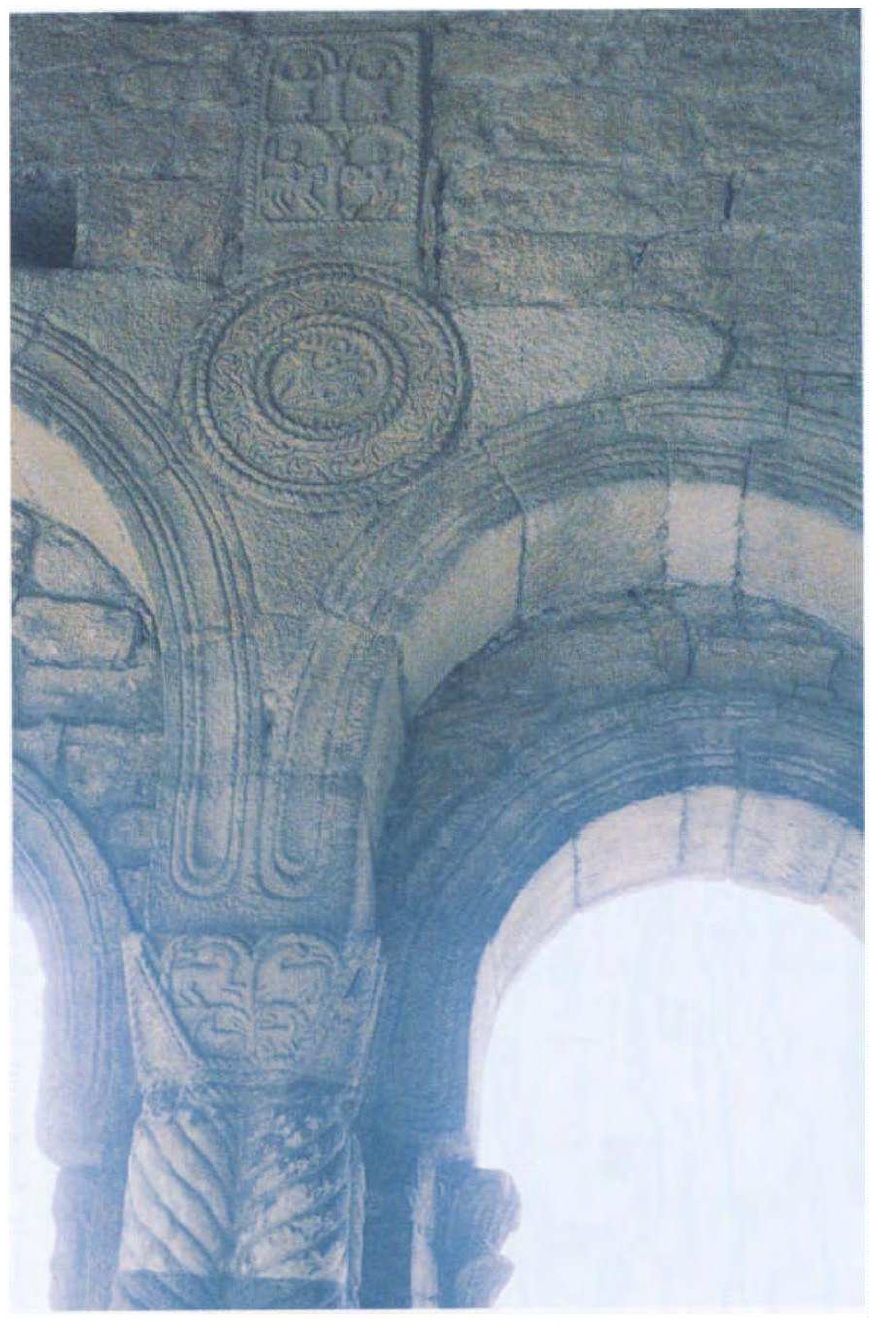
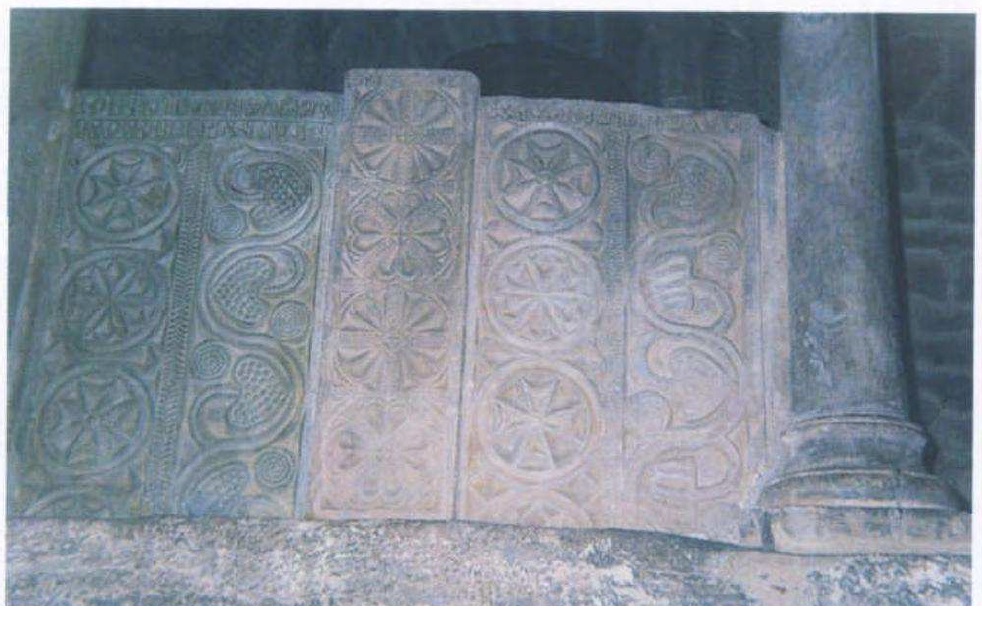
Kirche "Santa Maria" [kap5 foto8] (S.98) -- Kirche "Santa Cristina" [kap5 foto9] -- Kirche "Santa Cristina": gefälschte byzantinische Ikonostase [kap5 foto10] (S.99)
Church "Santa Maria" [chapter 5 photo 8] (p. 98) -- Church "Santa Cristina" [chapter 5 photo 9] -- Church "Santa Cristina": forged Byzantine iconostasis [chapter 5 photo 10] (p. 99)-
-- The expulsion of Muslims (Berbers) is claimed by the Jesus Fantasy Catholic Church to have begun with FAKE Hero Pelayo from 720 - in reality, it started with the Jesus Fantasy Crusades at the end of the 11th century [from 1096] (p. 91)
Topper quote (translation):
"But this conquest begins only about simultaneously with the [Jesus Fantasy] Crusades in the East (end of the 11th century), not as early as 720, as the [Jesus Fantasy] Church wants to pretend with its [Fantasy] hero Pelayo." (p. 91)
[According to historian Christoph Pfister in his book "Matrix", in reality the Crusades should be placed in the 15th century, after the Vatican established itself in Rome - and the Jesus Fantasy Crusades only occupy a short period of time. Instead, there is an approximately 300-year presence of France with large castles in the Peloponnese in Greece].
-- Now see this: there are hundreds of Latin stone inscriptions in Spain that are supposed to prove early Jesus Fantasy "Christianity" - unfortunately, they are all forged (p. 91)
Topper quote (translation):
"Admittedly: Several hundred stone inscriptions are not easy to discredit. But if a large number of them are acknowledged to be forgeries — what does that mean? It indicates that there was a severe need for forgery. And thus, even the most deceptively made inscriptions fall into the same pit." (p. 91)
-- In the 10th century existed the only "Christian" Jesus Fantasy church In Andalusia [southern Spain] in Bobastro - it was built by the [Fantasy?] Arab Omar ben Hafsun in 927 [or it was a Berber?] (p. 91)
Topper quote (translation):
"In Andalusia, there was only one single Christian [Jesus Fantasy] church building in the 10th century: that was founded by the [Fantasy?] Arab Omar ben Hafsun shortly before his death in 927 in Bobastro." (p. 91)
-- The Visigoths [in present-day Catalonia] are said to have built a Jesus Fantasy church "Santa Maria de Melque" near Toledo (p. 91, 94), around the same time [10th century]. However, it may be younger and have arisen due to the forced mission during the FAKE "reconquest" from Asturias (p. 94)
Topper quote (translation):
"One considers the church "Santa Maria de Melque" near Toledo was built by the Visigoths (p.91) to be approximately in the same period, but it could also be younger and be a result of the Asturian mission [of the FAKE "reconquest"]." (p.94)
-- There were no other Jesus Fantasy "Christian" churches in Spain, neither in the Bética region [the mountain ranges in South of Spain] nor in Lusitania [southern Portugal and southwestern Spain] - or they were halls of other faiths. The Jesus Fantasy holy inscriptions are forged, for example in the village of Medina Sidonia [southern Spain near Gibraltar] (p. 94)
Topper quote (translation):
"All other so-called Christian [Jesus Fantasy] churches of the Bética and Lusitania (that is, of the whole western Iberian Peninsula) are pure fables or were not Christian in the Catholic sense. The inscriptions – like the retouched one in Medina Sidonia – turn out to be forgeries." (p. 94)
5.5. Gothic coins [gold coins suddenly "detected" - but there are no silver coins]
5.5.A. Faking coins for supporting Fantasy chronologies
-- The "Christian" authority of the Vatican was also a coin mint forgers' workshop, to underpin the forged chronologies of the chroniclers - the coin forgers sometimes did not know how to spell the names of the Fantasy kings correctly, and so there are coins with different spellings in circulation - in the case of the Fantasy king Chindasvint, there are said to be 21 variations (Book by Heiss 1872) (p. 94):
Book by Alois Heiss: General discription of coins of the Gothic Kings in Spain
-- French version: Description génerale des monnaies des rois Wisigoths d'Espagne - Paris 1872; reprint 1976;
-- ESP orig.: Descripción general de las monedas hispano-cristianas desde la invasiónde los Arabes (vol. I, Zaragoza 1962) (S.277)
Topper quote (translation):
"Christian [Jesus Fantasy] rule can be evidenced not only on stone and parchment but also in gold. Many coins with the names of the Visigothic and Suevic kings, which have been catapulted into historical reality through Isidore's Chronicle, can be clearly proven to be elegant forgeries. The first coin appeared in the late Renaissance in 1593 and was only recognized as a forgery in 1835. Soon, such findings began to accumulate. The best historians have fallen for this and often based their hypotheses on a few (false) coins, which have prevailed over time and are now not easily overturned because they support an entire edifice [the "Christian" castle in the air]. Without elaborating on the outrageous details here, I would like to note that, for example, on the coins of King Chindasvint, this name is written in 21 variations (Heiss 1872)! They are always forgeries, intended to support the texts of Isidor or other "chroniclers", which is obvious to experts (such as Beltran 1972)." (p.94)
-- Historians have been trapped for the fake Jesus Fantasy coins for hundreds of years, and the "historical tradition" never really wants to get rid of the FAKED gold coins (p. 94)
-- in addition, the circumstances under which the FAKE coins were found are often not clearly indicated but are "quite mysterious" (p. 94)
Topper quote (translation):
"Famous collections possess FAKE Gothic coins, and the known fakes fetch auction prices hardly lower than real coins. Are there even real coins from the Visigoths? Upon further reflection, that seems almost unlikely. Archaeological facts about these coin findings are extremely rare; on the contrary, the circumstances of the findings are often quite mysterious." (p. 94)
5.5.B. The finding of coins of 1891 in La Capilla (Sevilla): It is claimed that 904 Gothic gold coins were found, but only 250 are confirmed - only 68 became known - only 43 were photographed - further findings - without any context
[-- First of all there is the question why Gothic coins from today's Catalonia come to Sevilla in this quantity - and were not found in Catalonia - already the location seems to be a FAKE]
-- In 1891, a treasure with 904 gold coins is said to have been found in La Capilla (Sevilla), but then it suddenly turned out to be many fewer coins [there can be admitted: certain people stole coins as it seems], 250 were confirmed, and by 1952 only 68 became known, Mr. Barral (Spanish historian and archeologist) later only managed to take photos of 43 (p.94)
[Additional note: What might have happened there
Apparently, the Catholic Jesus Fantasy finder thought he could state a fictional number "904", OR the finder believed that the Fantasy god had given him the right to steal and set aside most of the find - OR the finder distributed coins to his friends as well - archaeology is just not so important for him, and 250 coins are enough to give away - the house or the car for the family along with a bottle of Jesus Fantasy wine per day are much more important - then the blood ritual of the cr. Jesus Fantasy Vatican along with the church's tithe tax (protection money) is safely fulfilled for years (!) - I only remember another case, the one of Ecuador when the big collectionist Crespi in Cuenca had died: all his picture collection including metal plates of natives was NOT presented in a museum but the works were distributed in all Ecuador ornating the "noble" halls of the "Elite" and the metal plates could not be found any more when I visited Ecuador in 2012 (link) - archeology and arts have only a relative value in "Catholic" regions (!) - and this case with gold coins of Seville seems just one of this cases of big robbery].
- L'art preromànic a Catalunya (Pre-romanic art of Catalonia)
- Les mosaïques médiévales de Venise, Toreello i Murano (Medieval mosaics at Venice, Torcello Island and Murano Island [2 island near Venice])
- Tresors artístics catalans (Catalonian art tresuries)
- La sculpture du Moyen Âge (con Georges Duby) (Sculptures of the Middle Ages (with Georges Duby))
- La catedral romànica de Vic, Artstudi 1979 (Romanic Cathedral of Vic, art's study 1979)
- Història Universal de l'Art, L'antiguitat clàssica,Vol II, editorial Planeta, 1988 (Universal arts history: Classic Antiquity; Planeta Edition 1988)
- Compostelle, le grand chemin, colección «Découvertes Gallimard» (nº 174), 1993 (Compostella, the long way - collection Découvertes Gallimard)
- Les catedrals de Catalunya, Edicions 62, 1994 (The cathedrals of Catalonia; Edicions 62)
- Art de Catalunya. Arquitectura religiosa moderna i contemporània, L'isard, 1999
(Arts from Catalonia. Religious modern and nowaday's arquitecture; L'isard Edition 1999)
- Vitralls Medievals de Catalunya, Lunwerg Editors, 2000 (Catalonian medieval church windows; Lunwerg Edition 2000)
- L'art i la política de l'art, Galerada, 2001[3] ISBN 978-84-922737-9-9 (Art and art's politics; Galerada Edition 2001)
- Josep Puig i Cadafalch. Escrits d'arquitectura art i polític, IEC, 2004
(Joseph Puig and Cadafalch: scriptures about arts arquitecture and politics; IEC 2004)
- Catalunya destruïda, Edicions 62, 2005 (Destroyed Catalonia; Edicions 62 2005)
Topper quote (translation):
"Here we have the important treasure finding of La Capilla (Seville) in 1891, where out of the 904 gold coins only 250 were documented and by 1952 only 68 were known (Barral can only depict 43)." (p.94)
Gothic coins [kap5 foto6]
Coins from Asturias (drawing) [kap5 foto7]
Coins of the Visigoth kings of the 6th century and for comparison, genuine coins of the Asturian kings
from the 11th century (according to Heiss 1872 and 1962 as well as in the book of Cabre 1946, Plate 15) (p. 95)
-- The coin finding remains questionable - and according to Mr. Barral, the workers allegedly threw 95 gold coins into the river or they were destroyed [or robbed to buy themselves a house or to pay a mortgage] (p. 96)
Book by Xavier Barral i Altet: The Circulation of the Coins of the Suebi and Visigoths (orig. French: La circulation des monnaies Suèves et Visigotiques - Munich 1976) (p. 275)
Topper quote (translation):
"whereby in some cases, he has retroactively determined the belonging to the finding; 95 of these gold coins were allegedly thrown into the river or destroyed by the workers back then, he writes" [what a bad JOKE!]. (p. 96)
-- The coin collector Mr. Jean Lafaurie (1914-2008 [web22]) claimed that these "Gothic coins" [found in Seville La Capilla in 1891] are still very mysterious (p. 96)
-- Imitations of Byzantine gold coins were found in Seville (p. 96)
-- The same coin collector Lafaurie stated that some coins should originate from the Gothic Kingdom, which lasted for about 100 years (p. 96)
-- In 1946, Ms. Archaeologist Cabré (Mrs. Encarnación Cabré Herreros - 1911-2005 [web23]) postulated the same during the excavation of the treasure of Zorita (gardens in the city of Zorita in southwestern Spain [web24]) (p. 96)
Topper quote (translation):
"[The coin collector] Mr. Lafaunie summarizes that there is still considerable darkness regarding the Gothic coins, and hardly any problem can be considered solved, but it is clear that the forgeries of Byzantine gold coins found in Seville in 1972 indicate that at least some coins from the period of about a century of Gothic rule can be regarded as genuine (as already noted by Cabré during the excavation of the hoard from Zorita in 1946)." (p.96)
-- The context of gold coins being scattered so widely is inexplicable, so did the Goths only have gold coins? That doesn’t really make sense, because to buy a house, gold coins were the right currency, but not for normal trading payments - silver or copper coins have not been found so far - this is really strange (p.96)
Topper quote (translation):
"The experts are wondering what function the actually far too valuable coins could have played in the daily life of the Goths! (Barral, p. 74 and 164) Such a gold coin would have been enough to buy a piece of land or a villa, but just with that it was impossible to trade in the Gothic feudal state. And silver coins were not minted, copper money was practically unknown. Strange enough." (p. 96)
[Moreover, the question arises: Who actually has the gold available to simply forge that amount of gold coins? - Criminal Vatican].
5.5.C. Asturias 11th century: normal coins were spread in normal quantities
-- The "Christian" Jesus Fantasy kings of Asturias in Northern Spain began to mint Visigothic coins, which spread even to Central Europe and Poland - and in this way it's normal (p. 96)
Topper quote (translation):
"Only with the coin sovereignty of the Asturian kings, starting with Alfonso 'V.' in the 11th century, did a Visigothic coin type emerge that had real distribution and is also traceable in Central Europe up to Poland. Here we find ourselves again in tangible history." (p. 96)
5.5.D. IT'S ALL A LIE in Spain
-- We see that the criminal Vatican INVENTED a "early Christianization" in Spain, for which a heap of material had to be FORGED - and then a defeat against the Muslims [reality: they were Berbers] and Goths was claimed for INVENTING a "reconquest". And the criminal Jesus Fantasy Vatican has deceived people for hundreds of years (p. 96).
Topper quote (translation):
"Thus, when viewing the Spanish representation, one gets the impression that the Big Action was carried out most thoroughly there, for nowhere else was it more necessary. This must be admired as a successful piece of art. Apart from Olagüe (Spanish historian 1903-1974 [web25]), no modern historian has uncovered this fraud." (p. 96)
[Addition: Historian Olagüe sees the significant manipulations in Spanish historiography
https://es.wikipedia.org/wiki/Ignacio_Olagüe
Ignacio Olagüe Videla (San Sebastián, February 12, 1903 - Játiva, March 10, 1974) was a Spanish paleontologist (fossil researcher) and historian.
Translation:
Born on February 12, 1903, he studied law at the universities of Valladolid and Madrid. From 1924 to 1936, he worked in the paleontology lab of the Museum of Natural Sciences in Madrid, where he was a student of José Royo. He was a member of the board of the Royal Spanish Society for Natural History and participated in international colloquiums. In 1929, he founded the first Spanish film club and a gallery for contemporary art in Madrid, together with Ernesto Giménez Caballero. He was a trade union member of the Juntas de Ofensiva Nacional-Sindicalista (JONS). He did not go into exile and did not have problems with his historical theories under Franco's regime, quite the opposite. Since the 1950s, he traveled and published in France. He was the vice president of the International Society for Comparative Studies of Civilizations. He wrote "The Islamic Revolution in the West" (1974), in which he defended some aspects of Américo Castro's theories.
A large part of his library, with works from the 17th century, including the editions of Francisco de Quevedo, was donated to the Velázquez House (Casa de Velázquez). [...]
Controversial historiography:
A group of specialized critics has documented various theses about the invalidity of Olagüe's hypothesis in the current historiography of the Islamic Revolution in the West. As early as 1974, Pierre Guichard pointed out the paradox of denying the Arab conquest [they were Berbers] and at the same time speaking of "Orientalization". Later, however, Emilio González Ferrín, an Arabist at the University of Seville, continued Olagüe's line in his work "History of al-Andalus" and considered his work to be underestimated for political reasons and because he was not an academic. However, he notes, that the work "is quite difficult to refute for anyone who reads it" and emphasizes that "Olagüe... represents something extremely significant: that the apparent revolutions of history are evolutionary processes." In contrast, Luis Molina points out that Ferrín's work is not intended as historical science, but rather as parody.
In 2008, Arabist Maribel Fierro, a research professor at the Institute of Philology of the CSIC, emphasized the influence of Olagüe's ideological profile, which is linked to the origins of fascism in Spain, as an aspect that affects historiographical controversies.
Historian Eduardo Manzano Moreno writes and notes that "the most surprising thing about Olagüe's thesis is not the absurdity and audacity that it radiates. There are dozens or hundreds of absurd and far-fetched historical theories produced by amateurs, copywriters, or even academic historians." Normally, they are forgotten with the same speed with which they cause a certain initial uproar. In contrast, the idea that Muslims did not really invade Hispania [but this were Berbers], although it did not receive excessive attention at the time, seems to be gaining attention again lately. Partially also discussion in some internet forums were contributing to sread this knowledge where always some people can be found calling for new conspiracy theories, or where questioning of established knowledge is well-known.
In 2014, Alejandro García Sanjuán published an extensive critique of Olagüe's theses on the Muslim conquest [they were Berbers], in which he analyzed the manipulation of the Muslim [Berber] period on the Iberian Peninsula. He states that there is a "negationist movement that attempts to decouple the origin of al-Andalus from the conquest and to present it solely", so says the author. This would be "a historiographical fraud that in some cases is based on manipulation and in other cases on the omission of historical evidence." [They were Berbers].
Photos
p.97:
Konrad Celtes: FAKE map of the FAKE Roman Empire, around 1500 - entrusted to Konrad Peutinger - "Peutinger Table" [cap4 photo1] (p. 97)
(p.97)
(p.98)
"Church 'Santa Maria' in Oviedo (Spain): Wall decoration of the native cultures with energy symbols from BEFORE Christianization [kap5 foto8]
Topper (translation):
"To page 91: Wall decoration in the Gothic throne room of the present-day church Sta. Maria in Oviedo — no trace of Christianity. (Photo: U. Topper)" (p. 98)
"Church" "Santa Cristina" in Oviedo (Spain): Wall decorations of indigenous cultures with energy symbols from BEFORE Christianization [cap5 photo9]
Topper (translation):
"To page 91: The iconostasis in Sta. Cristina, Visigothic, '7th century'; as can be seen, it is inserted inorganically. The inscriptions at the top are indicating the 15th century."
(p.99)
"Church" "Santa Cristina" in Oviedo (Spain): A fake Byzantine element was inserted here [chap5 photo10]
Topper (translation):
The "Church" Sta. Cristina with the fake iconostasis as a Byzantine stylistic feature of Visigothic architecture. (Both photos: U. Topper) (p.99)
(p.99)
(p.100)
Fantasy Painting: The FAKE Apostle John writes the FAKE Apocalypse [chap5 photo11]
Topper (translation): On pages 106 and 211: "The Evangelist John, writing the Apocalypse", Irish miniature from the 8th century (Abbey Library of St. Gallen) (p. 100)
Portugal with Jesus Fantasy Bible madness: A modern tile picture depicts a Fantasy soul in a Fantasy purgatory, and a Fantasy healer comforts [kap5 foto12]
Topper (translation): On page 134: Modern tile picture in Portugal: The souls of the deceased are comforted in purgatory by the saints. (Photo: U. Topper) (p.101)
(p.101)
(p.101)
Portugal with Jesus Fantasy Bible madness: A modern tile picture in a niche of a donation box (see the money slot below) claims to depict several Fantasy souls in a Fantasy purgatory, Fantasy angels comforting, and a Fantasy mother with a Fantasy child hovering OVER the Fantasy purgatory [cap5 photo13]
Topper: On page 134: Modern [Fantasy] purgatory image with donation box for coins in Portugal. (Photo: U.Topper) (p.101)
[The crual FANTASY should be rewarded with donations - THAT is the logic of the cr. Jesus Fantasy Church!]
(p.102)
Villaviciosa (Asturias, Spain): A wall relief of the Jesus Fantasy church "Santa Maria" shows a boar trying to bite into a banana. Gothic story [chap5 photo14]
Topper: To page 161: Erotic scene at the portal of the [Jesus Fantasy] church Sta. Maria in Villaviciosa (Asturias, Spain): A boar is chasing a man and trying to bite off his genitals. One of the many examples of Gothic paganism in the 13th century. (Photo: U. Topper) (p.102)
[Well, I can't see neither a boar nor a banana there].
The FANTASY Boniface baptizes a FANTASY Friesian - and then the FANTASY Boniface is FANTASY-killed by FANTASY-Friesians [chap5 photo15]
Topper: On page 162: 'Boniface baptizes a Friesian - Boniface is killed by the Friesians'. Sacramentary from Fulda, 'around 1000'.
From: The Franks. Pioneers of Europe; Mannheim-Main 1996, p.460 (p.103)
(p.103)
Jesus Fantasy Gospel from Lindisfarne (Ireland) with a book painting like a carpet - this is said to have been painted around 690 [chapter 5 photo 16]
Topper: On page 177: The famous "carpet page" from the Lindisfarne Gospels (Ireland), which is dated to "the time just before 700."
From: David M. Wilson: Cultures in the North; Munich 1980, p.80 (p.104)
(p.104)
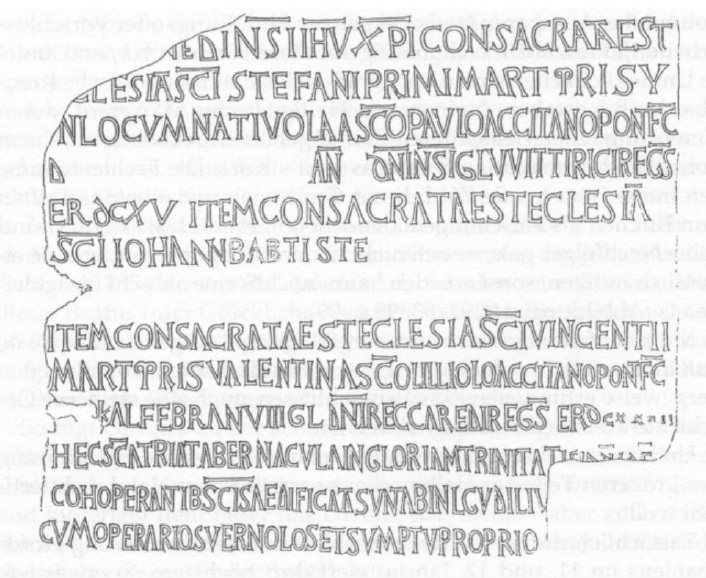
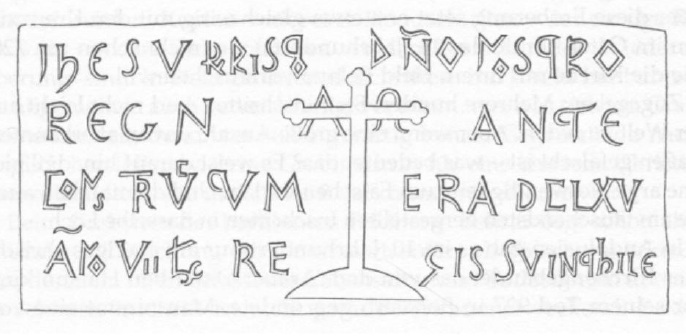
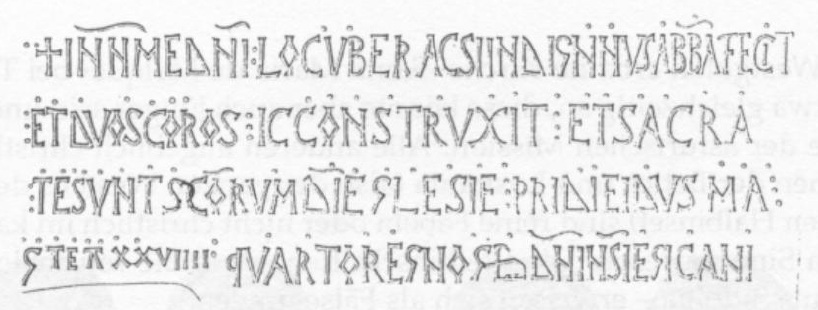
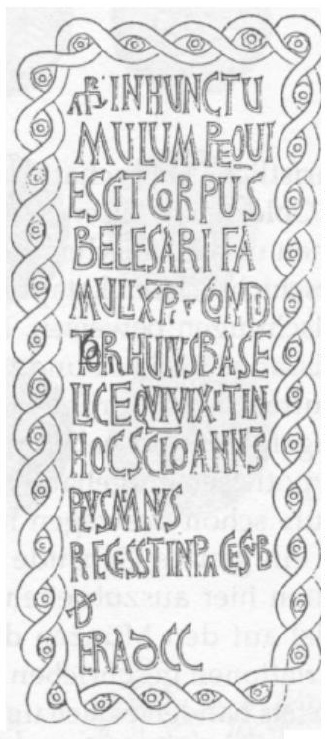
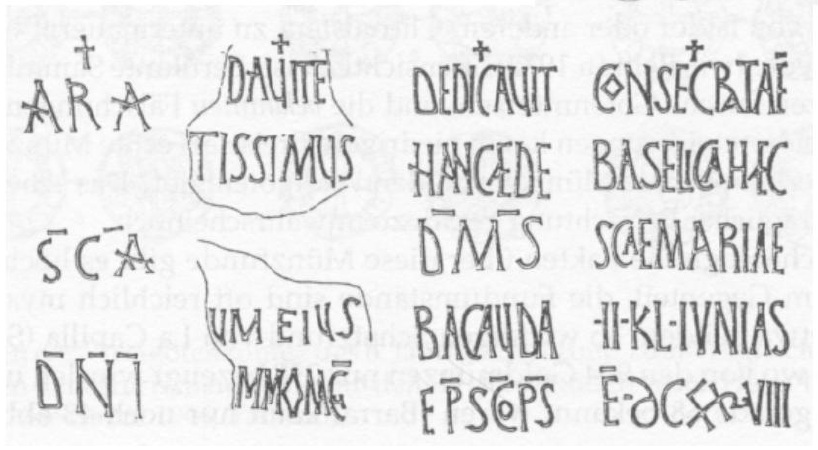
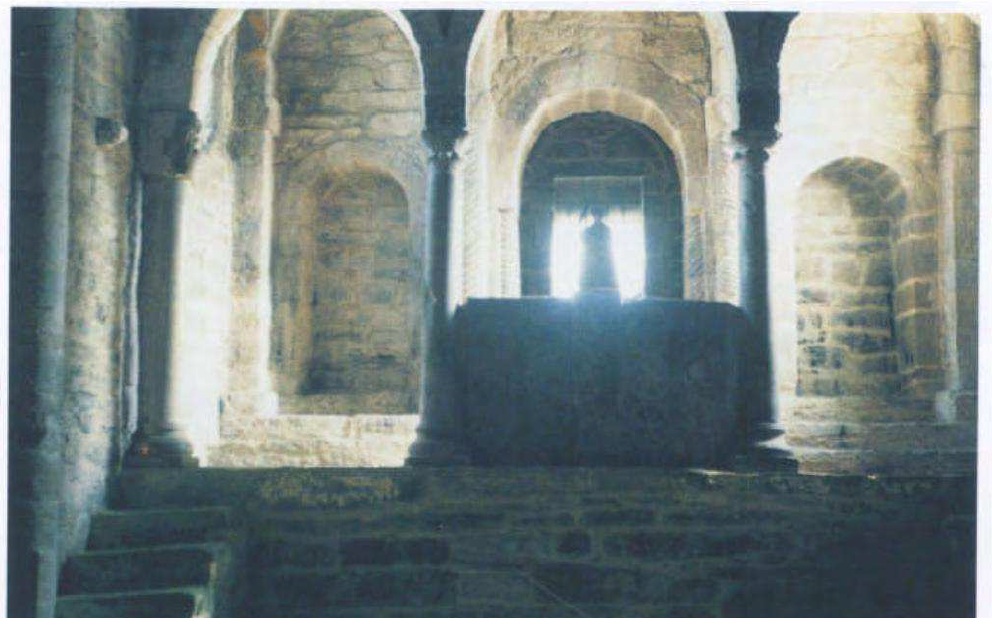
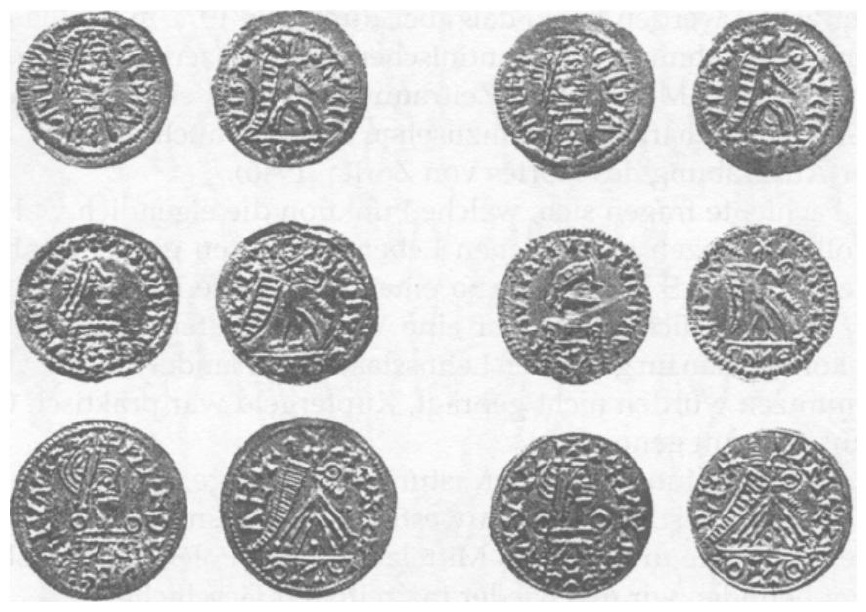
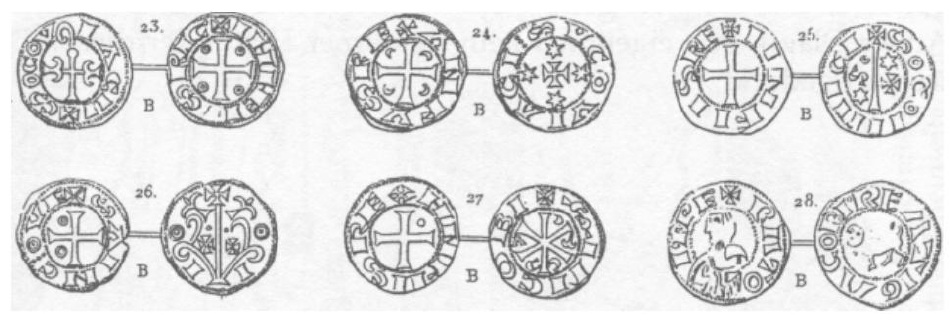
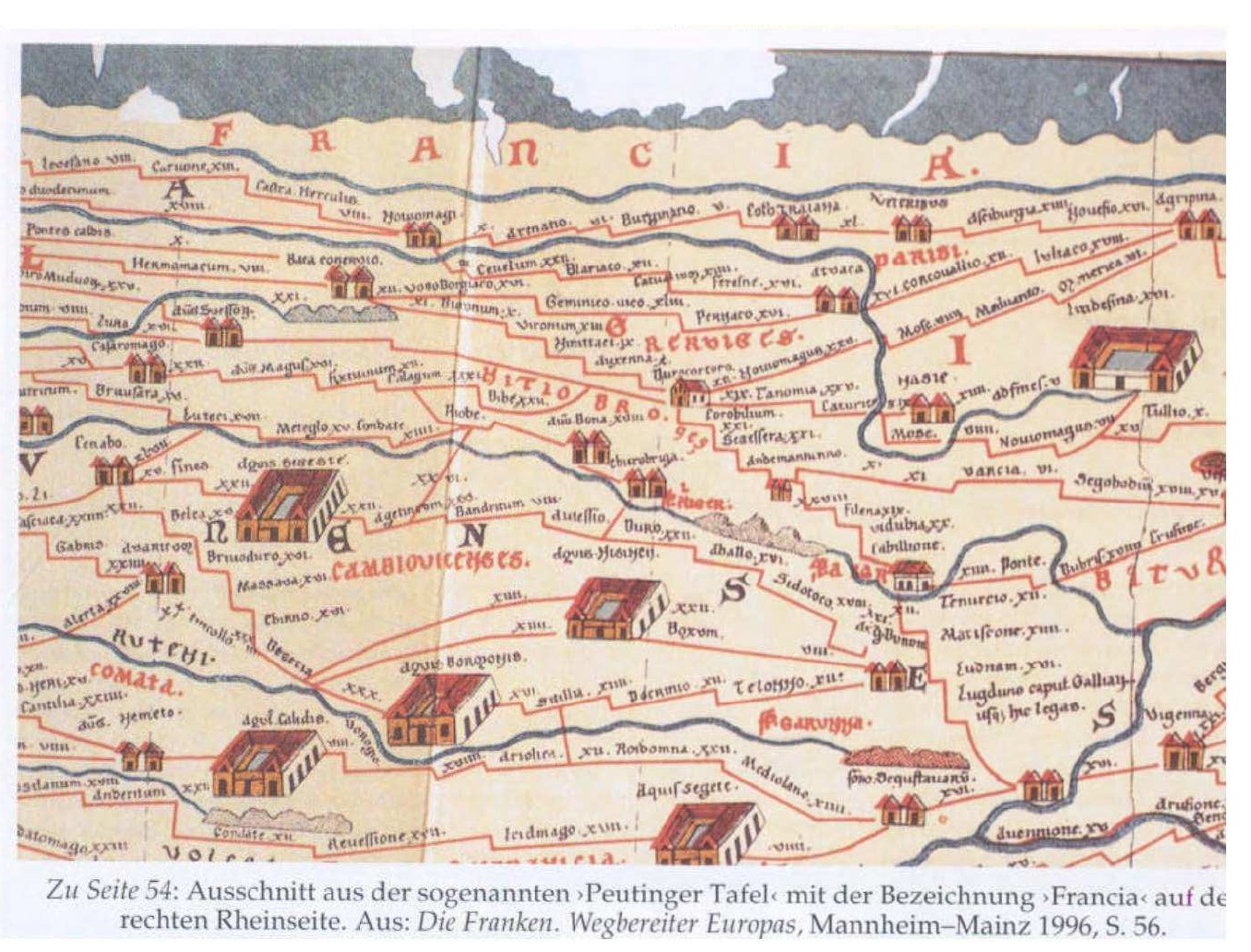
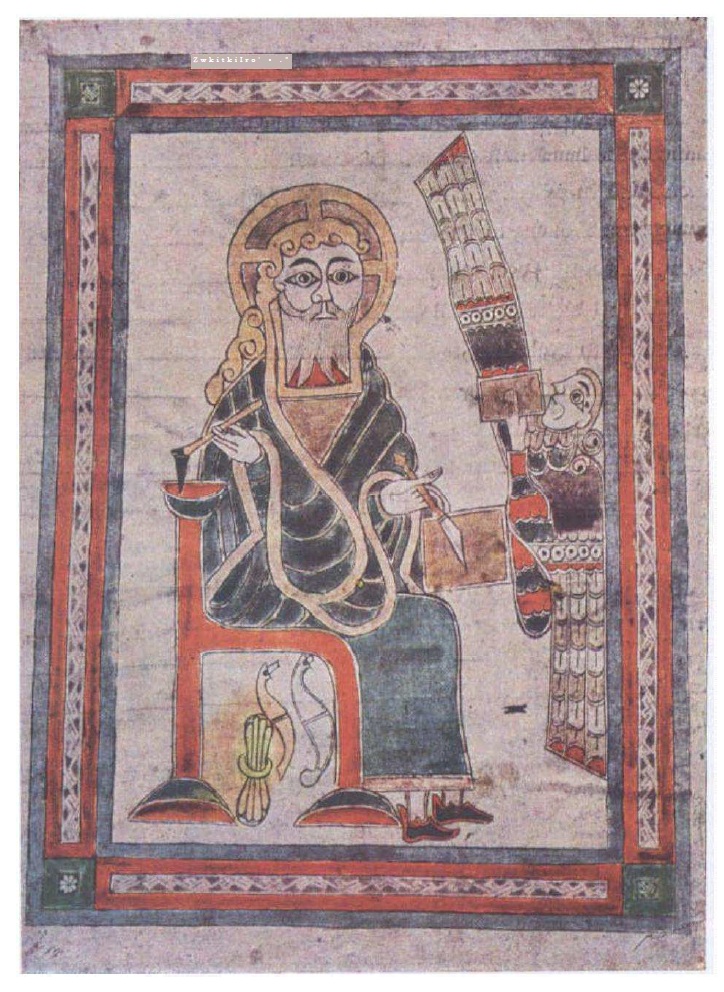
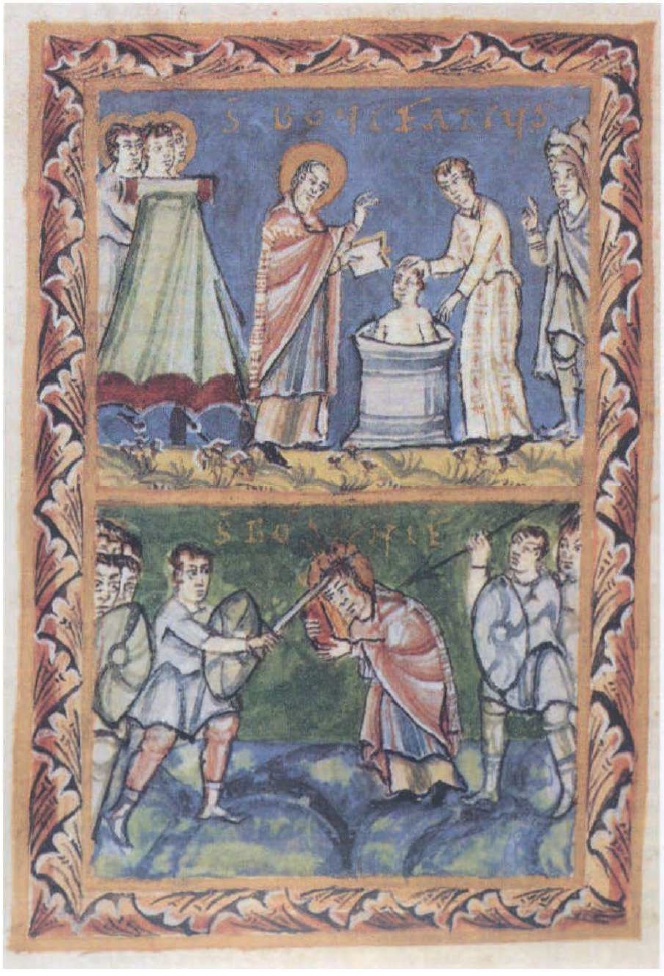
|
|
|
Sources
[web01] https://de.wikipedia.org/wiki/Medina_(Name)
[web02] https://es.wikipedia.org/wiki/Pedro_de_Medina
[web03] https://de.wikipedia.org/wiki/Mozaraber
[web04] https://de.wikipedia.org/wiki/Philipp_II._(Spanien)
[web05] https://de.wikipedia.org/wiki/Philipp_III._(Spanien)
[web06] https://de.wikipedia.org/wiki/Philipp_IV._(Spanien)
[web07] https://en.wikipedia.org/wiki/Hubert_Goltzius
[web08] https://es.wikipedia.org/w/index.php?title=Juan_Lucas_Cortés&oldid=132004869
[web09] https://archive.org/details/bub_gb_EMkJBBhifUwC
[web10] https://de.wikipedia.org/wiki/Jean_Bolland
[web11] https://www.mdpi.com/2077-1444/14/11/1417
[web12] https://www.amazon.com/Historia-Ecclesiae-Lusitanae-Euangelio-Promulgato/dp/1173772936
[web13] https://de.wikipedia.org/wiki/Conrad_Celtis
[web14] https://de.wikipedia.org/wiki/Sextus_Iulius_Africanus
[web15] https://de.wikipedia.org/wiki/Manetho
[web16] https://de.wikipedia.org/wiki/Ramón_Menéndez_Pidal
[web17] https://ap1.sib.uc.pt/bitstream/10316.2/46780/1/mons._miguel_de_oliveira.pdf
[web18] https://de.wikipedia.org/wiki/Hagiographie
[web19] https://de.wikipedia.org/wiki/Beatus
[web20] https://www.amazon.com/Larqueologia-Catalunya-Xavier-Barral-Altet/dp/8423318125
[web21] https://es.wikipedia.org/wiki/Xavier_Barral_i_Altet
[web22] https://fr.wikipedia.org/wiki/Lafaurie
[web23] https://es.wikipedia.org/wiki/Encarnación_Cabré
[web24] https://fr.wikipedia.org/wiki/Zorita_(commune)
[web25] https://es.wikipedia.org/wiki/Ignacio_Olagüe
[web26] https://es.wikipedia.org/wiki/Paleontología
https://de.wikipedia.org/wiki/Lukas_Holste