Mentioned literature
Introduction of the Indian numbers (then also "Arabic
numbers"):
FAKES:
-- the Fantasy Julius Africanus is also said to have
written a scientific compilation "Kestoi" ("Embroidery")
-- the chronology of Justis Scaliger: "Thesaurus temporum"
Introduction of Arabic numerals
-- Leonhard Fibonacci: "Arithmetic Book" ("Liber Abaci" -
1202) - The Introduction of Arabic Numerals
-- Denis Pétau (Petavius) from Orléans (France) "De
doctrina temporum" ("Theory of the Times"); Paris 1627
Analyses of the chronology history
--
Martin Wallraff and Laura Mecella: "The
Kestoy of Julius Africanus and its Tradition"
--
Gertrud Bodmann (historian):
-- Dissertation: Years and World Age. Time and Space
imaginations in the Middle Ages (Frankfurt am Main 1992)
(orig. German:
Jahreszahlen
und Weltalter. Zeit- und Raumvorstellungen im
Mittelalter)
-- as a book: Years and World Age: On the Foundation
of Time and Space Concepts in the Medieval Chronicle
(1992)
(orig. German:
Jahreszahlen
und Weltalter: Zur Grundlegung von Zeit- und
Raumvorstellungen in der mittelalterlichen Chronistik)
--
Heinrich Gelzer: "Sextus Julius
Africanus and the Byzantine chonolography" (1880/1898 -
Reprint: Hildesheim 1978)
(orig. German:
"Sextus
Julius Africanus und die Byzantinische Chronolographie")
--
Ginzel, F. K. (1906-14): Handbook of
Mathematical and Technical Chronology (3 vols., Leipzig)
(orig. German:
Handbuch
der mathematischen und technische Chronologie)
--
Eduard Schwartz: Diodorus (1903)
--
Karl Menninger: Number word and digit
(orig. German: Zahlwort und Ziffer - 2 volumes); Edition
Metzger, Göttingen (Germany) 1979
--
Ludwig Ideler: Handbook of Mathematical
and Technical Chronology (2nd vol., Berlin 1826)
(orig. German:
Handbuch
zur mathematischen und technische Chronologie)
Chapter 6: Fathers of our historiography
6.1. [FAKE] Julius Africanus [160/170-240
- an INVENTED historian with INVENTED chronology +
"universal knowledge book" "Kestoi"]
6.1.A. The Fantasy Africanus with a Fantasy chronology,
an Fantasy universal knowledge "Kestoy" - and with
Fantasy manuscripts
-- Mr.
Heinrich Gelzer raves about a
certain "
Julius Africanus" who is said to be
the "
father of Christian chronography"
(chronology studies) (p.105) - in his book "Sextus Julius
Africanus and Byzantine Chronography" (1880/1898 -
reprint: Hildesheim 1978) on page 1 (p.105)
* orig. German:
"Sextus Julius
Africanus und die Byzantinische Chronolographie"
-- The history inventors from the cr. Jesus Fantasy
Vatican claimed that the Fantasy
Julius Africanus
wrote his "Chronicle" between 212 and 221, and that this
would be "scientific" (p.105)
Topper quote (translation):
"
Julius Africanus is one of the most
celebrated names of the ancient church", begins Mr.
Heinrich
Gelzer (1880-1898, p. 1) his great work about
this [Fantasy] man; "through his historical [Fantasy] work
he has become the [Fantasy] father of [Jesus Fantasy]
Christian chronography." This first [Jesus Fantasy]
Christian historian – his [Fantasy] chronicle is estimated
to have been written between 212 and 221 – "is one of the
main [Fantasy] representatives of the new scientific
[Fantasy] direction of the [Jesus Fantasy] Church, which
stands in sharp contrast to the childlike simplicity of
the post-apostolic [Jesus Fantasy] fathers." (p. 105)
[Addition: The INVENTED Julius Africanus
-- is said to have lived from 160/170 to "after 240"
[web01]
-- is said to have been "a [FAKE] Christian scholar and
the [FAKE] founder of [FAKE] Christian world chronology"
[web01]
-- and it is ALL FICTION what is written about him, as
even Mossad-Wikipedia admits:
"There is hardly any reliable information about the
biography of Iulius Africanus. It is assumed that he
possibly came from Jerusalem. He was evidently highly
learned, spoke at least Latin and Greek, and perhaps also
some Hebrew. Africanus had good connections and mingled in
high circles; for example, he maintained good relations
with King Abgar VIII of Edessa, at whose court he stayed
several times. There he also became acquainted with
Bardesanes. Iulius Africanus attended the lectures of
Heraklas in Alexandria before 221 and was good friends
with his teacher Origenes. " [web01 - Status June 12,
2025]
[Addition: The chronology of the INVENTED Julius
Africanus does not actually exist
Mossad-Wikipedia admits (translation):
https://de.wikipedia.org/wiki/Sextus_Iulius_Africanus
[web01]
"The famous chronicle of Iulius Africanus described
the time period from the creation of the world to 221 A
[Fantasy] D and comprised five books [
4].
In books 1 and 2, the period until [Fantasy] Moses was
probably described, book 3 ended with the 1st Olympiad,
book 4 with the end of the Achaemenid Empire [
link],
while the last book encompassed the time from Alexander to
Elagabalus [
5].
However,
only fragmentary remains are
preserved in the texts of other authors, especially in
Eusebius of Caesarea [
link],
Georgios Syncellus [
link],
and in the Excerpta Latina Barbari [
link].
" [
6]
[And now the question is coming up why of a "famous" work
only remain some quotes in other works by INVENTED
authors?]}
Continuing with Topper:
-- The Fantasy Julius Africanus is also supposed to have
written a scientific FAKE compendium "
Kestoi"
- however, the analysis by Joseph Scaliger (Thesaurus
temporum 1606 [web34]) concluded that this is not the case
(p. 105)
Topper quote (translation):
"The contentious question of whether the [Fantasy] Kestoi
of the [Fantasy] Sextus Africanus originates from the same
author as the [Fantasy] Chronography of Julius Africanus
has already been discussed and denied by
Joseph
Scaliger.
Gelzer opts for an
affirmative answer. He considers both to be one and the
same person, Sextus Julius Africanus from Latin-speaking
Africa, who had also sufficient language skills in Greek,
in which he composed his works, Hebrew, and possibly also
Syriac." (p. 105)
[Supplement: "Kestoi" = Description of life topics,
including magic, military technology, medicine, poetry,
agriculture, technical units, etc.
There are still biblically faithful sheep who cling to
Fantasy interpretations of life lies of the Jesus Fantasy
Vatican, such as Martin Wallraff and Laura Mecella with
the book "The Kestoi of Julius Africanus and Their
Transmission." (orig. German:
Die
Kestoi des Julius Africanus und ihre Überlieferung). They
describe the work "Kestoi" as follows:
"The [Fantasy] Christian Julius Africanus wrote a work of
universal scholarship under the title 'Kestoi' (which
means: "embroidery") in the first half of the third
century, in which he seemingly treats a variaty of fields
of knowledge: from magic to military technology, from
veterinary medicine to poetry, from agriculture to the
doctrine of masses and weights. Scholars have long handled
this work with skepticism: it does not fit well into the
categories of modern literature and even less into the
ideas of ancient Christianity. In fact, there is no trace
of the author's Christian beliefs in the surviving parts
of the 'Kestoi'. Furthermore, the editorial situation and
text transmission are very complex." [web02]
[Mr. Martin Wallraff is one of the most persistent
defenders of the existence of Fantasy Julius Africanus,
see his mentions on the Mossad Wikipedia... [web01].
[Additional note: The "Kestoi" for the Roman
Fantasy emperor Severus
Mossad-Wikipedia describes in it's article about Fantasy
Africanus:
"In the year 222, [Fantasy] Julius Africanus advocated for
the city of Nikopolis in a letter to the Roman [Fantasy]
Emperor Severus Alexander, which was likely his residence
at the time. He also dedicated his [Fantasy] encyclopedic
work, the Embroideries, to this emperor. The [Fantasy]
fact that he was close to the [Fantasy] Roman ruler is
also evidenced by the [Fantasy] fact that he established
the [Fantasy] library of the Pantheon (
link)
at his [Fantasy] command. [
2]"
[web01]
And footnote 2 states: "The [Fantasy] location of the
[Fantasy] "Library of the Pantheon" is
unknown.
It may not have been housed in the Pantheon itself, but in
a public [Fantasy] building near the Pantheon" [web01]
[So we see, NOTHING IS TRUE here - it is ALL A FANTASY].
Continuing with Topper:
-- The dispute over the INVENTED Julius Africanus has been
dragging on for hundreds of years and shows no signs of
ending, because he is indeed INVENTED, which the Roman
Catholic Jesus Fantasy Church does NOT admit. Topper
describes the chaos (p. 105)
Topper quote (translation):
"It was only in the [Fantasy] work of Eusebius where
[Fantasy] Africanus is mentioned as a [Fantasy] author of
the [Fantasy] Kestoi. In the works of Jerome (Hieronymus)
and Rufinus this indication is missing. Mr. Henri Valois
was a friend of Scaliger concerning this question and
means that the indication is a fake. The reason is
obvious.
The problem of reconciling a predominantly pagan Sextus
and a [Jesus Fantasy] Christian Julius, both of whom bore
the surname "the African", is not seen by Gelzer, because
he considers both texts to be genuine." (p. 105)
-- Topper clearly states: The works of Fantasy Africanus
are written in too different styles, and therefore both
cannot be taken seriously (p. 105-106).
Topper quote (translation):
"For me, this confusion reflects the unstructured forgery
operation through which names were introduced into the
world that are not associated with any historical figures.
From the similarity of the surname 'Africanus,' a personal
union is then constructed, even if the texts are vastly
different in content and style (p. 105).
-- Topper mentions similar cases where FAKE authors are
said to have written FAKE works in totally different
styles, and that doesn't work: 2x James and 3x John -
thus, Julius Africanus is NOT an isolated case (!) (p.
106)
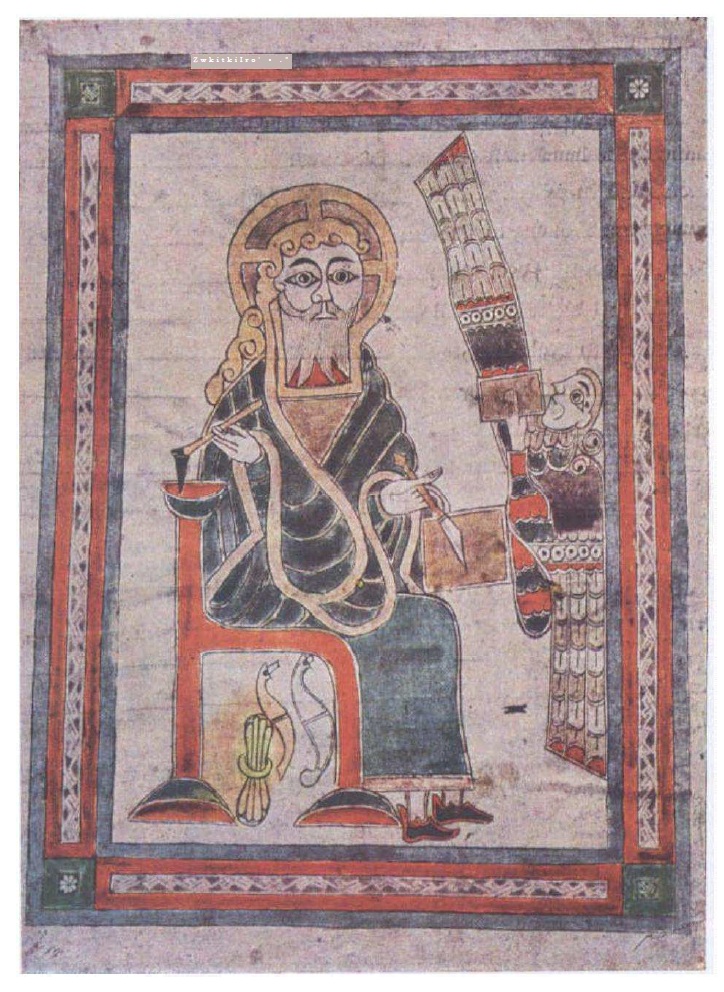
Fantasy painting: The FAKE Apostle John writes the
FAKE Apocalypse [chap5 photo11]
On pages 106 and 211: "The Evangelist John, writing
the Apocalypse", Irish miniature from the 8th century
(St. Gallen Abbey Library) (p.100)
Topper quote (translation):
"In a similar way, two [Fantasy] James were united and
even three [Fantasy] Johns, namely the [Fantasy]
Evangelist, the [Fantasy] letter writer, and the author of
the [Fantasy] Revelation. The later separation only
proceeds slowly and is not adopted by all scholars." (p.
106)
-- We see that the Fantasy Julius Africanus was "assigned"
a heap of works - the editors are just making profits from
it (p. 106)
-- "A treatise on the first martyrs" (p. 106)
-- "Two Munich manuscripts" by editor Ignaz von der Hardt
(Munich 1804) (p. 106)
-- It is assumed that the imaginary Julius constantly
switches between "pagan" and "Christian" elements, which
is very unlikely (p. 106)
-- A new mother goddess "Cybele" was installed and the
indigenous people ("pagans") were said to have jokes about
it (p. 106)
Topper quotes Heinrich Gelzer:
"Of course, Gelzer is not so foolish as to take seriously
all the works attributed to Africanus. A writing about the
first martyrs, which already labels itself in the title as
[Gelzer Quote]: 'honest and exquisite,' is suspicious to
him as a forgery. [And then further Gelzer Quote]: 'The
same applies to the strange contraption that
Ignaz
von der Hardt published based on two Munich
manuscripts (1804). The most peculiar thing about this
amusing farce is the complete mixing of Christian and
pagan, which makes the Lord the sun-Zeus, the great God,
King Jesus, and Mary into Hera and Urania, the queen of
heaven. The mockery of the pagans regarding the new
(Mother Goddess [web03])
Cybele, which
Isidor
of Pelusion complains about, becomes
particularly explicable through such products. This
Mary
cult, which stands out in all its crassness,
is already the hallmark of a much later epoch." (p. 19)
(p. 106)
-- the "manuscripts" remain unexplained (p.106)
Topper asks Gelzer something:
"That's right, Mr. Gelzer! Judging by the content, such
stupid forgeries are to be sorted out immediately. And
what about the manuscripts? Wasn't it already recognizable
from these parchments when they had been created? And if
today we have an even more open insight into the currents
of the time and have to sort out all the writings of all
Africanusse, what is left?" (p.106)
6.1.B. The structure of the Fantasy chronology of
Fantasy Julius Africanus - this does not match the
mentality of the times of that period
The structure of the "6 days of world ages" each
lasting 1000 years - Code 1000
-- The "chronography" is divided into "6 days of world
ages of 1000 years each" - such a structure only became
common from the mid-13th century onwards (p. 106)
-- The central figure is supposed to be a "patriarch
Phalek" (also: Pelek [web04]), "the [Fantasy] redemption
takes place 5500 years after [Fantasy] Adam," and the Last
[Fantasy] Judgment is allegedly said to occur "after
another 500 years of waiting" (p. 106)
Topper quote (translation):
"The [Fantasy] chronography of [Fantasy] Africanus has the
typical [Fantasy] structure of the six days of world ages
each lasting 1000 years, a certain tendency towards
eschatological expectation, which - just like the cult of
[Fantasy] Mary - occurs only after a certain time, namely
from the mid-13th century onwards. A [Fantasy] patriarch
Phalek is placed in the middle of the 6 millennia, because
(p. 24) under him "the world was divided" ([Fantasy]
Genesis). [Fantasy] Redemption takes place in 5500 after
[Fantasy] Adam, and after another 500 years of waiting,
the Last [Fantasy] Judgment would have to begin. This
position is intended to secure [Fantasy] Africanus as a
[Fantasy] author before the year 500." (p.106)
-- Then a "Sabbath" was added, a kingdom of 1000 years (p.
106)
Topper quote (translation):
"As the world continued to exist,
Eustathius of
Antioch added a
thousand-year Empire
as a Sabbath [of the 7th day] a hundred years later, thus
completing the week." (p. 106)
[The first week counting considered Saturday as a holiday,
when Christians and Jews still celebrated their free day
together. The separation to the Christian Jesus Fantasy
Sunday only came much later].
-- and the world still hasn't ended... writing such
nonsense was only possible after 1260 (p. 106-107).
Topper quote (translation):
"Theologians conclude that at that time the (p. 106)
'imminent expectation' transitioned into an indefinite
future. This actually corresponds only to the spiritual
movement after 1260, after the world-ending predicted by
Joachim
of Fiore did not occur." (p. 107)
-- The Fantasy historian
Prokop of Caesarea
(born around 500, died around 560 in Constantinople, a
specialist on the Fantasy emperor Justinian [web05]);
according to Gelzer, he did not know anything about 500
years of waiting or a 1000-year reign - well, the first
FAKE manuscripts of FAKE Prokop come from the 14th century
and the worldview was a different one then (p. 107)
Topper quote (translation):
"
Prokop, by the way, knows (still) nothing
of the 500 years of waiting or the thousand-year reign,
says Gelzer. He just can't, because the oldest manuscripts
of Prokop are from the 14th century, at which time this
kind of time concept was no longer part of the mentality."
(p. 107)
6.1.C. The dates of the FAKES of Fantasy Africanus
-- the Fantasy chronology of Fantasy Africanus is
therefore "certainly written after 1000" - and the
manuscripts with the list of place names were "only
written after 1450" (p. 107)
Topper quote (translation):
"Thus, the framework for our [Fantasy] Africanus is set:
Definitely written after 1000 and presumably only after
[Fantasy] Eusebius, who officially lived a century after
him and who, as I will show in the next section, can
earliest be [Fantasy] dated to the time of the Staufen
emperors. (The surviving [Fantasy] manuscripts that
provide the list of geographical place names can only have
been written after 1450, as I will further demonstrate.)"
(p. 107)
6.1.D. The Fantasy Africanus is cited in other works -
the FAKE manuscript from Syria - Armenian translations -
total chaos
-- There is the question whether the Fantasy Africanus is
mentioned somewhere in other works - Gelzer believes that
there is a "Syrian manuscript of the text of Fantasy
Africanus" - it was copied by a Fantasy Mr. Mar Michael
(Patriarch of Antioch) (p.107)
-- Unfortunately, the Syrian Fantasy original is not
accessible, so, eventually INVENTED - Fantasy rumors say
that it was written in the year 722 according to the
Armenian calendar, which would be 1273 after Fantasy
Christ, fitting into the non-existent Fantasy apocalypse
of 1260 (p.107)
Topper quote (translation):
"Are there any written testimonies that could support an
early Africanus? Gelzer, this linguistic genius, dealt
with this question long after his work was completed in
1880 and published a supplement in 1898 that turns out to
be in my favor. A Syriac manuscript of the text of
Africanus is assumed, which is believed to have served as
a basis for the Chronicle of Mar Michael (Patriarch of
Antioch from 1166 to 1199). If this is correct, then my
dating to the Staufer period would be too late. However,
this Syriac original has only been seen once and was
inaccessible to Gelzer. He keeps open whether it really
existed. It is said to have been produced in the year 722
according to the Armenian calendar (so 1273 A [Fantasy]
D), thus after the critical year of 1260!)" (p. 107)
-- Gelzer mentions "
two Armenian translations"
or rather "
adaptations", that's his
indication (Part 2, p.432), with many contradictions and
IMpossibilities that can only be traced by specialists who
are familiar with the details of the FAKE Africanus
(p.107-109)
Topper quote (translation):
"But Gelzer knows two Armenian translations or actually
'adaptations,' as he says (Part 2, p. 432). Let us read
the introduction of Gelzer's chapter on the Armenian text
witnesses (p. 466):
»The chronological works of the
Armenians are completely based (p. 107) on [Fantasy]
Eusebius; the translation of his chronicle into Armenian
is the foundation of all work in this field among the
Armenians. The original achievements of the Armenians in
this area are not noteworthy. The older chronographers are
in an absolutely dependent relationship to him, such as
Stephanos Asolik and Samuel of Ani. One epoch is formed by
the translation of the Syrian chronicle of Patriarch
Michael into Armenian. It seems to have matched the tastes
of the time extraordinarily well, and is therefore heavily
drawn upon by later writers. Representatives of this
direction are Vardan the Great and Mhithar of Ayriwankh.
«
Wardan died in 1271, and Mhithar wrote his
work after 1289; in both cases, the writing occurred later
than the critical year 1260. However, Gelzer does not deal
with the manuscript tradition but meticulously examines
the content. There are very strange things in
historiography, of which I want to highlight a few.
[Fantasy] Africanus destroys the older [Fantasy]
chronologies of the Egyptians and Assyrians because he
does not want to tolerate any important event in world
history before [Fantasy] Moses. This is a declared
characteristic of his work. "In a fragment that belongs
here, he rejected the boasts of the [Fantasy] Egyptians
about their annual myriads and their astronomical cycles
and also dismissed 'the Chaldean chatter' with the same
derision those who wanted to establish a reasonable prime
history by reducing the enormous numbers to lunar years.
Therefore, for the older [Fantasy] history of Egypt,
[Fantasy] Africanus had only one choice: reject
everything." (1st part, p. 165)
Who actually came up with these myriad of years? It was
Manetho, the Greek-writing temple servant from
Thebes in the 3rd century B [Fantasy] C.
However, we only know his list of dynasties from excerpts
that [Fantasy] Eusebius provides 700 years later, again
only cited in [Fantasy]
Syncellus ("8th
century"), a dubious transmitter of the [Fantasy]
Eusebius
text. That's how it is stated in the lexicons. So it's
quite simple: a very late manuscript claims that [the
Fantasy] Eusebius (4th century) quoted a certain [Fantasy]
Manetho, of whom we know nothing further.
And [the Fantasy] Africanus (3rd century) now contradicts
this nonsense presented there (p. 108), because it no
longer fits the modernized concept of the [Jesus Fantasy]
Church [with a Fantasy Moses is installed as begin of the
world]. Thus, [Fantasy] Africanus was written after
[Fantasy] Eusebius (or Syncellus). I had already
determined that through other means above.
[Fantasy] Synkellos ("helper of the Bishop")
is divided into two [Fantasy] individuals.
Gelzer
demonstrates this very precisely. The more significant of
the two, named [Fantasy]
Georgius,
wrote the chronicle of [Fantasy] Eusebius ("808"), is
difficult to pinpoint. The preserved [Fantasy] text does
not originate from him, but from "his friend and successor
Theophanes", who died in exile in 817. This text primarily
deals with the [Jesus Fantasy] Christian persecutions
under [Muhammad Fantasy] Islam and the fight of pictures
(Iconoclasm), which is a separate issue that I do not wish
to show here. It is clear that it involves the conflict
with [Muhammad Fantasy] Islam, which only occurred during
the [Jesus Fantasy] Crusades. Thus, we are progressively
approaching a real date, as the [Fantasy] Theophanes text
is also not preserved in its original form. Apart from the
rather silly oldest manuscript from the "10th century",
there is a complete one from the
16th century,
which I would rather consider as the
first version.
(p. 109)
6.1.E. FAKE chronology of Africanus: fixed time
intervals of 490 years - fillers with "time of peace" or
"anarchy" - co-regency - IMpossible year dates
-- Gelzer notes that the "year sums of the seperate
bundles" are precisely defined, some even being the same
length - always
490 years, thus 7x70 years
(p. 109)
-- These are therefore only "numbers with sense [...]
without reference to the real reality" (p. 109)
-- Later texts provide "details," the names are all
invented and the years numbers are "symbolic dates"
[codes] (p. 109)
-- Slight variations are incorporated for "simulating an
impression of authenticity" (p. 109)
-- "Gaps" are filled with "anonymous kings" who represent
the "time of peace," or which are filled with "anarchy"
("times without ruler") (p. 109)
-- If Fantasy kings "overlap," a "co-regency" is invented
(p. 109)
-- The consequence is: the numbers of the years and the
works often appear impossible, for example with a Fantasy
Solomon who became king at 12 [code 12, the perfect
number] and at 13 he began the construction of the Fantasy
temple [code 13, lucky number] etc. (p. 109-110)
-- or for 70 years of kidnapping, the life dates of the
Fantasy Persian kings have to be invented (p. 110)
Topper quote (translation):
"Again and again, Gelzer notes that in biblical history
(of Africanus, Eusebius, etc.), the year sums of the
individual bundles – from the flood to the Tower of Babel,
from the Exodus from Egypt to the building of the temple,
and so forth – are fixed, often even equal in length, for
example, 490 years (which is 7 times 7 decades), thus
representing only symbolic numbers without a superficial
reference to reality. It is only the later written texts
that fill in the details, often with completely invented
names and associated significant dates. In these details,
there are then several 'traditions' that differ slightly
from each other (which gives an appearance of
authenticity!) and some tricks to 'emend' (correct) these
discrepancies that are always the same, whether among the
Byzantine chronographers or the contemporaries of Gelzer:
the gaps are filled with anonymous kings ("time of
peace"), or they are called "anarchy" (lack of rule), or,
conversely, when the periods overlap, kings are allowed to
rule together ("co-regency"), such as David and Solomon.
Sometimes quite unexpected results come out of the
assignment of dates (p.109), such as: Solomon became king
of Jerusalem at the age of 12 and began the building of
the temple there in his 13th year, which he completed at
the age of 20. Or you get exact dates of life of the
Persian kings, who have to fill the (already determined)
70 years of the Babylonian captivity of the Jewish
people." (p.110)
6.1.F. Africanus' chronology: Armenian calendar with
INVENTED dates
-- The Armenian Fantasy sources ALL present a time span
from the Fantasy Adam to the Fantasy Christ of 5198 years
(p. 110)
-- However, the dates in between vary depending on the
calendar (Fantasy Flood, Fantasy Abraham, Fantasy Exodus)
(p. 110)
-- consequently, it seems again that everything is FANTASY
and the Armenian calendars cannot be used as evidence for
the existence of any Fantasy "Church Fathers" (p. 110)
[Apparently, a confusion tactic is also at play here -
people is ordered to "believe and discuss" - and lose as
much time as possible with FAKE topics...]
Topper quote (translation):
"The data attested by the Armenian sources are also
treated freely, as the final list shows: From [Fantasy]
Adam to [Fantasy] Christ there are 5198 years in all
editions, but the intermediate stages that were to lead to
this total in the first place, for example the dates for
the Great [Fantasy] Flood, [Fantasy] Abraham or the
[Fantasy] Exodus, differ greatly from each other. So, this
confirmes in a certain way what we already know - and
there are many more examples for that - but we loose with
it the last chance to obtain any evidence of the
authenticity of the [Fantasy] "Church Fathers" through
foreign texts, such as [Fantasy] Syriac or [Fantasy]
Coptic." (p.110)
Now comes a certain Mr. Holstenius, he served in the Jesus
Fantasy Vatican in the library:
6.1.G. Holstenius claims a Fantasy chronology, with the
goal to confirm a Fantasy "Chronikon Paschale" (Easter
Festival Chronicle) from Fantasy Eastern Rome
--
Holstenius (a German jurist from Hamburg
who served as head librarian at the Jesus Fantasy Vatican
- 1596-1661 [web16]) claims to have seen a codex "Abbate
Farina" in the Vatican (p. 110)
-- Holstenius believes that with this information he can
prove the "Chronikon Paschale" (Easter Festival Chronicle)
(p. 110)
[-- "It is a [Fantasy] chronicle from the Eastern Roman
[Fantasy] Empire written in Greek, which was [Fantasy]
created around 630. The modern name comes from the
calendar used according to the Christian [Fantasy] Easter
canon. The author is unknown, because the beginning and
end of the chronicle are missing." [web17]
-- Mr. Gelzer clearly states that BOTH do not exist,
neither the claimed "codex" nor the "Chronikon Paschale"
from Fantasy Eastern Rome (p. 110).
Topper quote (translation):
"In reading Gelzer, other things come to light that cast
the mechanism of 19th-century historiography in a negative
light. It concerns a
codex that the famous
Holstenius (mentioned in the previous
chapter on Spain) allegedly claims to have seen. Gelzer is
proving convincingly that this codex, with which
Holstenius wants to prove the earlier authorship of the
Chronicon
Paschale (Easter Chronicle) by several
generations, cannot exist. Well, Gelzer evades the word
fraud for this: "I dare not call into question the
truthfulness of Holstenius to such an extent that I would
deny the existence of the codex used by him, that of
Abbate
Farina." But in reality, it is merely an
"invention of the educated man." (Part 2, p. 141)
For my understanding of science, this thought is very
strange, but nonetheless I can understand what was
expressed by it." (p. 110)
6.1.H. The Big Action becomes self-sustaining - the
"educated people" get FAKE data by the criminal Jesus
Fantasy Church
-- In the Renaissance, the cr. Vatican presented its
INVENTIONS - but the Big Action was still not finished (p.
110)
-- Even NON-believers want to believe in FAKE Antiquity
and are demanding even more works - and thus the "Big
Action" is feeding oneself (p. 110-111)
Topper quote (translation):
"They created codices, even in the 17th century yet, or
more simply: they invented them. How many "conclusions" of
this kind may have gone unnoticed? Thus, this entire
historic air castle as "Byzantium" and the "Roman Church",
etc., has steadily grown. In the Renaissance, the writers
knew very little about their prehistory. The Big Action
had only just begun and is still not finished. Certainly,
it is feeding oneself now and (p.110) continuing by itself
without the help of the [Jesus Fantasy] clergy, is even
eagerly supported by opponents of the church." (p.111)
-- Logician-analysts could only prove that individual
works were a FAKE, but not the entire process of the Big
Action, which was provoked by the cr. Jesus Fantasy
Vatican Church (p. 111)
Topper quote (translation):
"But perhaps this was already like that in the time of the
Humanists, because just the absence of a central steering
unit provoced a chaotic information in the texts which is
characteristic for whole Action and excludes any
"uncovering". The success of finding the truth was limited
to some individual works being detected as forgeries, not
exposing the entirety, because they had not the view for
the entirety." (p. 111)
-- The Jesus Fantasy theologians are "dreamers" in a dream
world of lies and inventions - they were "learned people",
but fed with FAKE data (p. 111).
Topper quote (translation):
"The scholars of the previous century, knew every
Byzantine [Fantasy] patriarch and every Roman [Fantasy]
pope of the [Fantasy] Middle Ages. This knowledge was not
only limiting their brain with FAKE data and FAKE decrees
and FAKE deeds, but it was also limiting their
personalities, because they were working only with
Fantasies vividly immersiing themselves. So, I think they
can be considered as "history" dreamers. Well, they were
highly learned people, in a way that there is no longer a
single one today - and all parties acknowledge this.
However, this does not make any statement about the value
of their knowledge, nor of the content [which was ALL
INVENTED and NILL]." (p. 111)
There are still today literary scholars who are
well-versed in James Joyce's novel
Ulysses
[web07] able to empathize with every mood of its author,
etc., or who can even experience
Tolkien's
Fantasy world, from the first to the last line, every tree
and stone and each of those invented characters as they
are described.
When I enhance the historiography of past centuries to
literary studies through this comparison, I must clarify
that the scholars of that time believed they were dealing
with facts, while a professor of Tolkien books knows that
he exists in the no man's land between author and
readership.
-- James Joyce, Irish writer 1882-1941 [web06]
-- J.R.R. Tolkien (1892-1973) invented a Fantasy
world.[web09]
And antiquity and the Middle Ages are just as much FANTASY
WORLDS - invented by monks, bishops, abbots, and priests -
to represent Jesus.
[And Antiquity and the Middle Ages are equally FANTASY
WORLDS - INVENTED by monks, bishops, abbots, and priests -
1. to attribute a 'beautiful past' to the Jesus
Fantasy church, and 2. to distract the masses with
an 'Antiquity', and 3. all this as a revenge against
Muhammad Fantasy Islam after the loss of Byzantium].
6.2. [FAKE] Eusebius of
Caesarea (260/264-339/340)
6.2.1. Historian Mrs. Gertrud Bodmann
(Germany) - book: "Concepts of Time and Space in the
Middle Ages"
Historian Mrs. Gertrud Bodmann and the corrections in
the INVENTED Middle Ages - the Fantasy Jesus is
supposed to have been Fantasy born in the 11th century
-- Historian Mrs. Gertrud Bodmann
(1942-2013? [web11]) thoroughly analyzed the Middle Ages
and arrived at some conclusions where "some boundary
lines" need to be drawn (p. 111)
-- Gertrud Bodmann points out many impossibilities, but
has no idea of the overall forgery of the Middle Ages by
criminal forger-monks in the criminal Vatican (p. 111)
Topper quote (translation):
"A very well-read and sharp-witted critic,
Gertrud
Bodmann, has rigorously reevaluated medieval
history in her dissertation "
Dates and world ages"
(orig. German: "Jahreszahlen und Weltalter" - 1992)
concerning comparing all this with the time mentality of
the past (p. 111) and has drawn some boundaries that must
be respected in the future. In the following, I will
engage with her book and adopt many of her thoughts, while
I must first clarify that she shows no slightest awareness
of the Big FAKE Action campaign; I only use her
conclusions." (p. 111)
It concerns the book by Gertrud Bodmann:
-- Dissertation: "Dates and World Ages: Concepts of time
and space in the Middle Ages" (Frankfurt am Main 1992) (p.
111)
(orig. German: "Jahreszahlen und Weltalter. Zeit- und
Raumvorstellungen im Mittelalter")
-- The dissertation was published as a book with the
title: "Dates and World Ages: Basics of concepts of time
and space in Medieval chronistics" (1992) [web10]
(orig. German: "Jahreszahlen und Weltalter: Zur
Grundlegung von Zeit- und Raumvorstellungen in der
mittelalterlichen Chronistik")
-- Gertrud Bodmann believes that the Fantasy birth of the
Fantasy Jesus took place in the 11th to 12th century: "
Since
when year numbers are existing at all? [...]
For counting the years after Christ's [Fantasy] birth, we
can set the 11th-12th century." (p.112)
-- An "
Adam of Bremen" is said to have first
used years with the remark
Fantasy "anno
Domini" in the 11th century and
calculated all events backward - for the Fantasy death day
of the Fantasy Boniface (p.112; Bodmann: p.40)
-- The imaginary Boniface = "Anglo-Saxon monk who is said
to have propagated the Jesus Fantasy "mission" in the
Frankish Empire - born around 673 until 6/5/754 [web12]
Topper quote (translation):
"So, Mr.
Adam of Bremen probably uses the
[Fantasy]
Anno Domini reckoning (that is: our dating
system) in the 11th century as one of the first and
applies it retroactively to Boniface, who therefore died
in the year 755 after the incarnation of the [Fantasy]
Lord (p. 40). A bold conclusion for an invented person
like Boniface. But the quote highlights the problem: If
this counting method started in the 11th/12th century,
then they surely had grand intentions. They obviously
wanted to introduce a fabricated history by writing it
backwards." (p. 112)
-- With this method of establishing a
"Christian"
Fantasy Anno Domini calculation, any people
can now INVENT a past, a "long history", a "long family
tree" (p. 112)
-- and the Jesus Fantasy Vatican does exactly that on a
large scale (p. 112)
Topper quote (translation):
"In a similar way, every people that values its historical
perspective creates a (possible far-reaching) history, a
long ancestral tree, and a unique beginning. The Christian
West was no exception to this when it created its
"pre-history" in the 12th century." (p. 112)
6.2.2. FAKE Eusebius (Eusebius - Caesarea
- 260/264-339/340)
The FANTASY Eusebius is said to have invented a Fantasy
world chronology from the "Creation" to his Fantasy
birth
[-- For the FAKE Church history, there exist
about
20 invented persons with the name
Eusebius
for the 4th century, making it impossible to know which
one is meant (!) [web13] - perhaps the FAKE "historian"
Eusebius is meant, who is said to have lived partly too
early, born 260/264 to 339/340 [web14]
-- The Fantasy Eusebius wanted to
calculate the
calendar back from his Fantasy birth to the "Creation"
- he worked with "symbolic time packets" with a "rather
spiritually conceived distance" (p.112)
-- The calendar draft of FANTASY Eusebius was allegedly
used as the basis for the ecclesiastical calculation of
the "Christian" timeline (p.112)
Topper quote (translation):
"As it seems,
Eusebius (in the 4th century)
was the first [Jesus Fantasy] Christian who sought to
estimate the time intervals from creation to his own
lifetime. He did not yet concern himself with real time as
we understand it, but with symbolic time packages that
were meant to reflect a more spiritually conceived
distance. The location of his moment of life in relation
to certain past events is said to have later become the
foundation for the ecclesiastical calculation of our
timeline, which is now universally accepted." (p.112)
-- The Fantasy Eusebius (shortened to "Euseb") seemingly
used
Fantasy chronologies of Fantasy predecessors -
historian Mrs. Gertrud Bodmann mentions in this context a
Fantasy Diodorus of Sicily, who supposedly
invented a Fantasy world history around 60 to 30 before
Fantasy Christ - down to the "earliest beginnings" (p.
113)
-- the
Fantasy Diodorus of Sicily allegedly
also relied on predecessors, for example on a
Fantasy
Polybius (2nd century before Fantasy Christ)
and on a
Fantasy Eratosthenes, who
established the Fantasy Olympic count (p. 113)
Topper quote (translation):
"[Fantasy] Eusebius did not act entirely helplessly in
this matter, but made use of predecessors, of whom Mrs.
Bodmann especially mentions the famous [Fantasy]
Diodorus
of Sicily, who is said to have established
something like a cross-cultural history from the earliest
beginnings between 60 and 30 B [Fantasy] C. Of course,
this great [Fantasy] historian also relied on [Fantasy]
models, for example on [Fantasy]
Polybius
(2nd century B [Fantasy] C) and [Fantasy]
Eratosthenes,
who had established the Olympic chronicle." (p.113)
6.2.3. FAKE Diodor (Sicily) with a FAKE
world chronology
[Addition: The FANTASY Diodorus from Sicily WITHOUT
dates of life (!) - first world chronology - 40 volumes
https://de.wikipedia.org/wiki/Diodor
The Mossad Wikipedia writes (translation):
"[The Fantasy]-
Diodorus (Greek Διόδωρος ὁ
Σικελιώτης Diódōros ho Sikeliṓtēs, Latinized
Diodorus
Siculus, 'Diodorus of Sicily') was an ancient
Greek [Fantasy] historian of the late [Fantasy] Hellenism
[Fantasy Greek world]. He lived in the first half of the
1st century B [Fantasy] C.
Little is known about [Fantasy] Diodorus's life [resp.
there were inventors missing!]. He came from the polis
Agyrion in Sicily [
1]
and claims to have undertaken many [Fantasy] travels.[
2]
It is secured that he spent a longer time in Rome to
conduct [Fantasy] source studies for the writing of his
[Fantasy] historical work, as well as that he lived in
Egypt during the time of the 180th [Fantasy] Olympiad
(i.e., in the period from 60/59 to 57/56 B.C.). [
3]
He reports [in his Fantasy works or in his Fantasy
letters] that in 59 B.C., during the latter [Fantasy]
stay, he saw a Roman [Fantasy] group of embassadors that
had traveled to [Fantasy] King Ptolemy XII (
link)
in Alexandria. [
4]
(estate: June 12, 2025)
[Das Wort "Barbaren" bei Diodor
Das Wort "Barbaren" ist das übliche kriminelle
Propagandawort des kr. Vatikans gegen Nicht-"Christen" -
man kann also schlussfolgern: Überall, wo in
historischen Texten über Nicht-Christen das Wort
"Barbaren" im Text vorkommt, ist ein Vatikan-Fälscher am
Werk].
[This "famous" FANTASY MAN "Diodor" is said to have
written a first FANTASY world chronicle, but left the
planet WITHOUT life dates - quite strange].
-- The work of Fantasy Diodor is said to encompass
40
Fantasy volumes - he supposedly first
connected the FAKE Greek with the FAKE Roman history, from
the Fantasy fall of Troy to the Fantasy Gallic War of a
Fantasy Caesar - including FANTASY "barbarians" (p.113)
[The word "barbarians" in Diodor - who are the
barbarians?
The word "barbarians" is the usual criminal propaganda
term of the criminal Jesus Fantasy Vatican against
non-"Christians" - one can thus conclude: Wherever in
historical texts the word "barbarians" appears in relation
to non-Christians, a Vatican forger is at work].
Topper quote (translation):
"But we do not want to lose ourselves in a foggy distance
that is slipping through our fingers anyway, but rather
consider the Greek Sicilian Diodorus as the
first
transnational writing [Fantasy] historian. In
his
40-volume historical work, he first
established a connection between Greek and Roman history,
from the [Fantasy] fall of Troy to [Fantasy] Caesar's
Gallic War. Amazingly, he even included the
barbarians!"
(p.113)
[Who are the barbarians?
The "Christians" are the real barbarians,
with stake and "Christian" Colonialism, not
only in the confessional or in cellar halls of the
churches with eternal sexual abuse, but on the whole
planet with barbarian NATO bombs since 1949 until today
(estate 2025)].
-- Historian Mrs. Bodmann believes that the scholar
Eduard
Schwartz (German "classical" philologist -
1858-1940) had the best knowledge about the Fantasy
Diodorus - Eduard Schwartz clearly notes in his book
"Diodorus" (1903) that the unbelieving peoples ("pagans")
never cited Diodorus (p. 113)
-- Only the Fantasy Eusebius is said to have cited
Diodorus, and before that, for 400 years, no one? That's
strange (p. 113)
-- The Fantasy Diodorus is supposed to have had his own
Fantasy library and to have cited many Fantasy authors in
his Fantasy works [for "confirming" them] (p.113)
Topper quote (translation):
"A scholar who knew him best, Eduard Schwartz (1903, p.
664), is cited by [historian Mrs. Gertrud] Bodmann (p.
65):
»No educated pagan ever
quotes Diodorus; ... only the Christians were
unpretentious enough for citing him.
«
Really — no one knew him before Eusebius, who allegedly
cited him in an extensive way? This already smells like
sulfur again." Such a grand undertaking as the Diodorean
library should have be without use for four centuries? And
this despite the fact that he provides a collection of
many author quotes that would otherwise be lost to us!
This trick is well known." (p.113)
6.2.4. The connection between FAKE
Eusebius and FAKE Diodor - this is probably the SAME
faker - timeline with a Fantasy Adam: Fantasy Torah
The FAKER of FAKE Eusebius also INVENTED the FAKE
Diodorus - and invented the "Christian" prehistory
-- the Fantasy Eusebius immortalized or rather INVENTED
the Fantasy Diodorus - the
birthplace Caesarea
is geographically not established, as there were at least
4 places with this name in FAKE Antiquity, "two of which
were in Palestine", one of which was on the coast, which
was "agreed upon" - and a Caesarea in Turkey was also
called "
Eusebeia" - thus the FAKER of
Eusebius could have invented himself as Diodorus (p. 113)
Topper quote (translation):
"So we must therefore rely on [FAKE] Eusebius, who in his
Greek historical work
immortalized the unique
[FAKE] Diodorus. Or invented him. If [FAKE]
Eusebius is not invented himself, which the 'speaking'
name - it means 'the pious' - already suggests again. His
place of origin was
Caesarea, but where
that was is a matter of dispute, as in Antiquity there
were
at least four locations of that name,
two of which were in Palestine; one was on the coast —
which has been agreed upon in modern times — the other one
at a spring of the Jordan, and another one was in Cilicia
(the present-day Kayseri in Turkey). This place, Caesarea,
was also called
Eusebeia, and so the
strange designation of the invented Church Father
"Eusebius of Caesarea" may have occurred. (The fourth was
located in North Africa and is ruled out here)." (p.113)
-- According to historian Mrs. Gertrud Bodmann, the
Fantasy
emperor Constantine commanded the Fantasy
"Christianity" and now this "Christianity" needed "a
unified or
unifying history", which the
Fantasy Eusebius is said to have written (p.114)
-- In this way, the peoples in the Roman Fantasy Empire "
became
a large family", and there was a need for a
"universal salvation history" against the non-Christian
cultures that still existed (p.114)
Topper quote (translation):
"Eusebius had — according to Mrs. Bodmann — a real reason
to write a true history of peoples, because Christianity
had just established itself as the state religion under
(possibly baptized)
Constantine and now
needed a unified or unifying history. The peoples of the
vast Roman Empire thus became
a large family,
and in place of their individual origins, which were of
religious (thus non-Christian) foundation, a
universal salvation history should now emerge
that connects them all." (p.114)
-- This "universal history of salvation" of the Fantasy
Eusebius is supposed to make all other stories from other
cultures appear insignificant or to destroy them (p.114)
-- It is the first
Fantasy chronology with
synchronized dates of the Jewish, Greek, and Latin
Fantasy world (later known as the
Torah)
with the origin of a Fantasy "
Adam" (p.114)
-- the FAKE Eusebius chronology seems to be composed by
the forgery Hieronymus (who himself invented the
"Cronicones") or by his successor forger Rufinus, with
calculations going back to the 5th and 6th centuries
(p.114)
Topper quote (translation):
"The own time of the tribe or culture is converted into a
world time. So far, Mrs. Bodmann (p. 83) has worked out
the motif for Euseb (or its invention) well. This
chronicle - together with the - canon presents for the
first time
synchronistic (i.e. coinciding
Jewish-Greek-Latin) year numbers from
Adam
onwards. But unfortunately,
no original has
survived of this chronicle. For a long time,
there was only the Latin translation of
Jerome
(Hieronymus) or, more precisely, his
successor,
Rufinus. There are supposed to
be manuscripts that date back to the 5th and 6th
centuries. Directly? (Or only copying the copies from the
11th and 12th centuries?)" (p.114)
6.2.5. The Armenian version of Fantasy
Eusebius
-- The Armenian version of the FAKE Eusebius Chronology
allegedly comes from manuscripts from the 13th or 14th
century (p. 114)
-- This time is assumed for the invention of FAKE Eusebius
(p. 114)
-- The Armenian FAKE manuscript was not accessible to
historian Mrs. Dr. Gertrud Bodmann (p. 114)
[and thus the Armenian version is not very credible]
Topper's quote:
"Since 1911, the scholarly world has also known an
Armenian version, which has come to us through
a Syriac intermediary ("around 600", purely speculative)
in manuscripts from the 13th or 14th century. This makes
sense to me, because [the FAKE] Eusebius cannot be much
older.
Mrs. Dr. Bodmann would have liked to
have insight into such a manuscript through a
well-informed professor, but that was not possible for
her. One can calculate the chances that remain for a
layman." (p.114)
6.2.6. The FAKE Eusebius chronology wants
to be the oldest one in the world - Fantasy Adam shall
be the origin of life
The main goal of the Fantasy Eusebius: Fantasy Moses
and Fantasy Abraham are supposed to be older than all
other cultures - and there is Fantasy prophecy
-- The Fantasy Eusebius primarily wants to prove that
Fantasy Moses "lived earlier than the great
legislators of other peoples" - which is why the Jewish
FAKE Moses culture is compared "with the Greeks and
barbarians" (in this case: Chaldeans) (p. 114)
-- And the
Fantasy prophecy in the Old FAKE
Testament for a
Fantasy prophet in the New
FAKE Testament is already incorporated into the chronology
version - thus the historical invention of the OT with
Fantasy
Moses and
Fantasy Abraham makes
sense (p. 114)
Topper quote (translation):
"[The FAKE]-
Eusebius [the forger is
probably Hieronymus] is primarily concerned (see Bodmann,
p. 89) with the age proof, that is, that the [FAKE]
legislator [Fantasy]
Moses lived earlier
than the great [Fantasy] legislators of other nations. For
this purpose, he creates
comparisons with the
Greeks and barbarians (here: Chaldeans);
furthermore, he already incorporates the
»prophecy proof
«,
that is, the
connection between the Old [Fantasy]
Testament and the [Fantasy] Christ event,
because only through this connection does the deep
drilling into prehistory makes sense, at the time of
[Fantasy]
Moses and [Fantasy]
Abraham."
(p.114)
-- The Fantasy Eusebius [probably invented by Jerome
(Hieronymus)] avoids to present the "creation of the
world" with the "first week of God" but starts with the
Fantasy sin of a
Fantasy "Adam" with a
Fantasy
"Eve" (p.114-115)
-- The Fantasy Eusebius integrates at the same time "the
numbers of years" of the Greek Old Fantasy Testament
(Septuagint [composed in Alexandria]) and the Hebrew
Fantasy Bible as well as the Fantasy Torah (p.115)
-- The chronologies show
differences about 100s of
years, "twice even about 650 years", but that
doesn't matter to the Fantasy Eusebius (p.115)
-- The numbers of the Torah have high symbolic value [with
number mysticism] and therefore they are NOTHING WORTH
anyway (p.115)
Topper quote (translation):
"The [FAKE]
Eusebius [the faker is
probably Jerome (Hieronymus)] wisely does not begin with
the creation of the world, otherwise he would have to work
with the first week of [Fantasy] God (the Church learned
in the 13th century that this could be a trap (p. 114)),
but [FAKE Eusebius began] with the [Fantasy] fall of
[Fantasy]
Adam and [Fantasy] Eve, thus with the
conception of [Fantasy] Cain."
[And then the FAKE Euseb is combining the years of the
different FANTASY calendars which already existed before
him]:
"In order not to appear biased, he [the FAKE Euseb]
presents the number of years from the Greek translation of
the [FAKE] Old Testament (
Septuagint)
alongside those of the [FAKE]
Hebrew Bible
and the [FAKE]
Torah of the Samaritans. The
fact that
all three often deviate
significantly from one another, twice even
by 650
years, does not bother him. Well, he does not
want to establish an absolute chronology but only to gain
geographic positions [claiming for territoies from the
Nile to the Euphrates, and for the cr. "Christians" shall
be all the world their territory by "missioning"].
Meaningful and wise at the same time. The
Samaritans,
with their jealously guarded [Fantasy]
Torah,
provide the lowest bundles of [Fantasy] numbers of years,
making them sympathetic (though not accurate). With the
[Fantasy]
Septuagint, over 5500 [Fantasy]
years are summed up between Cain's [Fantasy] begetting and
[Fantasy] Constantine's 20th throne festival, which - this
makes sense again - is at the same time as the [Fantasy]
Council
of Nicaea, the first of the entire [Jesus
Fantasy] Christendom. As all Jewish-Christian bundles of
[Fantasy] numbers are loaded with
symbolic value,
a more detailed examination is unnecessary here." (p.115)
6.2.7. Chaos of calendars and discussion:
numbers of years written in the manner of after 1240 -
Historian Mrs. Bodmann - FAKE Diodor - FAKE Hieronymus -
FAKE Eusebius - FAKE Africanus - chronology of FAKE
Josephus after 1000
Topper quote (translation):
"Unfortunately, in the so-called
Hieronymus
Canon, the years are
»set at
the margin in our writing style
«,
which already diminishes its value as a document (the
original was not even mentioned), because this writing
style only emerged with
Johannes von Sacrobosco
around
1240 (according to Mrs. Bodmann, p.
47).
Hieronymus ("Holy Name") was actually
named
Sophronius Eusebius, and that
complicates the names quite a bit. The oldest manuscripts
are said to come from the 7th and 8th centuries.
Calculation errors are common in them, as it probably
wasn't even possible to form correct sums yet then, means
Bodmann; without positional numbers or without
abacus
calculation board, this does not work (p. 103). How the
alleged astronomical calculations of the ancients were
working then, then remains an open question.
In any case, during my reading, I increasingly get the
impression that the work is an invention from the High
Middle Ages, especially because the topics appear to be
too familiar.
Ninos and Semiramis are
forming a lovely couple at the time of Abraham's birth;
the Persian kings, the Macedonian Alexander the Great, and
Cleopatra of Egypt follow in a colorful list
one after another; the peace emperor
Augustus
Sebastos and the birth of the Anointed One are
intimately connected. (p. 115)
But now, Mrs. Bodmann detects even more:
Julius
Africanus also had almost the same numerical
values, and he was more than a century before
Eusebius,
except that in the latter case the packages were not yet
analyzed. (about Julius see the section of before).
Therefore, I would like to—following Mrs. Bodmann—focus my
attention on some predecessors.
Mr. Josephus
According to
Diodorus's alleged history
describing the period between the fall of Troy to the
beginning of the Celtic War (this means: Caesar's Gallic
War, translatihn by Wahrmund 1866) — counts just 1180
years. We can see what this means. The Roman
[Fantasy]
Jew Josephus has attempted to analyze this
topic. Unfortunately, he was never mentioned in the
literature about [Fantasy] Talmud. Rumors say that he was
not a loved one because being rated as a traitor. For me,
he seems just too Christian, and therefore, he was not
taken earnest in Jewish circles. His counting of numbers
of years is copied partly from the Old [Fantasy]
Testament, the other part is all his invention.
Instead of
Diodorus's corresponding dates
(synchronisms), he creates a new alignment moment that he
repeats three times: 240 years after the founding of Tyre,
the Phoenician
Hiram meets the Hebrew
Solomon.
It is immediately clear what is at stake here: Two
"related" peoples are to be connected. One has disappeared
from history (the Phoenicians), so it can no longer harm,
only bring honor, while the other is just about to receive
a history. This was too much even for well-meaning Jews.
The Josephian approach to the construction of the first
temple long before the start of the Olympiads makes Israel
one of the oldest states in the ancient world, more
venerable than Hellas or Rome, but it is as flimsy as the
artificially doubled Olympiads of Eratosthenes or the
foundation of Rome, inflated by at least two centuries by
Titus Livius (see Albrecht 1995). And what
must seem the strangest: In accordance with other authors
(such as A. Schalft 1973), Mrs. Bodmann (p. 75) believes
that [the Fantasy]
Josephus seriously
foresaw the future state of the dispersion of his people.
Viewing back (in hindsight), this is easier to say than it
was in the year 70. That the dispersion only became a
reality under
Bar Kochba in 135 is
something that everyone has probably forgotten. Mrs.
Bodmann repeats it (p. 116; Bodmann: p. 76):
»... because in interpreting the
signs of his time, he (Josephus) had an idea of the
existence of the Jews through the centuries as a diaspora
existence.
« But:
»It is not the [Moses Fantasy] Jews
who remember him afterwards, but the [Jesus Fantasy]
Christians.
« Because they [the
Christians!] wrote it dowhn [the works of the Jew
Josephus], I would like to add. And it was written down
late, probably
after the year 1000. (p.
117)
[Synagogue, church, and mosque are ALL
just invented for provoking world wars among masses of
people. Peace is with Mother Earth].
6.2.8. FAKE Clement of Alexandria with
FAKE calendar in around 200 - from FAKE Adam to his
birth 5784 years - the FAKE Jesus date etc.
-- A fictional
Clement of Alexandria is
said to have composed a Fantasy chronology "
Stromata"
("
Carpets") in around 200 after Fantasy
Christ (p.117)
-- There are no originals, the oldest FAKE manuscript is
supposed to be from 914 and served as a "model" for many
texts (p.117)
Topper quote (translation):
We still have the Greek Christian
Clement of
Alexandria, who is said to have written his
Stromata
(= Carpets) around 200 A [Fantasy] D. The oldest
manuscript allegedly dates from 914 and was the basis for
all later texts. Well, he is quoting [the Greek Fantasy]
Eratosthenes,
but then starts with [fictional]
Adam and
invents finally a smooth 5784 years, 2 months, and 12 days
up to [the Roman fictional emperor]
Commodus
(his own time).
[Supplement to Fantas -Eratosthenes and Fantasy
Commodus
-- Mossad-Wikipedia claims: "
Eratosthenes of Cyrene
(Ancient Greek Ἐρατοσθένης Eratosthénēs; * between 276 and
273 B [Fantasy] C in Cyrene; † around 194 B [Fantasy] C in
Alexandria) was an extraordinarily versatile Greek scholar
during the height of Hellenistic sciences." [web18]
[Perhaps there is also a FAKE chronology associated with
the FAKE Eratosthenes?]
-- Mossad-Wikipedia claims: The Roman Fantasy Emperor
"Commodus" (161-192) is said to have ruled the
Fantasy Roman Empire from 180-192 [web19].
-- How does the
Fantasy Clemens deal with
the numbers? - He claims to have calculated the birth date
of the Fantasy Jesus (p.117)
Topper quote (translation):
"He is well counting everything, and from the section 145
on, he is using the numerical letters instead of the
number words. So, I admit that he did not make any
calculation mistake with numbers. Add to this, in this
section, he presents the
[Fantasy] "proof of the
birth of the [Fantasy] Savior": The
[Fantasy]
"census" of
[Fantasy] Augustus
took place in the 28th year of his reign, in which
[the
Fantasy] Jesus was born. In his 30th year of
life, [the Fantasy] Jesus was [Fantasy] baptized by
[Fantasy]
John at the Jordan River, and in the 31st
year, he was killed. There remained 42 years yet until the
destruction of Jerusalem. Anyone who calculates is to
blame himself. So, let's continue:
»From the birth of the [Fantasy]
Lord [Year 2 before 0?] to the end of the [Roman
Fantasy Emperor] Commodus [192], this is a total of
194 years, 1 month, and 13 days.
«
Huh? How can it be that in the year 200 should be a
counting with Anno Domini already? Remember the Easter
calender of
Dionysius Exiguus, the Scythian
backslider, which hardly anyone accepts today anyway, he
should be supposedly the first to count the years from
Christ's birth. So, [with Fantasy Clement] that would be
another 350 years earlier!
When was [Fantasy] Clement really written?
Presumably before [Fantasy] Eusebius, as he proceeds quite
carefully despite all the anachronisms. Maybe the
Big
Action wasn't as coordinated as Kammeier
thought." (p.117)
6.2.9. The FAKE Eusebius wins: His FAKE
chronology is incorporated into the FAKE Bible - with 3
years of FAKE "activity time" for the FANTASY Jesus
Topper quote (translation):
"[Fantasy]
Eusebius certainly creates the
first [Fantasy] hierarchy of the [Jesus Fantasy] Church by
establishing the beginning of the [Fantasy]
list of
[Jesus Fantasy] bishops (bishopric):
[Fantasy] James (Jakob), the
brother of
[Fantasy] Jesus, began his [Fantasy] office as
a [Jesus Fantasy] Bishop of Jerusalem with the [Fantasy]
blessing of all [Fantasy] apostles in the year 19 of
[Fantasy]
Tiberius, which is the same year
in which [the Fantasy] Jesus died and [Fantasy] rose
again. This makes [a real Fantasy] sense.
[The
Fantasy] Jesus now also has three [Fantasy] years
between his [Fantasy] baptism and [Fantasy] death as
an [Fantasy] activity time, not just one year
as carelessly mentioned by [Fantasy] Clement." (p.117)
6.2.10. The directory of geographical
names by Fantasy Eusebius - 15th century
The directory of geographical place names is from the
15th century - has NO relation to the Fantasy time of a
Fantasy Jesus - the arrangement in the order of the NT
Fantasy Canon
Topper quote (translation):
"Now comes a very strange chapter of Eusebius in
Hieronymus (p.117), a so-called Onomastikon (
directory
of names) of geographical place names in the
Holy [Fantasy] Land. This compilation wants us to
communicate how the place names were changing from time to
time, or if they remained, or how they are "today". Yes,
also chronological classification of place names is
important, says [historian] Mrs. Bodmann (p. 129) and
desires more attention for this directory. Me too, because
this could be a treasure trove in which the [Jesus
Fantasy] Crusades might possibly be recognized.
Anyone who wants to write a life description of [the
Fantasy] Jesus ([Fantasy] Gospels) and an early [Jesus
Fantasy] Church history (Acts of the [Fantasy] Apostles,
etc.) necessarily needs such a directory. However, it
seems to me that it was established too late, because
the
errors in the [Jesus Fantasy] Gospels are outrageous.
To an expert, the late compilation of the list of place
names is actually clear from the outset: it could not have
existed in this form
before the 15th century,
because the Hebrew place names are indeed ordered
alphabetically according to the beginnings of the words,
but then within each letter 'according to the order of the
biblical [Moses and Jesus Fantasy] books' (which seems to
confirm the canon of [Fantasy] Jerome [Hieronymus]), and
therein again according to chapters and verses [the order
in chapters and verses was not existing before the Church
councils after 1400, being provoked by the fall of
Byzantium in 1453]. The use of a verse arrangement at that
time [of Fantasy Eusebius] is curious.
The division
of the biblical text into verses was only introduced
into the Bible by the Humanists, more precisely by Erasmus
of Rotterdam [1466-1535].
Thus, the list [of geographic names] must have been
rewritten very late, perhaps to justify the errors in the
New [Fantasy] Testament. However, the entire manuscript in
which the chapter is embedded cannot be older (p. 118).
6.3. Interim report [on the development of
chronology / chronography]
6.3.A. Fantasy chronologies by Fantasy Eusebius
(probably forged by Jerome / Hieronymus) and by Jerome
himself ("Cronicones" - "Giga Chronology") are WORTHLESS
-- The chronologies of Fantasy Eusebius (likely written by
Jerome and Rufinus) are PURE FANTASY (p. 118)
-- Similarly, the Fantasy chronology of Jerome
(Hieronymus, the 'Cronicones' from Spain - 'Giga
Chronology') and that of his successor Rufinus are PURE
FANTASY (p. 118)
-- All dates and people are INVENTED (p. 118)
-- First, the Fantasy emperors in the Roman Fantasy Empire
were numbered yet - but when too many errors with the
numbering were detected, the numberin was then abolished
(pp. 118-119).
Topper quote (translation):
"What has this Eusebius (or Hieronymus or Rufinus) brought
us? The chronological list of Eusebius, which runs from
the birth of Cain to the 4th century and includes
more
than 2000 synchronisms of ancient history,
is
a nice little game without any factual value.
Nothing worth. It is a
numerical framework with
freely inserted individuals that was meant to
be elevated to world history – and it was elevated then.
Initially, the Roman [Fantasy] emperors from Caesar
onwards are even numbered (p. 118), but in the Armenian
canon and in Church history, which was written later, this
has been dropped again because it contained
too
many errors and did not appear archaic
enough." (p. 119)
6.3.B. FAKE Eusebius with the Armenian Fantasy version
"Historia ecclesiae" WITHOUT numbers - only relative
numbers - this makes it easier to falsify
-- The Armenian FAKE version "
Historia ecclesiae"
of the FAKE
Eusebius only provides relative
numerical data, making it easier to falsify (p. 119)
Topper quote (translation):
"Since the Armenian text of Eusebius reads somewhat more
coherently than the Latin one, I would assume that it was
written later. The church history is even a little bit
more intelligent because it
doesn't establish any
numerical framework that could be demolished.
The
numerical data are only presented relatively
to one another. This famous [Fantasy]
Historia
ecclesiae he only wrote towards the end of his
life. But when that was remains open." (p. 119)
6.3.C. FAKE Eusebius+FAKE Clement+Jerome+Rufinus are
enthusiastic about "strong" Fantasy emperors
-- The forgers seemed to be enthusiastic about "strong"
Fantasy emperors, which corresponds to Europe in the late
Staufer period (p. 119)
Topper quote (translation):
"I have already found a small hint. When I previously
mentioned that the
Humanists had a proper
horror of dictators and dictators, and that this is also
reflected in their "pseudo-writings" (this means:
forgeries), then I must (with [historian] Mrs. Bodmann, p.
127) now note that [the FAKE]
Eusebius and
his [FAKE] group, that is, also [the forgers]
Jerome
and Rufinus, just like [the FAKE]
Clement,
are enthusiastic about the great [FAKE] dictators; but
they forget [the FAKE]
Pericles and rather
don't want to speak about the [Roman Fantasy] republic.
This [this mentality] fits well into the late
Staufer
period." (p. 119)
[And even more likely is the forgery by Hieronymus and
Rufinus, who were NOT "Humanists", but it seems that they
were "Spanish Christians" idolizing the Roman Fantasy
emperors].
(p.119)
-- The fantasies from different countries complement each
other with various names - but the crucial element is the
Roman Fantasy king
Constantine, who is said
to have unified the Roman Fantasy Empire and commanded the
Jesus Fantasy Christianity as the state religion (p. 119):
Topper quote (translation):
"This thought can be elaborated further, as [historian
Mrs.] Bodmann has detailed it (in her book from p.142 on).
The 43rd year of the [Fantasy] world king
Ninos
was declared the birth year of [Fantasy]
Abraham,
and the 42nd year of the [Fantasy] peace emperor
Augustus
was declared the
[Fantasy] birth year of Jesus.
Like the (almost) omnipotent [Fantasy] Assyrian
Ninos,
also the ruler of the Roman Empire,
[Fantasy]
Augustus, is also an image of [Fantasy] God on
Earth. And in this way, finally [the Roman Fantasy
emperor]
Constantine, in whose reign the
[Fantasy] chronicle [of the Fantasy] Euseb was laid, was
stylized as a model for the work of the [Fantasy] anointed
one: He was said to have reunited the divided Roman
[Fantasy] world Empire and
elevated [Fantasy]
Christianity to the [Fantasy] state religion.
All these [Fantasy] rulers are [Fantasy] invented statists
in the salvation event [of the Fantasy] God. Moreover,
with the appearance of [Fantasy] Jesus, the Jewish High
[Fantasy] Priesthood ends (the last is [Herod's Fantasy],
"and the [Fantasy] prophet for that was a [Fantasy]
Daniel." (p.119)
6.3.D. These: Fantasy Josephus = Fantasy Eusebius
-- There are clear "commonalities" between the
Fantasy chronologies of the Fantasy Jew
Josephus
and the Fantasy Christian
Eusebius -
sould be the same FAKER so (p. 119)
Topper quote (translation):
"The commonalities between the [Fantasy] Jew
Josephus
and the [Fantasy] Christian
Eusebius are
evident at this point, which suggests not only
the
fabrication of poetry at the same time but
also
similarity in their religious backgrounds;
they were therefore invented more or less
at the
same time by the same people." (p.119)
[Supplement: The list of forgeries by Jerome and
Rufinus
This means that Fantasy-Josephus was also invented by the
criminal forger Jerome / Hieronymus and his successor
Rufinus. The list:
-- "Cronicones" / "Giga Chronology" forged for Spain]
-- Josephus' World Chronology forged
-- Eusebius' World Chronology forged
-- Clement's World Chronology forged
-- The Armenian version only forged with relative year
numbers].
6.3.E. The question of who is ruling the world
Topper quote (translation):
"However, some later [Jesus Fantasy] "Church Fathers" have
turned against this still quite pagan-sounding mindset.
Gregory
of Nazianzus, and especially
Augustine,
rejected this connection of the
[Fantasy] Son
of God and ruler of the world. This clearly
belongs to the Renaissance, as becomes evident frequently
with Augustine. His [Fantasy] God's State has left behind
the concordance dispute, the [Jesus Fantasy] Church is no
longer struggling for power with the [Fantasy] Emperor but
has already become eternal. The war of manuscripts was
worth it — nothing else."
6.3.F1. WHEN was the FAKE Eusebius written? Feature of
the 13th century: good Church Latin
-- Evidence for the time of origin in the 13th century:
Church Latin became "better" (p. 120)
"If Eusebius and his group were written during the 13th
century, as I am currently demonstrating, then this should
also be recognizable in other features. First and foremost
is the language. Church Latin has also undergone a little
development. It became better step by step. This is to be
expected with a artificially generated language.
Accordingly, the advantages of the late texts — that is,
Augustine
compared to
Jerome / Hieronymus — should
also show linguistically. This counts for a relatively
homogeneous group, but not in general. Because the
Big
Action — see above — was really a chaos." (p.
120)
6.3.F2. WHEN was the FAKE Eusebius written? In his
chronicle there is propaganda against murders, against
sexuality, and the claim of witchcraft - these are
indicators
-- Evidence for the time of origin in the 13th century is
said to be in the FAKE chronology also the recurring hate
against murders, "sinful sexuality" and witchcraft (p.120)
Topper quote (translation):
"And there is another feature for detecting the age of the
text: morality. It is indeed highly time-bound. Extensive
studies are required for this, which I do not want to
present here, but it's obvious:
Eusebius and his
people were eager to denounce murders, sexual
sins, and witchcraft, which does not fit into every
period. However, it fits quite well with
1260
and even more so to the time of the beginning of the
plague epidemics (since
1347). Augustine,
on the other hand, who uses such words sparingly, fits
more into the image of the Humanists. The early
Renaissance was just experiencing a liberation in this
regard, so it could go without such sharp attacks." (p.
120)
[Adición: condiciones terribles para la sexualidad en
Europa antes de la Revolución Tecnológica
La sexualidad libre estaba muy limitada por las
enfermedades sexuales, que en esa época todavía eran
mortales. Un progreso llegó solo con Pasteur, quien
descubrió la desinfección. Y: Faltaba el aceite de coco, y
tampoco preguntaron a los nativos cómo funcionaba la
anticoncepción natural con plantas hormonales. Los
cristianos simplemente eran demasiado tontos para
preguntar. Estos estudios médicos llegaron solo con la
etnología médica en el siglo XX.].
6.3.F3. WHEN was the FAKE Eusebius written? WITHOUT a
hope of redemption
-- The FAKE chronology of the FAKE Eusebius contains NO
hope of redemption, because around that time in 1260 the
expected end of the world did NOT occur (p. 120)
Topper quote (translation):
"And finally, the eschatological mentality (the hope of
redemption [web20]) should provide a clear indication.
Eusebius
[forged by Hieronymus + Rufinus etc.] and Hieronymus [with
his "Chronicon" / "Giga Chronology" about Spain] reject
any apocalypticism, they hardly mention
Julius
Africanus in order to distance themselves from
him in this regard. One can feel how sensitive the problem
was back then. Of course —
1260 was the
year of the apocalypse according to
Joachim of
Fiore, the most dangerous heretic!" (p. 120)
[Balance: The list of forgeries by Hieronymus and
Rufinus - these chronologies must all be written in
the Hieronymus style
1) in the best ecclesiastical Latin - 2) with
denunciations of murders, sexual freedoms and with the
assertion of sorcery - 3) WITHOUT hope of salvation
-- "Cronicones" / "Giga Chronology" forged for Spain.
-- Josephus' World Chronology forged
-- Eusebius' World Chronology forged
-- Clement's World Chronology forged
-- the Armenian version only forged with relative
years].
6.3.G. The chronology of Jerome / Hieronymus -
presumably continued by Orosius from Braga - with
wordplays from the 16th century and a calendar starting
from the founding of Rome, etc.
-- The
FAKE Orosius from Portugal and the
FAKE
Augustine in North Africa (Augustine of Hippo,
today the city of Annaba in Algeria [web22]) seem to be
connected, as the Mossad-Wikipedia claims (translation):
https://de.wikipedia.org/wiki/Orosius
"
Paulus Orosius (* around 385; † after 418)
was a late antique historian and [Fantasy Jesus] Christian
theologian born in Hispania (possibly in Braga in the
Roman province of Gallaecia). He lived in the late phase
of the Roman Empire, traveled to North Africa around 414
and became a student of the Church Father Augustine
there." [web21]
-- There is hardly any official information about the life
of
Orosius: "The living conditions of
Orosius are known only for a short period of about 414–418
A [Fantasy] D due to the
poor state of sources
– information comes primarily from his own writings and a
few remarks of
Augustine" [web21]
-- The
Fantasy Orosius wrote the Fantasy
work "Against the Pagans [native cultures]" in original
Latin: "
Adversum paganos" - the true forger
is not named (p. 279)
-- The
Fantasy Orosius is said to have
traveled from
Portugal to
North
Africa to visit the Fantasy "Church Father"
Augustine
of Hippo, who supposedly gave the Fantasy
Orosius a Fantasy commission to travel to Bethlehem to see
the holy Fantasy Hierarchy,
to "continue" the
Fantasy chronology there - however, he only
encountered an extended Fantasy version of
Fantasy
Rufinus (p. 121)
[-- Apparently, the Fantasy Orosius then continued the
chronology - which is impossible because Orosius lived
BEFORE Jerome / Hieronymus]
-- This extended version of
Rufinus
includes definitions of "Creation of the World", counts
the years starting from the "Founding of the City of Rome"
[year 0], something that was "only common around 1600" (p.
121)
-- In the FAKE work "Against the Pagans" by FAKE Orosius,
the Fantasy baptism of Fantasy Jesus by Fantasy John is
said to have been forgotten - but rumors say that there
are
antisemitic claims in it [against Jews]
- which could only be so severe in the 16th century [when
Jews were blamed for the plague] (p. 121)
Topper quote (translation):
"Let us briefly follow the further development of
chronography. [The historian Mrs.]
Bodmann
was working it out very well, she just did not have the
whole vision of the thing. There is a certain [Fantasy]
Orosius
from Braga (in Portugal), [who travels to
North Africa to visit the "Church Father" Augustine], who
is commissioned by
Augustine to travel to
Bethlehem
to continue the Greek chronography of
[Fantasy]
Jerome [Hieronymus]. Well, he was learning it
- as it is supposed - only with the Latin translation from
[Fantasy]
Rufinus (which was completed in
the year 395). Now [Fantasy] Orosius continued this
chronography applying word plays coming from a very
special mentality. For example, there is a quote "
ab
orbe condito" (since the foundation of the
world) being confronted by the term "ad Vrbe conditam"
["ad
Urbe conditam"] (up to the founding of the
city of Rome), and the words
"Vrbis orbis" ["Urbis
orbis"] are put side by side, as if this would
be a text of the
popes of the 16th century.
And he [Fantasy Orosius] knows even the expression
years
"ante urbem conditam", this is: before the
foundation of the town (of Rome), and this is just a very
late and abstract imagination. [Mrs. historian]
Bodmann
said at the beginning - these are expressions from the
time of 1600 on. [Fantasy]
Orosius is
reinforcing the
"eternity" of Rome, a
program that no longer refers to the pagan city, as the
counting with
UC (ab urbe condita) is
suggesting, but to
papal Rome. During all
this politicization,
Orosius almost forgets
the [Jesus Fantasy] Christian concern, such as the
[Fantasy] baptism of [the Fantasy] Jesus in the Jordan
River, in order to emphasize the [Fantasy] birth of
[Fantasy] Jesus. This, too, only becomes possible quite
late. Additionally, there is his anti-Semitism, which was
only expressed in such an extreme manner in the 16th
century." (p.121)
[when some stupid Christians claimed that the Jews would
be guilty for the plague - but Christian commercial ships
were to blame and some medical doctors who were
distributing things - see the note about: Plague is a lie
link]."
(p.121)
6.3.H. The total calendar chaos in the FAKE Christian
zone - a FAKE Gregory of Tours creates a FAKE "summary"
-- The Vatican fakers now connected the INVENTED
chronicles to each other to "confirm" them mutually (p.
122)
-- And now a
FAKE Gregory of Tours is
INVENTED (538-549 [web23]), who is supposed to have
"summarized"
the FAKE chronologies of FAKE
Eusebius, FAKE Jerome, and FAKE Rufinus (p.
122)
[Supplement: The FAKE Gregory of Tours wrote "10 FAKE
books of histories"
https://de.wikipedia.org/wiki/Gregor_von_Tours
[web24]
Translation:
"
Gregory of Tours (real name Georgius
Florentius Gregorius; * November 30, 538 in
Clermont-Ferrand; † presumably November 17, 594 in Tours)
was [a FAKE] Bishop of Tours (
link),
historian, and hagiographer [researcher of the Fantasy
saints]. His famous "Ten Books of Histories" (resp.:
Histories - [Latin: "Decem Libri Historiarum"]) are among
the most important sources for the transition period
between late [FAKE] Antiquity and the [FAKE] early Middle
Ages." [web24]
-- From the FAKE main work "10 Books Stories" - short
"Historiae" ("Histories") = "Christian Universal History"
- there is
NO original available (!)
[web24]:
"Gregory's main work is the
Ten Book Stories (Decem
libri historiarum) [
12],
which are usually referred to in research as
Historiae
("Histories") or, albeit misleadingly,
Historia Francorum ("History of the Franks"). [
13]
An original from Gregory's hand no longer exists,
but the extensive work has survived in more than 50
medieval [forged] manuscripts. [...] It is a Christian
[FAKE] universal history in the late antique [FAKE]
tradition. [The Fantasy] Gregory's intention was to
present the [FAKE] history of the [invented] universal
[Jesus Fantasy] church from an eschatological point of
view [with the hope of redemption], from the creation of
the world to the Frankish [FAKE] kings of the 6th
century." [web24]
-- the FAKE Saint Martin
is said to be "Martin of Tours" (Lat. "Martinus") - died
316/317 to 397 in Canes near Tours in France - he is
supposed to have been the third Jesus-fantasy-bishop of
Tours - in the Catholic Jesus Fantasy Church, he is one
of the "most famous [FAKE] saints" [web24]
Topper quote (translation):
"[Historian Mrs.] Bodmann reasonably suggests that a
framework of dates with events as a guide for chronicles
in the Middle Ages did not yet exist. Therefore, the
established chronicles must be connected to each other
through quotes and through "continuation", for example
like this: [FAKE]
Gregory of Tours (FAKE
death in 594) writes a [FAKE] summary of the
[FAKE] chronicle of [FAKE] Eusebius (332), which
[FAKE] Hieronymus (378) and [FAKE] Rufinus (395)
had continued, and the continuation was written until the
[FAKE] death of
[FAKE] Saint Martin ("412
years after the [invented] resurrection of [a Fantasy]
Jesus"), and then even further until his own time (591).
About the impossible content of his chronicle [of the FAKE
Gregory of Tours] could be said much, here I present you
the technique of continuation." (p. 122)
6.3.I. The Faker's technique of "connecting" in the
work of FAKE Gregory of Tours - an error of 44 years
Topper:
"When I, as a chronicler, connect to existing texts, I
only need to adopt their (p.121) established numerical
framework and build upon it until I regain a fixed point
myself. This initially lies for Gregory at the death of
Saint Martin, ("the Warlike"), whose hat became the war
flag of the Frankish kings, comparable to a Santiago."
-- The
FAKE Saint Martin was from Hungary,
supposedly became Bishop of Tours in 375 [absolutely
unlikely as a Hungarian] - his year of death is said to be
"unknown", it is assumed to be "around 400" (p. 122)
-- FAKE Gregory believes that the year of death of
FAKE
Saint Martin is 412 after the FAKE
resurrection of FAKE Jesus, which means 444, thus an error
of 44 years (p. 122)
Topper quote (translation):
"He came from Pannonia (modern-day Hungary) and became
Bishop of Tours in the year 375, but the year of his death
is unknown. It is assumed to be "around 400." This is
already strange, because with the martyrs, one usually
knows exactly the day they died. Even stranger, however,
is that Gregory, who wrote so much about this saint,
places his year of death at
»412
years after the resurrection of Christ
«,
so around the year 444, and that is 44 years too late."
(p.122)
-- then the
FAKE Chlodwig should have died
112 years after the FAKE Martin, etc. (p. 122)
Topper quote (translation):
"From this false reference point, he now calculates the
Frankish kings further, namely
Chlodwig's
death '112 years after Martin's death,' etc.,
from
Theudebert to Sigibert (within the lifetime of
Gregory), where the numbers then 'match,' so they
correspond with today's historical figures except for the
usual errors of 1 to 2 years. This can only have happened
because there are no independent testimonies from Gregory,
so our historiography entirely relies on these obviously
fabricated claims. It's better not to try to verify this!"
(p. 122)
6.3.J. The pressure of the "Christian" FAKE
chronologies in the 16th century - NO corrections - and
Scaliger 1629 (Thesaurus Temporum) hardly had a chance
-- it remains puzzling why the errors in the FAKE
Chronologies were not corrected before printing in the
16th century (p.122)
-- apparently, there was no better solution at hand -
research was lacking - then Scaliger came in 1629
(Thesaurus Temporum [web34]) - and so hardly any
corrections were made (p.122)
Topper quote (translation):
"But if everything has already been fabricated, then — the
contemporary says — one could have at least eliminated the
calculation errors in the 16th century, when the
manuscripts were first printed! I can only explain this
peculiarity in this way: One did not know a better
solution. By around 1520, there still was no reliable
chronological system that could have served as a standard.
And when
Scaliger's system was finally
finished and ready for use in
1629, most
texts had already been printed and widely distributed,
thus in use and incorporated into the new historiography,
inextricably intertwined. Where should one have started
with the corrections?" (p.122)
-- This chronology question has not been corrected to this
day (as of 2000) (p. 122)
Topper quote (translation):
"Basically, our historians still do this today. They
recognize misreadings, transcription errors, and mistakes
everywhere, and they make great efforts to 'emend'
(correct) them. However, this does not improve the
patchwork quilt; it only gets thicker as new patches are
sewn on." (p. 122)
[The entire chronology is FALSE because it is solely based
on INVENTIONS up to 1409, when the so-called
Gay-Drug-Vatican installed itself in Rome faking 1000
years with the maneuver "J" - "I" - "1" installing a FAKE
Antiquity and FAKE Middle Ages - lying a beautiful past
against Islam after the Fall of Bycantium in 1453].
6.3.K. FAKE Gregory with astronomical measurements for
the "back calculation"
-- The "Christian" astronomers have copied from "Arabic
star tables" (p.123)
-- And only in the "Renaissance" "Christian" astronomers
made their own observations (p.123)
-- According to these measurements the FAKE Gregory
chronology was written between 1470 and 1590 (p.123)
Topper quote (translation):
"Worse than wrong numbers, however, is a mental jump. The
[FAKE] Gregory [of Tours - 538-594] (according to [the
historian Mrs. Gertrud] Bodmann [in her book "Years and
Time Ages" (orig. German: "Jahreszahlen und Weltalter"),
p. 179 f.) tried to measure the hours of the night in
order to regulate the [Jesus Fantasy] monks' psalm
singing, and, according to today's experts, observed
everything himself, determined nothing theoretically, but
made exact astronomical statements on the
basis of measurements. This leads us straight into the
Renaissance,
where this approach gradually became important even for
the great astronomers, as they
moved away from
copying Arabic star charts and began making
their own observations. Thus, the time of the creation of
the Gregor Chronicle can be roughly established:
between
the beginning of book printing around 1470 and the end
of the 16th century." (p.123)
6.4. [The FAKE Englishman] Bede
Venerabilis [672/673-735 - FAKE chronology "Chronica
maiora"]
6.4.1. The FAKE chronology of FAKE Bede for England's
FAKE Church history
-- The chronology of FAKE Bede Venerabilis from England:
Bede Venerabilis: Historia ecclesiastica (trans. by Wilden
into German, Schaffhausen 1860) (p. 275)
[Supplement: The invented basic data of FAKE Bede
https://de.wikipedia.org/wiki/Beda_Venerabilis
Translation:
"Bede Venerabilis (English: Bede the Venerable;
German: Beda der Ehrwürdige; [Fantasy birth] *672/673 near
Wearmouth in Northumbria; [Fantasy death] † May 26, 735 at
the [Fantasy Jesus] Monastery of Jarrow in present-day
Tyne and Wear) was an Anglo-Saxon Benedictine monk,
theologian, and historian. His main work is regarded as
the Ecclesiastical History of the English People. He is
venerated as a saint in the Catholic Church, the Orthodox
Churches, the Anglican Communion, and some Protestant
denominations. His [Fantasy] feast day is May 25." [web25]
-- It is claimed that a
FAKE Bede Venerabilis
in England extended the FAKE chronology of FAKE Gregory of
Tours as the FAKE "Chronica maiora" from "725" (p.123) -
prior to this, there was supposed to be a FAKE "Chronica
minora" from "703" [web25]
-- In between, there is also a FAKE
Isidor of
Seville to be situated (FAKE chronicle from
"626"), which is not discussed here (p.123).
Topper quote (translation):
"And now an important man continues Gregor's [FAKE]
chronicle: It is [the FAKE]
Beda, the "Venerable"
with his [FAKE]
Chronica maiora ("725"). I
will skip the intervening FAKE
Isidore of Seville,
whose chronicle "from 626" (at the end of the 5th book in
Etymologia) I already mentioned, in order to highlight the
essentials of the Englishman Beda with [historian Mrs.
Gertrud]
Bodmann." (p.123)
-- The FAKE chronicle goes from the FAKE creation of the
world to his own FAKE life (p.123)
-- The basis is supposed to be the "True Hebrew Bible",
thus not the "Septuagint" [Alexandria] (p.123)
-- The "Hebrew Bible" in Judaism [with FAKE Moses and FAKE
Jesus] was only available in Europe from the 11th century
onwards (p.123)
-- The FAKE Englishman Beda is said to have traveled often
to Rome and it would have been possible for him to obtain
a FAKE translation (p.123)
Topper quote (translation):
"His chronicle has neatly counted "world age dates",
meaning a year count that leads (of course in packages)
from the creation of the world to his personal reference
point. These world creation dates are based on the "
True
Hebrew Bible", meaning not on the Septuagint,
and that alone makes them suspicious, because the text of
the
Hebrew Bible was only made accessible
by Jews in the 11th century in the West. But let's assume
that this
eager traveler to Rome could have
obtained a translation;" (p.123)
-- He uses "Anno Domini years" resp. "years of
incarnation" claiming that in the Fantasy Jesus woult be
the Fantasy Lord incarnated (p.123)
-- At the same time he makes connections to the
Fantasy emperors of Byzantium (p.123)
Topper quote (translation):
"His problems arise in completely different areas. He uses
— apart from the two dates
532 and
16
in his chronicle, which are questionable —
Anno
Domini years, or years of the
Incarnation,
as one would better call them in adjustment to his
expression "since the Incarnation of the Lord", throughout
7 [cases] of his history of the English church. However,
he makes cross-connections to the [Fantasy] emperors of
[Fantasy] Byzantium, such as to the year 603 = (p. 123)
1st year of
Phocas (602 would be correct
according to academia today, but I will overlook these
small errors from now on)." (p. 124)
-- how the FAKE Bede comes to connections to Byzantium is
a mystery, that's quite far away (p. 124)
-- there, the first FAKE emperor lists were just created
(p. 124)
-- probably the cross-connections were patched in
afterwards (p. 124)
"This year, the English [FAKE] King
Aethelfrit
(
Aethelfrith,
King of Bernicia
(North England) 593-616 [web26]) waged war against his
British neighbors.
Byzantium is completely
far away. [Historian Mrs.]
Bodmann argues
that the reference to
Phokas would be
necessary for Bede's readers in this 'time of upheaval,
the changeover' to the AD [Fantasy] counting, for the sake
of clarity." I do not understand this. Why is Aethelfrit
temporally better defined by the [FAKE] soldier-emperor
Phokas,
who ruled Byzantium for eight years and who would hardly
have been remembered in
England a century
later? That can only make sense in hindsight. In
Byzantium, history was first rewritten in the
10th
century by compiling lists of emperors."
(p.124)
-- The FAKE Bede is said to have used a new "world age
counting method" from Byzantium - thus the invented birth
of the Fantasy Jesus is placed in the year
3952
(p.124)
Topper quote (translation):
"The contact with this new creation had brought about the
AD [Fantasy] counting in the West. The connection between
the two had to be attempted - at least at certain points.
And how did [the FAKE]-Beda establish this "synchronism"?
It was only possible through a
way of counting
world ages that originated from
Byzantium.
This had probably never been properly used in the West,
only in a broad sense as a time bundle calculation. For
this, [the FAKE]-Beda wrote the chronicle. Its last date
is
world age year 4680, which would mean -
since [the invented] Christ's birth is in the year
3952
- the year
728 A [Fantasy] D; in addition,
[the FAKE]-Beda names the ninth year of reign of [FAKE]
Emperor
Leo (Isaurios, which would be academically 727
today)." (p. 124)
-- At the beginning of the FAKE church history of the FAKE
Beda there is an "
Ecberectus" with a
"correct Easter date" - and then everything is calculated
backwards (p. 124)
-- And on this basis, a FAKE church history is also
INVENTED for England like the FAKE Gregor of Tours in
France [and the same was made for Spain] (p.124)
Topper quote (translation):
"The year of 716, which comes shortly before, with
Ecberectus
and his propagation of the correct Easter date, is now
repeated at the beginning of his church history. Thus, the
two texts are linked. The church history becomes a
retrospective creation of history, in which the English
also retain their church, their Catholicized king, and
their martyrs. In principle, this proceeds in the same way
as with Gregory for France and with Isidore for the
Visigoths and Suevi." (p.124)
6.4.2. WHO was the gang of fakers? - The final goal
seemed to be ALWAYS Rome as the world center for a FAKE
Roman Empire
-- It seems that the fakers of all these FAKE chronologies
and FAKE Germanic Empires in Europe have together INVENTED
a Roman Fantasy Empire as a basis - and the end goal is a
"Roman Empire" (p.124)
Topper quote (translation):
"The question is only: Did these writers implant
a
fictional Rome as a model and [as a] reference
point into the "real" history of their respective peoples,
or did they create Germanic Empires that they legitimized
through the widely known Roman rule? The mutual
confirmation is obviously the desired effect, but the
actual aim is the construction of a Roman Empire." (p.124)
[which was defined with the Tordesillas Line of 1494]:
[Addendum: World domination of cr. Vatican in Rome is
defined with the line of Tordesillas of 1494
The "Roman Empire" of the criminal gay drug Vatican was
clearly defined with the
partition of the world in
1492 and then with the
line of
Tordesillas in 1494 - and has
NOT been
withdrawn to this day (estate: 2025). The
criminal Jesuits are running the secret services Opus Dei
Gay and Loge P2/P3 for world wide manipulations for
maintaining the FAKE power of cr. Jesus Fantasy Vatican
with eternal blackmail against other cultuers, with drug
traffic, money laundering in the Vatican Bank, and with
human trafficking collaborating with the Commettee of 300
in London etc. etc.
link
- and mass murder colonialism of the cr. Church
link
(ESP)].
Topper continues:
"The writers were Catholic Christians, not Germanic
leaders, as was especially clear (p.124) in the case of
Isidore. They created popular history with heroes and
baptized kings as a framework and cover for the future
Rome, the center of an all-embracing church." (p.125)
[killing simply everything that is not believing in the
cross and the dead body].
6.4.3. The FAKE Beda from England and his
inventions in his FAKE chronology
6.4.3.A. FAKE Beda INVENTS Roman buildings in Southern
England
-- The question comes up why the FAKE Beda INVENTS Roman
buildings in Southern England - apparently there were
already logicians and doubters at that time (p. 125)
Topper quote (translation):
"
[The FAKE] Beda unfortunately feels the
need to point to
Roman [Fantasy] buildings,
»cities, lighthouses, bridges,
and roads
« proving that the
[Fantasy] Romans actually ruled in England for 470 years.
Was that ever called into question?" (p. 125)
6.4.3.B. The FAKE Tacitus in England - the worst
forgery - the FAKE Bede had to "correct" something
Topper quote (translation):
"Since I read the
[FAKE] Agricola of
[FAKE]
Tacitus in hand, this evidence seems necessary
to me. Because hardly any of the old manuscripts is as
poorly forged as Tacitus (around 1428) (see the chapter
"Humanists" -
chapter 1:
link). And the buildings? Oh dear, do the
"Americans" rule in Bombay or Shanghai, just because there
are skyscrapers? This attempt at evidence makes Bede
questionable. If the Romans governed England as a province
until the handover of their capital to Alaric (410), then
Bede does not need to prove this cumbersome 300 years
later. Then it is common knowledge. Perhaps not anymore in
the 11th century? But certainly! Or the Roman rule in
England (and many other countries as well) is indeed a
late construction (see Geise 1995)." (p.125)
Geise, Gernot (1995): Who Were the
Romans? The Invention of an Invasion Army; Wessobrunn
[Upper Bavaria]
(orig. German: Wer waren die Römer? Die Erfindung einer
Invasionsarmee) (p.277)
6.4.3.C. FAKE Beda INVENTS a FAKE King Aethelberht of
Kent (552/560-616/618)
[Supplement: Basic data about the invented Aethelberht
https://de.wikipedia.org/wiki/Æthelberht_(Kent)
[web26]
Wikipedia faithfully claims according to the old Vatican
doctrine (translation):
"Æthelberht I. (also Æþelbryht, Æþelbyrht, Aedilberct,
Eðilberht, Eþelbriht or Ethelbert) ([FAKE]-born around
552/560; [FAKE]-died February 24, 616/618) was at the turn
of the 6th to the 7th century the first [Jesus Fantasy]
Christian [Fantasy] King of the Anglo-Saxon Kingdom of
Kent from the dynasty of the [Fantasy] Oiscingas (
link
German). He is venerated as a [Fantasy] saint."
[web26]
-- The FAKE Bede claims that the
FAKE Aethelberht
of Kent ascended directly to the Fantasy
"Kingdom of Heaven" (p. 125)
[but at the alleged date of death in 616, the dead went to
the Fantasy UNDERworld and NOT to Fantasy heaven]
-- The FAKE Aethelberht of Kent is said to have been
buried in the Jesus Fantasy Church of the INVENTED
"Blessed
Apostles Peter and Paul" - this wording is
impossible for the date of Aethelberht's death (p. 125)
-- The FAKE Bede uses the term "
Holy Father"
for the FAKE Pope - this term is also impossible for
Aethelberht's date of death (p. 125)
-- The claim of a
church "Apostles Peter and Paul"
is propaganda for a world domination by Rome, which only
became common from the 12th century (p. 125)
Topper quote (translation):
"Let us consider Bede's information about the [FAKE]
King
Aethelberht of Kent, who reigned there for 56
years until his death in 616 A [Fantasy] D and then
»ascended to the eternal joys of the
heavenly kingdom
«. Without an
intermediate state (limbo or purgatory)? He was buried in
the [Jesus Fantasy]
church of the »blessed Apostles
Peter and Paul.«
Anyone with a bit of awareness of the development of
ecclesiastical dogmas can see immediately that this
phrasing sounds impossible in the 8th century. Just like
Bede's expression
»Holy Father«
for the [FAKE] Pope of Rome. The argument for Rome as the
center of the [Jesus Fantasy] church becomes typical only
in the 12th and 13th century arguing that the
»blessed
[FAKE] Apostles Peter and Paul lived, taught, died and
were buried there
«.
[And this lie] is typical of the 12th and 13th centuries."
(p.125)
-- There were FAKE counter-popes for over 100 years
because of a FAKE James (p.125)
Topper quote (translation):
"Consider the dispute of the bishops of Santiago in
Galicia at that time, who considered themselves antipopes
for over a century because the Lord Brother Jacob is
buried among them, which ultimately entitles them to power
and prominence more than a simple apostle." (p. 125)
6.4.3.D. FAKE Bede INVENTS a "Synod of Whitby" (664) -
and a "universal church" in Asia and North Africa, where
Islam should actually rule
-- The FAKE Bede is not only inventing a synod of Whitby
in 664, but also "Christians" in Asia and North Africa who
should be Muslim according to the traditional chronology
(p.125)
Topper quote (translation):
"[Fantasy] Bede transfers his argumentation to a [Fantasy]
"Synod of Whitby, 664 A. [Fantasy] D.", whereby he also
brings into the field the greatness of the universal
[Jesus Fantasy] Church, which would dominate Africa, Asia
and Egypt (historian Mrs. Bodmann, p. 209). But at that
time (p.125) these areas must have been mostly in
[Muhammad Fantasy] Islamic hands. And they were never
really [Vatican] Catholic." (p.126)
6.4.3.E. The FAKE Bede INVENTS battles and a list of
the "holy places in Palestine"
Topper quote (translation):
"It's a pity that Bede's [Fantasy] book ends in the year
731; nevertheless, he knows about the [Fantasy] battle at
Tours and Poitiers (732), where the Saracens were
decisively defeated (historian Bodmann p. 213). And
completely unmotivated, [this Fantasy] Bede also provides
a [Fantasy] list of the holy [Fantasy] places in
Palestine." (p. 126)
6.4.3.F. The dispute over the FAKE Easter
date
The dispute over the FAKE Easter date with the
Fantasy murder of Fantasy Jesus - FAKE Bede with
March 21 is based on the solar calendar of FAKE Augustus
-- When fixing the FAKE Easter date, it is about when the
spring equinox occurs (p. 126)
[-- with this, the Jesus Fantasy Church is abusing a
festival of Mother Earth]
-- And the documents contradict each other for the
Fantasy Jesus - this is just a mess that the FAKE
Church simply cannot resolve (p. 126)
-- There are disputes among 1) the FAKE Council of
Caesarea - 2) the FAKE Community of Alexandria - 3) a
"pagan March 25" for the "dominance" of FAKE Rome - 4) and
FAKE Bede claims March 21, which according to the "Julian
calendar" was NOT POSSIBLE (p. 126)
Topper quote (translation):
"The whole dispute over the [Fantasy] Easter festival,
which is of great importance for [Fantasy] Beda, seems
anachronistic, as it signifies a loosening from [Moses
Fantasy] Judaism (historian Mrs. Bodmann, p. 214). This
either took place already in the 4th century — that is, if
there had already been a [Jesus Fantasy] church at that
time — or only became necessary from the 11th century
(historically speaking). The dispute over the date of
[Jesus Fantasy] Easter will still encounter us often. It
can always be used as an indication of the origin of the
text. The main problem is: When is the
spring
equinox?
According to the 'so-called Acts of the
Council of
Caesarea (5th/6th century),' it was on March
25, whereas the
community of Alexandria
maintained March 22. This day was indeed the last possible
date observed by the Jews before the start of their
expulsion; after that, no correction was possible. The
shift to the (pagan)
March 25 was intended
to secure the supremacy of Rome and to create a
demarcation
against the Jewish Passover. But [the FAKE]
Bede now independently elevates the
March 21
to a fixed point. He could not have observed this in the
8th century, because due to the error of the Julian
calendar, he should have determined the 14th of March as
the beginning of spring." (p. 126)
-- Calculating the 21st of March as the equinox is
possible according to the "real solar calendar of FAKE
Augustus" (p. 126)
"March 21 is a reference to the real solar calendar of
[Fantasy] Augustus, which was valid during the [Fantasy]
lifetime of [Fantasy] Jesus. Only by referring to this
does the [FAKE] Julian calendar go wrong in the 15th
century, a [Fantasy] fact that has been consistently noted
since Nicholas of Cusa and Regiomontanus." (p. 126)
The calendar reform of Pope Gregory - the FAKE Bede
announced the date of the equinox 700 years too EARLY
-- The calendar reform of
Pope Gregory was
10 days - and he set another reference point: the
"twenty-year festival" of the "first Christian" FAKE
emperor Constantine from 325 (p. 126)
-- This FAKE jubilee year was associated with the "first
worldwide FAKE council", the Council of Nicaea (p. 126)
-- Here, March 21 was also established as the equinox (p.
126)
-- Now it is evident that FAKE Bede approximately 700
years too EARLY set March 21 as the equinox (p. 126)
Topper quote (translation):
"When
Pope Gregory (1582) finally made the
astronomically determined correction, which was only 10
days, he referred to another 'great [Fantasy] event' that
had to take the place of [Fantasy] Jesus' moment of life
as a fixed point: the 20th anniversary of the 'first
Christian' [Fantasy] Emperor
Constantine
325, which was embellished with the 'first worldwide
[Fantasy] council' (of Nicaea). However, this outcome of
the entire dispute, the designation of March 21, comes a
good 700 years too early with [FAKE] Bede." (p.126)
6.4.3.G. The FAKE Bede INVENTS the FAKE occupation of
South England by the FAKE Caesar in the year 693 UC = 60
before Fantasy Christ
Topper quote (translation):
"And yet another typical mistake: In the timeline of Bede
and in the 2nd chapter of his first book of Church
history, a date appears 'before the Incarnation of the
Redeemer', namely an important fixed point, the
[Fantasy]
conquest of England by Caesar in 693 UC = 60 B
[Fantasy] C. Now, [the historian Mrs.] Bodmann assumes
(book: "Dates and World Ages" (orig. German: "Jahreszahlen
und Weltalter": p. 200) that 'due to the proximity to the
fixed point (meaning the year 1 A [Fantasy] D) this
subtraction was self-evident'. However, [the historian
Mrs.] Bodmann thereby dismantles her entire
well-constructed air castle, that dates 'before Christ's
[Fantasy] birth' only became common in the Renaissance.
Isidor made the same mistake (with another date)." (p.127)
6.4.4. FAKE maps in the FAKE chronicles of
Isidore and Bede - from the 14th century
-- FAKE
Isidore of Seville with FAKE
chronicle from "626" (p. 123)
-- FAKE
Bede Venerabilis in England with
the FAKE chronology "Chronica maiora" from "725" (p. 123)
-- Both FAKE chronicles are claimed to have used maps that
only apply to a much later time (p. 127)
Topper quote (translation):
"Another mistake that [the two INVENTED]
Isidore
and Bede share is the premature form of the
maps. Before the Ebstorf map (13th century), there were
only portolans, that is coastal charts for navigation. A
world map like the Catalan one (1375) is inconceivable in
the deep Middle Ages. How they ended up in Isidore's and
Bede's manuscripts should seem strange for any expert. But
this FAKE becomes more apparent when we learn that the
Catalan world atlas includes in the beginning of the book
a timeline and an Easter calculation, as [historian Mrs.]
Bodmann (p. 219) writes.
The 14th century
is therefore the right time and context for such
discussions! Geography, astronomy, and Church doctrine are
indeed closely related." (p.127)
6.5. At the turning point - [the FAKE
historian Regino of Prüm with a FAKE chronology -
840-915]
6.5.1.A. The FAKE Regino of Prüm INVENTS a
Fantasy battle of FAKE Charles Martel - the FAKE
focal point is the FAKE death of FAKE Charles Martel
"741"
[Supplement: The basic data of FAKE Regino of Prüm
(Rhineland and Trier)
https://de.wikipedia.org/wiki/Regino_von_Prüm
[web27]
"
Regino of Prüm (* around 840 probably in
Altrip near Ludwigshafen on the Rhine; † 915 in Trier) was
a music theorist, canonist, and historian. He was the
seventh [Jesus Fantasy] Abbot of the [FAKE] Abbey of Prüm
from 892 to 899 and had to deal particularly with the
[FAKE] reconstruction of the abbey after the [FAKE]
destructions by the [FAKE] Normans." [web27]
Prüm is a village in Rhineland-Palatinate in
Germany on today's German-Belgian border (as of 2025)
[web29].
-- The FAKE chronology of FAKE Regino von Prüm gave Topper
the impression for a long time to have written the "first
serious chronology" (p.127)
Topper quote (translation):
"Now we come with [historian Mrs.] Bodmann to [FAKE]
Regino
from Prüm (died 915), whom I initially
regarded — with
Regine Sonntag [engl:
Regine Sunday] — as the first chronicler to be taken
seriously. However - like its "predecessor" [FAKE] Bede -
it was not understood at the time, a favorite expression
of today's scientists, which actually only characterizes
our lack of understanding of this phenomenon.
»The time was not that far yet
«, says [historian Mrs.] Bodmann
(book: "Years and World Age" - German: "Zeiten und
Weltenalter" p. 223). We just know them, these great
misunderstood people who were always far ahead of their
contemporaries. But I have stronger and stronger doubts
with that." (p.127)
-- The FAKE Regino takes as a reference point in his FAKE
chronology the death of
FAKE Karl Martell
in
741, who is said to have defeated the
FAKE Saracens with his FAKE army - this is howthe FAKE
chronology of FAKE Bede from England continues (p.127)
Topper quote (translation):
"Regino's reference point is the [FAKE] death of the
heroic [FAKE] savior of the West, the [FAKE]
Saracen-slayer
Karl Martell in
741.
The [INVENTED] 'continuation' (p.127) of [FAKE] Bede is
accomplished with this." (p.127)
6.5.1.B. The FAKE Regino installs a FAKE starting point
with the year "1" with the term AD (AD=Anno Fantasy
Domini=after Fantasy-Christ)
-- At the same time, the FAKE Regino sets the beginning of
his FAKE chronology to the
year 1 after
Fantasy Christ WITHOUT reverting to antiquity - the moment
of the FAKE reincarnation of the FAKE 'Lord' in Fantasy
Jesus is supposed to be the starting point (p.127)
Topper quote (translation):
"Regino's Chronicle, however, begins in
the year AD
1 (= 1 AD) (AD=Anno [Fantasy] Domini [web28]),
there is no longer a prehistory. Or not yet? Here the
pivotal position of the [FAKE] monk from Prüm is revealed.
He is the first to actually use years of incarnation (so
presumably written only after 1000), an amphibious
intermediate link between humanistic and high medieval
forgery." (p.127)
-- The FAKE Regino counts the calendar years as "AD years"
= FAKE Anno Domini years (p.128)
Topper quote (translation):
"Regino is showing his [Fantasy] Byzantine Emperor list in
[FAKE]
AD years, which is the necessary
connection to the world chronicle. [Historian Mrs.]
Bodmann (in the book "Years and World Age" - German:
"Zeiten und Weltenalter" - p. 222) calls the procedure
"two-pronged", namely when the [FAKE] reign years of
Charles
Martell [in France] are placed next to the
[FAKE] Emperors of
Leo [in Byzantium]. This
is again a synchronism through which the story of the
Frankish kings comes into being. Then they are turned into
[FAKE]
AD years. This is by no means a
double track, but an [inventional] creation process of a
[FAKE] history out of nothing.
Regino's [Fantasy]
AD count "cannot therefore have yet achieved
the independence of those individual years that we take
for granted" (historian Mrs. Bodmann: p. 223)." (p.128)
-- The FAKE Regino is
the pioneer of the FAKE
"AD-years", which will since then (henceforth)
be adopted in all Jesus Fantasy monasteries (p. 128)
Topper quote (translation):
"Very important: The independence of the [FAKE] AD-years
emerges for the first time at this moment. Their
incorporation into later chronicles then makes them a
reality, such as with
Hermann of Reichenau
(1013-1054). He used a 'concept', the General [FAKE]
Suevic
Chronicle, in which the [Fantasy] reference
point AD 1 was still defined in the old way - it [this
reference point] was in fact the 42nd year of [FAKE]
Augustus,
and the years after 1000 must already be 'exactly'
attributed to the German [FAKE] Emperors. Consequently,
it's proved that he [Regino] is a century too early,
thus he was also backdated." (p. 128)
6.5.1.C. 100 years of waiting for the FAKE Regino of
Prüm until the AD counting is adopted
-- The FAKE chronologies will become a Europe-wide FAKE
"truth" - the FAKE chronology of FAKE Regino has to wait
100 years (p. 129)
[-- and with this Fantasy AD counting, all native cultures
in Europe are eliminated simply by date counting - and
Europe is "unified" by this date counting for being a "big
economic zone"]
Topper quote (translation):
"This constant aging of the first genuine chronicles has a
clear purpose. At the moment of the completion of the
chronicle, that is, in the (alleged) lifetime of the
chronicler, one could not expect this fabricated work from
any contemporary. Everyone would have denounced it as a
forgery. The last chapters were about contemporary
history. But one century later, these 'records' are
already considered the truth, because they were indeed not
faked in the past but just recently, that is, written with
the values of one's own time, and in this way, they could
not be detected as a forgery.
Some centuries later, when these ideas had changed, most
of these chronicles became suspicious and fell into disuse
and even were (p.128) replaced or reworked by better ones
[better forgeries!]. By then, it was too late to create
entirely new historical facts. The forgery had entered
historiography as a chronicle and could no longer be
disentangled from it. It had become reality, even if the
individual manuscripts were rejected." (p.129)
6.5.2. The FAKE Sigibert of Gembloux
(today central Belgium)
The FAKE "Chronicon" - continuation of FAKE Euseb
381-1111 - cycles of 532 years
[Supplement: Basic data of Sigebert of Gembloux
https://en.wikipedia.org/wiki/Sigebert_of_Gembloux
"Sigebert of Gembloux OSB [Benedictines], latinized
Sigebertus Gemblacensis (Fantasy birth * around 1030;
Fantasy death † October 5, 1112, in Gembloux), was a
historiographer, hagiographer, theologian, liturgist,
computist, and publicist." [web30]
-- The FAKE
Sigebert of Gembloux is said to
have published a FAKE
Big chronicle
(German: Chronikon) for the years 381 to 1111 - this FAKE
Chronicle was widely distributed and served as the basis
for the
continuation of the FAKE Chronology of the
FAKE Eusebius in England (p. 129)
Topper quote (translation):
"A striking example of the hinge function already
recognized by Regino is the famous
Sigebert of
Gembloux, [Fantasy] born in 1030 in
Brabant,
[Fantasy] died on October 5, 1112, who taught in
Metz
from 1050 to 1070. Among his numerous [FAKE] writings,
which were very popular in the [FAKE] Middle Ages, the
[FAKE]
Big Chronicle (German: Chronikon)
for the years
381 to 1111 served as the
basis for countless historical works, even though it
contains almost no independent information. He directly
continues the [FAKE] chronology of [the FAKE] '
Eusebius',
respectively of course from [the Saint FAKE]
Jerome
(Hieronymus) and incorporates the pagan
peoples [native cultures of other belief with Mother
Earth] in a late antique manner.
»But
was the method appropriate considering the 700 years in
between?
« asks Mrs. Bodmann
("Dates and Ages of the World" - German: "Zeiten und
Weltenalter", p. 225) and continues:
»No
historian of our time could afford to naively and
self-evidently take a 700-year-old model for his own work.
Today, this distance should be bridged byexplicitly
verbalizing it before even beginning with the work."
(p.129)
-- The FAKE Sigebert of Gembloux is also said to have
written "Books of Decadal Years" (p. 129)
-- With FAKE Sigibert, world history is divided into "
Easter
festival cycles of 532 years" and thus
attempts to correct the FAKE birth year of FAKE Jesus (p.
129)
-- Since the FAKE birth year of FAKE Jesus is so important
to him, the forger appears as a "Humanist," because the
FAKE birth date only becomes important
from 1450
onwards (p. 129)
Topper quote (translation):
"Considering also his [FAKE]
Book of Decadal Years
from
1092, the process becomes even
stranger: World history begins with [FAKE]
Adam
and is divided into [FAKE] Easter festival cycles of
532
years in order to correct the [FAKE] birth
year [of FAKE]-Jesus. By attributing such enormous
importance to this error, which he nonetheless cannot
eradicate, he reveals himself as a
Humanist,
because
only in the mid-15th century the
problem determining the precise year of [Fantasy] Jesus'
birth becomes important. Presumably, the [FAKE] ten-year
book is one of the early forgeries, which, for
understandable reasons, has not yet been replaced
[re-dated] into late [FAKE] Antiquity, and therefore it is
700 years too late. Therefore, his historical work is
"difficult to understand" for us today (Bodmann p. 225),
as it's hanging temporally in the air." (p.129)
6.5.3. The FAKE Ordericus Vitalis
(1075-1141): FAKE Church history + FAKE list of popes
Chronological attempt by Ordericus Vitalis
-- The FAKE Church Histories of
FAKE
Eusebius-Isidore-Bede are evaluated in
Normandy (France) by
FAKE Ordericus Vitalis
and then extended by him starting from 754 - with new FAKE
dates added - and another
FAKE Papal List
was invented (pp. 129-130)
[Additional Note: Ordericus Vitalis
https://de.wikipedia.org/wiki/Ordericus_Vitalis
[web32]
Mossad Wikipedia writes in a naive way: "
Ordericus
Vitalis (* 1075; † around 1142) was a Norman
chronicler. He wrote one of the major contemporary English
and Norman historical works of the 11th and 12th
centuries." He wrote 1. a Norman history and 2. a church
history [web32]
Topper quote (translation):
"A well-meaning attempt is also the [Jesus Fantasy] Church
history of [FAKE]
Ordericus Vitalis (1075
to after 1141), written in a [Jesus Fantasy] monastery in
Normandy and already "prefiguring" the style of later
[Jesus Fantasy] monastery chronicles. Again,
[the
FAKE] Eusebius, [the FAKE] Isidore, and [the FAKE]
Bede are "analyzed", but then some real dates
come in (after 754): 993, 999, 1002 (p. 129) etc. (Mrs.
Bodmann: p. 227). Here, the temporal progression of the
old style is linked with the new circumstances. A list of
[FAKE] popes was also submitted to him. (p. 130)
Note according to
Ideler (1825*): The first
"real" list of popes with AD [Fantasy] years originates
from [Jesus-Fantasy pope] Eugene IV (1431). (p. 130)
* Book by Ludwig Ideler: Handbook for Mathematical and
Technical Chronology (2 vols., Berlin 1826) (p. 277)
(orig. German: "Handbuch zur
mathematischen und technischen Chronologie")
[Supplement: The Jesus Fantasy Pope Eugene IV
(1383-1447, Pope 1431-1447)
https://de.wikipedia.org/wiki/Eugen_IV.
[web31]
Summary: Pope Eugene IV (* 1383 in Venice; † February 23,
1447 in Rome) was actually named "Gabriele Condulmer". He
was Pope from March 3, 1431, until his death. He
experienced the Council of Basel as well as the Council of
Ferrara/Florence - amidst "political unrest" within the
Church. [web31]
6.5.4. Time calculation by FAKE Marianus
Scotus (Ireland), which begins 22 to 23 years earlier
-- The FAKE chronist
Marianus Scotus
created a world history chronology that has its focal
point 22 to 23 years before the imaginary birth of the
imaginary Christ - the chronology was authorized by a FAKE
Papal Bull (p. 130)
[Supplement: Marianus Scotus from Ireland (1028-1082)
https://de.wikipedia.org/wiki/Marianus_Scotus_(Chronist)
Marianus Scotus (Gaelic Máel Brigte 'servant of
Brigid'; * 1028; † 1082 or 1083 in Mainz) was a medieval
Irish chronicler who must be distinguished from his
namesake Marianus Scottus, the abbot of St. Peter in
Regensburg.
[Life stations]: According to his own
chronicle, he became a monk in 1052 and went to Cologne to
the Irish monastery of St. Martin in 1056. From there,
Marianus Scotus went to Fulda and was ordained a priest in
Würzburg in 1059. In 1060, he became an hermit near Fulda
but moved in 1070 to the Monastery of St. Alban near Mainz
to his former abbot Siegfried (
link),
who had now become the Archbishop of Mainz. He is buried
in the St. Martin Cathedral in Mainz.
[The FAKE World Chronology]: His Chronicon
is designed as a world history from creation to the year
1082 and was very well known in the Middle Ages.
Particularly Florentius of Worcester (
link),
Johannes of Worcester (
link),
and Sigebert of Gembloux (
link)
adopted much from it. It was first printed in Basel in
1559 and published in the Monumenta Germaniae Historica in
1894, accompanied by an introduction by Georg Waitz (
link).
Two manuscripts located in the Vatican Library (Vatican,
830) date from the 11th century, one of which could be an
autograph. Scotus' Chronicon is the oldest historical work
that contains a report about Mrs. Pope Johanna (
link).
However, since these references only appear in late
manuscripts, it is assumed that they were taken from the
chronicle published by Martin of Troppau (
link)
in 1277."
Topper quote (translation):
Here is another remark necessary, which I read in the book
from Mr. Ginzel* (1914).
*[F.K.Ginzel, F. K. Handbook of Mathematical and Technical
Chronology (3 vol., Leipzig 1906-1914)].
[orig. German:
"Handbuch der mathematischen und
technischen Chronologie"]
In addition to the AD dates [FAKE Anno Domini dates - FAKE
year 0 = Fantasy birth of the Fantasy Christ], another era
was also used in the Vatican in the 12th century, which
Marianus
Scotus (1028-1082) is said to have introduced.
By a [Fantasy]
bull of Pope Urban II, which
indicates the year 1121 of this era, one can find out that
it starts in the
year 22 or 23 B [Fantasy] C,
because the [Fantasy] bull is dated to the year 1098 A
[Fantasy] D. This confusion is a system, but it also
indicates that in the 12th century, documents can be
expected to use the A [Fantasy] D counting at the
earliest. Therefore, my remark of before that the
chronicles of the 11th century come about a hundred years
too early is also justified for this reason.
6.5.5. The "Book of Calculation" by FAKE
Leonhard Fibonacci (1202) - Arabic numbers with the
"Liber Abaci"
--
Leonhard Fibonacci is an INVENTED
Italian mathematician from the Republic of Pisa (Italy),
supposedly originating from North Africa
-- In a FAKE book, the Arabic numbers and it's working was
summarized and then introduced in Europe, officially dated
approximately 300 years too early.
-- Leonardo is said to have learned the Hindu-Arabic
number system in Algeria as the son of a customs officer,
then wrote the "
Book of Calculation" and
thus spread Arabic numbers in Europe.
The books on the topic are written by
-- the book by historian Mrs. Gertrud Bodmann: Dates and
Ages of the World. Concepts of Time and Space in the
Middle Ages; Frankfurt /M. 1992 (p. 275)
(orig. German: "Jahreszahlen und Weltalter.
Zeit- und Raumvorstellungen im Mittelalter")
-- Book by Karl Menninger: Number Word and Digit (orig.
German: "
Zahlwort und Ziffer" - 2
volumes); Edition Metzger, Göttingen (Germany) 1979 (p.
279)
[Supplement: Let's see the official basic data of
Leonardo Bonacci
https://en.wikipedia.org/wiki/Fibonacci
[web33]
Leonardo Bonacci (FAKE birth about in 1170 – FAKE
death about in 1240–1250) [
3],
commonly known as
Fibonacci, was an Italian
mathematician from the Republic of Pisa who is considered
“the most talented Western [Fantasy] mathematician of the
[Fantasy] Middle Ages.” [
8]
The name under which he is commonly known,
Fibonacci,
first appears in a modern source in a text from 1838 by
the Franco-Italian mathematician
Guglielmo Libri
[
9]
[
10]
and is an abbreviation for
Filius Bonacci
('Son of Bonacci'). However, he is already mentioned in
1506 by
Perizolo, a notary of the Holy
Roman Empire, as “
Lionardo Fibonacci” [
12].
Fibonacci popularized the Indo-Arabic numeral system in
the Western world primarily through his 1202 composition
Liber Abaci (Book of Calculation -
link)
[
13]
[
14]
and subsequently introduced Europe to the Fibonacci
numbers, which he used as an example in the Liber Abaci [
15].
[It is claimed: childhood in Algeria - learned
Hindu-Arabic numeral system - wrote a "Book of
Calculation" - spread the numeral system in Europe
against Roman numerals - but the Roman numerals NEVER
EXISTED but are INVENTED]
Leonardo Fibonacci was born around 1170 as the son of
Guglielmo, an Italian merchant and customs officer, who
then led a trading post in Bugia, present-day Béjaïa in
Algeria. Fibonacci traveled to Algeria with his father as
a small child. In Bugia, he received training in the
Hindu-Arabic numeral system. [
17]
[
3]
Fibonacci traveled along the Mediterranean coast, met many
merchants, and learned their calculation systems. He soon
recognized the many advantages of the Hindu-Arabic system,
which allowed for simple calculations based on a
place-value system, unlike the [FAKE] Roman numerals that
were [NEVER] used at the time. In 1202, he completed the
Liber Abaci (
link
- Book of the Abacus or The Calculation Book) [
19],
which popularized Hindu-Arabic numerals in Europe [
3].
[FAKE] Fibonacci was a guest of [FAKE] Emperor Frederick
II, who enjoyed mathematics and science. A member of the
[FAKE] court of [FAKE] Frederick II, [FAKE] Johannes of
Palermo, posed several questions to [FAKE] Fibonacci based
on Arabic mathematical works for him to solve. In 1240,
the [FAKE?] Republic of Pisa honored Fibonacci (also
called
Leonardo Bigollo) [
20]
with a salary in a [FAKE] decree that recognized him for
the services he provided to the city as [FAKE] an advisor
on accounting issues and guidance to the citizens. It is
believed that Fibonacci died in Pisa between 1240 [
23]
and 1250 [
24].
We follow Uwe Topper:
6.5.5.A. Indian numbers = Arabic numbers - first
appearance in Europe around 1490
-- The Arabic numerals originate from India, thus they are
Indian numerals with place value and with zero (p. 130)
-- With these Indian numerals, arithmetic and quadratic
equations are possible for commercial calculations (p.
130)
-- Such calculations have been found in Germany for the
first time from the late 15th century, thus from around
1490 (p. 130)
-- Officially, the "Arabic numerals" were disseminated
from 1240 onwards and the system change progressed
"rapidly" (p. 130)
Topper quote (translation):
"At the end of her book, [historian Mrs.] Bodmann
considers fundamental problems in conclusion, namely the
already mentioned number secret: The "
Book of
Calculation" of
Leonhard Fibonacci
(1202) first uses Indian numerals
with place value
and zero. It immediately brings clear
arithmetic with quadratic equations, etc., for commercial
purposes. [Historian Mrs.] Bodmann with [Mr. Karl]
Menninger say in common that this only entered Germany at
the end of the 15th century. Printing errors? The spread
of Indian (= 'Arab') numerals stormed through all of
Europe starting in 1240." (p.130)
6.5.5.B. WHO was the first historian to calculate the
calendar backwards using Indian numbers? Rolevinck - and
took the Fantasy Jesus as the zero point? Scaliger and
Petavius - Denis Pétau (Jesuit Petavius) with the book
"De doctrina temporum" ("Doctrine of Times")
-- An "
anonymous [Jesus Fantasy] monk" is
said to have calculated the calendar backwards from the
Fantasy birth of the Fantasy Jesus in a book "
Flores
Temporum" ["Time Flowers"] in
1292
(p. 130)
-- The first backwards calculation without falsification
came from
Werner Rolevinck in
1474,
and
since 1480 this method of calculation
of world chronology became increasingly common (p. 130)
-- The first chroniclers with the Fantasy birth of the
Fantasy Jesus as the zero point of a calendar are the
Jesus Fantasy Protestant
Scaliger and the
Jesus Fantasy Jesuit
Petavius (p. 130)
-- Since
Denis Pétau of Orléans (France)
with his book
"De doctrina temporum" ("Doctrine of
Times"), this numbering became normal (p.
130-131).
Topper:
"And she [Mrs. historian Bodmann] mentions another
exception yet. An
anonymous [Jesus Fantasy] monk
is said to have specified years counting backward from the
[Fantasy] birth of [Fantasy] Christ ('ante Christum'[=AC])
in his book "Flores Temporum" ["Time Flowers"] as early as
1292. She considers this 'unlikely' and
thinks of simple subtractions of bundles of numbers, as
has also occurred in late antique writers. The first real
ante-Christum [Fantasy] dates were presented by
Werner
Rolevinck in
1474; in the
following decade, they became more frequent. But it was
only the Protestant
Scaliger and the Jesuit
Petavius who took the year 1 A [Fantasy] D
(after [Fantasy] Christ) as the [Fantasy] center of
[Fantasy] time, from which is counted now symmetrically
both: forwards and backwards, and this means: indefinitely
in both directions."
And about Mr. Denis Pétau:
"This method of counting years only became truly known
through the theologian
Denis Pétau (
Petavius)
from Orléans [in France] (1583-1652) and his book
(p. 130)
De doctrina temporum (
Doctrine
of Times, Paris 1627), which was taught in a
shortened version for several generations in all schools,
to the point where it was no longer possible to think
otherwise. His chronological table of kings, dynasties,
cities, and notable men's affairs (Paris 1628) became a
guideline. The basis for this chronology had been
Scaliger's work." (p. 131)
[Supplement: Basic data of the Fantasy Jesus Jesuit
Denis Pétau (Dionysius Petavius)
https://de.wikipedia.org/wiki/Denis_Pétau
[web34]
"
Denis Pétau SJ [from
the Jesuit Fantasy Association] also: Dionysius
Petavius (born August 21, 1583 in Orléans; died December
11, 1652 in Paris) was a French [Jesus Fantasy] Jesuit as
well as a famous chronologist and historian. After his
university studies, he took a position in teaching at the
Faculty of Philosophy in Bourges [France], but gave this
up after two years and joined the [Jesus Fantasy] Jesuit
order in Paris in 1605. He taught at various [Jesus
Fantasy] Jesuit colleges and became a professor of [Jesus
Fantasy] theology in Paris in 1621. ["Good" Fantasy Jesus
Jesuits receive endless honors by Jesus Fantasy mafia]:
There are several geographical places named after him: the
[Fantasy] Annales Petaviani (
link)
[with a Fantasy birth date of FAKE Charlemagne], the
[Fantasy] lunar crater Petavius (
link),
and the [Fantasy] Petavius Rilles (
link)."
- De doctrina temporum. 2 Bde. Paris 1627
- Uranologion. Paris 1630
- Tabulae chronologicae regum, dynastiarum, urbium,
rerum Virorumque illustrium. Paris 1628
- Theologicorum
dogmatum tomus primus–quartus. Cramoisy,
Paris 1644.
An excerpt: "Rationarium temporum" (first Paris 1633)
served for a long time as a textbook for history lessons
in schools, especially of the [Jesus Fantasy] Jesuits."
[web34]
[Conclusion: This
Jesuit Pétau is
essentially responsible for the backwards calculated FAKE
chronology, which is still used today by cr. Gay drugs
Vatican. He probably knew what he was doing].
6.5.5.C. Scaliger (Joseph Justus Scaliger)
Topper quote (translation):
"Scaliger's father was already a great expert of [FAKE]
Antiquity; he had written a treatise about scholarly
Latin:
De causis linguae latinae (
The
Foundations of the Latin [FAKE]-Language, Lyon
1540). His son
Joseph Justus (1540-1609)
produced many translations from Latin to Greek and vice
versa and compiled a collection of
ancient [FAKE]
inscriptions that is still valuable today
[nothing worth - all Antiquity is a Vatican INVENTION by
his Jesuit faker monks]. His 'time corrections'
De
emendatione temporum became important (1583,
published soon after the calendar reform, gaining more
attention only in the 1629 Geneva edition). In it, he
invented the (later known)
"Julian period"
of 7980 years by multiplying the known
532 years of
the Easter cycle by 15, the indiction number
(for tax collection). He fixed the beginning of the period
at 4713 B [Fantasy] C. All of this sounds reasonable and
enlightened, but it is nonetheless suspect: the indiction
number is a fairly late invention. All documents in which
it appears should be classified as forged and be
eliminated." (p.131)
6.5.5.D. The alleged "indiction number 15"
for alleged tax collection
6.5.5.D. Ginzel, with his "manual" (German: "Handbuch")
claims a 15-year cycle - the "Indiction number 15" - for
tax collection - but the starting point can never be
determined
--
Ginzel (Manual 1906-1914 3 volumes)
dealt with the "
Indiction number" and made a
time division into groups of 15 years - Topper claims that
this division is misleading (p. 131)
-- Ginzel believes that Egypt was the first country using
the 15-year rhythm and that Europe subsequently adopted it
(p. 131)
Topper quote (translation):
"
Ginzel (1914) has dealt extensively with
the
indiction number and has since been
disregarded by everyone on this point. I consider this
division of time into
15-year groups to be
a conscious deception. It has no organic background,
neither cosmic (thus calendar-based) nor biological
(generation-based). It is an invention of the writers.
Supposedly, it arose in Egypt in the early 4th century and
was used in Europe by the end of the same century. Its
period start lies in the year 3 B [Fantasy] C, says
Dionysius, the Scythian limper ("525"). He couldn't have
invented this in a more stupid way.
From the 5th century until 1087 [durint the INVENTED
Middle Ages], the indication of papal year numbers was
exclusively represented by numerical numbers. (This can be
easily claimed when there were no popes in that time).
Since 1218, under Frederick II of Hohenstaufen, it has
been the only valid time indication on documents for the
German Empire. However, there was never an agreement on
the beginning of this
time unit (p. 131) for tax
collection, and thus several (!) different
indictions were in use, even side by side in the same
chancellery (sic!)." (p. 132)
-- Suspicion: Many diplomas claiming this "Indication
Number 15" are lies
Topper quote (translation):
"The [Jesus Fantasy] clerics certainly didn't inform us
themselves; these were only our diligent diploma
researchers who found this out. Wouldn't it be a
compelling conclusion that the majority of these diplomas
are a FAKE? Very rarely (Ginzel III, p. 148 f. mentions
three cases) has there even been an attempt to apply the
indications as a continuous calendar, on a [Jesus Fantasy]
Easter candle (!) and in the infamous
forgery
monastery Corbie in France [also with Jesus
Fantasy as it's doctrine]." (p. 132)
6.5.5.E. Hartmann Schedel with "World Chronicle" from
1493 - REAL "Humanist" work WITHOUT FAKING
Topper quote (translation):
"For saving the honor of the Humanists, there is a remark
that some of their inventions were published with her real
names without faking a projection of a fake past. There is
the best example with
Mr. Hartmann Schedel
from Nuremberg, whose
World Chronicle from
1493 is not written in archaic Latin, but in
refreshingly clear High German, and includes a map of
Germany by
H. Münzer. This is where
scientific thinking, in our sense, begins." (p. 132)
6.5.5.F. Historian Mrs. Gertrud Bodmann: book: "Year
numbers and world age" (orig. German: "Jahreszahlen und
Weltalter" - 1992)
Topper quote (translation):
"Once again, I would like to emphasize that Mrs. Gertrud
Bodmann has rendered us a great service with her critical
examination, and that some conclusions I drew from it were
only possible only by her new perspective -
while this may not conur with her
intentions. As she occasionally refers to Mr. Le
Goff, who has also opened a new window to the [Fantasy]
Middle Ages with his writings, I will subsequently analyze
his most famous work.


