Mentioned literature
-- Jacques Le Goff: The Birth of Purgatory (German: Die
Geburt des Fegefeuers); 1984
-- Francis Bar: The ways of the other world (orig. French:
Les routes de l'autre monde - Paris 1946)
-- Adolf Harnack: Geschichte der altchristlichen Literatur
bis Eusebius (1893; Berlin 2. Aufl. Leipzig 1958)
Content
Chapter 7: Birth of purgatory
[and stake / pyre]
7.1. Book by historian
Jacques Le Goff: "The Birth of purgatory"
(1984)
7.1.A. The "cleansing fire" until about 1170 -
the word "purgatory" from about 1170 - the "fire
judgment" ("purgatorium")
7.1.B. The inventors of Antiquity and the Middle
Ages are using the Latin term "ignis
purgatorius"
7.1.C. The chronology of the word "purgatory" -
thesis
7.1.D. Ireland with Saint Patrick and
"purgatory"
7.1.E. The Fantasy of "purgatory" provoked the
split between the Western Church (Rome) and the
Eastern Church (Byzantium)
7.1.F. Criminal Church invents "purgatory" as a
"punishment for original sins"
7. 1. G. The tripartite divisions of the
"Christian" world: Le Goff with heaven-hell
refrigerium - and other tripartite divisions
7.1.H. purgatory and refrigerium are from the
Indian KARMA thinking with "Book in Heaven" -
relatives can save the sinners by paying (!) -
Karma nonsense has NOTHING to do with
"Christianity" - this came from India to Europe,
mediated by the cr. Crusades
7.1.I. Investigation by Le Goff: The
predecessors of "purgatory" - example of FAKE
"Perpetua"
7. 1. J. The perpetual Fantasy was written 1000
years later, around 1200
7.1.K. The calendar jump by 1000 years -
Portugal has REFUSED the calendar jump - data
manipulation possible in the "Perpetua" from 203
to 1203 - lions are invented in an arena of 1200
- the FAKE biblical exegesis of Abelard with
biblical exegesis: with a jump of 700 years
7.1.L. The invented characters Clement and
Origenes - the idea of a "purgatory" from the
Iranian text "Avesta"
7.2. Augustin [the analyses
of the French historian Le Goff - the FAKE
Augustin from Algeria is said to be the
"father of purgatory" idea - but this does
not work]
7.2.1. The introduction of "purgatory" in the
Catholic Church from the 12th century onwards -
Book by Le Goff "The Birth of purgatory" (1984)
- introduced in the Catholic Church from the
12th to the 15th century - Pyre = "real
purgatory"
7.2.2. Le Goff on the FAKE "Book of Enoch" -
contradictions and arbitrary epochs
7.2.3. Le Goff on the 4th FAKE "Book of Ezra"
7.2.4. Le Goff on Fantasy "apocalypse" FAKES
7.2.5. Le Goff shows how FAKE texts are written
and then attributed to the wrong people [this is
how they can be sold at a higher price]
7.2.6. Saint Augustine of Hippo (now Algeria)
with a FAKE text "De vera et falsa poenitentia"
("About true and false punishments")
7. 2. 7. Pictures with "purgatory"
7.2.8. Resistance to the idea of "purgatory"
7.2.9. FAKE Maccabees book with FAKE "purgatory"
- was probably written from the 12th century or
only in the Renaissance
7.2.10. Historian Le Goff on "Father Augustine"
of Hippo (today Algeria): is supposed to be
"father of purgatory" - not because of the gap
between the 5th + 12th century - a development
standstill and 3 bishops are INVENTED
7.3. Rear projection [WHO
invented the delusional idea of "purgatory"?
- the poetry from 0 to 1200]
7.3.1. The belief in a "rebirth" is replaced in
the Catholic Church by "purgatory" - with the
"ultimate goal" of "immortality" - the monks
simply claimed that the FAKE "purgatory" came
from the FAKE Antiquity, which they themselves
had INVENTED (!)
7.3.2. The cr. monks of the Vatican ARE
INVENTING Antiquity+Middle Ages and INVENT an
"Early Christianity" "Gnosis" that NEVER EXISTED
7.3.3. The FAKE Bede (Beda) of England with a
FAKE Church story
7.3.3.A. England: The INVENTION of
cross-connections: The FAKE Church history of
the FAKE Beda Venerabilis from England (FAKE
birth 672/673 near Wearmouth in Northumbria;
FAKE death on May 26, 735)
7.3.3.B. England with FAKE Bede: further
IMpossibilities in the FAKE Church history of
FAKE Bede: Falconry and stimulating plants
mentioned
7.3.4. The FAKE monks on the Reichenau Island in
Lake Constance: Wetti and Walafried (Walahfrid)
7.3.4.A. Island of Reichenau in Lake Constance:
more FAKE monks with FAKE agitation against
sexuality: FAKE monk Wetti - FAKE monk Walafried
- and the FAKE Charlemagne
7.3.4.B. Island of Reichenau in Lake Constance:
The FAKE monk Walafried INVENTS the FAKE Pope
Gregory the Great with a passion for an "End
Times" scenario: Raids against Rome INVENTED -
Tiber flood INVENTED - Plague INVENTED etc.
7.3.3.C. Island of Reichenau in Lake Constance:
FAKE monk Walafried INVENTS "Benedict of Monte
Cassino" - and installs the "base for purgatory"
7.4. St. Patrick
[purgaroty visions from ill "Christians" -
at the end also from a certain FAKE Patrick]
7.4.1. FAKE purgatory novel ov 1116 by FAKE
Guibert von Nogent - contradictions and puzzle
pieces
7.4.2.A. Other FAKE purgatory visions: of a FAKE
monk Alberic of Settefrati - of 1 FAKE abbot in
Monte Cassino - of 1 FAKE Peter Deacon - of two
FAKE women: Perpetua and Felicitas
7.4.2.B. More FAKE purgatory visions: the FAKE
Saint Anskar - with elements from the 12th
century
7.4.2.C. More FAKE purgatory visions: of a
Tnugdal of Ireland
7.4.2.D. Other FAKE purgatory visions: by a
certain FAKE Patrick (a Jesus Fantasy missionary
from Ireland, 5th century) - supposedly a
"bestseller" (!)
7.4.3. WARNINGS about fakes
7.4.3.A. The warnings of Abaelard: forger
workshop Monastery Saint-Denis near Paris (F) -
the Jesus Fantasy church only exists since the
11th century - NO originals available - the
manuscripts all come from the 13th and 14th
centuries
7.4.4. The holy FAKE Augustine of Hippo
7.4.4.A. Further FAKE purgatory visions: the
FAKE Augustine with the Fantasy Day of Judgment
7.4.4.B. Further FAKE purgatory visions: the
FAKE Pope Gregory the Great with torture against
"Shameful Acts"
7.4.4.C. The FAKE Augustine of Hippo is also
attributed a FAKE treatise on intercessions and
alms for the dead
7.4.5. The persecution of
"Christians" by the Roman Catholic Church,
who reject the FAKE purgatory - the
"heretic" persecution starting from the 12th
century
7.4.5.A. Church schism due to the Roman Fantasy
"purgatory": persecution of the Passaginians -
Albigensians - Waldensians - Paulicians
(Publicans)
7.4.5.B. Church schism due to the Fantasy
'purgatory': the Byzantine Church breaks away -
seat of Nicaea (Iznik) - the Council of Lyon
1274 makes the FAKE purgatory a FAKE Dogma - a
propaganda book by Dante "Divine Comedy" makes
the FAKE purgatory popular - Catholic Church
terror prevails
7.4.6. Church schism
due to the Fantasy "purgatory": The
criminal purgatory Vatican is highly
criminal against the Byzantine Church
7.4.6.A. Church schism due to the Fantasy
"purgatory": the Catholic Church discriminates
against the Byzantine Church - distorts its
works (!) - adds FAKE reasons for "false
statements" - declares inconvenient texts as a
"FAKE" - splits one author into 3 authors
7.4.6.B: Church splits due to Fantasy
"purgatory": The discrimination against Origenes
- calling ancient council documents shall be
FAKES - the era of forgery in the Church,
however, begins only with the purgatory madness
and the Inquisition (including the stake) -
texts are attributed to FAKE authors
7.4.6.C. The FAKE council texts of Nicaea
(official year 325) and Chalcedon (official year
451) were only written in the 16th century - old
"Church Fathers" are degraded to "heretics"
7.5. The works of FAKE
Dionysius Areopagita: a Sufi is faking a
Greek
7.5.1. The contradictions with FAKE Dionysius of
Athens
7.5.2. The authorship dispute over the FAKE
Dionysius: WHO wrote it? - and a FAKE solar
eclipse - and many Greek manuscripts - the
author is likely a Sufi from Morocco - the FAKE
works of the FAKE Dionysius of Athens were
written in the 13th century
|
|
Chapter 7: The Birth of purgatory
7.1. Book by historian Jacques Le Goff:
"The birth of [FAKE] purgatory" (1984)
7.1.A. The "cleansing fire" until about 1170 - the word
"purgatory" from about 1170 - the "fire judgment"
("purgatorium")
-- Historian Mr. Jacques Le Goff (1924 to 2014 [web01])
wrote a book about "The birth of [FAKE] purgatory" (1984
[web01]), but with a blocked Jesus Fantasy "Catholic"
perspective (p.133)
![Book by
historian De Goff: "The Birth of [Fantasy]
purgatory" (orig. German: "Geburt des
[Fantasie]-Fegefeuers")](../d/014-03-fototeil-d/kap07-01-buch-v-De-Goff_geburt-des-fegefeuers.jpg "Book by historian De Goff: \"The Birth of
[Fantasy] purgatory\" (orig. German: \"Geburt
des [Fantasie]-Fegefeuers\")")
Book by historian De Goff: "The Birth of [Fantasy]
purgatory" (orig. German: "Geburt des
[Fantasie]-Fegefeuers") [chap 7 photo 1]
Topper quote:
"A famous historian, Mr.
Jacques Le Goff,
makes a great effort and writes a fundamental work in 1981
(partly based on the book by Mr. Francis Bar: "Die Wege
der anderen Welt" (orig. Frz.: "Les routes de l'autre
monde" - Paris 1946, p. 275) about the [Fantasy] birth of
[Fantasy] purgatory (Lat.: purgatorium). He is presenting
the [Fantasy] development of this [Fantasy] concept from a
[Jesus Fantasy] Church perspective. But unfortunately, he
cannot see the background, and worse, he has to follow his
thesis that he fixed before beginning his analysis, so he
has to make changes on the model again and again. As a
believing [Jesus Fantasy] Catholic, he resists foreign
[truther] ideas. Nevertheless, I will present his book
here, for firstly, it represents the current state of
research on this topic and has already been extensively
used by the latest authors (like [the historian Ms.]
Bodmann), and secondly, just his mistakes and distortions
are the reason to see the real problem that he is
concealing."
First of all, he formally states (p.12) that the noun "
purgatory" did not exist before the 12th century, there
was only the adjective
purifying (purgatorius, -a,
-m) fire. This precision was already known but
in reality this distinction is not so harsh. Nevertheless,
he comes with this distinction to the conclusion that the
[Fantasy] purgatory came only to the West until around
1170
and thus represents a new theological [Fantasy] step.
Where older [FAKE] texts already have the word [Fantasy]
purgatory, LeGoff has to eliminate this as a copyist's
error, "emendation" (modern correction) or fault dating of
the manuscript.
The [Fantasy] word of "purgatory", however, was a very
common [Fantasy] word of that time, without any
theological background. It referred to a legally valid
public
judgment of [the Fantasy] God, usually in connection
with [a Fantasy] fire (Greek: pyr, "fire"),
and this should also be a medical [Fantasy] action, this
is the
[Fantasy] expulsion and [Fantasy]
purification (purgare), and also used
synonymously with
purgamentum ("waste, rubbish",
but also "apology", "atonement")." (p.133)
7.1.B. The inventors of Antiquity and of the Middle
Ages are using the Latin term "ignis purgatorius"
"The texts of the so-called [Jesus Fantasy] Church
fathers, who supposedly speak of it already in late
[Fantasy] Antiquity, mostly use [the Latin word] "ignis
(p.133) purgatorius", this means: "
purifying
[Fantasy] fire", whereby the term "fire"
occurs twice: "ignis" and "pure". However, "flumen
purgatorius", "
purifying [Fantasy] river",
and the like are also said to occur, so that one gets the
impression that those "ancient" authors were "no longer
conscious" of the meaning of the word, this means: the
fiery was only used in a figurative sense. This is my idea
about the late stage of development, not about the
beginning of the formation of concepts." (p.134)
7.1.C. The chronology of the word Fantasy "purgatory" -
thesis
"So the order looks more like this: First it was spoken
about the [Fantasy] purgatorium as a physical or mental
[Fantasy] purification, then of "Ignis purgatorius" in the
sense of a theological concept. Or presenting it in
another way: First we have the [Fantasy] writings of the
12th or 13th century on [Fantasy] purgatory, then the
[FAKE] justifying [Jesus Fantasy] Church Fathers of the
supposedly 2nd to 4th centuries, who turned the somewhat
primitive purgatory as a (pagan) location in the
Renaissance into a spiritualized meaning, which denotes a
punitive [Fantasy] action in the world of the [Fantasy]
beyond." (p.134)
7.1.D. Ireland with Saint Patrick and Fantasy
"purgatory"
Topper: "But when we approach the locally imagined
[Fantasy] purgatory of St. Patrick in Ireland in this
almost pagan world of the 12th century, quite unusual
insights emerge." (p.134)
7.1.E. The Fantasy of "purgatory" provoked the split
between the Jesus Fantasy organization: Western Church
(Rome) and the Eastern Church (Byzantium)
"We know — as a layman or as an expert, as a [Jesus
Fantasy] Christian or [Jewish Antifa] anarchist — what an
important role the [Fantasy] purgatory played in the West:
this was really the decisive distinguishing feature
between the
[Jesus Fantasy] Eastern Church
(Byzantium) and the [Jesus Fantasy] Western Church
(Rome); that it led to the dispute over
indulgences, which once again split the Western [Jesus
Fantasy] Church into a Reformed (or Protestant) and a
Catholic one; that it is a concept that even exceeds our
most modern theory of relativity: a place that lies beyond
all geographical definition and beyond all known
dimensions of time." (p.134)
7.1.F. Criminal Jesus Fantasy Church invents
"purgatory" as a "punishment for original sins"
"[Fantasy] purgatory is the [Fantasy] punishment that good
souls have to [Fantasy] suffer because they are subject to
[Fantasy] original sin. It is in a parallel time that lies
after the death of the individual and before the Last
[Fantasy] Judgment, so it is completely excluded from our
normal consciousness of time and space. In [Fantasy]
purgatory are suffering: [Fantasy] Adam and [Fantasy]
Moses and [Fantasy] Pope Peter I and [Fantasy] St.
Augustine and Pope John XXIII (I mean the one of the 20th,
not the 14th century). Nevertheless, this [Fantasy] place
is not outside of our world, but accessible through
[Fantasy] intercession and [Fantasy] sacrifice. (see also
illustration, page 101)" (p.134)
7. 1. G. The tripartite divisions of the Jesus Fantasy
"Christian" world: Mr. Le Goff with Fantasy
heaven-hell-refreshment or purgatory - and other
tripartite Fantasy divisions
Topper (translation):
"By the way, Mr.
Le Goff (in his book "The
Birth of Purgatory" from 1984 [web01]) wants to fix the
[Jesus Fantasy] Catholic idea to this threefold division:
[Fantasy]
heaven – purgatory – hell. The
[Jesus Fantasy] Catholic (p.134) deity is divided into
three parts. But in the texts of the Middle Ages there are
more versatile views. The symmetrical idea often occurs:
-- [Fantasy]
Heaven as the eternal place of
the saved,
-- [Fantasy]
Hell as the eternal place of
the damned,
-- Then [Fantasy]
Refrigerium (refreshment)
as a temporary [Fantasy] place of good souls and [Fantasy]
purgatorium (penal camp) as a temporary [Fantasy] place of
bad souls.
This symmetry was prevalent in the 11th/12th century.
That's why the New [Jesus Fantasy] Testament, which was
written at that time, also has clear ideas about it.
[Fantasy] Luke (16:22-31), in his example of Lazarus,
brings up the idea of
Abraham's [Fantasy] womb as a
[Fantasy] refrigerium.
Previously, the Refrigerium was not an intermediate realm,
but the
communal meal of relatives at the grave of
a deceased person (remembrance festivity).
[Jesus Fantasy] Church writers have invented with this an
own [Fantasy] place in the beyond. [FAKE] Paul (1
Corinthians 3:13-15) refers to [Fantasy] purgatory, still
in somewhat unclear language. Perhaps this [Fantasy]
wording was only obscured later, so as not to express too
decisively, what could change again anyway with the
healthy popular feeling." (p.135)
7.1.H. Fantasy purgatory and Fantasy refrigerium are
taken from the Indian Fantasy KARMA thinking with a
Fantasy "Book in Heaven" - relatives can save the
sinners by paying (!) - Fantasy Karma nonsense has
NOTHING to do with Jesus Fantasy "Christianity" - this
came from India to Europe, mediated by the criminal
Jesus Fantasy Crusades
Topper quote (translation):
"The [Fantasy] ideas on which the [Fantasy] Refrigerium
and [Fantasy] purgatory are based are completely
pagan.
Today we can only explain it in the Indian sense with
[Fantasy] karma thinking. All deeds committed, even such
trivial ones as laughing or gossiping, are written down in
a [Fantasy]
book in heaven, for each
soul individually, and this soul must atone for all these
deeds in the hereafter, after death, in a hellish
[Fantasy] realm, in [Fantasy] fire and [Fantasy] desert,
thirsting and languishing, until the person has either
paid the [Fantasy] debt through her suffering or until
pious relatives have payed for the [Fantasy] sins up to
the last penny." (p.135)
[Supplement: The big robbery with INVENTED DELICTS
The truth of what the criminal Catholic Church is now
doing with the idea of fantasy "purgatory" is: INVENT
OFFENSES and then a real purgatory is organized, the
STAKE. This is the fact that Topper FORGETS to mention -
and with the INVENTED offenses, an excuse is created to
block people's lives, organize funeral pyres, make people
disappear into the dungeon and in the end, if they have
not yet died in the dungeon, burning them at the stake. In
the process, crimes are SYSTEMATICALLY INVENTED, houses
are STOLEN, land is STOLEN, clan imprisonment is applied
(pure Nazism) against all other members of a victim's
family. Above all, natural medicine with its healers was
also destroyed in this way, as well as the physically
handicapped were murdered, where it was invented that they
were possessed by the "devil". THAT'S WHY the criminal
Jesus Fantasy Church split, because the Orthodox Church
did NOT want to participate in the mass murder on the
pyre, did NOT want to participate in the INVENTED crimes,
and did NOT want to participate in the collective
punishment against the victims' families. The pyre ritual
with the GREAT THEFT by the criminal Jesus Fantasy Church
thus spread 'only' in the Catholic and Protestant-reformed
areas until Napoleon came and CLEANED UP with the criminal
Vatican Church. The STAKE trauma with this crazy purgatory
idea lastet in Europe about 500 years, in Latin "America"
about 300 years - and the "Christians" thought that they
were the "good ones"].
From where came this madness with the Fantasy purgatory?
Topper:
"[Fantasy] Karma thinking is an innovation in the West,
unchristian
in every respect, but precisely determinable in time:
after the first [Jesus Fantasy]
Crusades.
In this respect, Mr. Le Goff is absolutely right in his
determination of the time: the birth of [Fantasy]
purgatory is not until the
12th century,
probably a little later. The derivation from the New
[Fantasy] Testament and the [falsified] writings of the
[FAKE] Church Fathers is nonsensical. There is
simultaneity. There is also a well-intentioned attempt on
the part of the [Jesus Fantasy] Christian church to
overcome the mercyless wall which [Muhammad Fantasy] Islam
and [Moses Fantasy] Judaism have erected between (p.135)
the cruel and hopeless [Fantasy] Gehennem / Sheol / Hell
and the glorious [Fantasy] realms of the blessed
(paradise) by means of a mitigated intermediate area. How
welcome! Well, those who place it in a place that has been
postponed by a thousand years from a historical point of
view will destroy the experiment removing the ground for
it. It was not the [falsified] Gospels or [invented]
Paul's letters, but the competing religions were the ones
requiring a distancing position on the part of the
Christian [Jesus Fantasy] Church – assimilating the
current trends of the periods and against strong popular
beliefs." (p.136)
7.1.I. Investigation by Mr. Le Goff: The predecessors
of "purgatory" - example of FAKE "Perpetua"
[First a supplement: the "calendar
jump" / "time jump" of 1000 years with the trick "J" -
"I" - "1"
During the criminal Crusades, Jesus Fantasy Church gave
the order to put a "J" for "Jesus" before their numbers
of years - and it is clear that this "J" became a "I"
and after that a "1" - this is the "calendar jump" - and
the 1000 invented years were filled with FAKE Antiquity
and FAKE Middle Ages for a "beautiful Fantasy past" -
see for example the historian Christoph Pfister (link)
with his book "Matrix" (unfortunately only in German) -
link]
-- Predecessor of Fantasy "purgatory" is supposed to be
the story of Fantasy "
Perpetua" from Fantasy
"Carthage", but in reality the fairy tale is a "Sufi
treatise" from the "heyday of the Sufis" around 1200
(p.136)
-- The Fantasy fairy tale of Fantasy "Perpetua" goes like
this: Two Fantasy women
Perpetua and Felicitas
are arrested, thrown into the dungeon, are there with 3
Fantasy men and at the end are Fantasy eaten by Fantasy
lions - officially written in the year 203 - with a
calendar jump of 1000 years this would come out as the
year of 1203 which would fit as a Sufi treatise (p.136)
[-- there are supposed to have been 3 authors: Perpetua is
said to have made notes (?!) -- or it was a companion
"Saturus" - or it was the Fantasy Tertullian [web02]
Topper quote (translation):
"Mr. Le Goff examines all possible predecessors, for
example the text of the
Perpetua (written
in the year 203), which would actually fit better with
Thomas
Aquinas (13th century), as Marie-Luise von
Franz was explaining, she was a woman pupil of [the
pioneer psychologist] Mr.
C.G. Jung."
[Perpetua is a Fantasy "Christian" martyr in FAKE Carthage
with the fictitious dates of life 181-203 [web02] [and
Jesus Fantasy Church is inventing many such martyrs for
celebrating the FAKE belief - as also FAKE Islam does].
"This "Passio Perpetuae et Felicitatis" (even the title is
indicative: "Suffering of the Perpetual and of the
Happiness") is actually a
Sufi treatise of
the simplest kind, somewhat still strange in the West, but
nevertheless acceptable. Acceptable around 1200, of
course, the
heyday of the Sufis [Berbers in
Spain]. The frame story of the imprisonment of the two
[Fantasy]
virgins Perpetua and Felicitas
[of course, Church invents always virgins] with their
three
male comrades [probably with group sex] and
their
extermination by lions in the arena
[which never existed with lions] is so unrealistic that
Westerners never really had any difficulties
understanding. It was known that it was a spiritualized
[Fantasy] story that was supposed to provoke an insight
and improvement of the way of life. A possible historical
background was certainly not intended." (p.136)
-- Now, the Jesus Fantasy Catholic Mr. Le Goff invents a
"core text" and believes in the action of 2 virgins in the
dungeon who are said to have been eaten by lions (p.136)
Topper quote (translation):
"Le Goff, however, and with him the recognized historical
scholarship as a whole today [as of 2000], remain in a
stiff way with their fantasy that [Fantasy] Perpetua and
her [Fantasy] comrades were killed in the arena in
[Fantasy] Carthage in 203 under [Fantasy] Emperor Septimus
Severus.
»Even the strictest
critics do not doubt the authenticity of the core text.
« (Le Goff: p. 74) And we are
assured that [the Fantasy] Tertullian, the [Jesus Fantasy]
Church Father, really did not write this text, but he was
a [Fantasy] witness to the [Fantasy] events in [Fantasy]
Carthage." (p.136)
7. 1. J. The Fantasy about Fantasy virgin Perpetua was
written 1000 years later, around 1200
Topper quote (translation):
"For me, on the other hand, [Fantasy virgin] Perpetua, the
"Everlasting", is an imago (as in Spitteler), invented for
literary reasons, loving and lovable, but it has nothing
to do with history. It was
written a millennium
later." (p.136)
[Supplement: In the criminal Jesus Fantasy Church it's
normal to be raped as a virgin in the confessional -
that's why the criminal Church is always so addicted to
virgins in their Fantasy stories].
7.1.K. The calendar jump by 1000 years - Portugal has
REFUSED the calendar jump - data manipulation possible
in the "Perpetua" story from 203 to 1203 - invented
lions in an arena of 1200 - the FAKE biblical exegesis
of Abelard with biblical exegesis: with a jump of 700
years
Topper quote (translation):
"Now look, we hear again and again the words: "1000 years
later" -, so I think the following: perhaps (p.136) the
years were written in the right way and in some Catholic
nations like
Portugal it's just like this
until today, writing the year numbers without the first
millennium; documents have the numbers like 998 for the
year of today. Because the year 1001 is in reality the
year 1. This was the time when the calendar with "Birth of
Christ" was introduced. When in an old text can be seen
the year
203, so, this could be
1203
of our era, and then this will be really right." (p.137)
[The trick applied by criminal Vatican
came from the defeat with the Crusades: putting a "J" -
a column "I" - and finally this became a "1" with the
Gregorian calendar reform - and thus 1000 years were
gained to invent and incorporate FAKE Antiquity + FAKE
Middle Ages into the "reformed" cronolgy - see Christoph
Pfister: "Matrix of Old History" (orig. German: "Die
Matrix der alten Geschichte" - link].
-- The lions in an arena are the spirit of the times
around the year 1100 to 1200 (p.137)
-- In the time of the Fantasy Romans there was still no
writing and no archives (p.137)
-- Another example of a leap in time is the biblical
exegesis of FAKE
Abelard, whereby the
exegesis is said to have been used by FAKE
Augustin
700 years earlier (p.137)
-- Another example is a letter from FAKE
Cyprian
to FAKE
Antoninus, which is said to come
from the 3rd century and already contains the "purgatory"
(p.137)
Topper quote (translation):
"The virgin martyrs in the Roman arena with the lions come
from the mentality of the 12th century and the willingness
to preserve such spiritualized texts by copying them for
posterity. But maybe they were later monks again." (p.137)
"Just like Abelard (French Jesus Fantasy theologian and
philosopher - 1079-1142 [web03]), who in the 12th century
founded a revolutionary new biblical exegesis, which
Augustine had already used seven centuries earlier. Le
Goff says." (p.137)
"Or how
Cyprian (Latin, mid-3rd century)
was assigned a text (letter to Antoninus) containing
purgatory." (p.137)
[Purgatory madness only becomes relevant by the Crusades
coming from Iran between 1200 and 1300 - for the letter,
this means a jump of 1000 years].
-- Le Goff recognizes the leaps in time (p.137)
-- The cr. Catholic Jesus Fantasy church is integrating
purgatory as the stake with mass murders of innocents -
Orthodox church in Byzantium reject this madness (p.137)
"Le Goff rejects this, rightly so, but does not conclude
that this text can then only have been written after 1170.
The contradiction that this famous historian uncovers is
already a key to knowledge. Actually, says Le Goff (Le
Goff: p. 79), two Greek [Fantasy] theologians introduced
purgatory into the [Jesus Fantasy] Church, namely Clement
of Alexandria and Origen (both in the 3rd century), but
the Patriarchate of
Byzantium rejected this
invention.
Rome, on the other hand,
accepted it, although only at the Council of
Lyon in 1274 (more precisely confirmed only at the Council
of Florence 1438-1439), but the struggle of the two
Churches against each other for this purgatory took place
in irreconcilable severity." (p.137)
[because the criminal Catholic Church of Vatican Rome had
a new way with the stake killing innocents, depriving
complete families of all goods and houses robbing them
EVERYTHING by clan liability - and the Orthodox Church
rejected this mass murder and mass robbery. Killing and
stealing is the Catholic business - up to now (2025) with
NATO].
7.1.L. The invented characters Mr. Clement and Mr.
Origenes - the idea of a "purgatory" from the Iranian
text "Avesta"
Topper quote (translation):
"I would like to conclude two things from this
controversy: the two Greeks
Clement and Origenes
were
invented by the Latin Church, and the
real
Council of Lyons in the 13th century
took place immediately after the dispute with the mother
Church in Byzantium. The writings of Clement and Origen
therefore date from the 13th century." (p.137)
-- The Fantasy Mr. Origen (Latin: Origenes) mentions the
"original sin" - and this could only be compensated by a
"purgatory" (p.138)
-- But the idea of a "purgatory" itself comes
from
Asia and was only brought to Europe by the
Crusades (p.138)
[-- And then the Church of Rome immediately installed
pyres to burn dissenters in the real "purgatory" - and
that was a pleasure for the criminal Catholic AND
Protestant nobility up to Napoleon - NATO and bombs from
Boeing etc. are the modern stake NEVER STOPPING murdering
innocents around...]
Topper quote (translation):
"Mr. Origen, for example, already knows the expression of
original sin [punishment by heritage, clan
imprisonment], which can only be compensated for by the
passage of fire.
The claim that all people have to
go through fire is laid down in the Iranian "Avesta"
and comparable texts, and these became known
to us Westerners very late, at the earliest in the
Crusades. The analysis of Mr. Le Goff (p. 83) also
suggests for other reasons that Mr. Origenes must have
been written in this period, because his idea that all
people are saved, and especially the use of the weekly
calculation as an apocalyptic measure of time
("Weltalterlehre") are typical of the new awakening in the
High Middle Ages. After all, Origen's idea of purgatory is
no longer pictorial, but already very spiritual, therefore
it probably belongs to the late phase [of the Middle
Ages]. But the Origen, who actually believed that he was
working in the interests of the church, was finally
dropped, he was later considered a heretic." (p.138)
"I already showed the contradictions with Clement of
Alexandria when I presented the book of Mrs. Bodmann. All
other purgatory writers are Latin writing people [best
Latin was written in 13th century]." (p.138)
7.2. Augustin [the analyses of the French
historian Le Goff - the FAKE Augustin from Algeria is
said to be the "father of purgatory" idea - cannot be]
7.2.1. The
introduction of "purgatory" in the Catholic Church
from the 12th century onwards - Book by Le Goff "The
Birth of purgatory" (1984) - introduced in the
Catholic Church from the 12th to the 15th century -
Pyre = "real purgatory"
7.2.2. Le Goff on the FAKE "Book of Enoch" -
contradictions and arbitrary epochs
7.2.3. Le Goff on the 4th FAKE "Book of Ezra"
7.2.4. Le Goff on Fantasy "apocalypse" FAKES
7.2.5. Le Goff shows how FAKE texts are written and then
attributed to the wrong people [this is how they can be
sold at a higher price]
7.2.6. Saint Augustine of Hippo (now Algeria)
with a FAKE text "De vera et falsa
poenitentia" ("About true and false punishments")
7. 2. 7. Pictures with "purgatory"
7.2.8. Resistance to the idea of "purgatory"
7.2.9. FAKE Maccabees book with FAKE "purgatory" - was
probably written from the 12th century or only in the
Renaissance
7.2.10. Historian Le Goff on "Father Augustine" of Hippo
(today Algeria): is supposed to be "father of purgatory"
- not because of the gap between the 5th + 12th century
- a development standstill and 3 bishops are INVENTED
7.2.1. The introduction of "purgatory" in the Catholic
Church from the 12th century onwards - Book by Le Goff
"The Birth of purgatory" (1984) - purgatory was
introduced in the Catholic Church from the 12th to the
15th century - Pyre = "real purgatory"
-- The French historian Mr. Jacques Le Goff (born in
Toulon 1924, died 2014 in Paris [web01]) wrote a book
about "The Birth of purgatory" (1984) [web01], but with a
blocked "Catholic" perspective (p.133)
-- The Catholic Church has introduced "purgatory" step by
step from the 12th to the 15th century [and at the same
time the "real purgatory", the stake, was introduced,
which Byzantium rejected and thus created the Orthodox
Church] (p.138)
Topper quote (translation):
"With Mr.
Le Goff (1924-2014 [web01]), who
is really competent for purgatory (even if I occasionally
doubt his dates), we can state that there was a
development in the Catholic Church that, after some hard
discussions, inserted purgatory [with the stake as "real
purgatory"]. But this development took place in a much
shorter period of time, namely in three centuries, from
the 12th to the 15th century. Of course, LeGoff is not
naïve in his dating. He accepts a certain degree of
textual criticism, at least in the case of less sacred
texts." (p.138)
7.2.2. Le Goff on the FAKE "Book of Enoch" -
contradictions and arbitrary epochs
-- The book of Enoch consists of a puzzle of texts which
are contradicting each other and which are written at
different times, some of them written only in the 12th
century, and therefore this is a forgery (p.138)
-- Altogether there are 3 apocryphal books of Enoch (not
approved by the "high religious government") [web05], and
Topper does not specify which one he means.
Topper quote (translation):
"The
Book of Enoch," he [historian Jacques
Le Goff] writes, "is composed of many parts that
contradict each other, which is why they cannot have been
written by that "Enoch" (3rd millennium B. [Fantasy] C.).
Some parts were written at the end of the Middle Ages,
i.e. from the 12th century onwards. But: Enoch should
actually be pre-Christian, at least a millennium older.
Mr. Le Goff does not come to the only possible conclusion
that this text was written after the Crusades (p.138), but
continues to cling to old dates that were attacked by
Christian scholars a hundred years ago." (p.138)
7.2.3. Le Goff on the 4th FAKE "Book of Ezra"
-- The
4th book of Ezra ("Esdra") is
supposed to "
announce" purgatory for
pre-Christian faith groups - officially written until the
year 120, actually written from the 9th century - original
"
lost" of course (p.139)
-- The idea of how the dead are strolling around comes
from the 12th century (p.139)
Topper quote (translation):
"Well, let's go to the
4th book of Ezra
([officially] this book was not written later than in the
"year of 120 Before [Fantasy] Christ"). This book is
presented as a proof for the pre-Christian
announcement
of purgatory because the definition is: this
must be a Jewish book. Rumors say that the oldest
manuscript had been written in the 9th century, but there
are mising some centuries probably for the final version.
The Greek original is lost of course. This
book contains a quarrel if the dead will be sleeping until
judgement (as it was the mentality for orthodox believers
until the Renaissance), or if they will be punished jut
after their death (this is the purgatory idea). The
feeling coming up is that the quarrel was moved back to
the
12th century, but the reality is: this
book was moved back to the pre-Christian time installing a
base for the New [Fantasy] Testament. Now, see the answer
which is given as a solution for the quarrel: it is a
dogma solution which counts for the 12th century:
The
dead are strolling around when they were bad persons,
and the good [Jesus Fantasy] Christians are relaxing in
their in their boxes until the Last Judgment." (p.139)
-- The
FAKE Clement quotes this text of the
4th FAKE book Ezra - so the FAKE Clement is another
temporal indicator (p.139)
"As
Mr. [FAKE] Clement of Alexandria quotes
this text, also Mr. Clement is once again detected. He
just was one of the two "
fathers of purgatory"
according to Le Goff." (p.139)
-- The FAKE Ambrose (Latin: Ambrosius) quotes the 4th FAKE
book Ezra extensively - thinking that the text would come
from other cultures ("pagan") (p.139)
Topper quote (translation):
"By the way, St.
Ambrose (Ambrosius) fell
for this text, especially the 4th [Fantasy book] of Esdra,
which he quotes extensively and considers pagan, so the
conclusion is that he is also invented by some humanists.
Unfortunately, he refers to the [Fantasy] Gospel of John
(14:2, the many [Fantasy] mansions in the [Fantasy] house
of the [Fantasy] Lord), so one can admit that also this
verse was inserted later." (p.139)
7.2.4. Le Goff on Fantasy "Apocalypse" FAKES
-- In the FAKE Torah and in the FAKE New Testament one can
find different apocalypses (p.139)
-- In Ezra (Esdra) there is a FAKE apocalypse in it - a
Hebrew original cannot be found (p.139)
-- See for example the Fantasy "apocalypse of the Fantasy
Peter" (p.139)
Topper quote:
"Then there are some
Apocalypses, for
example that of Esdras, in three parts, which is preserved
in two Latin manuscripts from the 11th and 12th centuries
and whose original (in Hebrew) is of course lost. (Compare
[the book of] 0. Wahl, Leiden 1977 [not mentioned in the
register]). And then there is the
Apocalypse of
Peter, "written around 1000 A.D.", which was
important to St. Patrick around 1200. Dante [maybe forged
by a corrupt puppet of the Vatican] was enthusiastic about
it. In addition to the Greek text, there is also an
Ethiopian text, as
Hennecke and Schneemelcher
testify." (p. 139)
7.2.5. Mr. Le Goff shows how FAKE texts are written and
then attributed to the wrong people [this is how they
can be sold at a higher price]
Topper quote:
"Mr. LeGoff is showing us the latest investigation results
about forgering actions, but he (p.139) isnot drawing any
conclusions. See this:
The famous text of
Peter Damiani (he died
in 1072) is now (at the earliest) by
Nicolas of
Clairvaux, who was [the] private secretary of
St. [Fantasy] Bernard and was still alive in
1176.
Here, a manuscript is simply postponed for a century, and
attributed as a forgery to a man of integrity, just like
this without any protest. In the same sense, the texts of
Mr.
Hildebert von Mans (he died in 1133)
are attributed to a Mr. "Peter the Eater" (German: Peter,
dem Fresser), schoolmaster at the College of Our Lady of
Paris,
who died half a century later, I assume that this happened
for stylistic reasons – and acknowledged by Le Goff, in
order to save the idea of the origin of purgatory around
1170 (p.490 f.)." (p.140)
7.2.6. Saint Augustine of Hippo (now Algeria) with a
FAKE text "De vera et falsa poenitentia" ("About true
and false punishments")
-- The text "De vera et falsa poenitentia" of "Saint
Augustine" of Hippo is from the end of the 12th century
(p.140)
-- The FAKE Augustine of Hippo ("Saint Augustine", "Saint
Augustine"), FAKE birth 354 and FAKE death 430 in Hippo
Regius, today Annaba (Algeria), was a FAKE bishop from
FAKE Roman times, then a FAKE church teacher [web04]
Topper quote (translation):
"Or see the following example with even more forging
energy: a text that was supposedly regarded throughout the
Middle Ages as a testimony of St.
Augustinus,
De vera et falsa poenitentia ("Of true and false
punishments"), now dates from the 12th
century; the oldest manuscript was written
shortly
before the year 1200. How could the writers of
the Middle Ages have known this text? Just only when the
texts had been written afterwards." (p. 140)
7. 2. 7. Pictures with "purgatory"
-- Le Goff indicates that the first picture of purgatory
is a miniature from 1296, then there is one from 1380, and
there is a fresco in the Old Cathedral of
Salamanca
[in Spain] (p.140)
-- Stylistic criteria provoke the shift of the year 1380
to 1480, according to Le Goff (p.140)
Topper quote (translation):
"By the way, the earliest pictorial representation of
purgatory is (according to Le Goff) a miniature from 1296,
the next one from 1380, and a fresco in the Old Cathedral
of
Salamanca, which is fixed by the dating
on the fresco itself to "ERA 1300" (= 1262 AD [of
Fantasy]). For stylistic reasons, the date is postponed by
a
hundred years later, as Le Goff makes
plausible with quoted expert judgments (which I consider
justified since I had seen the work personally). Not even
the colorful data available in limestone are valid
anymore." (p.140)
Topper Zitat:
"Aber der Mann hat ja recht! Selbstverständlich kam das
Fegefeuer erst so spät auf, das merkt man schon an den
Reaktionen der unkatholischen Kirchen, etwa der
tschechischen. Hus wandte sich lebhaft gegen eine solche
Idee. Oder die Waldenser, sie machten sich lustig darüber.
Und die Katharer fanden diesen Begriff absurd. Wenn das
Fegefeuer von den Kirchenvätern ein Jahrtausend früher
schon vorgeprägt worden wäre, dann könnte man als Christ –
ganz gleich welcher Strömung – das nicht mehr ablehnen."
(S.140)
7.2.8. Resistance to the idea of "purgatory"
-- Those churches which were NEVER Catholic reject the
"purgefier" of the cr. gay drug Vatican, for example the
Czech
Church (p.140)
-- Mr.
Hus totally rejected the idea of a
"purgatory" as well as the
Waldensians and the
Cathars [they rejected the stake+mass
murder+mass robbery] (p.140)
Topper quote (translation):
"Well, the man is right. Of course, purgatory only came
late, and the reactions of the not Catholic Churches were
against such an idea like the
Czech Church.
Mr.
Hus also faught against such an idea.
Or the
Waldenses, they just made jokes
about it. And the
Cathars considered this
idea perverse. When the purgatory was invented 1000 years
before already by the Church Fathers, so this would not
have been possible to reject as a Christ - not important
which of which current." (p.140)
-- Le Goff mentions "
church fathers", but
the original Christianity is a lie, there was NEVER any,
and "
church fathers" exist only from the 12th
century and from the Renaissance (p.141)
"So: These
Church Fathers that Mr. Le Goff
is citing
did not exist at all. At least
not then,
but from the 12th century at the earliest
and some only in the Renaissance." (p. 141)
7.2.9. FAKE Maccabees book with FAKE "purgatory" - was
probably written from the 12th century or only in the
Renaissance
-- In the FAKE
Maccabees book there is a "
purgatory"
(p.141)
-- But many Jesus Fantasy theologians think that the
passage
was inserted later because the passage does
not fit into the claimed time - so this is another FAKE
(p.141)
-- Presumably
the book of Maccabees was written
only from the 12th century or only in the Renaissance
(p.141)
Topper quote (translation):
"The
Maccabean piece is considered by many
ancient church authors as a proof of purgatory in
pre-Christian times (2 Macc. 12:41-46), but most
theologians think that
the passage was inserted
later, because at that time the ideas of
the release of the dead by sacrifice and the
representation of sin by amulets still seem rather
anachronistic. The sum of
2000 drachmas
does not sound serious either. Now the question is how all
these late insertions can be coped with. Will there even
remain a "core text" left? Presumably,
all this
[the complete Maccabean book] was written in the late
Middle Ages or in the early Renaissance."
(p.141)
[in the FAKER's monasteries somewhere].
7.2.10. Historian Le Goff on "Father Augustine" of
Hippo (today Algeria): is supposed to be "father of
purgatory" - this does not work because of the gap
between the 5th + 12th century - inventions are: a
standstill of development and 3 bishops are INVENTED
-- Historian Le Goff said that the FAKE "Augustine" is the
"true father" of the FAKE "purgatory" (p.141)
-- With the 1000-year leap everything becomes
understandable with monks of 1413 thinking like the FAKE
Augustin (p.141)
-- The gap between the FAKE Augustin and the 12th century
remains unexplained and 3 FAKE bishops are invented, who
are quoting FAKE "Church Fathers" (p.141)
Topper quote (translation):
"Mr. Le Goff is stating that [FAKE] Father Augustin had
been the "true father of purgatory" (p.92), especially
since the year 413 onwards. But now, we can see already
how we have to interpretate the numbers of years. In 1413,
monks were living which are known to us and their
mentality of thinking is corresponding well to the
mentality of Augustin. Who it was precisely, find it out
yourself analysing the matter." (p.141)
[And we see, there is another example of a time jump of
1000 years: from 413 to 1413].
And now comes the gap:
"Then comes another difficulty, which Le Goff (p. 133)
presents as follows: "Between
Gregory the Great
and the 12th century – that is,
for 5 centuries –
the idea of purgatory no longer developed."
For this [for this block of development], he finds long
explanations, which only make one thing clear, namely that
this time did not take place. Because a way of life
without development is unthinkable. That's why three
Spanish [FAKE] bishops appear on the scene to save the
interim period:
Mr. Tajon of Zaragoza, Mr. Isidore
of Seville and Mr. Julian of Toledo. Now see
this: they approach the subject in the same way, even
quoting the Greek [FAKE] Church Fathers, and by this, they
finally confirm what I did not want to believe. In the 7th
century, which was barbarously destined for the Hispanics
(these are the words of the bishops when they mean the
Visigoths), these writers informed us of the true doctrine
of purgatory. There is a great deal of manuscripts of
Isidore's books, but for certain reasons they cannot be
older than the 10th century (as Oliveira has already
shown). Also Julian cannot have been written earlier,
either. And Tajon is practically unknown." (p.141)
-- heaps of poems are attributed to the fake Isidore:
"After all, Isidore's texts date back to the 10th century,
that's something! So this is how non-Arian Christianity
began in
Western Europe – about as early as
in
Byzantium, hardly a generation after
Armenia
or Arabia. It does not help that a clever
theologian,
Manuel Diaz y Diaz (1972,
quoted in Le Goff), now attributes a work of Isidore to an
unknown Irishman of the same century. It is not the
geographical displacement that brings us closer to the
truth, but the temporal one." (p.141)
7.3. Rear projection [WHO invented the mad
idea of "purgatory"? - the poetry from 0 to 1200]
7.3.1. The belief in a "rebirth" is
replaced in the Catholic Church by "purgatory" - with
the "ultimate goal" of "immortality" - the monks simply
claimed that the FAKE "purgatory" came from the FAKE
Antiquity, which they themselves had INVENTED (!)
7.3.2. The cr. monks of the Vatican ARE INVENTING
Antiquity+Middle Ages and INVENT an "Early Christianity"
"Gnosis" that NEVER EXISTED
7.3.3. The FAKE Bede (Beda) of England with a FAKE
Church story
7.3.3.A. England: The INVENTION of cross-connections:
The FAKE Church history of the FAKE Beda Venerabilis
from England (FAKE birth 672/673 near Wearmouth in
Northumbria; FAKE death on May 26, 735)
7.3.3.B. England with FAKE Bede: further IMpossibilities
in the FAKE Church history of FAKE Bede: Falconry and
stimulating plants mentioned
7.3.4. The FAKE monks on the Reichenau Island in Lake
Constance: Wetti and Walafried (Walahfrid)
7.3.4.A. Island of Reichenau in Lake Constance: more
FAKE monks with FAKE agitation against sexuality: FAKE
monk Wetti - FAKE monk Walafried - and the FAKE
Charlemagne
7.3.4.B. Island of Reichenau in Lake Constance: The FAKE
monk Walafried INVENTS the FAKE Pope Gregory the Great
with a passion for an "End Times" scenario: Raids
against Rome INVENTED - Tiber flood INVENTED - Plague
INVENTED etc.
7.3.3.C. Island of Reichenau in Lake Constance: FAKE
monk Walafried INVENTS "Benedict of Monte Cassino" - and
installs the "base for purgatory"
7.3.1. The belief in a "rebirth" is replaced in the
Catholic Church by "purgatory" - with the "ultimate
goal" of "immortality" - the monks simply claimed that
the FAKE "purgatory" came from the FAKE Antiquity, which
they themselves had INVENTED (!)
-- At the end of the 12th century the [compulsory] belief
was with a "
rebirth" and a "retribution of
deeds" respectively a "purification" by a "purgatory"
before the rebirth (p.142)
-- There was a delusion that the whole life should include
several lives in order to reach the "final goal", the
"immortality" (p.142)
-- The Christian madness [of the cr. Catholics] then
claimed an "end times" WITHOUT rebirth, so
they
replaced the "rebirth" by "purgatory", a new
"law of retribution" (p.142)
[and then,
they installed this with an Inquisition
and the STAKE as a "real purgatory" with all
mass murder and all other things belonging to it!]
Topper quote (translation):
"Mr. Le Goff assumes that the "purgatory" was created [in
the "Christian" Fantasy zone] at
the end of the
12th century. We hve to analyze the mentality
of these times at
the end of the 12th century.
Catholic Christianism was created [with the criminal stake
as the real purgatory]). These
people still
believed in rebirth and retribution of deeds
(though not in a karmic way). A subsequent attribution
that includes this fact, such as the origin of the concept
of purgatory, cannot be detached from the pagan idea. Only
those who believe in rebirth know purgatory. Or to put it
another way: purgatory is the substitute for the rebirth
in which the person purified himself.
The achievement of the ultimate goal – immortality – in a
single life is impossible, that much was clear to
everyone. But if rebirth was excluded by the new Christian
idea of the end times, which did not allow for any return,
then a substitute had to be created. For those who were no
longer allowed to accept the rebirth, a new possibility
had to be created, namely a passage of fire in the pagan
style, which did not thwart the new timetable of Christ's
return. Purgatory thus gained its right to exist. so we
have a law of retribution and the necessity of
purification through a life after this present one (well,
a purgatory as a concentration camp or a fire revelation).
These are the philosophical preconditions for the
invention of "purgatory".
-- The monks claimed that the delusion of a "purgatory"
came from FAKE Antiquity which the monks had ALSO INVENTED
(p.142)
-- The monks INVENTED the "ancient gods" and presented
them in the "Renaissance" especially from 1430 as the
antithesis to the German world of gods in Central Europe
(p.142)
-- Some monks even INVENTED an "early Christianity" called
"Gnosis" which NEVER EXISTED (p.142)
Topper quote (translation):
"As you can see, there is pagan content, and not antique
greek and roman content of Antiquity (p.142). Don't let
yourself be fooled! The content is often our own one that
is ordered to suppress. The authority claims that they had
detected old antique gods in Gothic Italy and in Germany
during the Renaissance (especially since 1430). But this
is all invented, they invented a new calendar for
destroying German paganism. This was also the conclusion
in the works of Mr. Kammeier.
I wanted to deepen this thought by reading Le Goff: there
were two phases of backward projection, one in the 12th
century, which is also gradually recognized by scholars,
and the other in the Renaissance, which was much more
profound, because it preceded the historical period of
1200 with a completely unreal "Christian" time, a
transition from Roman Antiquity to the new Gnosis,
that never existed. This is — in the chronographic sense —
fraud." (p.143)
7.3.2. The cr. monks of the Vatican ARE INVENTING
Antiquity+Middle Ages and ARE INVENTING an "Early
Christianity" "Gnosis" that NEVER EXISTED
-- The giant fraud of the criminal monks of the Vatican
with the invention of a FAKE Antiquity and FAKE Middle
Ages is unbelievable (p.143)
-- In addition there is the INVENTION of a FAKE early
Christianity after the FAKE Antiquity - then the Byzantium
split from the Church and the resistance by Islam was
invented, which existed in 1453, but not against a
Christianity which is supposed to have had more than 1000
years of "tradition" (p.143)
-- More fraud by the criminal Vatican is not really
possible - the "Christian refugees" from Constantinople
were traumatized and became the most zealous poets and
inventors of history! (p.143)
Topper quote (translation):
"Of course, it is already fraud when monks are fooling us
into believing that we have a century, such as the texts
which are attributed to Bernard of Clairvaux or to his
secretary, which were not written until a hundred years
later. But they even invented an early Church putting it
1000 years before, this is just another thing. This is not
a little fraud with faked handwriting which could be
considered as a skandal. this is a new ideological
creation!
The Church invented Antiquity and invented an early Church
in those times. This was the propaganda of power inventing
just an almost Christian Aniquity. Fortunately for
them, the Seljuks were victorious over Anatolia at that
time.
[Islam came to Byzantium in 1453 - because the Vatican
sent no defense forces]
And some time later the Ottomans over Byzantium. The
gentlemen of the Vatican, who were already quite
financially strong at the time, did not send any help to
Constantinople, but had purchase contracts with the Turks.
They did not think geopolitically, but spiritually. They
created their own Church, shrunken but manageable, without
Nestorians or Jacobites.
The Christian refugees from Constantinople were the most
eager to write a new history. They invented their own
history, ennobled themselves with a Christianity that
corresponded to the spirit of the times. You can feel it
in her writings and admire the bravery. But a backward
projection by a millennium was not necessary at the time
and is absurd today. The texts of the Greek-(p.143) Latin
writers, who were made known as Church Fathers, are new
creations of these refugees and their students. To what
extent they resorted to old texts, which were then also
confirmed by Armenian and Syrian, even Ethiopian
manuscripts, one can only guess. It is questionable
whether the whole process goes back to memories that were
already available before the year 1000." (p.143)
[Supplement:
There are also theses suggesting that there was a major
deal: Muhammad Fantasy Islam should get Byzantium, and the
Jesus Fantasy Church in return should get Granada, which
was occupied in the same year of 1453 and was cleansed by
the Jesus Fantasy Christians].
7.3.3. The FAKE Bede (Beda) of England
with a FAKE Church chronology
7.3.3.A. England: The INVENTION of cross-connections:
The FAKE Church history of the FAKE Beda Venerabilis
from England (FAKE birth 672/673 near Wearmouth in
Northumbria; FAKE death on May 26, 735)
-- The INVENTION of "cross-connections" (p.144)
-- The invented Bede (p.144) was placed in England and he
was even given a "memorial day". The Mossad Wikipedia
faithfully writes (translation):
"
Bede Venerabilis (German: Bede the
Venerable; * 672/673 at Wearmouth in Northumbria; † 26 May
735 in the monastery of Jarrow (
link)
in the county of Tyne and Wear of today -
link)
was an Anglo-Saxon Benedictine monk, theologian and
historian. His main work is considered to be the [FAKE]
Church History of the English People (
link).
He is venerated as a saint in the Catholic Church, the
Orthodox churches, the Anglican Communion and some
Protestant denominations. His feast day is May 25."
[web06] - in English he is called "Bede" [web07]
-- In the FAKE Church history of the FAKE "Beda
Venerabilis" ("honorable Beda") an "
intermediate
Empire" is invented, which is supposed to come
from a FAKE "vision of Drythelm" (p.144)
-- The FAKE Bede is also said to have demanded
intercessory
prayers, fasting and giving alms [whereby the
poor are poor only because they are deprived of the cr.
Jesus Fantasy Church!], but after the life of Bede after
the year of 735, these 3 demands do not appear again for
300 years - strange (p.144)
Topper quote (translation):
"There are no real cross-connections, and if there ever
were any, they were eliminated by the Holy Office
(Inquisition). But
cross-connections were created
that later emerged as useful textual witnesses. Let's look
at a few other heroes of the medieval church with [the
French historian] Le Goff, for example the "Venerable"
Bede
(he is really called like that, Venerabilis), who made
several [FAKE] journeys from his native England to Rome in
the first third of the 8th century. The vision of the
intermediate
Empire, which he communicates in his famous
Church Hstory as the
vision of Drythelm, is
the first in its way in Church history. Actually, it is a
dying experience, as [the FAKE] Plato has handed down from
the hero (see also the book of Topper from 1988: "Rebirth.
The Knowledge of the Peoples" (orig. German:
"Wiedergeburt. Das Wissen der Völker",
p. 19). The four places of Heaven-Hell and
Paradise-meadow-against-purgatory appear next to each
other, confession plays a major role (which was declared
obligatory in the 13th century). And the theme of
purgatory, which is quite naturally classified here in
terms of space and time, is not taken up again until the
12th century (according to Le Goff). Even the
prayers
of intercession, fasting and alms payments for
the poor souls, which Bede demands, actually only occur
with
Abbot Odilon (died 1049) – but perhaps
also this one is installed back by a good century, because
it appears in the
Book of Visions of
Othlon
of Regensburg (see Bar, p. 106) as an
experience of
Drycthelm." (p.144)
7.3.3.B. England with FAKE Bede: further
IMpossibilities in the FAKE Church history of FAKE Bede:
Falconry and stimulating plants mentioned
Topper quote:
"There is another contradiction in Bede's Church history
with his propaganda against bird hunting, this is hunting
with
falconry, but this was introduced in
Europe and England only after the
Crusades;
and another contradiction is the propaganda against
plants
for more sex life, which were only known after
the Crusades being transmitted from the Arabs." (p.144)
7.3.4. The FAKE monks on the Reichenau
Island in Lake Constance: Wetti and Walafried
(Walahfrid)
7.3.4.A. Island of Reichenau in Lake Constance: more
FAKE monks with FAKE agitation against sexuality: FAKE
monk Wetti - FAKE monk Walafried - and the FAKE
Charlemagne
-- The
FAKE monk Wetti (Latin Wettinus
Augiensis) received the FAKE date of birth 780 and the
FAKE date of death 824, he was assigned the designations
"monk, hagiographer (inventor of saints' life) and
schoolmaster" in the monastery of Reichenau [
link
- island of Reichenau in Lake Constance] - in addition a
FAKE pupil "Walahfrid" (Walafried) and a biography "Vita"
of a FAKE Gallus are attributed to him [web08]
-- The FAKE "
vita" of the FAKE Gallus is
said to have been written in "hexameters" which was edited
by his FAKE pupil Walahfrid (Walafried) [web08]
-- 4 FAKE works are attributed to the FAKE Walahfrid
(Walafried):
1) The FAKE "
Vision of Wetti" ("Visio
Wettini" 824) in Latin hexameters with a vision of death
and the idea of the afterlife [web09]
2) The FAKE horticulture manual "Book on the cultivation
of gardens" ("Liber de cultura hortorum" 840), also simply
"
Hortulus", in verse form, with 24 medicinal
plants [web09]
3) The FAKE criticism of the
FAKE Palatine Chapel
of Aachen (Germany), where a FAKE statue of
the FAKE Ostrogoth king Theodoric the Great of Ravenna
should be erected (but this remained only a project)
[web09]
4) The FAKE Bible interpretation "
Glossa ordinaria"
[web09]
-- the FAKE "verse epic" of Walafried [unfortunately it is
not specified which one] is supposed to agitate against
normal sexuality all the time, with a FAKE Charlemagne
whose masculinity is being eaten away by animals and so
on. Allisonlycrazy, because such admonitions only come
with the real plague from the late Renaissance (p.144-145)
[and the reason for the plague were Christian trading
ships with rats and fleas as well as corrupt doctors who
deliberately spread the plague].
Topper quote (translation):
"But it's getting even more famous. The
monk Wetti
(died 824) in the monastery of Reichenau had a vision in
the night before his death, which was written down by the
monastery abbot Heito and from the text of
which the later (p.144)
abbot Walafried Strabo
created a verse epic, which with its almost
baroque
anti-sex lust hangs completely
anachronistically in the space-time continuum. St.
Charlemagne
is tormented by wild animals that tear apart his man's
member — but only this one — because he is said to have
engaged in illegitimate or even incestuous intercourse.
Were such accusations possible just a few years after
Charlemagne's death? But even if it was not Wetti, but
Walafried
(died 849) who invented it, it is still too early, because
the numerous admonitions against sodomy and lust of women
did not become a topic of the day until the time of the
plague at the earliest, rather in the late Renaissance."
(p.145)
[Addition: Syphilis in Europe since 1492
Since 1492, syphilis spreads in Europe, brought by native
women from the Caribbean who had no problem with it.
Columbus had brought the women to the Spanish court. From
this point on, it can be assumed that sexuality becomes
now a topic in official literature in Europe, not before].
"
Walafried, who bore an ancient title
(Strabo) like many of these antiquated hypocrites, was the
one who newly published Einhard's biography of
Charlemagne
and fought against the idea that a statue of the
Ostrogoth
king Theodoric would be erected in
Charlemagne's
imperial cathedral ['Palatine Chapel'] at Aachen.
[Historian] Mr. Illig was proving in 1977 that the
architecture of the chappel is a FAKE and could only have
been built some centuries later (see illustration, p.
146). And also the other indications do not match but are
fables of nonsense. These fables could be told in the High
Middle Ages as stories from a distant mythological past,
but not to Charlemagne's contemporaries." (p.145)
[And of course this Charlemagne is another FAKE - for
INVENTING a great, French-German-Christian empire for
embellishing the French German FAKE history in Europe..]
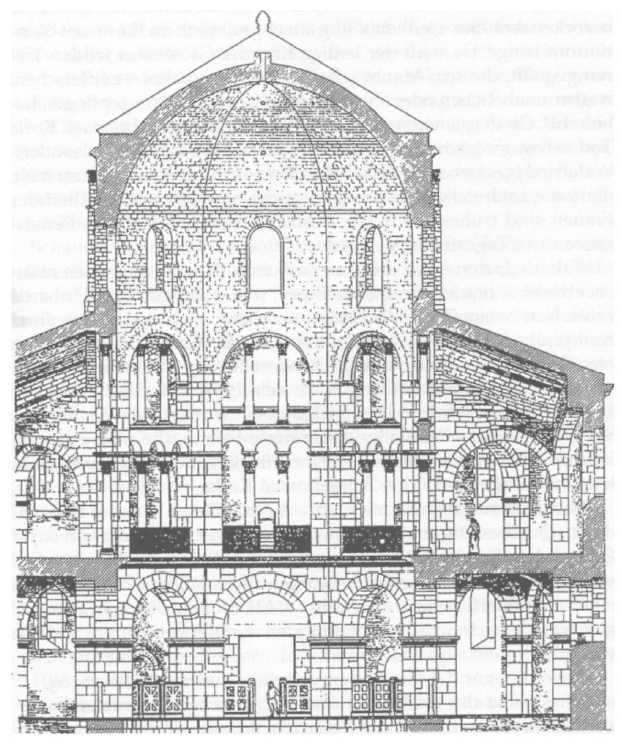
Aachen: FAKE-Kirche Pfalzkapelle [kap7 foto2]
Zu den Anachronismen an der Aachener Pfalzkapelle
(hier Querschnitt) zählen im Erdgeschoss der offene
Sturz überm Eingangstor, im ersten Stock die schrägen
Gewölbetonnen, die Fensterlaibungen und der senkrecht
beschnittene Kämpfer im Umgang. Aus: Heribert Illig,
Das erfundene Mittelalter, Düsseldorf 1997, S. 253
(nach Albrecht Haupt, Die Pfalzkapelle Kaiser Karls
des Grossen, 1913). (S.146)
Among the anachronisms in the Palatine Chapel of Aachen
(here in cross-section) are the open lintel above the
entrance gate on the ground floor, the slanted vaulted
ceilings in the first floor, the window recesses, and
the vertically cut impost in the passageway. From:
Heribert Illig, The Invented Middle Ages, Düsseldorf
1997, p. 253 (according to Albrecht Haupt, The Palatine
Chapel of Emperor Charlemagne, 1913). (p. 146)
yyyyy
7.3.4.B. Island of Reichenau in Lake Constance: The
FAKE monk Walafried INVENTS the FAKE Pope Gregory the
Great with a passion for an "End Times" scenario: Raids
against Rome INVENTED - Tiber flood INVENTED - Plague
INVENTED etc.
Topper quote:
"
Walafried also betrays himself — or should
this become one of the necessary 'cross-confirmations'? —
by quoting the dialogues of
Pope Gregory the Great.
This truly belongs to the
Renaissance, as
can be seen from the dialogues themselves. I want to
translate a characteristic passage from LeGoff's book (pp.
121 f.), in which the French author we are examining also
becomes vivid (p. 145):
7.3.4.B. Insel Reichenau im Bodensee: Der FAKE-Mönch
Walafried ERFINDET den FAKE-Papst Gregor der Grosse mit
der Leidenschaft für eine "Endzeit": Raubzüge gegen Rom
ERFUNDEN - Tiber-Überschwemmung ERFUNDEN - Pest ERFUNDEN
etc.
Topper Zitat:
"
Walafried verrät sich ausserdem — oder
sollte es eine der notwendigen „Querbestätigungen“ werden?
—, indem er die Dialoge von
Papst Gregor dem
Grossen zitiert. Der gehört wirklich in die
Renaissance, wie aus den Dialogen selbst
hervorgeht. Ich will aus LeGoffs Buch einen
charakteristischen Abschnitt (S. 121 f.) übersetzen, in
dem zugleich auch der französische Autor, den wir hier
betrachten, bildhaft wird (S.145):
»Bevor Gregor der Grosse „konvertierte“ und die Kutte
anzog, . . . ar er Präfekt der Stadt Rom und mit
Versorgungsproblemen beauftragt in jenem Italien, das
Beute der Byzantiner, Goten und Langobarden und der Pest
war; ausserdem war er Botschafter des Papstes beim Kaiser
in Konstantinopel. Im Jahre 590 wird er unter dramatischen
Umständen auf den Heiligen Stuhl berufen: Der Tiber ist
schrecklich angeschwollen und überschwemmt die Stadt
inmitten von angsterregenden Wunderereignissen; vor allem
eine schreckliche Pestepidemie (eine der stärksten
Ausbreitungen dieser grossen (S.145) Seuche, der ersten
schwarzen Pest, die sogenannte justinianische, die seit
einem halben Jahrhundert schon den Mittleren Osten, die
byzantinische Welt, Nordafrika und das mittelmeerische
Europa heimsucht) dezimiert die Bevölkerung. Wie Cäsarius,
mehr noch als er, entsprechend seiner Funktion,
Persönlichkeit und dem historischen Augenblick, wird
Gregor zum Hirten der Endzeit. Überzeugt, dass das Ende
der Welt nahe bevorsteht, wirft er sich mit Leidenschaft
in das grosse Unternehmen der Rettung des
[FAKE]-Christenvolkes, wofür er bald Rechenschaft vor [dem
Fantasie]-Gott ablegen muss. Für die [Fantasie]-Christen
im Inland ist er ein grosser Organisator von
[Fantasie]-Prozessionen und [Fantasie]-Zeremonien, . . .
den fremden Völkern schenkt er [nötigende] Missionare [mit
systematischer Irreführung und Fantasie]:
-- Den Engländern, die zum [Götterwelt]-Heidentum
zurückgekehrt sind, schickt er eine
[Fantasie]-Gesandtschaft nach Canterbury, die die
christliche [Jesus-Fantasie]-Wiedereroberung
Grossbritanniens beginnt.
-- Den Italienern schenkt er ein Buch mit
[FAKE]-Heiligenlegenden und zeichnet unter den
italienischen Vätern einen kürzlich gestorbenen
[Fantasie]-Mönch, Benedikt von Monte Cassino, aus, indem
er ihn zu einem grossen [Fantasie]-Heiligen der
[Fantasie]-Christenheit macht.
Gibt es unter den Christen, die gerettet werden müssen,
keine wiederzugewinnenden Toten? Die Endzeitleidenschaft
Gregors wirkt sich noch jenseits des Todes aus.« (S.147)
-- also die Häufung der Erfindungen in pathetischer
Sprache ist eine Zumutung - und die Erfindung von
Pestepidemien hat in der FAKE-Kirche Tradition (S.147)
-- die Erfindung von Pestepidemien ist eine reine
Angstmacherei der kr. Mönche vom Fatikaan (S.147)
-- nach den Gründen der Pest wird aber NIE gesucht,
sondern einfach immer ein Fantasie-Urteil eines
Fantasie-Gottes erfunden (S.147)
"Before Gregory the Great 'converted' and put on the
habit, . . . he prefect of the city of Rome and charged
with supply problems in that Italy that was the prey of
the Byzantines, Goths and Lombards and the plague; he was
also the Pope's ambassador to the emperor in
Constantinople. In 590, he was summoned to the Holy See
under dramatic circumstances: the Tiber had swelled
terribly and flooded the city in the midst of frightening
miracles; above all a terrible plague epidemic (one of the
strongest spreads of this great (p.145) plague, the first
black plague, the so-called Justinian plague, which has
been afflicting the Middle East, the Byzantine world,
North Africa and Mediterranean Europe for half a century)
is decimating the population. Like Caesarius, even more
than he, according to his function, personality and
historical moment, Gregory becomes the shepherd of the end
times. Convinced that the end of the world is near, he
throws himself passionately into the great enterprise of
saving the [FAKE] Christian people, for which he soon has
to give an account before [the Fantasy] God. For the
[Fantasy] Christians at home, he is a great organizer of
[Fantasy] processions and [Fantasy] ceremonies, . . . to
the foreign peoples he gives [coercing] missionaries [with
systematic deception and Fantasy]:
-- To the English, who have returned to paganism, he sends
a [Fantasy] embassy to Canterbury, which begins the
Christian [Jesus Fantasy] reconquest of Great Britain.
-- He gives a book of [FAKE] legends of saints to the
Italians and distinguishes among the Italian fathers a
recently deceased [Fantasy] monk, Benedict of Monte
Cassino, by making him a great [Fantasy] saint of
[Fantasy] Christianity.
Are there no dead to be recovered among Christians who
need to be saved? Gregor's passion for the Last Days has
an effect beyond death." (p.147)
-- so the accumulation of inventions in pathetic language
is an imposition - and the invention of plague epidemics
has a tradition in the FAKE Church [1) to spread fear and
2) therefore to retain the lying power] (p.147)
-- the invention of plague epidemics is a pure
fear-mongering of the cr. monks of the cr. gay drug and
Satanic Vatican (p.147)
-- but the reasons of the plague are NEVER sought, but
simply a Fantasy judgment of a Fantasy god is always
invented (p.147)
Topper Zitat:
"Abgesehen von der pathetischen Sprache sind in diesem
kleinen Abschnitt dermassen viele Erfindungen
zusammengestellt, dass allein schon diese Häufung eine
völlige Streichung des romanhaften Superpapstes verlangt.
Hinweisen möchte ich hier auf die zahlreichen Erwähnungen
von Pestepidemien in den kirchlichen Texten – eine andere
soll 744-747 gewütet haben –, die von geschichtlich
forschenden Medizinern für Erfindungen gehalten werden.
Vor den Pestausbrüchen im 14. Jahrhundert kann keine
wirklich dingfest gemacht werden. Die Rückprojektion der
Pest ist ein typisches Mittel der Kirche, derartige
ausserhalb ihrer Kontrolle liegenden Katastrophen zur
Gewohnheit zu deklarieren, um Fragen nach den Gründen
auszuschalten." (S.147)
Topper quote:
"Apart from the pathetic language, this small section
contains so
many inventions that this
accumulation alone requires a complete removal of the
novel-like super pope. I would like to point out the
numerous
mentions of plague epidemics in the
ecclesiastical texts – another is said to have raged from
744-747 – which are considered
inventions
by historians and medical researchers. No real evidence
can be established concerning the plague outbreaks in the
14th century. The retrojection of the plague is a typical
means employed by the Church to declare such
catastrophes,
which are outside of its control,
to be
a norm in order to eliminate questions
regarding the causes." (p. 147)
[The indirect message of the lying Church is this one:
Natives with Mother Earth cannot live cleanly and
therefore plague is said to have always spread there - but
all this is a LIE. In reality, it is like this: The CHURCH
is the PEST on the planet with eternal lies, bullying and
character assassinations. And Synagogue and mosque are no
better...]
7.3.4.C. Insel Reichenau im Bodensee: FAKE-Mönch
Walafried ERFINDET den "Benedikt von Monte Cassino" -
und legt die "Grundlage für das Fegefeuer"
Topper Zitat:
"In den Dialogen (2. Buch) hat Gregor nicht nur den
heiligen Benedikt von Monte Cassino (529, eine völlig
legendäre Gestalt) als Neubegründer des Mönchstums
»lanciert«, wie Le Goff (S. 241 f.) sich ausdrückt,
sondern (im 4. Buch) auch die theologische Grundlage für
das Fegefeuer geschaffen, und das kommt selbst nach [dem
französischen Historiker] Le Goff rund sechs Jahrhunderte
zu früh. Erst in dem Wunderbuch des Petrus (S.147)
Damiani (angeblich 1063-1072 verfasst), eines Mönchs von
Monte Cassino, kehren die Seelen aus dem Fegefeuer wieder,
um die Lebenden um Hilfe zu bitten oder vor Sünden zu
warnen. Die Jungfrau Maria hat nämlich einige Seelen, die
in ihrer Jugend zuviel Sex hatten, für jeweils ein Jahr
befreit, und zwar ausgerechnet in der Nacht vor dem 15.
August, Mariä Himmelfahrt (S. 243). Damit springen wir
zeitlich weit voraus, sowohl sprachlich als auch
inhaltlich, die „Wiedergänger“ und den Marienkult
betreffend." (S.148)
7.3.4.C. Island of Reichenau in Lake Constance: FAKE
monk Walafried INVENTS "Benedict of Monte Cassino" - and
installs the "base for purgatory"
Topper quote:
"In the Dialogues (Book 2), Gregory not only 'launched'
[INVENTED]
Saint Benedict of Monte Cassino
(529, a completely legendary figure) as the re-establisher
of monasticism, as Le Goff (p. 241 f.) puts it, but (in
Book 4) also established the theological foundation for
purgatory, which according to [the French historian] Le
Goff is around six centuries too early. Only in the Book
of Miracles of Peter (p.147) Damiani (allegedly written
1063-1072), a monk from Monte Cassino, do souls return
from purgatory to ask the living for help or to warn them
of sins. The
Virgin Mary has freed some
souls who had too much sex in their youth for one year
each, specifically on the night before August 15, the
Assumption
of Mary (p. 243). This takes us far ahead in
time, both linguistically and in terms of content,
regarding the 'Wiedergänger' and the cult of Mary.
7.4. St. Patrick [Fegefeuer-Visionen von
geisteskranken "Christen" - am Ende auch von einem
FAKE-Patrick]
7.4.1. FAKE-Fegefeuer-Roman 1116 von FAKE-Guibert von
Nogent - Widersprüche und Puzzleteile
7.4.2.A. Weitere FAKE-Fegefeuer-Visionen: von einem
FAKE-Mönch Alberic von Settefrati - von 1 FAKE-Abt in
Monte Cassino - von 1 FAKE-Petrus Diakonus - von 1
FAKE-Perpetua und Felicitas
7.4.2.B. Weitere FAKE-Fegefeuer-Visionen: Der FAKE-Heilige
Anskar - mit Elementen des 12. Jh.
7.4.2.C. Weitere FAKE-Fegefeuer-Visionen: von einem
Tnugdal von Irland
7.4.2.D. Weitere FAKE-Fegefeuer-Visionen: von einem
FAKE-Patrick (ein Jesus-Fantasie-Missionar von Irland,
5.Jh.) - soll ein "Bestseller" gewesen sein (!)
7.4. St. Patrick [purgatory visions of
mentally ill "Christians" - finally also from a certain
FAKE Patrick]
7.4.1. FAKE purgatory novel ov 1116 by FAKE Guibert von
Nogent - contradictions and puzzle pieces
7.4.2.A. Other FAKE purgatory visions: of a FAKE monk
Alberic of Settefrati - of 1 FAKE abbot in Monte Cassino -
of 1 FAKE Peter Deacon - of two FAKE women: Perpetua and
Felicitas
7.4.2.B. More FAKE purgatory visions: the FAKE Saint
Anskar - with elements from the 12th century
7.4.2.C. More FAKE purgatory visions: of a Tnugdal of
Ireland
7.4.2.D. Other FAKE purgatory visions: by a certain FAKE
Patrick (a Jesus Fantasy missionary from Ireland, 5th
century) - supposedly a "bestseller" (!)
7.4.1. FAKE-Fegefeuer-Roman 1116 von FAKE-Guibert von
Nogent - Widersprüche und Puzzleteile
--
FAKE-Guibert von Nogent (um1055 bis
1125) wird als für seine Zeit "unbedeutend" taxiert,
"Benediktiner,
Geschichtsschreiber
und Theologe" und Autobiograph, der genaue Geburtsort ist
unbekannt, wird in die Region Beauvais platziert, soll
"vermutlich 1125" gestorben sein - die Mönche des Vatikans
erfanden dann, er sei wegen der
FAKE-Mittelalterbeschreibungen ab der Renaissance mehr
erwähnt worden [web10]
-- FAKE-Werke sind
1) eine
FAKE-Beschreibung des Ersten Kreuzzugs
(Gottes Taten durch die Franken - lat.: Gesta Dei per
Francos - kurz: "Gesta" -
Link)
- "die er zwischen 1106 und 1109 verfasste und die 1121
bekannt wurde" - dabei soll er eine anonyme Geschichte
eines "normannischen Autors" bearbeitet haben und sein
Latein soll "schwierig zu lesen" sein - "akrobatisch,
absichtlich schwieriges" Latein - mit FAKE-Zitaten von
FAKE-Kreuzzugsteilnehmern - und die Franzosen werden mit
ihrem "kriegerischen [Mörder]-Geist" verherrlicht, die nur
von den Türken gestoppt werden könnten [web10]
2)
FAKE-Autobiographie 1115 "De vita sua
sive monodiarum suarum libri tres" - kurz: "Memoiren", im
selben Stil wie die FAKE-"Confessiones" von
FAKE-Augustinius von Hippo mit Beschreibungen von
Gesellschaft und Bräuchen in Frankreich, einer "Kommune
von Laon", über Burg, FAKE-Kloster,
FAKE-Erziehungsmethoden, FAKE-Zeitgenossen, mit
FAKE-Hobbys und FAKE-Feindbildern [web10]
7.4.1. FAKE purgatory novel ov 1116 by FAKE Guibert von
Nogent - contradictions and puzzle pieces
--
FAKE Guibert von Nogent (FAKE birth
around 1055, FAKE death in 1125) is estimated as
"insignificant" for his time, "Benedictine, historian and
theologian" and autobiographer, the exact place of birth
is unknown, is placed in the region of Beauvais in France,
is said to have died "probably in 1125" - the monks of the
Vatican then invented that he had been mentioned more
because of the FAKE descriptions of the Middle Ages from
the Renaissance onwards [web10]
-- FAKE works are
1) a
FAKE description of the First Crusade
(God's deeds by the Franks - Latin: Gesta Dei per Francos
- short: "Gesta" - Link) - "which he wrote between 1106
and 1109 and which became known in 1121" - he is said to
have edited an anonymous story of a "Norman author" and
his Latin is said to be "difficult to read" - "acrobatic,
deliberately difficult" Latin - with FAKE quotes from FAKE
crusade participants - and the French are confronted with
their "warlike [murderer] spirit", which could only be
stopped by the Turks [web10]
2)
FAKE autobiography 1115 "De vita sua
sive monodiarum suarum libri tres" - short: "Memoirs", in
the same style as the FAKE "Confessions" by FAKE
Augustinius of Hippo with descriptions of society and
customs in France, a "Commune of Laon", about castle, FAKE
monastery, FAKE educational methods, FAKE contemporaries,
with FAKE hobbies and FAKE enemy images [web10]
Topper now mentions that there should be a FAKE novel
about FAKE purgatory by FAKE Guibert von Nogent. Quote:
"[French historian] Le Goff [1924-2014] is moving forward
tirelessly. In 1116, Guibert of Nogent wrote a
"psychoanalytical" novel about purgatory in northeastern
France." (p.148)
[Too bad the name of the book is missing, or does it mean
the autobiography of 1115? - But everybody knows now that
this Guibert is a FAKE].
7.4.2.A. Other FAKE purgatory visions: of a FAKE monk
Alberic of Settefrati - of 1 FAKE abbot in Monte Cassino
- of 1 FAKE Peter Deacon - of two FAKE women: Perpetua
and Felicitas
-- and there are supposed to be even more FAKE visions
from other FAKE monks: FAKE monk Alberic of Settefrati,
FAKE abbot in Monte Cassino, a FAKE Peter deacon, an
alleged "original" (p.148):
Topper erwähnt nun es solle von FAKE-Guibert von Nogent
ein FAKE-Roman über das FAKE-Fegefeuer existieren. Zitat:
"[Der französische Historiker] Le Goff [1924-2014]
schreitet unermüdlich voran.
1116 entstand
in Nordostfrankreich durch
Guibert von Nogent
ein „psychoanalysierender“ Roman über das Fegefeuer."
(S.148)
[Schade, dass der Name des Buches fehlt, oder ist damit
die Autobiographie von 1115 gemeint?].
7.4.2.A. Weitere FAKE-Fegefeuer-Visionen: von einem
FAKE-Mönch Alberic von Settefrati - von 1 FAKE-Abt in
Monte Cassino - von 1 FAKE-Petrus Diakonus - von 1
FAKE-Perpetua und Felicitas
-- und es soll noch mehr FAKE-Visionen von anderen
FAKE-Mönchen geben: FAKE-Mönch Alberic von Settefrati,
FAKE-Abt in Monte Cassino, ein FAKE-Petrus Diakonus, ein
angebliches "Original" (S.148):
"[French historian] Le Goff [1924-2014] is moving forward
tirelessly. In
1116,
Guibert of
Nogent wrote a "psychoanalytical" novel about
purgatory in northeastern France." (p.148)
[But the name of the book is missing, or does it mean the
autobiography of 1115?].
Topper weiter:
"der noch übertroffen wird von jener Vision des Mönchs
Alberic
von Settefrati, die er als zehnjähriges Kind
in einem neuntägigen Koma hatte (1110) und zehn Jahre
später seinem
Abt in Monte Cassino
erzählte, die dieser sogleich aufschrieb. Die Weitergabe
des Textes durch zu viele Mönche hatte aber zur Folge,
dass er zu sehr verändert wurde, weshalb weitere zehn
Jahre später
Petrus Diakonus mithalf, ihn
wieder zu bereinigen (um 1130). Dieser Text ist uns
erhalten. Er passt zu den Visionen, sagt Le Goff (S. 251),
die uns auch sonst so von Monte Cassino bekannt sind,
nämlich die schon erwähnten der heiligen
Perpetua
und Felicitas (2. Jahrhundert), des Wetti (9.
Jahrhundert), das Leben des Sankt Brandan und anderen."
(S.148)
Topper continues:
"who is surpassed by the vision of the monk
Alberic
of Settefrati, which he had as a ten-year-old
child in a nine-day coma (1110) and recounted to his
abbot
in Monte Cassino ten years later, which he
immediately wrote down. However, the transmission of the
text by too many monks resulted in it being altered too
much, which is why ten years later,
Petrus Diakonus
helped to restore it (around 1130). This text has been
preserved for us. It fits with the visions, says Le Goff
(p. 251), that are otherwise so well known from Monte
Cassino, namely the already mentioned ones of Saint
Perpetua and Felicitas (2nd century), that of Wetti (9th
century), the life of Saint Brendan, and others." (p.148)
-- die "Fegefeuer"-Legenden dieser FAKE-Mönche haben auch
noch eine komische Geschichte mit Verlust des Textes schon
nach 10 Jahren - dann folgt eine Vision von 20 Druckseiten
mit einem "chaotischen Spaziergang" von bunt
durcheinandergewürfelten Quellen (S.148)
Topper Zitat:
"Nicht nur diese Zusammenstellung, sondern auch die
seltsame Überlieferungsgeschichte — Verderbnis des Textes
schon nach zehn Jahren! — lassen nur sehr viel spätere
Abfassung annehmen. Übrigens füllt diese Vision 20
Druckseiten (!) und ist ein
chaotischer
»Spaziergang, aus zahlreichen literarischen
Quellen gespeist und von benediktinischem Patriotismus
beflügelt« (5. 255). Dadurch wird er keineswegs
glaubwürdiger." (S.148)
-- the "purgatory" legends of these FAKE monks also have a
funny story with the loss of the text already after 10
years - then follows a vision of 20 printed pages with a
"chaotic walk" of motley sources (p.148)
Topper quote (translation):
"Not only this compilation, but also the strange history
of tradition —corruption of the text after only ten years!
— can only be assumed to be written much later.
Incidentally, this vision fills 20 printed pages (!) and
is a
chaotic "walk, fed by numerous
literary sources and inspired by Benedictine patriotism"
(5. 255). That doesn't make him any more credible."
(p.148)
7.4.2.B. Weitere FAKE-Fegefeuer-Visionen: Der
FAKE-Heilige Anskar - mit Elementen des 12. Jh.
-- die Mönche ERFANDEN einen Mönch "Anskar" (auch
"Ansgar") in Bremen, mit FAKE-Geburt 801 in der Picardie,
mit FAKE-Tod in Bremen 865), ihm wird der Beruf
"Erzbischof von Hamburg und Bremen" sowie "Missionsbischof
für Skandinavien" zugedichtet - sein FAKE-Nachfolger
Rimbert hat die meisten FAKE-Daten von ihm in seiner
FAKE-Heiligengeschichte "Vita Anskari" überliefert [web11]
-- und dieser FAKE-Anskar soll auch eine FAKE-Vision eines
FAKE-Fegefeuers gehabt haben (S.148-149)
7.4.2.B. More FAKE purgatory visions: the FAKE Saint
Anskar - with elements from the 12th century
-- the monks INVENTED a monk "
Anskar" (also
"
Ansgar") in Bremen, with a FAKE birth in
801 in
Picardy (France), with a FAKE death
in Bremen in 865), he is attributed with the titles
"Archbishop of Hamburg and Bremen" as well as "Mission
Bishop for Scandinavia" - his FAKE successor Rimbert has
preserved most FAKE details about him in his FAKE
hagiography "
Vita Anskari" [web11]
-- and this FAKE Anskar is also said to have had a FAKE
vision of a FAKE purgatory (pp. 148-149).
Topper Zitat:
"Einzufügen wäre hier eine hübsche Legende des heiligen
[FAKE]-
Anskar, des
[Jesus-Fantasie]-Missionars des deutschen Nordens, dessen
Lebensbeschreibung durch seinen [FAKE]-Nachfolger
Rimbert
trotz aller scharfsinnigen Zweifel an den vielen im 18.
und 19. Jahrhundert gefälschten
Chronikbüchern
aus Korvey meist als echt gilt.
Schon als fünfjähriger Klosterschüler (S.148) hatte er
[der FAKE-Anskar] eine Vision der [FAKE]-Maria, und als
Jungmann war er beim
Tod [des FAKE]-Kaiser Karls des Grossen dermassen
niedergeschlagen, dass er eine Art [FAKE]-Sterbeerlebnis
hatte, wobei ihm [ein FAKE]-Petrus und [ein FAKE]-Johannes
(der Täufer) das [FAKE]-Fegefeuer zeigten. Drei Tage
musste er in dieser Feuerqual ausharren, was ihm wie
tausend Jahre vorkam, dann kehrte er unter die Lebenden
zurück mit der Gewissheit, die [FAKE]-Märtyrerkrone zu
erhalten (was sich aber dann doch nicht bewahrheitete).
Auch die Sündenbeichte wird in dem Text eingeführt – alles
Elemente, die frühestens ins 12. Jahrhundert gehören."
(S.149)
Topper quote:
"Here it would be nice to include a legend of the holy
[FAKE]-Anskar, the [Jesus-Fantasy] missionary of the
German North, whose life description is mostly considered
authentic despite all the sharp doubts about the many
chronicle books from
Corvey (abbey
monastery at Bremen [web16]) that were forged in the 18th
and 19th centuries, because of his [FAKE]-successor
Rimbert. At the age of five, as a monk schoolboy (p. 148),
he had a vision of [FAKE]-Mary, and as a young man, he was
so downcast at the death of [FAKE]-Emperor Charlemagne
that he experienced a sort of [FAKE]-near-death
experience, during which [a FAKE]-Peter and [a FAKE]-John
(the Baptist) showed him [the FAKE]-purgatory. He had to
endure three days in this fiery torment, which felt to him
like a thousand years, then he returned to the living with
the certainty of receiving the [FAKE]-martyr's crown
(which ultimately did not come to pass). The confession of
sins is also introduced in the text – all elements that
belong to the 12th century at the earliest." (p.149)
7.4.2.C. Weitere FAKE-Fegefeuer-Visionen: von einem
Tnugdal von Irland
-- der
FAKE-Tnugdal (lat. Tnugdalus,
vereinfacht auch Tundalus, Tondolus) ist ein FAKE-Ritter
aus Irland - er soll im 12.Jh. eine FAKE-Vision mit einer
Jenseitsvision geschrieben haben [web15]
-- dem FAKE-
Tnugdal von Irland wird eine
FAKE-Fegefeuer-Vision zugeschrieben, die soll aber erst
1882 in Erlangen gedruckt worden sein (S.149)
-- da kommt
Wiedergeburt und Karmadenken
vor, wie auch eine
Königsliste von Irland -
alles typische Elemente der "Humanisten"-Mönche des
Gay-Vatikans zwischen 1400 und 1600 (S.149)
7.4.2.C. More FAKE purgatory visions: of a Tnugdal of
Ireland
-- the
FAKE Tnugdal (lat. Tnugdalus,
simplified also Tundalus, Tondolus) is a FAKE knight from
Ireland - he is said to have written a FAKE vision with a
vision of the afterlife in the 12th century [web15]
-- the FAKE
Tnugdal of Ireland is
attributed a FAKE
purgatory-vision, but it
is said to have been printed only in 1882 in Erlangen
(p.149)
-- there is
rebirth and karma thinking, as
well as a
king list of Ireland - all
typical elements of the "humanist" monks of the gay
Vatican between 1400 and 1600 (p.149)
Topper Zitat:
"Folgen wir weiter Le Goff, der uns in dem lateinischen
Bericht des [FAKE]-
Tnugdal von Irland von
1149 (erwähnt im Buch von Francis Bar: Les routes de
l'autre monde (Paris 1946), S. 106) – gedruckt 1882 in
Erlangen – »indo-europäische Erbstücke« wie
Wiedergeburts-
und Karmadenken vorführt sowie
die
legendären Könige Irlands (ein typisches
Produkt der Humanisten). Le Goff wundert sich, dass die
irischen Könige als historisches Faktum geglaubt werden.
Ich wundere mich, dass Le Goff die Datierung ernst nimmt."
(S.149)
Topper quote:
"Let us continue to follow Le Goff, who presents in the
Latin account of the [FAKE]-
Tnugdal from Ireland
from 1149 (mentioned in the book by Francis Bar: Les
routes de l'autre monde (Paris 1946), p. 106) – printed in
1882 in Erlangen – 'Indo-European heirlooms' such as
ideas
of rebirth and karma, as well as the
legendary
kings of Ireland (a typical product of the
humanists). Le Goff wonders that the Irish kings are
believed as a historical fact. I wonder that Le Goff takes
the dating seriously." (p. 149)
7.4.2.D. Weitere FAKE-Fegefeuer-Visionen: von einem
FAKE-Patrick (ein Jesus-Fantasie-Missionar von Irland,
5.Jh.) - soll ein "Bestseller" gewesen sein (!)
-- die Mönche des Vatikans erfanden einen FAKE-Missionar
von Irland, der "
Heilige Patrick",
lateinisch: Magonus Sucatus Patricus, irisch:
Pádraig Mac
Calprainn, Naomh Pádraig; mit FAKE-Geburt Ende
4.Jh/Anfang 5.Jh, in der FAKE-römischen Provinz von GB,
mit FAKE-Tod 461 oder 493 [???] in Irland im County Down -
ihm wird der Beruf "römisch-britischer-christlicher
Missionar" angedichtet - er gilt in Irland als
"Nationalheiliger" - er soll in Irland "Klöster, Schulen
und Kirchen" gegründet haben und als "Bischo" amtiert
haben - "die Legenden wurden mindestens hundert Jahre
später verfasst" [web12]
-- der FAKE-Patrick bekam einen FAKE-Herausgeber, den
Henry of Saltrey, der
die FAKE-Vision
vom FAKE-Fegefeuer des FAKE-Patrick herausgab:
"
Treatise on the Purgatory of Saint Patrick"
(orig. Latin: "Tractatus de Purgatorio Sancti Patricii")
mit den FAKE-Jahreszahlen 1180-1184 [web13]
7.4.2.D. Other FAKE purgatory visions: by a certain
FAKE Patrick (a Jesus Fantasy missionary from Ireland,
5th century) - supposedly a "bestseller" (!)
-- The monks of the Vatican invented a FAKE missionary
from Ireland, the "
Saint Patrick", Latin:
Magonus Sucatus Patricus, Irish: Pádraig Mac Calprainn,
Naomh Pádraig; with a FAKE birth at the end of the 4th
century/beginning of the 5th century, in the FAKE Roman
province of GB, with a FAKE death in 461 or 493 [???] in
Ireland in County Down - he is ascribed the profession of
'Roman-British-Christian missionary' - he is regarded in
Ireland as the 'National Saint' - he is said to have
founded 'monasteries, schools, and churches' in Ireland
and served as a 'Bishop' - 'the legends were written at
least a hundred years later' [web12]
-- the FAKE Patrick got a FAKE publisher, Henry of
Saltrey, who published the purgatory vision from the FAKE
Patrick: 'Tractatus de Purgatorio Sancti Patricii' with
the FAKE years 1180-1184 [web13]
Topper Zitat:
"Oder: Die Beschreibung des heiligen [FAKE]-
Patrick,
[Jesus-Fantasie]-Missionar von Irland („5. Jahrhundert“),
geschrieben von
H. von Saltrey, der den
Ritter
Owein aus dem Artus-Roman
mitreiten lässt und zur theologischen Rechtfertigung
seiner Fegefeuerstory den
heiligen [FAKE]-Augustin
und
[den FAKE]-Papst Gregor den Grossen
anführt (deren Schriften ich beide ins 16. Jahrhundert
befördern möchte). Der Roman wurde erstmals 1624 durch
Messingham und dann 1647 durch den Jesuiten Colgan in
Löwen herausgegeben.
Le Goff, der die Verbindung mit Patrick für erfunden hält,
beruft sich auf eine erste Erwähnung des Buches um 1180,
wobei durch einige Wissenschaftler das Datum für diesen
„Bestseller des Mittelalters“, der schon 1190 ins
Französische übersetzt worden sei durch Marie de France,
auch bis auf 1210 hinaufgesetzt wird. 1497 wird die
Pilgerstätte des Patrick in Nordirland durch den damaligen
Papst verdammt, 1632 (und mehrmals später noch) sogar
gewaltsam zerstört, aber ab 1790 wieder stark besucht und
ist heute einer der meistbesuchten Wallfahrtsorte Irlands.
Aus all dem geht meines Erachtens klar hervor, dass sich
die christliche Verehrung dieses Ortes und die
dazugehörige Legende erst sehr spät geformt haben."
(S.149)
Topper quote:
"Or: The description of the holy [FAKE]-
Patrick,
[Jesus-Fantasy]-missionary of Ireland ('5th century'),
written by H. von Saltrey, who has the
knight Owein
ride alongside from the Arthurian Romance, and cites
Saint
[FAKE]-Augustine and
[the FAKE]-Pope
Gregory the Great for theological
justification of his purgatory story (whose writings I
would also like to push into the 16th century). The novel
was first published in 1624 by
Messingham
and then in 1647 by the
Jesuit Colgan in
Leuven
(Belgium).
Le Goff, who believes that the connection with Patrick is
fabricated, refers to an initial mention of the book
around
1180, although some scholars raise
this date for this 'bestseller of the Middle Ages,' which
is said to have been translated into French by
Marie
de France as early as
1190,
even up to
1210. In 1497, Patrick's
pilgrimage site in Northern Ireland was condemned by the
then pope, and in 1632 (and several times later) it was
violently destroyed, but from 1790 onwards it was heavily
visited again and is today one of the most visited
pilgrimage sites in Ireland. From all of this, it is clear
to me that the Christian veneration of this place and the
associated legend were only shaped very late.
[Going on pilgrimages because of a FAKE Jesus, a FAKE
cross, a FAKE hell, but for the HOLY WINE - for
celebrating "Christian" alcoholism – that's how they waste
time and loose their brain in the FANTASY Church...]
7.4.3. WARNUNG vor Fälschungen
7.4.3.A. Die Warnungen von Abaelard: Fälscher-Werkstatt
Kloster Saint-Denis bei Paris (F) - die
Jesus-Fantasie-Kirche gibt es erst seit dem 11.Jh. -
KEINE Originale vorhanden - die Manuskripte kommen alle
vom 13.+14.Jh.
Topper Zitat:
7.4.3. WARNINGS about fakes
7.4.3.A. The warnings of Abaelard: forger workshop
Monastery Saint-Denis near Paris (F) - the Jesus Fantasy
church only exists since the 11th century - NO originals
available - the manuscripts all come from the 13th and
14th centuries
Topper quote:
"Einige dieser Fälschungen wurden ja schon recht bald
aufgedeckt. So hat
Abaelard (im 12.
Jahrhundert) schon klargestellt, dass in dem berühmten
Kloster
Saint Denis von Paris zahlreiche Fälschungen —
häufig
Karl dem Kahlen zugeschrieben —
verfasst wurden. Und was ich gerade vorhin von
Abt
Odilon von Cluny vermutete, scheint sich
schon zu bestätigen: Der
Mönch Jotsuald
schrieb ihm zu, was
Petrus Damiani
wiederholte und
Jacob a Voragine im 13.
Jahrhundert in seine Goldene Legende aufnahm, nämlich dass
man eifrig
beten, fasten und
spenden solle für die armen Seelen im
Fegefeuer [die von der kriminellen Kirche systematisch
DISKRIMINIERT werden]. Le Goff dazu (S. 173): »Aber als
Jotsuald
und
Petrus Damiani das Leben des
Odilon
schrieben, war das Purgatorium noch nicht geboren.« Und
der Verehrenswerte
Beda, der das ein halbes
Jahrtausend vorher schon aufgebracht haben soll, wohl auch
nicht (geboren).
Denn — wieder Le Goff (S. 177): »
Das 12. Jahrhundert
ist das Jahrhundert der Explosion (Ausbruch) des
lateinischen Christentums.« Eben! Vorher war die Kirche
ein Jahrhundert lang ein Embryo, und davor lag sie im
Paradies der Ungeborenen.
Aber wie wir schon wissen (S. 183): »Die Literatur des 12.
Jahrhunderts ist belastet mit Apokryphen«, nämlich mit
Texten, die früheren Autoren untergeschoben wurden, weil
diese einen guten Ruf genossen.
Die Originale
fehlen allesamt. Die Manuskripte stammen
frühestens aus dem 13. und 14. Jahrhundert, sagt Le Goff.
Keine Einwände." (S.150)
Some of these forgeries were indeed uncovered quite early.
Abaelard (in the 12th century) made it clear
that numerous forgeries—often attributed to
Charles
the Bald — were created in the famous
monastery
of Saint Denis in Paris. And what I suspected
earlier from Abbot Odilon of Cluny seems to be confirming
itself: The
monk Jotsuald wrote to him what
Peter Damian repeated and
Jacobus de
Voragine included in his
Golden Legend
in the 13th century, namely that one should diligently
pray,
fast, and donate for the poor souls in
purgatory [who are systematically DISCRIMINATED against by
the criminal Church]. Le Goff comments on this (p. 173):
'But when
Jotsuald and
Peter Damian
wrote the life of
Odilon, purgatory had not
yet been born.' And the Venerable
Bede, who
supposedly brought this up half a millennium earlier,
likely had not been born either.
For — again Le Goff (p. 177): "The
12th century
is the century of the explosion (outburst) of Latin
Christianity." Exactly! Before that, the Church was an
embryo for a century, and before that, it lay in the
paradise of the unborn. But as we already know (p. 183):
"The literature of the 12th century is burdened with
apocrypha," namely texts that were attributed to earlier
authors because they enjoyed a good reputation.
The
originals are all missing. The manuscripts
date from at least the 13th and 14th centuries, says Le
Goff. No objections.
7.4.4. Der heilige FAKE-Augustin von Hippo
7.4.4.A. Weitere FAKE-Fegefeuer-Visionen: Der
FAKE-Augustin mit dem Fantasie-Gerichtstag
-- der FAKE-Augustin von Algerien (Hippo) - FAKE-Geburt
354 und FAKE-Tod 430 in Hippo Regius, heute Annaba
(Algerien) [web04] - erfand eine "Prüfung und Reinigung"
sowie einen Fantasie-Gerichtstag - dieses Konzept passt
ins 13.Jh., vorher nicht (S.150)
Topper Zitat:
"Für den heiligen Augustin begann die Prüfung und
Reinigung der Gläubigen schon durch die Leiden hienieden
auf Erden; im Jenseits wurde sie — vor dem
Gerichtstag,
sonst hätte es gar keinen Zweck — fortgesetzt. Das ist
eine recht späte Entwicklung des Fegefeuerkonzepts, die
ich nicht vor dem 13. Jahrhundert ansetzen würde." (S.150)
7.4.4. The holy FAKE Augustine of Hippo
7.4.4.A. Further FAKE purgatory visions: the FAKE
Augustine with the Fantasy Day of Judgment
-- the FAKE Augustine of Algeria (Hippo) - FAKE birth 354
and FAKE death 430 in Hippo Regius, now Annaba (Algeria)
[web04] - invented a "testing and purification" as well as
a Fantasy Day of Judgment - this concept fits in the 13th
century, not before (p. 150)
Topper quote:
"For Saint Augustine, the testing and purification of the
faithful began already through sufferings here on earth;
in the afterlife, it was continued - before the
Day
of Judgment, otherwise it wouldn't make any
sense - This is a fairly late development of the concept
of purgatory, which I would not date before the 13th
century." (p. 150)
7.4.4.B. Weitere FAKE-Fegefeuer-Visionen: Der
FAKE-Papst Gregor der Grosse mit Folter gegen
"Schandtaten"
Topper Zitat:
"Gregor der Grosse geht da noch einen Schritt weiter:
Schandtaten konnten durch
Foltern direkt an
den Orten, wo sie begangen worden waren, abgegolten
werden. Das ist psychologisch durchaus plausibel, aber
keineswegs spätantik, sondern frühestens Gedankengut der
Renaissance." (S.150)
7.4.4.C. Dem FAKE-Augustin von Algerien wird noch ein
FAKE-Traktat über Fürbitten und Almosten für Tote
zugeschrieben
Topper Zitat:
"Übrigens, von Augustin gibt es sogar ein Traktat über die
Fürbitten und Almosen für Tote: De cura pro mortuis
gerenda. Hat das einmal jemand auf seine Herkunft
untersucht?" (S.150)
7.4.4.B. Further FAKE purgatory visions: the FAKE Pope
Gregory the Great with torture against "Shameful Acts"
Topper quote:
"Gregory the Great goes even further: Shameful acts could
be expiated by
torturing directly at the
places where they were committed. This is psychologically
quite plausible, but by no means late antique, rather at
the earliest a concept of the Renaissance." (p.150)
7.4.4.C. The FAKE Augustine of Hippo is also attributed
a FAKE treatise on intercessions and alms for the dead
Topper quote:
"By the way, Augustine even has a treatise on
intercessions and alms for the dead: "On the care to be
taken for the dead" (orig. Latin: "De cura pro mortuis
gerenda"). Has anyone ever investigated its origin?"
(p.150)
7.4.5. Die Verfolgung der "Christen" durch
die kr. kath. Kirche, die das FAKE-Fegefeuer ablehnen -
die "Ketzer"-Verfolgung ab dem 12.Jh.
7.4.5.A. Kirchenspaltung wegen dem kr.
Fantasie-"Fegefeuer": Verfolgung der Passaginer -
Albigenser - Waldenser - Paulikianer (Publikaner)
-- die Diskussion um Wiedergeburt und Himmelsreise kommt
erst durch die kriminelle Vision eines "Fegefeuers" in
Gang - und alle, die nicht an die "Fegefeuer"-Fantasie
glauben, werden verfolgt [und auf das reale Fegefeuer, den
Scheiterhaufen geworfen] (S.151)
-- die kriminelle Kirche wird zur Massenmörderin der
eigenen "Christen" (S.151)
7.4.5. The persecution of "Christians" by
the Roman Catholic Church, who reject the FAKE purgatory
- the "heretic" persecution starting from the 12th
century
7.4.5.A. Church schism due to the Roman Fantasy
"purgatory": persecution of the Passaginians -
Albigensians - Waldensians - Paulicians (Publicans)
-- The discussion about rebirth and the journey to heaven
only begins due to the criminal vision of a "purgatory" -
and all who do not believe in the "purgatory" Fantasy are
persecuted [and thrown onto the real purgatory, the pyre]
(p.151)
-- The criminal church becomes a mass murderer of its own
"Christians" (p.151)Topper quote:
Topper Zitat:
"Der bekannte Ketzer
Johannes Scotus Eriugena
(„ 9. Jahrhundert“) argumentiert höchst präzise über das
Jenseits als »Nicht-Ort«, da die Seelen ja körperlos sind.
Allerdings kommt diese Diskussion (wie auch der geniale
Mann selbst) drei Jahrhunderte zu früh, denn im 12.
Jahrhundert greift ein direkter Schüler von ihm, der
mysteriöse Honorius von Autun, ein Ire in Regensburg, das
Thema in derselben Weise »wieder« auf (Le Goff, S. 184).
Dann allerdings ist es an der Tagesordnung, und dem
Nachlass des Scotus wird nun endlich seitens der Kirche
der Prozess gemacht. Man nimmt von jenem Zeitpunkt an ganz
allgemein alle „Ketzer“ aufs Korn, nämlich
alle
jene Mitbürger, die sich zwar irgendwie als Christen
fühlen, aber das Fegefeuer ablehnen. [und
friedlich OHNE Fegefeuer-Wahn und OHNE Scheiterhaufen
leben wollen, so wie in der Byzanz-Kirche].
Topper quote:
"The well-known heretic
Johannes Scotus Eriugena
('9th century') argues very precisely about the afterlife
as a 'non-place', since souls are, after all, incorporeal.
However, this discussion (as well as the brilliant man
himself) comes three centuries too early, for in the 12th
century, a direct disciple of his, the mysterious Honorius
of Autun, an Irishman in Regensburg, takes up the topic in
the same way 'again' (Le Goff, p. 184). Then, however, it
is on the agenda, and the church finally begins to take
action against the legacy of Scotus. From that point on,
all 'heretics' are generally targeted, namely
all
those fellow citizens who somehow feel like Christians
but reject purgatory [and want to live
peacefully WITHOUT the delusion of purgatory and WITHOUT
the burning stakes, as in the Byzantine Church].
-- Da gab es die
Passaginer, die noch stark
judaisierend an Christus glauben wollten und Beschneidung
und Altes Testament bevorzugten, bezeugt in den Jahren
zwischen 1184 und 1291, vor allem in der Lombardei.
-- Parallel zu ihnen die wohlbekannten
Albigenser
(Katharer). Oder
-- die Anhänger von Petrus Walden, die
Waldenser.
Und dann
-- die
Paulikianer, deren Name zu
Publikaner
verunstaltet wurde, womit man bald alle Ketzer
bezeichnete.
Die meisten Gruppen waren Vegetarier, hielten es mit der
Ehe recht frei (zumindest nicht als „Heiliges Sakrament“)
und hatten diesen gemeinsamen Fehler: Das Fegefeuer kam
ihnen absurd vor.
Ein Abtrünniger der Katharer,
Rainer Saceoni,
der 1250 Inquisitor der Kirche wurde und seine ehemaligen
Glaubensbrüder verfolgte, hat dies als Anklagepunkt
betont.
-- There were the
Passagins who still
wanted to believe in Christ with a strong Judaic influence
and preferred circumcision and the Old Testament,
evidenced in the years between 1184 and 1291, especially
in Lombardy.
-- Parallel to them were the well-known
Albigensians
(Cathars). Or
-- the followers of Peter Waldo, the
Waldensians.
And then
-- the
Paulicians, whose name was distorted
to '
Publicans,' soon referring to all
heretics.
Most groups were vegetarians, maintained a rather free
attitude towards marriage (at least not as a 'holy
sacrament') and shared this common mistake: they found
purgatory absurd.
A renegade of the Cathars,
Rainer Saceoni,
who became an inquisitor of the Church in 1250 and
persecuted his former fellow believers, emphasized this as
an accusation.
7.4.5.B. Kirchenspaltung wegen dem
Fantasie-"Fegefeuer": Die Byzanz-Kirche spaltet sich ab
- Sitz Nizäa (Iznik) - das Konzil von Lyon 1274 macht
das FAKE-Fegefeuer zum FAKE-Dogma - ein Propagandabuch
von Dante "Göttliche Komödie" macht das FAKE-Fegefeuer
populär - der kath. Kirchen-Terror setzt sich durch
Topper Zitat:
"1235 war die Diskussion ums Fegefeuer bereits Zankapfel
mit der
byzantinischen Kirche geworden, die
damals im
Exil in Nizäa [Iznik]
sass (Konstantinopel befand sich in den Händen der
„römischen“ Katholiken). Das Buch gegen die Irrtümer der
Griechen, das eigentlich die Einheit der beiden Kirchen
wieder herstellen sollte (1262), war eine »Sammlung von
Falschem, Gefälschtem und falsch Zugeordnetem«, wie Le
Goff (S. 381) sich ausdrückt. Auf dem lateinischen
Konzil
von Lyon 1274 wurde das
Purgatorium zum
Dogma erhoben.
7.4.5.B. Church schism due to the Fantasy 'purgatory':
the Byzantine Church breaks away - seat of Nicaea
(Iznik) - the Council of Lyon 1274 makes the FAKE
purgatory a FAKE Dogma - a propaganda book by Dante
"Divine Comedy" makes the FAKE purgatory popular -
Catholic Church terror prevails
Topper quote:
"In 1235, the discussion about purgatory had already
become a bone of contention with the
Byzantine
Church, which was then in
exile in
Nicaea [Iznik] (Constantinople was in the
hands of the 'Roman' Catholics). The book against the
errors of the Greeks, which was intended to restore the
unity of the two churches (1262), was a 'collection of
falsehoods, forgeries, and misattributions,' as Le Goff
(p. 381) expresses it. At the
Latin Council of Lyon
1274, purgatory was elevated to a
dogma."
Nun fehlt nicht mehr viel: 1319 vollendet
Dante
seine
Göttliche Komödie, und damit ist das
christliche Fegefeuer fertig gebaut. Die
Dreiteilung
ist nun beschlossene Sache. Die erfrischende Wiese als
Vorhimmel für die guten Christen ist verschwunden, es gibt
sie nur (S.151) noch als zwei Wurmfortsätze:
-- den
Limbus für ungetaufte Kinder und
eine Art Wartesaal für antike Heiden, im Vorgefühl der nun
einsetzenden Renaissance.
-- Die Heiligen und Märtyrer kommen dafür direkt in den
Himmel, ohne Gerichtsverhandlung.
-- Diese völlige Abkehr von der jüdischen Eschatologie und
die vernunftmässige Durchgestaltung der Jenseitswelt sind
das Ergebnis langer Vorbereitungen, Streitschriften und
Machtkämpfe mit viel Blutvergiessen, Folter und
Vertreibung. In diesen Wehen ist die katholische Kirche
entstanden. Nur durch die Abgrenzung gegen die vielen
anderen Bewegungen konnte sie zu ihrer geschlossenen Form
finden (S.152).
[Mit Scheiterhaufen, Folter, Inquisition, Hexenwahn,
Judenvernichtung etc. - die Kirche ist die kriminellste
Organisation der Welt].
Now there is not much left: in 1319,
Dante
completes his
Divine Comedy [maybe he was
well bribed by the Cath. Church for gloryfying the
purgatory!] and with that, the Christian purgatory is
fully constructed. The
tripartition is now
a settled matter. The refreshing meadow as a pre-heaven
for good Christians has disappeared; it only exists (p.
151) as two appendices:
-- The
limbo for unbaptized children and a
kind of waiting room for ancient pagans, in anticipation
of the approaching Renaissance.
-- Now, the Saints and martyrs go
directly to
heaven without trial.
-- This complete departure from Jewish eschatology and the
rational structuring of the afterlife are the results of
long preparations, polemics, and power struggles with much
bloodshed, torture, and expulsion. In these pains, the
Catholic Church was born. Only by distinguishing itself
from many other movements could it find its closed form
(p. 152).
[With stakes, torture, inquisition, witch mania,
extermination of the Jews etc. - the church is the most
criminal organization in the world].
7.4.6. Kirchenspaltung wegen der
"Fegefeuer"-Fantasie: Der kr. Fegefeuer-Vatikan wird
gegen die byzantinische Kirche hochkriminell
7.4.6.A. Kirchenspaltung wegen dem
Fantasie-"Fegefeuer": Die kath. Kirche diskriminiert die
byzantinische Kirche - verfälscht ihre Werke (!) -
dichtet FAKE-Begründungen für "falsche Aussagen" hinzu -
erklärt unangenehme Texte für "gefälscht" - spaltet
einen Autor in 3 Autoren auf
-- der kriminelle Gay-Drogen-Vatikan wandte nun ALLE
kriminellen Mittel und Manöver an, um die Byzantinische
Kirche, die OHNE den Fegefeuer-Wahn [und OHNE
Scheiterhaufen-Wahn] weiterleben wollte, zu verleumden, zu
mobben und AUSzuschalten (S.152)
7.4.6. Church schism due to the Fantasy
"purgatory": The criminal purgatory Vatican is highly
criminal against the Byzantine Church
7.4.6.A. Church schism due to the Fantasy "purgatory":
the Catholic Church discriminates against the Byzantine
Church - distorts its works (!) - adds FAKE reasons for
"false statements" - declares inconvenient texts as a
"FAKE" - splits one author into 3 authors
-- the criminal Gay-Drug-Vatican now employed ALL criminal
means and maneuvers to slander, bully, and ELIMINATE the
Byzantine Church, which wanted to continue living WITHOUT
the purgatory delusion [and WITHOUT the bonfire delusion]
(p. 152)
Topper Zitat:
"Der baltische Theologe
Adolf Harnack hat
(1893, Einleitung) diese Wandlung des Kirchendogmas ganz
deutlich ausgesprochen. Einst angesehene
orthodoxe
Schriftsteller fielen später in Ungnade. Man
unterschlug
ihre Werke, kopierte sie nicht mehr,
beziehungsweise anders:
Man legte ihnen neue Texte
unter, um die Rechtgläubigkeit dieser Männer,
die ja inzwischen zum Fundus des theologischen Apparates
gehörten, zu beweisen. In Handschriften von Irenäus-Texten
wurden Erwartungen des Tausendjahrreichs ausradiert, weil
sie überfällig geworden waren. Bei der ständigen
Umgestaltung
der „ apostolischen“
Schriften behielt man manchmal nur die Titel
und den Umfang bei, da diese in lexikalischen Werken
verzeichnet waren. Wo Änderungen gar unmöglich waren,
fügte man hinzu, der jeweilige Heilige
habe zum
Schutz der Kirche gelogen oder seinen Irrtum
auf dem Totenbett bereut oder durch den Märtyrertod
gesühnt.
Man schuf laufend neue Märtyrer, Konzilien und
Schriftsteller, um dem Tagesgeschehen, das sich in der
Renaissance mit rasender Geschwindigkeit wandelte, gerecht
zu werden. So wandelte sich mit der Kirche auch ihr
eigenes Bild von ihrer Entstehung. Wichtige Texte wurden
überschattet durch die immer stärker ausgemalten
Heiligenlegenden. Und es wurden unlautere Methoden
angewendet, um gegnerische Schriften auszuschalten.
„Schon“ Augustin arbeitete so.
Man erklärte
unangenehm gewordene Texte für gefälscht oder
spaltete die Verfasser in zwei oder mehr Personen auf
und behauptete, das echte Zeugnis sei
verloren."
(S.152)
Topper quote:
"The Baltic theologian
Adolf Harnack stated
this transformation of church dogma quite clearly (1893,
Introduction). Formerly esteemed
orthodox writers
later fell into disfavor. Their
works
were suppressed, no longer copied, or rather:
new texts were placed under their names to
prove the orthodoxy of these men, who had meanwhile become
part of the theological apparatus. In manuscripts of
Irenaeus texts, expectations of the millennium were erased
because they had become overdue. In the constant
reshaping
of the 'apostolic' writings, sometimes only
the titles and the scope were retained, as these were
recorded in lexicon works. Where changes were completely
impossible, it was added that the respective saint
had
lied for the protection of the church or had repented
his mistake on his deathbed or had atoned for it
through martyrdom.
New martyrs, councils, and writers were continuously
created to keep pace with the rapidly changing events of
the Renaissance. Thus, with the Church, its own image of
its origins also changed. Important texts were
overshadowed by increasingly elaborated legends of saints.
Underhanded methods were employed to eliminate opposing
writings. 'Even' Augustine worked this way.
Unpleasant
texts were declared forgeries, or the authors were
split into two or more persons, claiming that
the true testimony was
lost." (p.152)
7.4.6.B: Kirchenspaltung wegen Fantasie-"Fegefeuer":
Die Diskriminierung eines Origenes - alte Konzilsakten
als gefälscht bezeichnen - die Fälscherzeit in der
Kirche fängt aber erst mit Fegefeuer-Wahn und
Inquisition (samt Scheiterhaufen) an - Texte werden
falschen Autoren untergeschoben
Topper Zitat:
"An
Origenes („um 400“) wurde das
durchpraktiziert: Rufinus schreibt im Vorwort seiner
(S.152) Übersetzung der Principiis, die ehrwürdigen Sätze
seien durch Ketzer verändert worden. Auch ganze
Konzilsakten wurden als Fälschungen bezeichnet, wenn sie
nicht mehr passten. Den Alten die Aufrichtigkeit
absprechen und Fälschungen suggerieren ist aber nur
möglich in einer Zeit, in der das gang und gäbe ist,
nämlich
in der Zeit der Inquisition, als
Aufrichtigkeit gefährlich war und Lüge an der
Tagesordnung.
Die seltsame Tatsache, dass die
Klöster so viele antik-heidnische Werke kopiert und
bewahrt haben, jedoch sehr wenige altchristliche,
löst Harnack im selben Sinne: Vor dem Heidentum brauchte
sich die Kirche nicht zu fürchten, das war pass; nur die
eigene Vergangenheit konnte gefährlich sein. Sie musste
dauernd umgestaltet werden, den jeweiligen Erfordernissen
der Gegenwart angemessen. Trotz aller Schärfe der Kritik
sieht Harnack noch nicht, dass auch die heidnische
Literatur grösstenteils neu geschaffen wurde. Man musste
die „Kirchenväter“ ja in einen geschichtlichen Rahmen
einbetten, ohne diesen würde die konstruierte
Vergangenheit der Kirche in der Luft hängen.
[Adolf Harnack: Geschichte der altchristlichen Literatur
bis Eusebius (1893; Berlin 2. Aufl. Leipzig 1958)]
7.4.6.B: Church splits due to Fantasy "purgatory": The
discrimination against Origenes - calling ancient
council documents shall be FAKES - the era of forgery in
the Church, however, begins only with the purgatory
madness and the Inquisition (including the stake) -
texts are attributed to FAKE authors
Topper quote:
"In the case of
Origenes (around 400), this
was practiced: Rufinus writes in the preface to his (p.
152) translation of the Principiis that the venerable
statements were altered by heretics. Entire council acts
were also labeled as forgeries when they no longer fit.
Questioning the sincerity of the ancients and suggesting
forgeries, however, is only possible in a time when this
is commonplace, namely
in the time of the
Inquisition, when honesty was dangerous and
lies were the order of the day.
The strange fact
that the monasteries copied and preserved so many
ancient pagan works, however very few ancient
Christian ones, is explained by
Harnack
in the same sense: The Church had no to be afraid of
paganism, that was passive; only its own past could be
dangerous. It had to be constantly reshaped to meet the
demands of the present. Despite all the sharpness of the
criticism, Harnack does not yet see that much of the pagan
literature was largely newly created as well. One had to
embed the 'Church Fathers' in a historical framework;
without this, the constructed past of the Church would be
left hanging in the air.
[Adolf Harnack: History of Early Christian Literature
until Eusebius (1893; Berlin 2nd ed. Leipzig 1958)]
Harnack entschuldigt die »litterarischen Sünden« der
Kirche mit dem »Kampf auf Leben und Tod« gegen Ketzer und
Heiden. Das Ergebnis, sagt er, ist die Schaffung und
Bewahrung des Alten und Neuen Testamentes. Wenn Harnack
diese Aussage in ihren rechten Zeitraum angesiedelt hätte,
also in die echten Ketzerkriege (gegen Juden, Moslems und
Katharer), dann wäre sie identisch mit meinen eigenen
Gedanken.
Grundsätzlich, sagt Harnack (§2), sind alle christlichen
Schriften, die vor Nizäa [Iznik] verfasst sind, dem
byzantinischen Dogma vollständig fremd und erforderten
ständig verdrehende Auslegungen. Aber den naheliegenden
Schluss, dass diese Texte dann gar nicht in jenen Rahmen
gehören können, sondern in einen anderen, sei er römisch
oder später, hat Harnack noch nicht gewagt. Fälschung und
Rückprojektion sehr viel modernerer Ideen usw. hält er für
die beste Erklärung, aber völlige Erfindung erkennt er
noch nicht. Die Einzelheiten, die Harnack bestens
darstellt, sprechen aber deutlich genug: Viele „Autoren
des 2. und 3. Jahrhunderts“ wurden, damit sie an Gewicht
gewännen, durch
Euseb, Origenes, Pamphilus
und andere zu Apostelschülern gemacht und damit um mehrere
Generationen vorverlegt (S.153), obgleich Euseb und seine
Kollegen das doch wirklich besser wissen müssten. Zwei
Autoren namens
Klemens oder
drei
Johannesse wurden übereinandergestapelt, was
erst durch moderne Kritik wieder aufgelöst werden kann.
Hätten die Autoren des 4. Jahrhunderts das ihren
Zeitgenossen bieten können? Ich glaube nicht." (S.154)
Harnack excuses the 'literary sins' of the church with the
'life and death struggle' against heretics and heathens.
The result, he says, is the creation and preservation of
the Old and New Testaments. If Harnack had placed this
statement in its rightful period, that is, in the actual
heretic wars (against Jews, Muslims, and Cathars), then it
would be identical to my own thoughts.
Essentially, says Harnack (§2), all Christian writings
that were composed before Nicaea [Iznik] are completely
foreign to Byzantine dogma and required constantly
twisting interpretations. But the obvious conclusion that
these texts cannot belong in that framework at all, but
rather in another, whether Roman or later, Harnack has not
yet dared to make. He considers forgery and retrojection
of much more modern ideas, etc., to be the best
explanation, but he does not yet recognize total
invention. The details, which Harnack presents very well,
speak clearly enough:
Many 'authors of the 2nd and 3rd centuries' were made
disciples of the apostles by
Eusebius, Origen,
Pamphilus, and others, in order to gain
weight, and thus were placed several generations earlier
(p. 153), although Eusebius and his colleagues really
should know better. Two authors named
Clement
or
three men named John were piled on top
of each other, which can only be resolved by modern
criticism. Could the authors of the 4th century have
offered this to their contemporaries? I don’t believe so.
7.4.6.C. Die FAKE-Konzilstexte von Nizäa (offiziel Jahr
325) und Chalcedon (offiziell Jahr 451) sind erst im
16.Jh. geschrieben - alte "Kirchenväter" werden zu
"Ketzern" degradiert
Topper Zitat:
"Die Konzilsformeln von Nizäa und Chalcedon müssen
übrigens sehr spät erfunden sein, wohl im
16.
Jahrhundert erst, als man die Kirchenväter,
die noch stark dagegen verstossen, wirklich nicht mehr
umgestalten konnte. So blieb nur noch der Kunstgriff,
Tertullian,
Origenes und andere zu Ketzern zu erklären.
Sogar
Euseb wurde zeitweise zum Arianer
abgestempelt." (S.154)
7.4.6.C. The FAKE council texts of Nicaea (official
year 325) and Chalcedon (official year 451) were only
written in the 16th century - old "Church Fathers" are
degraded to "heretics"
Topper quote:
"The council formulas of Nicaea and Chalcedon must have
been invented very late, probably only in the
16th
century, when the Church Fathers, who still
strongly opposed this, could really no longer be reshaped.
Thus, the only trick left was to declare
Tertullian,
Origenes, and others to be heretics. Even
Eusebius was temporarily branded as an Arian." (p.154)
7.5. Die Werke von
FAKE-Dionysius Areopagita [ein Sufi fälscht einen
Griechen]
7.5.1. Die Widersprüche beim FAKE-Dionysius von Athen
-- die ERFUNDENE Person Dionysius Areopagita
(griech: Dionysios Areopagites) soll im 1. Jh. gelebt
haben - FAKE-Geburt und FAKE-Tod sind unbekannt - als
Beruf wird "Beisitzer in Athen" sowie "der zweite Bischof
von Athen" erfunden - es wird eine FAKE-Bekehrung durch
den FAKE-Paulus erfunden (FAKE-Apg 17,34), und der
FAKE-Eusebius berichtet in seiner FAKE-Historia Ecclesiae
3,4 über den FAKE-Dionysius als FAKE-Bischof von Athen
[web14]
-- in Athen erleidet der FAKE-Dionysius den Märtyrertod
als Krönung seiner Karriere - die Dichtung seiner
FAKE-Werke geschah wohl um 500 in Syrien mit der Erwähnung
von Plotin und Proklos - es mischen sich "christliche
Lehre und neuplatonische Spekulationen" (S.154)
Topper über die Widersprüche beim FAKE-Dionysius in Athen:
7.5. The works of FAKE Dionysius
Areopagita [a Sufi is faking a Greek]
7.5.1. The contradictions with FAKE Dionysius of Athens
-- The INVENTED person
Dionysius Areopagita
(Greek: Dionysios Areopagites) is said to have lived in
the 1st century - FAKE birth and FAKE death are unknown -
as a profession, 'assessor in Athens' and 'the second
bishop of Athens' are invented - a FAKE conversion by the
FAKE Paul is fabricated (FAKE Acts 17:34), and the FAKE
Eusebius reports in his FAKE "
Historia Ecclesiae"
3:4 about the FAKE Dionysius as FAKE bishop of Athens
[web14]
-- In Athens, the FAKE Dionysius suffers a FAKE martyrdom
as the crowning of his FAKE career - the fiction of his
FAKE works likely occurred around 500 in Syria with
mentions of
Plotinus and Proclus -
'Christian doctrine and Neoplatonic speculations'
intermingle (p.154)
Topper on the contradictions with FAKE Dionysius in
Athens:
"Mit einer aufschlussreichen Entdeckung möchte ich das
Kapitel „Kirchenväter“ abschliessen:
Es geht um die grosse Wirkung der Bücher des
Dionysius
Areopagita (siehe Ritter in Camphausen 1991).
Die
erste lateinische Ausgabe erschien
gedruckt in
Florenz 1516. Dionysius wird in
der [FAKE]-
Apostelgeschichte (17, 34)
genannt, wo er von [FAKE]-Paulus in Athen zum
[FAKE]-Christentum bekehrt wird. Natürlich wurde er als
[FAKE]-Bischof von Athen mit dem [FAKE]-Märtyrertod
gekrönt. Die ihm zugeschriebenen [FAKE]-Schriften sind
aber „wohl um 500 im palästinensischen Syrien“ entstanden
[Quelle fehlt], denn in ihnen werden Plotin und Proklos
verarbeitet. Da durchmischen sich christliche Lehre und
neuplatonische Spekulationen, woraus sich ein
gnostisch-mystisches Gebäude entwickelt.
Johannes
Scotus Eriugena (bis „877“) habe ihn viel
abgeschrieben und ins Lateinische übersetzt. Ein
Schlaumeier, der
Abt Hilduin von Saint Denis
(um „832“, also ein halbes Jahrhundert vorher), habe das
erste vollständige lateinische Korpus hergestellt und den
Areopagiten [den Dionysius] des 1.
Jahrhunderts mit dem Heiligen und Märtyrer (um 250), dem
das wichtigste Kloster Frankreichs geweiht ist, dem
Bischof
Dionysius (Denis), gleichgesetzt.
Das ergab nun eine
Dreieinigkeit in einer
Person: den Apostelschüler D., den gleichnamigen Missionar
Frankreichs 200 Jahre später und den unbekannten
Schriftsteller in Syrien 300 Jahre darauf." (S.154)
"With a revealing discovery, I would like to conclude the
chapter "Church Fathers":
It concerns the great impact of the books of
Dionysius
Areopagita (see Ritter in Camphausen 1991).
The
first Latin edition was printed in
Florence
in 1516. Dionysius is mentioned in the
[FAKE]-Acts
of the Apostles (17:34), where he is converted
to [FAKE]-Christianity by [FAKE]-Paul in Athens. Of
course, he was crowned as [FAKE]-Bishop of Athens with a
[FAKE]-martyr's death. However, the writings attributed to
him are believed to have originated "around 500 in
Palestinian Syria" [source missing], as they integrate
Plotinus and Proclus. Here, Christian doctrine and
Neoplatonic speculations intermingle, resulting in a
Gnostic-mystical structure.
John Scotus Eriugena
(until "877") reportedly copied a lot from him and
translated it into Latin. A clever fellow,
Abbot
Hilduin of Saint Denis (around "832", which is
half a century earlier) created the first complete Latin
corpus and equated the
Areopagite
[Dionysius] of the 1st century with the saint and martyr
(around 250), to whom the most important monastery in
France is dedicated,
Bishop Dionysius (Denis).
This now resulted in a
Trinity in one
person: the apostolic disciple D., the eponymous
missionary of France 200 years later, and the unknown
writer in Syria 300 years thereafter." (p.154)
7.5.2. Der Autorenstreit um den FAKE-Dionysius: WER
hat's geschrieben? - und eine FAKE-Sonnenfinsternis -
und viele griechische Handschriften - der Autor ist
wahrscheinlich ein Sufi aus Marokko - die FAKE-Werke des
FAKE-Dionysius von Athen wurden im 13.Jh. geschrieben
Topper Zitat:
7.5.2. The authorship dispute over the FAKE Dionysius:
WHO wrote it? - and a FAKE solar eclipse - and many
Greek manuscripts - the author is likely a Sufi from
Morocco - the FAKE works of the FAKE Dionysius of Athens
were written in the 13th century
Topper quote:
"Wer die Werke wirklich schrieb, bleibt ein Geheimnis.
Zwischendurch war längere Zeit auch der
Ketzer
Apollinar (4. Jahrhundert) Favorit im
Autorenstreit.
Spanische Jesuiten vertraten
diese Meinung noch im 17. Jahrhundert.
Pierre
Abaelard (12. Jahrhundert) bestritt (Davy:
Encyclopédie: S.154) die Personalunion dieser
Dionysiusse, und
Lorenzo de Valla
(1457) wies auf die unmöglichen Widersprüche hin:
Kein
Lateiner vor Gregor und
kein älterer Grieche kannte diesen Dionysius.
Dessen Behauptung, fern von Palästina die
Sonnenfinsternis
beim Tode Jesu gesehen zu haben, wurde durch
Rückberechnung als Lüge entlarvt. Stutzig machen muss auch
die
hervorragende Überlieferungslage, die
ganz ungewöhnlich ist: Es gibt
über 150 griechische
Handschriften, davon 120 vollständige! »Alle
sind gleichzeitig bekannt geworden; und von späteren
Bearbeitungen fehlt in der handschriftlichen
Überlieferung, auch der (älteren) syrischen, jede Spur.«
Selbst die in den Werken genannten anderen Schriften »hat
es so gut wie sicher nie gegeben!« (Davy: Encyclopédie: S.
117)
"Who truly wrote the works remains a mystery. For a long
time, the
heretic Apollinar (4th century)
was also a favorite in the authorship debate.
Spanish
Jesuits maintained this opinion as late as the
17th century.
Pierre Abaelard (12th
century) disputed (Davy: Encyclopédie: p.154) the personal
union of these Dionysii, and
Lorenzo de Valla
(1457) pointed out the impossible contradictions:
No
Latin speaker before Gregory and no older Greek knew
this Dionysius. His claim to have seen the
solar
eclipse at the death of Jesus far from
Palestine was debunked as a lie through retro-calculation.
The
excellent situation of manuscript tradition,
which is quite unusual, must also raise eyebrows: There
are
over 150 Greek manuscripts, of which
120 are complete! 'All became known at the same time; and
there is no trace in the manuscript tradition, even in the
(older) Syriac, of later revisions.' Even the other
writings mentioned in the works "most likely never
existed!" (Davy: Encyclopedia: p. 117)
Was machen wir aus diesem Durcheinander, in dem drei
fiktive Personen ein Werk vertreten, das sicher von keinem
von ihnen stammt und das nur deshalb so grosse Autorität
besessen hat, weil es einem dieser sagenhaften Märtyrer
zugeschrieben wurde? Seine Schriften ȟbten auf das
abendländische Mittelalter eine fast nur noch mit
Aristoteles und Augustin vergleichbare Faszination aus«.
(Davy: Encyclopédie: S. 124)
Es ist gezeigt worden, dass weder Aristoteles noch
Augustin im Mittelalter bekannt waren und dass die
tatsächlich greifbare Diskussion um die Schriften des
Dionysius nicht vor dem 13. Jahrhundert beginnt, zugleich
mit der Aufnahme des Aristoteles (über das islamische
Córdoba).
Eine Textprobe aus seinem Werk Über die mystische
Theologie zeigt uns in wenigen Sätzen, wohin er gehört:
What do we make of this mess, in which three fictional
characters represent a work that surely does not originate
from any of them and has only possessed such great
authority because it was attributed to one of these
legendary martyrs? His writings 'exerted an almost
unparalleled fascination on the Western Middle Ages,
comparable only to that of
Aristotle and Augustine.'
(Davy: Encyclopédie: p. 124)
It has been shown that neither Aristotle nor Augustine
were known in the Middle Ages and that the actual tangible
discussion around the writings of Dionysius does not begin
before the 13th century, coinciding with the introduction
of Aristotle (via Islamic Córdoba [they were Berbers]).
(p.155)
A sample text from his work "On Mystical Theology" shows
us in just a few sentences where he belongs:
»Hinausschreitend aus der Welt, wo man gesehen wird und wo
man sieht, dringt Moses ein ins wahre mystische Dunkel der
Unwissenheit. Dort stillt er sein drängendes Wissen,
entgleitet vollkommen jeder Art von Ergriffensein oder
Vision, denn er gehört nun ausschliesslich dem, der
jenseits von allem ist. Er gehört nicht mehr sich selbst
und auch niemandem ausserhalb seiner selbst, sondern ist
verbunden durch sein Bestes mit dem, der jenseits der
Erkenntnisse ist, da er allem bejahenden Wissen entsagt
hat und dank dieser Unwissenheit Einsicht hat in das, was
jenseits des Wissens liegt.« (zitiert nach Marie-Madeleine
Davy: Encyclopédie des mystiques (4 Bände, Paris 1972), S.
478, meine Übers.)
Oder knapp formuliert: Hier ist Gott nicht mehr der
Gegenstand der mystischen Vision, sondern Gott ist die
Vereinigung selbst, die (S.155) dem Mystiker
unverständlich bleiben muss. Wer könnte das geschrieben
haben? In welche Zeit und Kultur würde das passen? Die
Einbettung in das Moses-Geschehen am Sinai ist natürlich
nur stilistischer Rahmen.
Asin Palacios,
der spanische Gelehrte und Kenner des
Sufismus,
hat den Fingerzeig (1931, Kap. X) gegeben: Es war der
„Grösste Meister“, der andalusische
Sufi Ibn Arabi
(1165-1240). Der hier zitierte Text könnte eine freie
Übersetzung aus den
Futuhat el Mekkiya
sein. Nicht nur sinngemäss, sondern bis in die einzelnen
Ausdrücke hinein stimmen diese mystischen Gedanken
überein." (S.156)
"Stepping out of the world, where one is seen and where
one sees, Moses penetrates into the true mystical darkness
of ignorance. There he quenches his pressing knowledge,
completely escaping every form of being entranced or
vision, for he now belongs exclusively to the one who is
beyond all. He no longer belongs to himself or to anyone
outside of himself, but is connected through his best with
the one who is beyond knowledge, having renounced all
affirmative knowledge and, thanks to this ignorance, has
insight into what lies beyond knowledge." (quoted from
Marie-Madeleine Davy: Encyclopédie des mystiques (4
volumes, Paris 1972), p. 478, my translation.)
Or to put it briefly: Here God is no longer the object of
the mystical vision, but God is the union itself, which
(p.155) must remain incomprehensible to the mystic. Who
could have written that? What time and culture would that
fit into? The embedding in the Moses event at Sinai is, of
course, only a stylistic framework.
Asin Palacios,
the Spanish scholar and connoisseur of
Sufism,
has given the hint (1931, chap. X): It was the "Greatest
Master", the Andalusian
Sufi Ibn Arabi
(1165-1240). The text quoted here could be a free
translation from the
Futuhat el Mekkiya.
These mystical thoughts agree not only in their meaning,
but down to the individual expressions." (p.156)
Und noch etwas haben die beiden gemeinsam,
Dionysius
und Ibn Arabi, was sonst fast nirgendwo in
dieser ausgeprägten Weise vorkommt:
Beide
schreiben und zitieren erotische Hymnen,
in denen Gott sich in der Schönheit der
Frau offenbart. Der Sufi-Meister lebte später
im Orient und starb in Damaskus, aber seine Ideen wurden
vor allem im Maghreb und in Andalusien aufgegriffen und
weitergeführt. Der Wirkunsgbereich der Schriften des
Dionysius war vor allem Frankreich, Süd- und
Westdeutschland und Norditalien. Ich denke, dass der Weg
über Andalusien geführt hat.
Dann überrascht auch nicht mehr, dass der vorhin zitierte
Autor Ritter mit begeisterten Worten auf den
hochstrebenden gotischen Kirchenbau und die Papstbulle von
1302, die für die Kirche den Status einer Grossmacht
beansprucht, als direkte Folgen der Dionysius-Rezeption
hinweist. Die Mystik des Dionysius trägt deutlich sufische
Züge und wurde von Meister Eckehart übernommen.
Jede Zeit hat ihren eigenen Geist. Wenn den Theologen
heute die Zurückverlegung dieser Schriften ins 1.
Jahrhundert unsinnig erscheint, ins 3. auch schon sehr
zweifelhaft, ins 6. aber noch korrekt, dann müssen wir
wohl noch lange warten, bis man ihre Entstehungszeit in
dem Jahrhundert sieht, in dem sie ihre erste und grösste
Wirkung entfalteten, dem 13." (S.156)
And there is one more thing that the two,
Dionysius
and Ibn Arabi, have in common, which is rarely
found elsewhere in such a pronounced way:
both
write and quote erotic hymns in which God reveals
Himself in the beauty of a woman. The Sufi
master lived later in the Orient and died in
Damascus,
but his ideas were primarily taken up and further
developed in the
Maghreb and Andalusia. The
area of influence of Dionysius's writings was mainly
France,
southern and western Germany, and northern Italy.
I believe that the path led through Andalusia.
Then it is no longer surprising that the previously cited
author Ritter enthusiastically refers to the aspiring
Gothic church architecture and the papal bull of 1302,
which claims the status of a great power for the church,
as direct consequences of the reception of Dionysius. The
mysticism of Dionysius clearly has Sufi traits and was
adopted by Mastro Eckhart [missing in the register of
literature].
Every era has its own spirit. If theologians today [year
2000] find it senseless to date these writings back to the
1st century, already very questionable for the 3rd, but
still correct for the 6th, then we will likely have to
wait a long time before their origin is recognized in the
century in which they had their first and greatest impact,
the 13th.
[The Church defined its world domination in 1494 with the
Treaty of Tordesillas. Pride comes before a fall].