|
|
|


8. Heretics and pagans [also "gnosis" from 0 to 1100 is a FAKE]
The criminal gay drug Vatican is also a faking company
8.1. Arianism [FAKE Gnosis - FAKE Gothic Bible - FAKING principle with "palimpsest" parchment - FAKE Arian]
8.2. Paganism [the FAKE of early Christianity in Germany+France - they had their first religions for a long time yet]
8.2.3. The FAKE of "Early Christianity" in France and Germany
8.3. Language [Vulgar Latin - Arabic terms - themes of the Renaissance]
[8.4. The transition from Greek to Latin in the official version]
[8.5. Strange findings in Jesus Fantasy monasteries: Nibelungen song - Igor's sea trip - story of Edda]
8.6. Art [FAKED altars, FAKED book illustrations: female angels - perspective technique comes from Renaissance only - clothing - weapons - stirrups as criteria, etc.]
from: The Big Action. Europe's invented history. The Systematic Falsification of Our Past from Antiquity to the Enlightenment --
orig. German: Die Grosse Aktion. Europas erfundene Geschichte. Die planmässige Fälschung unserer Vergangenheit von der Antike bis zur Aufklärung --
Edition Grabert -- ISBN 3-87847-172-6 -- Tübingen 1998; 2nd edition 2000
Commented edition
presented by Michael Palomino (2025)
| Share: |
Facebook |
|
Twitter
X |
|
|
|
Mentioned literature
-- Book by Klaus von See: Germanic Ideology from Humanism to the Present; Frankfurt a.M. 1970
(orig. German: Buch von Klaus von See: Deutsche Germanen-Ideologie vom Humanismus bis zur Gegenwart; Frankfurt /M. 1970)
-- Book by Regine Sonntag: Studies on the Evaluation of Numerical Data in Early Medieval Historiography; Dissertation Munich 1987
(orig. German: Buch von Regine Sonntag: Studien zur Bewertung von Zahlenangaben in der Geschichtsschreibung des frühen Mittelalters; Dissertation München 1987)
-- Book by Hans Blüher: The Aristie of Jesus of Nazareth; Prien 1921
(orig. German: Buch von Hans Blüher: Die Aristie des Jesus von Nazareth; Prien 1921)
-- Book by Hermann Rönsch: Itala and Vulgate (orig. German: Itala und Vulgata); Marburg 1875; Reprint Munich 1965
-- Book by Harry C. Schnur: Latin Fables of the Middle Ages; Munich 1979
(orig. German: Buch von Harry C. Schnur: Lateinische Fabeln des Mittelalters; München 1979)
-- Book by Herbert Hunger: History of Text Transmission, Volume 1: Ancient and Medieval Book and Writing Culture, History of Transmission of Ancient Literature; Foreword by Martin Bodmer; Atlantis Verlag, Zurich 1961
(orig. German: Buch von Herbert Hunger: Geschichte der Textüberlieferung, Band 1: Antikes und mittelalterliches Buch- und Schriftwesen, Überlieferungsgeschichte der antiken Literatur; Vorwort von Martin Bodmer; Atlantis Verlag, Zürich 1961)
-- Book by Helmut de Boor: German Literature; Volume 1; Munich 1979
(orig. German: Buch von Helmut de Boor: Die deutsche Literatur; Band 1; München 1979)
-- Book by Ludwig Ettmüller: Old Norse Saga Treasury - Selection; Zurich 1869
(orig. German: Buch von Ludwig Ettmüller: Altnordischer Sagenschatz - Auswahl; Zürich 1869)
Article
-- Josef Eberle: Interview with Cicero (orig. German: Interview mit Cicero - Stuttgart 1956)
Content
8.1. Arianismus [FAKE-Gnosis - FAKE-Gotenbibel - FAKE-Prinzip mit "Palimpsest"-Pergament - FAKE-Arian]
8.1.1. The INVENTED "Gnosis" since FAKE Rome - and the TRUE "Gnosis" since the Vatican dictatorship
8.1.1.A. The FAKE Gnosis after the FAKE Roman Empire with a FAKE Valentine - and FAKE scholars of FAKE Valentine: Heracleon+Ptolemy - plus Coptic FAKE writings from Egypt
8.1.1.B. The FAKE Gothic Bible of FAKE Wulfila - Impossibilities in a new "Gothic script" in a Gothic that did not exist
8.1.2. The forgery principle of parchment papers "Palimpsest" - simply erase and fake something new
8.1.2.A. Documents on parchment - and then erase and overwrite ("Palimpsest") - endless forgery
8.1.2.B. Paper in Europe - and the Vatican continues to forge on expensive parchment simulating old documents (!)
8.1.2.C. The purpose of the FAKE "Gothic Bible"
8.1.3. The invented "Arian" and "Arianism"
8.2. Paganism [the FAKE of early Christianity in Germany+France - native religions were lasting a long time yet]
8.2.1. "Christianization" was not like that - example of the fake Boniface in Hesse
8.2.2. "Christianization" with "fortified churches": to protect the Jesus Fantasy missionaries
8.2.3. The FAKE of "Early Christianity" in France and Germany
8.2.3.A. The Forgery of "Early Christianity" in France+Germany: The Palace of Venantius on the Moselle River was NEVER found
8.2.3.B. The forgery of "Early Christianity" in France+Germany: FAKE numbers about armies - FAKE years - FAKE Arians - FAKE riders
8.2.3.C. The forgery of "early Christianity" in F+D: church with indigenous symbols - FAKE tombstones - IMpossible texts with a soul in heaven, although this idea only became normal from around 1550
8.2.3.D. The forgery of "Early Christianity" in F+D: FAKE royal lists - FAKE bishop lists - FAKE throne of FAKE-Dagobert etc.
8.2.3.E. The forgery of "Early Christianity" in France+Germany: A FAKE knife - and other FAKE tombstones
8.2.3.F. The forgery of "early [Jesus Fantasy] Christianity" in F+D: The Franconian exhibition has SIMULATED an "early [Jesus Fantasy] Christianity"
8.2.3.G. Question: HOW was the Jesus Fantasy "Christianization" of Europe actually proceded? Like an "epidemic" without a shot?
8.3. Language [Vulgar Latin - Arabic terms - topics of the Renaissance]
8.3.1. Works and documents in Latin - but partly it's a very funny Latin
8.3.2. FAKES are uncovered through language analysis: language analyst Mr. Baldauf examines the vocabulary of the Latin FAKE Bible - the impossible Latin word "manducare"
8.3.3. FAKES are exposed through language analysis: The FAKE-Mr. Cassiodorus Senator: Official, advisor, scribe, librarian - having papyrus rolls transcribed into book form on parchment - the book form - and a Fantasy world chronicle from the Renaissance - Arabic words can be only since the Crusades
8.3.4. FAKES are exposed by language analysis: The FAKE Boethius is said to represent both an "old faith" and the new Catholicism with fantasy cross and fantasy blood at the same time
8.3.5. Who were the forgers and ghostwriters? - mostly unknown until today [estate: 2000] (!)
8.3.6. FAKES are exposed through language analysis: An investigation is missing for Hrabanus Maurus (German Rhineland from Mainz 780 to Winkel in Rheingau 856) - an abbot in Fulda - investigation is missing
8.3.7. FAKES are revealed through language analysis: German literary history with a gap
8.3.8. FAKES are uncovered by language analysis: The "Novel of a Mr. Ruodlieb" without an author: is written in verses that were only possible after 1100 - the author has NOT been found to this day - 18 fragments (!) - written on a parchment binding - from the Abbey of Tegernsee (Germany)
8.3.9. FAKES are uncovered through language analysis: Saxo Grammaticus with folklore, heroic tales, and FAKE chronology about Denmark
[8.4. The transition from Greek to Latin - the official version]
8.4.1. Latin
8.4.2. FAKE Vulgar Latin with "Carmina Burana" - the FAKE assertion that Vulgar Latin is a "language development" - the FAKE Plautus - the FAKE Bible
[8.5. Strange findings in Jesus Fantasy monasteries: Nibelungen song - Igor's sea trip - story of Edda]
8.5.1. Strange find: Nibelungen song found in 1998 in the Jesus Fantasy Benedictine Monastery Melk (Austria) - in a book fodder
8.5.2. Copy work with personal fantasy
8.5.3. Strange find: Igor's Campaign "found" in a Russian Jesus fantasy monastery in 1795
8.5.4. Strange finding: The work "Edda" from the 12th-13th century was only "found" in 1640
8.5.5. Strange findings: everything is a chaos of inventions with endless contradictions
8.6. Art [FAKED altars, FAKED book illustrations: female angels - perspective technique comes from Renaissance only - clothing fashion - weapons - stirrups as a criteria, etc.]
8.6.1. FAKE art in the FAKE church: The FAKE Gospel of Aachen with female angels, Madonnas, and crucifixes
8.6.2. FAKE art in the FAKE church: The marble throne of FAKE Gregory the Great with lion feet
8.6.3. FAKE art in the FAKE church: Criteria for book illustrations: Female angels - perspective in book illustrations - clothing fashion - 4 figures for 4 FAKE religions or 4 FAKE evangelists
8.6.4. FAKE art in the FAKE church: Book illustrations: "The three FAKE Magi" - old Spanish book painting
8.6.5. FAKE art in the FAKE church: Book illustrations: The FAKE Revelation of John - old Spanish book painting with FAKE collaborators
8.6.6. FAKE art in the FAKE church: Book illustrations: Commentary on the FAKE Revelation of John by Beatus of Liébana (Spain) with stirrups
8.6.7. The chronological correction in criminal "Christianity" is sorely missing. 8.6.8. The "Walk to Canossa" also seems to be a FAKE - the Freemason politics does not care about that.
Chapter 8: Heretics and Gentiles
8.1. Arianism [FAKE Gnosis - FAKE Gothic Bible - FAKING principle with "palimpsest" parchment - FAKE Arian]
8.1.1.A. The FAKE Gnosis after the FAKE Roman Empire with a FAKE Valentine - and FAKE scholars of FAKE Valentine: Heracleon+Ptolemy - plus Coptic FAKE writings from Egypt
8.1.1.B. The FAKE Gothic Bible of FAKE Wulfila - Impossibilities in a new "Gothic script" in a Gothic that did not exist
8.1.2. The forgery principle of parchment papers "Palimpsest" - simply erase and fake something new
8.1.2.A. Documents on parchment - and then erase and overwrite ("Palimpsest") - endless forgery
8.1.2.B. Paper in Europe - and the Vatican continues to forge on expensive parchment simulating old documents (!)
8.1.2.C. The purpose of the FAKE "Gothic Bible"
8.1.3. The invented "Arian" and "Arianism"
8.1.1. The INVENTED "Gnosis" since FAKE Rome - and the TRUE "Gnosis" since the Vatican dictatorship
8.1.1.A. The FAKE Gnosis after the FAKE Roman Empire with a FAKE Valentine - and FAKE scholars of FAKE Valentine: Heracleon+Ptolemy - plus Coptic FAKE writings from Egypt
-- The catholic church INVENTED a FAKE Roman Empire, and since the FAKE year of 0, there had been FAKE groups partly with "Christian" content being called "gnosis", the Gnostics, the "Gnostic" movements [web01]
-- These first groups with "Christian" elements were INVENTED by the Vatican monks between 1409 and 1600 in "writing rooms" of certain monasteries to present them always as a negative example, with "gnostic writers like "Valentine" ("around 180") who is said to have written a "Gospel of Truth" etc. (p.157)
-- Later, when the bloody Catholic dictatorship with Avignon in the south of France was becoming more and more established and in 1409 the change to Rome took place, big alternative Christian groups were formed, which did not want to have anything to do with many elements of the Catholic nonsense: The Paulinics, the Bogomils, the Cathars - Catholic Vatican dictators in Rome considered them a "new Gnosis" then, a "thorn in the side" which had to be destroyed (p.157)
-- In Egypt in the city of Nag Hammadi in 1945, 47 Christian "texts" ("codices") in Coptic language were "found" - but they are a bit different from the FAKE "Valentine" with his "Gospel of Truth"... (p.157 - [web02])
Topper Quote:
"The Church created its own Gnosis as an enemy for fighting them. It's easier to win on it's own field. Of course, there were the Gnosis: Paulinics, Bogomils, Cathars, all after 900. All ideologies to be fought were attributed to the Gnostics:
-- Dualism (Iranian character),
-- Demiurge (a creator god between the Almighty and men, emerged from the Greek hero cult, like the demigod Hercules),
-- Christ as an angel (Docetism, Islam).
Gnostic writers were invented like Valentine who around 180 already quotes from almost all books of the New Testament, but this is absurd, I think [the NT was created in about 1400, historian Pfister indicates 1760 appr.]. Even the "Church Fathers" do not succeed in this two centuries later, although they are quite neatly invented. Valentine's Gospel of Truth probably never existed, and another one was found under the same name in the location of Nag Hammadi (Egypt), but this is quiet different to the one of Clemens and Irenaeus which was saved by Valentine. Some people claim common elements in these works, but only the titles are the same. Well, some peoples utter their cientific wishes or are making political maneuvers for the Church - or both." (p.157)
-- and now there are also FAKE students of FAKE Valentin:
-- Heracleon is said to have written a "commentary on the Gospel of John"
-- Ptolemy always quotes in a certain "letter" the Fantasy Gospel of Matthew, and Paul's letters
-- And the Coptic FAKE writings from Egypt from the city of Nag Hammadi also come from the 10th century.
-- constantly the FAKE content of FAKE OT and FAKE NT are combined "playing" with, and Plato as well as Homer must not be missing - all of which were written much later.
Topper Quote:
"Accordingly, the commentary on the Gospel of John by Heracleon, a disciple of Valentine, is a young creation of the humanistic Church.
And another pupil of him, Ptolemy, quotes in his letter to Ms. Frau (or Mrs.) Flora (how pretty the monks thought it was!) constantly read the [FAKE] Gospel of Matthew, as well as Paul's [FAKE] letters. That is still unthinkable even in the 3rd century." (p.157)
So if we want to classify the finds of Nag Hammadi correctly, then probably towards the end of the 10th century or later.
The quotations from the [INVENTED] Holy Scriptures are numerous and arbitrary, often even combined, which of course presupposes that they were already known. As there is also a tiny fragment from Plato's [FAKE] Politeia (p.157) (588b-589b) and as there is even Homer's [FAKE] Odyssey three times (in the treatise "About the Soul"), this cannot be a remnant of a Chritian library, but only the typical syncretic material that came into circulation from about the year 1000 onwards." (p.158)
8.1.1.B. The FAKE Gothic Bible of FAKE Wulfila - Impossibilities in a new "Gothic script" in a Gothic that did not exist
-- A Fantasy person being called "Wulfila" is said to have written a "Gothic [Fantasy] Bible" - the mother tongue of "Wulfila" is said to have been Greek - whether he understood Latin and knew the Latin Gospels is not very probable (p.158)
-- The Fantasy Mr. "Wulfila" is said to have copied parts of the Fantasy Bible as a Fantasy "Gothic Bible" in the Gothic script, and - what a surprise - he is said to have been the one who had developed the Gothic scripture (link) - the fantasy "Gothic Bible" is also called "Wulfila Bible" (link) or it's also known as "Silver Codex" (lat.: "Codex Argenteus" - link) [web03]
-- The FAKE fragments of the FAKE Visigoth Bible came from Italy - from the Ostrogoths - and ended up in the German monastery of Werden on Ruhr River, then in 1996 to Prague and finally ending up at Stockholm where a relationship between Scandinavians and Goths was claimed (p.158)
-- The purpose of the long journey of the FAKE "Gothic Bible" was to secure the Church's trade routes to northern Europe with a Fantasy Jesus (p.158)
[Church wanted simply all the toll].
Topper quote:
"Unfortunately, even an examination of the Gothic Bible of Wulfila ("4th century") yields no evidence of such an early Christianity, no matter how Arian and barbaric it should have been. Rumors say that this translation "also used a Greek text, but always resorted to the Latin (Itala!)." (Meyers Lexikon, Vol. 15). Mr. [FAKE] Wulfila came from Cappadocia and spoke Greek as his mother tongue. Did he know mainly Latin [Fantasy] Gospels? Or is this famous one-of-a-kind piece also a humanistic creation? The surviving fragments of the Visigoth Bible came from Italy (the Ostrogoth area) to the monastery of Werden on the Ruhr River and then reached Prague first and finally Stockholm in 1669, where at that time an earlier relationship between the Scandinavians and the Gothic people was discovered (which has since been recognized as absurd, see the book by Mr. von See 1970*). The path of this Silver Codex [Latin: "Codex Argenteus"] shows the Church's interest in trade [robbing all tolls from the natives]. Church was interested in the trip of this work for making profits with it or spreading the content." (p.158)
* Book by Mr. Klaus von See: German Germanic ideology from Humanism to the present (Frankfurt on the Main 1970)
(orig. German: Deutsche Germanen-Ideologie vom Humanismus bis zur Gegenwart)
-- Suddenly more fragments of the "Gothic Bible" are "discovered" in Germany and in Italy - they were probably forged to make the first forgery more credible (p.158)
-- And the "Gothic" of the "Gothic Bible" has NOTHING TO DO with the real Gothic - ooooo! (p.158)
Topper Quote:
"See this: At Wolfenbüttel (Germany), a palimpsest (overwriting) fragment with 40 verses was discovered in 1758, and in 1817 some more palimpsest fragments appeared in northern Italy, but this is not sufficient to save the Silver Codex of Wulfila from suspicion of forgery. The brazenly forged bilingual (Latin-Gothic) parchment sheet from the town of Giessen (Germany) really speaks "volumes".
There are no comparable pieces anywhere for the writing and language of the unique book of the Visigoths. The few Gothic words that philologists have found out elsewhere sound completely different from those of the Wulfila Bible. So I can't help thinking that it might be a fantasy creation of the Renaissance." (p.158)
A page of the Wulfila Bible with Gothic and Latin text, overwritten with a text by Isidore of Seville
(Codex Carolinus, at Wolfenbüttel, from the book of Mr. Henning 1913). (p.159)
8.1.2. The forgery principle of parchment papers "Palimpsest" - simply erase and fake something new
8.1.2.A. Documents on parchment - and then erase and overwrite ("Palimpsest") - endless forgery
-- Parchment can be written on - erased - and overwritten - endless forgery is possible (p.160):
Topper quote:
"Let's think a little bit about the mentality of the reserchers proving that the palimpsests should be true. Writing was just a loving activity (p.158) and much was written on parchment, because it's easy to produce it and it's very durable. The leather has not even be tanned, but simply scraping is enough. Being used one time, it can be washed , again scraped and it can be written on it one more time; this is called a "palimpsest". Now you can see two texts: the old one is in the back ground, the new one in the foreground, and it's not easy to read it. But cientists say, the client has to be satisfied.
And he has a clear justification for this maneuver: 'Of course, the choice of parchment was also a cost issue, as the production of an extensive codex required many animals to give their lives.' (see the text of Martin Bodmer: Hunger 1961, p. 35*)." (p. 160)
*Book by Herbert Hunger: History of Text Transmission, Volume 1: Ancient and Medieval Book and Writing Culture, Transmission History of Ancient Literature; Foreword by Martin Bodmer; Atlantis Publishing, Zurich 1961 [web16]
(orig. German: *Buch von Herbert Hunger: Geschichte der Textüberlieferung, Band 1: Antikes und mittelalterliches Buch- und Schriftwesen, Überlieferungsgeschichte der antiken Literatur; Vorwort von Martin Bodmer; Atlantis Verlag, Zürich 1961 [web16])
-- This argument that leather hides were missing is probably not true, because hides from cattle, sheep, and goats have ALWAYS existed.
Topper quote:
"Even if the medieval monks were supposed to be vegetarians, there were always furs from cattle, sheep, goats, etc. in such large quantities that only a fraction of it could be processed." (p. 160)
-- Furthermore, neither leather nor parchment was expensive; but the costly elements were the ink and the colors for the small paintings in the books (p. 160)
-- It is therefore inexplicable why documents were destroyed on parchment and others were overwritten, but that was the "mentality of these scholars" of that time: keep the power based on forgery was the business (p. 160)
[-- All this happened in an environment where the masses were kept in illiteracy, could not read nor write, but the one who could had all power]
-- Some "classical texts" [all of which were INVENTED between 1409 and 1600], have been manipulated simulating to be "old" (to be "aged") and written on palimpsests, e.g., the FAKE Cicero with the INVENTED work "De republica" (p. 160).
-- Furthermore, the question arises why the palimpsests have survived better than the originals [which are all said to have "disappeared"] (p.160)
Topper quote:
"It may have been that parchment was lacking in a time of need in an isolated monastery, but did one really have to copy the Gothic Wulfila Bible? Erasing a classical text perhaps? By the way, ink and colors for the little paintings were much more expensive than the parchment. And considering how rarely a book was copied and how much time a scribe was working for one copy — sometimes years — then the claim of lack of parchment is absurd. Consider also the researcher's mentality who seriously assume that a monk would scrape off an ancient text that no longer suited him as pagan or otherwise offensive in order to write the holy word of [the Fantasy] God over it. Or the other way round was also possible: one of those novels of Saints is written over the much older venerable text of the Church Father Gregory of Nazianzus (p. 38). And some classical texts we only have as palimpsests, such as [FAKE] Cicero's De republica. And why should jut these palimpsests in particular have survived so much better than the originals? Often we only have a few sheets (p.160) of an ancient work of Antiquity in this cheep manner or as a proof. They didn't even bother to falsify the whole [FAKE] code." (p.161)
8.1.2.B. Paper in Europe - and the Vatican continues to forge on expensive parchment simulating old documents (!)
Topper quote:
"From the 12th century onwards, paper is imported, initially from China, then from Arabia, and soon manufactured in Central Europe in excellent quality, cheaper than parchment. Leather as a material was given up because it was less variable. However, during the time of the humanists, it suddenly regained great popularity. Countless old texts are now being rewritten on parchment - not important if there was a new printing technique taking over the world. The connection with the Great Action seems the best explanation for this. Of course, not every humanist forged without limits expressing his love for [FAKE] Antiquity. But when we have sacred and theological writings on scraps of parchment (with holes!) or as overwrites, then in my opinion, this can be only forgery. They just took an old piece of leather that had remained described a story in an archaizing way (sometimes quite fantasy) for making business with it or for impose an ideology." (p.161)
8.1.2.C. The purpose of the FAKE "Gothic Bible"
-- The Jesus Fantasy Protestants of the North were to receive their "own Bible" to bolster pride (p. 161)
-- During the time [of mass illiteracy], the use of a Latin original and the invention of a new Gothic script went unnoticed (p. 161)
[-- The Church was the only institution where one could learn to read and write and just with this, Church hat the total authority]
Topper quote:
"And why should the Church have produced a Gothic (heretical) version of the New Testament like the Wulfila Bible? Precisely because the opponents of the Church — here the Protestants of the North — will not permit any investigation of this special book. They will defend the authenticity of this impossible book with claws and teeth. And what is the benefit of this? This provides proof — even by the opponents of the Church — that the New Testament already existed 'in early times' (in the 4th century) and was even translated into exotic languages for the mission of the pagans [Mother Earth cultures were destroyed].
The minor artistic errors — namely the use of a Latin model and a fantasy scripture — were not calling any attention at that time; they were quite ingenious within Renaissance thinking and the historical inventions of that time. Even elements of Scandinavian runes were used for pleasing the customers. Only today all this calls attention and is detected as absurd." (p.161)
Villaviciosa (Asturias, Spain): A wall relief of the church of "Santa Maria" shows a boar trying to bite into a banana. Gothic story [chap5 photo14]
Topper: To page 161: Erotic scene at the portal of the church Sta. Maria in Villaviciosa (Asturias, Spain): A boar is chasing a man and trying to bite off his genitals. One of the many examples of Gothic paganism in the 13th century. (Photo: U. Topper) (p.102)
[Well, I can't see a boar or a banana there].
8.1.3. The invented "Arian" and "Arianism"
-- The monastic scholars invented an "Arian" as an ennemy to be fought, and they invented a story for him in which the Jesus Fantasy Church is always winning (p.162)
-- Some old churches still have Arian symbols to this day [year 2000] (p.162)
Topper quote:
"Also the heretic Arian could be an invented figure for hiding just a more powerful religion, this what is about the idea of Arianism with "heretic priests". A simple man like this Arian can be fought as an adversary; a world religion simply cannot. An weak ennemy is created which should be defeited. Simple.
There are some churches in Western Europe where the Arian symbols are existing yet, where the pagan stone figures on the facade are not destroyed. When [the Fantasy] God forgets something, you can see the [Fantasy] devil." (p.162)
-- What was going on there? A religious dispute between "Christians" was INVENTED:
Mossad Wikipedia quote (estate of June 30, 2025):
https://de.wikipedia.org/wiki/Arianismus
Translation:
"Arianism was an anti-Trinitarian theological position within early Christianity of late antiquity, which was directly represented by its namesake theologian Arius (circa 260–327 A.D.) and his followers.
Arius considered the assertion of the equal nature of God/God the Father and the Son, as claimed in the Nicene Creed (325 - link), to be a heresy, as it contradicted monotheism, in which the Son and the Holy Spirit could only be conceived in a subordinate, not God-equal standing and dignity. Positions such as the Trinity, which was elevated to dogma in the Niceno-Constatinopolitanum (381 - link) with a Son and Holy Spirit coequal with God, were from his theological perspective even more heretical. According to Arius, the doctrine of the Trinity not only contradicted the statements of the Bible but also the Aristotelian syllogism (link) and was therefore illogical. Conversely, from the perspective of the representatives of the Trinity doctrine from Nicaea or Constantinople and the Christian communities and churches that still recognize this today, Arianism is considered a heresy (Arian controversy link).Since late antiquity, however, the term Arians was often used by followers of the Nicene Trinitarian doctrine as a fighting term for various non-Nicene Christologies or non-Nicene conceptions of the Trinity, even though these movements and their followers did not share the specific views of Arius. In contrast to earlier research, many ancient historians and church historians have therefore limited the term Arians in recent decades to the immediate followers of Arius, whereas, for example, the Homoeans, with their non-Nicene doctrine of the Trinity, have been inaccurately referred to as Arians since late antiquity, but have now been established in scholarly research as an independent, non-Arian Trinitarian/Christological movement of late antiquity. [1] In fact, true Neo-Arians in the original sense only existed from the late 350s among the followers of Aetius, the Heterousians (previously also known as Anhomoeans or Neo-Arians), who denied a similarity of essence between the Father and the Son, instead claiming a unity of will between the two. [2] Most homoean Christians of late antiquity were labeled as 'Arians' by their opponents, but they rejected Arius' teachings and followed the decisions of the councils of Ariminum (359) and Constantinople (360), which had rejected both Arianism and the Nicene Creed."
8.2. Paganism [the FAKE of early Christianity in Germany+France - native religions were lasting a long time yet]
8.2.1. "Christianization" was not like that - example of the fake Boniface in Hesse
8.2.2. "Christianization" with "fortified churches": to protect the Jesus Fantasy missionaries
8.2.3. The FAKE of "Early Christianity" in France and Germany
8.2.3.A. The Forgery of "Early Christianity" in France+Germany: The Palace of Venantius on the Moselle River was NEVER found
8.2.3.B. The forgery of "Early Christianity" in France+Germany: FAKE numbers about armies - FAKE years - FAKE Arians - FAKE riders
8.2.3.C. The forgery of "early Christianity" in F+D: church with indigenous symbols - FAKE tombstones - IMpossible texts with a soul in heaven, although this idea only became normal from around 1550
8.2.3.D. The forgery of "Early Christianity" in F+D: FAKE royal lists - FAKE bishop lists - FAKE throne of FAKE-Dagobert etc.
8.2.3.E. The forgery of "Early Christianity" in France+Germany: A FAKE knife - and other FAKE tombstones
8.2.3.F. The forgery of "early [Jesus Fantasy] Christianity" in F+D: The Franconian exhibition has SIMULATED an "early [Jesus Fantasy] Christianity"
8.2.3.G. Question: HOW was the Jesus Fantasy "Christianization" of Europe actually proceded? Like an "epidemic" without a shot?
8.2.1. "Christianization" was not like that - example of the fake Boniface in Hesse
-- The entire early "Christianization" after the FAKE Roman Empire is a lie, it never actually happened (p. 162)
-- The example of the invented Boniface in Hesse makes it clear that: cutting of Donar oak is a fake, and also all his letters along with the reply letters are faked and published (!) - he tries to present a perfect Latin in education texts (tracts) - and in the end, his biography once again matches the matrix with a "martyr's death" (p. 162)
The FANTASY Boniface baptizes a FANTASY Friesian - and then the FANTASY Boniface is FANTASY killed by FANTASY Friesians [chap5 photo15]
Topper: On page 162: "Boniface baptizes a Friesian - Boniface is killed by the Friesians". Sacramentary from Fulda, "around 1000".
From: The Franks. Pioneers of Europe; Mannheim-Main 1996, p.460 (p.103)
Topper quote:
"And how was Cristianization in our region [in Germany]? We do not know. Certainly not in the way that Church texts describe it, neither in terms of time nor in the manner of proceeding. In the legends, the highest is turned to the lowest and everything is distorted. The English missionary Mr. Winfried, known as Boniface (Latin: Bonifatius), who felled the Donar Oak to convert the Hessians, died as the church father of the Germans, and it was a martyr's death of course (754), but his writings are typical of the efforts of the Humanists to establish Latin: treatises on grammar and metrics as well as poems (!).
Moreover, there is a thick volume of his letters, to which, interestingly, the reply letters from his correspondents are also attached, as well as the letters of his English companion Lul. Without hesitation, I would attribute this corpus of letters to one or more Humanists. (see also the illustration on page 103)." (p.162)
8.2.2. "Christianization" with "fortified churches": to protect the Jesus Fantasy missionaries
-- The "fortified churches" housed the Jesus Fantasy missionaries - this was on German and French territory (p. 162-163)
-- Officially, Vatican propaganda claims in encyclopedias that the "fortified churches" were built for the "Christian population" to protect them from "pagans" - a classic Vatican lie (p. 162)
Topper quote:
"And what about the Christian architecture? The 'fortified churches', especially in the Slavic region, were supposedly built 'for the protection of the population' (see the Brockhaus Lexicon of 1996), but they protected neither the town nor the population, but only the missionaries who had entrenched themselves in the churches, who had an easy stand against the surrounding people, which consisted of peaceful farmers, who were extremely tolerant in religious matters and did not care much about the priests.
Fortified churches were built because they were needed in Franconia and the model was simply copied. Because also the Franks (p. 162) were not Christians either, as the Exhibition of the Francs (Paris-Mannheim—Berlin 1997) made painfully evident with its propaganda which was just shameless or ridiculous. It became clear just there how bad the situation for the Church really was: there were neither Christians in the Frankish nor in the Carolingian era in Central Europe, at least not Roman Catholic loyalists. Therefore, all these artifacts had to be forged." (p. 163)
8.2.3. The FAKE of "Early Christianity" in France and Germany
8.2.3.A. The Forgery of "Early Christianity" in France+Germany: The Palace of Venantius on the Moselle River was NEVER found
-- The Vatican Church invented an "early Christian history" for France with a FAKE bishop "Gregory of Tours" and a "companion" Venantius (p. 163)
-- The style of the compositions with excessive exaggerations and Jesus Fantasy proud gives us the conclusion: this must have a Renaissance origin (p. 163)
-- The FAKE Venantius also describes in his FAKE work a FAKE palace near Breitenstein above the Moselle River, but nothing of it could ever be found (p. 163)
-- But consider this: the Vatican "science" is obliged to believe in this palace and even invents "foreign workers" from Gallia (France) as "experts" - thus, imagine that even back then there was supposedly a "German-French friendship" with joint works as a precursor to "European unification" (p. 163)
Topper quote:
"Our entire image of the history of the early Christian Frankish Empire [France] is based on two Latin texts, namely the 'Books of History' by Bishop Gregory of Tours and the poetry of his 'friend and companion' Venantius, the 'Fortunate', from the 6th century. That both must have been written very late is suggested by their style, excessive exaggerations, and missionary pathos. The huge palace atop the mountain at Breitenstein above the Moselle River, which Venantius describes in detail, with its 30 towers and the colonnaded entrance front, has never been found; however, it is considered a fact in [the official] science [being censored by the Vatican], from which far-reaching [Fantasy] conclusions can be drawn about the social life of that time: Foreign workers appear, who are brought in as specialists from Gallia (Gaul, France), yet they do not compete with the local stonemasons for jobs, as if the history of that time would promote today’s European unification [estate: 2000]." (p. 163)
8.2.3.B. The forgery of "Early Christianity" in France+Germany: FAKE numbers about armies - FAKE years - FAKE Arians - FAKE riders
-- There are many FAKE numbers about armies which were already exposed in 1987 in the book of Ms. Regine Sonntag (p. 163)
-- The INVENTED Pope Gregory also invented Arians (p. 163)
-- The indigenous population with the original religions supposedly transitioned non-violently in Ireland to the Nazi Cross Blood Cult of the Church, because military churches are absent there (p. 163)
-- The cavalry was cultivated - but in France, the Church showed "Christian Rider Saints" from Germany, which were forged, for example, in the Northern Harz mountain region (in Germany) (p. 163)
Topper quote:
"[Pope] Gregory's fantasies were dismantled by Ms. Regine Sonntag (book from 1987*).
* Book by Ms. Regine Sonntag: Studies on the Evaluation of Numerical Data in Early Medieval Historiography (Dissertation Munich 1987)
She found that while architectural details generally sound reliable, numbers regarding troop strengths or time periods belong to the realm of fables, having likely been written much later. The trick is simple: architecture descriptions, and some myths and some king's lists added to it. This I had already seen in the Spanish chronicles of Spanish "chroniclers" of the 16th century. Whether there were Arians in Central Europe during Gregory's time (5th-8th century) remains to be investigated. It is likely that people prayed in groves and near stones, that theyt had a syncretic-pagan worldview [with Mother Earth], and that they knew nothing of the crucified Palestinian. The transition to Irish Christianity was gradual and nonviolent. There was no need for fortified churches.
But the "choir barriers" that were found in these "fortified churches" (p.163), such as the equestrian relief of Hornhausen (illustration, p. 165), clearly show what kind of brainchild the population of that time was. Like a Wotan, the unhelmeted rider sits on his horse, while the Midgard serpent writhes below him. For the Franconian exhibition, this became a helmeted "Christian equestrian saint from the 1st half of the 7th century" – a little far away for Franconia, namely found in the hills of the northern Harz [in Germany] – as part of a "six-part church choir barrier". As proof, horse graves (dated 200 years later) are cited there. Have a nice day, this is indicated in the catalogue." (p.164)
Wodan stone [kap8 foto2]
The Wodan stone from Hornhausen, Germanic horseman with Midgard serpent (fig. from David M. Wilson, Cultures in the North, Munich 1980, p. 55) was baptized Catholic for the exhibition 'The Franks' in Paris and Berlin in 1997: 'Christian Horseman Hero' from a 'Church Choir Railing'. (p.165)
8.2.3.C. The forgery of "early Christianity" in F+D: church with indigenous symbols - FAKE tombstones - IMpossible texts with a soul in heaven, although this idea only became normal from around 1550
-- The so-called Church of Saint Willibrord from the Rhineland shows NO "Christian" symbols (p.164)
-- The data regarding the invented Willibrord: Willibrord (Villibrordus) was given his FAKE birth in 658 in Northumbria (England), and his FAKE death on Nov 7, 739 in Echternach, and as an Anglo-Saxon Jesus fantasy missionary, he supposedly founded the FAKE diocese of Utrecht (now Holland) and the FAKE monastery of Echternach (now German Rhineland). And he is also said to have been the "Apostle of the Frisians" [web04]
-- Frankish tombstones also show NO "Christian" symbols; the Fantasy cross is even missing from an abbot - suspicion of total forgery (p.164)
-- Or they are Fantasy crosses in late Gothic style or in Art Nouveau from the 15th century, some forgeries of tombstones even date from the 19th and 20th centuries, made with modern grinding machines (p. 164)
-- Some texts on fake tombstones are IMpossible, for example describing a soul after death flying to heaven, this idea was not present in the 8th century [because at that time the mentality said that after death the soul would visit the underworld] (p. 164)
"Let's see the rest of the church of a Saint Willibrord from the Rhineland, with its magnificent sarcophagus and stone lectern ("738 AD"), and what a surprise: There is not one single Christian symbol in the relief.
Also Frankish gravestones have no Christian texts. Even an abbot was depicted in a stone without any cross. At the other side, there are other stones with only crosses and nothing else; but these are crosses in a Late Gothic manner, or ever in an Art Nouveau style. In some cases, technique is revealing the truth, when modern grinding tools (Flex) were used. See an impossible text here:
HIC. PAV
SAT. COR
PUS ALD
UALUHI.CV
IUS. ANIMA
GAUDET. IN
CAELO.
"Here rests the body of Aldualuhus, whose soul rejoices in heaven." This is attributed to a "priest (?)" from the "8th century," who was buried in the mountain monastery near Worms. This could be a good modern joke. But historians of today know that (p.164) first the mentality was that the soul after death was waiting in the grave, and only after a long time it went directly to heaven, after Reformation. Thus, such a "priesterly gravestone" on an exhibition is just a FAKE, also when Mr. Kohl and Mr. Chirac were visiting the exhibition." (p.165)
8.2.3.D. The forgery of "Early Christianity" in F+D: FAKE royal lists - FAKE bishop lists - FAKE throne of FAKE-Dagobert etc.
-- During the Frank exhibition,
-- An "ivory book cover" was displayed at the Exhibition of the Francs, which was supposed to document the Fantasy baptism of Fantasy Clodwig (p. 166)
-- Another book cover showed a ruler list of Austrasia between 575 and 662, and yet another one shows a list of Fantasy bishops of Jesus from the 6th century (p.166)
-- The throne of FAKE “Dagobert” (3 Frankish kings were named “Dagobert” [web05]) is a “style mix” of European and African styles - typical Renaissance (p. 166)
Topper quote:
"Otherwise, one saw there an ivory book cover that is supposed to document the baptism of [FAKE] Chlothar; another one that intends to prove the rulers of [FAKE] Austrasia between 575 and 662 with a whole list; or one that lists the names of several posthumous bishops of the 6th century, whom one still considered authentic in 1659, but later washed away again because they were far too unbelievable.
And Dagobert's throne ("Main parts from the 7th century, supplemented in the 9th century") with its mixed style, this could only have been created in a syncretistic era like the Renaissance: flanked by lions with Moorish fur patterns, along with ancient decor and late Gothic ornamentation. It is "unique" and "one of a kind for its time," historically impossible in terms of technology. (see p. 185)" (p. 166)
FAKE throne of FAKE Dagobert [chap9 photo1]
On page 166: Throne of Dagobert with Orientalizing lions ('7th century'). Frankish Exhibition Berlin 1997.
From: The Franks. Pioneers of Europe, Mannheim–Mainz 1996, p. 395. (p. 185)
8.2.3.E. The forgery of "Early Christianity" in France+Germany: A FAKE knife - and other FAKE tombstones
-- At the Exhibitions of the Francs, an "iron knife" was shown with a blade with brass gears from a modern pocket watch affixed - this knife was supposed to be from the 4th century - IMpossible (p. 166)
-- One tombstone had an "antique" back side with engraved whale fish and leather knives, which should represent the culture of the natives, but this was made with modern technology - IMpossible (p. 166)
Topper quote:
"Speaking about technology: Here you see a masterpiece in a glas display case, an iron knife (not just a canonical form), with a blade with brass gears of a modern pocket watch incorporated. On both sides. This should be from a "man's grave from 4th century". - "Finding conditions are absolutely safe for being an authentic object", this is the official comment. But controlling the finding conditions, there is not one little proof for example for the princes' graves under the Cologne Cathedral. Inlay may have occurred in jewellery and weapons, but by hand you can only punch yellow cast iron into gears as accurately as you can see with a magnifying glass, but not with the precision of fractions of a millimetre that modern castings have." (p.166)
FAKE knife of a Frank with gears [chap9 photo6]
On page 166: Knife of a Frank, decorated with gears from the 20th century. Exhibition of the Franks at Berlin 1997. (Photo: U. Topper) (p. 187)
"Equally unsuccessful is another forgery, where a gravestone acquires great age in 'palimpsest' style: The back is worked as an ancient god stele fragment; however, like the engraved front side, it was probably done only in the last century, namely as pagan evidence. Now it serves Christianity, although neither the whales nor the leather knives can have anything to do with Catholic symbols. 'The overall concept is unique (p. 166) and makes the stone monument from Helmsingen a unique work of art from the younger Merovingian period.' (Catalog text)" (p. 168)
[Forgeries at the exhibition of the Franks]
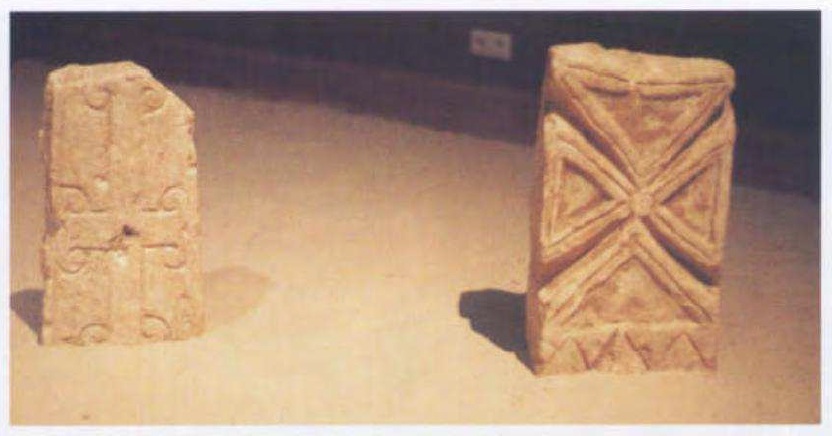
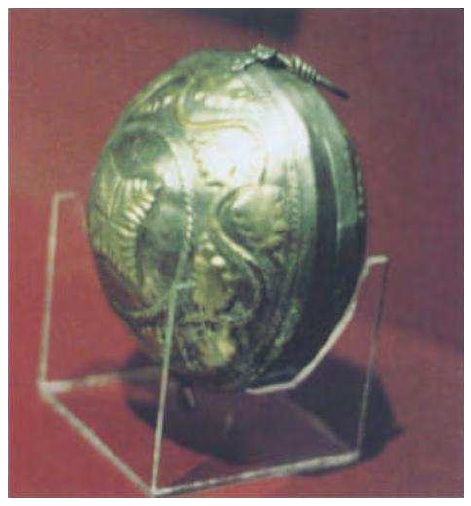
FAKE crosses [chap9 photo2] -- Amulet [chap9 photo3] -- FAKE pillars [chap9 photo5]
To page 166: Modern crosses as evidence of the Christianity of the Franks. Frankish exhibition (p.186)
To page 168: Baroque silver amulet container from the prince's grave under the cathedral of Cologne. (p.186)
To page 166: Pulpit pillar made of limestone, Paris, Hôtel Dieu, ('7th century'). Frankish exhibition Berlin 1997. (Photo: U. Topper) (p.187)
Two exhibition items from the exhibition of the Franks (Berlin 1997).
FAKE gravestone [chap8 photo3]
Left: Alleged gravestone of a Frank, "7th century", in the simple Art Nouveau style of the participants of the First World War. (Photo: Uwe Topper) (p.167)
FAKE Merovingian image [chap8 photo4]
"Frankish king during the treasure throw". Scribble in an allegedly Merovingian manuscript. According to the exhibition catalog (p. 496) "Legislator image in the Lex Ribuaria (p. 167)"
-- and Topper describes another FAKE tombstone at the exhibition of the Franks: from Lower Dollendorf (Niederdollendorf, NRW, on the Rine River) (p. 168)
Topper quote:
"Similar pagan design has the tombstone from Lower Dollendorf (Niederdollendorf) (see p. 186). Today it serves as evidence of [Jesus Fantasy] Christianity, but the worrior has a short sword and a pouch bottle and cannot at all remind one of [Fantasy] Christ, nor the engraved man with lance and halo on the back side. Controlling the nose, the fingers, and the feet more closely is coming an astonishing result about the forger's incompetence." (p. 168)
FAKE gravestone [chap9 photo4]
To page 168: The "Christian gravestone" of Lower Dollendorf ("7th century"), on which a pagan warrior and the Midgard snake are depicted.
Exhibition of the Franks at Berlin in 1997. (Photo: U. Töpper) (p.186)
8.2.3.F. The forgery of "early [Jesus Fantasy] Christianity" in F+D: The Franconian exhibition has SIMULATED an "early [Jesus Fantasy] Christianity"
Topper quote:
"[...] I want to spare the reader from a further tour through this exhibition with its often childish, rarely skillful forgeries (see my lecture and essay of 1998, in print) and [I can] only repeat the conclusion once more: If it is necessary to simulate a [Jesus Fantasy] Christian prehistory of Central Europe through such elaborate fraud, then the conclusion is justified that there were not even minimal traces to prove a [Jesus Fantasy] Christian church before the Ottonians." (p.168)
Topper Zitat:
"Wie Franken, Slawen, Germanen und Angelsachsen das Christentum annahmen, schreibt Blüher (1921, S. 23), »ist zunächst eine völlig dunkle Sache«.
* Buch von Hans Blüher:
8.2.3.G. Question: HOW was the Jesus Fantasy "Christianization" of Europe actually proceded? Like an "epidemic" without a shot?
-- The chroniclers-logicians and truthers are wondering how the terrorist Church with its cross cult and blood cult achieved a [Jesus Fantasy] "Christianization" when both - "Antiquity" and the Middle Ages are a FAKE (p. 168)
-- The emperor supporter and philosopher Mr. Hans Blüher (1888-1955 [web06]) claimed that the Jesus Fantasy religion simply "shaped" old forms in a new way like an "epidemic", and all the [Fantasy] apostles and [Fantasy] missionaries from Asia to Italy are FALSE (p. 168)
-- The resistance to his thesis came promptly from [Jesus Fantasy] Church circles (p. 169)
Topper Quote:
Mr. Blüher asks: "How the Franks, Slavs, Germans, and Anglo-Saxons adopted [Jesus Fantasy] Christianity (1921, p. 23), "is during the first times a completely dark matter'."
* Book by Mr. Hans Blüher: The Aristeia of [Fantasy] Jesus of Nazareth (Prien 1921 - orig. German: Die Aristie des [Fantasie]-Jesus von Nazareth (Prien 1921)
He thinks clearly that the adoption of the new [Jesus Fantasy] religion as a real elective affinity. No foreign Oriental cult is adopted (and certainly not by force), but a new religious form is created. "[Jesus Fantasy] Christianity was not "proclaimed" in geographical spread from Galilee and Asia Minor passing Greece reaching Italy, but erupted almost simultaneously in the humanity of that time. This event... was the epidemic of the then world." (Blüher: p. 184)
I would like to emphasize this simultaneity — with Islam and Judaism — with these quotes, even though Blüher did not yet see the exact time (980-1090) (p. 168). This is only a thin veneer over the actual statement, because the fundamental statement is very European (p. 169).
-- and now the resistance came Blüher's thesis that the Jesus FAKE "Christianity" had spread silently like an "epidemic" (p. 169)
Topper quote:
"This shocked certain persons very hard, like Ernest Renan (French writer 1823-1892 [?] [web07]) or his most recent opponent, Maurice 01ender [?], so they wanted to clarify or suppress these questions with all the energy at their disposal. On the one hand, [Jesus Fantasy] Christianity would lose it's reputation that it was created in one blow which was important for the [FAKE] authority: coming from the distant ancient Orient. On the other hand, the recognitino that our [Jesus Fantasy] Christianity was merely a fairy tale to express our own ethics is sobering and stimulates independent thinking. [The Fantasy] God should be first!" (p.169) [fooling people with the highest Masonic code of 33!].
8.3. Language [Vulgar Latin - Arabic terms - topics of the Renaissance]
8.3.1. Works and documents in Latin - but partly it's a very funny Latin
8.3.2. FAKES are uncovered through language analysis: language analyst Mr. Baldauf examines the vocabulary of the Latin FAKE Bible - the impossible Latin word "manducare"
8.3.3. FAKES are exposed through language analysis: The FAKE-Mr. Cassiodorus Senator: Official, advisor, scribe, librarian - having papyrus rolls transcribed into book form on parchment - the book form - and a Fantasy world chronicle from the Renaissance - Arabic words can be only since the Crusades
8.3.4. FAKES are exposed by language analysis: The FAKE Boethius is said to represent both an "old faith" and the new Catholicism with fantasy cross and fantasy blood at the same time
8.3.5. Who were the forgers and ghostwriters? - mostly unknown until today [estate: 2000] (!)
8.3.6. FAKES are exposed through language analysis: An investigation is missing for Hrabanus Maurus (German Rhineland from Mainz 780 to Winkel in Rheingau 856) - an abbot in Fulda - investigation is missing
8.3.7. FAKES are revealed through language analysis: German literary history with a gap
8.3.8. FAKES are uncovered by language analysis: The "Novel of a Mr. Ruodlieb" without an author: is written in verses that were only possible after 1100 - the author has NOT been found to this day - 18 fragments (!) - written on a parchment binding - from the Abbey of Tegernsee (Germany)
8.3.9. FAKES are uncovered through language analysis: Saxo Grammaticus with folklore, heroic tales, and FAKE chronology about Denmark
8.3.1. Works and documents in Latin - but partly it's a very funny Latin
-- the best Latin was developed during the 15th century during the Renaissance, because the [Jesus Fantasy] Vatican fakers became better and better, Mr. Erasmus with "High Latin" - some forgers also wrote in "Vulgar Latin" (p. 169)
Topper quote:
"Linguistic uncertainty plays another role in the rating of the works. Humanists were always developping a better Latin, writing increasingly 'classically'. While medieval theological [FAKE] writings are often characterized by an odd ('gossip') Vulgar Latin, Mr. Erasmus wrote flawless High Latin. Thus, one could establish a general rule for Christian texts [of FAKE Antiquity and of the FAKE Middle Ages]: the better the Latin, the later was written the [FORGED] text." (p. 169)
8.3.2. FAKES are uncovered through language analysis: language analyst Mr. Baldauf examines the vocabulary of the Latin FAKE Bible - the impossible Latin word "manducare"
-- in the Latin [Thora+Jesus Fantasy] Bible, the fantasy word "manducare" appears, which is missing in the FAKE Revelation and in other FAKE literature (p.169).
"An analysis of the vocabulary, as presented by [the linguist] Mr. Baldauf, would bring clear results about the age of the [Fantasy] Gospels. For example, when the [Fantasy] Pharisee says to [the Fantasy] Jesus: 'Rabbi, peto ut mecum hodie velis manducare = Rabbi, please [I ask you] whether you want to eat with me today' - then it is almost our own language, except for the last word: manducare. The word is common in both the Old and New [FAKE] Testaments, but it does not occur in the Revelation and in normal literature (Rönsch, p. 214).*
* Book by Hermann Rönsch: Itala and Vulgata; Marburg 1875 (orig. German: Itala und Vulgata); reprint Munich 1965)
It is classified as "silver Latin" (a provisional term) and is explained as a contraction of mandere ("to hand over") and masticare ("to chew").
It [the word of "manducare"] is rated as a "silver Latinity" (an artificial term) and it is explained as a contraction of mandere ("to give into the hand") and masticare ("to chew, to chop"), which "logically" becomes manducare = "to eat". Another solution would be a developoment from the "Romansh" mangare, so a Latin word was derivated from the slang? This procedure is often the case! The authenticity of a document should be detectable by a corresponding language criterion (p.169), especially in the transitional [Fantasy] period between [FAKE] Antiquity and the [FAKE] Middle Ages." (p.170)
8.3.3. FAKES are exposed through language analysis: The FAKE-Mr. Cassiodorus Senator: Official, advisor, scribe, librarian - having papyrus rolls transcribed into book form on parchment - the book form - and a Fantasy world chronicle from the Renaissance - Arabic words can be only since the Crusades
-- the Mossad Wikipedia is naive indicating the following: The [FAKE] Cassiodorus (lat. Cassiodorus), also Cassiodorus Senator, supposedly had his FAKE birth in 485 in Southern Italy in Scylaceum (today Squillace [web09]), and his FAKE death is said to have been "around 580" in the Monastery of Vivarium (link) in the same region. His FAKE professions were "Roman statesman, scholar, and writer" [a good FAKE!] [web08]
-- he supposedly devoted himself in the [Jesus Fantasy] Monastery of Vivarium to the preservation of writings, is said to have operated a [Jesus Fantasy] scriptorium with [Jesus Fantasy] monks who systematically transcribed all ancient [Fantasy] papyrus rolls onto new parchment in book form (p. 170)
-- but there could be another FACT that in this [Jesus Fantasy] monastery many "classics" [FAKE Antiquity books] were INVENTED [this works with the "J" before the year numbers - then a bar "I", and finally a "1" with the Gregorian Calendar] (p. 170)
Topper quote:
"Let’s take a look at two writers of this time: The most important person in the transmission of ancient tradition was [FAKE] Cassiodorus 'Senator' (FAKE-born in Calabria in 468 and FAKE-died there in 562 at the age of 94). He was initially an official of Odoacer and, after Odoacer's defeat, an advisor and scribe to the Gothic king Theodoric. After Theodoric's death, he entered a [Jesus Fantasy] monastery at the [FAKE]-age of 70 and devoted himself to the preservation of ancient pagan and [FAKE]-Catholic literature. He created a large [FAKE] library by having all available books, which were written on not very steady papyrus, copied onto parchment. Through him, the codex (our modern book form instead of the scroll) was introduced in the [Jesus Fantasy] Church. This wise man regarded the copying of ancient [Fantasy] works as one of the highest duties of all [Jesus Fantasy] monks, thus shaping the cultural life of the West for a [Fantasy] millennium. Without his exemplary guidance, classical literature would be lost, it is said [in real there were about 200 years not more]. Or perhaps we should say: Thanks to the order of Cassiodorus, we now possess an entire library of rewritten [FAKE] classics." (p.170)
-- From Cassiodorus in the Monastery of Vivarium it is said that only a small FAKE book "On Spelling" (German: "Über Rechtschreibung") and a FAKE world chronicle have survived (p. 170)
-- FAKE quotes from FAKE Cassiodorus are said to be transmitted through Mr. FAKE Jordanes (p. 170)
-- FAKE Cassiodorus is said to have created a FAKE world chronicle for the FAKE Ostrogoth king Mr. [FAKE] Theodoric with the beginning with Fantasy Adam until the year 519 after Fantasy Jesus (p. 170)
Topper quote:
"Unfortunately, only a small [FAKE] book from his last year of life has survived, namely on spelling, which is today [estate: 2000] in St. Petersburg. The rest of him are only some quotes, for example in the [FAKE] works of a Mr. Jordanes. In his chronicle, he presented a [FAKE] world history for the [FAKE] Arian Theodoric beginning with a [Fantasy] Adam to the year 519 A [Fantasy] D. This kind of Catholic [FAKE] chronicle has already been uncovered several times as much later forgeries; for a scribe in the service of a [FAKE] Gothic (Arian) king, it is anyway unbelievable. Similarly, an Easter Festival Painting is attributed to him — parallel to his contemporary Dionysius Exiguus." (p.170)
We have already uncovered this kind of Catholic chronicle several times as much later forgeries, for a scribe in the service of a Gothic (Arian) king it is in any case implausible. Likewise, an Easter table — i.e. parallel to his contemporary Dionysius Exiguus — is attributed to him, but today it is usually regarded as an afterthought." (p.170)
-- The [FAKE] Cassidor is said to have written a very funny [FAKE] Latin in his [FAKE] world chronicle because of style and choice of words - there is Middle Latin, there are Arabic words which became common in Europe only after the Crusades, and there is a "wild mixture of topics" (p.170), e.g. with sundials, water clocks, history of music up to amber - these are probably more the topics of Renaissance (p.171)s
Topper quote:
"And how does this Latin read? Mr. Josef Eberle, one of the last Germans who wrote in Latin (1956, p. 130 f.), is loosing his "patience" with Cassiodorus's style and word choice. Classical Latin cannot yet be spoken of; these are the first attempts at a new creation. In the few samples that I could read, we have an interesting mix of 'medieval Latin' expressions, and even Arabic appears, which fits better into the time shortly after the first Crusades. The colorful mixture of topics of his Varia chapter — which (p. 170) were actually [FAKE] writings to [FAKE] offices describing the healing power of mineral springs, the construction of sundials and water clocks, and the history of music, along with some mention of amber — rather reveal the vocabulary and topics of the [FAKE] High Middle Ages [or of the FAKE Renaissance]." (p. 171)
-- Mr. FAKE Cassidor integrates the FAKE "Antiquity" into the Catholic cross-blood rite faith, and this is unimaginable before Dante (p.171)
Topper quote:
"Typical for him is also the incorporation of pagan [FAKE] Antiquity into the Catholic [Jesus Fantasy] faith, and I cannot imagine that well before Petrarch and Dante." (p.171)
8.3.4. FAKES are exposed by language analysis: The FAKE Boethius is said to represent both an "old faith" and the new Catholicism with fantasy cross and fantasy blood at the same time
Topper quote:
"The most famous contemporary of Cassiodorus was [FAKE] Boethius (480-525), the 'last pagan' of [FAKE] Antiquity. He is a 'complex figure', obviously composed. His late work, Consolatio philosophiae (Consolation of Philosophy), is late antique paganism, but his early treatises are Catholic polemics. In a manuscript 'from the 9th century', the text De fide catholica is not yet attributed to Boethius. One can almost witness how figures are created, expanded, and modified. Thus, these [FAKE] classics now become semblance figures for us." (p.171)
8.3.5. Who were the forgers and ghostwriters? - mostly unknown until today [estate: 2000] (!)
-- Forgers could include: Mr. Reuchlin, Mr. Wimpfeling (p. 171)
"Who their ghostwriters were can only be guessed. Probably Mr. Reuchlin and Mr. Wimpfeling were playing their part in this. But who wrote for whom is still hardly clarified, except in the case of Roswitha [with perfect comedies and a brothel report see chapter 1 to 3 link] and other texts from the circle of Mr. Celtes." (p. 171)
8.3.6. FAKES are exposed through language analysis: An investigation is missing for Hrabanus Maurus (German Rhineland from Mainz 780 to Winkel in Rheingau 856) - an abbot in Fulda - investigation is missing
-- The FAKE Maurus received his FAKE name Hrabanus Maurus or Raban / Rhaban with his FAKE birth around 780 in Mainz and his FAKE death in Winkel in the Rheingau on February 4 of the year 856 - he is credited with the profession of "Abbot" in the Jesus-fantasy-monastery Fulda, also Priest, "Universal Scholar, Teacher and Author" [web10]
-- The FAKE Maurus is said to have well known the FAKE Emperor Louis the Pious and his FAKE bride Empress Judith, later also with the FAKE Emperor Lothar I and his FAKE bride Empress Irmingard - and a multitude of works, letters, and poems are attributed to him [web10]
-- His FAKE collected works were published in 1503 in Pforzheim, including the Gospel Harmony, the Hildebrand Song, an Encyclopedia (22 volumes) (p.171), Bible commentaries (p.173)
-- The poetry claims that the FAKE Maurus instructed his FAKE monks to read the FAKE classics of FAKE Antiquity and the "pagan philosophers" (p.171)
-- The FAKE Maurus is said to have had some FAKE students who are repeatedly mentioned: Walafried Strabo, Otfried of Weissenburg, Gottschalk the Saxon, Rudolf of Fulda, etc. (p.171)
Topper quote:
"A remarkable author whose writings need to be examined is Mr. Hrabanus Maurus who was writing in "Medieval Latin" (= 'Black Raven', Mainz '9th century', called 'Master of the Germans', see illustration, p. 172). His complete works, published in 1503 in Pforzheim, are regarded as a 'compilation' (collection) of 'old' authors, without revealing an opinion of his own. He encouraged his monks to study ancient classics and pagan philosophers, which is simply referred to as the Carolingian Renaissance in today's history books [estate: 2000]. Among his students, we have already encountered some as fabricated: Walafried Strabo and Otfried of Weissenburg; also Gottschalk the Saxon and Rudolf of Fulda belonged to this group. Important for us were his edition of the [Fantasy] Gospel harmony ('Tatian') as well as the Heliand and the Krist, which are said to have been written under his direction or inspiration. Even the German Hildebrandslied is regarded as a work of Hrabanus again after critical examination. He was thus at least bilingual.
This same man, however, apart from a 22-volume Encyclopedia, which is said to have been illustrated as early as the 11th century, in addition to grammar and arithmetic books, also wrote (p.171) commentaries on almost all the books of the Bible, and this would be where he could be caught [here are the proofs demostrating that he is an INVENTED figure]: There is nothing that has changed more quickly than theological views, and hardly anything that is more personal when presented in such large quantities.
Maurus: dedication poem [chap8 photo5]
Hrabanus Maurus, On the Praises of the Holy Cross (orig. Latin: De laudibus sanctae crucis), dedication poem to Louis the Pious with an imperial portrait, Anstein around 1172-79, from: Exhibition catalog: The Time of the Staufer; Stuttgart 1977, Fig. 508. (p.172)
8.3.7. FAKES are revealed through language analysis: German literary history with a gap
-- The FAKE documents are in Latin - sometimes supplemented with German words as explanations (p. 173)
-- Heroic poetry exists in Old High German until 911 and resumes again in 1063 - the gap between 911 and 1063, which only has Latin literature, is inexplicable (p. 173)
Topper quote:
"The development of German literature in the Middle Ages is quite peculiar (see de Boor I, 1979).*
*Book by Helmut de Boor: German Literature (orig. German: Die deutsche Literatur); Volume 1; Munich 1979
Although most documents were issued in Latin during the Carolingian period, when it comes to accuracy of expression, German words are often added, as German was evidently also a written language and much more precise than Latin. Heroic poetry as well as early Christian writings (Heliand, Krist. . .) were composed in (Old High) German, and that until the year 911. Then a 150-year gap occurs, because it is not until 1063 that we have German texts again. In the meantime, Latin was written, and even a classical one, such as Roswitha von Gandersheim or the numerous "monastery chronicles" of that time with their impossible solar and lunar eclipses. And these Latin works are isolated, they do not fit into the course of development of German literature, are not quoted or exploited or continued anywhere." (p.173)
8.3.8. FAKES are uncovered by language analysis: The "Novel of a Mr. Ruodlieb" without an author: is written in verses that were only possible after 1100 - the author has NOT been found to this day - 18 fragments (!) - written on a parchment binding - from the Abbey of Tegernsee (Germany)
-- Wikipedia reports about the "Ruodlieb" novel: ""Ruodlieb" is a Latin epic poem from the early High Middle Ages, which was presumably written around the mid-11th century by a monk from Tegernsee in good Leonine hexameters (link) The work, of which about 2300 verses are preserved in eighteen fragments, can be seen as an early precursor to the courtly romance of the 12th century. It apparently had no dissemination."
-- Works without a name of an author could have been forged by anyone [conclusion]
-- The verse form places the novel in the 12th century or later (p. 173)
-- How they arranged the "finding": the novel is said to have been found in the isolated Jesus Fantasy Abbey of Tegernsee in 1807, when the parchment covers were removed from some books - so, the novel was discovered on the parchments - after 30 years, the same text fas found another time - afterwards, it was decided to print and publish it (p.173)
Uwe Topper quote:
"Completely "isolated and lonely", in its "mysteriousness" almost treacherous, stands the novel of Ruodlieb, which Schmeller (who also published Heliand, Muspilli, and Carmina Burana) and Jacob Grimm published in 1838. It shows a distinct "zigzag movement" (de Boor, p. 98), as it stylistically and linguistically anticipates what was only possible several centuries later. Of the verse novel, 2324 verses or verse sections have survived, about 1500 are considered lost. Therefore, we have quite a large fragment that allows us insight. The discovery is also unremarkable: After the forced closure of the Tegernsee Abbey in 1803, this novel, which no one had known before, was found there in 1807 on parchment strips that had been misused as bookbinding material. When 30 years later some parchments with the exact same text were discovered, a decision was made for its publication. The classification of the manuscripts into the last third of the 11th century was done solely on the basis of the script form!" (p.173)
8.3.9. FAKES are uncovered through language analysis: Saxo Grammaticus with folklore, heroic tales, and FAKE chronology about Denmark
-- The FAKE Saxo Grammaticus was given his FAKE birth in 1160, his FAKE death is recorded as "after 1216"; his profession is attributed as "Danish historian and cleric" - due to his correct Latin, he is awarded the nickname "Grammaticus" [web11]
-- The FAKE Denmark chronology in 16 volumes is written in rhymed rhythms, a "collection of legends" - the first 9 volumes are pure poetry - they contain "oriental insertions", "with genuine Islamic gimmickry", with "erotic fantasies"; the designation of the Slavs comes from the 15th century - Byzantium plays a significant role with corruption - the mention of a water clock is one more element making the forgery even more likely (p. 174).
Topper Quote:
"Among the Latin books of the 12th century, which were evidently written only 300 years later, is also the book "Saxo (p.173) Grammaticus", which forms an impossible mixture of convoluted folk tradition, romantically inspired hero ages, and historical fiction inventions. In a Latin influenced by Justinus (see the book of Ettmüller 1869),*
*Book by Ludwig Ettmüller: Ancient Nordic Saga Treasure - Selection (orig. German: Altnordischer Sagenschatz - Auswahl); Zurich 1869
the alleged history of Denmark is written [invented] in 16 volumes. At least the first 9 volumes, which could be a valuable collection of sagas, are pure nonsense. Mr. Ettmüller was translating the song stanzas back into German and a rhymed rhythmic 'back-translation' came out proving the Romantic inventors had about the same fantasy like the Renaissance inventors. There are also orientalistic elements to be found (II, 2, Hödh), pure Islamic magic worlds describing as "element of our time", and "all descendants" will still fear. Also erotic fantasies à la Boccaccio can be found: Wodan serves as a maid in the house of the queen (like the Maghreb Sufi Bu Azza for his teacher's wife). Byzantium is not missed, and Slavic tribes are already called with the names of the 15th century. The gods of the Edda, Wodan, Ullr, Baldur, etc., are presented in a ridiculous way, degraded to humans, and are connected with the ["Christian"] corruption of Byzantium. The mention of a water clock is another element for the suspition, even for Mr. Ettmüller, but he is not drawing any conclusion of it. All in all, the book "Saxo Grammaticus" can be called a parody of the high medieval chivalric romances, but all mystique elements of the originals are destroyed." (p.174)
[8.4. The transition from Greek to Latin - the official version]
8.4.1. Latin
8.4.2. FAKE Vulgar Latin with "Carmina Burana" - the FAKE assertion that Vulgar Latin is a "language development" - the FAKE Plautus - the FAKE Bible
8.4.1. Latin
-- Josef Eberle believes that Latin poetry adopted the Greek model with a strange metric system
-- Josef Eberle (writer - link (German)) (pseudonym Mr. Sebastian Blau; 1901–1986), German writer and publisher [web12]
Topper quote:
"We had spoken already about the modern Latin poet Mr. Eberle*
*book: Josef Eberle: Interview with Cicero (orig. German: Interview mit Cicero - Stuttgart 1956)
Mr. Eberle had an enormous knowledge of Latin (see his book p.112f.) and described some basic caracteristics of this language which provoked to be rare to me: The position of words in the sentence is so arbitrary and chaotic that an understanding of the sentence is only possible when the reader is reaching the end of the sentence and sorting the words. Therefore, basically, this can only be a written language and not a spoke one. The sentence has to be written on the table for being analyzed during minutes. Spoken Latin had to be just very different, so. Eberle also notes that the popular dialect is only known from some quotes and inscriptions and some "doodles". Latin poetry, he says, is "grotesque". It was created with Greek as a model and adopted it's strange metric system in such a way that any poetry was (p.174) completely incomprehensible to the people. One can see it like a teacher-student relationship between Greek and Latin with such a strong dependency that there would have been no Latin literature without Hellas." (p.175)
-- FAKE Rome has no Roman FAKE poet from Rome (p. 175)
Topper quote:
"And I have to add: there were no poets who were real "Roman inhabitants", Eberle says. Horace, Virgil, Terence, etc. – all came from the provinces, where Italic or other dialects were spoken." (p. 175)
-- Latin was never spoken (p. 175)
Topper quote:
"And now, this language [Latin]
if this language has proven to be merely a written language from the very beginning, then there was never a development change with it, because neither in the Middle Ages nor in the Modern Era did anyone speak Latin as their mother tongue. All people writing in Latin had to learn this written language like a foreign language." (p. 175)
-- WHEN was Latin invented? In the Renaissance - and all the forged Latin literature of the Renaissance was dated back around 1500 to 1000 years [for being "more precious"]. (p. 175)
Topper quote:
"The impression that it was constructed very late and that its entire literature is retrojected is further reinforced investigating the the early texts of the High Middle Ages." (p. 175)
-- Altphilologe Harry C. Schnur meint, das Vulgärlatein sei eine "eigene Sprachentwicklung", und schon der FAKE-Plautus habe in Vulgärlatein geschrieben (S.175)
8.4.2. FAKE Vulgar Latin with "Carmina Burana" - the FAKE assertion that Vulgar Latin is a "language development" - the FAKE Plautus - the FAKE Bible
-- The opera "Carmina Burana" written in Vulgar Latin is said to have been composed in Carinthia by 1250 at the latest, it is all "elegant copy poetry" translated from German into Latin - the back translations from Latin into German are working "surprisingly well" (p.175)
Topper quote:
"The Carmina Burana (written in Carinthia by 1250 at the latest) contains many German songs by popular poets, which were sung to well known melodies. Many of the accompanying Latin stanzas are elegant copies of poetry, perhaps written by traveling students who had an international feeling. Modern translations of the Latin verses [into German] work surprisingly well and rather resemble back translations." (p.175)
-- classical philologist Mr. Harry C. Schnur thinks that the Vulgar Latin is a "separate language development", and already the FAKE Plautus has written in Vulgar Latin (p.175)
Topper quote:
"About this Vulgar Latin, the classical philologist [web13] Mr. Harry Schnur states (in his book of 1979, p. 21*)
*book of Mr. Harry C. Schnur: Latin Fables of the Middle Ages (orig. German: Lateinische Fabeln des Mittelalters - Munich 1979)
that this would not be a bad classical Latin, but this would be an own language development. This would begin with [FAKE] Plautus already. Normal system data indicate him as a Roman poet of theater plays of the 3d century B [Fantasy] Christ. Mr. Varro (in FAKE Rome there are many FAKE Varros [web14]) gives us a list of 130 comedies from him, but consideres only 21 as authentic. Today [year 2000] we have just 20 plays from him, and some fragments. The name Plautus means "applause", and also the rest could be an invention of the Middle Ages, as Baldauf (see above) convincingly demonstrated." (p. 175)
-- after a 500-year pause, new works in Vulgar Latin are appearing: The FAKE Bible
Topper quote:
"After Plautus, we only have the Bible translations in this Vulgar language again (officially it was created about half a millennium later). And why did the Church Fathers write their biblical texts and many theological treatises in this "broken" Latin, even though they personally had the best classical education? "To make themselves understandable to the people." But consider this: [1) Most of the population were illiterates, and] 2) were not interested in theological disputes." (p.175)
[8.5. Strange findings in Jesus Fantasy monasteries: Nibelungen song - Igor's sea trip - story of Edda]
8.5.1. Strange find: Nibelungen song found in 1998 in the Jesus Fantasy Benedictine Monastery Melk (Austria) - in a book fodder
8.5.2. Copy work with personal fantasy
8.5.3. Strange find: Igor's Campaign "found" in a Russian Jesus fantasy monastery in 1795
8.5.4. Strange finding: The work "Edda" from the 12th-13th century was only "found" in 1640
8.5.5. Strange findings: everything is a chaos of inventions with endless contradictions
8.5.1. Strange find: Nibelungen song found in 1998 in the Jesus Fantasy Benedictine Monastery Melk (Austria) - in a book fodder
-- In 1998, the cr. Jesus Fantasy Church claimed that a copy of a "Nibelungen Song" had been found in the Jesus Fantasy Benedictine monastery in the town of Melk in Austria, the finder was the German scholar Ms. Christine Glassner - and it had been cut up and stuck in a book lining (p.176)
-- Topper wonders why monks should have copied the Germanic Nibelungenlied and why did they have to hide it in a book feed? (p.176)
Topper quote:
"In January 1998, a new fragment of parchment from the Nibelungen song was found at the Benedictine monastery of Melk on the Danube by the woman Germanist Ms. Christine Glassner. It was cut up and used as book padding in a manuscript from the 15th century, but it likely originates from the 13th century. 'What motivated the monks to destroy the manuscript cannot be understood.' It consists of 15 stanzas, some of which are incompletely preserved, from the 20th section of the Nibelungen song: Markgraf Rüdiger of Bechelaren is travelling to the Burgundians at the Rhine to the widow Kriemhild of Siegfried, in the name of the Hun king Etzel - wanting to marry her.
Now not only the question comes up, why in the 15th century this jewel was cut into pieces, but the other question is: why the monks were copying this pagan knight's song and conserving it for 200 years? Why at all these old songs were copied and stored? Could it be that the monasteries were pagan, or were old songs corrected and forged in it's meaning being reproduced as FAKES (for example for claiming Christianity 1000 years earlier)? Is the use as book fodder "in the fold of another manuscript" a destruction or a preservation tactic?" (p.176)
8.5.2. Copy work with personal fantasy
Topper quote:
"One of the most important tasks of the Renaissance was to preserve the texts. And variations were made with personal knowledge or judgments. The line between benevolent adaptation and conscious forgery is hard to draw. It is precisely here that the investigation of language should become effective." (p.176)
8.5.3. Strange find: Igor's Campaign "found" in a Russian Jesus fantasy monastery in 1795
Topper quote:
"The poet MacPherson (18th century) could not have invented the Gaelic language of the 12th century; he did not even fully master the Gaelic language, this is shown with his translation errors often made. Just like his Ossian (1760), also Igor's Campaign has been doubted. Found in a Russian monastery in 1795, dated as a manuscript to the 16th century, it is likely to be 'half-authentic', thus: this could be a late variation of an orally transmitted song." (p. 176)
8.5.4. Strange finding: The work "Edda" from the 12th-13th century was only "found" in 1640
-- The story of an "Edda" is said to have been written in the 12th-13th century, but only "discovered" in 1640 - does anyone believe that? (p. 176)
"With this compromise solution, the Edda (written in the 12th-13th centuries, but only discovered in 1640) is saved, even if one cannot overlook the strong penetration of Christian beliefs. Maybe, the audience of Mr. Snorri Sturluson just had been christianized." (p. 176)
8.5.5. Strange findings: everything is a chaos of inventions with endless contradictions
Topper quote:
"The Wulfilas Bible is not saved, nor is Tacitus. And not Saxo Grammaticus. Considering this big chaos with very big dimenions is already the great indication that there had been a fraud procedure for centuries with different goals. These monks were writing history, as today [2000] science fiction authors are writing for the future, with the difference: the monks were not looking in the future, but they were inventing a past. They let free the date lines for filling them afterwards so the works would match into their timeline, this was their Big Action. This work could not be done by a Church with central administration. The organization came from another power." (p.177)
[Criminal Jesuits].
8.6. Art [FAKED altars, FAKED book illustrations: female angels - perspective technique comes from Renaissance only - clothing fashion - weapons - stirrups as a criteria, etc.]
8.6.1. FAKE art in the FAKE church: The FAKE Gospel of Aachen with female angels, Madonnas, and crucifixes
8.6.2. FAKE art in the FAKE church: The marble throne of FAKE Gregory the Great with lion feet
8.6.3. FAKE art in the FAKE church: Criteria for book illustrations: Female angels - perspective in book illustrations - clothing fashion - 4 figures for 4 FAKE religions or 4 FAKE evangelists
8.6.4. FAKE art in the FAKE church: Book illustrations: "The three FAKE Magi" - old Spanish book painting
8.6.5. FAKE art in the FAKE church: Book illustrations: The FAKE Revelation of John - old Spanish book painting with FAKE collaborators
8.6.6. FAKE art in the FAKE church: Book illustrations: Commentary on the FAKE Revelation of John by Beatus of Liébana (Spain) with stirrups
8.6.7. The chronological correction in criminal "Christianity" is sorely missing. 8.6.8. The "Walk to Canossa" also seems to be a FAKE - the Freemason politics does not care about that.
Fantasy gospel from Lindisfarne (Ireland) with a book painting like a carpet - this is said to have been painted around 690 [chapter 5 photo 16]
Topper: On page 177: The famous "carpet page" from the Lindisfarne Gospels (Ireland), which is dated to "the time just before 700."
From: David M. Wilson: Cultures in the North; Munich 1980, p.80 (p.104)
8.6.1. FAKE art in the FAKE Church: The FAKE Gospel Book from Aachen with female angels, Madonnas, and crucifixes
-- Mr. Topper clearly states: In the museums in Europe, many "art treasures" are not at all "art treasures" (p. 177)
-- Many ecclesiastical "miniatures" and "gospel books" are forged or painted with perspective, which only becomes develops from in the Renaissance (p. 177)
-- Weapons and clothing on the paintings are from the Renaissance and do not fit into the FAKE Middle Ages either (p. 177)
-- The Gospel Book from Aachen is such a case (p. 177)
-- Female angels only exist from the Renaissance; before that, all angels were always male - and Madonnas and crucifixes are in a foreign style (p. 177)
Topper quote:
"Let's control the treasures of art in the European museums - and you will see: new results are coming out comparing the stiles of the objects. There are magnificent miniatures and Gospel books, but they are not from the Middle Ages - they were made many centuries later! (see fig. p. 104). (Consider perspective painting in a Renaisance perspective which are called from the Migle Ages, consider the weaponry or clothes not matching, consider the Baroque little angels or the face expression of the Saints! Here is a striking example: the Gospel book of Aachen with the apotheosis of Otto III, "from around 990 from the Abbey of Reichenau." When female angels appear, it becomes questionable anyway. Angels have always been men. And then there are the stylistically alien Madonnas and crucifixes!" (p. 177)
8.6.2. FAKE art in the FAKE church: The marble throne of FAKE Gregory the Great with the feet of a lion
-- with lion feet
"Or one should look at the marble throne of Gregory the Great (590-604) in Rome with its Arabian-style lion feet and filigree decor!" (p. 177)
[can only be after the Crusades because of the Arab elements].
8.6.3. FAKE art in the FAKE Church: Criteria for book illustrations: Female angels - perspective in book illustrations - fashion - 4 figures for 4 FAKE religions or 4 FAKE evangelists
Topper quote:
"Originally, angels were always male. When female angels are coming up, this is an indication when the book really was illustrated. Also perspective and fashion are putting clear time limits. Another element can be used for classifying paintings: If the four apocalyptic figures appear as symbols of the great religions, they are possible before 1100; [but] if they are intended as symbols of the four [FAKE] evangelists, it reflects a later time period. In such characteristics, the forger (or later misdater) can hardly cheat, because it is about 'content', about dogma history, like with the texts." (p.177)
Trier: Gospel book, a little Fantasy angel [chap8, photo6]
Matthew symbol from the front cover of the Helmarshausen Gospel around 1000 (Trier, Cathedral Library),
from: Art and Culture in the region of Weser River, Münster 21966, Fig. 179. (p. 178)
8.6.4. FAKE art in the FAKE Church: Book illustrations: "The three FAKE magi" - ancient Spanish book painting
Topper quote:
"An early motif in book illustration is the adoration of the [Fantasy] Jesus child by the three [Fantasy] magi, the [Fantasy] kings from the East. In a Spanish codex (Roda), which is said to date from the early 10th century and includes the "Chronicle" of Alfonso the Great, this scene is already depicted. This beautiful codex, preserved in Madrid, has many signs that attest to its authenticity: the Byzantine stiffness of the figures, the Arabic-influenced features, and the contemporary Latin; dating the work could result in one or two centuries later if experts will investigate it with new points of view. This work could become a standard for comparing it with other paintings and other codices." (p. 179)
8.6.5. FAKE art in the FAKE Church: book illustrations: the FAKE Revelation of FAKE John - old Spanish book painting with FAKE employees
Topper quote:
"There is real Christian book painting that is quite old: the so-called 'pre-Romanesque' illustrations of the [FAKE] Revelation of [FAKE] John in Northern Spain. The most famous, the magnificent work Beatus of Liébana, I have examined. It is said to have been created in the 8th century, but it closely resembles similar book paintings that can be reliably dated to 1047 (Beatus of Fernando I and Doña Sancha). Investigate the details: facial expression, drapery, architectural paintings, and even the coloring of these apocalyptic illustrations are remarkably similar. The earliest are dated to 968 (Beatus of Magius) and 970 (Beatus of Täbara). A woman, Eude, also participated in the work (Beatus of Gerona, 975)." (p.179)
8.6.6. FAKE art in the FAKE Church: Book illustrations: Commentary on the FAKE Revelation of FAKE John by FAKE Beatus of Liébana (Spain) with stirrups
-- The FAKE Beatus of Liébana was a monk in Asturias in the valley of Liébana in northern Spain - his FAKE birth is not dated, his FAKE death is set at 798 - he is officially attributed the profession of "monk and theologian" [web15]
-- Here, too, there is an inconsistency in the details of the illustrations: stirrups became known in Europe only through the Hungarians (p. 179)
-- The forgers of the Vatican have backdated the work to the 8th century to create an impulse for the FAKE reconquest of Spain against the FAKE Muslims [but we know: they were Berbers - see chapter 5 link] (p. 179)
Topper quote:
"Beatus of Liébana cannot be older either, as the apocalyptic riders already used stirrups, which only became known in Europe through the 'Hungarians' in the 10th century. (see p. 188) Why was this masterpiece made two to three centuries older then? Because Christian witnesses were needed for the beginning of the 're' conquest of Spain in the 8th century." (p. 179)
[But 1) they were Berbers to be defeated, and 2) until then there had never been a Christian rule in southern Spain - so it was NOT a "re"-conquest].
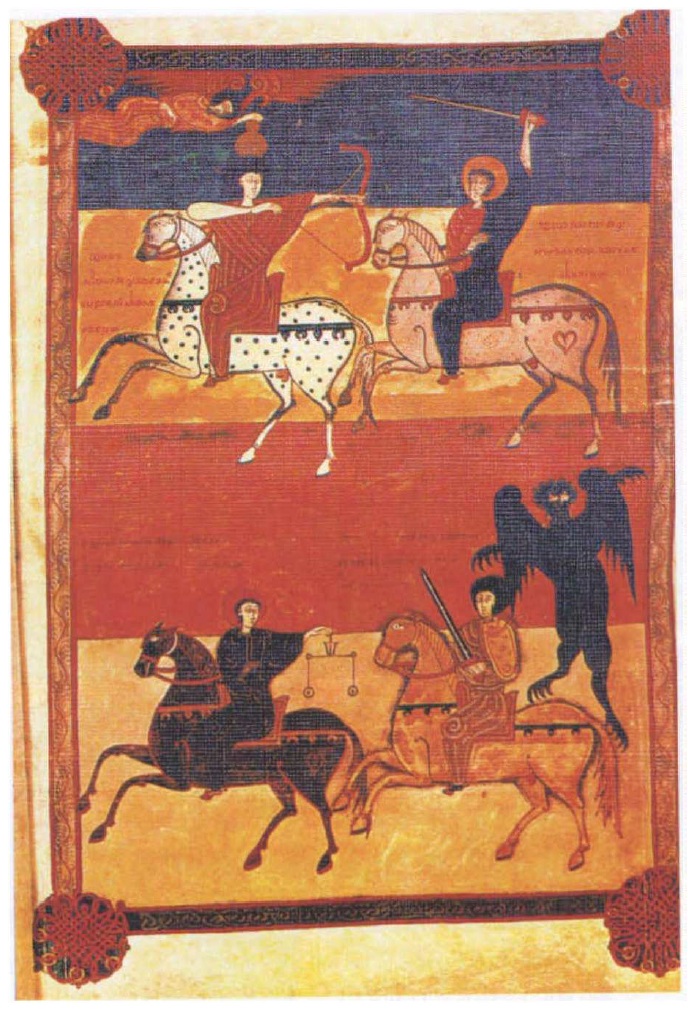
FAKE with 4 apocalyptic riders [chap9 photo7]
On page 179: The four apocalyptic riders are already wearing stirrups. Book illustration by Liebana, Spain, end of the 10th century. (p.188)
-- The FAKE Beatus of Liébana is also said to have composed a FAKE battle song in which a "Santiago" is celebrated as a hero of the FAKE reconquest (p.179)
-- Thus the FAKE Beatus is an element to fill the invented millennium in Spain with FAKE Christian content (p.179)
Topper Quote:
"This Beatus supposedly wrote a battle song that introduced the hero of the "Reconquista", Santiago. Thus, the empty unchristian space was filled with
Legends filled. Modern Spanish historians have also noticed this." (p.179)
8.6.7. The chronology correction in criminal "Christianity" is missing - urgent case
Topper Quote:
"But there is still a long way to go before an honest clean-up of historiography — for example in schools to reduce hostility against the Islamic neighbors. It's no different for us." (p.179)
8.6.8. The "Walk to Canossa" also seems to be a FAKE - the Freemason politics are not interested in truth of history
"Individual historical works such as the report of the monk Lambert about the 'Walk to Canossa' by Emperor (p. 179) Henry IV. (see also fig. p. 189) are absolutely unreliable, as historians acknowledge. Nevertheless, these forgeries, fabricated with political intent and not confirmed by any other source, continue to be carried along as facts (Kammeier, p. 296)." (p. 180)
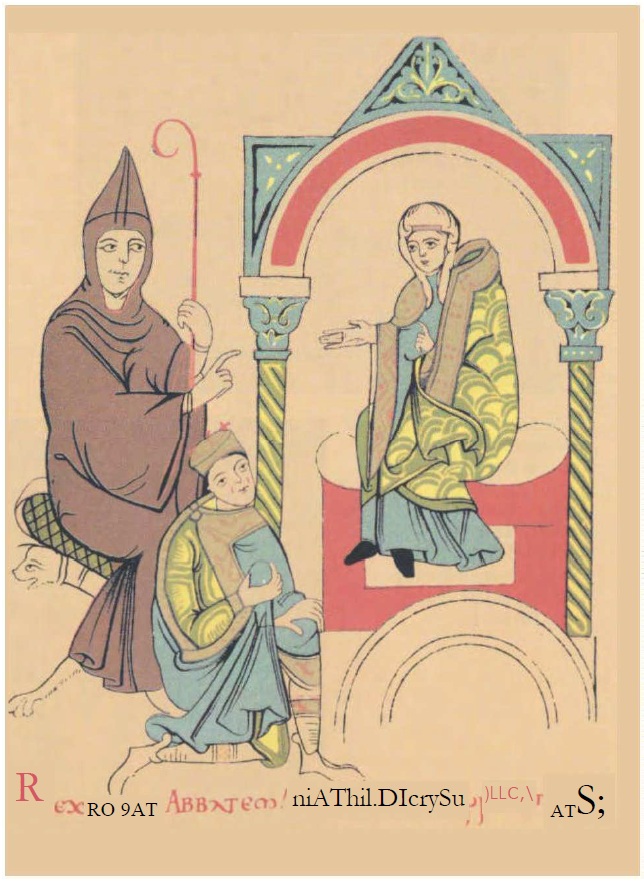
FAKE Canossa [kap9 foto 8]
On page 180: "Emperor Henry IV kneeling before the Margravine at Canossa". From the parchment manuscript of the monk Donizo,
Life of Matilda, completed in "1111". (Vatican Library Rome) (p.189)
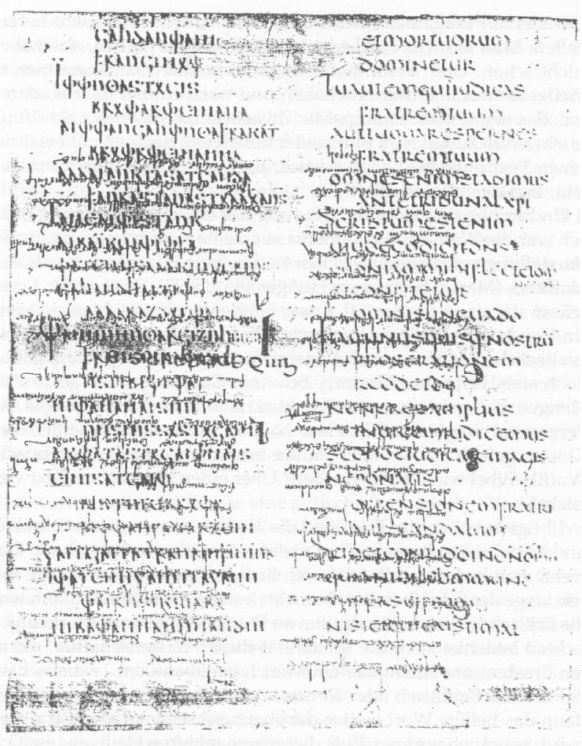
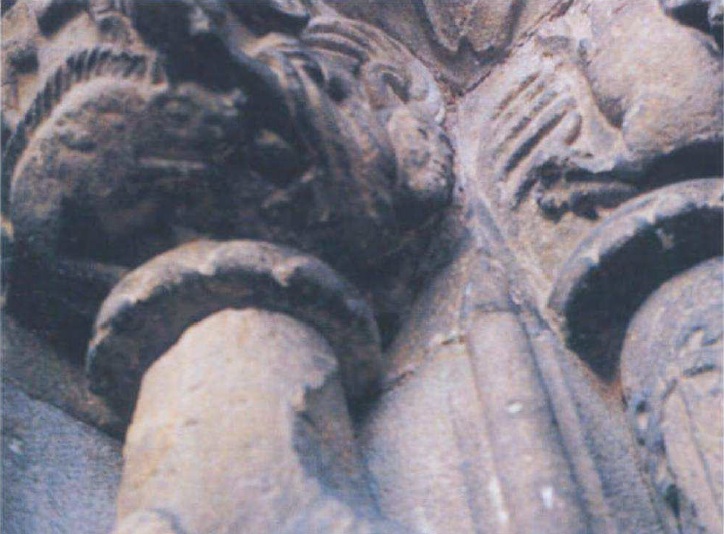
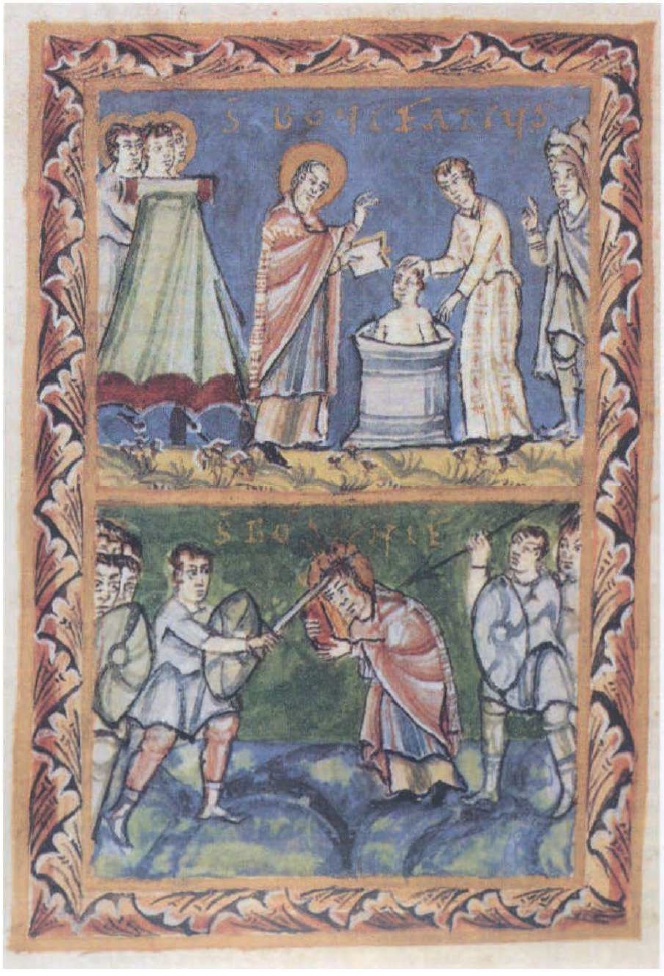
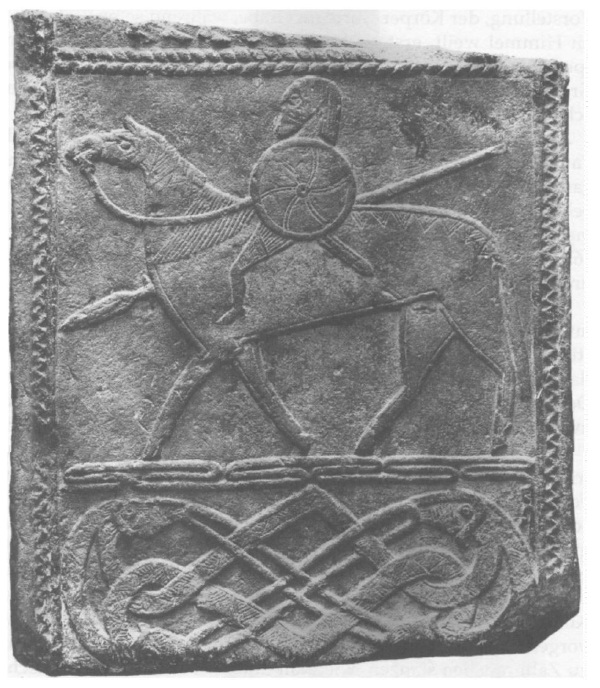
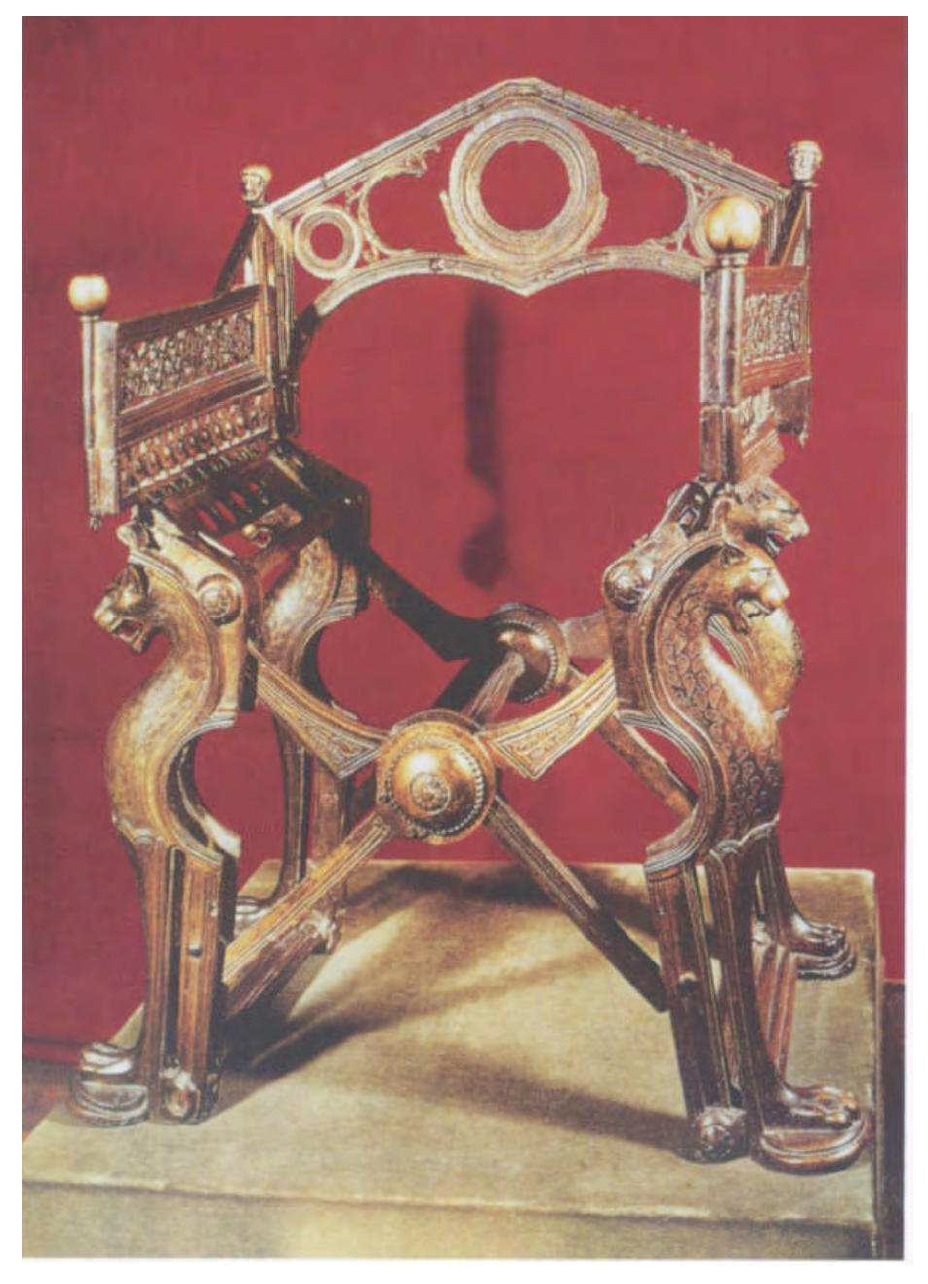
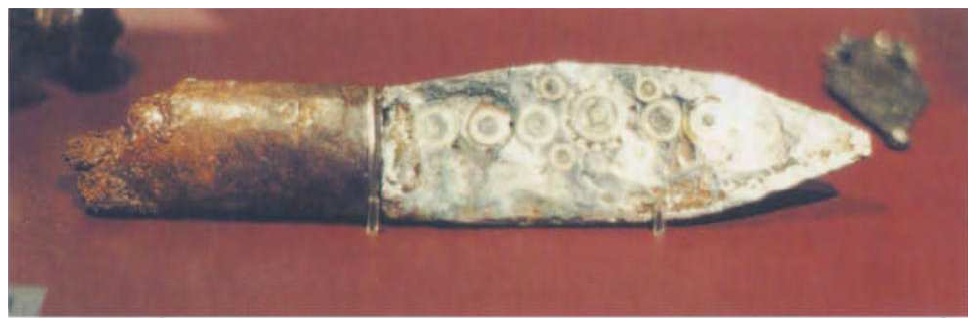
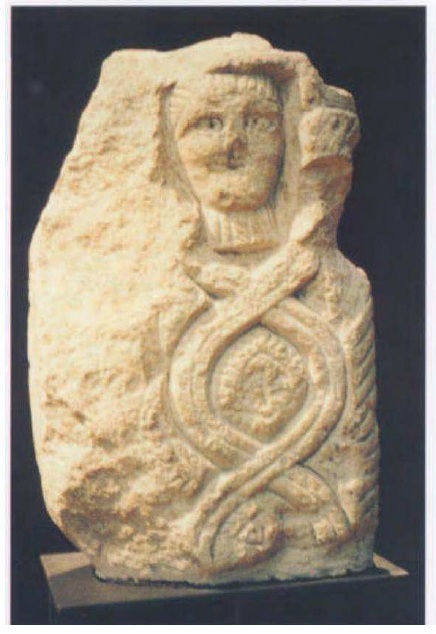
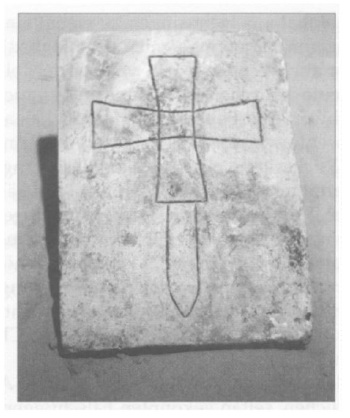
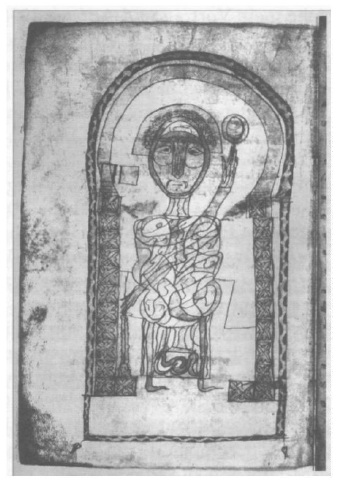
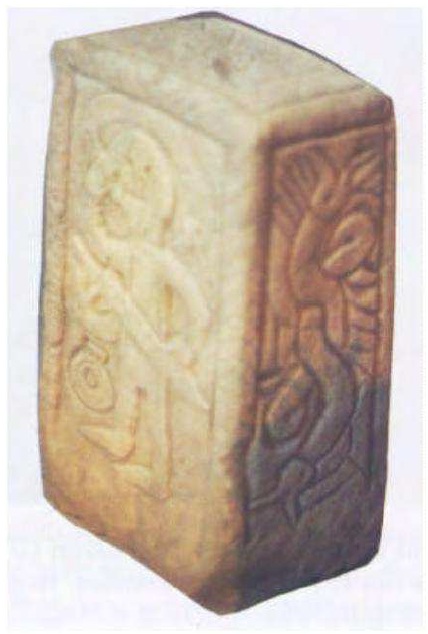
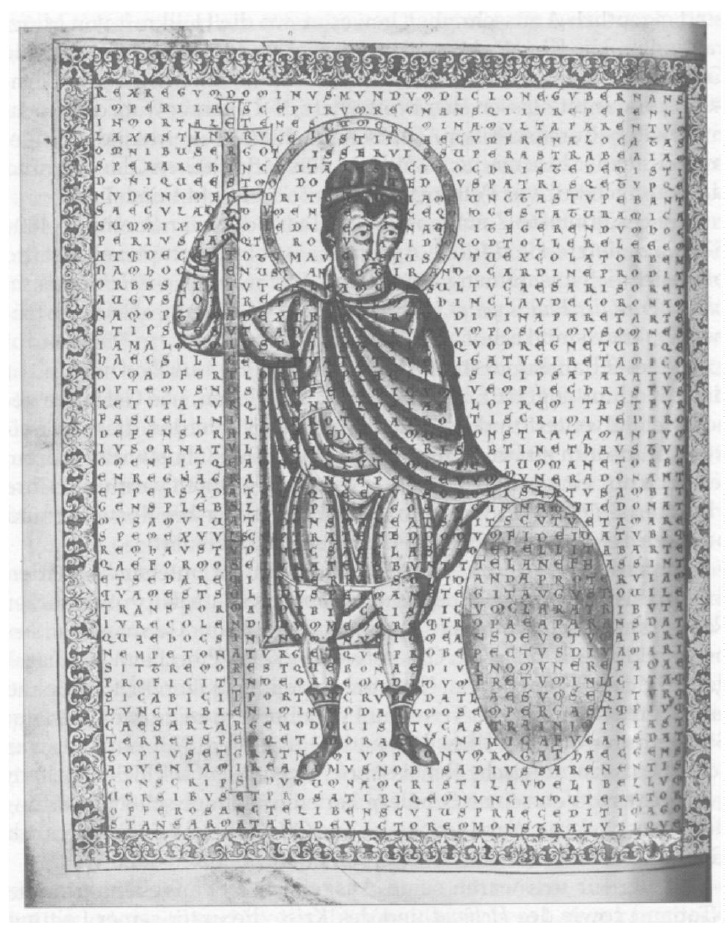
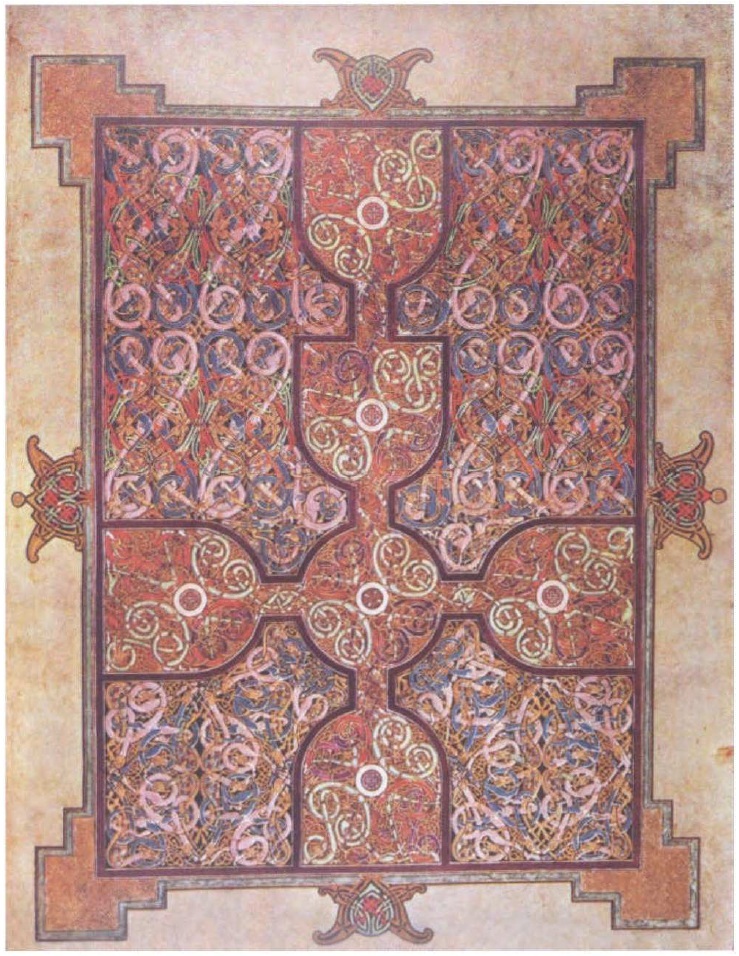
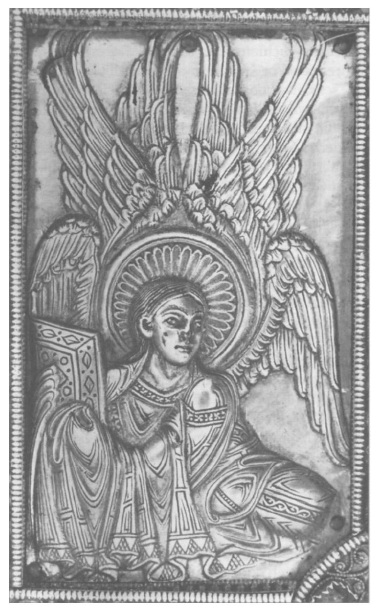
|
|
|
Sources
[web01] https://de.wikipedia.org/wiki/Gnosis
[web02] https://de.wikipedia.org/wiki/Nag_Hammadi
[web03] https://de.wikipedia.org/wiki/Wulfila
[web04] https://de.wikipedia.org/wiki/Willibrord
[web05] https://de.wikipedia.org/wiki/Dagobert
[web06] https://de.wikipedia.org/wiki/Hans_Blüher
[web07] https://de.wikipedia.org/wiki/Ernest_Renan
[web08] https://de.wikipedia.org/wiki/Cassiodor
[web09] https://de.wikipedia.org/wiki/Squillace
[web10] https://de.wikipedia.org/wiki/Hrabanus_Maurus
[web11] https://de.wikipedia.org/wiki/Saxo_Grammaticus
[web12] https://de.wikipedia.org/wiki/Eberle
[web13] https://de.wikipedia.org/wiki/Harry_C._Schnur
[web14] https://de.wikipedia.org/wiki/Varro
[web15] https://de.wikipedia.org/wiki/Beatus_von_Liébana
[web16] https://de.wikipedia.org/wiki/Martin_Bodmer_(Privatgelehrter)