[The name of "Lithuania"]
<LITHUANIA (Lithuanian Lietuva; Pol. Litwa; Rus. Litva;
Heb. Lita; Yid. Lite), southernmost of Baltic states of N.E.
Europe; from 1940 Lithuanian S.S.R. (for early period, see
*Poland-Lithuania).
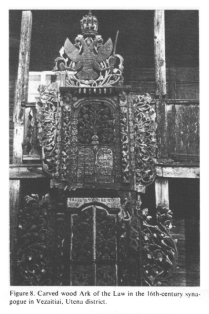
Encyclopaedia Judaica (1971): Lithuania, vol. 11, col.
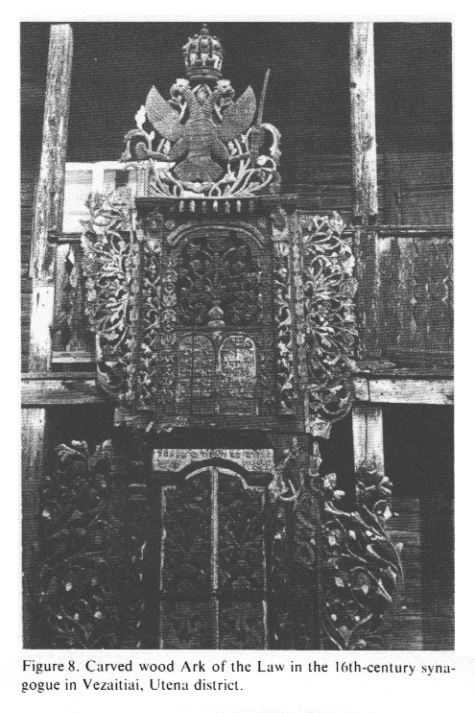
371-372, photo 01: Carved wood Ark of the Law
in the 16th-century synagogue in Vezaitiai, Utena district
With the partition of Poland at the close of the 18th
century the territories of Lithuania passed to Russia.
Subsequently, for over 120 years, Lithuania ceased to exist
as a political or administrative unit. It was divided up
into six or seven provinces in which the history of the Jews
was similar to that of the Jews throughout *Russia.
Lithuanian Jewry nevertheless retained its specific
character, and its influence on Russian Jewry - and on world
Jewry in general - extended beyond the boundaries of
historic Lithuania. (col. 361)
[[...]]
Character and influence on
the Diaspora.
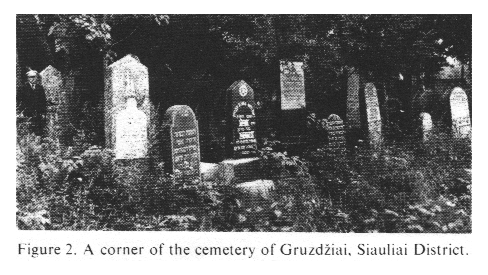
Encyclopaedia Judaica (1971): Lithuania, vol. 11, col.
365-366:
a corner of the cemetery of Gruzdziai (Gruzd¾iai)
The notion of "Lithuanian" (
"Litvak" in Yiddish) to be found in
speech, folklore, and Jewish literature in all its languages
applies to the Jewish community which developed within the
boundaries of historic Lithuania, the region which formed
part of the greater Polish kingdom during the 16th to 18th
centuries.
From the close of the 18th century until World War I this
area came under the rule of czarist Russia and included the
provinces of Kovno, *
Vilna,
Grodno, and northern Suwalki, which were essentially of
Lithuanian-Polish character, and of *
Vitebsk,
*
Minsk,
and *Mogilev, which were Belorussian-Russian in character. A
distinction is sometimes made between Lithuanian Jews in a
restricted sense (from the provinces of Vilna, Kovno, and
the northern parts of the provinces of Suwalki and Grodno)
and the Belorussian Jews ("province of Russia").
At the close of 19th century, about 1,500,000 Jews lived in
this region; they constituted more than one-eighth of the
total population. The Jews were mainly concentrated in the
(col. 361)
towns and villages, where in the main they were in the
majority. There were over 300 communities in Lithuania with
over 1,000 persons, including 12 large communities each
numbering over 20,000 persons: Vilna, Minsk, *Bialystok,
Vitebsk, Dvinsk (*Daugavpils), *Brest-Litovsk, Kovno,
Grodno, Mogilev, *Pinsk, *Bobruisk, and *Gomel; but even the
smaller settlements with only some dozens of Jewish families
had a vibrant and full Jewish life.
Both economic and historical factors were responsible for
the unique character of Lithuanian Jewry. Lithuania was a
poor country, and the mass of its inhabitants, consisting of
Lithuanian and Belorussian peasants, formed a low social
stratum whose national culture was undeveloped. The Jews who
had contacts with them as contractors, merchants,
shopkeepers, innkeepers, craftsmen, etc. regarded themselves
as their superior in every respect.
Lithuanian Jewry was relatively less affected by the *
Chmielnicki
massacres that devastated the Jews of Ukraine in
1648-49, and those perpetrated by the *Haidamacks during the
18th century. Even when the wave of pogroms swept Russia
during the last decades of czarist rule, there were only
isolated manifestations of anti-Jewish violence in Lithuania
(Gomel, Bialystok). These circumstances gave the Lithuanian
Jews a feeling of stability and security, as a result of
which they developed no desire to adopt the language and
culture of the surrounding peoples.
[Cultural life of the Jews
in Lithuania]
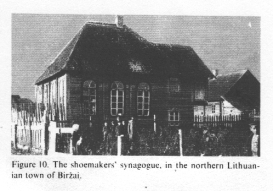
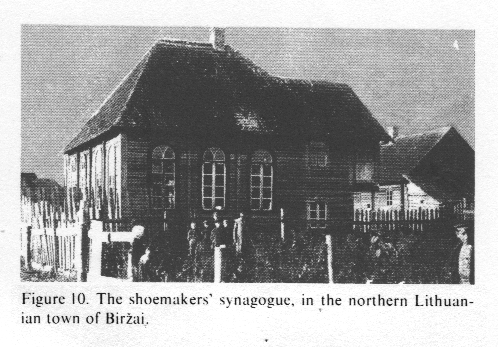
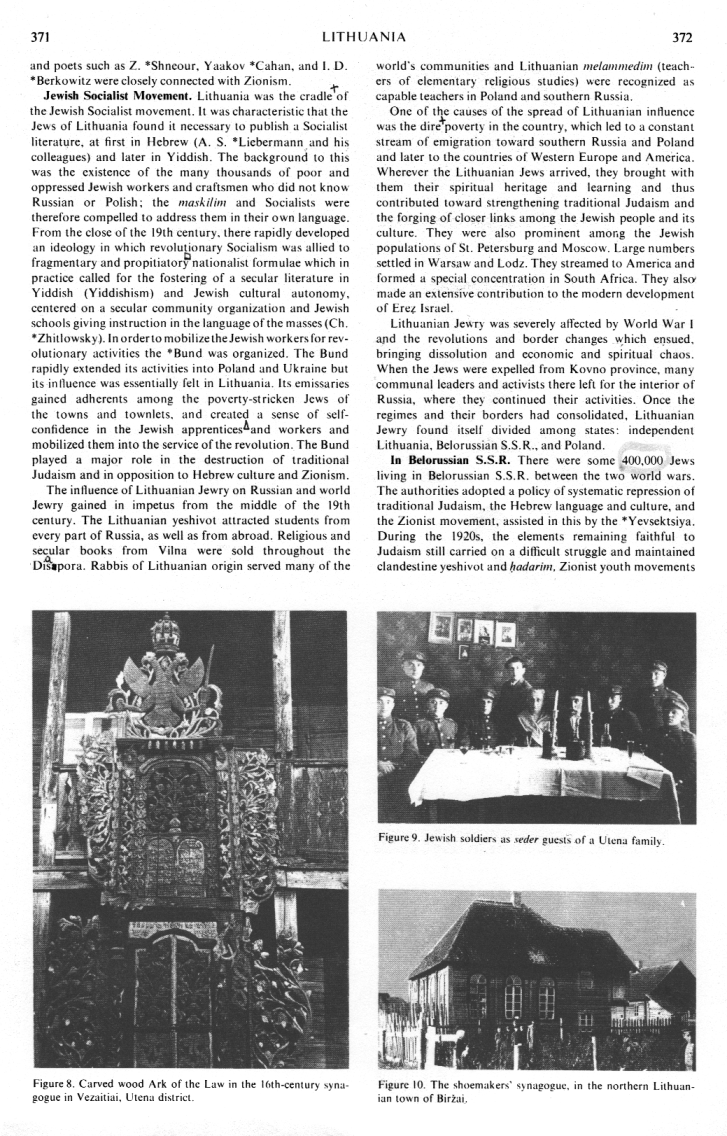
Encyclopaedia Judaica (1971): Lithuania, vol.
11, col. 371-372, photo 03: The shoemakers'
synagogue, in the northern Lithuanian town of
Birzai (Bir¾ai) |
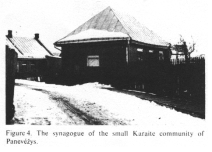
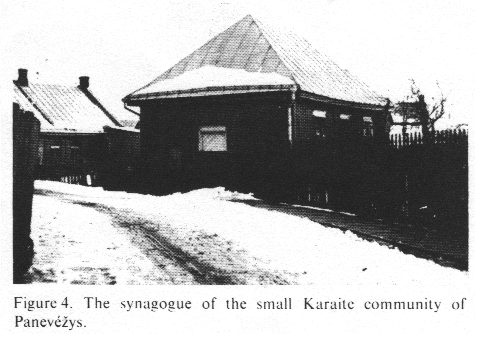
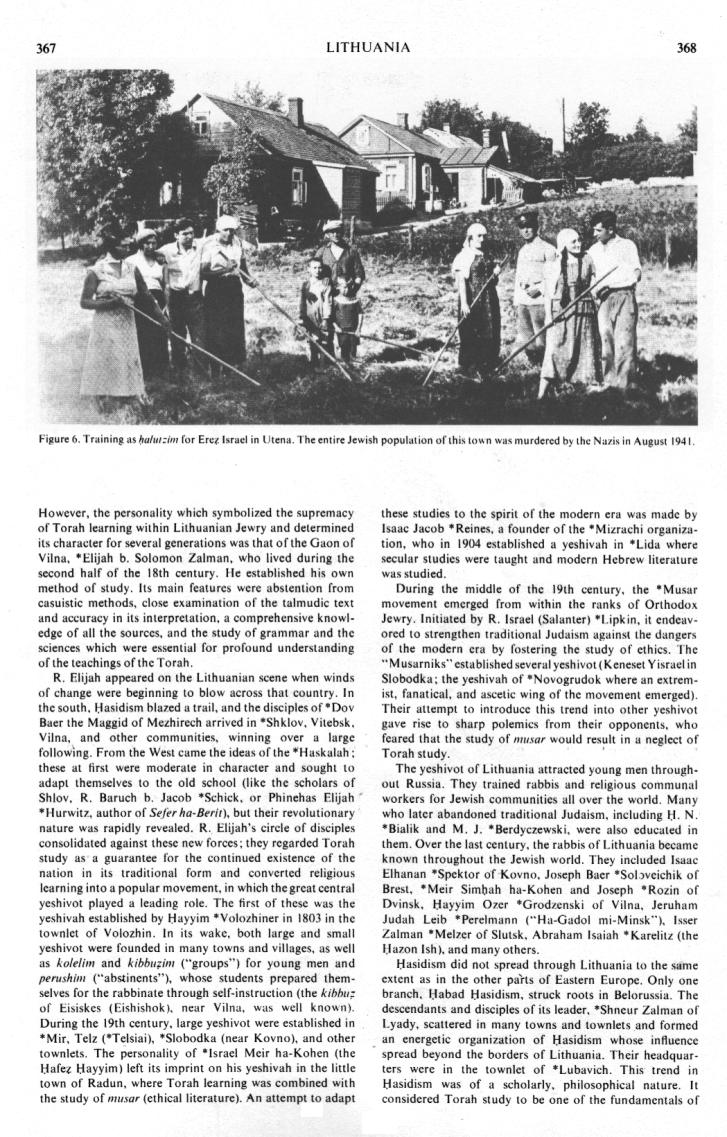
Encyclopaedia Judaica (1971): Lithuania, vol. 11,
col. 365-366, photo 04: the synagogue of the small
Karaite community of Panevézys (Panevé¾ys) |
The Jews of Lithuania maintained their own way of life. They
spoke a special dialect of Yiddish-Lithuanian Yiddish -
which differed from the Yiddish spoken in Poland and
Volhynia mainly in the pronunciation of the vowels (and in
certain districts in the pronunciation of the shin as sin or
samekh. The world outlook and way of life of Lithuanian
Jewry were based on the Written Law and the Oral Law.
The Shulhan Arukh and its commentaries guided them in their
everyday life. Torah learning florished among wide circles,
and love of Torah and esteem for its study was widespread
among the masses of Jews. The Jews who lived in the region
bordering Lithuania, the "Poles" in the west and the
"Volhynians" in the south, associated specific
characteristics with the Lithuanian Jews: a certain
emotional dryness, the superiority of the intellect over
emotion, mental alertness, sharp-wittedness, and pungency
[[accuracy]]. Their piety was also questioned (hence the
popular derogatory appellation for the Lithuanian Jews,
"tseylem-kop"). It was
also a feature of Lithuanian Jewry that *Hasidism (Ḥasidism)
did not strike roots in northern Lithuania, while in the
provinces of Belorussia it assumed a different nature and
content the Habad (Ḥabad) trend - from the original Hasidism
(Ḥasidism) of Ukraine and Poland (see below). Lithuanian
Jews were considered the "prototype" of the
*Mitnaggedim
[["opponents"]].
Spiritual Trends and
Leaders. [Torah and other teaching]
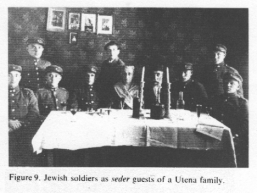
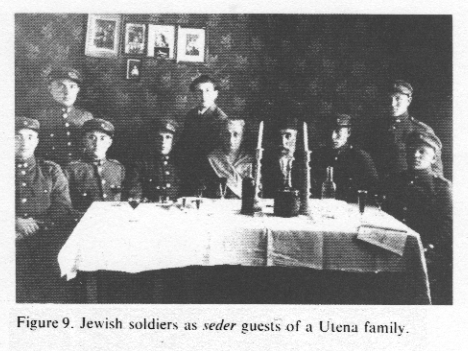
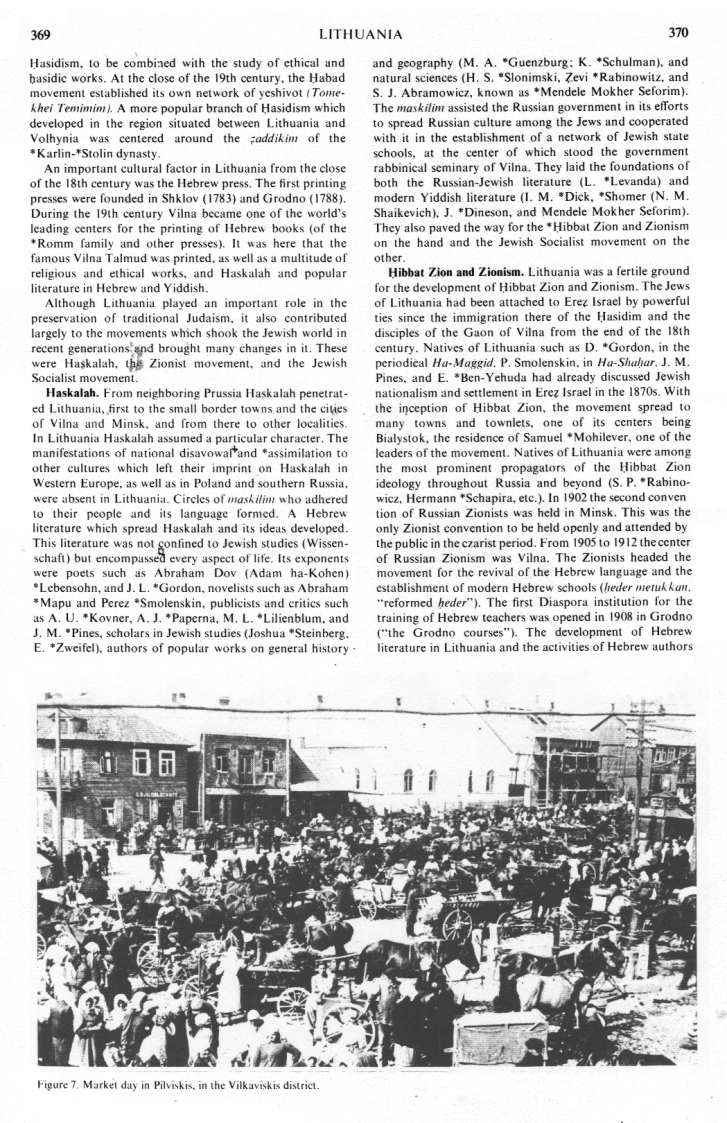
Encyclopaedia Judaica (1971): Lithuania, vol. 11, col.
371-372, photo 02:
Jewish soldiers as seder guests of a Utena family
Until the 16th century the Jews of Lithuania were on the
outer fringe of European Jewry. During the 16th and 17th
centuries, they were influenced by Polish Jewry, and adopted
its organizational methods (Lithuanian Council; see
*Councils of the Lands), its educational system, and its
mode of learning.
The first prominent rabbis who were called upon to officiate
in the large Lithuanian communities, such as Mordecai b.
Abraham *Jaffe, author of the
Levushim, and Joel *Sirkes, author of
Bavit Hadash (Bavit Ḥadas) (the "Bah", "Baḥ"), came from
outside Lithuania. Solomon b. Jehiel *Luria (the Maharshal),
who was of Lithuanian origin and promoted Torah learning
there for a number of years, acquired most of his education
and was mainly active beyond the borders of that country.
It was only during the 17th century that leading Torah
scholars emerged from the yeshivot [[religious Torah
schools]] of Lithuania. Among them were the commentators on
the Shulhan Arukh (Shulḥan Arukh), *Shabbetai b. Meir
ha-Kohen (the Shakh), and Moses b. Naphtali Hirsch *Rivkes,
author of
Be'er ha-Golah.
(col. 362)
However, the personality which symbolized the supremacy of
Torah learning within Lithuanian Jewry and determined its
character for several generations was that of Gaon of Vilna,
*Elijah b. Solomon Zalman, who lived during the second half
of the 18th century. He established his own method of study.
Its main features were abstention from casuistic methods,
close examination of the Talmudic text and accuracy in its
interpretation, a comprehensive knowledge of all the
sources, and the study of grammar and the sciences which
were essential for profound understanding of the teachings
of the Torah.
R. Elijah appeared on the Lithuanian scene when winds of
change were beginning to blow across that country. In the
south, Hasidism (Ḥasidism) blazed a trail, and the disciples
of *Dov Baer the Maggid of Mezhirech arrived in *Shklov,
Vitebsk, Vilna, and other communities, winning over a large
following. From the West came the ideas of the *Haskalah;
these at first were moderate in character and sought to
adapt themselves to the old school (like the scholars of
Shlov, R. Baruch b. Jacob *Schick, or Phinehas Elijah
*Hurwitz, author of
Sefer
ha-Berit), but their revolutionary nature was
rapidly revealed. R. Elijah's circle of disciples
consolidated against these new forces, they regarded Torah
study as a guarantee for the continued existence of the
nation in its traditional form and converted religious
learning into a popular movement, in which the great central
yeshivot played a leading role. the first of these was the
yeshivah established by Hayyim *Voloshiner (Ḥayyim
Voloshiner) in 1803 in the townlet of Volozhin. In its wake,
both large and small yeshivot were founded in many towns and
villages, as well as
kolelim
[[advanced Talmud and rabbinic literature institutes for
men]] and
kibbuzim
("groups") for young men and
perushim ("abstinents"), whose students
prepared themselves for the rabbinate through
self-instruction (the
kibbuz
(kibbuẓ) of Eisiskes (Eishishok), near Vilna, was
well known).
During the 19th century, large yeshivot were established in
*Mir, Telz (*Telsiai), *Slobodka (near Kovno), and other
townlets. The personality of *Israel Meir ha-Kohen (the
Hafez Hayyim (Ḥafeẓ Ḥayyim) left its imprint on his yeshivah
in the little town of Radun, where Torah learning was
combined with the study of
musar (ethical literature) [[literature of
medieval Jewish moralistic and ethical teachings]].
An attempt to adapt (col. 367)
these studies to the spirit of the modern era was made by
Isaac Jacob *Reines, a founder of the *Mizrachi
organization, who in 1904 established a yeshivah in *Lida
where secular studies were taught and modern Hebrew
literature was studied.
During the middle of the 19th century, the *Musar movement
emerged from within the ranks of Orthodox Jewry. Initiated
by R. Israel (Salanter) *Lipkin, it endeavored to strengthen
traditional Judaism against the dangers of the modern era by
fostering the study of ethics. The "Musarniks" established
several yeshivot (Keneset Yisrael in Slobodka; the yeshivah
of *Novogrudok where an extremist, fanatical, and ascetic
wing of the movement emerged). Their attempt to introduce
this trend into other yeshivot gave rise to sharp polemics
from their opponents, who feared that the study of
musar would result in a
neglect of Torah study.
[Lithuanian Jewish
schooling institutions attracting Jews from abroad -
Hasisidm - Hebrew press in Lithuania]
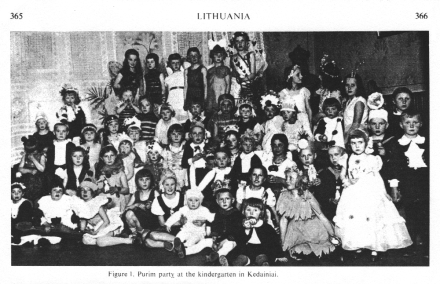
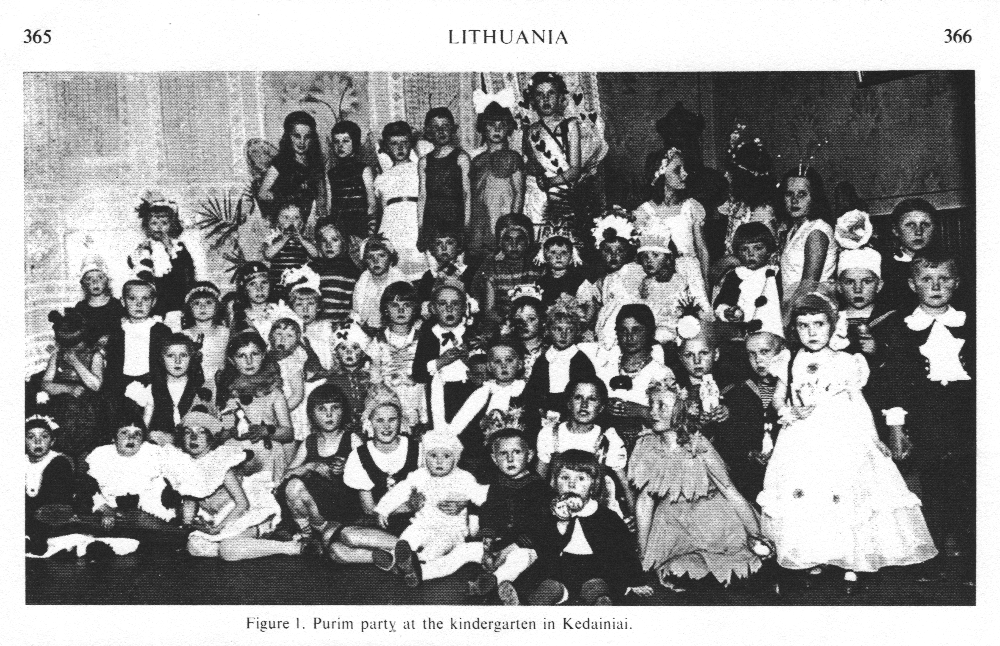
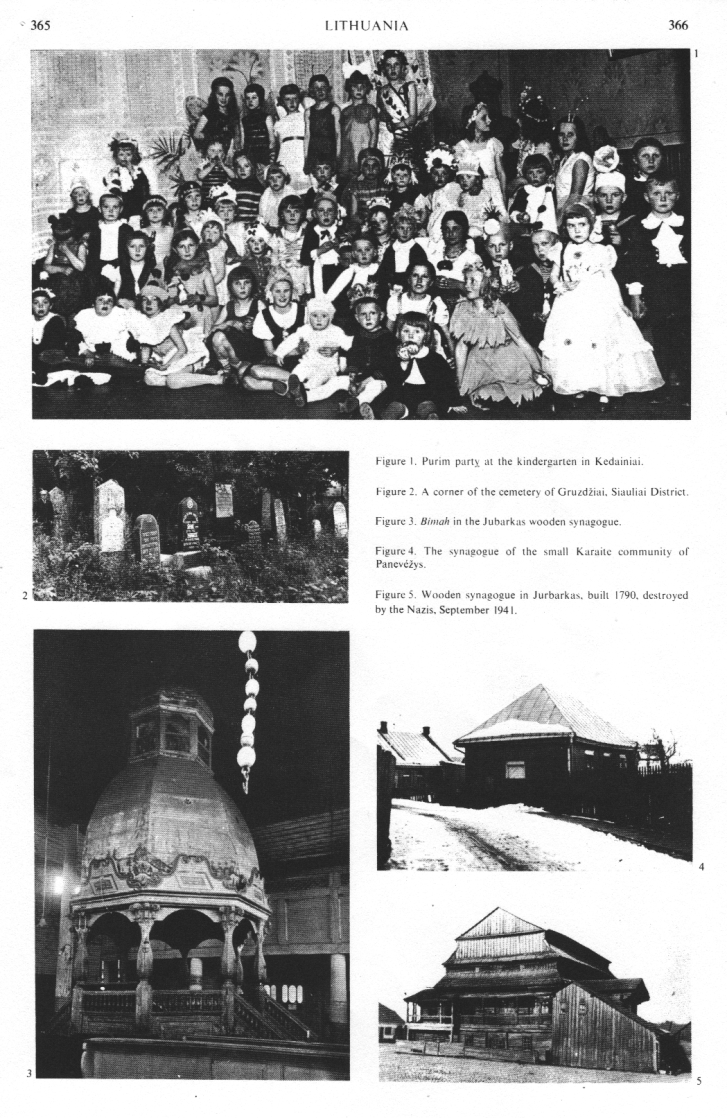
Encyclopaedia Judaica (1971): Lithuania, vol. 11, col.
365-366, photo 01: Purim party at the kindergarten in
Kedainiai
The yeshivot of Lithuania attracted young men throughout
Russia. They trained rabbis and religious communal workers
for Jewish communities all over the world. Many who later
abandoned traditional Judaism, including H. N. *Bialik and
M.J. *Berdyczewski, were also educated in them. Over the
last century, the rabbis of Lithuania became known
throughout the Jewish world. They included Isaac Elhanan
*Spektor of Kovno, Joseph Baer *Soloveichik of Brest, *Meir
Simhah ha-Kohen (Meir Simḥah ha-Kohen) and Joseph *Rozin of
Dvinsk, Hayyim (Ḥayyim) Ozer *Grodzenski of Vilna, Jeruham
Judah Leib *Perelmann ("Ha-Gadol mi-Minsk"), Isser Zalman
*Melzer of Slutsk, Abraham Isaiah *Karelitz (the Hazon Ish
(Ḥazon Ish), and many others.
Hasidism (Ḥasidism) did not spread through Lithuania to the
same extent as in the other parts of eastern Europe. Only
one branch, Habad Hasidism (Ḥabad Ḥasidism), struck roots in
Belorussia. The descendants and disciples of its leader,
*Shneur Zalman of Lyady, scattered in many towns and
townlets and formed an energetic organization of Hasidism
(Ḥasidism) whose influence spread beyond the borders of
Lithuania. Their headquarters were in the townlet of
*Lubavich. This trend in Hasidism (Ḥasidism) was of a
scholarly, philosophical nature. It considered Torah study
to be one of the fundamentals of (col. 368)
Hasidism (Ḥasidism), to be combined with the study of
ethical and hasidic (ḥasidic) works. At the close of the
19th century, the Habad (Ḥabad) movement established its own
network of yeshivot
(Tomekhei
Temimim). A more popular branch of Hasidism
(Ḥasidism) which developed in the region situated between
Lithuania and Volhynia was centered around the zaddikim
(ẓaddikim) of the *Karlin-*Stolin dynasty.
An important cultural factor in Lithuania from the close of
the 18th century was the Hebrew press. The first printing
presses were founded in Shklov (1783) and Grodno (1788).
During the 19th century Vilna became one of the world's
leading centers for the printing of Hebrew books (of the
*Romm family and other presses). It was here that the famous
Vilna Talmud was printed, as well as a multitude of
religious and ethical works, and Haskalah and popular
literature in Hebrew and Yiddish.
[Haskalah, racist Zionism,
and Jewish Socialism in Lithuania]
Although Lithuania played an important role in the
preservation of traditional Judaism, it also contributed
largely to the movements which shook the Jewish world in
recent generations and brought many changes in it. These
were Haskalah, the Zionist movement, and the Jewish
Socialist movement.
Haskalah.
From neighboring Prussia Haskalah penetrated Lithuania,
first to the small border towns and the cities of Vilna and
Minsk, and from there to other localities. In Lithuania
Haskalah assumed a particular character. The manifestations
of national disavowal [[not-acknowledgment]] and
*assimilation to other cultures which left their imprint on
Haskalah in western Europe, as well as in Poland and
southern Russia, were absent in Lithuania. Circles of
maskilim [[
followers of the
Haskalah, enlightenment Jews, secularists]] who adhered to
their people and its language formed. A Hebrew literature
which spread Haskalah and its ideas developed. This
literature was not confined to Jewish studies (Wissenschaft)
but encompassed [[comprised]] every aspect of life. Its
exponents were poets such as Abraham Dov (Adam ha-kohen)
*Lebensohn, and J.L. *Gordon, novelists such as Abraham
*Mapu and Perez *Smolenskin, publicists and critics such as
A.U. *Kovner, A.J. *Paperna, M.L. *Lilienblum, and J.M.
*Pines, scholars in Jewish studies (Joshua *Steinberg), E.
*Zweifel), authors of popular works on general history (col.
369)
and geography (M.A. *Guenzburg; K. *Schulman), and natural
sciences (H.S. *Slonimski, Zevi *Rabinowitz, and S.J.
Abramowicz, known as *Mendele Mokher Seforim). The
maskilim assisted the
Russian government in its efforts to spread Russian culture
among the Jews and cooperated with it in the establishment
of a network of Jewish state schools, at the center of which
stood the government rabbinical seminary of Vilna. They laid
the foundations of both the Russian-Jewish literature (L.
*Levanda) and modern Yiddish literature (I.M. *Dick, *Shomer
(N.M. Shaikevich), J. *Dineson, and Mendele Mokher Seforim).
They also paved the way for the *Hibbat Zion (Ḥibbat Zion)
and Zionism on the hand and the Jewish Socialist movement on
the other.
Hibbat Zion (Ḥibbat Zion)
and [racist] Zionism.
Lithuania was a fertile ground for the development of Hibbat
Zion (Ḥibbat Zion) and Zionism. the Jews of Lithuania had
been attached to Erez Israel (Ereẓ Israel) by powerful ties
since the immigration there of the Hasidim (Ḥasidim) and the
disciples of the Gaon of Vilna from the end of the 18th
century. Natives of Lithuania such as D. *Gordon, in the
periodical
Ha-Maggid,
P. Smolenskin, in
Ha-Shahar
(Ha-Shaḥar), J.M. Pines, and E. *Ben-Yehuda had
already discussed Jewish nationalism and settlement in Erez
Israel (Ereẓ Israel) in the 1870s.
With the inception of Hibbat Zion (Ḥibbat Zion), the
movement spread to many towns and townlets, one of its
centers being Bialystok, the residence of Samuel *Mohilever,
one of the leaders of the movement. Natives of Lithuania
were among the most prominent propagators of the Hibbat Zion
(Ḥibbat Zion) ideology throughout Russia and beyond (S.P.
*Rabinowicz, Hermann *Schapira, etc.).
In 1902 the second convention of Russian Zionists was held
in Minsk. This was the only Zionist convention to be held
openly and attended by the public in the czarist period.
From 1905 to 1912 the center of Russian Zionism was Vilna.
The [[racist]] Zionists headed the movement for the revival
of the Hebrew language and the establishment of modern
Hebrew schools (
heder
metukkan, "reformed
heder") (
ḥeder
metukkan, "reformed
ḥeder").
The first Diaspora institution for the training of Hebrew
teachers was opened in 1908 in Grodno ("the Grodno
courses"). The development of Hebrew literature in Lithuania
and the activities of Hebrew authors (col. 370)
and poets such as Z. *Shneour, Yaakov *Cahan, and I.D.
*Berkowitz were closely connected with [[racist]] Zionism.
[[The Arabs were never asked...]]
Jewish Socialist Movement.
[combined enlightenment with socialist movement - the
Bund]
Lithuania was the cradle [[the origin place]] of the Jewish
Socialist movement. It was characteristic that the Jews of
Lithuania found it necessary to publish a Socialist
literature, at first in Hebrew (A.S. *Liebermann and his
colleagues) and later in Yiddish. The background to this was
the existence of the many thousands of poor and oppressed
Jewish workers and craftsmen who did not know Russian or
Polish; the
maskilim
[[
followers of the
Haskalah, enlightenment Jews, secularists]] and Socialists
were therefore compelled to address them in their own
language.
From the close of the 19th century, there rapidly developed
an ideology in which revolutionary Socialism was allied to
fragmentary and propitiatory [[for reconciliation]]
nationalist formulae which in practice called for the
fostering of a secular literature in Yiddish (Yiddishism)
and Jewish cultural autonomy, centered on a secular
community organization and Jewish schools giving instruction
in the language of the masses (Ch. *Zhitlowsky).
In order to mobilize the Jewish workers for revolutionary
activities the *Bund was organized. The Bund rapidly
extended its activities into Poland and Ukraine but its
influence was essentially felt in Lithuania. Its emissaries
gained adherents among the poverty-stricken Jews of the
towns and townlets, and created a sense of self-confidence
in the Jewish apprentices and workers and mobilized them
into the service of the revolution. The Bund played a major
role in the destruction of traditional Judaism and in
opposition to Hebrew culture and [[racist]] Zionism.
The influence of Lithuanian Jewry on Russian and world Jewry
gained in impetus from the middle of the 19th century. The
Lithuanian yeshivot attracted students from every part of
Russia, as well as from abroad. Religious and secular books
from Vilna were sold throughout the Diaspora. Rabbis of
Lithuanian origin served many of the (col. 371)
world's communities and Lithuanian
melammedim (teachers of elementary
religious studies) were recognized as capable teachers in
Poland and southern Russia.
[Emigration movements from
impoverished Lithuania]
One of the causes of the spread of Lithuanian influence was
the dire [[dreadful]] poverty in the country, which led to a
constant stream of emigration toward southern Russia and
Poland and later to the countries of western Europe and
America. Wherever the Lithuanian Jews arrived, they brought
with them their spiritual heritage and learning and thus
contributed toward strengthening traditional Judaism and the
forging of closer links among the Jewish people and its
culture. They were also prominent among the Jewish
populations of St. Petersburg and Moscow. Large numbers
settled in Warsaw and Lodz. They streamed to America and
formed a special concentration in South Africa [[a.o. the
Jews got work in the diamond industry, see:
Jews
in
South Africa]]. They also made an extensive
contribution to the modern development of Erez Israel (Ereẓ
Israel)> (col. 372)
[[with drying swamps and converting the desert into earth,
and then racist Zionists used the movement for their
purposes]].
[[...]]